
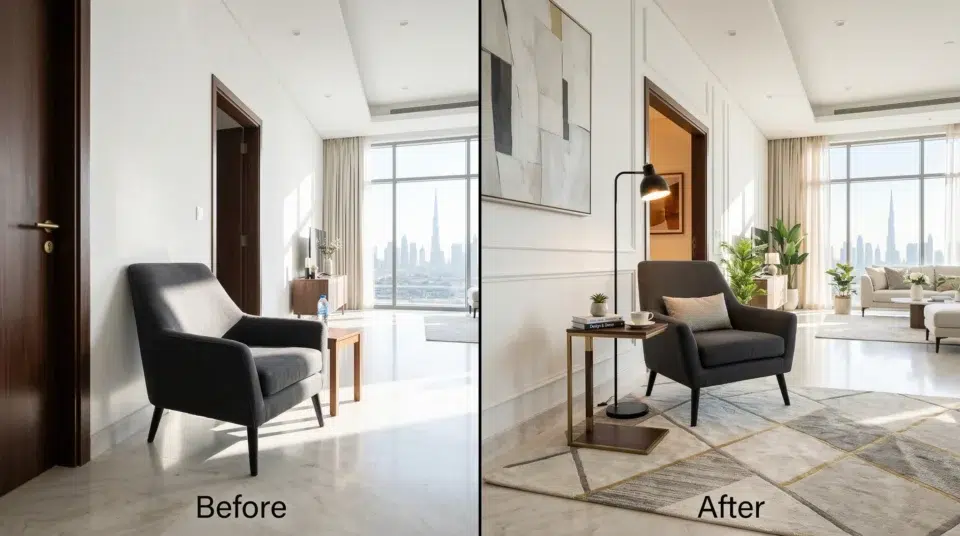
You bought the accent chair you loved. You had it delivered, placed it in the corner you had been imagining for three weeks, and something was immediately wrong. The room did not look like the way the inspiration image looked. The chair seems too large, or oddly placed, or it fights with the sofa rather than completing the room. You are not alone. In our 36 years of delivering furniture to homes across Dubai, Sharjah, Abu Dhabi, and the wider UAE, we have seen the same mistakes made repeatedly by buyers who had genuinely good taste but lacked the specific local knowledge to avoid them. The mistakes are predictable. More importantly, every single one of them is fixable, most without spending another dirham.
At Karnak Home, we have been inside more than 70,000 UAE homes. Our delivery teams observe rooms that are working and rooms that are not. Our consultants receive calls from customers who bought a chair six months ago and have never quite reconciled themselves to it. Over three and a half decades, these observations have accumulated into a detailed map of the specific accent chair errors most common in UAE living contexts, and the specific corrections that resolve each one. That map is what this article represents. It is not generic furniture advice translated from a European or American context. It is built from the inside of UAE apartments in JVC, villas in Arabian Ranches, high-floor flats in Business Bay, and family homes in Mirdif and Al Nahda.
This guide covers the seven accent chair mistakes UAE homeowners make most consistently in 2026. For each mistake, we explain why it happens, why it is particularly problematic in the UAE’s specific architectural, climatic, and lifestyle context, and exactly what to do to correct it. We also cover the materials mistakes that are uniquely punishing in the UAE climate, the scale errors that arise from shopping with European proportions in mind, and the styling omissions that leave even well-chosen chairs looking provisional and unsettled. By the end, the chair you already own may work better than you thought. And if you are still shopping, the chair you buy next will not make these errors.
Why Accent Chair Mistakes Hit Harder in UAE Homes Than Anywhere Else
Before the seven mistakes, an essential framing: accent chair errors are more consequential in UAE homes than in most other residential contexts for reasons that are specific to how UAE homes are built, used, and lit.
UAE Open-Plan Living Means the Chair Is Always Visible
The majority of UAE apartments and villas built after 2005, across developments from JLT and Dubai Marina to Arabian Ranches and Al Reem Island, feature open-plan living areas where the kitchen, dining, and living zones share one continuous space. In this configuration, the accent chair is visible from the entrance foyer, the dining table, the kitchen, and the sofa simultaneously. There is no private corner where a poorly chosen or badly placed chair can be quietly ignored. A mistake in a UAE open-plan room is a mistake visible from every occupied point in the home.
UAE Sunlight and the UV Acceleration Factor
UAE south and west-facing windows receive six to ten hours of direct or near-direct sunlight daily for eight months of the year, with summer UV intensity reaching levels that cause measurable fabric fading in twelve to eighteen months in unprotected positions. A chair placed incorrectly relative to the sun does not just look less good over time. It deteriorates visibly and often irreversibly, particularly in natural fabrics and lower-grade synthetic leathers. In temperate climates, a slightly sun-exposed chair fades gently over five to eight years. In a west-facing Dubai apartment, the same chair can show visible fading within two summers. The placement mistake and the fabric mistake compound each other rapidly in UAE conditions.
UAE Apartment Proportions Differ from Every Design Reference Available Online
The vast majority of interior design content available online was created for European, North American, or East Asian homes with ceiling heights of 2.4 to 2.6 metres, room widths of 3 to 4 metres, and floor plans that typically separate living and dining areas. UAE apartments built post-2010 have ceiling heights of 2.7 to 3.0 metres, open-plan living areas of 30 to 55 square metres, and in many developments, unusually generous window-to-wall ratios that flood rooms with light. A chair that looks proportionally correct in a 2.4-metre-ceiling European photograph will look underwhelming and misproportionate in a 2.85-metre-ceiling Dubai Marina apartment. The scale reference most UAE buyers carry in their heads from online inspiration images is wrong for their actual rooms.
UAE Lifestyle Demands Both Formal and Casual Function from the Same Piece
UAE households, particularly those with children and pets in family communities like Mirdif, Jumeirah Village Triangle, and Arabian Ranches, need furniture that performs across a wide range of daily uses without the formal and casual rooms that larger homes in older housing cultures often provide. An accent chair in a UAE family home is used for reading in the morning, homework supervision in the afternoon, and adult relaxation in the evening. A chair chosen purely for its formal aesthetic, without consideration of daily functional demands, fails quickly in the UAE family context, regardless of how beautiful it is.
Mistake 1: Buying a Chair Scaled for a European Room and Placing It in a UAE Villa
This is the most common and the most visually obvious accent chair mistake in UAE homes with ceiling heights above 3 metres, and it affects villa owners in Emirates Hills, Jumeirah, The Springs, Mohammed Bin Rashid City, and compound properties across Abu Dhabi far more than apartment dwellers.
Why It Happens
The global interior design content ecosystem is dominated by European and Scandinavian imagery. Pinterest, Instagram, and design blogs are filled with beautifully photographed rooms where compact, slim-profile accent chairs in rooms with 2.4-metre ceilings look perfectly proportioned. UAE villa owners absorb these images and purchase the chairs they see, arriving home to discover that the chair that looked substantial in a Stockholm apartment looks like a footstool in their 3.6-metre-ceiling formal reception room in Arabian Ranches.
Why It Is Particularly Damaging in the UAE
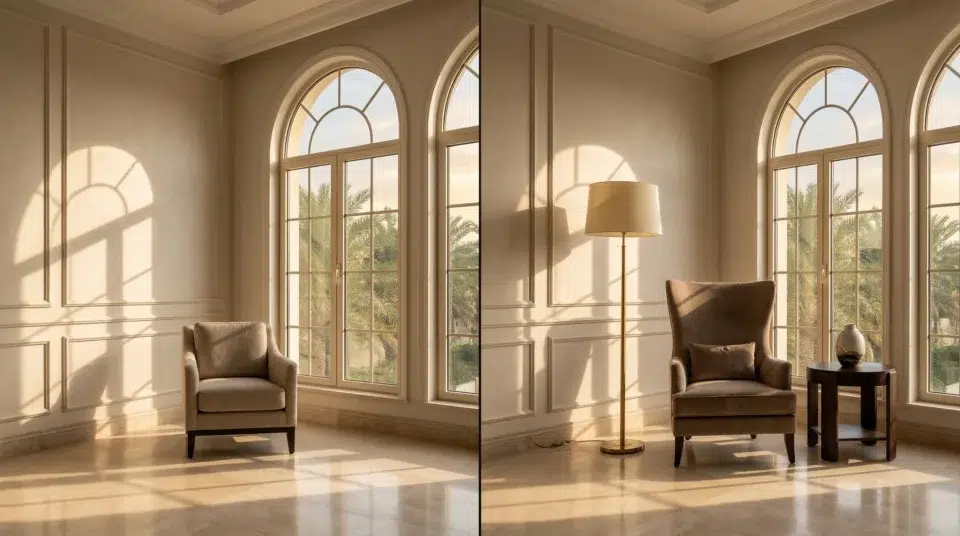
A chair that is visually too small for its room does not just look wrong. It destabilises the entire room’s design composition. In a large UAE villa reception room with a substantial sofa, a marble floor, high windows, and 3.5-metre ceilings, a small accent chair reads as an accidental piece that wandered in from another room rather than a deliberate design statement. It also makes the room feel emptier and less furnished than it actually is, which is the opposite of the effect a well-scaled accent chair should produce.
The Fix
For UAE villa rooms with ceiling heights of 3 metres and above, the correct accent chair specification starts at a back height of 100 to 115 centimetres and an overall width of 82 to 95 centimetres. The visual column created by the chair must have sufficient height to engage with the room’s vertical space rather than being dwarfed by it. If you already own a chair that is too small for your villa room, the fastest fix does not require replacing the chair. Add a tall floor lamp, positioned directly behind the chair with its head at 170 to 180 centimetres, and a large indoor plant in a generous ceramic pot on the opposite side. These two additions extend the chair’s visual column upward and fill the vertical space around it, correcting the proportional imbalance without spending on a new chair. For longer-term resolution, browse our large-scale accent chairs for UAE villas for options scaled correctly for generous UAE room heights.
Mistake 2: Placing the Chair Flat Against the Wall, Parallel to the Sofa
This is the placement mistake we see most consistently across deliveries to apartments in JVC, Business Bay, and Al Nahda, and it is the single change that most reliably transforms an accent chair from a piece that looks awkward to one that looks designed.
Why It Happens
Placing furniture against walls feels instinctively space-saving and tidy. In a compact UAE apartment where the available floor area is genuinely limited, pushing the accent chair against the nearest wall seems like the responsible choice. The resulting arrangement, sofa along one wall, accent chair along the adjacent wall, coffee table in the middle, is also the default configuration shown in many UAE furniture catalogues, which reinforces the impression that it is correct.
Why It Is Particularly Damaging in the UAE
Flat-against-the-wall placement creates two specific problems in UAE open-plan apartments. First, the accent chair has no spatial relationship with the sofa. It sits in isolation, looking as though it belongs to a different seating arrangement that was never completed. Second, the arrangement creates a perimeter seating layout rather than a conversational seating group, which means the room reads as functional storage of furniture rather than a designed living space. In the UAE context, where the living area is also the primary social space for family and guests, this failure to create a conversational arrangement is particularly felt. The room works for watching television but not for any other purpose.
The Fix
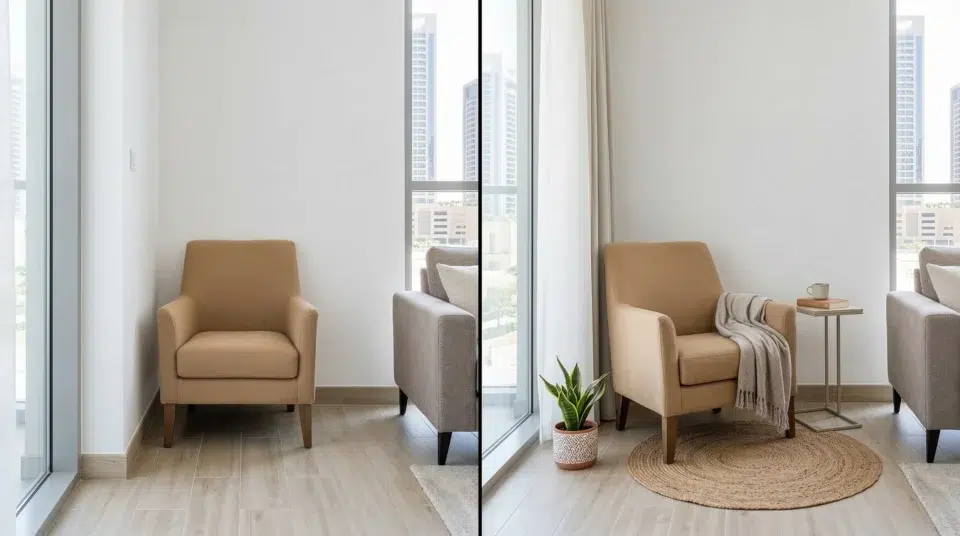
Rotate the accent chair 30 to 45 degrees toward the main sofa. Pull it at least 30 centimetres away from the wall behind it. If your room is too compact for this movement, even a 20-degree angle away from the wall creates a perceptible improvement in the spatial relationship between chair and sofa. The angled chair implies a conversation zone, creates visual depth in the corner, and uses the available floor area far more effectively than a wall-hugging configuration. For rooms where the chair has been flat against a wall for some time, and the floor marks show, a small area rug under the chair’s new position will conceal the previous marks and anchor the chair in its corrected placement. Explore our correctly scaled accent chairs with placement guides for the full range.
Mistake 3: Choosing a Fabric That Cannot Survive the UAE Climate
This is the mistake that costs the most money over time, and it is almost entirely caused by purchasing a chair based on how it looks in a showroom rather than on how its material will perform in the buyer’s specific UAE home.
Why It Happens
UAE furniture showrooms are climate-controlled environments with balanced commercial lighting that makes every fabric look beautiful. Cream linen looks fresh and serene. Light bouclé looks textural and luxurious. Full-grain leather looks rich and permanent. None of these showroom impressions account for what happens to these materials in a south-facing Business Bay apartment with six hours of daily UV, or a coastal Dubai Marina flat with 80 per cent ambient humidity, or a family home in Mirdif where children eat breakfast in the living room every morning.
Why It Is Particularly Damaging in the UAE
The UAE’s combination of extreme UV, air-conditioning thermal cycling, coastal humidity, and shamal dust creates an upholstery stress environment unlike anywhere else in the world. Light linen on a south-facing UAE chair can yellow noticeably within six months. Bonded leather begins to peel in the UAE’s air-conditioning cycle within twelve to eighteen months. Untreated light bouclé in a family room with children accumulates fine gypsum dust from shamal wind events and becomes difficult to maintain within a single season. These failures are not slow or subtle. They are rapid and often irreversible, and they turn an expensive purchase into a source of daily frustration.
For the complete technical breakdown of every fabric’s performance in UAE conditions, our dedicated fabric vs leather accent chair UAE guide covers every material across six UAE-specific criteria. The summary for this mistakes guide is this: performance fabric is the correct default for the majority of UAE family homes, dark-tone tight-pile velvet works in consistently air-conditioned rooms with limited daily use, and bonded leather should be avoided entirely in the UAE climate.
The Fix
If you already own a chair in a fabric that is struggling with UAE conditions, three interventions can extend its useful life. First, apply a professional fabric protection spray, available from UAE hardware retailers for AED 35 to 90 per can, which creates a surface barrier against moisture, dust adhesion, and minor staining. Second, reposition the chair away from direct UV exposure by moving it to a north or east-facing position or adding UV-filtering window film to south and west-facing glass. Third, use a quality washable cotton throw over the seat and arm areas during heavy-use periods, protecting the underlying fabric and washing the throw rather than the chair. For a permanent upgrade, browse our UAE climate-proven accent chair fabrics for performance-specified replacements.
Mistake 4: Not Anchoring the Chair with a Rug and Side Table
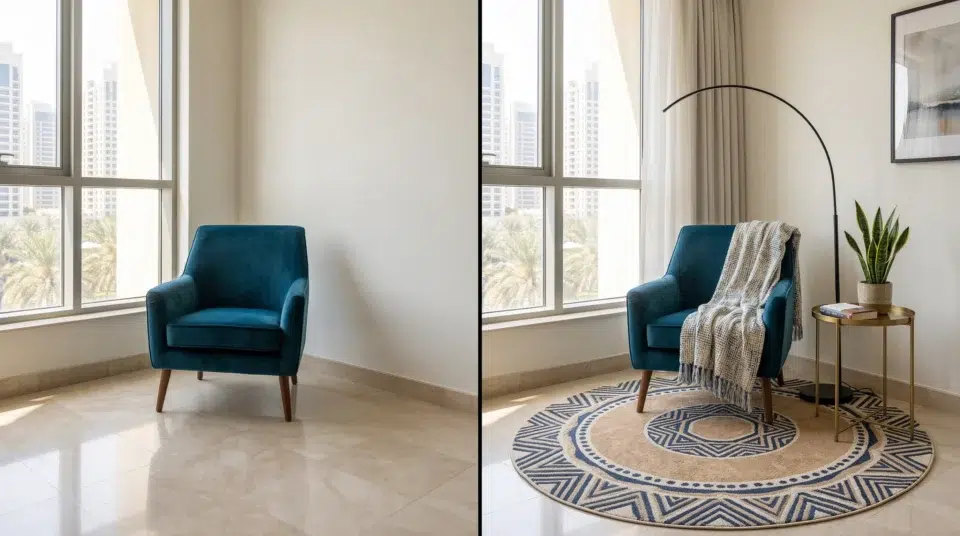
An accent chair without a rug beneath it and a side table beside it is an incomplete composition. It is the single most consistent styling omission we see across UAE apartment deliveries, and it is the reason that many genuinely good chairs look less impressive in their owners’ homes than they did in the showroom.
Why It Happens
Many UAE buyers treat the accent chair as a standalone purchase and the rug and side table as future considerations that can be added later. Later often does not arrive, and the chair sits in its corner indefinitely on the bare floor without any supporting elements. The showroom environment that made the chair look so good was almost certainly styled with both a rug and a side table, but buyers do not always register these contextual elements when they are focused on the chair itself.
Why It Is Particularly Damaging in the UAE
UAE apartments with tile, marble, or laminate flooring, which describes the majority of rental properties across Dubai, Sharjah, and Abu Dhabi, have hard floor surfaces that make furniture look floating and disconnected without a rug beneath. A chair on a bare tile floor in a white-walled rental apartment looks like it has been temporarily placed for storage rather than permanently positioned as a design statement. The hard floor also amplifies the chair’s acoustic isolation: it makes small sounds when moved and sits slightly differently on tile than on carpet, compounding the sense that it does not quite belong in the space.
The Fix
The rug and side table are not optional accessories for an accent chair. They are the completion of the composition. The rug should extend at least 30 centimetres beyond the chair on all three visible sides, with the chair’s front legs resting on the rug’s inner area. A 90 to 120-centimetre diameter round rug is the most versatile size for a single UAE apartment accent chair corner. The side table should sit at armrest height, within 2 to 5 centimetres of the chair’s armrest level, and its diameter should not exceed half the chair’s overall width. A 30 to 38-centimetre-diameter round side table is correct for most UAE compact apartment chairs. If budget is a constraint, a 90-centimetre round rug at AED 150 to 400 and a small side table at AED 120 to 350 add less than AED 750 to the total investment and transform a floating chair into a complete corner. Browse our accent chair and side table combinations in the UAE for curated pairings.
Mistake 5: Choosing a Colour That Fights the Room Instead of Completing It
This is the mistake most commonly described by UAE buyers who call us to say they love their chair individually but feel it does not work in their room. Almost every time, the cause is a colour relationship problem rather than anything wrong with the chair itself.
Why It Happens
Colour decisions in furniture buying are frequently made in isolation. A buyer falls in love with a chair in cobalt blue, purchases it, and arrives home to discover that their sofa is warm sand, their rug is terracotta, their walls are off-white, and the cobalt chair reads as something from a completely different room. The mistake is not the cobalt chair. It is the absence of any colour relationship between the chair and the existing room palette.
Why It Is Particularly Damaging in the UAE
UAE rental apartments across Dubai, Sharjah, and Abu Dhabi almost universally have off-white or warm white walls and tile or laminate floors in warm neutral tones. Most tenants furnish with neutral sofas to avoid clashing with the unknown landlord’s wall colours. Into this restrained neutral field, an accent chair in a strong saturated colour has enormous visual power. When that colour is coherent with the room’s existing palette, it creates exactly the intended effect: a deliberate focal point with presence and personality. When it is incoherent with the existing palette, the same chair dominates the room’s attention in a negative way, pulling the eye compulsively without rewarding it.
The Fix
Before purchasing any accent chair, identify the three dominant colours already present in your room: the wall tone, the sofa upholstery, and the floor covering. Your accent chair colour should either be a deeper or more saturated version of one of those three tones (a tone-on-tone relationship), or a complementary colour that shares the same warmth or coolness temperature as your dominant palette. A warm-toned room, off-white walls, sand sofa, warm oak floor, pairs naturally with accent chairs in terracotta, burnt orange, warm olive, or camel. The same room does not pair well with cool blue or cool grey chairs, because the colour temperature mismatch creates visual dissonance even when the individual colours are beautiful in isolation.
If you already own a colour-mismatched accent chair, the fastest correction is to introduce connecting elements: cushions on the sofa in the chair’s colour, or a rug that includes both the chair’s colour and the room’s dominant neutral. These bridges create the colour relationship that the chair’s purchase did not plan for. Explore our accent chairs in UAE-tested colour palettes for options pre-calibrated to the most common UAE interior colour schemes.
Mistake 6: Buying a Purely Formal Chair for an UAE Family Living Room
This mistake is particularly common among UAE buyers who are inspired by formal or high-design interior photography and purchase a chair that looks extraordinary in a styled editorial image but fails when it encounters the actual conditions of their family home.
Why It Happens
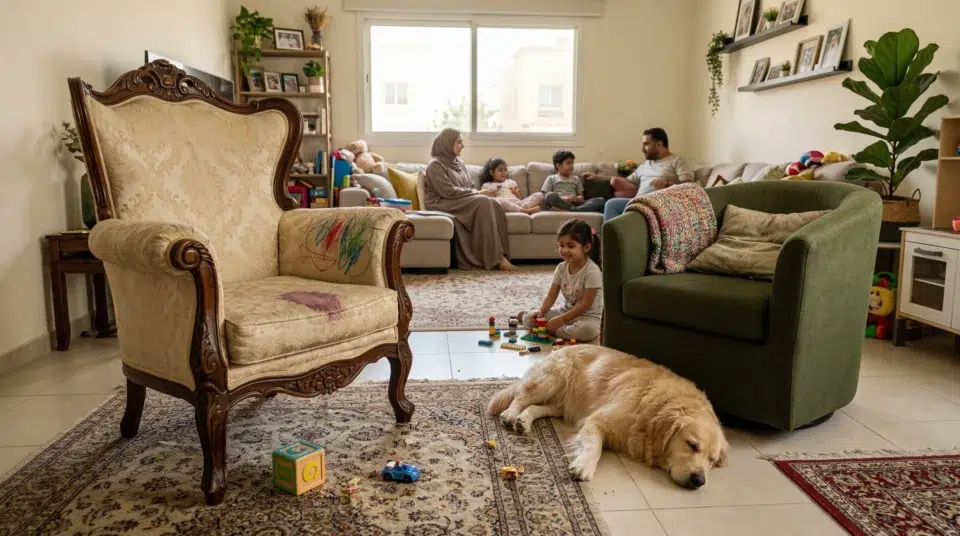
Editorial interior photography is staged and styled for a single moment of visual perfection. The cream brocade accent chair in that photograph has never been sat in by a seven-year-old with sticky hands. It has never been in a room where a dog shakes water off its coat after a walk. It exists in a fictional domestic reality that does not correspond to the daily conditions of most UAE family homes. Buyers who purchase based on these images are purchasing a chair for a life they do not actually live, rather than for the life they do.
Why It Is Particularly Damaging in the UAE
In UAE family apartments, particularly those in Mirdif, Al Barsha, JVC, and Jumeirah Village Triangle, where 65 per cent of UAE residents live in apartments, and most households include children and often pets, a purely formal chair becomes a source of ongoing domestic anxiety. Parents tell children not to sit in it. The chair is moved to a corner and covered with a throw. The household adjusts its behaviour around the furniture rather than the furniture serving the household. This is the precise inversion of what furniture is for.
The Fix
Choose the chair for the family you have, not for the photograph you loved. For UAE family rooms with children under twelve and pets, performance fabric is the correct default in any colour or silhouette you find beautiful. Performance fabric in deep olive, warm terracotta, slate grey, or forest green delivers the same visual impact as formal fabrics while cleaning with a damp cloth and surviving the genuine daily conditions of a UAE family home. For the formal accent chair you love aesthetically, reserve it for a low-traffic adult space: a master bedroom corner, a formal guest room, or a villa study. Browse our family-friendly accent chairs UAE for performance fabric options in elevated aesthetics.
Mistake 7: Placing the Chair in Direct South or West-Facing Sunlight Without UV Protection
This is the mistake that costs the most in the long term, and it is almost entirely invisible until the damage is done. In the UAE, direct sunlight through unprotected south and west-facing glass causes furniture fading that most buyers attribute to manufacturing quality rather than placement, which means they frequently replace the chair rather than correcting the fundamental problem.
Why It Happens
UAE apartment and villa living rooms are designed to maximise the views available from the property, which means the best positions in the room, the corners beside large windows with the most natural light, are also the positions with the most intense UV exposure. These are exactly the positions that buyers want to place an accent chair, both because the natural light is pleasant and because the chair is most visible from these positions. The conflict between visual preference and material preservation is real, and most buyers do not know it exists until they observe their chair fading six months after purchase.
Why It Is Particularly Damaging in the UAE
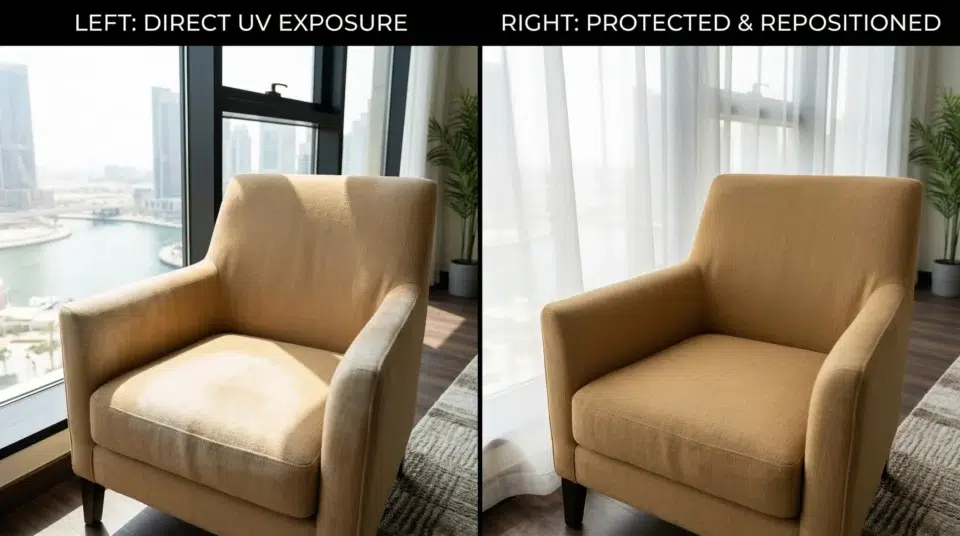
UAE south and west-facing windows receive UV radiation of sufficient intensity that measurable fading can occur in natural fabrics within twelve months of placement. In a Dubai Marina or Business Bay apartment with floor-to-ceiling glass and a south or west exposure, a linen accent chair placed in the direct light path will show visible colour loss within two summers. Even performance fabrics that are not solution-dyed can show surface fading within three to four years under the same conditions. The mistake is not choosing the corner position. The mistake is not protecting the chair once it is in that position.
The Fix
Three interventions protect a UAE accent chair from UV damage. First, reposition the chair so it sits in the room’s natural light without being in the direct beam of sunlight from the window, typically 40 to 60 centimetres back from the glass line. Second, install sheer UV-filtering window curtains or UV-protective film on south and west-facing glass. Quality UV window film reduces UV transmission by 60 to 99 per cent, is typically AED 150 to 350 per square metre installed, and protects every piece of furniture and flooring in the room simultaneously. Third, if replacement is necessary, specify a solution-dyed performance fabric for the replacement chair. Solution-dyed fabrics have colour embedded through the entire fibre cross-section rather than on the surface, which means UV cannot bleach them from the outside in. Our UV-resistant accent chairs Dubai are specified with solution-dyed fabric options for UAE sun-exposed rooms.
2026 Trends That Help You Avoid All 7 Mistakes Simultaneously
Understanding current 2026 UAE interior design directions makes avoiding the above mistakes easier because these trends reflect accumulated market intelligence about what actually works in UAE homes, and what does not.
Trend 1: Intentional Scale for UAE Proportions
The most influential trend in UAE residential interiors in 2026 is the deliberate calibration of furniture scale to UAE architectural proportions rather than to European design references. UAE furniture buyers and designers are increasingly rejecting the compact, minimal furniture vocabulary of Scandinavian design and selecting pieces whose scale reflects the genuine generosity of UAE living spaces. An accent chair with a 90-centimetre back height, an 82-centimetre seat width, and visible leg clearance is now understood by informed UAE buyers as the minimum correct specification for a standard villa family room, rather than a maximum statement piece. This shift directly prevents Mistake 1.
Trend 2: Corner Vignettes as Complete Compositions
The 2026 UAE interior design conversation has largely moved beyond individual furniture pieces toward the concept of the corner vignette: a complete miniature composition of chair, rug, side table, and lamp that functions as a designed scene within the larger room. This compositional thinking directly prevents Mistakes 4 (no rug and side table) and 2 (flat against the wall placement) because it begins the buying process from the perspective of the complete arrangement rather than the individual piece.
Trend 3: Climate-Intelligent Material Selection as a Design Value
In 2026, choosing a material appropriate to the UAE climate is increasingly understood among informed UAE buyers as a design value rather than a practical compromise. A performance fabric accent chair in a beautiful deep teal or warm terracotta is not a less sophisticated choice than a natural linen chair. It is a more sophisticated choice because it demonstrates that the buyer understands their specific environment and has made a selection that will honour the chair’s design intention over time by maintaining its appearance. This trend directly prevents Mistake 3 and Mistake 7.
Materials and Fabrics: Avoiding the UAE Climate Mistakes
The full technical breakdown of material performance in UAE conditions is covered comprehensively in our complete fabric and material guide. For this mistakes guide, the essential material rules that prevent the most common UAE accent chair errors are these four.
Rule 1: Never buy bonded leather in the UAE. Bonded leather peels in the UAE temperature cycling within twelve to twenty-four months. There is no UAE-specific maintenance routine that prevents this failure. If you want a leather-look chair, choose high-quality PU leather over a fabric core at AED 800 to 2,200.
Rule 2: Avoid untreated natural linen or cotton in coastal UAE properties. Dubai Marina, JBR, Palm Jumeirah, and Abu Dhabi Corniche apartments have ambient humidity levels of 70 to 85 per cent during peak summer. Untreated natural fibres absorb this humidity and can develop odour within months. Either treat the fabric with a professional protector spray at delivery or choose a performance fabric that mimics the natural linen aesthetic with none of its moisture vulnerability.
Rule 3: Always specify solution-dyed fabric for south and west-facing UAE rooms. Solution-dyed performance fabric maintains colour stability under UAE UV for five to eight years. Surface-dyed fabrics in the same position show measurable fading within two to three years. The price difference between the two specifications is typically AED 100 to 400 per chair. It is always worth paying.
Rule 4: Confirm foam density before any purchase. A chair with 22 kg foam density collapses within eighteen months of daily UAE use. A chair with 38 to 42 kg HR foam maintains its profile for six to ten years. This specification is not visible in a product photograph and is not volunteered by all retailers. Ask specifically, every time. Our team at Karnak Home provides foam density specifications for every piece in our UAE-climate-rated accent chairs collection.
8 Frequently Asked Questions About Accent Chair Mistakes in UAE Homes
FAQ 1: How do I know if my accent chair is the wrong size for my UAE room?
The clearest signs of a scale mismatch in a UAE room are: the chair’s back height is less than two thirds of the ceiling height measured from the floor; the chair looks like a small object when viewed from the room’s entrance rather than a significant piece of furniture; the chair appears to float visually in its corner without making contact with the room’s proportions. For UAE rooms with ceiling heights above 3 metres, including most villa family rooms and formal reception spaces in Arabian Ranches, Emirates Hills, and Al Reem Island, a chair with a back height below 95 centimetres is typically undersized. Browse our large-format accent chairs for UAE villas for correctly scaled options.
FAQ 2: What is the correct angle to place an accent chair in a UAE apartment?
The correct placement angle is 30 to 45 degrees toward the main sofa, pulling the chair at least 20 centimetres away from the wall behind it. This angle creates a conversational relationship between the chair and the sofa, implies a seating zone rather than a row of parked furniture, and creates visual depth in the corner that flat-against-wall placement cannot achieve. In compact UAE apartments in JVC, Al Nahda, and Sharjah, where every centimetre matters, even a 20-degree rotation from the wall creates a measurable visual improvement. The chair does not need to be far from the wall to benefit from angled placement. The angle itself is the change that matters.
FAQ 3: My accent chair fabric is already fading from the UAE sunlight. Can it be fixed?
Mild fabric fading in UAE sun-exposed positions can sometimes be partially addressed with a quality fabric dye refresh treatment applied by a professional upholstery service, available across Dubai and Sharjah for AED 200 to 500 per chair. This works best on solid-colour, medium-weight fabrics with even fading across the surface. It does not work well on patterned fabrics, velvet, or fabrics with very uneven fading. For severe fading or irreversible bleaching, the most cost-effective solution is professional reupholstery, which costs AED 600 to 1,800 for an accent chair in Dubai and allows you to specify a solution-dyed UV-resistant replacement fabric. Contact our team at +971 58 908 8107 for upholstery service referrals in your area.
FAQ 4: What rug size should I use under an accent chair in a UAE apartment?
For a single accent chair in a UAE apartment, a circular rug of 90 to 120 centimetres in diameter is the most versatile choice. The chair’s front legs should rest on the rug’s inner area, approximately 25 to 35 centimetres from the rug’s centre. The rug should extend at least 30 centimetres beyond the chair on all three visible sides. A rug smaller than 80 centimetres in diameter looks like it is trying to hide under the chair rather than anchor it. A rug larger than 140 centimetres begins to dominate the corner composition and compete with the chair rather than supporting it. For a chair-plus-ottoman combination, increase the rug diameter to 140 to 160 centimetres to accommodate both pieces on the rug’s surface.
FAQ 5: How do I fix an accent chair that clashes with the rest of my UAE living room?
Three options resolve a colour clash between an accent chair and its room. First, add connecting elements: cushions on the sofa in the chair’s colour, or a rug that includes both the chair’s colour and the room’s dominant neutral tone, creating a visual bridge. Second, repaint the room’s accent wall in a tone that harmonises with the chair, which is appropriate for homeowners but not for UAE renters. Third, reupholster the chair in a fabric that aligns with the room’s existing palette, which costs AED 600 to 1,500 for an accent chair and may be the most cost-effective solution if the chair’s frame and structure are good quality. For a fresh start, browse our accent chairs in warm neutral tones in the UAE for options calibrated to the most common UAE rental apartment palettes.
FAQ 6: Is it a mistake to choose a very formal accent chair for a UAE family home?
Yes, for daily-use family rooms. A purely formal accent chair, brocade upholstery, very low seat height, delicate carved frame, in a UAE family living room where children and pets are present daily, creates ongoing domestic anxiety and deteriorates faster than a practical alternative without delivering better design results. The correct approach is to choose a chair whose aesthetic is as elevated as you wish, but whose material specification is appropriate for the actual household that will use it. Performance fabric is available in every silhouette, colour, and design vocabulary, including formal and heritage-inspired aesthetics. There is no design compromise in choosing it. There is only practical intelligence. View our UAE family-tested accent chairs for formal aesthetics in practical materials.
FAQ 7: What is the most common accent chair mistake in UAE villa formal rooms?
The most consistent mistake in UAE villa formal rooms, particularly dedicated majlis and formal reception spaces in Emirates Hills, Khalifa City, and Mohamed Bin Zayed City, is placing the primary accent chair against a side wall rather than at the room’s focal axis opposite the entrance. This placement undermines the social and design logic of the formal room by removing the chair from its culturally correct position of visual authority. The second most common formal room mistake is using light or cream upholstery in a room that receives regular guest use during Ramadan and Eid without planning for the cleaning frequency that light formal fabric requires in high-use periods. For more details on Arabic and majlis-context accent chair placement, our Arabic accent chair UAE guide covers this in depth.
FAQ 8: Does Karnak Home offer advice on fixing existing accent chair problems without buying a new chair?
Yes. Our team provides WhatsApp consultations for exactly this situation. If you share a photograph of your existing accent chair and its room context at +971 58 908 8107, our consultants will identify the specific issue, whether it is placement, scale, anchoring, colour relationship, or fabric condition, and advise on the most cost-effective correction. Many accent chair problems are resolved without any new purchase at all: a repositioning, a rug addition, a side table, or a lamp resolves the majority of the issues described in this guide. When a replacement or upgrade is genuinely the right answer, our team will advise which specific pieces from our current accent chair collection address the identified problem correctly.
Conclusion
The seven accent chair mistakes in this guide share one common origin: a decision made without UAE-specific knowledge. Wrong scale because the design reference was European. Wrong placement because the instinct was tidiness rather than composition. Wrong fabric because the showroom environment made everything look equally durable. Wrong colour because the room’s existing palette was not consulted. Wrong formality because the inspiration image was styled rather than lived in. Wrong UV position because nobody mentioned what the UAE sunlight does to upholstery over two summers. Every one of these errors is the result of good intentions meeting the wrong information. The right information was always available. Now you have it.
For UAE families who have already made one of these mistakes, the most important thing to know is that most of them are correctable without a new chair purchase. A repositioning, a rug, a side table, a lamp, and, in some cases, a professional fabric protection treatment will resolve the majority of accent chair problems in UAE homes. The chair you already own may be the right chair in the wrong position, with the wrong companions, in the wrong relationship to the light. Correct those variables, and the room will often surprise you with how well it works.
Karnak Home’s team has been solving exactly these problems in UAE homes since 1988. Whether you need a consultation on an existing chair, a replacement that avoids the mistakes described here, or guidance on styling a complete accent chair corner in your specific UAE apartment or villa, WhatsApp us at +971 58 908 8107 with a photograph of your room, and we will respond with specific, actionable advice. Our Sharjah showroom is open Saturday to Thursday, 9 AM to 9 PM. Free delivery and free installation come standard on all eligible orders across the UAE.
Ready to Get Your Accent Chair Right?
Shop Accent Chairs Online: Browse the full UAE accent chair collection at Karnak Home
Visit Our Showroom: Industrial Area, Sharjah, UAE (Saturday to Thursday, 9 AM to 9 PM)
WhatsApp Us: +971 58 908 8107 (Send a room photo for instant advice)
Call: +971 58 908 8107
Ready to Get Your Accent Chair Right the First Time?
You’ve just reviewed the 7 most common (and costly) accent chair mistakes UAE buyers make in 2026—from ignoring exact measurements and proportions, choosing the wrong fabric for humidity/UV/dust/AC, poor placement blocking flow or creating dead zones, skipping quality checks (frame, stitching, foam density), buying purely on trend without lifestyle fit, underestimating delivery/installation challenges in high-rises/villas, and overspending on low-value pieces vs smart mid-range options. Avoiding these pitfalls saves thousands of AED and years of frustration in real Dubai, Abu Dhabi, and Sharjah homes. Now browse our carefully curated accent chair collections built to UAE standards—with free delivery, free professional installation, and free in-home consultation across all Emirates to help you choose confidently.
- → Accent Chairs – Quality-checked collection with proper sizing, UAE climate fabrics, and durable construction to avoid common regrets
- → Living Room Furniture – Full pieces to test scale and flow before finalizing your accent chair placement
- → Sofas – Matching sofas in performance fabrics to ensure harmonious proportions with accent chairs
- → 2-Seater Sofas Dubai – Apartment-scale sofas that leave proper clearance for accent chairs in tight layouts
- → Coffee Tables – Proportionate tables to complete seating groups without overcrowding
- → Console Tables – Versatile consoles for entryway or side placement beside accent chairs
- → Furniture Packages – Bundles with accent chairs included—great for avoiding mismatched scale and saving money
- → Karnak Deals – Value offers on high-quality accent chairs that deliver better longevity than cheap alternatives
💬 Get Free Consultation on WhatsApp Shop All Accent Chairs Now →