
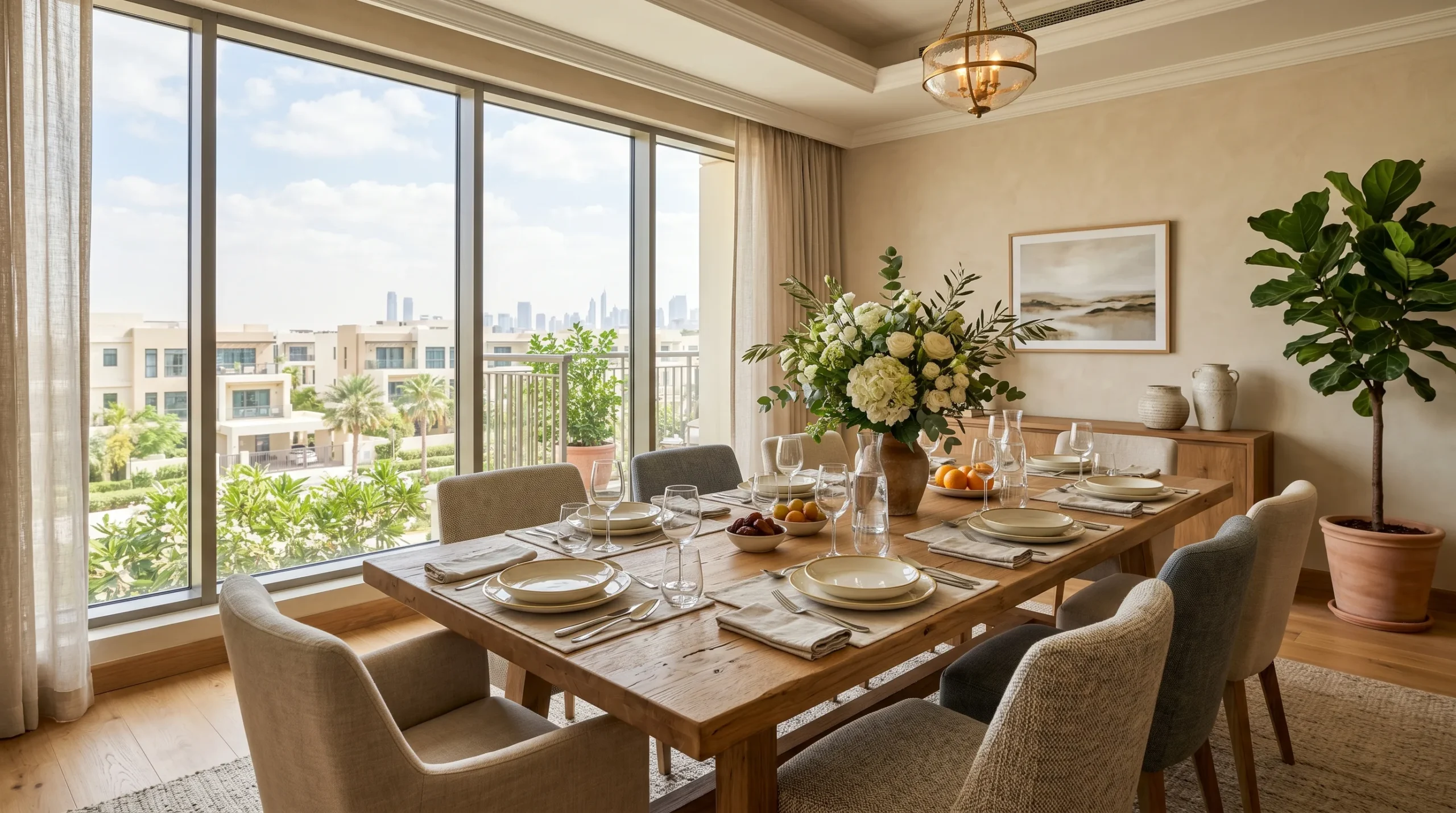
Every year, we see the same situation unfold in our showroom. A family walks in, falls in love with a beautiful dining table, orders it, and then calls us two weeks after delivery to ask whether we can swap it — because it barely leaves enough room to pull the chairs back. It happens more often than you would think, and it is entirely preventable.
Over 35 years and more than 70,000 families helped across the UAE, the team at Karnak Home has learned that choosing a dining table is not really about picking a style you love. Style comes second. Size comes first. Get the size wrong and even the most beautiful table will cause daily frustration. Get it right and your dining room becomes one of the most used, most enjoyed spaces in your home.
This guide is here to make sure you get it right the first time. We will walk you through everything from measuring your room correctly to understanding how many people actually fit at different table sizes — with specific guidance for the kinds of homes UAE families live in, whether that is a compact apartment in JVC, a mid-size villa in Mirdif, or a spacious townhouse in Arabian Ranches.
Living in the UAE adds a few dimensions to this decision that families in other parts of the world do not necessarily face. Homes here often host larger gatherings. Extended family visits during Eid, Ramadan Iftar nights, regular family dinners — the dining table in a UAE household works harder than in most countries. You may need to seat six on a quiet Tuesday and fourteen during a celebration. Your table needs to accommodate both realities without permanently dominating your space. That balance is exactly what we are going to help you find.
Start With the Room, Not the Table
This is the single most important principle in choosing a dining table, and it is the one most people reverse. They see a table they love online or in a showroom, they measure the table, and they try to fit it into their room. The right approach is the opposite. Measure your room first, then find the table that works within it.
The Golden Rule: Chair Clearance
The measurement most people forget is not the table itself — it is the space you need around the table once chairs are occupied. Furniture experts, including our team here, use a consistent standard: you need a minimum of 90 centimetres of clearance between the edge of the table and any wall or piece of furniture behind the chairs. This allows a person to sit comfortably, push the chair back slightly, and stand up without bumping into anything.
If you are tight on space, 85 centimetres is the absolute minimum and will feel workable but not generous. Anything less and daily use becomes awkward and slightly claustrophobic. If you have the room, 100 to 110 centimetres of clearance on the main seating sides is genuinely comfortable and makes a real difference to how the space feels.
What this means practically: if your dining room is 4 metres wide, you cannot fit a table that is wider than 4 metres minus 90 centimetres on each side, which gives you a maximum table width of 2.2 metres. In reality, for comfortable movement you would look for a table no wider than 2 metres in that room.
How to Measure Your Space Correctly
Before you look at a single table, do this: take a measuring tape and note down the full length and width of your dining area in centimetres. If your dining area is open-plan — which is common in UAE apartments and modern villas — identify where the dining zone begins and ends. This is usually defined by a pendant light above the table or a rug beneath it. Measure that defined zone, not the entire open-plan room.
Now subtract 90 centimetres from each side where chairs will be placed. What remains is your maximum table footprint. Write that number down. That is your most important number when shopping.
If you have an existing dining set and you are replacing it, measure how the current set fits the room. Is it too large? Too small? Does it feel right but you just want a different style? That real-world feedback is extremely useful when shopping for something new.
Dining Room Sizes Across UAE Homes
Based on the homes we visit and the families we work with across all seven emirates, here are the rough dining area dimensions we encounter most frequently:
Apartments in Dubai Marina, JLT, Business Bay, and similar urban towers typically have dining areas between 3 metres by 3 metres and 3.5 metres by 3.5 metres. These spaces suit a 4-seater or a compact 6-seater table.
Mid-range villas and townhouses in communities like Mirdif, Al Quoz residential, Jumeirah Village, and similar areas typically have dining rooms from 3.5 metres by 4 metres to 4 metres by 4.5 metres. A comfortable 6-seater or a stretched 8-seater works well here.
Larger villas in Emirates Hills, Arabian Ranches, Palm Jumeirah, and similar premium communities often have dedicated dining rooms of 4.5 metres by 5 metres or larger. These spaces can accommodate 8-seater to 12-seater tables and often have room for a sideboard or buffet cabinet as well.
Homes in Sharjah, Ajman, and the Northern Emirates tend to have more generous room sizes relative to their price point, which means families there often have more flexibility than they realise.
Understanding Dining Table Sizes by Seating Capacity
Once you know your maximum table footprint, the next step is matching that to the right seating capacity for your family. Here is the comprehensive breakdown we use at Karnak Home.
2-Seater and 4-Seater Tables
A 2-seater table is typically 75 to 90 centimetres in diameter for round tables, or 80 by 80 centimetres for square formats. These are best suited for studio apartments or as breakfast nook tables in larger homes. They are not a primary family dining table.
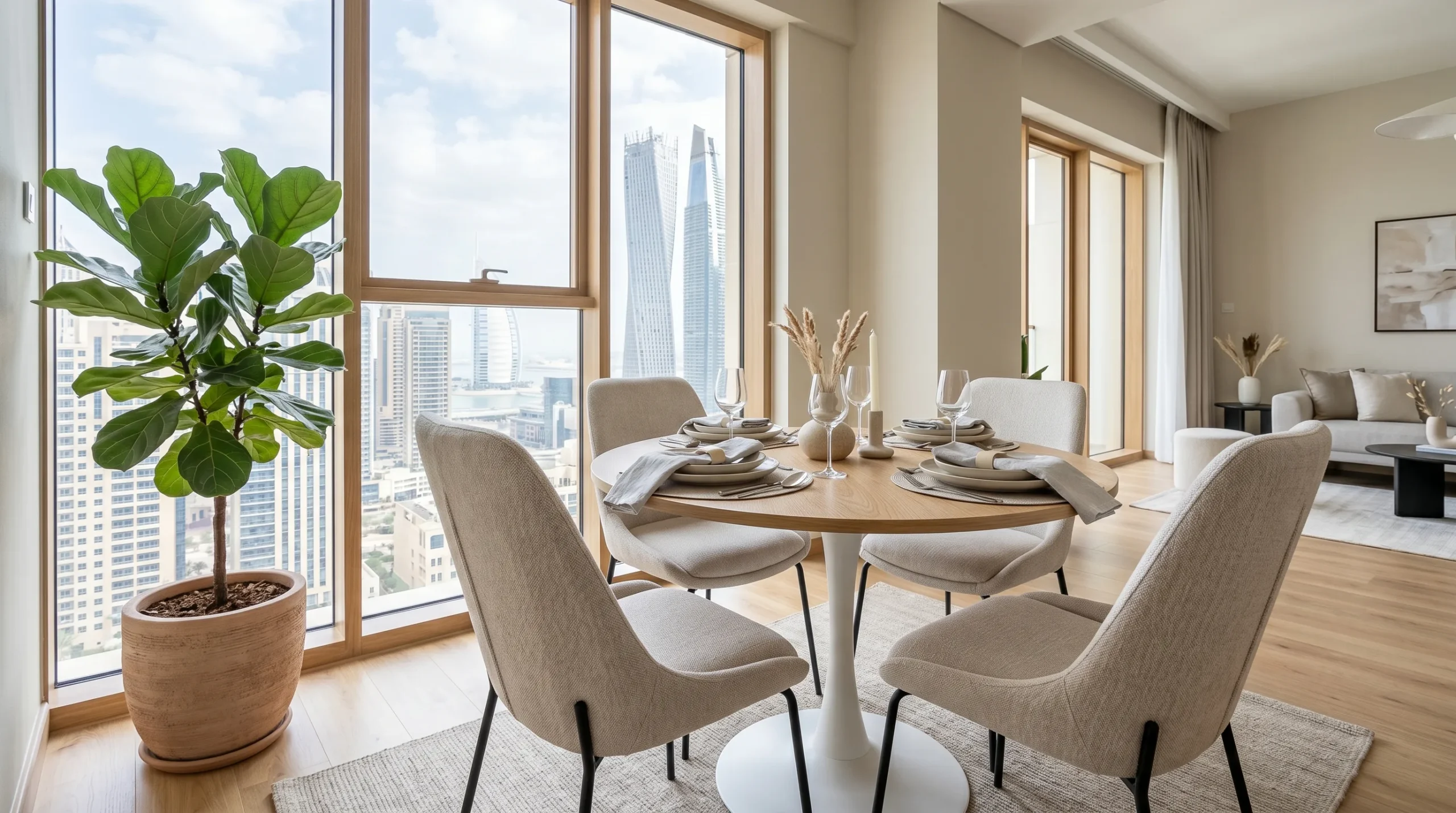
A 4-seater table is where most small family purchases start. Rectangular 4-seater tables are typically 110 to 130 centimetres long and 70 to 80 centimetres wide. Round 4-seater tables are typically 90 to 100 centimetres in diameter. These work well for couples with one or two young children in apartment settings. In UAE terms, if your dining area is roughly 3 metres by 3 metres, a 4-seater is your best fit.
6-Seater Tables: The UAE Family Standard
In our experience across 35 years of selling dining furniture in the UAE, the 6-seater dining table is the single most popular choice for the widest range of families. It seats a family of four or five comfortably every day, accommodates a grandparent or two guests without any arrangement, and fits the majority of UAE dining rooms.
The standard dimensions for a 6-seater rectangular table are 160 to 180 centimetres long and 80 to 90 centimetres wide. A round 6-seater is typically 135 to 150 centimetres in diameter. To comfortably house a 6-seater table, you ideally want a dining area of at least 3.5 metres by 3.5 metres for a rectangular version, and 3.2 metres by 3.2 metres for a round one.
One practical note on 6-seater tables: while a 160-centimetre table can technically seat six, the two people at either short end feel a bit pinched. If you are choosing a 6-seater specifically because you regularly use all six seats, opt for 175 to 180 centimetres in length. Your guests will notice the difference.
8-Seater Tables: Growing Families and Entertaining
The 8-seater is the right choice for families with three or more children, families who regularly host extended relatives, or anyone who genuinely uses all eight seats on a regular basis — not just at Eid. In UAE homes, we see 8-seater tables purchased most often by families with parents, children, and frequent visits from grandparents or siblings.
A rectangular 8-seater table is typically 200 to 240 centimetres long and 90 to 100 centimetres wide. A round or oval 8-seater needs at least 150 to 180 centimetres in diameter. The room requirement is correspondingly larger: plan for a dining area of at least 4 metres by 4.5 metres for a rectangular 8-seater, and ensure your chair clearance measurements still hold on all occupied sides.
The most common mistake with 8-seater tables is buying the table for the occasional big gathering and then living with an oversized table that overwhelms the room every other day of the year. Before committing, be honest about your typical household size versus your entertaining frequency. If you seat eight only a few times a year, an extendable table is likely a smarter solution — we will cover those shortly.
10-Seater and 12-Seater Tables: Large Villas and Formal Dining
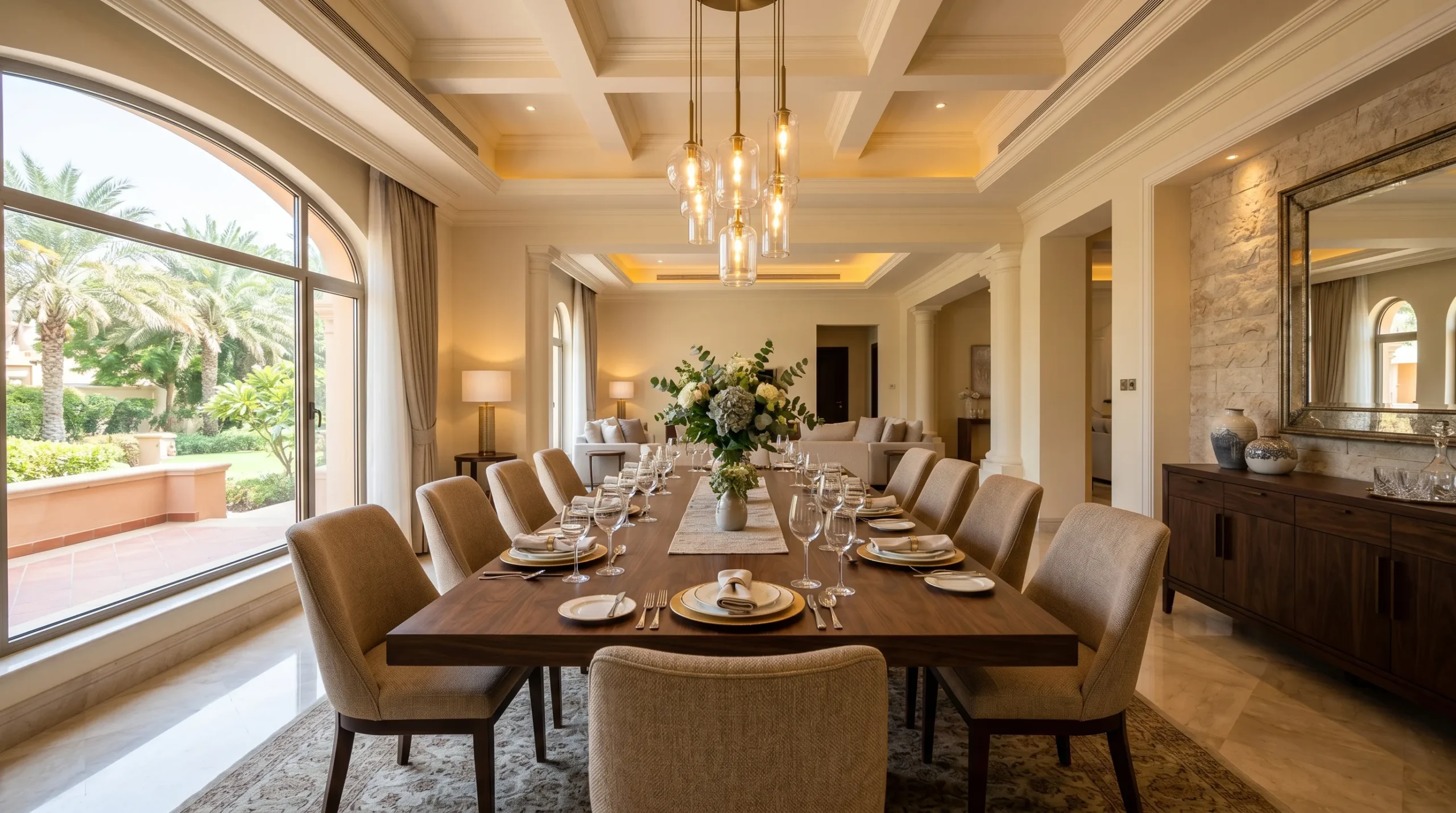
A 10-seater rectangular table runs from 270 to 300 centimetres in length. A 12-seater runs from 300 to 360 centimetres. These tables require dedicated, generously sized dining rooms. For a 12-seater, plan for a room of at least 5.5 metres by 5 metres, and ideally more.
In the UAE context, these are most appropriate for large villas with formal dining rooms, families who host regular Iftar gatherings or large celebrations, or homes where the dining room is a statement space designed for entertaining. At this scale, the quality of the table matters enormously — a low-budget table at 3 metres long will flex, creak, and show wear quickly. This is an investment piece and it should be treated as one.
The Case for Extendable Dining Tables in UAE Homes
If there is one table type we find ourselves recommending more and more to UAE families, it is the extendable dining table. And honestly, for the way most families here live, it makes tremendous sense.
The reality of family life in the UAE is that your dining needs vary enormously across the year. A regular weekday might mean four people around the table. A Friday lunch with siblings and parents means eight. An Eid gathering could mean twelve or more. An extendable table lets you live with a manageable everyday size and expand when life demands it.
How Extendable Tables Work
There are two main extension mechanisms. The first is a central butterfly extension, where a hidden leaf is stored within the table itself and unfolds from the centre when needed. These are the most convenient because you never need to find or store a separate leaf. The second type uses one or two separate leaves that you store elsewhere and insert into the table when extended. These offer greater size flexibility but require storage space for the leaves.
A common extendable option we offer at Karnak Home is a table that seats 6 in its standard configuration at 160 centimetres, and extends to seat 8 to 10 at 200 to 240 centimetres with one or two leaves. The everyday footprint is manageable. The extended size handles real gatherings.
When buying an extendable table, check the quality of the extension mechanism carefully. The join between the base table and the leaf should be flush, with no visible gap or uneven surface. The locking mechanism should be firm. Lower-quality extendable tables develop wobble at the joint over time, particularly with heavy use, and a wobbly joint at a full Iftar dinner is not something anyone wants to discover.
Space Planning for Extendable Tables
Because you need chair clearance in both the standard and extended configuration, measure both scenarios before purchasing. An extendable table that works at 160 centimetres in your room may not leave adequate clearance when opened to 240 centimetres. The extension is only useful if you can actually pull chairs back and sit comfortably.
Shape Matters as Much as Size
The footprint of your dining area and its proportions should guide the shape you choose. Here is how the main shapes play out in UAE homes.
Rectangular Tables
Rectangular is the most versatile and most common. It suits long, narrow dining rooms and open-plan spaces well. It is the easiest shape to add chairs to at each end if you need to squeeze in extra guests. For most UAE families, a rectangular table is the practical default, and it works in virtually every space configuration.
Round Tables
Round tables are exceptional for smaller spaces and for families with young children. There are no sharp corners, which matters enormously with toddlers. The circular format creates a genuinely inclusive conversation dynamic — everyone faces everyone else. The limitation is scale. Round tables above 150 centimetres in diameter become unwieldy and require a very square room. Above 6 seats, round tables begin to lose their conversational intimacy anyway.
For apartments and smaller dining areas, a round 4-seater or 6-seater is often a better spatial and social choice than a small rectangular table. We see this combination working extremely well in compact Dubai apartment dining areas.
Square Tables
Square tables work beautifully for 4-seater configurations in square rooms. They create a balanced, symmetrical look and feel more communal than a narrow rectangular table. The challenge is scaling up — an 8-seater square table needs a very large square room, and the people in the centre of each side end up far from the people at the corners. For most UAE families, square tables work best at 4-seater scale.
Oval Tables
Oval tables combine the spatial efficiency of rectangular tables with the softer aesthetic of round ones, and they eliminate sharp corners entirely. For families who love the look of a round table but need to seat more than six, an oval is an elegant solution. They can be slightly harder to find in a wide variety of styles, but the Karnak Home dining collection includes a strong selection of oval formats.
Common Mistakes UAE Families Make When Buying Dining Tables
In 35 years of working with families across the UAE, certain mistakes come up repeatedly. Every one of them is preventable.
Mistake 1: Buying for the Biggest Occasion, Not for Daily Life
The Eid table that seats fourteen is genuinely useful four days a year. Every other day of the year, you are living with a table that is too large for your household. Unless you have a genuinely spacious dedicated dining room and regularly host large gatherings, size your table for your everyday household and buy an extendable option to cover larger occasions.
Mistake 2: Forgetting the Chair Clearance Calculation
We covered this above, but it bears repeating because it is the single most common practical mistake. The table dimensions alone do not tell you whether the table fits. What matters is whether the table fits with chairs around it, occupied, with room to move. Always do the chair clearance calculation before purchasing.
Mistake 3: Ignoring the Table Height
Standard dining table height is 75 to 77 centimetres. Standard dining chair seat height is 44 to 47 centimetres. These proportions are designed to work together, and the vast majority of dining furniture is built to these standards. Where problems arise is when people mix tables and chairs from different sources or buy bar-height tables (usually around 90 centimetres) without buying the matching counter-height stools. Always check that your table and chairs are matched in height, particularly when buying them separately.
Mistake 4: Choosing Material Without Considering the UAE Climate and Household
The UAE climate — specifically the combination of air conditioning and high ambient humidity when doors open — is genuinely demanding on furniture. Solid hardwoods like oak, walnut, and teak handle this environment well when properly finished. Cheaper particleboard or MDF tables with veneer finishes can swell, delaminate, or warp over time if the climate control in the room is inconsistent.
Families with young children need to think about surface durability. A beautiful white lacquer table looks stunning in a showroom and will look significantly less stunning six months into daily family use. Textured matte surfaces, darker tones, or stone tops are all more forgiving of daily activity.
Mistake 5: Buying Without Sitting at the Table First
This one sounds obvious, but with the rise of online furniture shopping, more families are purchasing dining tables they have never physically sat at. The table height, the overhang of the tabletop above your lap, the comfort of sitting for an extended meal — these things matter and they are not always evident from photos or dimensions. If you are considering a significant purchase, visiting the Karnak Home showroom to sit at the table before ordering is genuinely worth the trip.
Dining Table Materials: What Works in UAE Homes
Choosing the right material is about the intersection of aesthetics, durability, and realistic maintenance given your household.

Solid wood remains the most popular and most enduring material for dining tables in the UAE, and for good reason. A well-made solid oak or walnut table, properly cared for, will last decades. It can be refinished if it sustains significant surface damage. It develops character over time rather than simply degrading. The price range is substantial: a solid wood 6-seater from Karnak Home starts at approximately 2,500 AED for hardwood options and can range to 8,000 AED or more for premium bookmatched walnut or teak designs.
Engineered wood — MDF or particleboard with high-quality veneer — offers the visual warmth of wood at a lower price point, typically 1,200 to 2,500 AED for a 6-seater. The honest caveat is durability. Veneer surfaces can chip, peel, or delaminate, and they cannot be refinished the way solid wood can. For a primary family dining table used every day for years, engineered wood should be considered a medium-term rather than long-term purchase.
Marble and stone tops are visually striking and have seen significant popularity in UAE homes over the past several years. The material is genuinely durable and heat-resistant, which suits the way UAE families use dining tables — hot dishes placed directly on the surface, extended meal times. The considerations are weight (marble tables cannot be moved easily), porosity (unsealed marble stains from acidic foods and liquids), and cost. Genuine marble 6-seater dining tables start at around 4,000 AED and can exceed 15,000 AED for premium Italian marble with quality bases.
Sintered stone — a compressed porcelain material often sold under brand names — has emerged as a practical alternative to genuine marble. It offers a very similar aesthetic, is non-porous and stain-resistant, handles heat well, and is somewhat more forgiving in daily use. Many families in the UAE who want the marble aesthetic without the maintenance choose sintered stone. Expect pricing from about 3,500 AED for a 6-seater.
Glass tabletops remain popular, particularly in contemporary apartment settings. They create a visual lightness that works well in smaller spaces. The practical concerns are scratching, fingerprints, and the consequence of breakage. Tempered safety glass is standard on well-made glass tables, but any table with children in the household should have this confirmed before purchase.
Honest Pricing Guide for Dining Tables in the UAE
Prices in AED for dining table sets (table plus standard chairs, excluding buffet or additional pieces) from reputable furniture retailers in the UAE including Karnak Home.
A 4-seater dining set in solid wood or quality engineered wood runs from approximately 1,800 AED to 4,500 AED. Below 1,500 AED, build quality begins to compromise noticeably.
A 6-seater dining set in solid hardwood typically falls between 2,800 AED and 7,000 AED for mid-range quality. Premium solid wood or stone-top versions can reach 12,000 AED to 18,000 AED. Engineered wood 6-seater sets can be found from 1,500 AED, though families should factor in a shorter lifespan at the lower end.
An 8-seater solid wood dining set starts at approximately 4,500 AED for good quality and commonly runs to 10,000 to 15,000 AED for premium materials.
An extendable dining table (without chairs) in solid wood ranges from approximately 3,000 AED to 9,000 AED depending on size and material. The extension mechanism quality is a significant factor in longevity at any price point.
Our honest guidance: buy the best quality you can afford within your realistic budget. A well-made dining table from a reputable UAE retailer will outlast two or three cheaper replacements. Over ten to fifteen years, the economics of quality become very clear.
Expert Tips From 35 Years of Helping UAE Families
These are the practical insights we share when families come to us in our showroom or call our team for advice.
Always measure twice and bring the measurements with you when you shop. Write them on your phone, not a scrap of paper that will get lost. Include your maximum table footprint after chair clearance calculation.
When shopping online, use painter’s tape on your floor to mark out the table footprint before you order. Live with the tape for a day. Walk around it. Sit in imaginary chairs at the marked edges. This simple exercise prevents the most expensive mistakes.
Consider your dining chairs as part of the table decision, not a separate one. Chair arm height must clear the tabletop overhang. Chair seat depth affects how much room you need behind the chair. If you plan to buy the table and chairs separately, bring the chair dimensions with you when you shop for the table.
Think about who sets the table and who clears it. Wide tables look impressive but require a significant reach to place items in the centre, which matters if there are children or older family members doing this task. A table deeper than 95 centimetres requires some thought about how you will manage serving.
If you have young children under five, prioritise round or oval tables until they are older. A sharp corner at toddler head height is a genuine daily hazard that no amount of table beauty compensates for.
UAE summers mean air conditioning runs consistently for months. If your dining room gets very cold from AC and your table is against an exterior wall that heats up, this temperature differential over time can stress solid wood joints. Maintain relatively consistent room temperature and keep solid wood furniture away from direct AC vents.
Consider the acoustic quality of your dining room. Hard surfaces — stone floors, glass tables, hard walls — create echo and noise that makes conversation at large family dinners genuinely tiring. A warm solid wood table, upholstered chairs, and soft furnishings in the space together create a much more pleasant acoustic environment.
Conclusion: Making the Right Decision for Your Family
Choosing the right dining table is one of the more consequential furniture decisions you will make for your home. It is a piece that your family will use every single day. The right table will anchor your dining space for a decade or more. The wrong one will cause daily frustration from the moment it arrives.
The framework is straightforward: measure your room first, calculate your chair clearance, identify your real everyday seating needs, decide whether an extendable option makes sense for how you entertain, choose your material based on your household realities, and then find the style you love within those parameters.
If you are still uncertain after working through this guide, we would genuinely encourage you to visit us. Our team at Karnak Home has been having exactly this conversation with UAE families for 35 years. We are not here to sell you the most expensive table in the showroom. We are here to help you find the right table for your home and your family.
Key Takeaways:
- Measure your room and calculate chair clearance before looking at any table. Your maximum table footprint is the most important number in this decision.
- Size for your everyday household, not your biggest occasion. An extendable table is the smart solution for families who entertain large groups periodically.
- Material choice should reflect your household realities — children, climate, maintenance willingness — not just aesthetics.
Ready to Find Your Perfect Dining Table? Browse our full dining table collection at karnakhome.com, where you can filter by seating capacity, material, and style. If you would prefer to see the tables in person — sit at them, feel the surface quality, check the proportions against your room measurements — our showroom team is ready to help. We have been doing this for 35 years and we will have you leaving with complete confidence in your choice.
Shop Online: karnakhome.com
Visit Showroom: Al Barsha South, Dubai, UAE
Expert Advice: Call +971 50 465 6780 | WhatsApp Us : +971 50 465 6780