
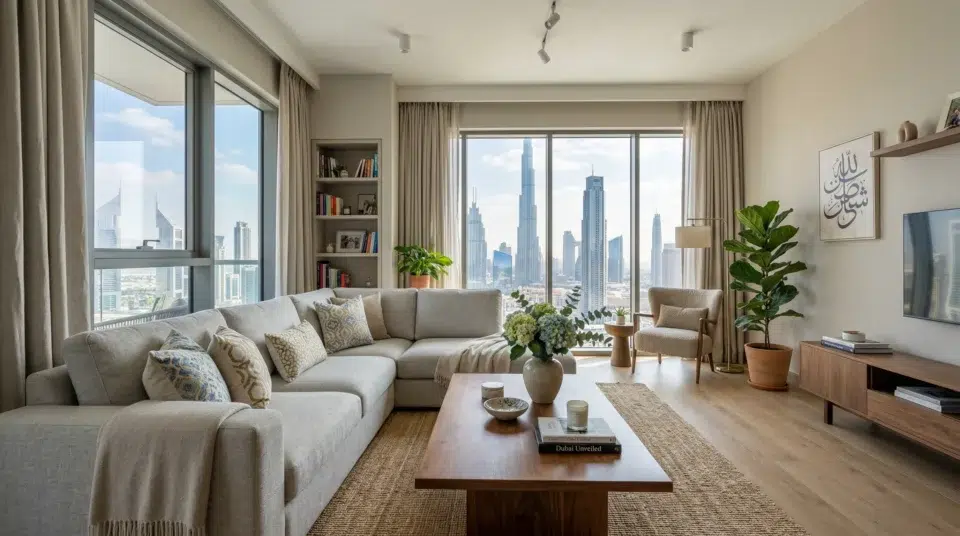
Where do you even begin when you’re staring at an empty living room? It’s a question we hear constantly — from newlyweds in a JVC apartment to families upgrading to a villa in Arabian Ranches. After 35 years and more than 70,000 families served across the UAE, the team at Karnak Home has seen every layout challenge, every style dilemma, and every budget constraint you can imagine. This guide distills that experience into a practical, honest roadmap for furnishing your Dubai living room the right way the first time.
Dubai living rooms come with a unique set of conditions that simply don’t apply in other parts of the world. You’re dealing with intense summer heat that affects material choices, open-plan layouts common in modern towers, traditional Majlis expectations in villas, and a genuinely multicultural aesthetic — families from dozens of countries all calling the UAE home and blending their tastes. Getting the furniture right here means understanding all of that, not just copying a Pinterest board.
Start With Your Space: Measuring Before Anything Else
The single most important thing you can do before spending a single dirham on furniture is measure your room properly. This sounds obvious, but it’s where the majority of living room mistakes begin. A sofa that looks reasonable in a showroom can dwarf a typical Dubai apartment living room, or look lost in a sprawling villa majlis.
Standard living rooms in Dubai apartments typically range from 18 to 30 square metres. In villa communities like Mirdif, Emirates Hills, or Al Furjan, ground-floor living and dining spaces often combine to 50 square metres or more. These two scenarios require completely different furniture strategies, and treating them the same is a recipe for a room that never feels quite right.
Start with a floor plan, even a simple one sketched on paper. Mark your windows, doors, air conditioning vents, and any fixed features like pillars or built-in shelving. Note where your main light source comes from. In many Dubai apartments facing east or west, afternoon glare is a real factor that affects where you want your seating positioned relative to your television.
How to Measure for a Sofa
Your sofa should leave at least 45–60 cm of clear walkway on each open side. If you’re placing a sofa opposite a TV unit, the ideal viewing distance is roughly 1.5 to 2.5 times the diagonal screen size. So for a common 65-inch television (165 cm diagonal), you want your seating positioned between 2.5 and 4 metres away. Most Dubai apartment living rooms fall comfortably within that range if planned correctly.
For an L-shaped or corner sectional — by far the most popular sofa style among UAE families we work with — allow at least 3 metres along the longer wall and 2 metres along the shorter return. In a room narrower than 3.5 metres, an L-shaped sectional will typically dominate too aggressively. In that case, a 3-seater sofa with a matching armchair gives you flexibility and breathing room.
Villa Living Rooms: Different Rules Apply
In larger villa spaces, the challenge flips. The room is big enough that furniture can get lost, and without proper planning you end up with a sparse, hotel-lobby feeling. Here, a generously sized corner sectional makes sense, often in a U-shape configuration for families who entertain. Coffee tables need to be proportionally larger — think 120–140 cm length rather than the 90 cm tables suited to apartments.
If your villa has a separate Majlis or formal sitting room, it warrants a distinctly different treatment from your main family living area. Traditional low seating, rich upholstery, and a formal arrangement around a central table remain the practical choice here and continue to reflect authentic UAE hospitality norms.
Choosing the Right Sofa for a Dubai Home
The sofa is the anchor of your living room. Everything else — the rug, coffee table, accent chairs, lighting — orbits around it. Getting this piece right matters more than any other single decision.
Fabric vs Leather: What Works in UAE Conditions
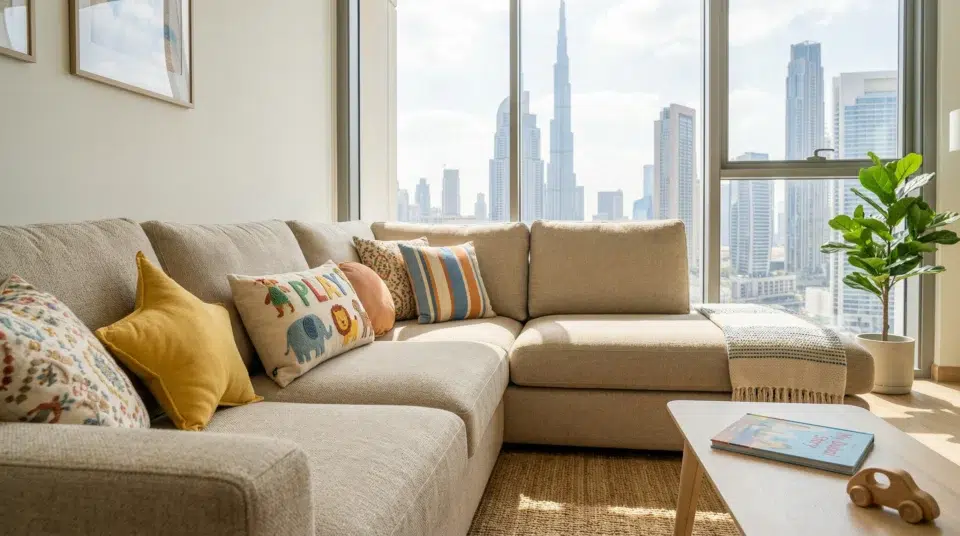
This is genuinely one of the most common questions we answer. The honest answer depends on how you live. Leather and faux-leather sofas feel cool to the touch initially but can become uncomfortable in Dubai’s summer humidity if your air conditioning is anything less than excellent. They are, however, significantly easier to wipe clean — a meaningful advantage for families with young children.
High-quality fabric sofas, particularly those in tightly woven polyester blends or performance fabric, have become the preferred choice for most Dubai families in recent years. They’re warmer and more comfortable in the cool months, they don’t crack or peel in dry air-conditioned environments the way cheaper faux leather does, and modern performance fabrics repel stains reasonably well. Look specifically for sofas described as featuring water-resistant or stain-resistant upholstery — these aren’t marketing terms, they reflect a genuine difference in fabric treatment that matters in a family home.
Pure natural linen and cotton sofas look beautiful but are more demanding maintenance-wise in the UAE’s dusty environment. They can work well if you’re disciplined about regular cleaning, but in a busy family home they tend to show wear and soil faster than performance blends.
Sofa Sizes and Configurations
For a typical 20–25 square metre Dubai apartment living room, a 3-seater sofa (220–240 cm length) or a compact L-shaped sectional (260 x 180 cm approximately) works well. Prices for a quality 3-seater sofa in Dubai start at around AED 2,500–3,500 for a solid mid-range option and rise to AED 6,000–12,000 for premium construction with better frame materials and higher-grade foam.
Corner sectionals for family villa living rooms are realistically priced from AED 4,500 at the entry level to AED 15,000+ for larger, better-constructed pieces. Be cautious of unusually cheap sectionals — the frame construction and foam density are where costs are genuinely cut, and a sofa that sags within two years is not a saving.
A Word on Sofa Frame Quality
After 35 years in this industry, our advice is simple: ask about the frame before you ask about the price. A sofa with a kiln-dried hardwood frame and high-density foam (28 kg/m³ or above) will last a decade of family use. A sofa with a softwood or particleboard frame and low-density foam may look identical in the showroom but will show its weakness within 18–24 months of regular use. Any honest furniture retailer should be able to tell you what’s inside their sofas. If they can’t, that tells you something.
Living Room Layout Principles That Actually Work
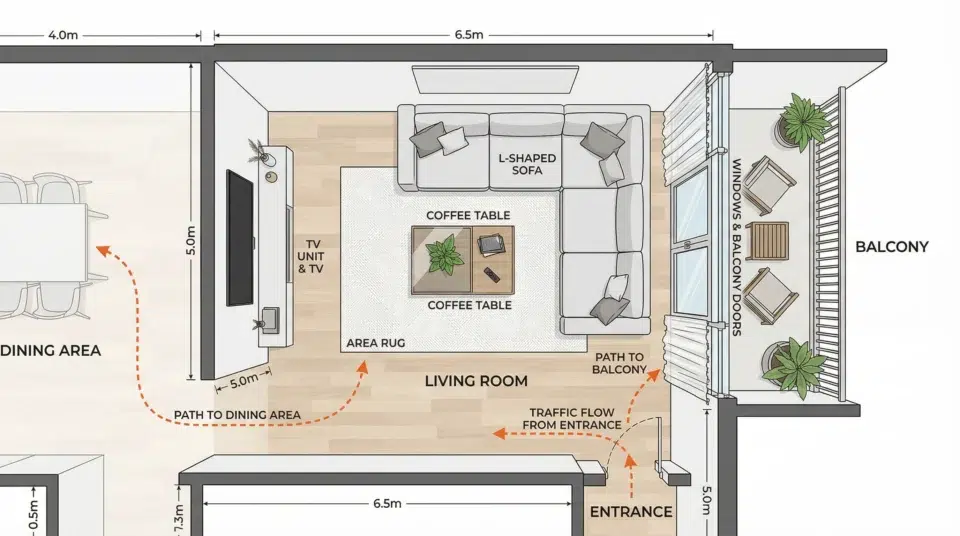
Furniture placement is where most living rooms succeed or fail before a single cushion is chosen. There are a few principles that apply reliably across the different home types we see throughout the UAE.
Anchor With a Rug
A rug defines your seating zone and prevents the living room from feeling like a furniture showroom. The most common mistake is buying a rug that’s too small — it ends up looking like a doormat in the middle of the room. In most Dubai living rooms, a rug of at least 200 x 290 cm is appropriate. For villa living areas, 240 x 340 cm or larger is more proportional.
The standard approach is to have all the front legs of your seating on the rug, with the back legs off. This connects the furniture to the rug without requiring an enormous size. Alternatively, in a large villa room, all legs on the rug creates a more formal, cohesive look.
TV Placement and Viewing Angles
In apartments with open-plan layouts — common in Dubai Marina, Business Bay, Downtown, and most newer developments — the television is typically mounted on the wall at the far end of the living space. Avoid placing the TV where afternoon sunlight hits the screen directly; this is a surprisingly common oversight in west-facing apartments and results in screens that are unusable between 3–7 pm.
A TV unit or media console grounds the screen and provides essential storage. For a standard apartment living room, a TV unit of 150–180 cm in width is proportional. Villa living rooms can accommodate 200–240 cm media consoles that also integrate display shelving.
Traffic Flow
Leave at least 90 cm of clear pathway between the sofa and any adjacent furniture or wall. In open-plan homes, the living room typically flows into a dining area, and that transition needs to feel natural. Avoid pushing all furniture against walls — this is a common instinct but it typically makes rooms feel smaller and less inviting, not larger.
Style Directions That Work in UAE Homes
Dubai is genuinely one of the most style-diverse cities in the world when it comes to interiors. That said, a few aesthetic directions consistently work well with UAE architecture, climate, and lifestyle.
Modern Arabic: The Most Timeless Choice
Modern Arabic or Gulf Contemporary design blends clean contemporary lines with warm materials — wood tones, brass accents, geometric textiles, and a palette drawn from the natural UAE landscape: sandy neutrals, warm whites, terracotta, sage green. This style works in virtually every type of UAE home, from a compact apartment in Jumeirah Village Circle to a large villa in Khalifa City, Abu Dhabi.
Furniture choices that support this direction include low-profile sofas in warm neutral upholstery, solid wood coffee tables, and accent chairs with subtle embroidered or woven cushion covers. The result feels distinctly at home in the UAE without being overly traditional.
Scandinavian-Minimalist
Clean lines, light wood finishes, functional furniture, and a light neutral palette. This works particularly well in apartments where maximising the sense of space is a priority. It’s forgiving in smaller rooms because it avoids visual clutter. The practical note for UAE homes: in very sunny apartments, light-coloured upholstery can fade over time if exposed to direct sunlight, so UV-filtering window film is worth considering alongside your furniture.
Contemporary with Warm Accents
A flexible middle ground that most UAE families settle into naturally. A grey or warm white sofa, a dark walnut coffee table, textured cushions, a floor lamp, and a few considered accessories. This direction allows personal expression without committing to a rigid aesthetic, and it ages well as tastes evolve.
Must-Have Living Room Pieces and Honest Pricing
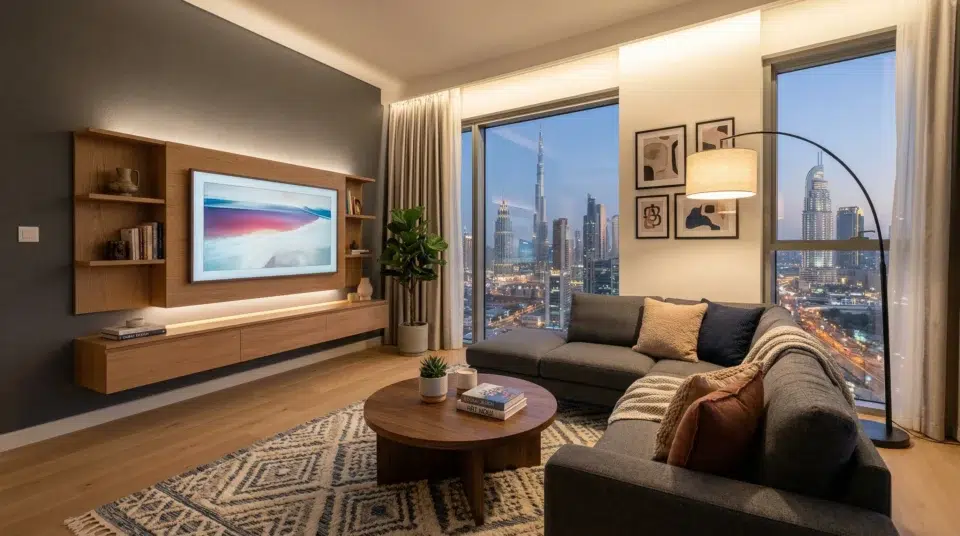
Beyond the sofa, a well-furnished living room needs a handful of supporting pieces. Here’s an honest look at each one.
Coffee Table
The coffee table should be roughly half to two-thirds the length of your sofa. For a 220 cm sofa, that means a coffee table of 100–140 cm. Round coffee tables work well in smaller rooms where sharp corners are a concern for young children. Solid wood tables are the most durable choice for family use; tempered glass looks elegant but shows fingerprints constantly and is a practical frustration in homes with young children. Expect to pay AED 600–2,500 for a quality coffee table in Dubai.
TV Unit / Media Console
A ground-mounted TV unit provides more visual stability and storage than a floating shelf. It also conceals cables more practically. Choose a depth of at least 40 cm to accommodate media equipment properly. Prices range from AED 800 for a straightforward flat-pack option to AED 3,500–6,000 for solid wood or premium engineered wood with soft-close doors.
Accent Chairs
A pair of accent chairs flanking the sofa or positioned across from it creates conversation groupings and visual balance. Single-seater chairs with clean frames in a complementary fabric work well and don’t need to match the sofa exactly — a slight contrast often looks more considered. Budget AED 700–2,500 per chair for good quality.
Storage and Display
Living rooms accumulate things: remotes, books, children’s toys, phone chargers. A sideboard or media unit with closed storage keeps the room manageable. Sideboards between 140–180 cm in length are versatile and serve as both storage and a surface for decor. Price range: AED 1,200–4,000 depending on material and construction.
Lighting
This is consistently overlooked in UAE homes. Overhead lighting alone produces flat, unflattering light. A floor lamp beside the sofa, a table lamp on a sideboard, and where possible, dimmable lighting transforms the evening atmosphere of a living room. This is a modest investment — AED 200–800 for a quality floor lamp — that makes a disproportionate difference.
Common Mistakes to Avoid When Furnishing a Dubai Living Room
Mistake 1: Buying Furniture Before Measuring
This causes more returns and regrets than anything else. Even if you’re confident about the size, measure the doorways and elevator dimensions if you’re in an apartment. Many Dubai apartment buildings have standard elevator dimensions of around 100–120 cm in width, and a large sofa may need to be partially disassembled to get it into the unit. A reputable retailer will discuss delivery access with you beforehand.
Mistake 2: Choosing a Rug That’s Too Small
As mentioned above, this is nearly universal. When in doubt, go larger. A rug that’s slightly too large can be managed; a rug that’s too small makes the entire room feel disconnected and slightly off in a way that’s hard to articulate but immediately visible.
Mistake 3: Buying Everything at Once to Match
Rooms that are purchased as a single “set” — sofa, rug, coffee table, TV unit all from the same collection — often feel stiff and impersonal. The most appealing living rooms mix textures and slightly varied tones within a consistent palette. Buy your anchor pieces (sofa, rug) first, then build around them over time.
Mistake 4: Ignoring the Effect of Dubai’s Climate on Materials
Solid wood furniture can shift slightly with the dramatic humidity swings between outdoor summer conditions and heavily air-conditioned indoor environments in the UAE. This is rarely a structural problem but can cause slight warping or gaps in lower-quality pieces. Choose furniture made from properly dried, kiln-treated solid wood or quality engineered wood for stable performance in UAE conditions. Cheap MDF with a thin veneer tends to delaminate at the edges within a few years in humid conditions.
Mistake 5: Underestimating Maintenance Needs
White and very pale upholstery looks beautiful in showrooms and in photography. In a family home in Dubai — with dust, children, and frequent entertaining — it becomes a source of constant anxiety. Choose colours and fabrics you can actually live with. A mid-toned warm grey, beige, or sand sofa is forgiving, ages well, and can be refreshed easily with new cushion covers.
Realistic Budget Guide: What to Expect in AED
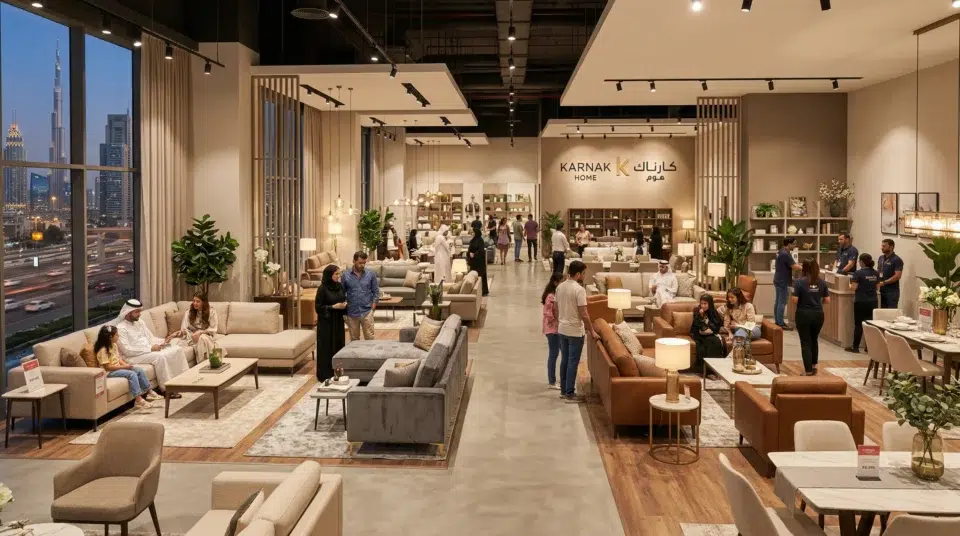
Furnishing a living room in Dubai is possible at almost every budget. Here’s an honest breakdown of what you get at different price points.
For a complete apartment living room — sofa, coffee table, TV unit, rug, and a floor lamp — a realistic mid-range budget is AED 8,000–15,000. This gets you quality construction that will last five to eight years with reasonable use and care.
At AED 5,000–8,000, you can furnish the same room acceptably, but you’ll be making compromises on materials and construction. This is a realistic starting point for a first apartment, with the expectation that pieces will be upgraded over three to five years.
At AED 15,000–30,000, you’re into premium territory: solid wood frames, high-density foam, better upholstery fabrics, and pieces that will genuinely last a decade or more. For a family villa’s main living space, this is a sensible target investment.
For a villa living room with larger furniture requirements, the full setup budget rises proportionally — expect AED 20,000–50,000 for a well-furnished, high-quality space. This remains significantly more affordable than equivalent quality in most European or North American markets.
Expert Tips From 35 Years of Furnishing UAE Homes
These are the practical observations we’ve gathered from more than three decades and 70,000+ families. They’re not design rules — they’re real patterns from real homes.
Think about your air conditioning vents before placing sofas. Positioning a sofa directly under a vent creates cold draughts on seated occupants — uncomfortable in winter months when indoor temperatures can be over-cooled, and prone to dust accumulation on upholstery directly below the vent.
Buy sofa cushion covers in pairs as backup. Keep a spare set of cushion covers in a storage drawer. Sun fading in Dubai — even through glass — affects upholstery over time, and having replacements extends the life of the sofa visually by years.
Consider blackout curtains as part of your living room plan. They affect furniture placement, light management, and the entire feel of the room. Plan them alongside your furniture, not after.
For families with children under five, avoid glass-topped tables entirely. The safety risk is real. Round wooden coffee tables or padded ottomans as coffee tables are practical solutions that don’t require constant vigilance.
Test sofa comfort with the people who will actually use it. Sit on it for five minutes. Lie on it. Have your partner or your parents try it. Comfort preferences vary significantly, and a sofa one person finds perfect another finds too firm or too deep.
Don’t overlook the back of the sofa. In many Dubai apartment layouts, the sofa faces away from the entrance and the back is clearly visible. A clean, well-finished sofa back matters in open-plan spaces.
Give yourself a few weeks before finishing accessories. Lay out your core furniture, live with it briefly, then buy cushions, throws, and decorative pieces. You’ll make much better choices once you can see how the room actually lives and where it naturally draws the eye.
Conclusion: Making Your Living Room Decision
Furnishing a living room in Dubai is genuinely one of the more considered purchases most families make. The space is used daily, it reflects how you live and host, and the right furniture makes a real difference to how your home feels for years. The wrong choices — and they’re usually avoidable ones — create expense and frustration.
The principles that matter most are simple: measure first, anchor with the sofa, choose materials suited to how you actually live, and build the room gradually rather than all at once. Plan for Dubai’s specific conditions — the climate, the light, the layout realities of both apartments and villas — and you’ll avoid the most common mistakes.
At Karnak Home, we’ve been helping UAE families with exactly this since 1988. Our showroom carries a wide range of sofas, TV units, coffee tables, accent chairs, and every other piece covered in this guide — across styles from modern minimalist to contemporary Arabic, and at pricing that covers everything from first-apartment practicality to long-term quality investment.
Key Takeaways:
- Measure your room and doorways before purchasing anything. Know your dimensions precisely.
- The sofa is your anchor — invest in quality construction (frame and foam) over superficial aesthetics.
- Choose materials suited to your actual lifestyle, not the showroom ideal. Performance fabrics and solid or kiln-dried wood suit UAE conditions and family use best.
- Rug sizing, lighting, and traffic flow are as important as the furniture pieces themselves.
- Budget AED 8,000–15,000 for a complete, quality apartment living room setup as a realistic mid-range target.
Ready to Furnish Your Dubai Living Room?
Browse our full living room furniture collection online at karnakhome.com, or visit our Dubai showroom to see the pieces in person, test the comfort, and speak with our team. Whether you’re furnishing a one-bedroom apartment in Dubai Marina or a five-bedroom villa in Jumeirah, we can help you find the right pieces at the right price. Our team is available to advise on layout, sizing, and style — with no pressure and no upselling, just honest guidance from people who’ve been doing this for 35 years.
Shop Online: karnakhome.com Visit Our Showroom: [1 Block C Office 110C – near Miracle Garden – Al Barsha South Third – Al Barsha South – Dubai] Expert Advice: [+971525554207]
Related Articles:
- How to Choose the Right Sofa Size for Your UAE Apartment
- Villa vs Apartment Furniture: What Changes and What Doesn’t
- Bedroom Furniture Guide for Dubai Homes: Beds, Wardrobes & Storage
- How to Create a Majlis That Feels Both Traditional and Modern
Ready to Furnish Your Dubai UAE Living Room? Explore Our Full Living Room Collections
Now that you know the right layout, sofa, and must-haves for your villa or apartment browse our complete living room range below. UAE-made, climate-ready, built for family gatherings, open-plan spaces, and Majlis traditions. Free delivery & installation across all seven emirates.
- → All Living Room – Complete collection for villas & apartments
- → All Sofas – Modern to classic, starting AED 999
- → Corner & L-Shaped Sofas – Space-saving for large open-plan villas
- → 3-Seater Sofas – Classic family centerpiece
- → Coffee Tables & Center Tables – Matching pieces to anchor your layout
- → TV Media Units – Storage & display for your setup
- → Majlis Furniture – Traditional UAE seating for family & guests
- → Bookcases & Display Units — Add storage & personality
- → Consoles & Buffets — For entryways & dining flow
Special March Offer: Up to 50% off living room pieces + free delivery & installation limited time.
WhatsApp for Free Layout Advice & Quote
Shop All Living Room Now →