
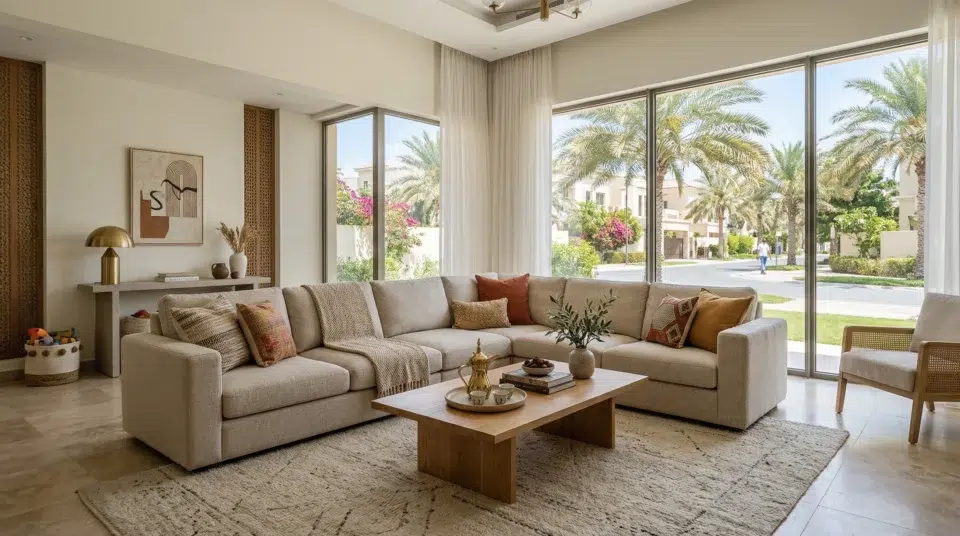
Have you ever fallen in love with a sofa in a showroom, ordered it, waited three weeks for delivery — and then watched four delivery men struggle to get it through your front door? Or placed a dining table that looked perfectly reasonable on a website, only to discover your family has to shuffle sideways to reach their chairs?
You’re not alone. In 35 years serving over 70,000 UAE families across Dubai, Abu Dhabi, Sharjah, and beyond, this is one of the most common and most avoidable problems we see at Karnak Home. The good news: with the right measurements and a basic understanding of how UAE homes are actually laid out, you can get it right every single time — before anything is ordered.
This guide gives you the exact dimensions, clearance rules, and room-by-room advice that our in-store consultants share with families every day. No guesswork. No returns. Just furniture that fits and feels right from day one.
Understanding UAE Home Layouts: Apartments vs. Villas
Before we talk specific measurements, it helps to understand why furniture sizing in the UAE has its own particular challenges — and why what works in a European or South Asian home doesn’t automatically translate here.
UAE residential spaces broadly fall into two very different categories: apartments (typically in high-rises across JBR, Business Bay, Al Reem Island, Al Nahda, Deira, and similar urban areas) and villas (found in communities like Arabian Ranches, Al Furjan, Mirdif, Al Ain suburbs, and Khalifa City in Abu Dhabi). These two categories have fundamentally different space constraints, and the furniture choices that serve one rarely suit the other without adjustment.
Apartments in the UAE tend to have open-plan living-dining areas ranging from about 25 to 45 square metres in a standard 1BHK, up to 55–70 square metres in a 2BHK. Ceilings are typically 2.7 to 3 metres high. Doorways, and critically, lift dimensions, are the hidden constraint — standard lifts in most Dubai residential towers have a depth of 1.4 to 1.6 metres and a width of around 1.1 to 1.3 metres. That immediately rules out certain oversized furniture unless it disassembles or comes through the emergency stairwell.
Villas offer considerably more floor area — a typical 3-bedroom townhouse in a community like Damac Hills will have a living room of 40–60 square metres — but they come with their own challenge: double-height spaces and large open-plan layouts can make modestly sized furniture look lost and under-scaled.
Understanding which category your home falls into is the single most important step before you start shopping.
Living Room Furniture Sizes: Getting the Sofa Right
The sofa is almost always the first and most consequential furniture decision in any home. Get it right and the rest of the room falls into place. Get it wrong and no amount of clever styling rescues it.
Standard Sofa Dimensions for UAE Apartments
For a typical UAE apartment living room — say a 4 x 5 metre open-plan space — a 3-seater sofa running between 200 cm and 220 cm wide is usually the sweet spot. Go beyond 230 cm and you’re eating into circulation space. Go below 185 cm and the sofa can look timid against a large-format TV wall.
Depth matters as much as width. UAE families tend to prefer a generous seat depth for comfort during long evenings — around 90 to 95 cm total depth (seat depth of 55–60 cm) is comfortable for most adults without overwhelming a moderate-sized room. Anything beyond 100 cm total depth in an apartment under 40 square metres starts creating problems with walkways.
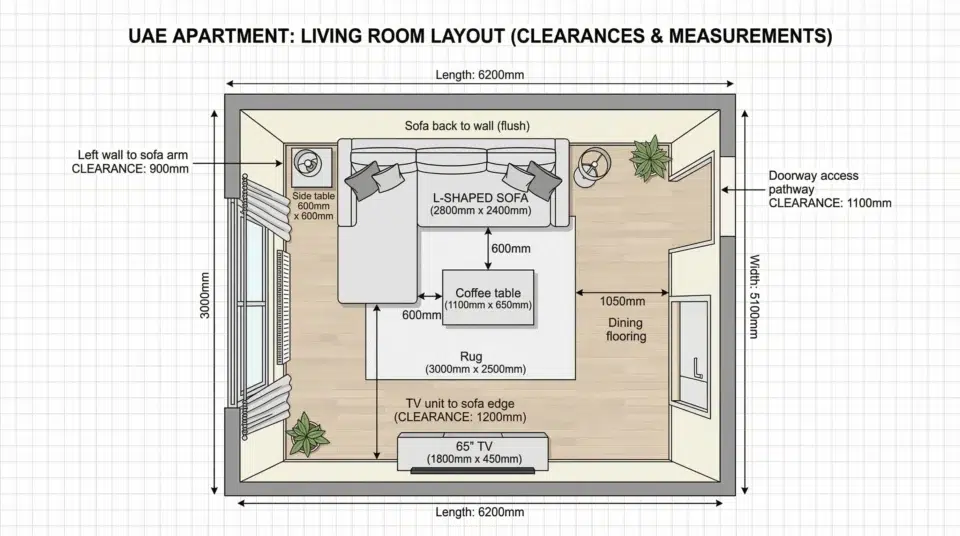
A practical rule: leave a minimum of 90 cm of clearance between the front edge of your sofa and the facing wall or TV unit. 45 cm is the absolute minimum to walk through; 90 cm is comfortable for a household with children. If you’re placing a coffee table between the sofa and TV wall, the table should sit 35–45 cm from the sofa’s front edge — close enough to reach without leaning uncomfortably far forward.
L-Shaped Sofas in UAE Homes: When They Work and When They Don’t
L-shaped or sectional sofas are enormously popular with UAE families, and for good reason: they create a natural gathering space and work well for both family evenings and hosting guests. But they’re also the most frequently mis-sized piece of furniture we see.
A compact L-sofa — around 240 cm on the long side and 160 cm on the short return — can work beautifully in an apartment living room of 4 x 4.5 metres or larger. A large L-sofa running 290 cm x 200 cm belongs in a villa, not an apartment. The mistake families make is measuring the longest wall and assuming the sofa will fit along it, forgetting that the return section extends into the room and blocks traffic flow.
The corner placement rule: If you’re putting an L-sofa into a corner, you need at least 50 cm of clearance on both open sides for comfortable movement, and at least 3 metres of open floor space in front of the sofa to avoid the room feeling cramped.
Sofa Heights and UAE Interiors
Standard sofa heights in the UAE market run between 80 and 90 cm to the top of the back cushion. Low-profile sofas (65–75 cm) look striking in villa spaces with high ceilings but can feel awkward in apartments with standard 2.7 m ceilings where the visual proportions call for something with a little more presence.
If your living room has a feature wall or large artwork above the sofa, aim for a sofa back height of at least 85 cm so the furniture anchors the wall properly rather than appearing to float beneath it.
Coffee Tables, Side Tables, and Clearance
Coffee table sizing is simple once you remember one rule: the table should be roughly two-thirds the length of your sofa, and its height should be within 5 cm of your sofa’s seat height (typically 40–45 cm). For a 220 cm sofa, a coffee table around 130–140 cm long is ideal. Too short and it looks like an afterthought; too long and it creates an obstacle course.
Bedroom Furniture Sizes: Beds, Wardrobes, and Breathing Room
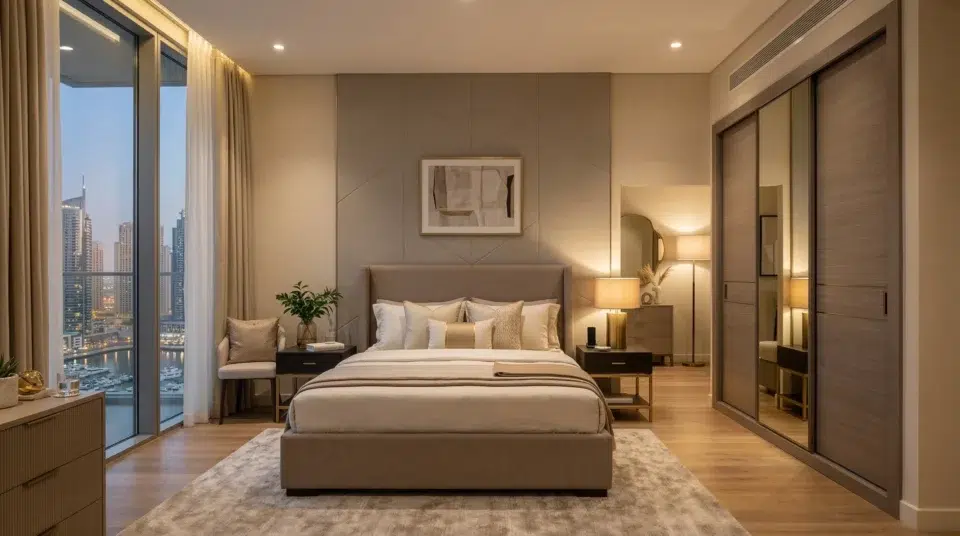
Bedrooms in UAE apartments are often the most constrained spaces in the home — the master bedroom in a typical 1BHK in Dubai Marina or JVC might be only 3.2 x 3.8 metres. Getting the bed size, wardrobe depth, and clearance right is essential.
Bed Sizes in the UAE: What the Standards Actually Mean
UAE bed sizing generally follows either European or US standards, and this matters because the wrong mattress size ends up costing extra and fitting poorly. Here’s the practical guide:
A Single bed is typically 90 cm x 200 cm — right for a child’s room or a guest room in a compact apartment. A Queen bed runs 150 cm x 200 cm and is the most versatile size for UAE apartments: it gives two adults comfortable sleeping space while allowing functional clearance in a 3.2-metre-wide room. A King bed is 180 cm x 200 cm, and an Emperor or Super King hits 200 cm x 200 cm — firmly in villa-master-bedroom territory.
The clearance rule for bedrooms is 60 cm minimum on all sides you walk past. That means a king bed (180 cm wide) in a room only 3.0 metres wide leaves you just 60 cm on one side — technically functional, but uncomfortably tight. In a room that narrow, a queen is the right call. For a room of 3.6 metres or wider, a king works comfortably.
Wardrobes: Depth Is the Overlooked Dimension
Built-in wardrobes in UAE apartments are usually 55–60 cm deep, and freestanding wardrobes from most furniture retailers match this standard. This is worth knowing because a wardrobe that’s only 45 cm deep — common in some imported flat-pack ranges — won’t hang clothes front-to-back without folding shoulders; garments crease and the rod placement feels awkward.
Sliding door wardrobes are very popular in UAE bedrooms because they don’t require swing clearance in front — particularly valuable in compact rooms. Hinged door wardrobes need 50–60 cm of clearance in front of them to open fully, which in a 3.0 x 3.5 m room can be genuinely problematic.
Width-wise, a practical three-section wardrobe for a couple runs 180–240 cm wide. A 150 cm wardrobe serves one person adequately. For a 300 cm wardrobe in a villa master bedroom, you have excellent storage flexibility — consider a mix of hanging, shelving, and drawer sections.
Bedside Tables and Bedroom Circulation
Bedside tables should be within 5 cm of the mattress top height — typically 50–60 cm tall for a standard UAE bed frame and mattress combination (bed frame 25–30 cm + mattress 20–25 cm = sleeping surface at 45–55 cm). A table that sits too far below the mattress means fumbling for your phone in the dark; too far above looks proportionally odd.
Standard bedside table widths run 45–60 cm. In a very compact room, wall-mounted floating shelves (30 cm deep, 40–50 cm wide) do the job without occupying floor space.
Dining Room Furniture: Tables, Chairs, and the Space Between Them
The Dining furniture is where families in the UAE most often underestimate the space required , not for the table itself, but for the chairs pulled out and the walking room behind them.
Dining Table Sizes for UAE Families
A 4-seater dining table typically runs 80–100 cm wide and 140–160 cm long. A 6-seater extends to 160–200 cm long. An 8-seater needs 200–240 cm minimum length.
For width, 80 cm is tight but workable; 90–100 cm is comfortable for place settings without elbowing your neighbour.
In UAE family culture, the dining table is often used for more than eating — homework, board games, Ramadan Iftar with extended family. This is a strong argument for sizing up one category: if you’re a family of four but regularly host or have children who use the table for school work, a 6-seater at 180 cm long will serve you far better than a perfectly proportioned 4-seater.
Extendable dining tables are genuinely useful here. A table that seats 6 in everyday configuration and extends to seat 8–10 for Eid gatherings is a practical investment for UAE families who host regularly.
Clearance Rules That Most Families Get Wrong
Here’s the measurement most people skip: you need 90 cm of clearance between the edge of the dining table and the nearest wall or furniture when the chairs are pulled out. A chair in use extends roughly 50–55 cm from the table edge; someone walking behind a seated person needs another 35–40 cm. That adds up to 90 cm minimum. In a dedicated dining room of 3.5 x 4 metres, a 6-person table works comfortably. In a 3 x 3.5 metre dining area, a 4-person table is your practical maximum.
Dining Chairs: Height Matching Matters
Standard dining table height is 75–76 cm. Standard dining chair seat height should be 44–47 cm, leaving a 28–30 cm gap between seat and tabletop — the ergonomic sweet spot. Buy your table and chairs together, or verify dimensions before mixing and matching from different ranges.
Kids’ Room Furniture: Sizing for Safety and Growing Space
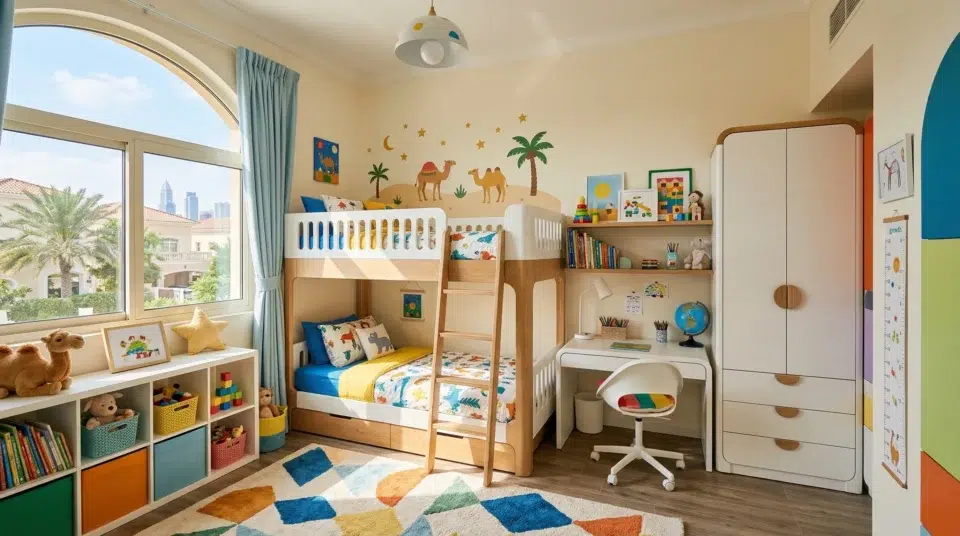
Children’s bedrooms in UAE apartments range from genuinely compact (2.8 x 3.0 metres in an older building in Sharjah or Deira) to generous (3.5 x 4.0 metres in a villa). The approach to furnishing them should reflect not just current needs but the next 3–5 years of your child’s growth.
A single bed for a child under 10 is perfectly appropriate at 90 x 200 cm. For children 10 and above, a twin-single at 100 x 200 cm or moving to a semi-double at 120 x 200 cm gives more useful life before it’s outgrown. Bunk beds for shared rooms — very common in UAE villas with two or three children — need a ceiling height of at least 2.4 metres above the upper mattress surface for safe use; most UAE apartments and villas meet this requirement comfortably with standard 2.7–3.0 m ceilings.
Study desks for children should be height-adjustable where possible — a desk fixed at 72–75 cm (adult height) is too tall for a 7-year-old. Look for desks in the 55–75 cm adjustable range that can grow with the child. A depth of 60 cm gives space for a laptop, books, and a small lamp without crowding.
Home Office Furniture: Fitting Work Into UAE Homes
Since 2020, the home office has gone from a luxury to a genuine room requirement for many UAE families. Whether you have a dedicated study, a bedroom corner, or a converted storage space, the dimensions here matter for productivity and comfort.
A functional desk needs a minimum depth of 60 cm and a width of 100 cm for a single-monitor setup. Dual-monitor or design work calls for 140–160 cm width. Height should be 72–75 cm for standing adult use, or adjustable if multiple family members share the space.
An office chair, pulled out and reclined, occupies roughly 60–70 cm of depth behind the desk edge. Factor this into your planning — many families position a desk against a wall without accounting for the chair’s swing radius, then find themselves constantly bumping the wall or wardrobe behind them.
For a compact home office corner in a bedroom, the minimum footprint you can realistically work with comfortably is 100 cm wide x 120 cm deep (including the chair). Anything smaller is a compromise that tends to cause people to abandon the space.
Common Mistakes UAE Families Make (And How to Avoid Them)
After 35 years and tens of thousands of deliveries, we’ve seen the same sizing mistakes repeat across every emirate. Here are the ones worth knowing before you order anything.
Mistake 1: Measuring the Room But Not the Doorways and Lift
The most expensive mistake is ordering a sofa or bed frame that physically cannot get into your home. Measure your apartment’s front door (width and height), the corridor width, any turns in the corridor, the lift internal dimensions, and — particularly in older buildings in Deira, Sharjah, or Ajman — the stairwell width if the lift is small.
A standard UAE apartment lift is approximately 110–130 cm wide and 140–160 cm deep. A standard front door is 90–100 cm wide. A three-seater sofa at 220 cm long and 90 cm deep needs to navigate these dimensions; it can usually be tilted diagonally, but anything beyond 240 cm becomes genuinely difficult without disassembly.
Mistake 2: Buying for the Empty Room, Not the Lived-In Room
A freshly painted empty room looks enormous. Families routinely size up their furniture by one category because the space seems to invite it. Remember that a UAE family’s living room also contains a TV unit, rugs, pendant lighting, plants, and the movement of children and adults. Size for the lived-in room, not the empty one.
Mistake 3: Forgetting Clearance Space Entirely
We’ve covered the specific clearances above — 90 cm behind dining chairs, 60 cm along the side of a bed, 45 cm minimum walkway. The general principle: furniture placement that looks fine in a 2D floor plan sketch can feel claustrophobic in three dimensions. Always verify clearance after placing furniture on your floor plan, not just total room occupancy.
Mistake 4: Choosing Sofa Depth Based on Showroom Feel, Not Home Proportions
A 100 cm deep sofa feels wonderfully luxurious to sink into in a 500 square metre showroom. In a 4 x 4.5 metre apartment living room, that same sofa claims nearly a quarter of the floor depth and creates cramped circulation. Sit in sofas, yes — but also note the dimensions on the spec sheet and map them to your actual room before you commit.
Mistake 5: Not Accounting for UAE Climate in Material Choices
This isn’t a sizing mistake, but it’s one that costs UAE families money every few years. Solid wood furniture expands and contracts with humidity changes. In UAE apartments with air conditioning running intensively from May to October, interior humidity fluctuates significantly. Furniture with real wood veneer over engineered board tends to be more dimensionally stable than solid wood in these conditions. Leather softens and creases more aggressively in heat. These are worth knowing when comparing options at similar price points.
Our Expert Tips from 35 Years Of Furnishing UAE Homes
1. Use masking tape on the floor first. Before ordering any large piece, mark out its exact footprint on your floor with masking tape. Live with it for 24 hours. Walk around it. See how it feels in actual use, not just on paper.
2. Photograph your empty room with a reference object. Place something of known height — a standard door, a 30 cm ruler held vertically — in your room photo and photograph it. This gives you an accurate sense of scale when browsing furniture online.
3. Modular is worth considering for apartments. Modular sofas, extendable dining tables, and beds with storage drawers underneath are more expensive upfront but give UAE apartment dwellers flexibility that fixed furniture never can.
4. For villa living rooms, size up your rug first. In large open-plan villa spaces, the rug defines the furniture zone. A rug that’s too small makes even correctly proportioned furniture look unanchored. For a villa seating arrangement, the rug should extend at least 20–30 cm beyond the front legs of your sofa on all sides.
5. Check the spec sheet, not just the displayed dimensions. Some retailers show overall sofa dimensions including armrests that aren’t fully representative of seat space. Always check seat width, seat depth, and back height separately.
6. For Ramadan and hosting culture, think about chair stacking or folding options. UAE families often host large Iftar gatherings that require temporary seating. A dining set that accommodates 6 day-to-day but allows 4 additional folding chairs to be placed comfortably is a more practical buy than a fixed 10-seater that dominates the room 11 months of the year.
7. Wardrobe delivery is where assembly quality matters most. Large wardrobes for UAE bedrooms should ideally be assembled in the room — not in a corridor and angled in. Ensure your retailer offers in-room assembly as standard. At Karnak Home, all bedroom furniture deliveries include room-of-choice placement and full assembly as part of the standard service.
8. If you’re unsure, visit the showroom with your floor plan. Bring a printout or sketch of your room dimensions. Our consultants can walk you through the entire range with your specific space in mind and save you significant time, money, and the stress of returns.

Pricing Guidance: What to Expect in AED
Understanding what furniture costs in the UAE helps set realistic expectations and avoid being either overcharged or tempted by quality compromises.
For sofas, a durable 3-seater in performance fabric suitable for UAE family life (washable, fade-resistant) typically runs AED 2,500–5,500 from a reputable retailer. A large L-shaped sectional in a quality fabric ranges from AED 4,500 to AED 9,000 depending on size and material. Premium leather or Italian-fabric sofas go higher; budget flat-pack options go lower but generally don’t hold up to UAE conditions (heavy air conditioning, dusty environment, active children) beyond 3–4 years.
For beds, a solid queen-size bed frame with a decent headboard runs AED 1,800–4,500. King frames start around AED 2,500 and go up to AED 8,000+ for premium upholstered designs. A quality mattress is a separate investment: a good UAE-suitable mattress (medium-firm is the most broadly comfortable for most people) runs AED 1,500–4,000 for queen size.
Dining sets (table + 6 chairs) range from AED 2,500 for entry-level solid wood or MDF options to AED 8,000–15,000 for solid hardwood or marble-topped sets. The mid-range — AED 4,000–7,000 — tends to deliver the best balance of durability and value for UAE family use.
Wardrobes (2 or 3-door sliding) run AED 1,800–6,500 depending on size, material, and interior configuration. Adding soft-close runners, interior lighting, or premium mirror panels adds cost but meaningfully improves daily usability.
Conclusion: For Making Your Decision
Furniture sizing isn’t the most glamorous part of decorating your home — but it’s the part that determines whether your home actually works or just looks good in photos. A correctly sized sofa in a Dubai apartment, a queen bed with proper bedroom clearance in a JVC flat, a dining table that fits your family’s actual lifestyle — these are the decisions that you live with every day for years.
The key insight from three and a half decades of helping UAE families is this: most sizing mistakes come not from lack of information but from not taking the measurements seriously before falling in love with a piece. Measure your rooms, measure your doorways, mark your floors with tape, and let the dimensions guide your shortlist before your taste takes over.
Key Takeaways:
- Always measure doorways, corridors, and lift dimensions before ordering — not just room dimensions
- Allow 90 cm clearance behind dining chairs, 60 cm along the side of beds, and 35–45 cm between sofa and coffee table
- In UAE apartments, queen beds and 200–220 cm sofas are usually the practical maximum; size up only in rooms that genuinely support it
- Extendable dining tables and modular sofas offer genuine flexibility for UAE family hosting culture
- UAE climate conditions — humidity swings with intense AC use — should influence material choices alongside aesthetics
Ready to Find Furniture That Actually Fits?
At Karnak Home, every piece in our showroom is displayed with dimensions clearly marked, and our consultants are trained specifically to help you match furniture to your actual space — not just to what looks good on a display floor. Bring your room dimensions, your floor plan sketch, or even just your questions. We’ve helped over 70,000 UAE families get this right, and we’re happy to help you do the same.
Shop Online: karnakhome.com Visit Our Showroom: Karnak Home, Sheikh Zayed Road, Dubai, UAE Speak to an Expert: Call or WhatsApp for sizing advice
Related Articles:
- How to Choose the Right Sofa for Your UAE Home
- Bedroom Design Ideas for Dubai Apartments: Small Space Solutions
- Dining Room Furniture Guide: Styles, Materials, and What Lasts in the UAE
- Kids’ Room Furniture Safety Guide: What UAE Parents Should Know
Ready to Find Furniture That Actually Fits Your UAE Home? Explore Our Collections
Now that you have the exact sizes, clearance rules, and room-by-room advice for your apartment or villa browse our full range below. UAE-made, built for real family life, open-plan spaces, and our climate. Free delivery & installation across all seven emirates.
- → All Living Room – Sofas, coffee tables, TV units, majlis furniture
- → All Sofas – From 2-seater to L-shaped, starting AED 999
- → Corner & L-Shaped Sofas – Ideal for large villa open-plan living rooms
- → Coffee Tables & Center Tables – Matching pieces to anchor your layout
- → TV Media Units – Storage & display for your setup
- → All Bedroom – Beds, wardrobes, nightstands, dressing tables
- → Wardrobes – Fitted & freestanding storage
- → Kids Furniture – Beds, bunk beds, study desks
- → Mattresses – Pocket spring, memory foam, latex for comfort
Special March Offer: Up to 50% off selected furniture + free delivery & installation limited time.
WhatsApp for Free Size & Layout Advice
Shop All Furniture Now →