
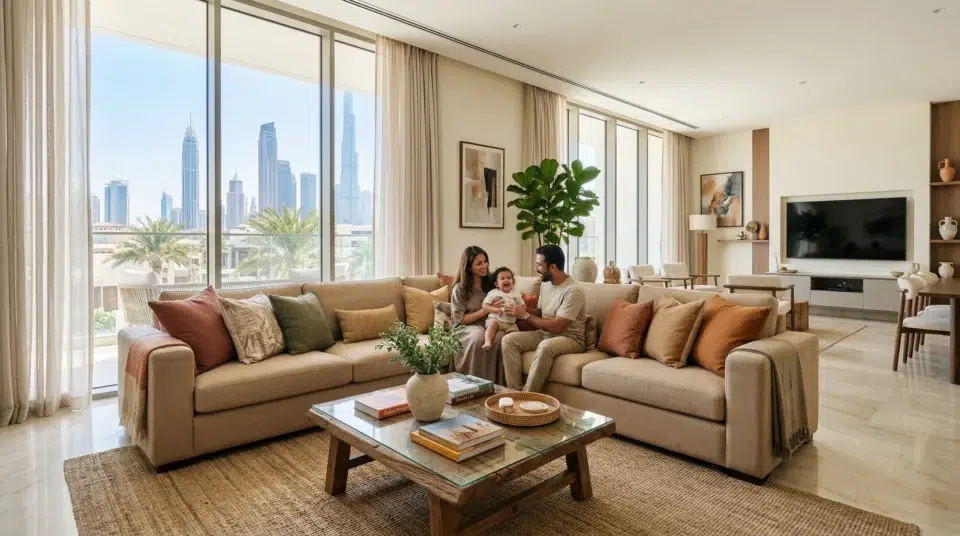
Buying a sofa should be exciting. But for most families in Dubai, it quickly becomes overwhelming — too many options, confusing sizing, materials you’ve never heard of, and price ranges that vary wildly from one shop to the next. After 35 years and more than 70,000 families served across the UAE, we’ve heard every version of this frustration at Karnak Home. A customer in Mirdif who bought the wrong size for her villa majlis. A young couple in JVC who chose leather — and regretted it the moment summer hit. A family in Sharjah who stretched their budget on a “luxury” piece that started pilling within a year.
This guide exists so none of that happens to you. We’re going to walk through everything — sizing, materials, shapes, budgeting in AED, and the specific lifestyle factors that make buying a sofa in the UAE different from anywhere else in the world. No sales pitch. Just the honest guidance we give customers who walk into our showroom and ask: “What should I actually get?”
Understanding the UAE Home: Why Sofa Shopping Here Is Different
Dubai isn’t London or New York. The way we live here — the climate, the home layouts, the family culture — has a direct impact on what makes a great sofa versus a disappointing one, and those differences are worth understanding before you spend a single dirham.
The first factor is scale. UAE homes, particularly villas in areas like Arabian Ranches, Jumeirah Village Circle, Damac Hills, and Mirdif, tend to have large, open-plan living areas. A sofa that looks substantial in a showroom can disappear into a 500 sq ft majlis. Apartments in Downtown Dubai, Dubai Marina, or Business Bay, on the other hand, have more compact living spaces where an oversized sectional becomes a daily obstacle course. Getting the sizing right for your actual room — not the showroom floor — is step one.
The second factor is climate. Dubai’s summers are brutal. Temperatures stay above 40°C for months, and while we live in air-conditioned homes, those AC systems create their own challenges for furniture — particularly materials that don’t breathe well, or fabrics that attract the fine dust that’s simply part of life in the UAE. The material you choose will directly affect how comfortable, durable, and easy to maintain your sofa is over the long term.
The third factor is family lifestyle. UAE families tend to be large, multigenerational, and social. Sofas take a beating — from kids doing homework, to extended family gatherings, to Friday afternoon visits from relatives. A sofa that works for a single professional in London is not necessarily the right sofa for a family of six hosting guests every weekend.
Step 1: Measure First, Shop Second
This is the single piece of advice that would prevent most sofa regrets in the UAE. Do not walk into a showroom or browse online before you have your room measurements in hand.
How to Measure Your Living Room for a Sofa
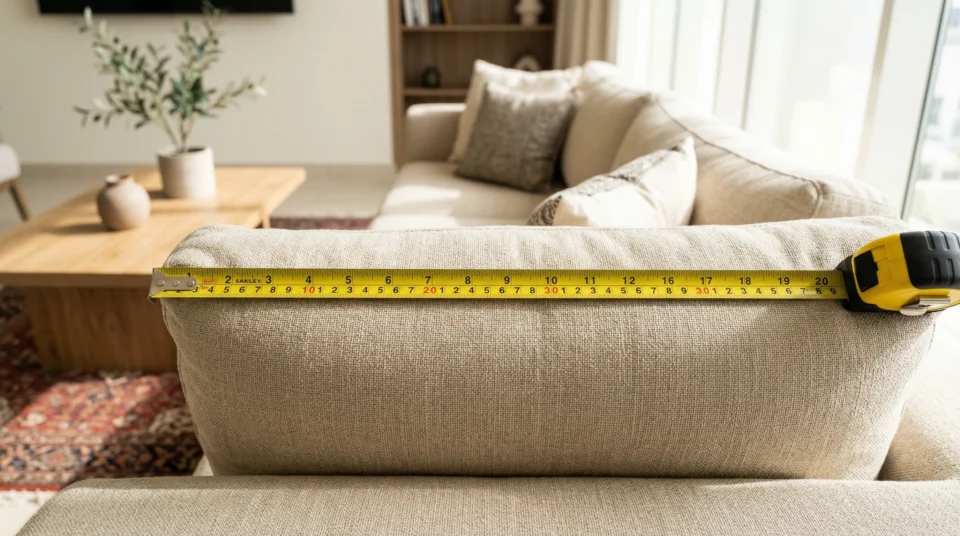
Start with the full room dimensions — length and width in centimetres or metres. Then identify where the sofa will actually sit. Is it against a wall? Floating in the middle of the room? Forming an L-shape with an adjacent wall? Once you know the sofa’s footprint, you can figure out the right size.
As a general rule, your sofa should take up roughly two-thirds of the room’s primary wall. In a typical apartment living room of 4–5 metres wide, a 220–240 cm (roughly 3-seater) sofa fits well. In a larger villa majlis of 6–8 metres, you’re looking at a corner sofa or L-shaped sectional, often starting at 280–320 cm across the longest dimension.
Critically, measure your doorways, corridors, and any staircases between the entrance and your living room. Many a beautiful sofa has arrived at the door only to get stuck in a 75 cm corridor. Standard sofas need at least 80–90 cm of clearance to navigate a corner. If your building has narrow access, flag it immediately — modular sofas that come in separate pieces are a practical solution, and worth prioritising.
Leave at least 45 cm between the sofa and a coffee table for comfortable movement. If you have kids running through constantly, 60 cm is better. Between the sofa and a TV unit or opposite wall, 90 cm is a minimum for comfortable viewing; most UAE families prefer 1.5–2 metres.
The Seat Depth Question
Seat depth is one of the most overlooked measurements and one of the most important for comfort. Standard seat depth runs 55–65 cm. If you’re taller than average or you love to curl up and read, a depth of 65–70 cm will feel luxurious. If you have older family members for whom getting up from a low, deep seat is difficult, stay closer to 55 cm and choose a firmer seat.
Seat height matters too. Most sofas sit at 42–48 cm from the floor. Higher seats (48 cm+) are easier for elderly family members. Lower seats (40–42 cm) have a more contemporary, lounge feel but can be harder to rise from.
Step 2: Choose the Right Sofa Shape for Your Space
Once you know your measurements, the shape of the sofa becomes much easier to decide. In the UAE, the most popular configurations break down into a few clear categories.
The 3-Seater or 2+3 Combination
The classic choice for apartments and smaller villa sitting rooms. A 3-seater runs 200–240 cm and pairs well with an armchair or a 2-seater loveseat opposite. This layout works particularly well in Dubai Marina and Downtown apartments where the living area is roughly square. It keeps the room feeling open and is easy to rearrange as your family grows or your space changes.
The L-Shaped / Corner Sofa
The UAE’s most popular sofa format, and for good reason. Corner sofas maximise seating without pushing furniture to every wall — they define a zone within an open-plan space and create a natural gathering point for families. In a villa living room, a corner sofa with a chaise longue can comfortably seat 6–8 people, which is essential for a culture that values hosting.
When buying a corner sofa in Dubai, confirm which direction the chaise falls — left-hand facing or right-hand facing — relative to how you’ll position it in your room. This is non-negotiable; getting it wrong means the sofa simply doesn’t work in the space.
The Modular Sofa
Growing in popularity in the UAE, modular sofas are made up of individual sections that can be reconfigured. They’re ideal if you’re in a rental property and expect to move, or if your living space doubles as a guest room. They’re also the practical answer to the narrow-corridor problem mentioned above. Modular pieces come through doors individually and are assembled in the room.
The Majlis-Style or Low-Profile Sofa
Traditional UAE homes and majlis spaces often call for a lower-profile seating arrangement, sometimes with floor cushions supplementing a low sofa. Contemporary interpretations pair a 40 cm seat height sofa with a low coffee table or Arabic-style seating to blend modern comfort with cultural tradition. If you’re furnishing a dedicated majlis rather than a Western-style living room, consider this layout carefully.
Step 3: Choose the Right Material for the UAE Climate
This is where many families in Dubai make their biggest mistake. They fall in love with a material in a showroom — usually leather — without thinking about what it’s like to sit on that material after six months of UAE summer living.
Fabric Sofas in the UAE
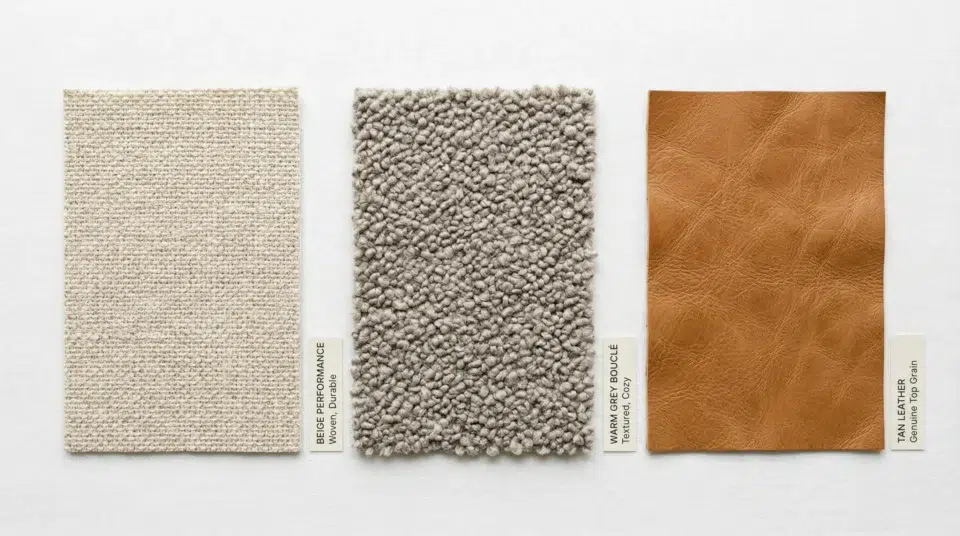
Performance fabrics are the most popular choice for family homes in the UAE, and for good reason. High-quality woven fabrics — polyester blends, microfibre, and particularly stain-resistant performance fabrics — are breathable, comfortable year-round, and significantly more forgiving with children and pets than leather.
Look for fabrics with a rub count (Martindale rating) of at least 30,000 for a family home. 50,000+ is ideal for a high-use living room. This rating tells you how many times the fabric can be rubbed before it begins to show wear — a 20,000-rub fabric sounds like a lot until you have three kids using the sofa daily.
UAE-specific tip: lighter colours — cream, beige, warm grey — show dust more readily in a sandy climate. If you live in an area with significant dust (parts of Sharjah, Al Ain, areas near open land), a mid-tone fabric or one with a slight texture will be more forgiving between cleans.
Leather Sofas in the UAE
Full-grain leather is a premium, durable choice that ages beautifully — but it’s not the right choice for every UAE family. Leather conducts temperature, which means it can feel cold when you first sit down in an air-conditioned room and becomes sticky in humid conditions. If your AC is inconsistent or you live in a naturally humid part of the UAE (coastal Ajman, parts of Sharjah, or ground-floor apartments with less airflow), leather requires more maintenance.
Bonded or faux leather is a different matter entirely. It looks similar to real leather in a showroom but degrades significantly faster — particularly in the UAE’s temperature swings between air-conditioned interiors and outdoor humidity. Peeling and cracking typically begin within 2–3 years. We’re honest about this at Karnak Home: if budget is the concern, a quality fabric sofa will outlast a budget bonded-leather option every time.
Velvet and Boucle
Velvet sofas have become extremely popular in UAE interior design. They look spectacular and feel luxurious, but require maintenance. They attract pet hair and dust, and need regular brushing in one direction to keep the pile looking pristine. In a large family home with children, velvet can look worn within a year without consistent care. Boucle — the textured, looped fabric — is more forgiving and on-trend, but similarly needs attention.
If you love the look of velvet or boucle and have a family home, consider reserving it for a statement armchair or a formal sitting room that gets lighter use. For the main family sofa, performance fabric wins.
Step 4: Sofa Prices in the UAE — What to Expect in AED
Budget conversations make people uncomfortable, but they shouldn’t. Understanding what different price points actually get you in the UAE sofa market helps you spend wisely rather than just spending.
Entry-Level: AED 1,500 – 3,500
At this price point, you’ll find basic 3-seater sofas with foam cushions and lower-grade fabric or bonded leather. These are appropriate for a guest room, a study, or a young professional furnishing a starter apartment. For a main family living room, they typically show wear within 2–3 years and are a false economy if you’re planning to stay in your home longer than that.
Mid-Range: AED 3,500 – 8,000
This is the sweet spot for most UAE families. A quality fabric 3-seater with good foam density (28 kg/m³ and above) and a hardwood or kiln-dried timber frame sits comfortably in this range. Corner sofas and sectionals range from AED 5,000–8,000. At this price, you’re looking at 7–10 years of solid family use with reasonable care. Browse our sofa collection to see what’s available across this range.
Premium: AED 8,000 – 20,000+
Premium sofas feature full-grain leather or high-spec performance fabrics, 8-way hand-tied spring systems or high-resilience foam, and solid hardwood frames. These are investment pieces — built to last 15–20 years and still look good doing it. If you’re furnishing a permanent family home and won’t be buying again for many years, a premium sofa often costs less per year than replacing a mid-range piece twice.
What Drives the Price Difference?
The three main cost factors in a sofa are the frame, the cushion system, and the fabric or upholstery. A solid kiln-dried hardwood frame (look for birch, beech, or poplar) is significantly more durable than a plywood or particle board frame. Pocket spring or sinuous spring cushion systems outlast pure foam, which tends to compress and lose shape over 3–5 years. And the difference between a 20,000 Martindale fabric and a 60,000 Martindale fabric isn’t visible in the showroom — but it’s very visible three years later.
Common Sofa Buying Mistakes UAE Families Make
These are the patterns we’ve seen repeat themselves across 35 years and thousands of sofa sales. Learning from other people’s experience is free.
Mistake 1: Buying Without Measuring the Room
Already covered above, but it bears repeating because it’s the most common issue. A sofa that looks right in a 500 sq metre showroom can overwhelm a 4×5 metre apartment living room. Always bring your measurements.
Mistake 2: Choosing Style Over Comfort
A sofa is a daily-use item. You will sit on it every evening for years. A gorgeous sculptural piece with minimal padding and a firm, low seat might photograph beautifully, but if it’s not comfortable for your family’s actual bodies, you’ll quietly stop using it within a few months. Always sit on a sofa for at least 5–10 minutes in the showroom before committing.
Mistake 3: Ignoring Delivery Logistics
Dubai buildings have widely varying access — narrow lifts, tight stairwells, low car park ceilings. Always confirm your delivery access before purchase. At Karnak Home, our delivery team will advise on access requirements before dispatch, but we need the right information from you. Measure your lift dimensions and any tight corners in advance.
Mistake 4: Buying Bonded Leather for a Long-Term Home
As discussed above — bonded leather degrades quickly in UAE conditions. If your budget is AED 3,000–4,000 and you’re choosing between a bonded leather sofa and a quality fabric sofa, the fabric will serve you better and longer. We’ll always tell you this, even though the leather sometimes has a higher margin.
Mistake 5: Not Considering How Your Family Will Grow
A family with a newborn today has a toddler in two years and a seven-year-old in six. The sofa you buy now needs to survive that arc. Choose materials and configurations with your future family in mind, not just your current one. Stain-resistant performance fabric, removable and washable covers where available, and robust frames are all worth paying for.
Expert Tips: 35 Years of UAE Sofa Knowledge
These are the practical tips that don’t make it into product descriptions but make a real difference to how happy you are with your sofa three years from now.
Tip 1 — Ask about the foam density. A sofa cushion should have foam with a density of at least 28 kg/m³ for the seat cushion. Below that, you’ll feel the sagging within two years of daily use. Higher-end sofas use 32–35 kg/m³ or a foam-and-fibre combination that retains shape while feeling softer.
Tip 2 — Check the frame warranty. A quality sofa should carry a frame warranty of at least 5 years. If a retailer can’t tell you their frame warranty, treat that as information.
Tip 3 — Rotate and flip cushions every 3 months. This single habit extends the life of removable sofa cushions significantly by distributing wear evenly. Most people never do it. Now you know.
Tip 4 — UAE dust is real. Weekly vacuuming with an upholstery attachment is genuinely important in the UAE, not just good practice. Dust that settles into fabric fibres acts as an abrasive over time. A fabric sofa that’s vacuumed weekly looks and feels noticeably better at five years than one that isn’t.
Tip 5 — Keep direct sunlight off your sofa. UAE sun is intense. UV exposure fades fabric and dries out leather. If your living room gets strong direct sunlight through glass, consider UV-filtering window film or reposition your sofa away from direct rays. This alone can add years to a sofa’s appearance.
Tip 6 — Test the sofa with everyone who’ll use it. If your parents visit regularly and they have mobility considerations, bring them to the showroom. If your partner is significantly taller or shorter than you, make sure you both sit on the sofa before buying. A sofa that works for one person’s body and not another’s becomes a source of quiet friction over time.
Tip 7 — Ask about the legs. Solid wood or metal legs are a detail that signals overall build quality. Plastic legs on a sofa in this price range are a shortcut that often indicates other shortcuts in the construction. It’s a small thing that tells you something bigger.
Tip 8 — Consider a sofa with built-in storage. For Dubai apartments where storage is always at a premium, sofas with ottoman-style bases or storage compartments under seat cushions are genuinely useful. They’re not a gimmick for families living in a 1BR or 2BR apartment.
Sofas for Specific UAE Living Situations
Villa Owners in Arabian Ranches, Jumeirah, or Al Barsha
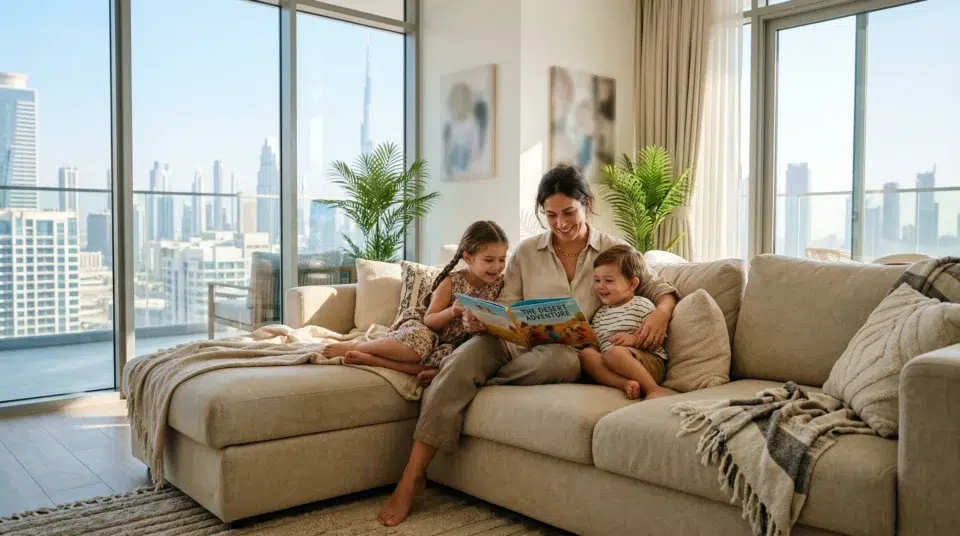
You have the space, so the question isn’t what fits — it’s what does the space justice. Large villa living rooms benefit from a corner sofa or a U-shaped sectional that creates a self-contained seating zone. In formal majlis rooms, consider pairing a three-seater with two single-seat accent chairs for a more traditional layout. Neutral tones in premium fabric or leather tend to age well as your interior evolves. View our sofa range for larger homes.
Apartment Dwellers in Dubai Marina, JVC, or Business Bay
Space efficiency is the priority. An L-shaped sofa with a built-in storage ottoman does the work of three separate pieces. Choose a sofa with legs rather than a plinth base — it makes the room feel taller and easier to clean underneath. Lighter fabrics in warm neutrals open up a space visually. If you move frequently, a modular sofa that can reconfigure for different floor plans is worth the investment.
Families in Sharjah, Ajman, and the Northern Emirates
Humidity is a more significant factor here than in central Dubai. Full-grain leather requires more conditioning in humid climates; performance fabric is a safer default. Larger family sizes in the Northern Emirates often mean more guests and heavier sofa use — prioritise Martindale rating and frame durability above aesthetics.
Expat Renters Furnishing for 2–3 Years
If you know your UAE stay is time-limited, a modular sofa that ships in pieces is worth considering — it’s easier to transport internationally. Alternatively, a quality mid-range fabric sofa in the AED 4,000–6,000 range offers good value with reasonable resale potential in Dubai’s active second-hand furniture market.
Conclusion: Making Your Sofa Decision
Buying a sofa in Dubai is not a complicated decision if you go in prepared. Measure your space. Know your materials. Understand what drives quality and price. Think about your family’s life three years from now, not just today. And sit on the sofa before you buy it — in the showroom, for long enough to actually feel whether it works.
At Karnak Home, we’ve been helping UAE families navigate exactly these decisions since 1988. We’re not going to oversell you or push you toward the most expensive option. We’ll show you what genuinely fits your space, your family, and your budget — whether that’s a AED 4,500 fabric 3-seater for a Marina apartment or a AED 14,000 premium corner sofa for a Jumeirah villa.
Key Takeaways:
- Always measure your room — and your building access — before you shop
- Choose fabric material based on your family’s actual lifestyle and the UAE climate, not just appearance
- Understand what drives sofa price: the frame, the foam density, and the fabric rating are the things that determine longevity
- Think about your family’s future needs, not just today’s
Ready to Find Your Perfect Sofa?
Our Online Store carries over 200+ sofa configurations across every style, size, and budget range. Our furniture consultants many of whom have been with Karnak Home for over a decade know the products inside out and will ask the right questions to make sure what you choose actually works in your home. You can also browse and order online with nationwide delivery across the UAE.
Shop Online: karnakhome.com Visit Our Showroom: Karnak Home, [1 Block C Office 110C – near Miracle Garden – Al Barsha South Third – Al Barsha South – Dubai], Dubai, UAE Expert Advice: [+971525554207]
Related Articles:
- How to Arrange Furniture in an Open-Plan UAE Living Room
- The Complete Guide to Buying a Bed in Dubai
- How to Choose the Right Dining Table for Your Family
- Sofa Care & Cleaning Guide for UAE Homes
Ready to Find the Perfect Sofa for Your Dubai – UAE Home?
Now that you know the right size, shape, material, and features for your family’s lifestyle whether it’s a compact 2-seater for a JVC apartment or a large L-shaped for a majlis in Arabian Ranches browse our full sofa collections below. Every piece is designed and made right here in the UAE to handle our climate, daily family use, and real living spaces. All include free delivery and professional installation across all seven emirates.
- → All Sofas – Complete collection from modern to classic, starting from AED 999+
- → Accent Chairs & 1-Seater Sofas – Compact statement pieces or extra seating for small spaces, reading corners, or apartment living rooms
- → 2-Seater Sofas – Perfect for couples, guest rooms, or smaller apartments in JBR, Downtown, or Business Bay
- → 3-Seater Sofas – Classic family centerpiece with room for 3–4 people ideal for open-plan villas in Mirdif, Emirates Hills, or The Springs
- → Corner & L-Shaped Sofas – Space-saving, high-capacity designs our most popular choice for large families and UAE villas
- → Sofa Beds & Sleeper Sofas – Dual-purpose for guests, studios, or small homes easy conversion with storage options
Special March-December 2026 Offer: Up to 50% off selected sofas + free delivery & installation limited time only.
WhatsApp Us for Free Advice & Quote
Shop All Sofas Now →
Ready to Furnish Your Living Room? Explore Our Living Room Collection – UAE
Now that you know the right size, shape, material, and features for your family’s lifestyle browse our complete living room range below. UAE-made, climate-ready, built for villas, apartments, and majlis gatherings. Free delivery & installation across all seven emirates.
- → Coffee Tables & Center Tables – Matching pieces to complete the look
- → TV Media Units – Storage & display for your setup
- → Majlis Furniture – Traditional UAE seating for family & guests
Special March Offer: Up to 50% off + free delivery & installation limited time.