
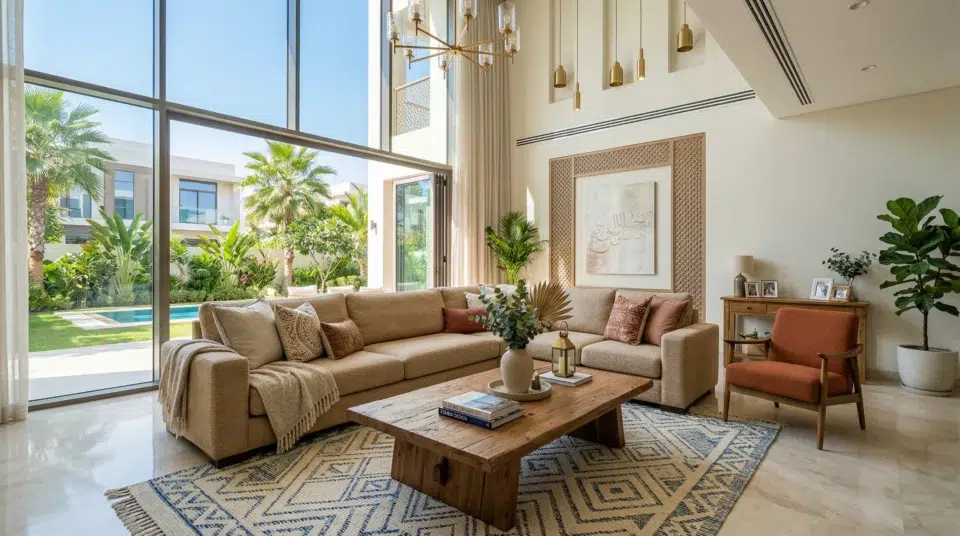
You just got the keys to your new Dubai villa. Five bedrooms. A sprawling living room. A formal dining space. A family room. A home office, maybe. And suddenly the excitement of moving in is replaced by a very real question: where on earth do you start?
Furnishing a villa is a completely different challenge from furnishing an apartment. The scale is bigger, the investment is larger, and the decisions you make now will shape how your family lives for years. Get it right and your home becomes the space you always dreamed of. Get it wrong and you’re living with expensive mistakes that are difficult and costly to fix.
At Karnak Home, we’ve been helping UAE families furnish their homes since 1988 — that’s more than 35 years and over 70,000 families across Dubai, Abu Dhabi, Sharjah, and beyond. We’ve seen every kind of villa, every kind of budget, and every kind of planning mistake. This guide gives you the honest, practical framework we share with our customers every single day.
Dubai villa living comes with its own specific considerations that you won’t find in any generic furniture guide. The climate pushes certain materials to their limits. The way UAE families live — hosting large gatherings, accommodating extended family, managing live-in help — changes what furniture you actually need. And the sheer variety of villa layouts across communities like Arabian Ranches, Jumeirah Golf Estates, Palm Jumeirah, Mirdif, and Al Barsha means there’s no one-size-fits-all answer. This guide is built around all of that reality.
Start With a Plan, Not a Purchase
The single biggest mistake villa owners make is rushing to buy before they’ve thought through how each room will actually be used. Before you set foot in a showroom or browse a single product page, spend time answering the questions below. They will save you tens of thousands of dirhams.
Walk through every room of your villa and think about the people who will use it. How many children do you have, and how old are they? Do you host large family gatherings regularly? Do you have live-in domestic staff who need practical, easy-to-clean surfaces throughout the home? Is this a family home you’ll grow into over ten years, or a two-year posting before you relocate? These answers dictate everything from fabric choices to how much you should spend per room.
Next, measure every room carefully — and measure again. Dubai villas vary enormously in room proportions. A villa in Jumeirah Village Circle might have a compact 5m x 6m living room, while a villa on the Palm could have a double-height reception exceeding 80 square metres. The furniture that works beautifully in one space will look wrong or feel cramped in another. Before you buy anything, you need the actual dimensions of every room: length, width, ceiling height, and the position of doors, windows, and air conditioning vents.
It’s also worth creating a rough priority list. Most families can’t — and shouldn’t — furnish all five-plus rooms at once. Knowing which rooms need to be ready first (typically master bedroom, main living area, and kitchen dining) lets you allocate budget sensibly and avoid rushed decisions in lower-priority spaces.
Mapping Your Villa Room by Room
Start with a floor plan, even a hand-drawn one. Mark each room and note its primary function. In UAE villas, rooms often serve dual purposes — a formal majlis that doubles as a guest bedroom, a family room that acts as a homework space, a study that becomes a spare room during Ramadan when extended family visits. Furniture that handles dual use without looking like a compromise is your goal.
For each room, note the natural traffic flow. Where do people enter and exit? Where does natural light come from, and where does it create glare during Dubai’s intense summer afternoons? Which rooms face the garden and will you want large sofas oriented toward outdoor views? These details determine furniture placement before you’ve bought a single piece.
Also consider the visual connection between rooms. Open-plan villas — extremely common in Dubai’s newer developments — mean your living room sofa, dining table, and kitchen are often visible from the same viewpoint. If these three areas clash in style or colour, the whole ground floor feels disjointed. Planning a coherent visual thread between connected spaces is far easier to do on paper than to fix after delivery.
Setting a Realistic Villa Furniture Budget in AED
Budget planning for a full villa is where many families either overspend impulsively or underspend and regret it. Here is an honest picture of what furniture costs in Dubai across different quality levels.
For a five-bedroom villa with living room, dining room, family room, and study, expect to budget in the following ranges:
A mid-range budget of AED 80,000–130,000 will furnish all rooms comfortably with good-quality furniture that lasts well and looks attractive. This is the range where most of our customers at Karnak Home operate, and it delivers genuinely good results when the budget is allocated carefully.
A value-focused budget of AED 45,000–75,000 is achievable but requires prioritisation. You’ll furnish the priority rooms well and use simpler, more functional pieces in secondary spaces. This works well for families who are planning to upgrade over time.
A premium budget of AED 150,000 and above opens up solid hardwood collections, bespoke upholstery options, and designer-level dining and bedroom sets. This is appropriate for long-term family homes where quality and longevity are the priority.
The most important advice we can give on budget: spend most heavily on the pieces you interact with physically every day — the sofa, the master bed, the dining chairs. These take the most wear and matter most to daily comfort. Spend more conservatively on decorative furniture like sideboards, console tables, and occasional chairs that carry less daily stress.
Room-by-Room Planning Guide for Dubai Villas
The Living Room: Your Villa’s First Impression
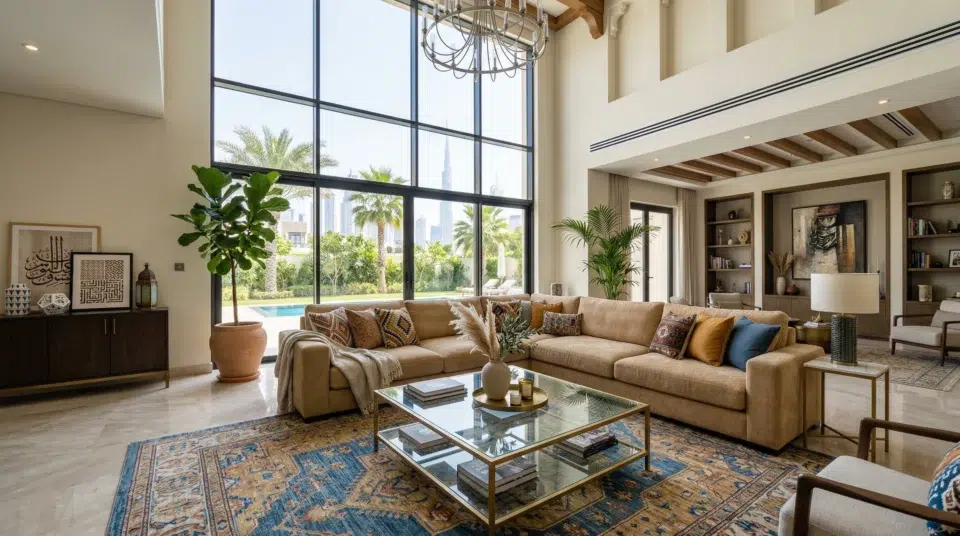
The main living room in a Dubai villa typically needs to handle two competing demands: it must look impressive for guests (hospitality is central to UAE culture), and it must be genuinely comfortable for everyday family use. These two demands are not incompatible, but they require thought.
The sofa is the centrepiece decision. For a standard villa living room of 6m x 7m or larger, an L-shaped sofa or a three-seater paired with a two-seater will give you the seating capacity you need without making the room feel like a waiting room. In Dubai’s open-plan villas, the sofa often defines the living zone visually, so its orientation and scale relative to the room matters enormously.
For fabric choice in Dubai’s climate, performance fabrics are worth serious consideration. Dubai homes run air conditioning for eight or more months of the year, which is actually gentler on fabrics than humid climates. However, the combination of intense sunlight through large windows and frequent use by children makes solution-dyed fabrics or high-performance microfiber the practical choice for family sofas. Velvet and linen look beautiful but require more care; keep them for formal sitting rooms with lower daily traffic. Browse our sofa collection to see the full range of fabrics and configurations available.
Colour for the main sofa is a long-term decision. Neutral tones — warm greys, sand, taupe, off-white — give you the flexibility to refresh the room’s look with cushions and rugs as trends change, without replacing the sofa itself. Deep jewel tones look stunning but commit you to a colour palette for years.
The Master Bedroom: Invest Here First
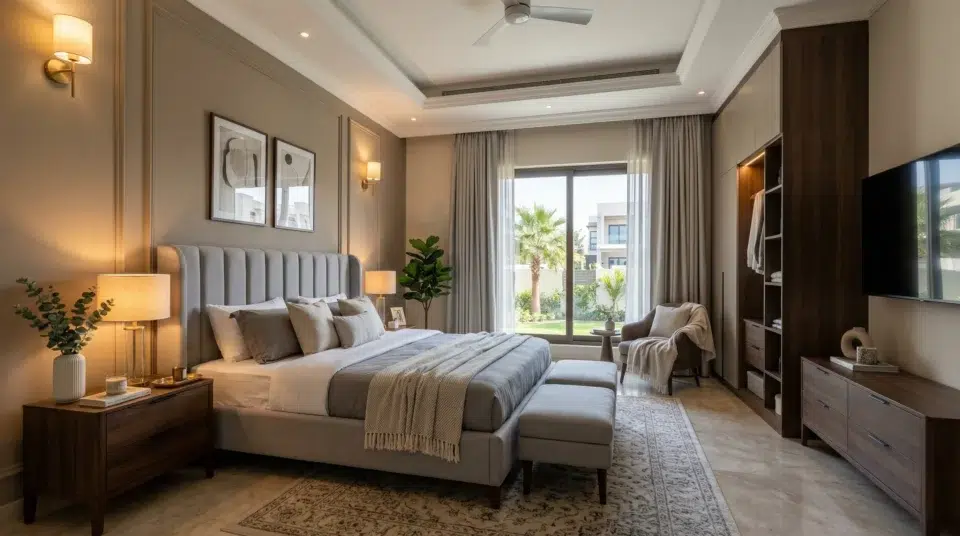
The master bedroom in a Dubai villa is often generously sized — 5m x 5m or larger is common — which means undersized furniture will look lost. A king-size bed (180cm x 200cm) is the appropriate choice for most master bedrooms, and in larger rooms, a super-king (200cm x 200cm) works beautifully.
Storage in the master is critical and often underestimated during planning. UAE families tend to have substantial wardrobes — multiple cultural dress requirements, formal guest occasion wear, seasonal items despite a limited seasonal shift. A fitted wardrobe running a full wall, typically 3–4 metres, is not excessive; it’s practical. If your villa has a walk-in wardrobe space, furnish it properly with a combination of hanging rail sections, shelving, and deep drawers rather than treating it as a storage room with a door.
For bed frame choice, upholstered frames in performance fabric or a solid wood frame are both appropriate for Dubai’s climate. Solid wood — particularly teak and engineered hardwood — holds up well in air-conditioned environments. Avoid MDF-heavy construction in pieces you want to last more than five years; the repeated thermal cycling of Dubai’s AC-on/AC-off environments in less-used rooms can stress cheaper composite constructions. Explore our bedroom furniture collection for options suited to UAE homes.
Bedside tables and a dresser complete the room. Allow for at least 60cm of clearance on each side of the bed for comfortable movement, and 90cm at the foot of the bed if space permits.
The Dining Room: Scale It Properly
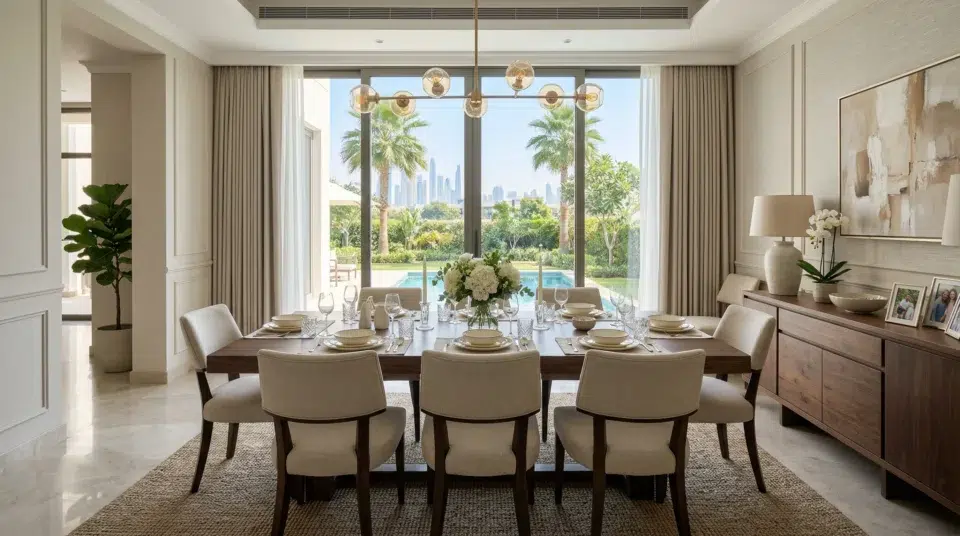
One of the most common villa furniture mistakes we see is an undersized dining table in a large dining room. In UAE family culture, the dining table is a genuine gathering point — Friday lunches, Eid gatherings, weeknight family meals — and it needs to accommodate not just the immediate family but guests regularly.
For a family of four to six, a 180–200cm rectangular table seats six comfortably and eight at a push. For a family of six to eight, move to 220–240cm. Round tables work beautifully in square dining rooms and encourage conversation, but they require a larger room to seat the same number of people as a rectangular table.
Extending tables are worth considering if your guest numbers fluctuate significantly — a 160cm table that extends to 220cm gives you both a practical daily size and the capacity for larger gatherings. Quality extension mechanisms on a well-made table are reliable; the cheaper ones become stiff or misaligned within two to three years.
For dining chairs, upholstered seats in easy-clean fabric or faux leather are the practical UAE family choice. Full fabric looks wonderful but is harder to maintain if you have young children. Solid wood dining chairs last essentially forever if the joints are well-made. Browse our dining furniture range to find the right combination of table and chairs for your villa’s dining space.
Children’s Bedrooms: Build for Growth
Children’s bedroom furniture in a UAE villa is a genuinely different planning challenge. The furniture you buy today needs to work for a 6-year-old and still be appropriate for a 14-year-old. That rules out most highly themed “children’s” furniture, which looks charming for two years and then becomes an embarrassment.
The practical approach: invest in well-made, simple-lined beds that will age gracefully. A single bed (90cm x 200cm) for younger children, moving to a single-to-double convertible or a full double (135cm x 200cm) for older children works across a wide age range. Avoid novelty bed frames that can’t grow with the child.
Storage in children’s rooms needs to be generous and accessible — open shelving at child height, deep drawers, and a wardrobe with adjustable interior fittings. The wardrobe should be adult height from day one; low wardrobes look like they belong in a nursery and will need replacing within a few years.
For safety, anchor all tall furniture to the wall. This is non-negotiable in children’s rooms. Bookshelves, wardrobes, and tall storage units must be fixed to the wall in every children’s bedroom. UAE regulations increasingly require this, and it’s simply the right thing to do. Explore our kids furniture range for options designed with safety and longevity in mind.
The Home Office: Don’t Afterthought It
The home office in a Dubai villa often gets the furniture budget’s leftovers, and it shows. Given how many UAE residents now work from home at least part of the time, the study deserves proper planning.
The desk should be sized for actual work: a minimum of 140cm wide if you use a laptop, 160cm or more if you use dual monitors. Depth of 70–80cm gives you enough distance from screens for comfortable working posture. Solid wood or solid wood veneer desks hold their surface quality far better than laminated MDF under daily working conditions.
A proper task chair is non-negotiable for anyone working from home more than two hours a day. The ergonomic chair market has improved enormously in recent years, and a quality option at AED 1,200–2,500 is a sound investment compared to back problems from a fashion chair that looks good but provides no support.
Storage in the home office — shelving, a filing cabinet, or a credenza — is often underestimated during planning. Build in more storage than you think you need; you will fill it.
Choosing Furniture Styles That Work Together
Contemporary Arabic and Modern Gulf Design
The most enduring interior design direction for Dubai villa is what we might call Contemporary Gulf — clean lines and quality materials drawn from international contemporary design, warmed with Arabic design signatures: geometric patterns in cushions or rugs, brass or gold hardware accents, deep jewel-tone accent pieces, and the generous seating layouts that reflect UAE hospitality culture.
This direction works well because it suits the scale of Dubai villas, ages gracefully, and photographs beautifully for the social media documentation of home life that matters to many UAE families. It also allows you to introduce Arabic design elements at low cost through accessories and textiles rather than expensive statement furniture.
Modern Minimalist and Scandinavian
Clean, light, wood-forward Scandinavian-influenced design has grown in popularity in UAE villas, particularly in newer community developments. This style suits open-plan layouts well and feels fresh in the UAE’s intense light. The risk: it can feel cold and echoey in very large rooms with tiled floors and high ceilings, which describes most Dubai villas. Rugs, layered textiles, and warm wood tones counter this effectively.
Transitional and Classic
Transitional furniture — which blends classic proportions with cleaner, updated lines — remains extremely popular in established Dubai communities like Jumeirah, Umm Suqeim, and Meadows. It photographs warmly, handles the formal-living requirements of UAE hospitality culture well, and is available across a wide price range. Fully classical European furniture (ornate carved details, heavily formal silhouettes) has fallen out of favour in most of the market and can date a room quickly.
Five Common Villa Furniture Mistakes (and How to Avoid Them)
Mistake 1: Buying Everything from One Delivery
There is a persistent belief that furnishing a villa requires a single enormous shopping trip and one delivery day. This approach almost always leads to regret. You make rushed decisions under time pressure, you can’t visualise how pieces will look in your actual rooms before buying, and you overspend on things that don’t matter while underspending on things that do.
The better approach is to furnish in phases. Phase one: master bedroom, main living room, and dining room. Live in the space for four to six weeks. You’ll understand the light, the traffic flow, and what’s missing far better than you did from an empty room. Phase two and three fill in the remaining rooms with much better-informed decisions.
Mistake 2: Ignoring Ceiling Height in the Living Room
Dubai villas often have double-height or high-ceiling living rooms — 3.5 to 5 metres is not unusual in larger villas. Standard-height furniture (sofas with 85cm backs, sideboards at 80cm) looks like dolls’ furniture in these spaces. You need taller, more substantial pieces: sofas with higher backs, taller display units, artwork scaled for the wall height. The fix costs nothing at the planning stage and a great deal after delivery.
Mistake 3: Under-Budgeting for the Sofa
The sofa will be sat on for several hours every day for potentially ten or more years. The cost-per-use of a quality sofa at AED 8,000–15,000 is genuinely lower than a cheap sofa at AED 2,500–4,000 that compresses, discolours, and structurally fails within three to four years. This is not marketing language — it is an arithmetic reality that 35 years of watching customers’ furniture choices confirms. Buy the best sofa your budget allows.
Mistake 4: Forgetting the Family Room
Many Dubai villas have both a formal living room and a family sitting room (sometimes called a family room or TV room). Families often budget carefully for the formal living room and then furnish the family room as an afterthought. But the family room is where your family actually lives — where children do homework, where adults relax after work, where informal guests spend most of their time. It deserves proper furniture that is comfortable, durable, and easy to maintain. Treat it as a primary room, not a secondary one.
Mistake 5: Choosing Furniture Before Measuring Doorways and Stairwells
This mistake causes genuine heartbreak every year. A beautiful large sofa purchased with total confidence in its room dimensions arrives on delivery day and cannot physically get through the villa’s front door, up the staircase, or around the internal corner. Before buying any large piece — particularly large sofas, king bed frames, and large wardrobes — measure your delivery route: front door width (most are 90–100cm), staircase width, landing turning radius, and bedroom door width. Some furniture can be partially assembled in-room; always ask at the point of purchase.
Budgeting by Room: Honest AED Guidance
Here is an honest room-by-room budget breakdown for a five-bedroom Dubai villa at mid-range quality level. These are real-world figures, not theoretical minimums.
Main Living Room (sofa, coffee table, rug, side tables, entertainment unit): AED 18,000–35,000
Formal Dining Room (table, 6–8 chairs, sideboard): AED 8,000–20,000
Master Bedroom (bed frame, mattress, two bedside tables, wardrobe, dresser): AED 12,000–25,000
Children’s Bedrooms x3 (bed, wardrobe, desk, chair, storage per room): AED 4,000–9,000 per room
Family/TV Room (sofa or sectional, media unit, rug): AED 8,000–16,000
Home Office (desk, chair, shelving): AED 3,000–8,000
Secondary Bedrooms x1–2 (bed, wardrobe, basic storage): AED 3,500–7,000 per room
Total Range for Full Villa: AED 68,000–145,000
These figures assume quality mid-range furniture — not the cheapest available, not luxury. Adjusting up or down from here is straightforward once you know the framework.
Expert Tips From 35 Years of Furnishing UAE Homes
1. Buy your rugs before your sofas. This sounds counterintuitive, but the rug defines the zone and scale of a living area better than anything else. Choose your rug first, then select the sofa to complement it. The alternative — buying the sofa and then trying to find a rug that works with it — is much harder.
2. Check that your wardrobe doors clear the bed. In a standard bedroom layout, sliding wardrobe doors need 0cm of clearance but swing doors need 60–70cm. More than half of bedroom furniture regrets we hear about involve a wardrobe whose swing doors are blocked by the bed or dresser. Check this at the planning stage.
3. In UAE climate, avoid real leather sofas in rooms with direct sun. Real leather in a room where afternoon sun hits directly will fade and crack within three to four years regardless of care. If you love the look of leather, use it in a shaded room or opt for a high-quality faux leather alternative that is UV-treated.
4. The dining table and living room should share a visual language. They don’t need to match exactly, but wood tone, leg style, and overall visual weight should be compatible. A rustic chunky wood dining table next to a sleek contemporary living room sofa in the same open-plan space looks unresolved.
5. Order a fabric swatch before committing to an upholstered sofa. Any reputable furniture retailer will provide fabric swatches. Hold the swatch in your actual room at different times of day. Dubai’s intense light changes colour dramatically between morning and evening, and what looks perfect in a showroom can read differently at home.
6. Plan electrical socket positions before finalising furniture placement. If you’re in a new villa before fit-out is complete, plan where your sofa, bed, home office desk, and entertainment unit will be, and ensure there are sockets at the right positions. Retrofitting sockets is expensive and disruptive; planning them costs nothing.
7. For kids’ rooms, buy the mattress and bed frame from the same brand where possible. Mattress and bed frame compatibility — particularly for beds with storage drawers underneath — is easier to guarantee when they come from the same collection.
8. Don’t furnish guest bedrooms at full budget. Guest bedrooms in UAE villas are typically used less than 30 nights per year. A well-made, simple bed at AED 1,800–3,000 and a clean wardrobe is entirely appropriate. The budget saved here is better deployed in the master bedroom or living room where you spend every day.
Conclusion: Your Villa, Furnished Well
Furnishing a Dubai villa is a significant undertaking, but it doesn’t have to be stressful or uncertain. The families who furnish their homes most successfully share a few things in common: they plan before they purchase, they measure carefully and repeatedly, they prioritise the rooms and pieces that matter most to daily life, and they invest in quality where it counts.
Take your time with this process. A well-furnished villa is the result of thoughtful decisions, not fast ones. Visit the rooms at different times of day. Live in the empty space for even a few days if you can. Trust your instincts on what feels right for how your family actually lives, not how a showroom displays it.
Key Takeaways:
- Plan room by room with real measurements before buying anything
- Allocate budget according to daily use — sofa and master bed deserve the most investment
- Buy in phases rather than all at once, and use what you learn from the first phase
- Choose furniture styles that create visual coherence across connected open-plan rooms
- Check delivery routes — door widths, stairwells, and corridors — before every large purchase
Ready to Furnish Your Villa?
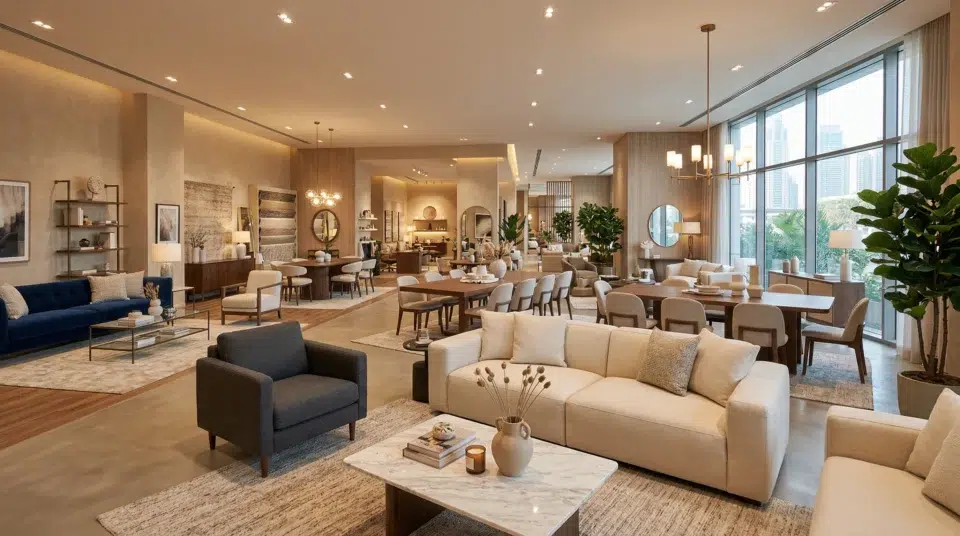
At Karnak Home, we’ve been helping UAE families make exactly these decisions since 1988. Our showroom in Dubai carries the full range of living room, bedroom, dining, kids, and office furniture, and our team can walk through your floor plan with you to help you make confident, informed choices. If you prefer to explore first, our full collection is available online at any time.
Shop Online: karnakhome.com Visit Our Showroom: Karnak Home, Sheikh Zayed Road, Dubai, UAE Expert Advice: Call us for a free furniture planning consultation
Related Articles:
- How to Choose the Right Sofa Size for Your UAE Living Room
- Master Bedroom Furniture Guide for Dubai Families
- Kids Bedroom Furniture That Grows With Your Child
- How to Plan an Open-Plan Living and Dining Space in a Dubai Villa
Ready to Furnish Your Entire Villa? Explore Our Room-by-Room Collections
Now that you have a clear plan for your 5+ room villa from living room centerpiece to master bedroom retreat browse our range below. UAE-made, built for family life, open-plan layouts, and our climate. Free delivery & installation across all emirates.
- → All Living Room – Sofas, coffee tables, TV units, majlis furniture
- → Sofas Collection – L-shaped, 3-seater, corner, sofa beds
- → All Bedroom – Beds, wardrobes, nightstands, dressing tables
- → Wardrobes – Fitted & freestanding for master & kids rooms
- → Dining Tables & Sets – For family meals & entertaining
- → Kids Furniture – Beds, bunk beds, study desks
- → Mattresses – Pocket spring, memory foam, latex for all beds
Special March Offer: Up to 50% off villa furniture + free delivery & installation limited time.
WhatsApp for Free Villa Consultation
Shop All Furniture Now →