
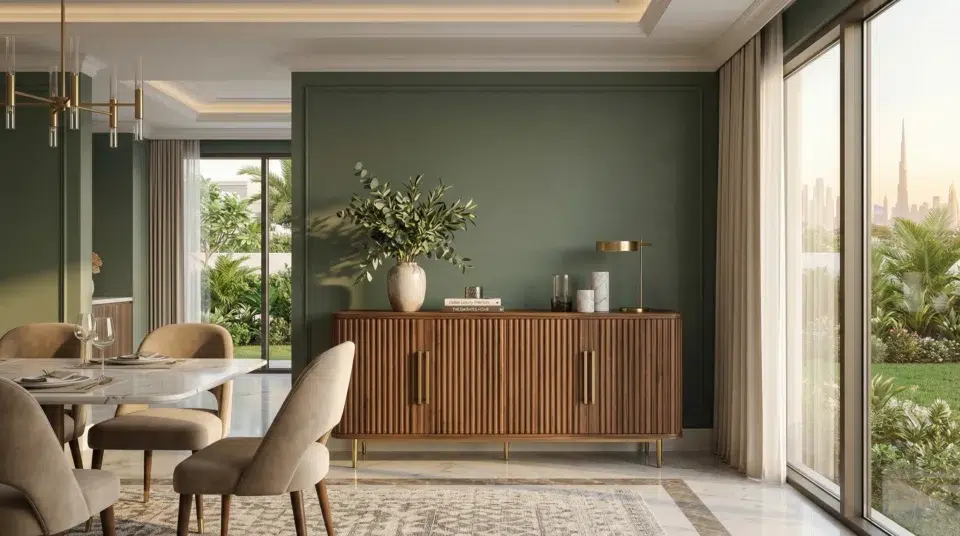
Every February, something predictable and wonderful happens across the UAE: families in Palm Jumeirah villas start rearranging furniture. Young couples in Business Bay apartments begin saving screenshots of dining rooms they love. Interior designers in Jumeirah and Dubai Hills receive a flood of consultation requests. The reason is simple: Ramadan and Eid are approaching, and the UAE home becomes a stage for the year’s most important social performances. The dining room must look right. The buffet, that hardworking anchor piece that holds the crockery, the Arabic coffee service, the extra linens, must feel new, or at least feel current.
In 2026, the buffet and sideboard category is experiencing its most significant design evolution in a decade. The all-white gloss era that defined UAE apartment interiors from roughly 2015 to 2023 is not disappearing; it is being joined, challenged, and in many cases replaced by a richer, more textured design language. The shifts happening in Dubai showrooms right now reflect a maturing UAE consumer: someone who has furnished and refurnished multiple homes, who has learned from past mistakes, who knows what the Gulf climate does to certain finishes, and who wants furniture that expresses genuine personality rather than safe neutrality.
At Karnak Home, we have been serving UAE families since 1988. Our team watches what sells, what gets returned, what clients photograph and share, and what they come back to ask about six months after delivery. In this guide, we decode exactly which buffet and sideboard trends are actually translating into purchases across Dubai, Sharjah, Abu Dhabi, and the Northern Emirates in 2026, and which global directions are failing to land in the Gulf context. We will tell you what works, what does not, why, and what to buy if you want your dining room to feel genuinely ahead of the moment this year.
Why 2026 Is a Turning Point for Buffet Design in the UAE
The UAE furniture market has historically lagged global design trends by 12 to 18 months. A direction that arrives in London or Milan showrooms in early 2024 typically reaches Dubai retail floors in mid to late 2025, and genuinely saturates the UAE buyer’s awareness by early 2026. This means that what design media is calling “emerging” globally is already arriving in UAE homes right now, and what was “trending” globally in 2023 is just reaching peak UAE adoption.
The Post-White-Gloss Shift
For nearly a decade, high-gloss white dominated the UAE apartment interior. It made sense: white reflects light in rooms that often relied on artificial lighting, it appealed to landlords and future tenants universally, and it was easy to keep clean. But after furnishing their second or third UAE home, buyers began to tire of it. The 2026 UAE buyer is actively seeking warmth, texture, and individuality, all three of which were absent from the white-gloss moment.
This does not mean white is finished. It means white now needs to earn its place: as a contrast element against a warm wood tone, as a clean surface that frames a statement hardware detail, or as a high-gloss finish on a piece whose form is interesting enough to hold the eye. Plain white, plain gloss, plain everything: that combination no longer satisfies the UAE buyer of 2026.
The Ramadan and Eid Refresh Cycle: UAE’s Most Powerful Design Driver
No other country in the world has a furniture refresh cycle as commercially concentrated as the UAE’s pre-Ramadan window. Between January and March each year, UAE households, particularly in Sharjah, Abu Dhabi, Ajman, and across the Northern Emirates, invest significantly in home updates. A new buffet is one of the most common purchases in this window because it visually transforms the dining and entertaining space most dramatically for the least expenditure.
This cycle is why date-stamped content like this guide matters: the buyer searching for buffet trends Dubai 2026 in January or February is not browsing idly. They have a budget, a room, and a delivery deadline in mind. Understanding which trends are real versus which are editorial noise is the difference between a purchase that still looks current in 2028 and one that looks dated by Eid Al Adha.
What Premium UAE Buyers Are Actually Asking For in 2026
Our sales team in our Sharjah showroom tracks specific customer language. In the last six months of 2025 and the opening months of 2026, three phrases appeared in client conversations more than any other: “texture,” “warmth,” and “something that feels less like a hotel.” These three words map directly onto the dominant design directions of 2026 and explain why the trends below are landing so powerfully in the UAE market.
Explore our 2026 range of buffets and sideboards for UAE homes to see how these directions are being expressed in furniture you can purchase and have delivered this week.
The Eight Buffet and Sideboard Trends Defining UAE Dining Rooms in 2026
Trend 1: Japandi Sideboards: The Most Important Direction in UAE Interiors Right Now
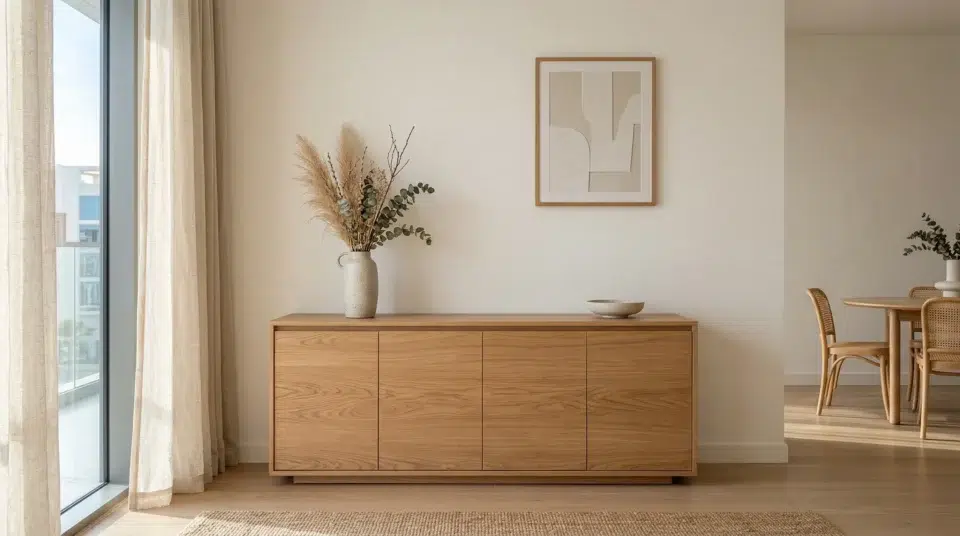
Japandi, the design fusion of Japanese minimalism and Scandinavian warmth, has been building momentum in global interiors since 2021. In 2026, it will have reached full maturity in the UAE market, and buffets are the category where it is expressing itself most powerfully.
A Japandi buffet in the UAE context typically has these characteristics: warm-toned timber (ash, bamboo-composite, or light oak veneer rather than grey-washed pine), handleless or near-invisible hardware, very clean horizontal lines, low to medium height (60 to 75 cm rather than the traditional 85 to 90 cm), and minimal ornamentation. The surface above is deliberately sparse: one ceramic, one plant, negative space.
Why does this work so well in UAE homes specifically? UAE interiors, particularly in newer developments like Dubai Hills, Dubai Creek Harbour, and Yas Island in Abu Dhabi, are already moving toward taller ceilings, larger windows, and more deliberately curated spaces. The Japandi buffet does not fight for attention; it anchors the room calmly while allowing architecture and light to lead. For a family in a Jumeirah apartment with 2.9-metre ceilings and a south-facing balcony flooding the room with light, a low, warm, minimal sideboard is the compositionally correct choice.
Price range in the UAE market: AED 2,200 to AED 7,500, depending on timber species and construction quality.
Trend 2: Fluted and Ribbed Panel Doors: Texture as the New Neutral
If you have visited a Dubai furniture showroom in the last 12 months, you have noticed that flat, smooth door fronts are no longer the default. Fluted panels, vertical grooves pressed, routed, or moulded into door fronts, are now appearing on everything from entry-level melamine pieces to premium solid-wood commissions, and they are selling extremely well.
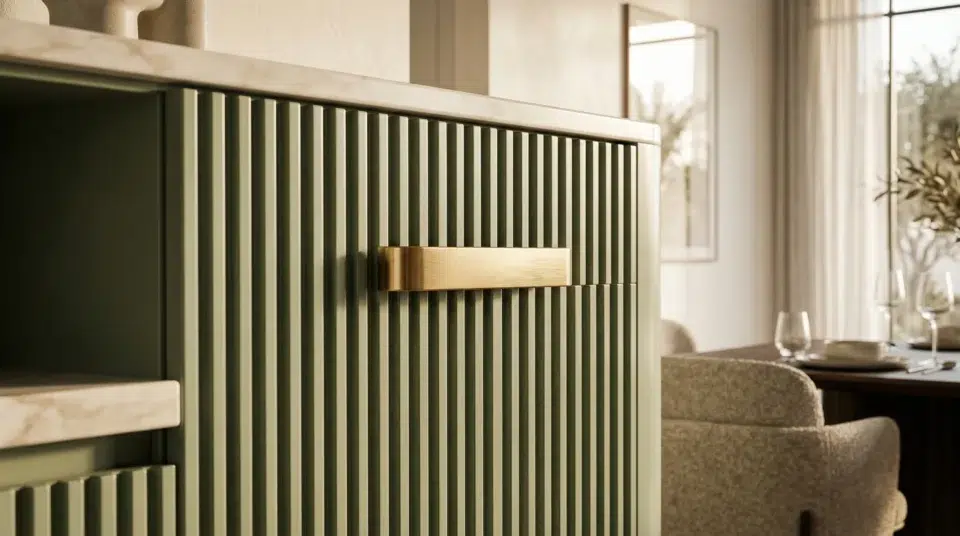
The reason is elegantly practical for UAE homes: a fluted surface creates visual interest without introducing a repeating pattern that must coordinate with other room elements. Flat, smooth doors demand that surrounding walls, floors, and accessories carry all the visual work. Fluted doors carry their own texture, meaning they work against a plain painted wall just as well as against a geometric tile feature or a patterned wallpaper.
In 2026, the UAE market is responding most strongly to fluted panels in three finishes: warm walnut veneer (classic, warm, universally appealing), warm white painted MDF (clean, light-maximising, renter-friendly), and sage green lacquer (the year’s breakout colour in the Gulf interior market). A quality fluted sideboard for a Dubai home will typically run between AED 1,800 and AED 5,500.
Trend 3: Marble and Stone Tops: Genuine Luxury at a Practical Price
Marble-topped buffets have been aspirational in UAE homes for years, but historically, they sat in a premium price bracket that excluded most buyers. In 2026, two developments have democratised the marble-top buffet: improved sintered stone technology (engineered surfaces that mimic marble closely at a fraction of the weight and cost) and a stronger supply chain bringing natural marble panels into mid-range furniture manufacturing.
A buffet with a genuine Carrara or Calacatta marble top now sits at AED 4,500 to AED 9,000 in the UAE market. Sintered stone tops that are visually near-identical run between AED 2,800 and AED 5,500. For UAE buyers in Palm Jumeirah, Emirates Hills, and Jumeirah Golf Estates, where marble is already present in floor tiles, kitchen counters, and bathroom surfaces, a marble-top buffet creates immediate visual coherence with the existing material palette of the home.
One practical note: UAE buyers placing hot serving dishes on a buffet surface during Eid or Ramadan gatherings must choose engineered sintered stone rather than natural marble for this purpose. Natural marble is heat-sensitive and will mark permanently under a warm casserole dish.
Trend 4: Dark Wood Makes a Decisive Return: Walnut, Smoked Oak, and Ebonised Finishes
After years of light, bleached, and grey-washed wood dominating UAE showrooms, dark wood is back, and it is back with confidence. Walnut veneer and solid walnut have been building momentum since 2024, and in 2026, they are joined by smoked oak (a medium-dark, complex grain with grey undertones) and ebonised finishes (near-black wood that reads as simultaneously dramatic and warm).
Why is this happening in the UAE now? Several reasons. First, the generation of UAE residents who associate dark wood with the heavy, ornate furniture of the 1990s and early 2000s interiors has aged enough to reappraise it, the new dark wood is lighter in silhouette, cleaner in line, and completely free of the carved ornamentation of its predecessor. Second, newer Dubai and Abu Dhabi developments are increasingly featuring light-coloured marble flooring, cream-toned walls, and high ceilings, all of which provide the perfect contrast for a dark walnut or smoked oak buffet to register dramatically.
A quality walnut buffet in the UAE market in 2026 sits between AED 3,200 and AED 8,500 for engineered-wood-core with genuine walnut veneer, or AED 7,000 to AED 14,000 for solid walnut construction. Our contemporary sideboard UAE collection includes the full range of dark-wood options currently available.
Trend 5: Handleless and Integrated-Pull Designs: The Sleek Minimalist Direction
Handleless buffets where the door and drawer fronts are engineered with a recessed lip or a push-to-open mechanism rather than an applied handle are gaining significant ground in UAE apartments in 2026. They appeal most strongly to buyers in high-design developments: Downtown Dubai, Dubai Creek Harbour, DIFC-adjacent residences, and Abu Dhabi’s Saadiyat Island.
The practical benefit for UAE families is underrated: no handles means no hardware to loosen, no metal to corrode in coastal environments, and no sharp edges for children or pets. The aesthetic benefit is obvious: a handleless front reads as one uninterrupted surface plane, making even a standard-sized buffet look architectural.
The main disadvantage is that handleless push-to-open mechanisms require precise cabinet making: if the door is even slightly warped by UAE humidity, the mechanism sticks or fails. For this reason, we recommend handleless designs only in engineered wood with moisture-resistant board and quality soft-close push-to-open hardware rated for UAE climatic conditions.
Trend 6: Rattan and Cane Accents: Natural Material Returns to UAE Homes
Rattan and cane-webbing inserts, typically used as panel inserts in buffet door fronts, are bringing a warm, natural texture to UAE dining rooms that neither wood grain nor lacquer can replicate. In 2026, they appear most prominently in the mid-range market, particularly in buffets targeting buyers in Al Barsha, JLT, and the family villa communities of Mirdif and Jumeirah.
The textural warmth of natural rattan reads beautifully against the high-contrast materials common in UAE interiors: polished marble, crisp white walls, and metal pendant lighting. It is also one of the few genuinely breathable panel materials, which matters slightly in UAE homes where interior humidity can spike during summer months.
One honest caveat: natural rattan in UAE conditions requires occasional conditioning with a light natural oil (coconut or tung oil) every 12 to 18 months to prevent drying and cracking in the Gulf’s low winter humidity. Synthetic rattan, a woven polymer material designed to mimic the appearance, requires no maintenance but lacks the depth of colour that makes natural rattan desirable.
Trend 7: Floating and Wall-Mounted Sideboards: Space Efficiency in Dubai Apartments
Wall-mounted sideboards, fixed to the wall at 40 to 60 cm above the floor, leaving the floor beneath them entirely clear, are one of the most practical design directions of 2026 for UAE apartment dwellers. In a JVC two-bedroom apartment or a Business Bay one-bedroom, a floating sideboard creates the visual impression of more floor space, simplifies cleaning (a single pass of a mop handles the full floor without furniture lifting), and allows you to place a low pendant light or wall sconce above and a decorative mat below to frame the piece architecturally.
The structural requirement is non-negotiable: floating sideboards must be fixed to load-bearing wall material, not just the plasterboard finish common in UAE apartment construction. Our installation team carries the correct fixings for UAE concrete walls and will always confirm structural suitability before mounting any wall-fixed furniture.
Browse our modern buffet cabinet Dubai collection to see the full range of wall-mounted and floating sideboard options currently available for UAE homes.
Trend 8: Statement Colour: Beyond Beige and Into Confident Territory
The biggest story in UAE buffet design for 2026 is not a material or a form, it is colour. After years of safe neutral finishes dominating UAE showrooms, a meaningful segment of buyers is choosing colour with real conviction. The colours resonating most powerfully in the UAE market right now are:
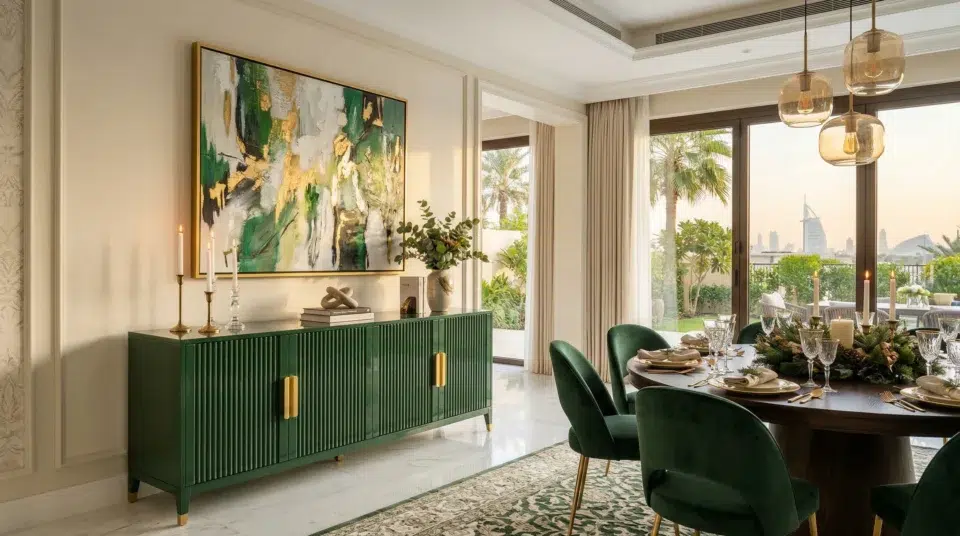
Deep forest green (a warm, botanical tone that pairs effortlessly with brass hardware and natural wood elements), terracotta and warm clay (earthy, sun-drenched tones that carry the warmth of the Gulf landscape into the interior), and deep navy lacquer (a classic combination of depth and formality that works powerfully in villa dining rooms where the ceiling height allows a dark piece to breathe).
These are not colours for a renter who needs broad market appeal at the end of a lease. They are colours for an owner, a long-term tenant, or a buyer who is confident enough in their aesthetic to commit. In our Sharjah showroom, they are generating significant attention and very quick purchase decisions — the buyer drawn to a deep green fluted buffet typically makes up their mind within ten minutes.
Which 2026 Buffet Trends Work Best by UAE Home Type
Not every 2026 trend suits every UAE living situation. The practical realities of your specific home type, your tenure in the UAE, and your family structure should determine which direction you pursue.
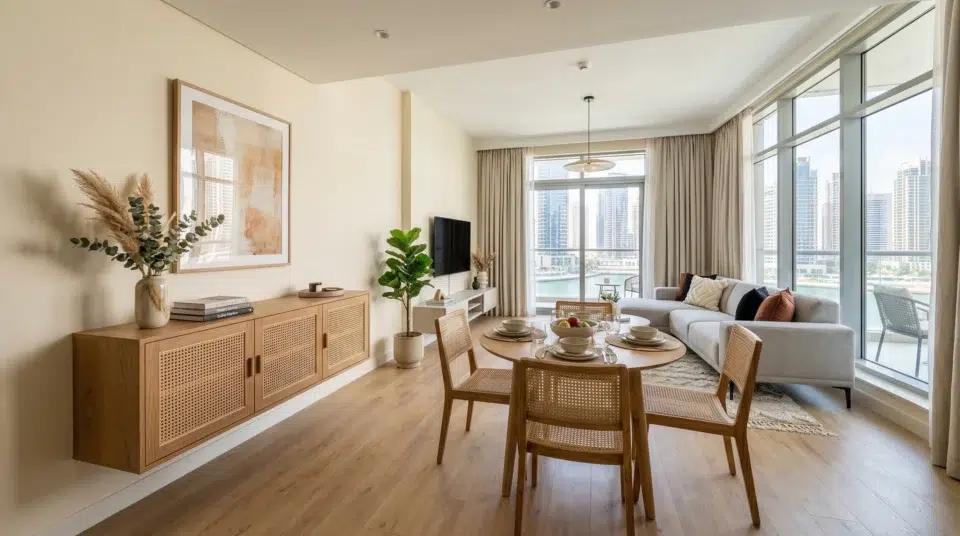
For Apartments in Business Bay, JLT, and JVC
The most versatile 2026 directions for apartment buyers are Japandi handleless designs in warm neutrals, fluted panels in white or linen, and floating sideboards in oak or ash. These choices perform well across different tenants and different apartment colour schemes, critical for renters who may need to appeal to future landlords or sell the piece when they move.
Avoid statement colour for apartment use unless you own the property and plan to stay for five or more years. A deep green buffet is spectacular in the right context, but difficult to resell and risky to match with a future apartment’s colour scheme.
Recommended spend for a quality trend-forward apartment buffet: AED 2,200 to AED 4,500. Our buffet furniture ideas Dubai collection covers this range with clear style category labelling.
For Villas in Arabian Ranches, Mirdif, and Al Furjan
Villa buyers in 2026 have more flexibility in both scale and commitment. A 180 to 220 cm wide walnut buffet with a marble top is proportionally appropriate for a villa dining room and creates a piece of furniture that will anchor the space for a decade. Statement colours work here: the scale of a villa dining room absorbs and showcases a bold buffet in a way that a 65-square-metre apartment simply cannot.
For villa dining rooms, we recommend spending at the premium tier: AED 4,500 to AED 10,000 for a piece that will outlast multiple rental cycles and hold its aesthetic value.
For Luxury Residences on Palm Jumeirah and Saadiyat Island, Abu Dhabi
At the luxury end of the UAE market, 2026 is the year of genuine craft: solid walnut and solid teak buffets with hand-finished details, marble tops with bookmatched grain, bespoke hardware in unlacquered brass that will patina naturally over time. These buyers are not shopping for trends; they are shopping for permanence and the kind of visual richness that comes only from real materials that change and deepen with age.
For this audience, we recommend consulting our team directly. WhatsApp us at +971 58 908 8107 with your room dimensions and existing material palette, and our senior consultants will advise on the right piece across our full luxury dining room furniture UAE range.
Materials Driving the 2026 Buffet Trend Movement in the UAE
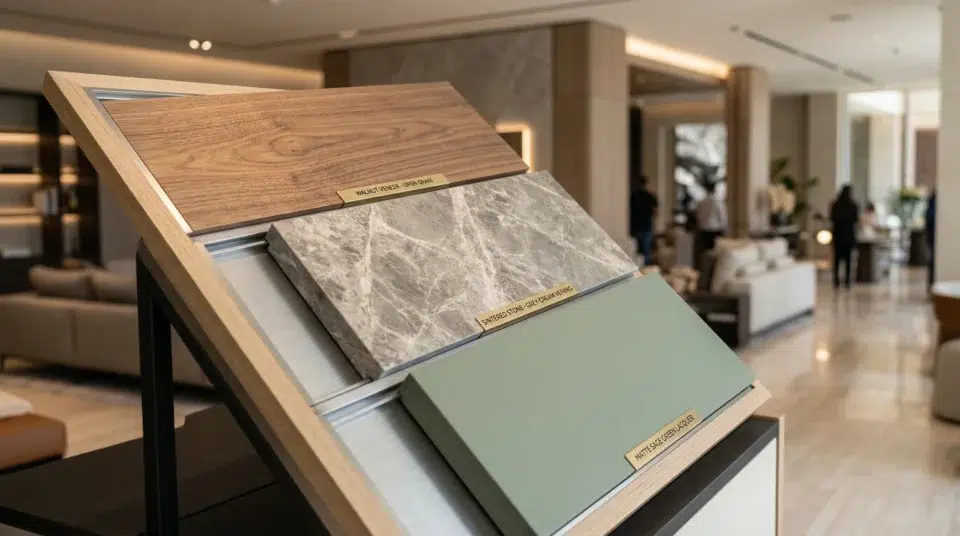
Why Warm Wood Tones Are Outperforming Cool Grey in the UAE Climate
The grey-washed wood that dominated global interiors from 2016 to 2022 was always a somewhat uncomfortable fit for the UAE. Grey reads as cool; the Gulf is warm. Grey-washed finishes also tend to look tired faster in high-UV environments — the pigment in the wash coat fades unevenly, creating a patchy rather than gracefully aged effect. In 2026, the pendulum has swung decisively toward warm: honey oak, walnut, amber ash, and teak all perform better under UAE light conditions and age more gracefully in the Gulf climate.
Lacquer Quality in 2026: What Has Changed and Why It Matters
The lacquer technology available in the mid-range buffet market has improved significantly in the last two years. The standard in quality UAE furniture in 2026 is a UV-cured, two-component lacquer system that provides hardness above 3H on the pencil scale, resistance to typical domestic cleaning agents, and a colour fastness rating that maintains tone without yellowing for a minimum of seven years under normal UAE conditions. This is a meaningful upgrade from the air-dry lacquers common in the market as recently as 2023, and it significantly changes the value proposition of a painted buffet for UAE buyers.
Sintered Stone vs Natural Marble for UAE Buffet Tops
The question our showroom team is asked most often in 2026 is whether to choose a natural marble top or an engineered sintered stone top. For the UAE context, sintered stone is the stronger practical choice: it handles the heat of serving dishes during Eid gatherings, it is completely non-porous (meaning it will not absorb the oils and liquids that are inevitable in an active dining room), it weighs approximately 30 percent less than a comparable marble panel, and it is visually near-identical to the real thing at distances above 50 cm.
Natural marble retains its premium aesthetic status and its genuine uniqueness; no two natural marble panels are identical, which is a meaningful detail for a discerning buyer. If you choose natural marble, specify a minimum 20 mm thickness and a penetrating stone sealer applied every two years.
Frequently Asked Questions About Buffet Trends in Dubai 2026
FAQ 1: Which buffet trend is best for a rental apartment in Dubai?
For renters in Dubai, the most commercially safe 2026 trend choices are warm-toned Japandi designs and fluted-panel sideboards in white, linen, or warm oak. These finishes have the broadest appeal across different interior schemes, making them easy to resell or leave behind when your lease ends. Avoid statement colour in a rented apartment unless you are planning a long-term stay. A Japandi sideboard in warm ash or a white fluted-door buffet will work with virtually any paint colour your next landlord chooses, and will feel contemporary rather than dated when you photograph it for a resale listing. Budget between AED 1,900 and AED 4,000 for a quality trend-forward rental-friendly piece from our sideboard design trends UAE 2026 collection.
FAQ 2: Is the Japandi trend appropriate for a traditional Gulf home?
The Japandi direction works surprisingly well alongside traditional Gulf interior elements, provided the specific piece is chosen carefully. The key is to select a Japandi buffet with warm tones (amber wood rather than pale birch or cool ash) and to pair it with Gulf-traditional accessories: a brass coffee service on the surface, a geometric carpet below, and ornate cushions on adjacent seating. The contrast between the buffet’s calm simplicity and the surrounding richness of traditional Gulf decoration creates a modern-traditional dialogue that many UAE homeowners find deeply satisfying. It also respects the principle central to Gulf hospitality: the accessories, the service, and the guests are the focus — the furniture is their calm, dignified backdrop.
FAQ 3: How long will 2026 buffet trends remain current in the UAE?
Based on the cycle of UAE interior design trends over the past 36 years of our operation, the directions dominant in 2026 — Japandi, fluted panels, dark walnut, warm lacquer in greens and terracottas — represent a genuine stylistic shift rather than a seasonal fashion. We expect these directions to remain current and commercially appealing through at least 2029 to 2030 in the UAE market. This is partly because they are rooted in enduring material quality rather than novelty, and partly because the UAE market adopts trends after global saturation, meaning local peak comes later and fades later than in trend-originating markets. The 2026 UAE buyer who chooses a fluted walnut buffet is making a ten-year purchase, not a two-year one.
FAQ 4: Where can I see 2026 buffet trends in person in the UAE?
Our showroom in Industrial Area, Sharjah, open Saturday to Thursday, 9 AM to 9 PM, and currently displays our full 2026 trend range, including Japandi designs, fluted-panel buffets in multiple colourways, dark walnut pieces, and marble-top options. We deliberately maintain a large physical showroom because the tactile experience of touching wood grain, testing drawer mechanisms, and seeing lacquer colour in real light conditions cannot be replicated online. Call +971 58 908 8107 to confirm current floor availability for specific pieces, or WhatsApp us a photo of your room, and we will prepare a selection for your visit.
FAQ 5: Are 2026 buffet trends compatible with an existing traditional UAE dining set?
Yes, with some thoughtful coordination. If your existing dining table and chairs are in a traditional dark wood (mahogany-tone, dark cherry, or similar), the most harmonious 2026 buffet direction is a warm walnut or smoked oak piece that continues the dark-warm palette without exactly matching it. Exact matching between a buffet and a dining set that were not manufactured together is very difficult and rarely looks right; intentional tonal variation within the same colour family is always the more confident choice. A fluted door front in a walnut tone will add the 2026 texture moment while reading as completely at home alongside a traditional dining set.
FAQ 6: What buffet hardware is trending for UAE homes in 2026?
Hardware is one of the most impactful and least expensive ways to align your buffet with your 2026 direction. The strongest hardware trends in the UAE market right now are: satin brass bar handles (elongated, simple, warm-toned), matte black T-bars (clean, contemporary, strong contrast on light or medium wood tones), and unlacquered brass cup handles (slightly antique in finish, warm, and increasingly popular in homes going for the Japandi-with-Gulf-warmth hybrid look). Avoid overly ornate or highly polished chrome: these read as dated in 2026 and are the hardware equivalent of choosing the 2015 white-gloss finish. For coastal UAE locations in Dubai Marina or JBR, satin brass outperforms polished brass significantly in salt-air conditions. Our walnut buffet 2026 collection shows all current hardware options across the range.
FAQ 7: How do I refresh an existing buffet to look more current in 2026 without buying new?
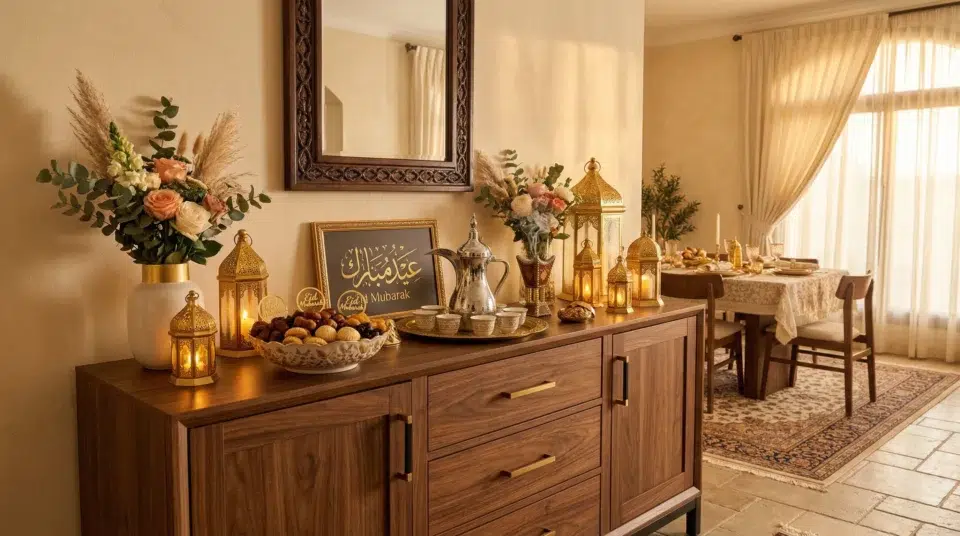
Three changes will modernise an existing buffet without replacement: first, swap the hardware, removing dated chrome or resin handles and replacing them with satin brass bar handles, which cost AED 80 to AED 200 and have an immediate visual impact. Second, restyle the surface using the rule of thirds: one functional zone, one decorative centrepiece, one seasonal element, with deliberate negative space between them. Third, add a low arrangement of dried or fresh botanicals, pampas grass, eucalyptus, or tropical foliage, in an architecturally interesting vessel. These three changes together can make a five-year-old buffet look entirely current for under AED 400.
FAQ 8: Which 2026 buffet trend works best for a UAE home with both Arab and Western aesthetic influences?
This is one of the most common questions from UAE families where both partners bring different cultural design languages to the home. The trend direction that bridges Arab and Western sensibilities most gracefully in 2026 is the warm, textured neutrals group: a fluted buffet in warm walnut tone, with satin brass hardware, styled with a mix of Arabic and contemporary decorative objects on the surface. The wood tone and brass carry the warmth and richness valued in Gulf aesthetics. The clean fluted form and horizontal proportion carry the contemporary Western clarity. It reads as intentional, global, and completely at home in a UAE dining room that is both. For specific product recommendations, our team is available via WhatsApp at +971 58 908 8107.
Conclusion
Three truths define buffet buying in the UAE for 2026: warmth has replaced sterility as the dominant design value, texture (fluted panels, natural rattan, marble grain) has replaced flatness, and the UAE buyer is confident enough to commit to pieces that express real personality rather than safe appeal to the broadest possible market. Whether you are refreshing a Business Bay apartment for Ramadan, furnishing a new villa in Arabian Ranches, or upgrading a Sharjah family home for the next decade, 2026 offers the most interesting and durable range of buffet design directions the UAE market has seen in a generation.
The Gulf has always had its own aesthetic vocabulary: warmth, richness, hospitality, the pleasure of beautiful objects in a space designed for gathering. The 2026 buffet trends arriving in UAE showrooms right now are not imports from Scandinavian design culture or European fashion cycles; they are interpretations of a global movement filtered through Gulf sensibility, Gulf climate, and Gulf family life. A fluted walnut sideboard with brass hardware is not trying to be a Stockholm apartment — it is trying to be exactly right for a Dubai dining room in 2026.
Visit our Sharjah showroom, browse the full range online, or WhatsApp us at +971 58 908 8107. Our team has been matching UAE families with the right furniture since 1988, and in 2026, the range available is the most exciting we have ever carried.
Ready to Bring 2026 Trends Into Your UAE Home?
Shop 2026 Buffets and Sideboards Online: Discover our full contemporary sideboard UAE collection
Visit Our Showroom: Industrial Area, Sharjah, UAE (Sat to Thu, 9 AM to 9 PM)
WhatsApp Us: +971 58 908 8107 (Trend advice, measurements, booking)
Call: +971 58 908 8107
Related Articles
- The Ultimate Guide to Buying Buffets in Dubai and the UAE (2026)
- TV Unit vs Buffet: How UAE Open-Plan Homes Use Both in 2026
- Wood vs High-Gloss Buffets: A UAE Climate Comparison
- Best Buffet Sizes for Dubai and Abu Dhabi Apartments
- Buffets Under AED 5000: The UAE Buyer’s Shortlist
Ready to Bring 2026 Buffet & Sideboard Trends to Your UAE Home?
You’ve just explored the biggest buffet and sideboard shifts for 2026, from Japandi warmth and fluted textures to sintered stone tops and statement colours that handle UAE humidity, majlis hosting, and family entertaining in villas and apartments alike. Now complete the look with matching pieces delivered free across Dubai, Sharjah, Abu Dhabi, and beyond, with free installation and free consultation included.
- → Buffets & Sideboards – 2026 trend-ready designs in Japandi, fluted, walnut, rattan & statement colours built for UAE climate & spaces
- → Living Room Furniture – Seamless open-plan collections that flow from your new buffet into majlis zones
- → Dining Tables – Matching tables in warm woods & stone tops perfect for large Eid & Ramadan gatherings
- → Coffee Tables – Centre & coffee tables echoing 2026 textures to unify your dining-living flow
- → Consoles – Slim entry & hallway consoles ideal for Dubai apartments & villa foyers
- → TV Media Units – Modern units that balance storage & style beside your trend-forward sideboard
- → Display Units – Glass & open displays showcasing your hosting pieces in luxury UAE homes
- → Center Tables – Low, wide tables in matching 2026 finishes for cohesive family entertaining spaces
- → Bookcases – Adjustable storage solutions that complement buffet organisation in multigenerational setups
- → Accent Chairs – Stylish chairs adding personality to dining corners around your new buffet
- → Sofas & Loveseats – Corner & modular sofas creating welcoming zones tied to your 2026 buffet aesthetic
✅ Free Delivery • ✅ Free Installation • ✅ Free Consultation across the UAE
💬 WhatsApp Us Now – Mention “2026 Buffet Trends” for priority advice