
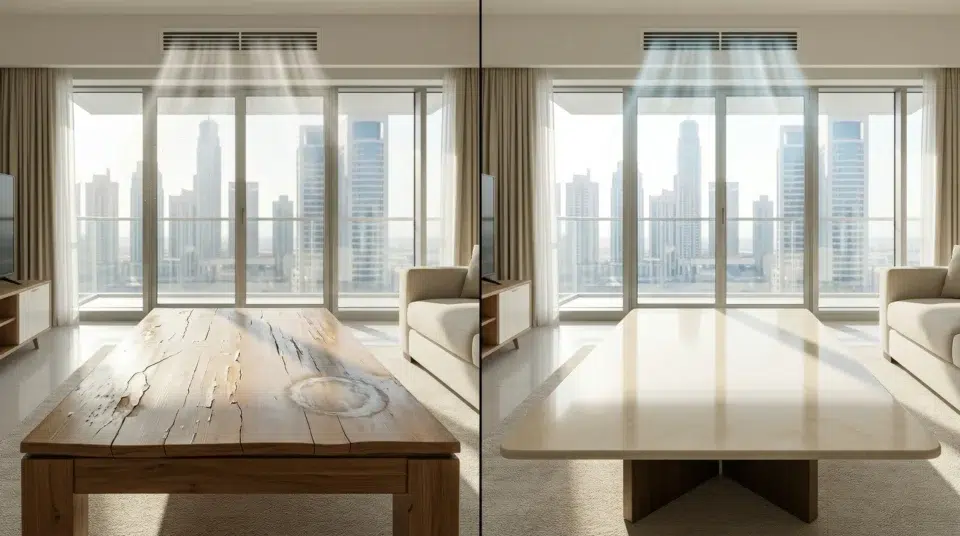
Every week, our customer care team at Karnak Home receives a variation of the same message from families across Dubai, Abu Dhabi, and Sharjah: “The center table I bought six months ago is already warping, and the frame has rust spots. What went wrong?” What went wrong is rarely poor quality in the conventional sense. What went wrong is that the wrong material was placed inside a UAE home without understanding how brutally specific the Gulf climate is on furniture. The combination of air-conditioning that drops interiors to 20 degrees Celsius while outdoor temperatures exceed 45 degrees, Shamal winds carrying abrasive dust through every window seal, and coastal humidity in areas like Ajman and Fujairah reaching 90% creates conditions no generic furniture guide addresses. This article does.
For 36 years, Karnak Home has delivered and installed center tables in over 70,000 UAE homes, from studios in Al Nahda and Deira to grand villas on Saadiyat Island and in Arabian Ranches. Our delivery and installation teams observe the results of material choices years after purchase, which gives us a perspective no catalogue description or online review can replicate. We know which materials survive the Gulf climate and which ones quietly fail within months, and this guide exists to share that knowledge with every UAE family making this decision in 2026.
By the end of this article, you will understand precisely why each major center table material succeeds or struggles in UAE conditions, what maintenance each surface genuinely requires in this climate, which combinations of top and frame perform best across different home types and budgets, and the eight most damaging material mistakes UAE buyers make. Our center table material guide for UAE buyers is right here.
Why the UAE Climate Destroys the Wrong Center Table Materials
The Temperature Cycling Problem: From 45 Degrees Outside to 20 Degrees Inside
The most damaging condition for furniture materials in UAE homes is not the heat alone. It is the relentless temperature cycling that occurs every time a door opens or the air conditioning cycles on and off. In a Dubai apartment in July, the outdoor temperature is 45 degrees Celsius while the interior is maintained at 20 to 22 degrees. Every material in your living room expands and contracts with these temperature shifts, and over hundreds of cycles across a single summer, materials that are structurally vulnerable begin to show it. Solid wood joints develop hairline cracks. Unsealed MDF swells at the edges where moisture enters. Natural stone develops micro-fractures that eventually cause surface chipping near the edges of the top. Understanding this cycling effect is the foundation of every smart material decision for a center table in UAE homes.
Coastal Humidity: Why Fujairah, Ajman, and Dubai Marina Are Different
Families living in coastal areas of the UAE face a secondary challenge beyond temperature cycling. Coastal humidity in Fujairah, Ajman, the Dubai Marina waterfront, and Abu Dhabi Corniche-facing buildings regularly reaches 70 to 90% during the summer months. At these humidity levels, any furniture material with even minimal moisture sensitivity begins to degrade. Metal frames without a proper protective coating develop surface oxidation within a year. Untreated wood surfaces absorb ambient moisture and can swell by several millimetres across a table width, pushing apart joinery, buckling surface veneers, and creating an uneven top that rocks on the base. This is the specific failure mode behind most of the metal furniture rust that UAE families report after their first coastal summer.
Shamal Wind and the Dust Accumulation Factor
Between March and August, the Shamal wind carries fine desert silica dust across the entire UAE, from Ras Al Khaimah in the north to Al Ain and Abu Dhabi further south and west. This dust is microscopically abrasive and penetrates apartment buildings through every imperfect seal around windows and doors. On a center table, Shamal dust settles as a fine layer that, when wiped dry with a cloth, acts like very fine sandpaper across the surface. Polished marble develops a subtle haze over time when wiped dry without moisture. Natural wood with an oil finish loses its lustre faster than lacquered wood for the same reason. The scratch-resistant center table that UAE families genuinely need is one with a surface hardness that repels light abrasion from daily cleaning.
Wood Center Tables in the UAE: What Actually Works
Solid Wood: Beautiful but Vulnerable Without Precautions
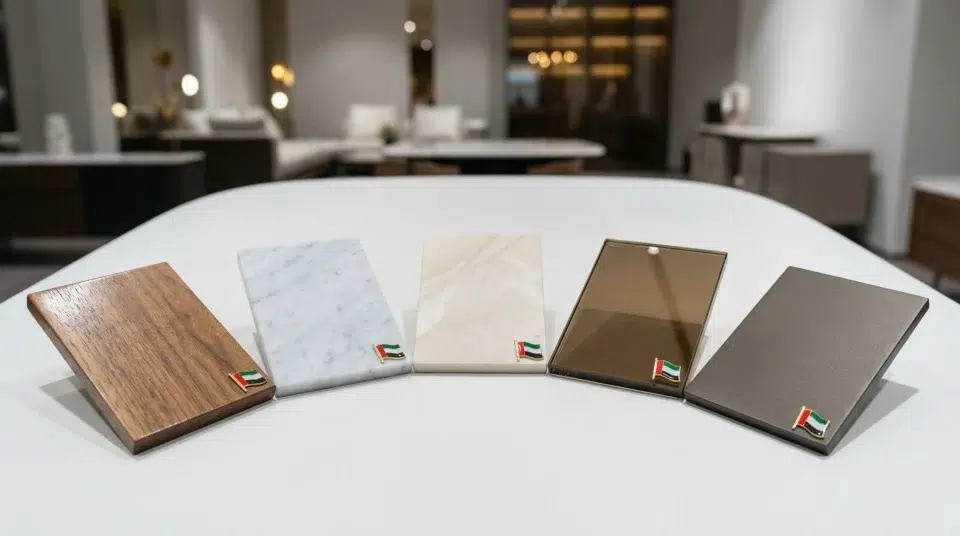
Solid hardwood center tables in teak, oak, and walnut are among the most sought-after choices in UAE villa living rooms, particularly in Arabian Ranches, Jumeirah, and the larger villas of Abu Dhabi. The appeal is entirely understandable: solid wood carries genuine warmth, improves in character as it ages, and can be professionally resurfaced if the top develops deep scratches. The challenge in the UAE is specific. Solid wood is hygroscopic, meaning it absorbs and releases moisture in response to ambient humidity. In a coastal apartment in Ajman or Dubai Marina, where indoor humidity can oscillate between 30% in winter and 70% in summer, this movement is substantial. Teak performs best of all the hardwoods in the UAE because its natural oil content provides inherent moisture resistance. However, even teak requires an annual coat of teak oil in the UAE climate to maintain its performance and prevent the surface from greying and drying.
Engineered Wood: The Consistent Performer for UAE Apartments
For apartments across JVC, Silicon Oasis, Business Bay, and Al Nahda, engineered wood with a lacquered real-wood veneer is the best wood for furniture, UAE climate conditions demand. An MDF or HDF core topped with a genuine wood veneer and sealed with a UV-cured polyurethane lacquer delivers visual warmth identical to solid wood with dramatically superior dimensional stability. The lacquer coat seals every pore, preventing moisture absorption from humid coastal air and protecting against the Shamal dust abrasion problem entirely. When choosing engineered wood center tables, always confirm that the edge banding and all raw edges are fully sealed with the same lacquer finish. Exposed raw MDF edges are the single most common failure point and will swell and delaminate if moisture reaches them in a humid environment.
Marble Center Tables: The Truth UAE Buyers Need
Natural Marble: Stunning and Specific in Its Demands
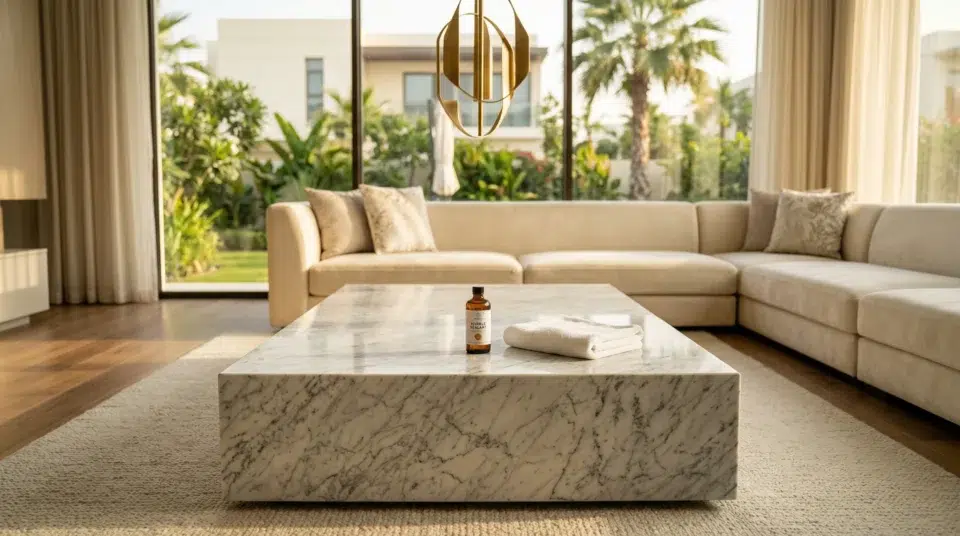
Natural marble center tables are one of the most requested pieces in our Sharjah showroom, particularly from families furnishing villas in Dubai Hills, Jumeirah Park, and Abu Dhabi. The appeal is obvious: no manufactured material replicates the depth of veining, the cool surface temperature, and the sheer visual authority of a genuine marble slab. The reality of marble center table maintenance in Dubai homes is more demanding than most buyers anticipate. Natural marble is calcium carbonate, which means it reacts chemically with acids. Every day in a UAE home, acidic substances come into contact with surfaces: karak chai, orange juice, pomegranate juice, lemon-based cleaning products, and even the mild carbonic acid in sparkling water. Each contact etches the marble surface, leaving a dull ring that polishing can reduce but not always fully eliminate.
For a UAE family home with children under twelve, the daily risk level makes unsealed natural marble a high-maintenance choice. The fix is straightforward: confirm at purchase that the table includes a factory-applied penetrating impregnating sealer, and plan to reseal it professionally once per year. A properly sealed marble surface resists staining for twelve months in typical UAE household use. The sintered stone vs marble Dubai comparison comes down entirely to lifestyle: natural marble for formal, lower-traffic settings; sintered stone for active family homes.
Sintered Stone: The Climate-Proof Choice for UAE Family Homes
Sintered stone, marketed under brand names such as Dekton and Neolith, is produced by compressing natural mineral particles under extreme heat and pressure to create a surface of near-zero porosity. This manufacturing process makes sintered stone entirely stain-proof, acid-resistant, UV-stable, and scratch-resistant to a hardness that surpasses natural marble significantly. For the UAE climate specifically, sintered stone offers two additional advantages that no other material can match. First, it does not fade or discolour under the intense direct UV exposure that fills large-window villa and apartment living rooms in Dubai, Abu Dhabi, and Ras Al Khaimah for 300-plus days per year. Second, its thermal stability under the temperature cycling conditions described earlier is superior to that of every other surface material, including solid stone. Our installation teams consistently recommend sintered stone tops on our center table collection to families with young children, pets, or high-traffic living rooms anywhere in the UAE.
Glass Center Tables: The Complete Picture
Tempered Glass: Practical and Visually Light
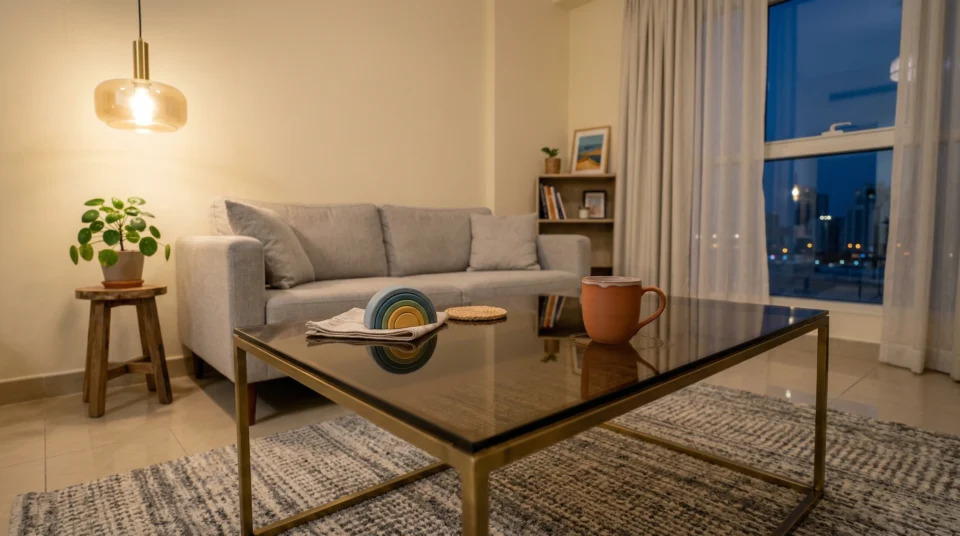
Tempered glass center tables remain one of the most popular choices in UAE apartments precisely because they address the small-space challenge visually. A glass top does not interrupt sightlines across the room, reflects available natural light to brighten compact apartments in Deira, Al Nahda, and older Sharjah buildings, and wipes clean in seconds from spills, dust, and fingerprints. Glass table humidity Dubai considerations centre on two specific issues. First, the intense condensation that forms on cool glass surfaces from cold cups in humid summer air leaves water rings that, while temporary, require prompt wiping to prevent mineral deposits from the UAE’s hard tap water from etching the surface over time. Second, in coastal homes in Ajman and Fujairah, glass surfaces require more frequent cleaning to remove the salt residue that humid coastal air deposits on interior surfaces.
Metal Frames: The Most Overlooked Decision in UAE Center Tables
Powder-Coated Steel: Accessible and Effective When Applied Correctly
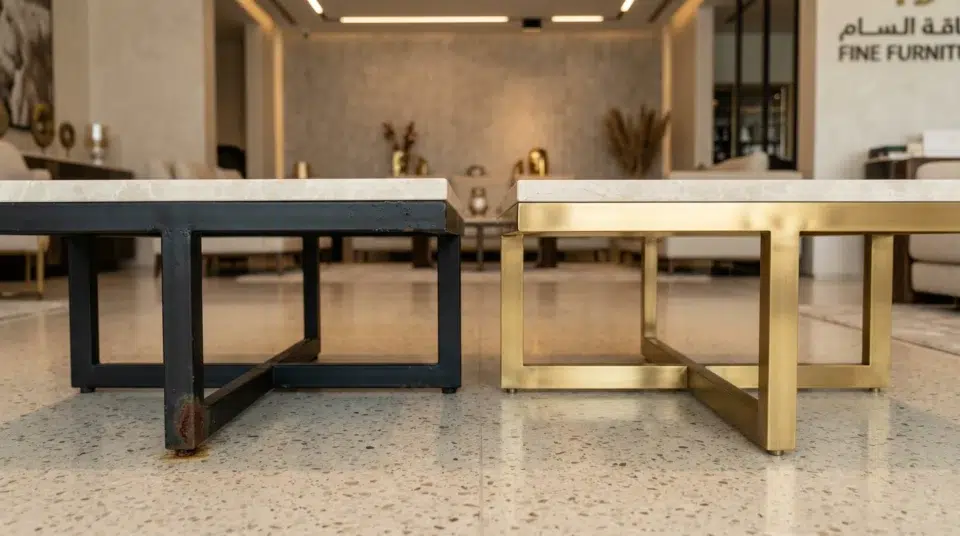
Powder-coated steel frames represent the most practical and affordable metal frame option for UAE center tables across all budget tiers. The powder coat creates a protective polymer skin over the steel substrate that, when applied correctly to a properly primed and cleaned surface, resists oxidation in coastal humidity and repels the alkaline dust of the UAE interior. The word “correctly” is critical: powder-coated frames produced with inadequate primer layers or thin coating applications develop rust spots at edges and weld points within twelve to eighteen months in coastal areas such as Dubai Marina and Abu Dhabi. When evaluating powder-coated frame quality, run your fingernail firmly across a weld point. A coating that flakes or feels papery at a weld point will fail at that location within the first UAE summer.
Brushed Brass and Brushed Stainless Steel: The Climate-Proof Premium
Brushed brass and brushed stainless steel frames are the correct choice for any center table intended to last a decade or more in a UAE home, particularly in coastal areas or high-humidity buildings. Brass naturally develops a warm patina in humid environments that enhances rather than damages its appearance. Brushed stainless steel is impervious to all forms of oxidation and maintains its appearance without any maintenance beyond periodic wiping. Both finishes also hide minor surface contact marks far better than polished chrome, which shows every fingerprint and water mark in the intense natural light that fills UAE villa living rooms for most of the year. Metal furniture rust in UAE families almost exclusively occurs in polished chrome and inadequately coated steel, never in properly brushed or solid brass and stainless constructions.
8 Center Table Material Mistakes UAE Buyers Make in 2026
Mistake 1: Choosing Solid Wood Without Knowing the Building’s Humidity Level
Families moving into a new apartment in a coastal area of Dubai Marina or Ajman often purchase a solid wood center table without knowing the building’s typical indoor humidity range. In buildings with ageing ventilation or reduced air conditioning capacity, indoor humidity can sit above 60% for months on end, which is well beyond the safe operating range for untreated solid wood. The fix: before purchasing solid wood for a coastal UAE address, ask our team at Karnak Home to recommend an engineered wood alternative with a fully sealed lacquered surface that delivers the identical look with zero moisture risk.
Mistake 2: Placing Natural Marble Without a Sealer in a Family Home
An unsealed marble table in a household with young children is a staining event waiting to happen. Karak chai, which is a staple in virtually every UAE home from Jumeirah to Al Ain, creates a permanent tannin stain on unsealed marble within minutes. The fix: always confirm the table includes a factory penetrating sealer, and reseal every twelve months using a UAE-available stone sealer from any hardware outlet in Sharjah or Dubai.
Mistake 3: Buying Polished Chrome Frames Near a Coastal Location
Polished chrome develops surface oxidation spots in high-humidity coastal environments and requires constant wiping to remain presentable under the strong natural light in modern UAE apartments. The fix: choose brushed stainless steel or powder-coated frames for all coastal addresses in Fujairah, Ajman, Dubai Marina, and Abu Dhabi Corniche-facing buildings.
Mistake 4: Using Glass Without Hard-Water Stain Prevention
UAE tap water has an extremely high mineral content. When water from a glass, condensation from a cold cup, or a cleaning wipe with plain tap water evaporates on a glass table surface, it leaves a white mineral deposit that builds up into permanent clouding over time. The fix: always dry glass surfaces immediately after any moisture contact, and use a diluted distilled white vinegar solution for monthly deep cleaning to dissolve mineral deposits before they etch the glass.
Mistake 5: Selecting Rattan or Natural Fibre Inserts for UAE Apartments
Rattan woven shelves, wicker elements, and natural fibre inserts on center tables have appeared in international interior design trends. In the UAE, these materials absorb humidity, develop mould spots in coastal areas, and become structurally weakened by the temperature cycling effect within one to two years. The fix: choose center tables where any shelf or lower tier is made from sealed wood, sintered stone, or tempered glass rather than any natural fibre weave.
Mistake 6: Ignoring UV Fading on Coloured or Dark-Toned Tables
Many UAE apartments and villas have large windows with minimal UV filtration. A dark-stained wood center table positioned near a sunny window in a Downtown Dubai or JVC apartment can fade unevenly within a single summer, creating a patchy, bleached appearance. The fix: choose UV-resistant finishes such as factory-lacquered wood, sintered stone, or powder-coated metal for any center table placed within two metres of a large west-facing window. UV-resistant furniture Dubai selection starts with confirming the surface finish type before purchase.
Mistake 7: Choosing Very Thin Glass Tops for Heavy-Use Family Tables
Six-millimeter glass tops are common in lower-priced center tables. In a family home where children lean across the table, place heavy books, or sit on the edge, six-millimeter glass carries a real risk of flexing under uneven load and, in rare cases, shattering. The fix: for any family home with children under fifteen, select a minimum of 10 millimeters of fully tempered safety glass. Confirm with the retailer that the glass is tempered, not annealed, which is a critical safety distinction.
Mistake 8: Buying a Premium Material Without Confirming UAE After-Sales Support
Some buyers invest in high-end marble or sintered stone tables from brands without a UAE service presence. When the surface develops an issue or the frame requires adjustment after delivery, there is no local support available. The fix: purchase from a UAE-based retailer with a physical showroom, a local installation team, and a direct WhatsApp contact for after-sales queries. At Karnak Home, our team at +971 58 908 8107 handles all post-delivery questions for every table in our living room furniture collection.
Center Table Materials: 2026 Budget Guide in AED
| Tier | AED Range | Materials Available | Best UAE Home Type |
|---|---|---|---|
| Budget | AED 299 to AED 799 | Lacquered engineered wood, 6mm tempered glass, powder-coated steel frames | Sintered stone (Dekton, Neolith), natural marble with factory sealer, travertine, solid brushed brass, or stainless frames |
| Mid-Range | AED 800 to AED 2,499 | Studios and one-bed apartments in Al Nahda, Deira, Ajman, and older Sharjah areas | Two and three-bed apartments in JVC, Silicon Oasis, Business Bay, Mirdif |
| Premium | AED 2,500 to AED 7,000 plus | Sintered stone (Dekton, Neolith), natural marble with factory sealer, travertine, solid brushed brass or stainless frames | Villas in Arabian Ranches, Dubai Hills, Jumeirah, Saadiyat Island, Abu Dhabi |
10 Expert Tips from 36 Years of UAE Furniture Deliveries
In our 36 years, we have seen the full spectrum of material performance in UAE homes, and these ten tips distil the most consistent lessons our team shares with customers every week.
Tip 1: In our 36 years, we have seen more solid wood tables returned with warping complaints from apartments in Deira and Al Nahda than from any other building type in the UAE. Older buildings in these areas tend to have inconsistent air conditioning performance, which creates the exact humidity fluctuation conditions that damage solid wood most rapidly.
Tip 2: Always buy a pack of high-quality silicone coaster sets when purchasing a glass or marble center table. The combination of UAE hard water condensation and cold ceramic cups creates the majority of surface staining issues we see on follow-up visits. This is a ten-dirham solution that protects a two-thousand-dirham table.
Tip 3: For villa owners in Arabian Ranches or Jumeirah who want natural marble, we always recommend requesting a marble sample from the showroom and placing it in direct sunlight from your largest west-facing window for three days. This confirms whether the particular marble batch has any unusual UV sensitivity before you commit to the full piece.
Tip 4: If you have a dining table with a wood finish, your center table does not need to match it exactly. In our experience, UAE homes that pair a warm wood dining table with a sintered stone center table achieve a more sophisticated and considered layering of materials than rooms where every piece matches identically.
Tip 5: In our 36 years, we have seen the Shamal season damage the surface finish of rattan and natural cane shelf inserts on center tables faster than any other material in the UAE. If you see a center table with woven natural fibre elements and you live anywhere in the UAE interior or near the Hajar mountain foothills of Ras Al Khaimah, avoid it entirely.
Tip 6: For families with pets, particularly cats who jump onto furniture, choose a sintered stone or lacquered engineered wood top rather than natural marble. Cat claws on unsealed natural marble leave surface scratches that are expensive to professionally buff out and cannot be repaired at home. Sintered stone at grade five hardness resists cat claws entirely.
Tip 7: When choosing a center table to complement accent chairs in your living room, match the frame metal finish to the chair leg metal rather than the chair upholstery. This small detail creates a sense of deliberate material coordination that elevates the entire room’s design coherence.
Tip 8: In our experience delivering to high-floor apartments in Business Bay and DIFC, families on floors above the twentieth level experience significantly more direct UV exposure through glass facades than those on lower floors with shade from surrounding buildings. At these elevations, always choose sintered stone or UV-lacquered wood over natural marble, which can develop subtle bleaching at the surface near the window edge within a single year of intense direct exposure.
Tip 9: We consistently advise customers in Ras Al Khaimah and Fujairah, where summer temperatures push outdoor furniture storage into question, that no center table material is suitable for extended outdoor use in the UAE. Even materials marketed as outdoor-safe will degrade under the combined UV intensity, salt humidity, and Shamal abrasion of a UAE summer. All center tables belong indoors, positioned away from the direct path of air conditioning vents.
Tip 10: When a customer tells us they want a premium material but has a mid-range budget, our recommendation is always to invest in a higher-quality base frame rather than the top surface. A sintered stone top on a budget powder-coated frame will look degraded within two years when the frame develops surface oxidation. A more modest marble-look porcelain top on a solid brushed steel frame will look as good on delivery day as it does in year five. The frame carries the longevity; the top carries the style.
Frequently Asked Questions
What is the best center table material for a Dubai apartment with young children?
For families with young children in Dubai apartments across JVC, Silicon Oasis, Mirdif, and Business Bay, sintered stone tops on powder-coated or brushed steel frames are consistently the strongest choice. Sintered stone is completely non-porous, stain-proof, acid-resistant, and scratch-resistant to a degree that natural marble, glass, and wood surfaces cannot match. It survives direct contact with juices, karak tea, paint, and food without staining, and wipes clean with a damp cloth in seconds. Lacquered engineered wood is a close and more affordable alternative if your budget is in the mid-range tier. Visit our full center tables range to compare both material types with exact dimensions and AED pricing.
Does natural marble really stain in UAE homes?
Yes, unsealed natural marble stains readily in the daily conditions of a UAE family home. The issue is chemical rather than cosmetic: marble is calcium carbonate and reacts to acidic substances, including citrus juices, karak chai, coffee, pomegranate, and even sparkling water over repeated contact. The result is an etched patch that appears dull and slightly recessed compared to the polished surrounding surface. A factory-applied penetrating sealer significantly reduces this risk, but no sealer makes natural marble entirely stain-proof. For marble center table maintenance, Dubai families should follow: reseal once per year and wipe all spills immediately. If you prefer zero maintenance, sintered stone delivers an identical visual result with none of the porosity.
Which metal frame finish lasts longest in the UAE coastal areas?
Brushed stainless steel is the longest-lasting metal frame finish for center tables in coastal UAE areas, including Fujairah, Ajman, Dubai Marina, and Abu Dhabi Corniche-facing apartments. It is completely oxidation-proof, requires no coating that can chip or thin over time, and maintains its appearance with nothing more than an occasional wipe with a damp cloth. Brushed brass is a close second and develops a warm, natural patina in humid environments that many customers find adds character. Polished chrome and inadequately primed powder-coated steel are the finishes most vulnerable to metal furniture rust that coastal conditions in the UAE produce.
Is tempered glass safe for a family home with children in the UAE?
Tempered glass at 10 millimetres or above is a safe and practical choice for family homes with children, and it is the only glass specification we recommend for families at Karnak Home. The tempering process makes the glass approximately four times stronger than standard annealed glass and, in the rare event of breakage, causes it to shatter into small blunt granules rather than sharp shards. Always confirm with the retailer that the glass is fully tempered, not laminated or annealed. Pair your glass table with rounded or fully polished edges rather than sharp-cut edges for complete child safety. The glass table humidity Dubai considerations, primarily hard-water mineral deposits from condensation, are managed easily with a weekly diluted vinegar wipe.
How does air conditioning affect wood center tables in UAE apartments?
Air conditioning in UAE apartments creates two distinct challenges for wood center tables. First, the cold air itself is extremely dry, typically reducing indoor relative humidity to 30 to 40% in winter, which causes wood fibres to contract and can create surface checking (micro-cracks) in insufficiently sealed solid wood. Second, the temperature difference between the cold indoor environment and warm outdoor air creates condensation on any cool surface, including wood tabletops, when the air conditioning cycles off. Over time, repeated condensation cycles cause finish degradation on insufficiently lacquered wood surfaces. Engineered wood with a UV-cured polyurethane lacquer resists both conditions significantly better than oil-finished or wax-finished solid wood for UAE apartments.
Can I use a center table outdoors in my UAE villa courtyard?
We strongly advise against placing any standard indoor center table in a UAE outdoor space, including covered villa courtyards, balconies, and terraces. The UAE’s outdoor conditions, combining direct UV radiation of extreme intensity, periodic desert dust storms, coastal salt humidity, and nighttime temperature drops, will degrade every indoor furniture material within one to two seasons. If you need occasional outdoor seating around a central table in a villa courtyard in Arabian Ranches or a Jumeirah garden, use purpose-built outdoor furniture rated specifically for UAE climate conditions. Bring the pieces indoors during the Shamal season.
What is the difference between sintered stone and marble-look porcelain for a center table top?
Both materials offer a visual replica of natural marble, but their performance levels differ significantly. Sintered stone such as Dekton achieves a surface hardness and density that approaches natural rock, with near-zero porosity and superior scratch resistance. Marble-look porcelain is a ceramic tile product baked at lower temperatures and achieves a surface hardness lower than sintered stone, making it more susceptible to chipping at edges under impact. For a center table that will see daily family use in a Dubai or Abu Dhabi home, sintered stone is the higher-performance choice. Porcelain tops offer a convincing visual result at a lower AED investment and are a sound mid-range choice for adults-only households or lower-traffic rooms.
How do I clean and maintain a sintered stone center table in a UAE home?
Sintered stone is the lowest-maintenance center table surface available for UAE homes. For daily cleaning, wipe with a slightly damp microfibre cloth to remove dust and any surface residue, then dry with a clean dry cloth to prevent hard-water mineral deposits from forming. For deeper weekly cleaning, any pH-neutral household cleaner diluted in water is entirely safe on sintered stone. Avoid abrasive scrubbing pads, bleach in concentration, and any silicone-based polishes, which can leave a slippery residue on the surface. Sintered stone requires no sealing at any point in its life. For any further material care advice, WhatsApp our team at +971 58 908 8107, and we will respond with specific guidance for your table model and surface type.
Conclusion
The UAE climate is genuinely unique in the demands it places on every material inside your home, and understanding the specific mechanisms of temperature cycling, coastal humidity, and Shamal dust abrasion gives you an immediate and decisive advantage over every buyer who chooses a center table by appearance alone. Sintered stone and properly lacquered engineered wood deliver the best combination of UAE climate performance, low maintenance, and family practicality, while natural marble remains a magnificent choice for villa settings where the maintenance commitment is embraced rather than overlooked.
At Karnak Home, 36 years and over 70,000 UAE home deliveries have taught us that the families who are most satisfied with their center tables years after purchase are those who asked one question before buying: “How does this material behave in my specific UAE home?” Families in coastal Fujairah and Ajman need different solutions from families in dry-interior Al Ain and Ras Al Khaimah. Villa owners in Arabian Ranches have different priorities than renters in compact JVC apartments. This guide exists to ensure you ask the right questions and receive answers grounded in UAE-specific experience rather than generic international design advice.
Visit our Sharjah showroom to feel every material surface in person, compare finishes under natural light, and have our consultants recommend the exact center table for your room dimensions, family size, and UAE home type. Alternatively, WhatsApp our team for a personalised material recommendation based on your specific address and household needs.
Ready to Choose the Right Material for Your UAE Home?
Shop Climate-Tested Center Tables Online: Browse our center table collection engineered for UAE homes
Visit Our Showroom: Industrial Area, Sharjah, UAE (Saturday to Thursday, 9 AM to 9 PM)
WhatsApp Us: +971 58 908 8107 (Material samples, swatches, expert guidance)
Call: +971 58 908 8107