
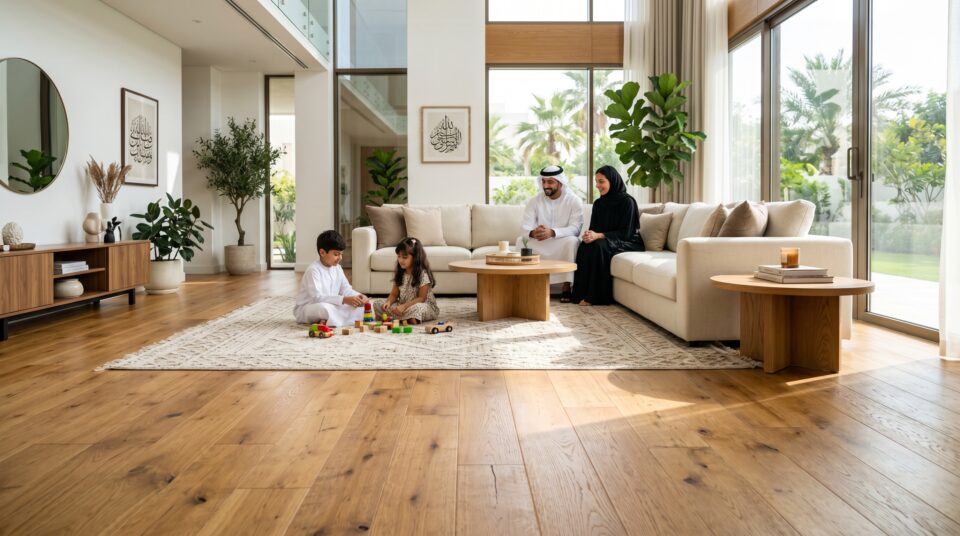
Walk into almost any Dubai property built before 2015 and you will find the same floor: cold, beige ceramic tile that looked practical in the developer brochure and looked dated by the time the family moved in. For homeowners in Jumeirah Village Circle, Arabian Ranches, and Dubai Silicon Oasis — and for office managers fitting out spaces in Business Bay and DIFC — the question is no longer whether to upgrade the floor, but how to choose the right material for a climate and lifestyle that most flooring guides written for European or American readers simply do not account for.
At Karnak Home, we have been delivering and installing flooring across the UAE since 1988. In that time we have served more than 70,000 families, fitted out commercial offices from Abu Dhabi to Fujairah, and watched every major flooring trend arrive in the UAE, succeed or fail, and either become a staple or disappear. That history gives us a practical understanding of what actually works on a concrete subfloor in a 45-degree summer, what fails after two years of heavy AC cycling, and what the difference between a premium installation and a rushed one looks like twelve months later.
This guide covers everything you need to make a confident flooring decision in 2026. We will walk through every major material category — Luxury Vinyl Tile, carpet tiles, and parquet and engineered hardwood — explain why each one performs differently in UAE conditions than in the climates it was originally designed for, give you a complete 2026 price guide in AED, list the eight most common mistakes UAE buyers make, and answer the eight questions our showroom team hears most often. By the end you will know exactly what to specify, what to budget, and what questions to ask any flooring contractor in Dubai before work begins.
Why Flooring Services in Dubai Are Different From Everywhere Else in 2026
If you have previously renovated a home in the UK, Europe, or North America, your flooring instincts are probably wrong for Dubai. The materials that perform beautifully in those climates can fail quickly here, and the reasons are not obvious until you understand the specific stresses that UAE properties place on floor finishes.
The UAE Climate Creates Conditions Most Flooring Was Never Designed For
Dubai’s climate is characterised by heat extremes that few residential or commercial flooring products were originally engineered to handle. Outdoor temperatures above 45 degrees Celsius are routine from June through September. Unoccupied properties — a holiday villa on Palm Jumeirah, an apartment between tenants in JLT — can reach interior temperatures above 55 degrees. This level of heat causes dimensional changes in any organic or semi-organic material: solid wood swells, contracts, and eventually cracks or buckles. Some adhesives soften and release. PVC-based products without proper stabilisation can warp permanently.
The second climate factor is humidity variation. Coastal communities — Dubai Marina, JBR, Palm Jumeirah — experience summer humidity above 80 percent. Inland communities like Motor City, DAMAC Hills, and Dubai South can drop 30 percent relative humidity below during the winter months. A wood floor that adjusts to high coastal humidity and then experiences a dry winter does not return to its original dimensions. Over two or three seasonal cycles, the cumulative movement produces visible gapping, cupping, or surface distortion.
Dubai Apartments Present Specific Structural Challenges
The majority of Dubai’s residential property stock consists of mid-rise and high-rise apartments, not standalone villas. These apartments share structural concrete slabs between floors, and that creates three challenges that do not exist in freehold houses. Concrete subfloors retain moisture from construction for much longer than timber subframes, in some Dubai properties built during the 2008 to 2015 construction boom, residual construction moisture is still measurable in the subfloor. Sound transmission between floors is a major concern in apartment buildings, making acoustic underlay a practical necessity rather than an optional upgrade. And many Dubai apartments have existing ceramic or porcelain tile that developers installed at the base-build stage, understanding whether your new floor goes over that tile or replaces it changes both the product specification and the installation cost substantially.
Renters and the 78 Percent Reality
Approximately 78 percent of Dubai residents are renters. This shapes flooring decisions profoundly. Renters looking to improve their space need flooring that can be installed without permanent modification to the property, that can be removed cleanly at the end of a tenancy, and that does not require landlord approval for invasive works. SPC LVT as a floating floor satisfies all three criteria: it clicks together without adhesive, sits directly on top of existing tile, and can be dismantled and moved to a new property. For tenants in Discovery Gardens, Deira, or Bur Dubai making a long-term rental feel like a home, this matters enormously.
Villa Owners in Gated Communities Face Different Decisions
Freehold villa owners in gated communities — Arabian Ranches, Jumeirah Golf Estates, Al Barari, Mudon — are making a long-term investment in a property they often own for a decade or more. Their flooring decision is an asset decision, not just an aesthetic one. Premium engineered parquet flooring in Dubai consistently adds measurable value to villa resale prices. The right specification — 4 mm veneer, 9-ply core, UV-stable oil finish — can last 25 to 30 years with proper maintenance. The wrong specification, however well-intentioned, may need full replacement within five to seven years.
The Majlis Dimension — Culture Shapes Flooring Decisions in the UAE
No flooring guide for the UAE is complete without acknowledging the majlis. The traditional Arabic reception room — present in most Emirati and Gulf Arab homes, and increasingly specified by Arab expat families from Lebanon, Jordan, Egypt, and beyond — has specific flooring requirements. The floor is both a functional surface and a social statement. Guests sit on floor cushions. Incense holders sit directly on the floor. Prayer rugs are placed and removed daily. Flooring in a majlis must be easy to clean, resistant to incense residue and perfume oil staining, and aesthetically appropriate to a formal reception context. Large-format porcelain tile, natural stone effect LVT flooring in Dubai, and traditional patterned tiles all serve this space well. Carpet tiles do not.
H3: Multigenerational Living and Pet Households Are Reshaping UAE Specifications
Dubai in 2026 is home to a growing number of multigenerational households — grandparents, parents, and children sharing a villa — as well as a significant and rapidly growing pet-owning population. Both groups place unusual demands on flooring. Elderly residents need slip-resistant surfaces that provide grip even in bare feet on a cool morning. Young children need surfaces that cushion falls and do not harbour allergens. Pets, particularly large dogs and cats with claws, need flooring with genuine surface hardness and abrasion resistance. Commercial-grade LVT with a 20 mil wear layer handles all three groups better than almost any alternative at a comparable price point.
The Five Flooring Categories That Define the UAE Market in 2026
Luxury Vinyl Tile — Why LVT Dominates Dubai Residential Installations
LVT has become the dominant residential flooring material in Dubai not because of marketing, but because it genuinely outperforms the alternatives on the criteria that matter most in this market. It is 100 percent waterproof, dimensionally stable across the temperature and humidity ranges UAE properties experience, available in high-quality wood and stone visual effects, and — in its SPC core format — rigid enough to install as a floating floor over almost any existing surface.
The specification detail that separates adequate LVT from excellent LVT in the UAE context is the wear layer. Standard residential LVT carries a 12 mil wear layer. In UAE conditions — where fine desert sand acts as a continuous abrasive on any floor surface and cleaning involves frequent damp mopping — 12 mil wears noticeably faster than it does in comparable European properties. At Karnak, we recommend a minimum 20 mil wear layer for all residential areas and 28 mil for any commercial or high-traffic application. The cost difference between 12 mil and 20 mil LVT is typically AED 15 to 25 per square metre — money that pays for itself many times over in extended product life.
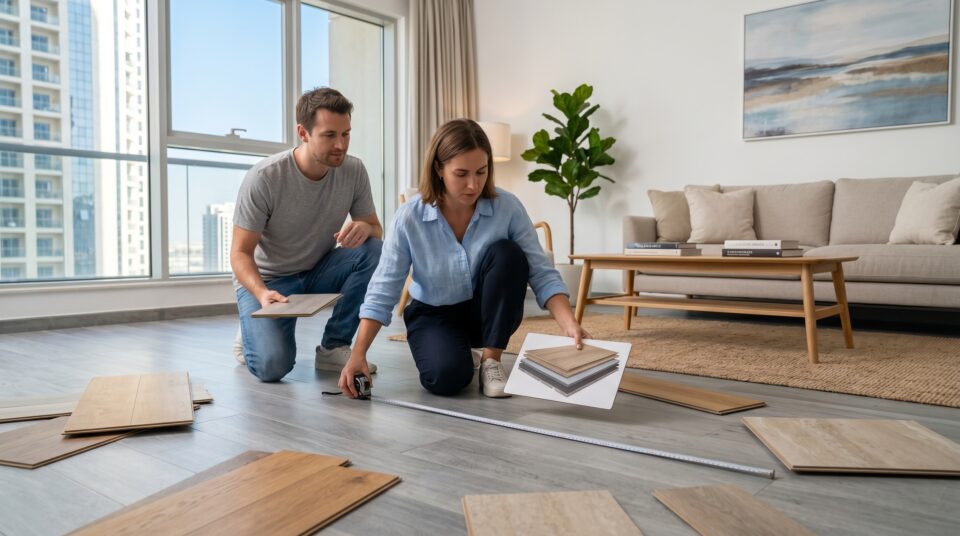
SPC (Stone Plastic Composite) core LVT is the correct choice for virtually all Dubai over-tile installations. Its rigid mineral-composite core does not flex under point loads, handles thermal expansion without buckling, and produces a floor surface that feels and sounds like a hard material underfoot — unlike flexible WPC LVT, which can feel slightly hollow. For the common Dubai renovation scenario of installing new flooring directly over existing porcelain or ceramic tile, SPC LVT with a 2 mm integrated underlay is the standard specification.
WPC (Wood Plastic Composite) core LVT has a foamed core that provides slightly more cushioning. In temperate climates this is valued for bedroom comfort. In Dubai, where AC reduces floor surface temperatures considerably, the marginal comfort benefit of WPC over SPC is negligible, and SPC’s superior thermal stability makes it the better specification in almost every scenario.
Carpet Tiles — The Commercial Standard and the Residential Opportunity
Carpet tiles — modular 50 x 50 cm carpet squares — dominate UAE commercial flooring for reasons that translate directly to residential spaces that see high foot traffic or need acoustic performance. In open-plan offices in Business Bay, DAFZA, or Dubai Internet City, carpet tiles reduce ambient noise levels by 8 to 12 dB compared with hard floors. In residential media rooms, children’s bedrooms, and home offices in villas across Emirates Hills and Al Barsha, the same acoustic benefit applies.
The practical advantage of carpet tiles in the UAE is their replaceability. Individual tiles that sustain staining, burning, or heavy furniture indentation are simply removed and replaced. In a 200 square metre office fitted with carpet tiles, a coffee machine spill that ruins a 1 square metre area costs the price of four replacement tiles and twenty minutes of installation time. The same spill on broadloom carpet triggers a full replacement discussion.
Specify carpet tiles for UAE environments with bitumen or glass-fibre backing, which is dimensionally stable under temperature fluctuation. Anti-static treatment is essential in air-conditioned commercial spaces. For any installation directly on concrete subfloor — which describes almost every base-build commercial space in Dubai — specify tiles with an integrated moisture barrier backing.
Parquet and Engineered Hardwood — Getting Timber Right in the UAE
Parquet flooring in Dubai requires a different specification conversation than anywhere else in the world. The question is never simply which wood species or pattern looks best; it is which construction and finish can survive the specific stresses of a UAE property without requiring replacement within a decade.
Solid hardwood is unambiguously the wrong choice for most Dubai applications. Seasonal movement of 3 to 5 mm per linear metre of board width is typical in UAE conditions, producing visible gapping in winter and potential cupping or buckling in summer. Most experienced Dubai interior designers have stopped specifying solid hardwood for primary living spaces.
Engineered hardwood — a real wood veneer of 2 to 6 mm bonded to a multi-ply HDF core — behaves fundamentally differently. The cross-ply construction reduces dimensional movement by approximately 70 percent compared with solid wood, making it a viable and beautiful choice for Dubai villas when correctly specified. The critical specification points are: a minimum 3 mm wear veneer (allowing at least one sand-and-refinish), a 7-ply or 9-ply core (more plies means more stability), and a UV-stable oil or lacquer surface finish to resist solar fade in rooms with glass exposure. A mandatory 7 to 10 day on-site acclimatisation period — boards stacked in the room they will be installed in, with the AC running at normal household settings — is non-negotiable before installation begins.
Herringbone and chevron parquet patterns remain the premium choice for Dubai villa master bedrooms, formal dining rooms, and entrance halls. At Karnak, our parquet installation team in Dubai regularly installs herringbone in villas across Jumeirah, Mirdif, and The Villa development in Dubailand.
Porcelain and Stone Effect Tile — The Enduring UAE Standard
Large-format porcelain tile remains the dominant flooring material in new UAE developments for good reason: it is genuinely impervious to moisture, heat, sand, and UV, requires no acclimatisation, tolerates every cleaning product on the market, and when properly installed on a well-prepared screed, can last the lifetime of the building. For bathrooms, kitchens, external covered terraces, and pool surrounds, porcelain tile is still the correct first choice.
The specification shift in 2026 is toward larger formats — 80 x 80 cm and 100 x 100 cm tiles are now the standard in premium Dubai residential projects, replacing the 60 x 60 cm tiles that dominated the market for the previous decade. Larger formats produce fewer grout lines, a cleaner aesthetic, and easier maintenance.
Laminate Flooring — Honest Advice for UAE Buyers
Laminate flooring — a photographic wood or stone print bonded to an HDF core — is widely available in the UAE at attractive price points. It deserves an honest assessment rather than either promotion or dismissal. Standard laminate is not appropriate for UAE kitchens, bathrooms, or laundry areas: it is not waterproof, and moisture damage to the HDF core is irreversible. In dry bedroom or study applications with stable AC and no moisture risk, good-quality laminate (AC4 rating minimum, 12 mm thickness) performs acceptably. However, the price gap between quality laminate and entry-level SPC LVT has narrowed significantly from 2025 to 2026, and LVT’s genuine waterproofing makes it a better choice at comparable price points for most UAE applications.
2026 Flooring Trends That Actually Work in UAE Homes and Offices
Wide Plank Formats Dominate Across All Material Categories
The single most consistent trend across all flooring categories in Dubai in 2026 is the move toward wider, longer plank and tile formats. In LVT, planks of 228 mm x 1524 mm have largely replaced the narrower 152 mm widths that were standard five years ago. In engineered hardwood, 200 mm wide boards are now more common than 120 mm boards in premium Dubai projects. In porcelain tile, 100 x 100 cm large slabs are entering residential projects that would previously have specified 60 x 60 cm.
The practical benefit of wider formats in UAE homes is fewer visual joints — and therefore a cleaner, more continuous surface that reads as more spacious in the compact apartment footprints common in JVC, Dubai Silicon Oasis, and International City.
Warm Neutrals Are Replacing Cool Greys
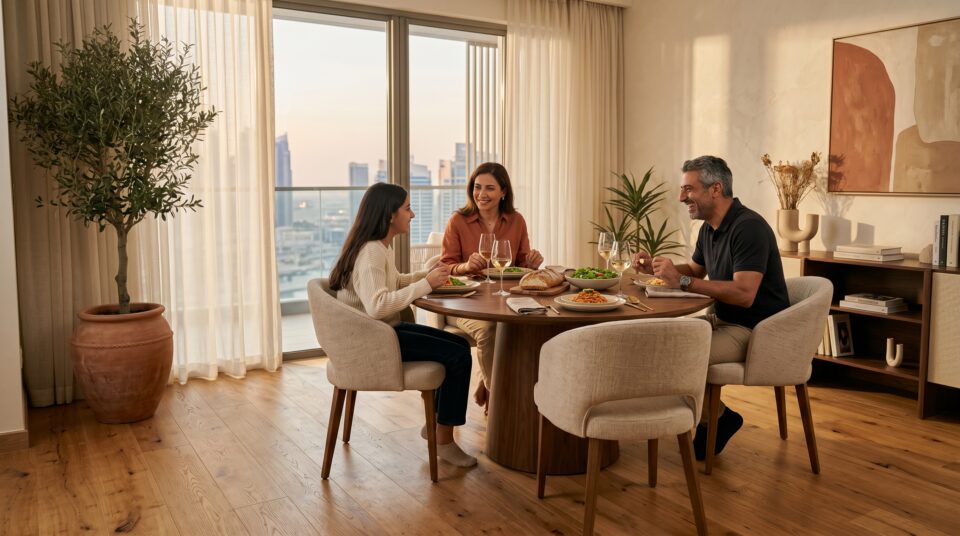
For the past five years, the dominant colour direction in Dubai residential flooring was cool grey: grey stone-effect LVT, grey-washed oak engineered boards, grey porcelain tile. In 2026, that direction has clearly reversed. Warm beiges, honey oaks, greige tones, and natural-feeling warm neutrals now dominate new showroom arrivals and the specifications coming through our design consultation service. This shift aligns with a broader interior design direction toward warmer, more organic-feeling spaces — biophilic design elements, natural textures, and materials that feel less clinical and more habitable.
Herringbone Beyond the Master Bedroom
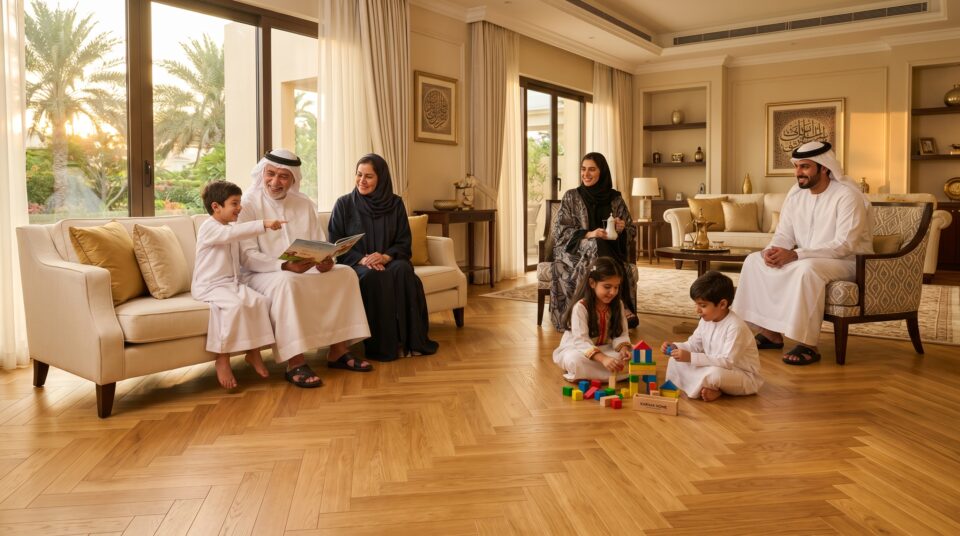
Herringbone parquet has been the premium residential flooring pattern in Dubai for the past decade, but its placement has traditionally been confined to master bedrooms and entrance halls. In 2026, herringbone is moving into living areas, open-plan kitchen-diners, and even some commercial reception spaces. The pattern works particularly well with wider-board engineered hardwood in warm oak tones, creating a visual interest that plain, straight-lay boards cannot achieve at the same floor area.
Biophilic and Natural Stone Effects in LVT
The technical quality of stone-effect LVT printing has advanced dramatically in the past three years. Current premium LVT products faithfully replicate travertine, terrazzo, limestone, and marble to a degree that requires close inspection to distinguish them from the natural material. For Dubai homeowners who want the aesthetic of natural stone without the maintenance requirements, sealing, polishing, and susceptibility to acid etching, high-resolution stone-effect LVT has become a genuinely compelling alternative.
Acoustic Flooring Becomes a Priority in Dubai Apartments
Noise complaints between floors are among the most common issues in Dubai apartment buildings. As Dubai’s residential population matures and families spend more time at home, a trend accelerated by the post-pandemic growth in remote working, tolerance for floor-impact noise from upstairs neighbours has declined. In 2026, acoustic underlay is increasingly specified not as an optional add-on but as a standard part of any flooring installation in multi-storey buildings. The performance difference between a 2 mm foam underlay and a 5 mm acoustic underlay with integrated moisture barrier is measurable: approximately 4 to 6 dB of additional sound reduction.
Modular and Mixed-Material Floors for Open-Plan Spaces
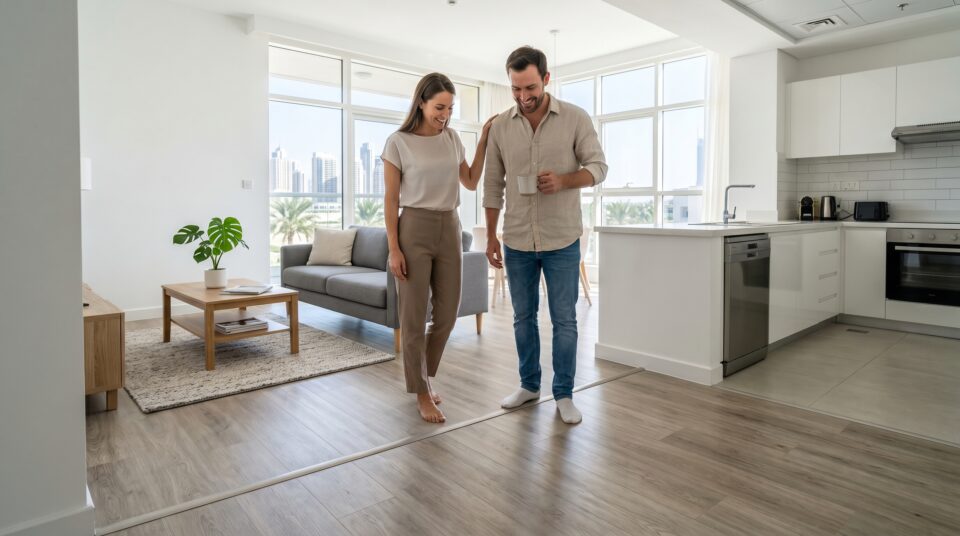
Open-plan living, the combination of kitchen, dining, and living area on a single floor level, has been the dominant residential layout in Dubai developments for the past decade. In 2026, the most interesting flooring design direction for open-plan spaces is intentional zoning using different but complementary floor materials: LVT in the kitchen zone, engineered hardwood or herringbone parquet in the living zone, and a transition strip or inlay border defining the boundary. This approach is popular in villas in Al Sufouh and Meydan, where the open-plan areas exceed 100 square metres.
Anti-Slip Specification Becomes Standard in Family Properties
With Dubai’s family demographics shifting toward more children and multigenerational households, anti-slip flooring specification has moved from a niche requirement to a standard consideration in family properties. Slip resistance is measured using the R rating (R9 for standard, R11 for wet areas) or the DIN 51130 scale. For UAE kitchens, bathrooms, and pool surrounds, R11 is the appropriate minimum. For family living rooms with elderly residents or toddlers, an R10-rated LVT or porcelain tile is worth specifying even in dry areas.
Materials and Fabrics Built for the UAE Climate: What Survives and What Does Not
Heat Performance: Which Materials Handle the UAE Summer
Surface temperature testing in UAE properties reveals a 12 to 18 degree difference between heavily air-conditioned interior spaces and non-AC areas like storage rooms, covered parking, and transition spaces. Materials that perform at 24 degrees may behave differently at 40 degrees. SPC LVT maintains dimensional stability up to 60 degrees Celsius above the temperature of any occupied interior space. Engineered hardwood with a 9-ply core is stable to approximately 35 degrees ambient temperature. Solid hardwood begins to show movement above 28 degrees in variable humidity conditions.
Moisture and Humidity Resistance by Material
Genuine waterproofing is only achievable with porcelain tile, natural stone, and 100 percent PVC-core LVT products. Engineered hardwood, carpet tiles, and laminate all have moisture thresholds that, when exceeded, cause permanent and irreversible damage. In UAE coastal properties, particularly ground-floor apartments in communities near the creek or shoreline in areas like Deira, Al Jaddaf, and Dubai Creek Harbour, the combination of high ambient humidity and concrete subfloor moisture makes genuine waterproofing a practical requirement rather than a premium specification.
Sand Abrasion The UAE’s Invisible Floor Destroyer
Haboob events, the sand and dust storms that periodically sweep through Dubai and Abu Dhabi, deposit fine particulate inside properties, which functions as a very effective abrasive on floor surfaces. Properties in Al Ain, Sharjah, and communities on Dubai’s southern and western perimeter experience this more intensely than coastal communities. Flooring in these areas should be specified with maximum wear layer thickness (for LVT), maximum surface hardness (AC5 or higher for laminate), and the highest available glaze hardness rating for porcelain tile.
UV Resistance for Light-Flooded UAE Interiors
UAE properties, particularly newer villa developments with full-height glazing and floor-to-ceiling windows, receive intense direct solar radiation for a significant portion of the day for most of the year. UV-related fading affects all organic materials: natural wood oils turn grey, unsealed timber loses warmth and depth, and some LVT printing layers fade perceptibly over three to five years without UV-stable surface treatment. When specifying any material for UAE rooms with significant direct sun exposure, require the manufacturer’s UV resistance certification and specify UV-stable surface finishes as a contract requirement.
Pet and Child Safety Surface Performance for Family Households
For households with dogs, the relevant specification metrics are scratch resistance (surface hardness) and grip. High-density SPC LVT with a ceramic bead coating on the wear layer provides the best scratch resistance available in resilient flooring and outperforms most engineered hardwood options at equivalent price points. For households with young children who spend time on the floor, the relevant metrics are surface temperature (LVT is cooler than ceramic in AC environments, warmer than ceramic in non-AC spaces), cushioning (carpet tile offers the best fall absorption), and VOC emissions (specify flooring with FloorScore or GREENGUARD certification for children’s rooms).
Eight Mistakes UAE Buyers Make When Choosing Flooring Services in Dubai in 2026
Mistake 1: Specifying solid hardwood in a coastal or inland villa without testing humidity levels first. The UAE has no stable humidity baseline. Coastal villas in Palm Jumeirah regularly exceed 80 percent relative humidity in summer. Inland villas in Reem or Mudon can drop 30 percent below in winter. Solid hardwood moves significantly across this range. Fix: Always specify engineered hardwood (minimum 7-ply core, 3 mm wear veneer) for UAE villa applications. Budget AED 150 to 220 per square metre installed for a product that will actually last.
Mistake 2: Installing floating LVT in a bathroom or wet kitchen zone. Floating LVT creates micro-gaps at board joins. Water penetrating these joins reaches the subfloor, causes mould, and can damage the structural screed. This is a particularly common mistake in Dubai apartment renovations, where the same LVT specified for the living area is extended into the kitchen. Fix: In any wet zone, specify glue-down LVT and seal all perimeter joins with silicone. Budget an additional AED 8 to 12 per square metre for the adhesive and sealing process.
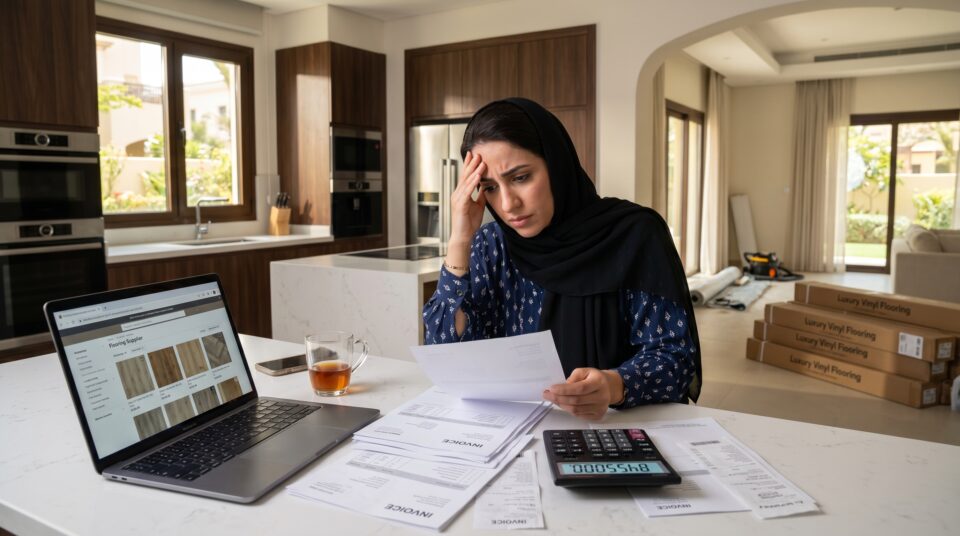
Mistake 3: Skipping subfloor preparation to reduce cost. The single most common source of flooring complaints we receive at Karnak is premature joint separation, hollow spots, or surface cracking in floors that were installed without proper subfloor assessment and levelling. In Dubai, construction-era concrete subfloors are frequently out of level by more than the 3 mm tolerance that floating floors require, and moisture readings are often above manufacturer thresholds. Fix: Insist on a written subfloor condition report before installation begins. Budget AED 25 to 45 per square metre for screeding if required.
Mistake 4: Ignoring acoustic underlay in apartment buildings. A floor that sounds beautiful and performs durably is still a floor that creates legal liability in an apartment building if it transmits impact noise to the unit below. Dubai’s joint ownership law and community management rules in most master-planned communities set minimum acoustic performance requirements. Fix: Specify a minimum 3 mm acoustic underlay with an integrated moisture barrier for any hard floor installation above another occupied unit. The additional cost is AED 12 to 18 per square metre negligible relative to the cost of a noise dispute.
Mistake 5: Choosing a flooring contractor based on the lowest price alone. The UAE flooring market includes contractors at every quality level. A quote that is 30 percent below the median typically reflects reduced material quality, unskilled labour, skipped subfloor preparation, or all three. In our 36 years of UAE deliveries, we have received calls from families whose low-cost installations failed within 18 months and who paid more to correct the work than they saved on the original job. Fix: Obtain three written quotes, compare the scope of work line by line, and ask for UAE-specific references. Verify the contractor’s DED trade licence before signing anything.
Mistake 6: Not accounting for threshold transitions in over-tile installations. Installing a floating floor over existing tile raises the floor level by 6 to 12 mm. In an apartment with standard door clearances, this can prevent doors from opening fully or require door trimming. In open-plan spaces transitioning to tiled bathrooms or balconies, an unplanned height difference creates a trip hazard and looks unfinished. Fix: Measure door clearances before specification. Budget AED 150 to 300 per door for trimming if required. Specify flush threshold transition profiles at every level change.
Mistake 7: Specifying residential-grade flooring for home office or commercial-use areas. Many Dubai professionals now work from home in dedicated study rooms or converted bedrooms. These spaces receive the same daily foot traffic as a small office. Residential-grade LVT (12 mil wear layer) specified in a home office used 8 to 10 hours daily will show wear within 3 to 4 years. Fix: For any space used as a working office, specify commercial-grade LVT (minimum 20 mil wear layer, EN 685 Class 33). The price premium is typically AED 20 to 35 per square metre and the product life difference is 10 to 15 additional years.
Mistake 8: Ordering materials without a site measurement by a professional. Online floor area calculators using room dimensions from property brochures are consistently inaccurate by 8 to 15 percent for irregular room shapes, alcoves, built-in wardrobes, and structural columns — all of which are common in Dubai apartment and villa layouts. Ordering materials on the basis of inaccurate measurements either creates a project-stopping shortfall mid-installation or results in significant wasted material that cannot be returned. Fix: Always request a free professional site measurement before finalising your order. At Karnak, we provide this service at no charge across Dubai, Sharjah, and Abu Dhabi.
2026 Budget Guide for Flooring Services in Dubai (AED)
The following table reflects Karnak’s current installed pricing inclusive of standard subfloor preparation, materials, labour, and basic threshold transitions. It does not include heavy screeding (add AED 35 to 55 per m² if required) or specialised pattern installation such as custom inlay or medallion work.
| Tier | Product Type | AED per m² (installed) | Best For |
|---|---|---|---|
| Budget | Entry SPC LVT, 12 mil wear, straight lay | AED 65 to 90 | Rental apartments, short-term refurbishment, Dubai South, International City, Discovery Gardens |
| Budget | Standard carpet tile, 600 g/m² pile | AED 75 to 100 | Home offices, rental bedrooms, small commercial spaces |
| Budget | Basic porcelain tile 60×60, straight lay | AED 80 to 110 | Kitchens, bathrooms, utility areas |
| Mid | Premium SPC LVT, 20 mil wear, wide plank | AED 110 to 155 | Owner-occupied apartments, JVC, JLT, Business Bay, Al Reem Abu Dhabi |
| Mid | Commercial carpet tile, anti-static, 28 oz | AED 120 to 160 | Professional offices, co-working spaces, retail |
| Mid | Engineered hardwood, 3-ply, straight lay | AED 130 to 185 | Family villas, Dubai Hills, Motor City, Arabian Ranches |
| Premium | Engineered hardwood, 9-ply, herringbone parquet | AED 195 to 280 | Master bedrooms, entrance halls, premium villas, Jumeirah, Emirates Hills |
| Premium | Large-format porcelain tile 100×100, rectified | AED 180 to 250 | Premium living areas, commercial lobbies, majlis spaces |
| Premium | Custom parquet with inlay border | AED 320 and above | Signature villas, penthouse apartments, show homes |
Ten Expert Tips From 36 Years of Flooring Services Across the UAE
In our 36 years of delivering and installing flooring from Abu Dhabi to Fujairah, and from Ras Al Khaimah to Al Ain, we have learned things about UAE flooring that no product specification sheet will tell you. Here are the ten most valuable lessons from our installation teams.
Tip 1: Acclimatise before you install. We have seen more timber floor failures caused by skipped acclimatisation than by any other single factor. Engineered hardwood brought directly from a cool warehouse into a warm Dubai villa and installed on the same day will move unpredictably in the first weeks. Allow 7 to 10 full days, with boards stacked in the installation room with the AC running at normal household temperature and humidity.
Tip 2: Test subfloor moisture before committing to a timber specification. Our teams carry calibrated moisture meters on every site visit. We have found moisture readings above 75 percent RH in the subfloor of Dubai apartments built as recently as 2018. Above 65 percent RH, no timber-based flooring should be installed without a DPM (damp-proof membrane) layer. This test takes five minutes and prevents a floor failure that could cost tens of thousands of dirhams to rectify.
Tip 3: Match your grout colour to your tile, not to your wall. Grout lines are the most visible element of a tiled floor at floor level. Dark grout on light tile creates a strong grid pattern that visually interrupts the floor surface and shows every footprint. Light-to-matching grout on the same tile reads as a single continuous surface and feels more spacious — which matters in Dubai apartments where rooms are often compact.
Tip 4: Plan for furniture legs, not just open floor space. Heavy furniture — marble-top dining tables, solid wood wardrobes, stone coffee tables — concentrates enormous pressure on small contact points. Without furniture leg pads, these points can indent SPC LVT, crack large-format porcelain tile, and leave permanent marks in engineered hardwood. We provide furniture leg pads with every installation at no additional charge, and we recommend replacing them every 18 months.
Tip 5: Order 10 to 12 percent extra material for cuts and future repairs. Dubai apartments have irregular room shapes, structural columns, and alcoves that generate more cutting waste than a standard rectangular room. Ordering exactly the calculated area is a false economy: mid-project material shortfalls cause delays while additional stock is sourced, and the new batch may have a slight colour or texture variation from the original. Order 10 percent extra for rectangular rooms and 12 percent extra for rooms with columns or non-right-angle walls.
Tip 6: Specify your skirting boards before your floor, not after. Skirting boards sit on top of your finished floor. If you choose a tile-height skirting profile designed for a 10 mm floor height and then install a 14 mm SPC LVT with underlay, the skirting will not sit flush against the wall. Plan your complete floor-to-wall junction detail before any materials are ordered. Our design consultants can walk you through this in a single thirty-minute showroom visit.
Tip 7: In properties above the third floor, always use a moisture barrier underlay. Even in buildings where the floor above is a solid concrete slab, the temperature differential between the air-conditioned room and the structural slab creates condensation conditions in the underlay void. We have opened floors in Dubai Marina and JBR apartments after 4 to 5 years and found significant moisture accumulation that was not visible from the surface but was actively damaging the flooring product above it.
Tip 8: For Ramadan and Eid renovation projects, book your installation date eight to ten weeks in advance. The peak renovation season in the UAE runs from October through April, with a secondary surge in July and August when families return from summer travel. Professional installation teams are fully booked within two to three weeks during these periods. Planning ahead is not a luxury; it is the difference between completing your project before your family moves in and living on bare concrete for six weeks.
Tip 9: Always request a written handover document listing the exact product batch number installed. If a board is damaged during the property’s lifetime and needs replacement, matching the colour exactly requires sourcing from the same production batch. Without the batch number, an exact match is frequently impossible. We document this on every Karnak installation and provide the record to the client at handover.
Tip 10: Consider the full lifecycle cost, not just the installation price. A budget LVT floor at AED 75 per square metre that needs replacement in six years costs more over a 20-year property ownership than a premium SPC floor at AED 140 per square metre that lasts the full period. When evaluating quotes, ask every contractor for their expected product life in UAE conditions and calculate the total cost of ownership. This is the metric that actually matters for Dubai property owners and long-term tenants.
Frequently Asked Questions Flooring Services Dubai 2026
FAQ 1: What is the best flooring for a Dubai apartment in 2026? For most Dubai apartments, SPC LVT with a 20 mil wear layer is the strongest all-round recommendation. It is 100 percent waterproof, dimensionally stable across the humidity and temperature variations UAE apartments experience, and available in excellent wood and stone visual effects. For premium apartments in Downtown Dubai, Dubai Marina, or Business Bay where the aesthetic standard is higher, engineered hardwood in wide-plank straight lay or herringbone parquet delivers a level of warmth and prestige that LVT cannot fully replicate. Explore our complete LVT collection for Dubai apartments for current 2026 specifications and pricing.
FAQ 2: How much does flooring installation cost in Dubai in 2026? Installation costs in Dubai range from AED 65 per square metre for budget SPC LVT to AED 280 and above for premium herringbone parquet. These figures include materials, standard labour, and basic threshold transitions. Heavy subfloor screeding — required when the existing concrete is significantly out of level or has high moisture readings — adds AED 35 to 55 per square metre. Our 2026 flooring price guide provides a complete tier-by-tier breakdown with product examples at each price point.
FAQ 3: Can I install LVT flooring over existing tiles in my Dubai property? Yes. Over-tile installation of SPC LVT is one of the most common flooring scenarios we handle across Dubai, Sharjah, and Abu Dhabi. The existing tiles must be sound (no hollow, cracked, or de-bonded sections), reasonably level (within 3 mm over a 2-metre span), and clean. The combined height increase of 6 to 10 mm must be accounted for at door thresholds — doors may require trimming, and threshold transition profiles are required at all level changes to balconies and bathrooms. Book a free professional site measurement to confirm suitability before ordering materials.
FAQ 4: How long does flooring installation take in a typical Dubai villa? A 3-bedroom villa with approximately 200 square metres of floor area typically requires 3 to 5 working days for SPC LVT installation and 7 to 10 working days for herringbone parquet. These timelines assume a prepared subfloor and do not include time for screeding (add 5 to 7 days) or tile removal (add 3 to 5 days). During peak renovation season — October to April and the July to August summer surge — installation teams should be booked 8 to 10 weeks in advance. Contact our team on WhatsApp at +971 58 908 8107 to check current availability.
FAQ 5: Is parquet flooring suitable for the Dubai climate? Engineered parquet is suitable for Dubai when correctly specified and installed. The critical requirements are a minimum 3 mm real wood veneer, a 7-ply or 9-ply HDF core for dimensional stability, a UV-stable surface finish, and a mandatory 7 to 10 day on-site acclimatisation period before installation. Solid hardwood parquet is not recommended for most UAE applications due to the significant dimensional movement it experiences across UAE seasonal humidity variation. Browse our parquet and engineered hardwood collection for UAE-specific product specifications.
FAQ 6: What flooring is best for UAE offices and commercial spaces? Commercial spaces in Dubai require flooring rated to EN 685 Class 33 minimum. Carpet tiles with anti-static treatment and bitumen or glass-fibre backing are the standard specification for open-plan offices, providing excellent acoustics, easy partial replacement, and high durability under rolling chair and trolley traffic. For reception areas and commercial lobbies, large-format porcelain tile or commercial-grade LVT with 28 mil wear layer delivers the combination of durability and aesthetics that client-facing areas require. Our office flooring UAE range covers both categories with UAE stock available for rapid delivery.
FAQ 7: Do I need to move my furniture for flooring installation, and will Karnak handle this? Yes, all furniture must be cleared from the installation area before work begins. For large-volume installations across complete villas or office floors, our team can advise on the most efficient room-by-room sequencing to minimise disruption. We do not move furniture as part of our standard installation service, but we can recommend trusted removal partners in Dubai, Sharjah, and Abu Dhabi. If you are purchasing new furniture from Karnak as part of a full home renovation, we coordinate furniture and flooring delivery and installation to eliminate scheduling conflicts.
FAQ 8: Does Karnak offer a warranty on flooring installation, and what does it cover? Karnak provides a 2-year workmanship warranty on all flooring installations, covering joint separation, lifting, surface delamination, and any defect attributable to the installation method. This is separate from, and in addition to, the manufacturer’s product warranty, which typically runs from 10 years (entry-level products) to 25 years (premium commercial-grade LVT). To maintain both warranties, flooring must be maintained in accordance with the manufacturer’s cleaning and care guidelines, which we provide in written form at every installation handover. Contact us on WhatsApp at +971 58 908 8107 for any warranty query.
The three decisions that matter most when choosing flooring services in Dubai are these: select a material that was genuinely engineered to handle UAE heat, humidity variation, and sand abrasion, not one that simply looks good in a catalogue photograph from a European market. Specify the correct core construction, wear layer thickness, and surface finish for your specific location, use, and family situation. And work with a contractor who knows the UAE environment from years of real deliveries and installations, not one who learned their trade in a climate where the worst problem is a cold winter.
Dubai families make their flooring choices under real constraints that most interior design guides do not acknowledge: compact apartment footprints in JVC and International City, where every square metre of floor visible from the entrance defines the entire feel of the home. Rental situations where the floor needs to be installed without landlord approval and removed cleanly at the end of a contract. Multigenerational households in villas in Mirdif and Al Barsha, where a grandparent’s grip on a morning floor and a toddler’s safety on an afternoon one are equally important. The right flooring decision accounts for all of these realities — not just the aesthetic preference in an ideal scenario.
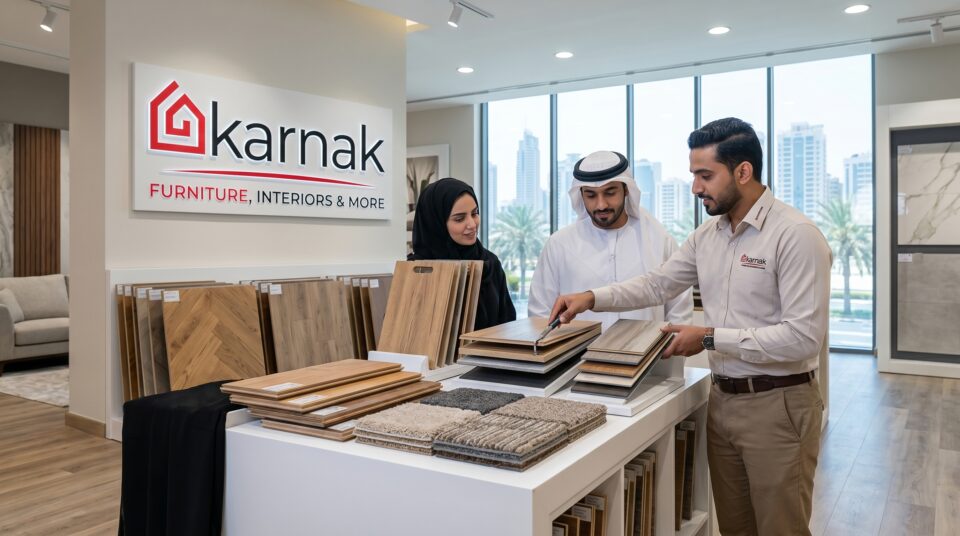
Karnak Home has been part of the UAE family life since 1988. We deliver to every emirate. Our showroom in Industrial Area, Sharjah, is open Saturday to Thursday from 9 AM to 9 PM, and our WhatsApp team at +971 58 908 8107 answers measurement questions, arranges sample delivery, and books free site surveys seven days a week. Browse our full flooring range below, or come and see the materials in person because no photograph, however good, replaces standing on a floor and feeling it underfoot.
Ready to Transform Your UAE Home?
Shop Flooring Online: Explore our complete flooring collection for UAE homes and offices
Visit Our Showroom: Industrial Area, Sharjah, UAE (Saturday to Thursday, 9 AM to 9 PM)
WhatsApp Us: +971 58 908 8107 (Measurements, samples, site survey booking)
Call: +971 58 908 8107
Related Articles
- LVT vs Parquet vs Carpet Tiles: Which Flooring Wins in the UAE Climate?
- 2026 Flooring Trends: What Dubai Designers Are Specifying Now
- 7 Flooring Mistakes Dubai Homeowners Make and How to Avoid Them
- How Much Does Flooring Cost in Dubai? Full 2026 Price Breakdown
- How to Choose a Flooring Contractor in Dubai: The Complete 2026 Guide
Expert Resources from Karnak Home
- Full guide to SPC LVT for Dubai apartments
- Engineered hardwood and parquet installation guide UAE
- Office flooring solutions for Dubai and Abu Dhabi businesses
- Anti-slip flooring for UAE kitchens, bathrooms, and outdoor areas
- Flooring care and maintenance in the UAE climate
- Browse all flooring products at Karnak Home
- Book a free flooring site survey in Dubai or Sharjah
دليلك الشامل لخدمات الأرضيات في دبي 2026: اختر الأرضية المثالية لمنزلك
يعرف كل من عاش في الإمارات أن اختيار الأرضية المناسبة ليس مجرد قرار جمالي، بل هو قرار عملي يؤثر على راحة الأسرة ويوميات الحياة في ظل مناخ فريد من نوعه. في دبي وأبوظبي والشارقة، تواجه الأرضيات تحديات حقيقية: حرارة صيفية شديدة قد تتجاوز 45 درجة مئوية، ورطوبة متفاوتة بين المناطق الساحلية والداخلية، وغبار ورمال يتسلل إلى أدق الفراغات. لهذا السبب، تختلف معايير اختيار الأرضيات في الإمارات اختلافاً جوهرياً عن معاييرها في أوروبا أو أمريكا.
في كرنك هوم، نعمل منذ عام 1988 على خدمة أكثر من 70,000 أسرة إماراتية وعربية وعائلات مقيمة من مختلف الجنسيات. ومن خلال هذه التجربة الممتدة، نعلم جيداً أن أفضل أرضية فينيل كمالية في الإمارات ليست بالضرورة الأغلى ثمناً، بل هي تلك التي تجمع بين الأداء التقني المناسب للمناخ المحلي والجماليات التي تعكس ذوق الأسرة. سواء كنت تبحث عن أرضية LVT للشقق أو باركيه للفلل الفاخرة في الإمارات، فإن الاختيار الصحيح يبدأ بفهم خصوصية بيئتك.
تحتل أرضيات الفينيل الفاخرة المرونة الأولى في سوق الإمارات اليوم، لأنها تجمع بين مقاومة الماء الكاملة وثبات الأبعاد في مواجهة الحرارة والرطوبة. أما بالنسبة لأصحاب الفلل والبيوت الواسعة في دبي وأبوظبي والعين والشارقة، فإن خشب الباركيه المهندس يوفر الدفء والرقي الذي لا يضاهيه أي مادة أخرى، شرط أن يُختار بالمواصفات المناسبة لمناخ الخليج. وتبقى البلاط الخزفي والبورسلان الخيار الثابت للمطابخ والحمامات والمجالس، حيث المتانة شرط لا تفاوض فيه.
إن خدمات تركيب الأرضيات في دبي التي نقدمها تشمل التقييم الكامل للأرضية الحاملة، والتحضير المناسب قبل التركيب، وضمان سنتين على جودة العمل. نصل إلى جميع مناطق الإمارات، ونوفر خدمة قياس مجانية في الموقع حتى تحصل على عرض سعر دقيق يشمل كل تفاصيل مشروعك. سواء كنت في شقة إيجارية في الجداف أو فيلا مملوكة في المرابع العربية، فريقنا جاهز لمساعدتك في كل خطوة من خطوات اختيار الأرضية المثالية.
تفضل بزيارة معرضنا في المنطقة الصناعية بالشارقة من السبت إلى الخميس، من الساعة التاسعة صباحاً حتى التاسعة مساءً. أو تواصل معنا مباشرة عبر واتساب على الرقم +971 58 908 8107 للحصول على استشارة مجانية، أو لحجز موعد قياس في منزلك. أسرتك تستحق الأفضل، ونحن في كرنك هوم هنا لنجعل ذلك ممكناً.