
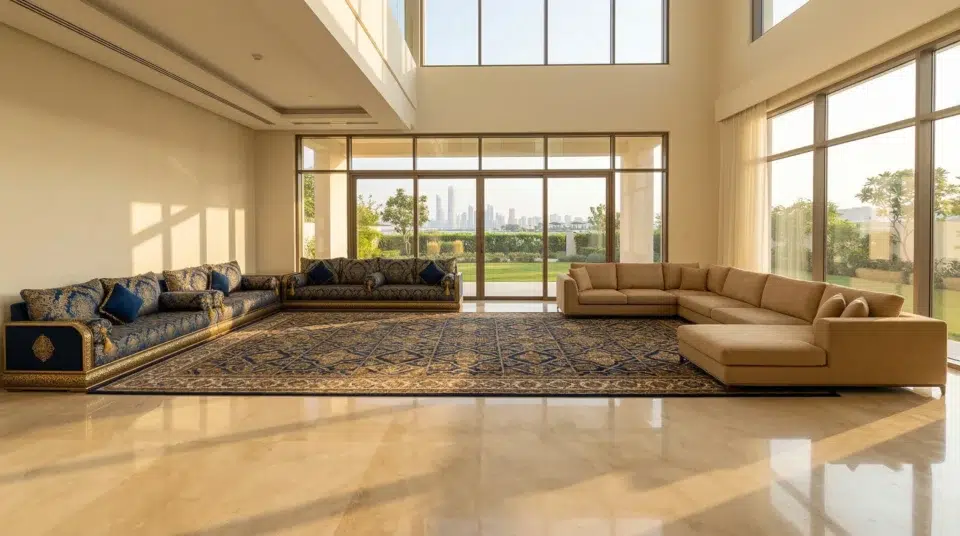
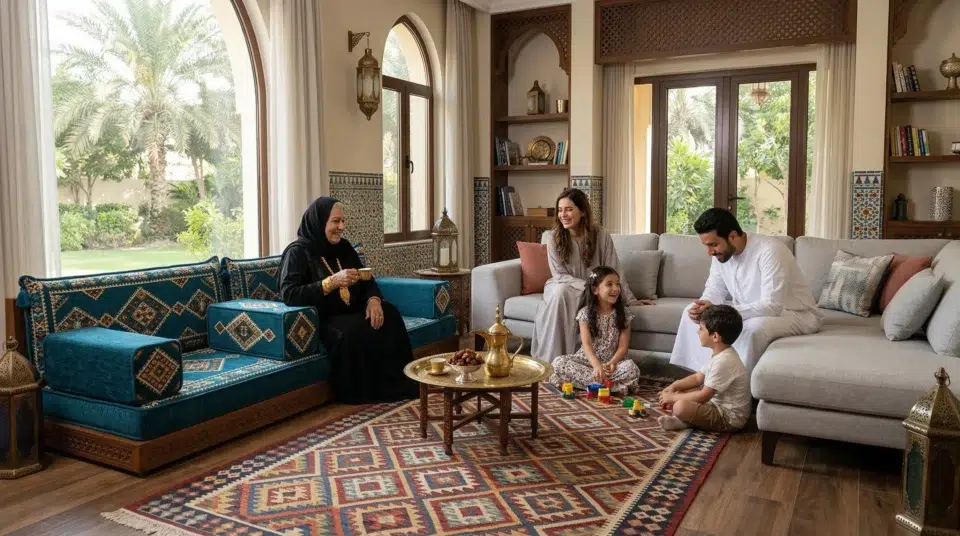
There is a conversation happening in UAE homes right now that no furniture brand is addressing honestly. In villa communities across Abu Dhabi’s Khalifa City, Dubai’s Arabian Ranches, and Sharjah’s Al Tai, Emirati families and Gulf nationals are asking the same design question: how do we honour the majlis, the heart of Arabic hospitality culture, the room that defines how we receive guests, build community, and express family identity, while also living in a home that reflects the contemporary world we move through every day?
This is not a question about style preferences. It is a question about identity, about what it means to be a UAE family in 2026. The majlis is not merely a furniture category. It is a spatial expression of core values: generosity, community, respect for guests, and the sanctity of family bonds. No amount of global interior design trend-chasing changes those values. But the physical form through which they are expressed is genuinely evolving, and the most interesting living rooms in the UAE right now are the ones navigating that evolution thoughtfully.
At Karnak Home, we have been manufacturing Arabic living room furniture and contemporary living room pieces for UAE families since 1988, 36 years of sitting with both sides of this conversation. We supply traditional ornate majlis sets to Emirati villas in Abu Dhabi and contemporary modular sofas to Dubai apartments in the same week. We have watched tastes evolve, we have listened to what families actually want, and we have a clear, grounded perspective on what is working and what is not when UAE families attempt to blend the majlis and the modern living room in 2026.
This guide is written for every UAE family navigating this question, whether you are an Emirati homeowner furnishing a new villa in Yas Island, a Gulf expat wanting to incorporate Arabic seating culture into a Dubai Hills townhouse, or an interior designer working on a Saadiyat Island residential project that needs to honour both worlds. We will cover the cultural foundations of the majlis, how it has evolved, the five distinct blending approaches UAE families are using in 2026, which furniture pieces make each approach work, and the common mistakes that undermine even well-intentioned attempts to bridge both aesthetics.
For the complete foundation on all UAE living room furniture decisions, begin with our Ultimate Guide to Living Room Furniture in the UAE.
Understanding the Majlis: More Than a Room, More Than Furniture
Before any discussion of blending or modernising can be grounded, it requires an honest understanding of what the majlis actually is — because much of what passes for “Arabic-inspired” interior design in the UAE and globally treats the majlis as a visual style rather than a functional and cultural institution.
The Majlis as Social Architecture
The word مجلس (majlis) means, literally, a place of sitting, from the Arabic root جلس (jalasa), to sit. But the physical act of sitting together in a majlis is not incidental. It is the architecture of a social contract: the host and guest occupy the same level (traditionally the floor or low seating), eye contact is direct and respectful, the arrangement is communal rather than hierarchical, and the physical gesture of sitting together creates an obligation of hospitality that the host takes seriously as a matter of honour.
In classical majlis architecture, seating runs along the walls of the room rather than around a central point. This wall-facing arrangement is deliberate: it maximises the number of people who can be accommodated, ensures everyone in the room can see and be seen, and allows conversations to ripple across the entire group rather than fragmenting into small clusters as Western-style furniture arrangements tend to do. The eldest or most honoured guest sits closest to the entrance, a positional convention that modern majlis furniture layouts still honour in most UAE households.
Understanding these spatial and social principles is what separates majlis furniture that feels authentic from majlis furniture that merely looks Arabic.
How the UAE Majlis Has Evolved Through Three Generations
The majlis of the 1970s and 1980s in the UAE, the era when Karnak Home was founded, was characterised by low, floor-level seating, thick wool and silk carpets spread across entire rooms, bolster cushions along walls, and a sober, traditional aesthetic focused on comfort and capacity rather than visual drama.
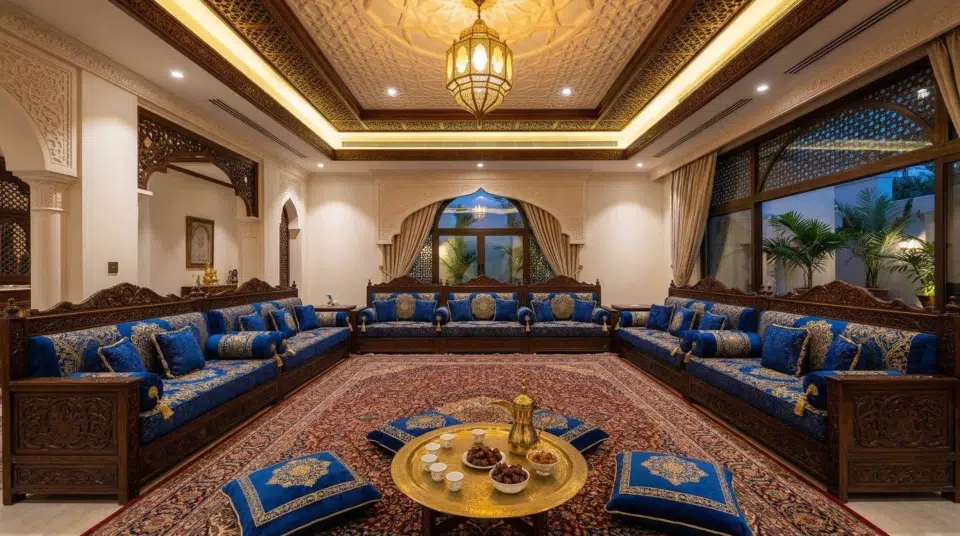
Through the 1990s and 2000s, the UAE’s rapid economic development brought an influx of ornate, heavily decorated majlis furniture carved wooden frames with hand-applied gold leaf, heavy brocade and jacquard upholstery in deep jewel tones, elaborate tasselled cushions, and large matching sets that reflected the period’s appetite for visible luxury. This aesthetic remains dominant in formal reception rooms in traditional Emirati family homes across Abu Dhabi, Al Ain, and the Northern Emirates.
The shift happening right now, the shift that makes this topic essential in 2026, is a third-generation evolution. Younger Emirati homeowners and Gulf nationals aged 25–45 who grew up in visually lavish traditional households are choosing a new direction: they want a majlis that functions fully as an Arabic hospitality space, that honours the spatial and social conventions their parents and grandparents taught them, but that does so through contemporary forms, restrained aesthetics, and furniture that connects visually with the modern home around it.
This is the “modern majlis,” and it is one of the most significant and commercially underserved design conversations in the UAE market right now.
The Five Approaches UAE Families Are Using to Blend Majlis and Modern in 2026
Through our delivery and installation work across Dubai, Abu Dhabi, Sharjah, Ajman, and the Northern Emirates, Karnak Home’s team encounters hundreds of UAE living rooms every month. The blend between traditional and modern is not a single approach it manifests in five distinct strategies, each with different design principles, furniture requirements, and AED investment profiles.
The Dedicated-Room Majlis with Modern Family Living Room
What it is: The most traditional approach, and still the dominant choice in UAE villas with 4+ bedrooms. The home retains a dedicated majlis room — entirely separate from the family sitting room — that is furnished exclusively with traditional Arabic seating. The family living room, used daily by immediate family members, is furnished in a contemporary style with no formal Arabic seating elements.
Who it suits: Emirati families in large villas (5–7 bedrooms) in Abu Dhabi’s Khalifa City, Mohammed Bin Zayed City, Al Ain, and Dubai’s older established villa communities, where home layout physically accommodates a dedicated reception room. Families where the social role of the majlis is actively used — regular diwaniya gatherings, official guest reception, community meetings.
The majlis furniture for this approach: The dedicated majlis demands the most considered furniture investment of all five approaches. Since this room exists entirely for formal guest reception, the furniture must communicate the family’s values through quality, proportion, and cultural fidelity. The classic configuration seats 20–40 guests along three walls in a large room (typically 40–80 m²), with the primary sofa, longer and more ornate than side pieces, facing the entrance.
Key pieces:
- Main corner Arabic sofa set (3-piece or full wall-length configuration)
- Matching side reception chairs (كرسي استقبال) flanking the corners
- Low Arabic side tables are placed at regular intervals along the sofa, for service
- A central ornate coffee table or a series of small service tables
- Traditional floor covering (large patterned rug or fitted carpet)
Explore Karnak Home’s majlis furniture collection, manufactured in the UAE since 1988, available in traditional ornate and contemporary simplified configurations.
AED investment: AED 8,000–45,000+ for a complete dedicated majlis furniture setup, depending on room size, fabric selection, and frame detailing level.
The Open-Plan Blended Room: Majlis Zone + Modern Zone
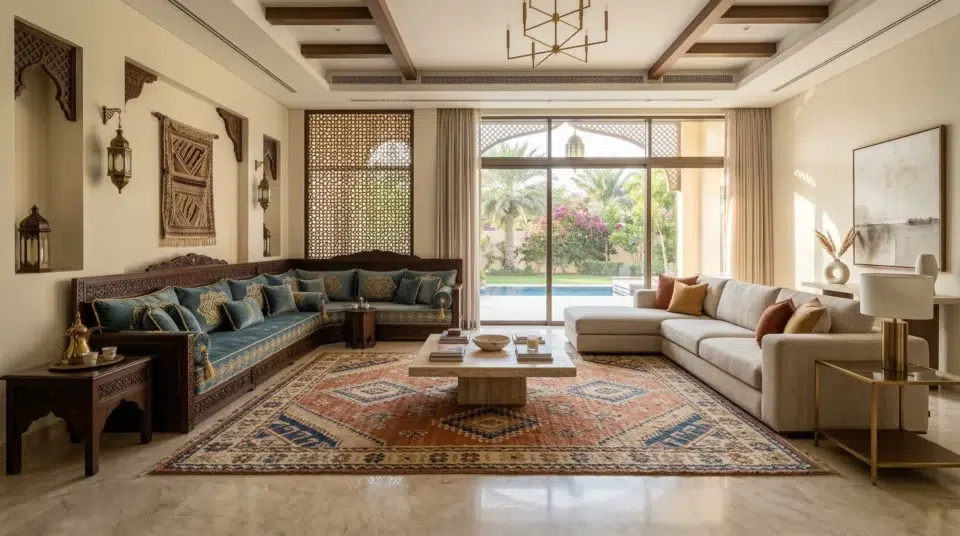
What it is: Increasingly common in UAE villas and larger townhouses where architectural layouts feature one large reception room rather than separate formal and informal spaces. The room is physically divided into two functional zones, an Arabic seating zone and a contemporary family seating zone, unified by consistent flooring, colour palette, and a shared design language that makes both zones feel like parts of a single, considered whole rather than two unrelated rooms awkwardly sharing a space.
Who it suits: UAE villa families in mid-size properties (3–4 bedroom villas in Arabian Ranches, Damac Hills, Al Furjan, Mudon) where the ground floor layout does not provide a separate dedicated reception room, but the family still wants genuine Arabic seating for regular guest hosting.
The design principles that make it work:
The most common error in blended open-plan rooms is treating the Arabic seating zone and the modern zone as independent design projects, then pushing them together and hoping for harmony. The result is almost always incoherent, two rooms that happen to share a floor, with a visual tension that makes the entire space feel unsettled.
The design principles that create genuine harmony:
Principle 1 Unified flooring: A single large rug covering both zones (minimum 300 × 400 cm in a typical villa reception room of 60+ m²) is the most powerful unifying element available. The rug should carry design elements that bridge both aesthetics, a geometric Arabesque pattern in a contemporary palette (warm sand, muted terracotta, dusty sage) achieves this most effectively.
Principle 2 A shared colour anchor: Choose one dominant colour that appears in both zones, in the Arabic zone through upholstery or cushion accents, in the modern zone through a throw, cushions, or a statement piece. In 2026, warm terracotta and deep dusty blue are the most successful bridge colours across this aesthetic divide.
Principle 3 Proportional dialogue: The Arabic seating zone’s characteristic low profile (typically 35–45 cm seat height) creates a visual contrast with the higher-seated contemporary sofa (typically 42–50 cm). To prevent this difference from feeling like a mismatch, position the Arabic seating zone further from the main viewing angle, near the entrance wall, and the contemporary seating closer to the room’s social centre.
Principle 4 Material consistency: Choose at least one material that appears in both zones. Natural wood frame finishes appearing in both the Arabic sofa’s carved frame and the modern TV unit, or a brass metal accent present in both the Arabic side table and the contemporary floor lamp, create the visual thread that makes both zones feel designed together.
Furniture for the Arabic zone in Approach 2: Low Arabic corner sofa in a contemporary palette, muted jewel tones, warm dusty gold, or deep teal rather than the vivid primary colours of traditional formal majlis pieces. Paired with a contemporary side table in brass-finish metal or natural wood.
Furniture for the modern zone in Approach 2: A modular corner sofa in performance microfibre or performance velvet, in a colour that harmonises with the Arabic zone’s palette. A coffee table in natural travertine or warm wood grain.
AED investment: AED 18,000–45,000 for a complete open-plan blended room furnishing (both zones).
The Modern Majlis: Contemporary Forms, Arabic Soul
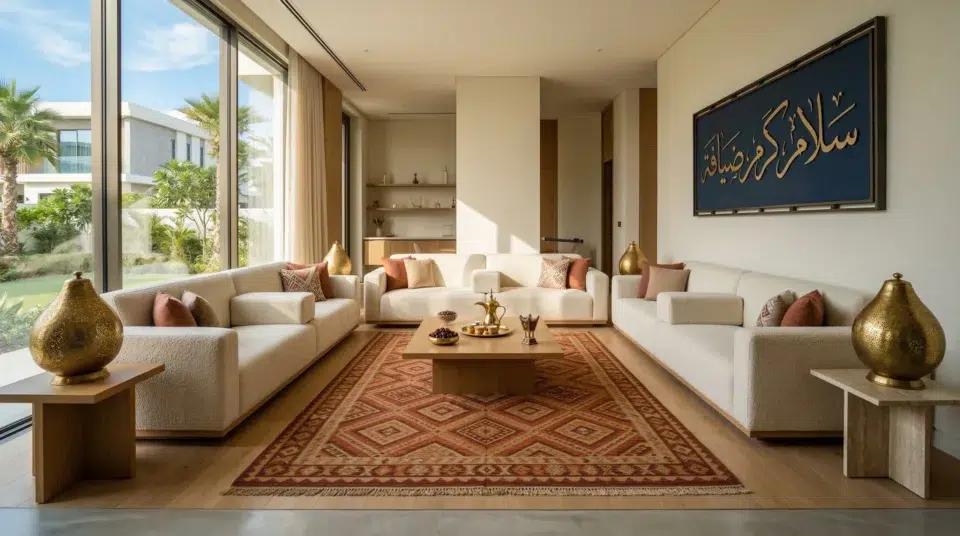
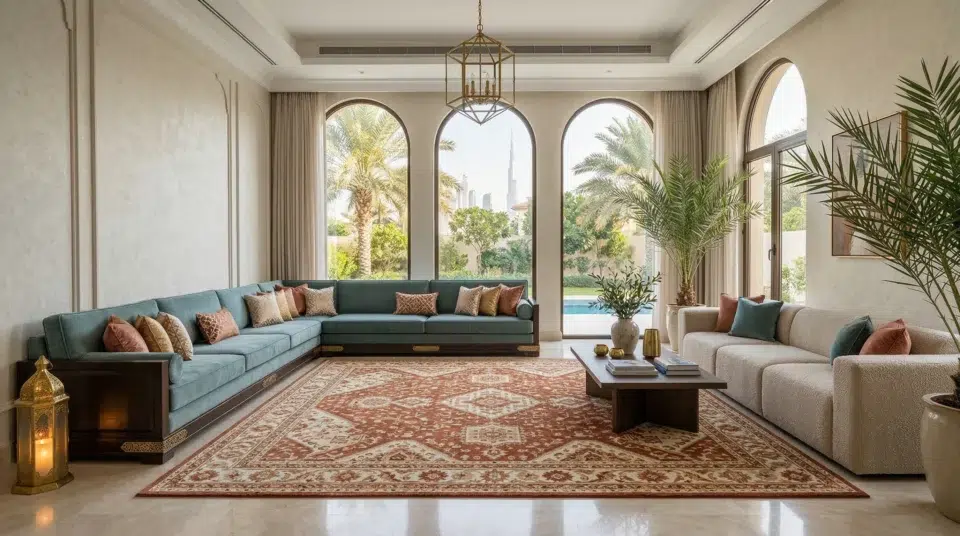
What it is: The fastest-growing approach among younger Emirati homeowners and design-conscious Gulf nationals in 2026. The majlis function is preserved entirely through wall-aligned seating, adequate capacity for guest hosting, and formal orientation toward the entrance, but achieved through contemporary furniture forms rather than ornate traditional ones. Think clean-lined, low-profile sofas in contemporary fabrics, with Arabic cultural identity expressed through textile patterns, calligraphic artwork, traditional metalwork accessories, and architectural detailing rather than through carved wooden furniture frames.
Who it suits: Emirati families aged 28–45 in premium properties in Dubai Hills, Yas Island, Saadiyat Island Cultural District, and City Walk who want a living room that photographs at international design standards while remaining culturally authentic in use. Second-generation UAE residents who grew up with traditional majlis culture and want to honour it in a contemporary design language.
The furniture choices that define the modern majlis:
The low contemporary sofa: The fundamental spatial requirement of the majlis low, wall-aligned seating at 35–45 cm seat height can be met by contemporary furniture that carries none of the ornate detailing of traditional pieces. A clean-lined, low-profile sofa in performance bouclé or premium microfibre positioned along two or three walls of the room achieves the majlis spatial convention while reading as completely contemporary. The key specification: seat height must remain in the 35–45 cm range to preserve the social equality and visual horizontality that define the majlis atmosphere.
The arabesque textile: In the modern majlis, cultural identity moves from the furniture frame to the soft furnishing layer. Throw cushions in geometric Arabesque patterns, a hand-knotted or machine-made rug with traditional geometric motifs in a contemporary palette, and draped textiles in traditional weaving patterns carry the cultural message without requiring ornate furniture.
The metalwork accent: Brass lanterns, copper coffee service trays, and hand-hammered metal side tables from traditional UAE craft traditions sit beautifully against contemporary furniture backdrops. In 2026, the most sophisticated modern majlis rooms in Saadiyat Island and Dubai Hills use one or two exceptional traditional craft pieces as focal points against otherwise completely contemporary furniture.
The calligraphic element: Framed Arabic calligraphy, particularly Quranic verses traditionally placed in reception rooms, translates perfectly into contemporary wall art. Large-format calligraphic canvases or metal wall panels serve as cultural anchors in rooms where the furniture itself does not carry traditional visual coding.
AED investment for a modern majlis setup:
- Contemporary low sofas (wall-configuration for 15–20 guests): AED 12,000–28,000
- Arabesque textile layer (large rug, cushion set, throws): AED 3,000–8,000
- Metalwork and traditional craft accent pieces: AED 2,000–6,000
- Calligraphic wall art: AED 1,500–5,000
- Total: AED 18,500–47,000
The Hybrid Accent — Modern Room with Arabic Seating Corner
What it is: The most accessible approach for UAE families, particularly expat Arab families and Gulf nationals in smaller properties, who want a genuine Arabic seating presence in their home without the space requirements of a full majlis configuration. A primarily contemporary living room receives a dedicated Arabic seating corner: a low Arabic loveseat or two-piece corner sofa set positioned along one wall, with a traditional rug section, low side table, and Arabic coffee service creating a culturally functional seating zone within an otherwise modern room.
Who it suits: Arab expat families in 2–3 bedroom apartments and townhouses in Business Bay, Dubai Marina, JVC, and Al Reem Island who want to honour Arabic hospitality culture in their home without a dedicated reception room. Emirati families in smaller villa properties where a full separate majlis is not architecturally possible.
What makes the hybrid accent work versus look like an afterthought:
The difference between a hybrid accent that feels intentional and one that feels like a corner of leftover furniture lies in three details:
Scale commitment: The Arabic seating element must be substantial enough to read as a genuine zone, not a decorative gesture. A single Arabic cushion chair pushed into a corner does not create a majlis atmosphere. A two-piece Arabic corner sofa configuration (minimum combined length 200 cm) along one wall, with a proper low side table and a partial rug, does.
Colour bridge: The Arabic seating element’s colour must communicate with the rest of the room. In 2026, the most successful hybrid accent uses Arabic upholstery in a tone that references the room’s accent colour terracotta Arabic cushions in a room with terracotta throw cushions on the main sofa, or deep dusty blue Arabic velvet in a room where the accent chair is in the same blue family.
Dedicated serving element: The Arabic seating corner needs its own service point a low side table in brass or traditional metalwork at a height of 30–35 cm to be functionally complete. Without it, the corner reads as decorative rather than hospitable.
AED investment: AED 5,500–14,000 for a complete hybrid accent corner including Arabic sofa, rug section, and side table.
Approach 5: The Fusion Statement Arabic Craft in a Contemporary Setting
What it is: The most design-forward approach, most commonly seen in premium UAE properties, where the homeowner has strong aesthetic confidence. Rather than replicating either a traditional majlis or a modern majlis, this approach uses elements of Arabic craft tradition as statement pieces within a fully contemporary interior a single exceptional hand-carved Arabic sideboard against a white wall in an otherwise minimalist room, an ornate Arabic floor lamp in hammered brass as the living room’s primary lighting statement, or a traditional mashrabiya (geometric wooden screen) as an architectural room divider between the living area and a corridor.
Who it suits: Design-confident homeowners in premium properties (Palm Jumeirah, Emirates Hills, DIFC, Saadiyat Island) with international design exposure who want cultural authenticity without replicating a traditional interior. Interior designers working on high-end UAE residential projects.
The principle: One exceptional traditional craft object in a contemporary space carries more cultural weight and design power than an entire room of reproduced traditional furniture. Quality and intention over quantity and comprehensiveness.
Materials and Fabrics: What Works for UAE Majlis Furniture in 2026
Arabic furniture upholstery has traditionally prioritised visual richness over climate performance. Heavy brocade, silk-blend jacquard, and wool tapestry fabrics create the jewel-toned, textured surfaces that define formal majlis aesthetics, but all three present genuine challenges in UAE conditions.
Traditional Majlis Fabrics: Performance Realities for the UAE Climate
Brocade and jacquard: Beautiful, culturally authentic, and in formal dedicated majlis rooms that are air-conditioned at a consistent 22–23°C and used primarily for guest occasions rather than daily family living genuinely durable. The challenge arises in open-plan blended rooms or family-use majlis spaces where these fabrics face daily exposure to UAE humidity cycling and children’s use. In high-use situations, even quality brocade shows wear faster in Gulf conditions than in the European or Asian climates where most traditional fabric designs originate.
Recommendation: Reserve traditional brocade and jacquard for dedicated formal majlis rooms that are properly air-conditioned and used for guest reception rather than daily family lounging. For open-plan blended rooms and family-use spaces, the contemporary performance fabric alternatives below deliver better long-term value.
Contemporary Performance Alternatives for Modern Majlis Applications
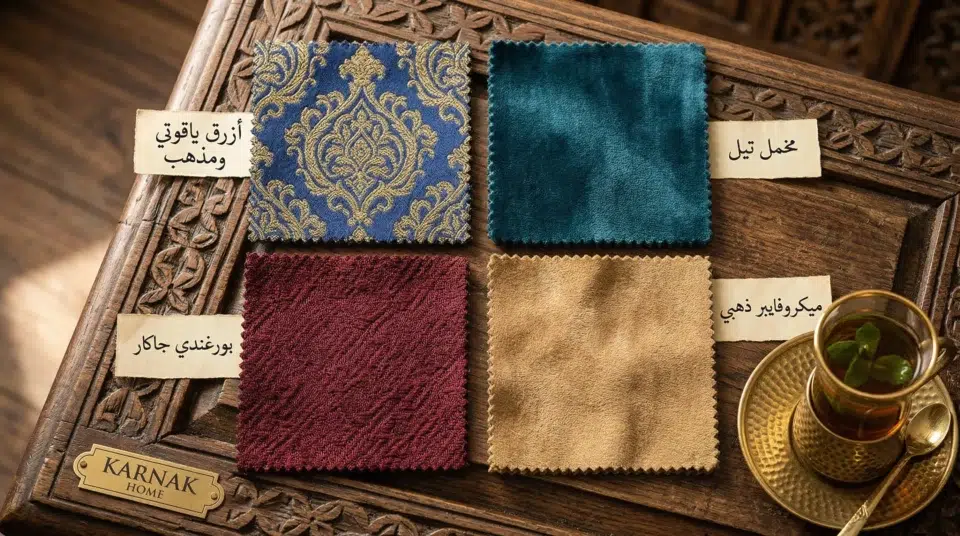
Performance velvet in jewel tones: The most successful contemporary replacement for traditional brocade in modern and hybrid majlis applications. Performance velvet in deep sapphire, emerald, burgundy, and warm gold delivers the visual richness of traditional majlis fabrics with the humidity resistance, UV stability, and cleanability that UAE daily use requires. Available from Karnak Home in the same tonal ranges as traditional majlis colour palettes.
High-grade microfibre in contemporary majlis tones: For the most family-practical modern majlis applications, high-grade performance microfibre in warm gold, dusty teal, or muted terracotta delivers Arabic colour culture in the UAE’s most durable upholstery material.
What never to use for majlis seating in the UAE: Natural silk degrades rapidly in UAE humidity and UV, and is genuinely damaged by the moisture from hands and seated contact in a warm Gulf climate. Untreated linen absorbs humidity and dust, becomes uncomfortable in the shamal season, and fades unevenly under the UAE sun. Both look exceptional for the first three to six months and deteriorate disappointingly thereafter.
Sizing a UAE Majlis: Traditional Conventions and Modern Adaptations
One of the most practical areas where traditional and contemporary majlis design diverges is in sizing conventions. Understanding the traditional spatial rules and knowing which ones are culturally essential versus which are simply conventional is what allows modern adaptations to maintain authentic hospitality function.
Traditional Majlis Sizing Conventions
Seating height: Traditional Arabic floor seating ranges from directly on carpet or cushions (floor-level, still common in Northern Emirates and Omani-influenced households) to low platform seating at 20–30 cm, to the most widely adopted convention in UAE urban households of 35–45 cm seat height. This range is culturally significant; it keeps guests at a respectful, equal, and intimate level that higher Western-style seating (50–55 cm) disrupts.
Wall clearance: Traditional majlis seating runs directly against the wall, with 0–5 cm clearance. This is both functional (maximises room capacity) and social (the wall becomes a natural back rest, making extended sitting comfortable without leaning on other guests).
Sofa depth: Traditional Arabic sofa seating is shallower than contemporary sofas, typically 55–65 cm deep, compared to 70–90 cm for contemporary lounging sofas. This shallower depth facilitates the upright, attentive posture appropriate for guest reception, as opposed to the reclined posture of casual family lounging.
Seating run length: A traditional majlis for a family villa in the UAE typically accommodates 15–30 guests. At approximately 55–65 cm of seating width per person (the typical Arabic seating convention), this requires 8–20 metres of total wall-length seating, meaning a purpose-built majlis room of 25–60 m² with seating along two or three walls.
Modern Adaptations That Preserve Majlis Function
For contemporary or hybrid approaches, these conventions can be adapted without losing functional integrity:
- Seat height can increase to 42–48 cm while maintaining the relatively low-to-the-room effect that creates a majlis atmosphere, provided ceiling height is sufficient (2.8 m minimum) to preserve proportion
- Seating can move 10–15 cm from the wall when the room’s primary function is family use rather than formal reception, creating a small service ledge behind the sofa, useful for cables and wall-positioned lighting
- A modular sofa configured in an L-shape against two walls, rather than a custom-built wall-length continuous sofa, achieves the wall-aligned seating principle with contemporary furniture that can be reconfigured as family needs change
Sizing reference for a modern majlis setup in a UAE villa living room by property size:
| Room Size | Wall Configuration | Recommended Seating Length | Estimated Guest Capacity |
|---|---|---|---|
| 20–30 m² (small villa room) | Two walls (L-shape) | 400–500 cm total | 8–10 guests |
| 30–50 m² (mid-size villa room) | Two-three walls | 600–800 cm total | 12–16 guests |
| 50–80 m² (large dedicated majlis) | Three walls | 900–1,200 cm total | 18–25 guests |
| 80 m²+ (formal reception majlis) | Three walls + centre | 1,200 cm+ total | 25–40+ guests |
Common Mistakes UAE Families Make When Blending Majlis and Modern
The intent to blend is good in nearly every case we encounter. The execution is where it goes wrong. These are the five mistakes our team sees most consistently — and the corrections that transform a confused interior into a coherent one.
Mistake 1: Using Traditional Majlis Furniture That Is Too Heavy for the Room’s Scale
Ornate, heavily carved traditional Arabic furniture generates enormous visual weight. In a formal 60 m² dedicated majlis room, that weight is appropriate; it fills the space with the richness and gravitas the room demands. In a 30 m² open-plan living room that also needs to function as a daily family space and television room, the same furniture overwhelms the room and makes it feel like a museum rather than a home.
The fix: Match the visual weight of your Arabic furniture to the room’s scale and daily function. Smaller rooms and family-use spaces require simpler Arabic furniture, cleaner frames, less gold detailing, and more restrained colour choices. Save the most ornate pieces for rooms that can hold them.
Mistake 2: Mixing Arabic and Modern Furniture Without a Colour Strategy
Placing a deep burgundy ornate Arabic sofa set beside a light grey contemporary sectional in the same room without any colour bridging creates an interior that looks like two separate showroom displays, not a home. Colour is the primary design tool for creating dialogue between traditional and contemporary pieces, and without it, every blend attempt will feel like a clash.
The fix: Before purchasing either the Arabic or modern pieces, establish the room’s colour bridge, the tone that will appear in both zones. Then select the Arabic piece’s secondary colour and the modern piece’s accent colour from the same family as your bridge tone.
Mistake 3: Getting the Furniture Height Wrong
Placing a contemporary sofa at 48–55 cm seat height beside an Arabic seating element at 38–42 cm in the same room creates a visual disconnect that no amount of styling resolves. Guests notice the height difference physically and socially; it communicates, unintentionally, that the traditional seating is the inferior or secondary option rather than a co-equal or honoured element.
The fix: In open-plan blended rooms, select a contemporary sofa at 40–44 cm seat height to minimise the height differential with your Arabic seating element. The best contemporary sofas for majlis-modern blends are low-profile models in the 38–45 cm seat height range, which also happen to be among the most design-forward choices in UAE living room furniture for 2026.
Mistake 4: Under-Investing in the Rug
The rug is the single most powerful unifying element in a blended majlis-modern room. Yet it is consistently the most under-budgeted element in UAE living room projects. Families spend AED 20,000 on furniture and AED 800 on a rug that is visibly undersized for the room and cheap in texture relative to the furniture around it. The furniture then looks more expensive than it is because the rug undermines the entire composition.
The fix: Budget at minimum 10–15% of your total living room spend on the rug. In a blended majlis-modern room, the rug needs to be large enough to sit beneath all seating in both zones (minimum 300 × 400 cm for most UAE villa living rooms), and in a pattern and colour that explicitly bridges both aesthetic worlds, a geometric Arabesque pattern in a contemporary palette is the single most effective choice available.
Mistake 5: Treating the Majlis Element as Decorative Rather Than Functional
The most culturally significant mistake: purchasing Arabic-style furniture as interior decoration rather than as a functional hospitality element. When the Arabic sofa is too precious to sit on, positioned so awkwardly that guests would feel uncomfortable in it, or furnished without the low side tables and service elements required for traditional Arabic coffee and dates service, the majlis has been aestheticised out of its function. It looks Arabic, but does not work as a majlis.
The fix: Design the Arabic seating zone for use, not display. Ensure the seating is accessible and comfortable for the range of guests who will use it (including elderly family members who need to be able to sit and rise comfortably). Provide proper service tables at the right height (30–38 cm). Include adequate cushioning for extended sitting. The function creates the authenticity.
Budget Guide: What a Blended Majlis-Modern Living Room Costs in UAE (2026 AED)
| Approach | Arabic Zone (AED) | Modern Zone (AED) | Unifying Elements (AED) | Total Range (AED) |
|---|---|---|---|---|
| Approach 1: Dedicated Majlis + Separate Modern Room | 8,000–45,000 | 9,000–30,000 | 3,000–8,000 | 20,000–83,000 |
| Approach 2: Open-Plan Blended Room | 6,000–20,000 | 7,000–22,000 | 4,000–10,000 | 17,000–52,000 |
| Approach 3: Modern Majlis (contemporary forms) | 12,000–28,000 | N/A | 5,000–14,000 | 17,000–42,000 |
| Approach 4: Hybrid Accent Corner | 5,500–14,000 | 6,000–16,000 | 2,500–6,000 | 14,000–36,000 |
| Approach 5: Fusion Statement | 4,000–15,000 (statement pieces) | 10,000–30,000 | 3,000–8,000 | 17,000–53,000 |
For bundle savings on living room furniture across both Arabic and contemporary categories, explore our furniture packages for UAE families and check the Karnak Deals section for current promotions.
Expert Perspective: What Karnak Home’s Design Team Recommends for UAE Families in 2026
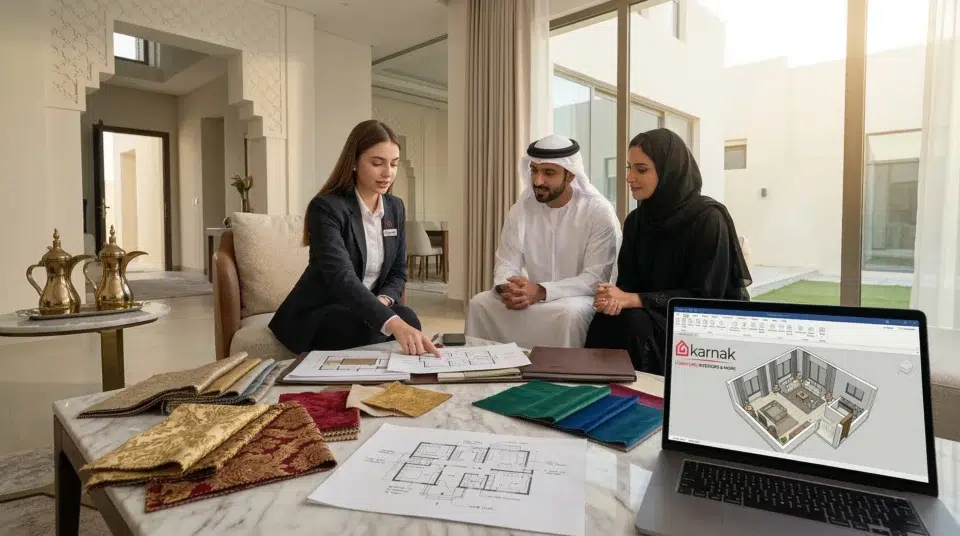
After 36 years of manufacturing both traditional Arabic and contemporary living room furniture for UAE families, our design consultants have developed a clear perspective on what works and what does not when UAE families attempt this blend. These are the recommendations we share most consistently with customers in our Sharjah showroom and during home visits across Dubai and Abu Dhabi:
Start from function, not aesthetics. Ask first: how will this room be used? Who will sit in it and for what occasions? How many guests does it need to accommodate at maximum capacity? The answers determine which approach is right before any aesthetic discussion begins.
Honour the majlis function even if you modernise the form. The wall-aligned seating orientation, the low table for service, the capacity for meaningful guest numbers, these functional elements are what make a space a majlis. A room that looks Arabic without serving the hospitality function it implies is a missed opportunity for both cultural authenticity and genuine social use.
Invest in quality for both zones. The most elegant blended rooms we see are ones where both the Arabic and contemporary elements are clearly high-quality. When one zone is premium, and the other is budget, the contrast reads as unresolved rather than intentional. Both zones communicating quality creates the impression of a cohesive, considered whole.
The rug is your most important single design decision in a blended room. More than any furniture piece, the rug determines whether the room feels unified or fragmented. Budget appropriately; it is not a secondary purchase.
Do not try to do everything in one purchase. The most successful blended UAE living rooms we encounter were furnished over two to three carefully considered stages, not in a single showroom sweep. Start with the primary seating in both zones, get the rug right, then layer in accent pieces, lighting, and decorative elements over subsequent months.
Conclusion: The Majlis Is Not a Style, It Is a Living Tradition
The most important thing we have learned in 36 years of furnishing UAE homes is that the families who are happiest with their blended majlis-modern living rooms are the ones who approached the project with cultural clarity rather than aesthetic anxiety. They knew what the majlis meant to them and their families, what obligations it represented, what occasions it would serve, what it communicated about their home’s values, and then made furniture decisions in service of that clarity.
The contemporary forms, the performance fabrics, the modern colour palettes, these are tools. The hospitality, the generosity, the welcome extended to guests through the physical space of the majlis, that is the tradition that transcends furniture and remains entirely relevant in every UAE living room in 2026.
Key Takeaways:
- The majlis is a functional space for Arabic hospitality, not just an aesthetic style: design for use first
- Five distinct blending approaches exist for UAE homes in 2026, from fully separate rooms to subtle accent corners; choose based on your property type, family lifestyle, and hosting needs
- Wall-aligned, low-profile seating (35–45 cm seat height) is the core spatial convention that makes a space feel and function as a majlis, regardless of aesthetic direction
- A unified rug in a bridging pattern is the single most powerful design tool in any blended majlis-modern room
- Performance velvet in jewel tones is the best contemporary replacement for traditional brocade; it delivers Arabic visual richness with UAE-climate durability
- Match the visual weight of Arabic furniture to your room’s scale; the most ornate pieces belong in dedicated formal rooms of 50 m² or more
- Invest equal quality in both zones; the contrast between premium and budget reads as unresolved, not eclectic
Furnish Your UAE Majlis and Living Room with Karnak Home
Since 1988, Karnak Home has manufactured both traditional Arabic majlis furniture and contemporary living room pieces for UAE families — making us uniquely equipped to help you furnish both zones of a blended living room with the same quality standard and a design coherence that most retailers cannot offer.
🕌 Explore the Majlis Furniture Collection: 🛋 Browse Contemporary Living Room Furniture: 📦 Furniture Packages (Best Value): 🏬 Visit Our Showroom: Industrial Area No. 1, Sharjah, UAE, Open 7 Days 📞 Free Design Consultation: Call or WhatsApp our UAE team, we speak Arabic and English
Ready to Create a Modern Majlis in Your UAE Home?
You’ve just explored how UAE families in 2026 are blending traditional majlis hospitality with modern living room design—covering dedicated vs open-plan approaches, modern adaptations with low-profile seating, performance fabrics for humidity and UV, sizing for villas and apartments, common mistakes like height mismatches or poor rug choices, and budget guides across five blending strategies. These ideas preserve cultural generosity while fitting contemporary Abu Dhabi villas, Dubai townhouses, and Sharjah apartments. Now discover our majlis and living room collections crafted for real UAE family life and guest hosting. All include free delivery, free professional installation, and free in-home consultation across every Emirate.
- → Majlis Furniture – Authentic low seating and corner sets updated for 2026, blending perfect for traditional hospitality in villas and hybrid modern rooms
- → Living Room Furniture – Versatile UAE collections that support majlis-modern fusion with unified rugs, neutral palettes, and family-friendly layouts
- → Sofas – Performance-fabric sofas in low-profile and modular designs ideal for modern majlis seating and daily UAE family use
- → Corner L-Shape Sofas – Space-efficient corner sofas in muted tones for open-plan blended rooms and villa majlis zones
- → Coffee Tables – Low, ornate, and travertine/wood tables suited for traditional majlis service and modern hybrid setups
- → Display Units UAE – Shelving and cabinets to showcase cultural accents like brass trays in majlis-modern living areas
- → Console Tables – Versatile low consoles for entryways and side service in blended UAE living spaces
- → Furniture Packages – Bundled majlis and living room sets with savings for complete villa or apartment blending projects
- → Karnak Deals – Value offers on performance fabrics and hybrid pieces for budget-conscious majlis updates
💬 Get Free Consultation on WhatsApp Shop All Majlis Furniture Now →