
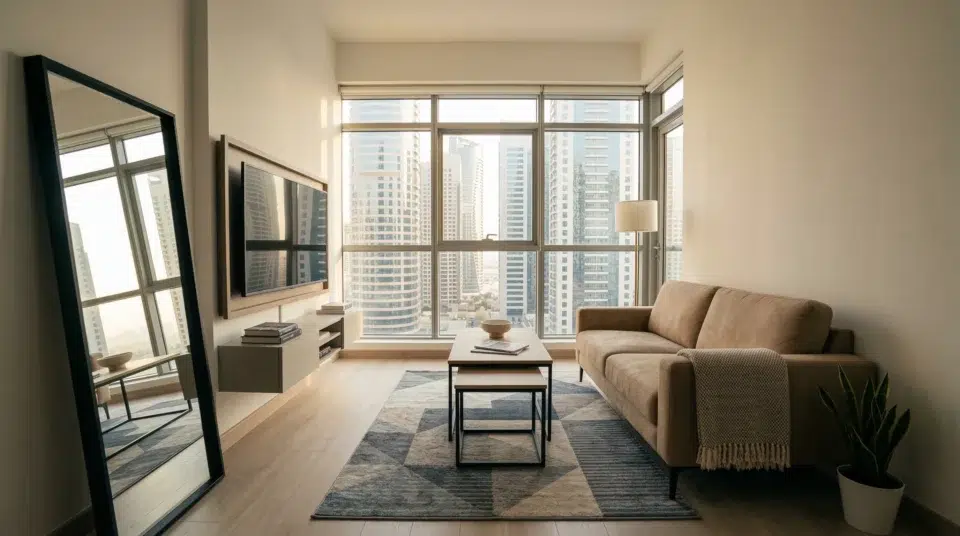
You found your apartment in JLT, Al Nahda, Sports City, or Al Reem Island. The location is right, the building is clean, and the commute is manageable. And then you step into the living room and do the calculation: maybe 25 square metres, a window on one side, a kitchen opening on the other, and somehow this space needs to function as your lounge, your home office, your guest space, and occasionally your dining room.
This is the lived reality of over 60% of UAE residents people renting or owning in the compact apartments that make up the majority of the UAE’s urban housing stock. The problem is not the space. The problem is that almost every piece of furniture advice you find, and almost every furniture showroom you walk into, is designed for villa living rooms and large open-plan layouts. The guides assume you have 50 square metres minimum. The showrooms display sectionals that would fill your entire apartment.
At Karnak Home, we have been manufacturing and delivering furniture for every type of UAE home since 1988, not just the villas. We understand the specific demands of a JLT one-bedroom with a 22 m² living room, a Sports City studio where the living and sleeping zones share the same floor, and a Sharjah two-bedroom where the living room doubles as a workspace five days a week. This guide is built entirely for those spaces.
Everything here is practical, specific, and grounded in real UAE apartment dimensions. By the end of this guide, you will know exactly which furniture pieces work for small UAE living rooms, how to arrange them, which products to buy, how much they cost in AED, and the eight design tricks that make compact UAE apartments look and genuinely feel larger than they are.
For the broader context on UAE living room furniture types and budgeting, see our Ultimate Guide to Living Room Furniture in UAE. If you are also navigating style choices for 2026, read our Living Room Furniture Trends in UAE for 2026 alongside this guide.
The UAE Apartment Living Room Reality: What You Are Actually Working With
Before any furniture advice can be useful, it needs to be grounded in the actual dimensions of UAE apartments, not the idealised spaces of interior design magazines. Here is the honest spatial profile of the small living rooms most UAE apartment dwellers are working with:
Studio apartment living zone (Dubai, Sharjah, Abu Dhabi): 14–22 m². The living and sleeping zones share the same space, or are separated only by a partial divider or furniture arrangement. Every piece of furniture must justify its floor footprint by doing at least two jobs.
1-bedroom apartment living room (JLT, Al Nahda, Sports City, Al Reem Island): 18–32 m². A defined living room separate from the bedroom, usually with an open-plan kitchen adjacent. The challenge is creating distinct functional zones, lounging, working, and dining within a single room.
2-bedroom apartment living room (Sharjah, Ajman, Deira, International City): 28–45 m². Technically enough space for a proper living room configuration, but UAE families in this category often have children, guests, and home office requirements all competing for the same floor space.
Compact townhouse living room (JVC, Mirdif, Discovery Gardens): 35–55 m². More space than a typical apartment, but often with awkward proportions, long and narrow, or divided by a staircase, which creates the same constraints as smaller rooms.
The single most important thing to understand about small UAE living rooms is this: the problem is rarely the total square metres. It is almost always the wrong furniture scale. A room of 22 m² with correctly sized furniture feels generous and livable. A room of 22 m² with a sofa two sizes too large feels oppressive, regardless of how good the interior design is. Every recommendation in this guide is calibrated to UAE apartment real-world dimensions, not to the aspirational spaces where furniture manufacturers photograph their products.
The 7 Furniture Rules for Small UAE Living Rooms
These are not aesthetic guidelines. They are spatial rules derived from 36 years of delivering and installing furniture in every size of UAE apartment, and from the consistent pattern of what makes small rooms work versus what makes them fail.
Rule 1: The Sofa Is Your Most Important Decision Get the Scale Right
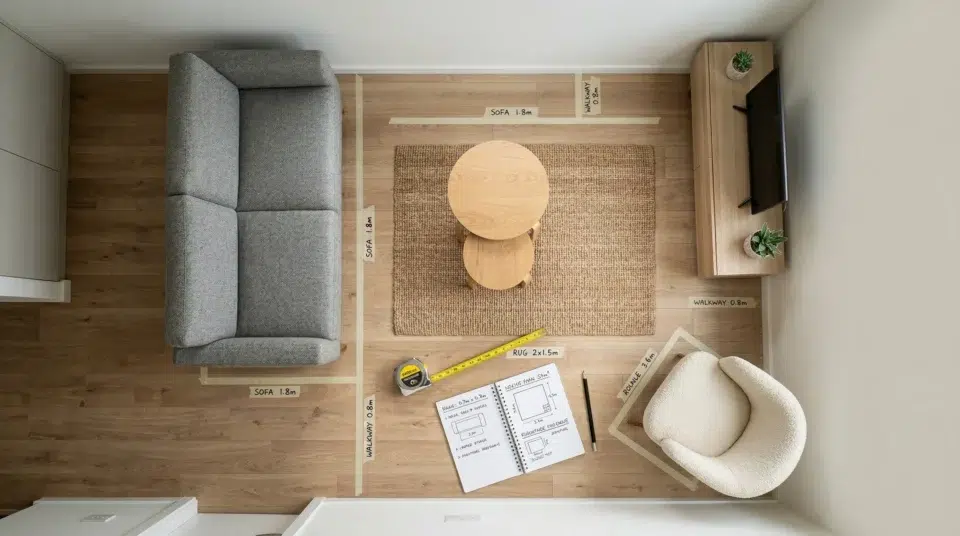
In a small UAE living room, the sofa’s length and depth determine everything else. A sofa that is too long makes the room impassable; a sofa that is too deep makes the room feel like a trench. The scale rules for UAE small living rooms by room size:
14–22 m² (studio / compact 1-bedroom): Maximum sofa length: 180 cm. A 2-seater sofa in the 150–170 cm range is the sweet spot — enough seating for two people or one person lying down without dominating the room. Seat depth: 75–82 cm maximum. Anything deeper starts to feel suffocating in this room size.
22–32 m² (standard 1-bedroom): Maximum sofa length: 220 cm. A 2-seater with chaise (typically 210–230 cm total) works if positioned along the longest wall. Alternatively, a 3-seater in the 185–200 cm range with no chaise, leaving space for a single accent chair. Seat depth: 80–88 cm.
32–45 m² (2-bedroom apartment or large 1-bedroom): A compact L-shaped sofa becomes viable, maximum 250 cm on the long side, maximum 150 cm on the short side. This is the smallest room size where an L-shape makes spatial sense without creating an obstacle course.
Browse our 2-seater sofa collection — compact dimensions designed for UAE apartment proportions, from AED 1,400.
Rule 2: The Coffee Table Should Float, Not Anchor
In a large living room, a substantial coffee table anchors the seating zone. In a small UAE apartment living room, the same piece becomes an obstacle. The rules for compact coffee tables in UAE apartments:
Nesting tables over a single table: Two or three nesting tables in graduated sizes give you surface space when you need it and floor space when you do not. When all tables are nested, they occupy roughly the footprint of a single 50 cm round table. Pulled apart for guests or working, they cover the functional range of a full coffee table. This is the highest-value furniture swap available for small UAE living rooms.
Round and oval over rectangular: Round and oval coffee tables have no corners to navigate around, sit more comfortably with non-parallel sofa arrangements (common in awkward room shapes), and visually soften small rooms where rectangular furniture creates a boxy, constrained feel.
Maximum dimensions for apartment coffee tables:
- Studio / compact 1-bedroom: 60–75 cm diameter (round) or 80 × 50 cm (rectangular)
- Standard 1-bedroom: 75–90 cm diameter or 90 × 55 cm
- 2-bedroom apartment: 90–110 cm diameter or 110 × 60 cm maximum
Minimum clearance between coffee table and sofa edge: 40 cm, the minimum comfortable walking pass. In rooms below 25 m², 35 cm is workable if the traffic path runs beside rather than between furniture.
Rule 3: Wall-Mount the TV Unit: No Exceptions Under 30 m²
In any UAE apartment living room below 30 m², a floor-standing TV unit is a significant spatial mistake. A floor-standing unit of 150 × 45 cm occupies 0.675 m² of floor area: meaningful in a 22 m² room, where it represents over 3% of total floor space. Beyond the floor footprint, a floor-standing unit visually compresses the room by interrupting the floor-to-wall transition and making the space feel lower.
A wall-mounted TV bracket with a floating shelf below for the set-top box and router accomplishes the same function in zero floor space and visually extends the room’s floor plane uninterrupted, the single most effective trick for making a small UAE apartment living room look larger than it is.
For apartments where wall mounting is permitted (check your tenancy agreement, RERA regulations in Dubai and Abu Dhabi allow reasonable fixture installation with landlord permission), a floating wall-mounted shelf system of 100–120 cm width provides ample storage and display space.
Where wall drilling is restricted, common in newer Dubai Marina, Downtown, and Business Bay developments, a slim-profile TV unit of maximum 35 cm depth is the best alternative. The depth is critical: a 45 cm deep TV unit in a 3-metre-wide room consumes 12.5% of the room’s width from just one piece.
Explore our TV and media unit collection, including slim-profile and wall-mountable options from AED 650.
Rule 4: Every Piece of Furniture Must Earn Its Footprint
In a small UAE living room, furniture that does one job is a luxury the space cannot afford. The standard coffee table should be a nesting table set or a lift-top storage piece. The ottoman should store blankets and remote controls. The console table should have at minimum two drawers. The sofa should be able to fold out as a guest bed if you are in a studio or compact one-bedroom.
The multifunctional furniture hierarchy for UAE small living rooms:
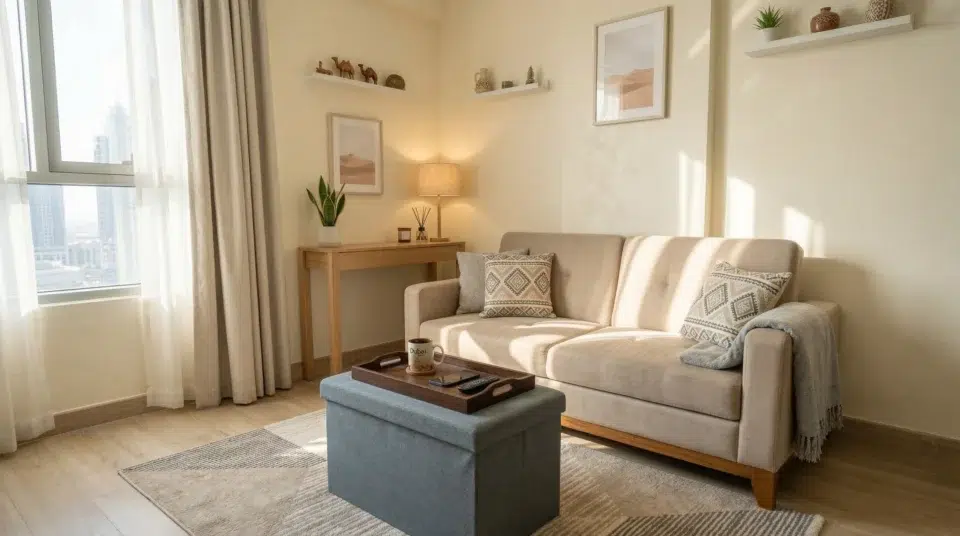
Priority 1 — The storage ottoman as coffee table: A 60–75 cm cube or rectangular ottoman in a durable fabric provides seating for one, a footrest for the sofa, storage for anything you need to hide quickly before guests arrive, and a flat surface with a tray for drinks and remotes. It is the single most space-efficient piece available for a UAE studio or 1-bedroom living room. Browse storage ottomans from AED 480.
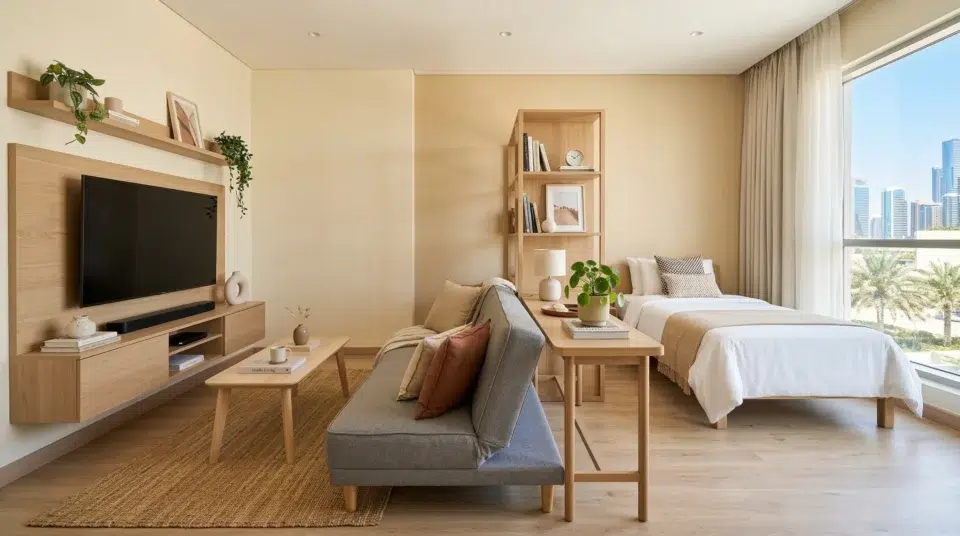
Priority 2 — The sofa bed for studio apartments: If your living room and sleeping area share the same space, a sofa bed is not a compromise; it is the correct furniture choice. Modern UAE sofa beds in performance microfibre open in under 30 seconds, sleep genuinely comfortably, and sit as normal sofas during the day with no visible evidence of their sleeping function. Explore sofa beds, from AED 1,800 for daily-use models.
Priority 3 — The console table as room divider: A narrow console table of 30–35 cm depth positioned behind a sofa that floats in the centre of a room creates a visual room divider between the living zone and a work or dining zone without requiring walls. It also provides a surface for a lamp, a mirror, and key storage, which makes the room feel structured and considered rather than unresolved.
Browse console tables — slim-profile options for UAE apartments from AED 580.
Rule 5: Respect the 90 cm Circulation Rule in Every Layout
Every traffic path through a UAE apartment living room needs a minimum 90 cm of unobstructed clearance. This is not a design preference; it is the minimum comfortable passage width for one person moving through a space without turning sideways. In apartments with two people and regular guests, 100–110 cm is noticeably more comfortable.
Map your circulation paths before placing any furniture:
- Entrance → living zone: Must be clear from the front door to the sofa
- Living zone → kitchen: The most-used path in any UAE apartment; must never be blocked by furniture
- Living zone → bedroom/bathroom: Can share with the kitchen path in studios, but must remain 90 cm clear
- Around the coffee table: 40 cm minimum between the coffee table and the sofa; 50 cm on the open side of the table for comfortable walking pass
The most common UAE apartment layout mistake: pushing all furniture against walls in an attempt to maximise central floor space. This creates the opposite of the intended effect — the room feels smaller, not larger, because the central space becomes dead and the furniture arrangement feels defensive and uncomfortable. A sofa floated 15–20 cm from the wall, with a narrow console behind it, uses slightly more floor space, but creates a room that feels genuinely livable.
Rule 6: Light Colours on Large Surfaces, Pattern and Texture in Accents
UAE apartments come in an overwhelmingly consistent finish: white or off-white walls, light grey or beige tiles, and white kitchen cabinets. This is a spatial gift that most residents treat as a problem to solve by introducing dark or heavily patterned furniture. The opposite approach works better.
Keep large surfaces light: Sofa upholstery in warm white, cream, light sand, or soft sage keeps the largest surface in the room visually receding rather than advancing. In a 22 m² living room, a dark charcoal sofa occupies a meaningful fraction of the visual field and makes the room feel significantly smaller than a sofa in the same dimensions but in a lighter tone.
Introduce pattern and texture in small pieces: Cushions, a small patterned rug, a single accent chair in a deeper tone, and decorative objects on shelves. These carry the room’s personality without claiming floor space or advancing visually into the room. A cream sofa with terracotta cushions and a geometric rug reads as interesting and considered; a dark terracotta sofa in a white apartment reads as heavy and space-consuming.
The rug as zone definer: In a UAE apartment where the living room is one of multiple uses happening in a single open space, a rug defines the living zone without walls. Keep the rug within the sofa footprint — ideally with the sofa’s front feet on the rug and the back feet off it. For studio apartments, a rug of 160 × 230 cm typically works. For 1-bedroom living rooms, 200 × 290 cm is the right scale.
Rule 7: Use Vertical Space, UAE Apartments Have More of It Than You Think
Most Dubai, Abu Dhabi, and Sharjah apartment buildings built after 2000 have ceiling heights of 260–280 cm, significantly higher than the European apartment stock of the same period. This vertical space is almost universally underused in the UAE’s small living rooms, where residents focus entirely on the floor plane.
Three practical applications of vertical space in a small living room in the UAE:
Tall, slim shelving: A narrow bookshelf or display unit of 35 cm depth × 200+ cm height provides substantial storage and display surface while using a fraction of the floor area of a low, wide unit. A 35 × 200 cm unit occupies 0.35 m² of floor area; a 90 × 80 cm sideboard occupies 0.72 m² twice the footprint for less than half the vertical storage.
Wall-mounted display shelves: Individual floating shelves at 30–40 cm depth positioned at 170–200 cm height provide display space, reduce the visual clutter of surfaces that collect items on lower furniture, and draw the eye upward the standard design trick for making ceilings feel higher and rooms feel taller.
Tall floor-standing mirrors: A mirror of 45 × 150 cm or taller, positioned to reflect the room’s light source (window) and primary seating zone, doubles the perceived depth of a small living room more effectively than any furniture rearrangement. Browse our floor mirror collection, an essential investment for any UAE apartment living room under 30 m².
The 8 Design Tricks That Make UAE Apartments Look Bigger
Beyond furniture selection, these eight design techniques, all applicable to UAE rental apartments without permanent modification, multiply the effect of correctly scaled furniture.
Trick 1: The Monochromatic Tone Stack
Choose one dominant warm neutral, cream, warm sand, or soft greige, and use it across 70–80% of the room’s surfaces: walls (already done by your developer), sofa, rug, and curtains. The eye perceives tonal unity as spatial continuity, making the boundaries of the room harder to read and the space feel larger. This is why hotel rooms feel bigger than their actual dimensions; they are almost universally decorated in a single tone family.
Trick 2: Legs Visible, Floor Visible
Furniture with visible legs, such as sofas, chairs, side tables, and even TV units with leg profiles rather than plinth bases, allows the floor plane to continue visually beneath the furniture, making the room feel more open. In a UAE apartment with light-coloured tile flooring, a sofa on 15 cm wooden or metal legs allows the floor colour to continue beneath the sofa and extends the perceived size of the room measurably. A sofa on a low plinth base that sits flush to the floor interrupts the floor plane and visually shrinks the room.
Trick 3: The Mirror Opposite the Window
Position a large mirror, minimum 60 cm wide, on the wall directly opposite your apartment’s main window. The mirror reflects the window’s daylight into the room, creating the illusion of a second light source and a second window. In UAE apartments where natural light enters from one direction only (common in single-aspect apartments in JLT, Al Nahda, and Deira), this technique transforms dark, cave-like living rooms into bright, open-feeling spaces. Cost: AED 400–1,200 for a floor or wall mirror of appropriate scale. Effect: priceless in a small apartment.
Trick 4: Keep the Floor Largely Visible
The more floor you can see, the larger the room feels. In a small living room in the UAE, resist the instinct to fill every corner with furniture and cover every surface with decorative objects. A deliberately spare floor arrangement, one sofa, one coffee table, one TV unit, one accent piece with visible floor around and between each piece, communicates scale better than a fully furnished room where every surface is occupied.
Trick 5: Curtains from Ceiling to Floor
Most UAE apartments come with curtain rails installed 10–20 cm below the ceiling. Replacing standard-length curtains with floor-to-ceiling panels, hung as high as the rail allows, falling to the floor creates the visual effect of taller ceilings and a larger window. The curtains do not need to cover a larger window area; they simply need to use all available height. In small UAE living rooms, this is a cost of AED 200–400 in curtain fabric but creates a visual impact equivalent to adding 30 cm to your ceiling height.
Trick 6: One Statement Piece, Everything Else Supporting
A small living room that tries to feature multiple visual focal points, a bold sofa, an art piece, a dramatic rug, and a patterned accent chair creates visual noise that makes the room feel busy and small. A small room with one clear visual focal point a single statement sofa in a warm colour against otherwise neutral surfaces, feels curated and spacious. Every other piece should support rather than compete. In UAE apartments, the sofa is almost always the right choice for the single statement piece.
Trick 7: Glass and Reflective Surfaces Used Selectively
Glass-top side tables and mirrored surface decorative pieces allow light to pass through rather than interrupting it, which is why interior designers use them strategically in small spaces. One glass-top side table in a small living room in the UAE introduces this lightness without making the room feel cold or impractical. More than two or three glass/mirror surfaces in a compact space tips from elegant into visually scattered.
Trick 8: The Rug That Defines, Not Fills
In a small UAE living room, the most common rug mistake is buying one that is either too small (creating a floating, unanchored island of furniture) or too large (covering the floor so completely that it removes the floor plane contrast that creates the sense of space). The ideal rug for a small living room in the UAE defines the seating zone without filling it: front sofa legs on the rug, remaining floor tiles visible around and beyond the rug perimeter.

Room-by-Room UAE Apartment Furniture Guides
The JLT / Sports City / Discovery Gardens 1-Bedroom: Furnishing a 25 m² Living Room
This is one of the most common apartment configurations in Dubai, a living room of approximately 22–28 m² adjacent to an open kitchen, with a single window wall and a bedroom corridor on the other side.
The optimal furniture layout:
- 2-seater sofa (165–180 cm) against the longest wall, floating 15 cm from the wall
- Console table (100–120 cm × 30 cm) behind the sofa
- Nesting tables (55 cm primary, nested to 40 cm) as a coffee table, centred in front of the sofa
- Wall-mounted TV bracket + floating shelf (100 cm) on the opposite wall
- Single accent chair (65 cm wide) in the corner nearest the window
- Floor mirror (45 × 150 cm) on the wall adjacent to the window
- Small geometric rug (160 × 230 cm) anchoring the sofa and nesting tables
- The arc floor lamp over the sofa corner provides ambient light without using surface or floor space
Total furniture footprint: Approximately 6.5 m² of the room’s 25 m² 26%, well within the 40% maximum rule. Estimated budget: AED 6,500–12,000 for all pieces above at mid-range quality.
The Al Nahda / Deira / Sharjah 2-Bedroom: Furnishing a 35–40 m² Living Room
The 2-bedroom apartment living room in these communities typically offers a wider but often shorter space, 5–6 m wide and 6–7 m long, often with a dining area adjacent.
The optimal furniture layout:
- Corner L-shaped sofa maximum 240 cm × 150 cm, positioned to define the living zone away from the dining area
- Storage ottoman (65 cm square) as a coffee table, serving double duty as additional seating for guests
- Slim TV unit (150 × 40 cm), floor-standing or wall-mounted, against the shorter wall
- Pair of nesting side tables at sofa ends replacing bulky side tables
- A rug of 200 × 290 cm anchors the living zone and visually separates it from the dining area
- One medium floor mirror on the dining-adjacent wall to extend visual depth between zones
Total furniture footprint: Approximately 11 m² of 38 m² 29%. Estimated budget: AED 9,000–16,000 for all pieces at mid-range quality.
Browse compact corner and L-shaped sofas UAE apartment-scale configurations.
The Abu Dhabi Al Reem Island / Khalifa City Studio: Furnishing a 20 m² Combined Living-Sleeping Space
The studio apartment furniture challenge is categorically different from other apartment types because it requires furniture that defines distinct zones within a single room rather than simply furnishing a living room.
The zone-defining approach:
- Sofa bed (180–200 cm when closed) positioned to face the TV wall and create the visual boundary between “living zone” and “sleeping zone.” When opened, it should not block the main circulation path. Explore sofa beds from AED 1,800 for daily-use comfort.
- A console table (120 cm × 30 cm) positioned behind the sofa bed acts as the room divider and defines the back edge of the living zone. When the sleeping zone is in use, this console becomes a bedside surface.
- A storage ottoman (60 cm square) in front of the sofa serves as a coffee table by day and blanket storage at night.
- Wall-mounted TV unit — essential in a studio, where every cm of floor space counts.
- Tall, slim shelving unit (35 cm deep × 180 cm tall) for book and personal storage, positioned to create a partial visual division between living and sleeping zones.
- Mirror (full length, 45 × 180 cm) on the end wall opposite the window.
Estimated budget: AED 5,500–9,500 for a complete, well-considered studio living-sleeping zone setup.
What to Spend: Compact Living Room Furniture Budgets in AED (2026)
One of the persistent myths about small-space furnishing is that compact furniture costs less. In the UAE market in 2026, the opposite is often true: well-designed compact furniture that performs multiple functions and uses quality materials in smaller quantities frequently costs comparably to standard-size pieces, and occasionally more. Understanding where to invest and where to economise in a small living room in the UAE prevents both under-spending on things that matter and over-spending on things that do not.
| Furniture Piece | Entry (AED) | Mid-Range (AED) | Quality Investment (AED) |
|---|---|---|---|
| 2-seater sofa | 1,200 – 1,800 | 1,800 – 3,500 | 3,500 – 7,000 |
| Compact 3-seater sofa | 1,600 – 2,200 | 2,200 – 4,500 | 4,500 – 9,000 |
| Sofa bed (daily-use quality) | 1,800 – 2,800 | 2,800 – 5,500 | 5,500 – 12,000 |
| Nesting table set (2–3 pieces) | 350 – 600 | 600 – 1,200 | 1,200 – 2,500 |
| Storage ottoman | 480 – 750 | 750 – 1,400 | 1,400 – 3,000 |
| Slim-profile TV unit | 650 – 1,000 | 1,000 – 2,200 | 2,200 – 4,500 |
| Console table (narrow) | 580 – 900 | 900 – 1,600 | 1,600 – 3,500 |
| Floor mirror (tall) | 400 – 700 | 700 – 1,400 | 1,400 – 3,000 |
| Small accent chair | 650 – 950 | 950 – 1,800 | 1,800 – 4,000 |
Where to invest: Primary sofa (or sofa bed for studios) it is your most-used piece, and its quality is felt every day. Sofa bed mechanism quality is critical if you will open and close it regularly; invest in the mechanism, not just the upholstery.
Where to save: Nesting tables, console tables, and mirrors, at normal viewing distance in a small UAE apartment, mid-range quality is indistinguishable from premium. Redirect the savings to a better sofa.
For bundled savings across living room pieces, explore our furniture packages for UAE families particularly relevant for newlyweds and expats furnishing their first UAE apartment. Check our Karnak Deals for current promotions on compact and apartment-scale living room furniture.
Renter-Specific Advice: Furnishing a UAE Apartment You Do Not Own
Over 78% of UAE residents are renters, and the furniture decisions renters face are genuinely different from those of homeowners. If you are furnishing a UAE rental apartment, these considerations are specific to your situation:
Neutral finishes for maximum resale and re-use flexibility. UAE expats relocate every 2–4 years on average. Furniture in neutral tones — warm sand, cream, light greige — transitions between apartments and between interior styles far more easily than bold or highly decorative pieces. A terracotta velvet sofa that looks perfect in your current JLT apartment may fight with the finishes in your next Barsha Heights unit.
Avoid permanent modifications without landlord consent. RERA regulations permit tenants to make minor interior modifications with landlord approval. Plugged holes from picture hooks and curtain rails are generally accepted; significant wall installations require written permission. Always check your tenancy contract before drilling for wall-mounted TV brackets, floating shelves, or heavy mirrors.
Modular furniture is your best friend. A modular sofa that can be reconfigured from an L-shape for your current apartment into a 3-seater for your next, smaller place gives you flexibility no fixed-configuration sofa can match. The additional cost of modular over standard is typically 15–25% a sound investment over a three-year UAE tenancy.
Quality over quantity, always. Expats who have been in the UAE for several tenancy cycles consistently give the same advice: they wish they had spent more on fewer, better pieces in their first apartment rather than filling the space cheaply. Cheap furniture does not survive the multiple moves, humid summers, and dusty shamal seasons of a UAE apartment lifestyle.
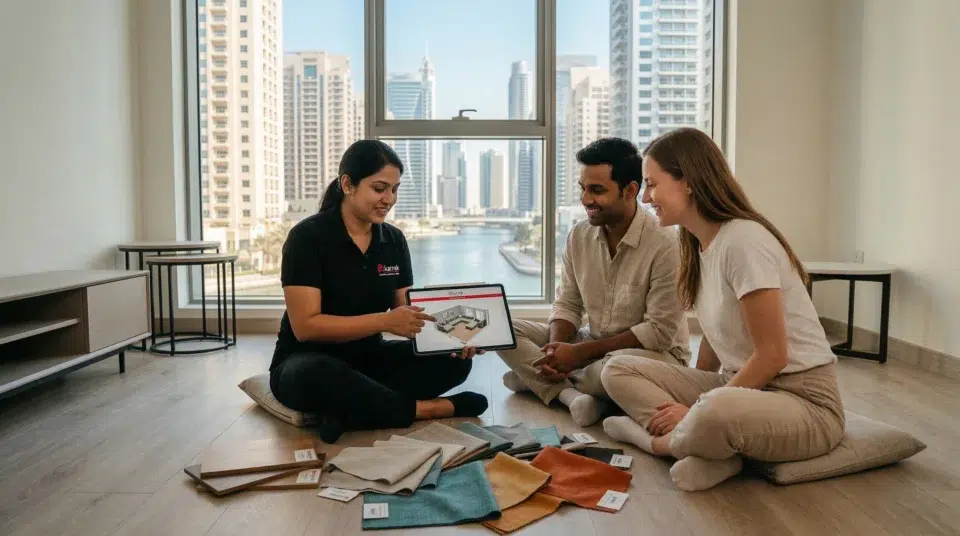
10 Most Common Small Living Room Mistakes in UAE Apartments
After 36 years of UAE furniture delivery and installation, these are the errors our teams encounter most often in compact UAE apartments and what to do instead.
1. Oversized sofa: The single most common and most damaging mistake. When in doubt, size down.
2. Glass dining table doubling as coffee table: Rarely works spatially or functionally. Use a proper small coffee table or nesting set.
3. Dark rug in a small room: Dark rugs absorb light and visually shrink floor space. Use light to mid-tone rugs in small UAE living rooms.
4. Matching sets: Full matching sets (sofa + 2 chairs + coffee table in the same material) make small rooms feel like showrooms, not homes. Mix one or two tones within a consistent palette.
5. Ignoring the dining zone: In open-plan UAE apartments, an unresolved dining area makes the entire living space feel disorganised. A small dining table (80 cm round or square) with folding or stackable chairs solves this efficiently.
6. Too many small decorative items: Multiple small objects on multiple surfaces create visual noise that reads as clutter. One or two well-chosen larger objects beat six small ones in a small room.
7. No overhead or ambient lighting plan: UAE apartments typically have a single central ceiling light. Adding one arc floor lamp over the sofa and one small table lamp creates depth, warmth, and the illusion of separate zones within a single room.
8. Buying furniture before measuring the lift: Already covered, but it is mistake number one for delivery headaches across Dubai high-rises.
9. Underusing the wall above 170 cm: Most UAE apartment walls between 170 cm and the ceiling height are bare. Floating shelves, artwork, and wall-mounted lighting in this zone draw the eye upward and make the ceilings feel higher.
10. Choosing furniture that looks good in photos over furniture that works in the room: Instagram-worthy furniture is frequently oversized, impractically pale, or fragile, none of which suits UAE apartment daily life. Choose for your actual life, not for a photograph.
Conclusion: Small Doesn’t Mean Compromised in the UAE
The best UAE apartment living rooms we have seen in 36 years are not the biggest ones. They are the ones where every furniture decision was made with full awareness of the space — its dimensions, its limitations, and its opportunities. They are rooms where a carefully chosen 2-seater sofa in warm cream microfibre, a pair of nesting tables, a wall-mounted TV unit, and a tall floor mirror create a living space that feels genuinely complete, generous, and liveable despite measuring under 25 m².
Small living room furniture in the UAE is not a consolation prize; it is a design discipline. And when it is done well, it produces rooms that feel larger, more considered, and more personally expressive than oversized villas full of furniture bought without thought.
Your small UAE living room checklist:
- Measure your room, lift, and corridors before shortlisting any furniture
- Scale your sofa to the room: maximum 180 cm for studios, 220 cm for 1-bedrooms, 250 cm L-shape for 2-bedrooms
- Wall-mount the TV unit in any room under 30 m²
- Use multifunctional pieces: storage ottoman, sofa bed for studios, nesting tables over a single coffee table
- Keep the sofa and rug in light, warm neutrals, save pattern and depth for cushions and accents
- Use the wall above 170 cm for shelves, art, and mirrors
- Position a large mirror opposite your main window
- Choose modular sofas for flexibility across your UAE tenancy
- Maintain 90 cm clearance on all circulation paths
- Invest in sofa quality; save on nesting tables and console tables
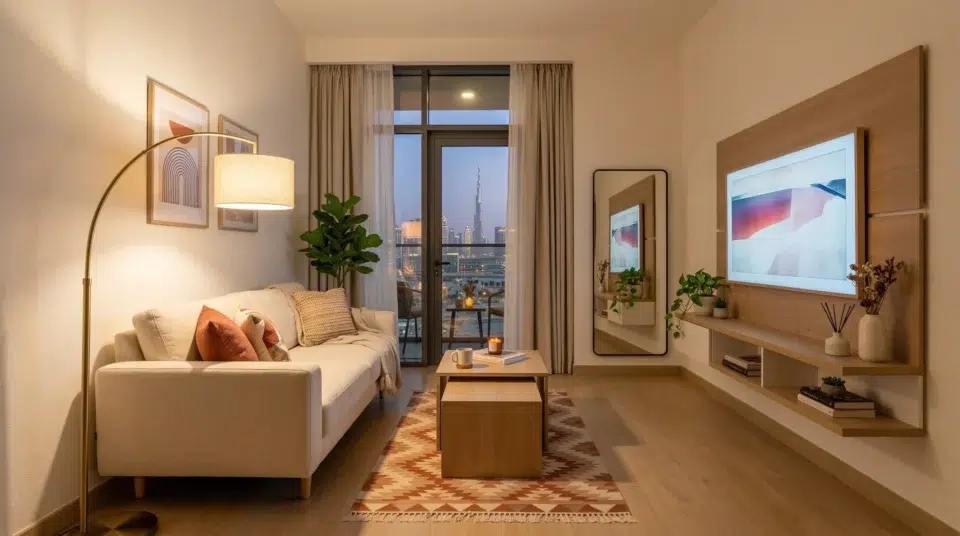
Ready to Furnish Your UAE Apartment Living Room?
Browse Karnak Home’s complete small living room furniture collection, including compact sofas, nesting tables, storage ottomans, sofa beds, slim TV units, console tables, and floor mirrors, all selected and manufactured with UAE apartment dimensions in mind. Free delivery and free professional installation across all seven Emirates.
🛋 Shop Small Living Room Furniture: 🛏 Explore Sofa Beds:🪑 Browse 2-Seater Sofas:🏬 Visit Our Showroom: Industrial Area No. 1, Sharjah, UAE Open 7 Days 📞 Free Consultation: Call or WhatsApp our UAE team, who will help you plan your space
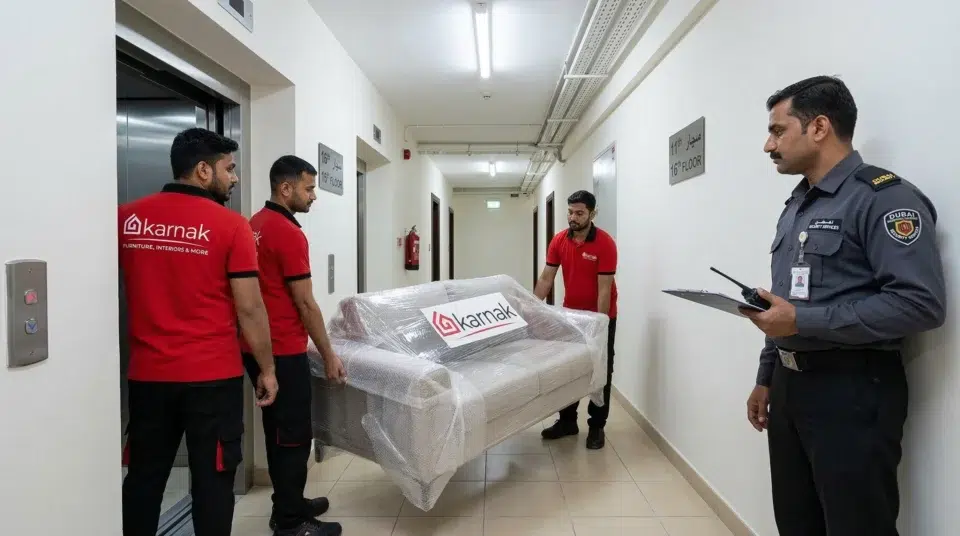
Ready to Choose Your Ideal Living Room Setup?
You’ve just followed the complete 8-step buyer’s roadmap for 2026: precise measuring for UAE apartments/villas, property-type breakdowns (studio to premium penthouse), climate-smart fabric ranking (performance microfibre top for humidity/UV), showroom vs online tips, understanding free delivery/installation, smart budgeting (45–55% on sofa), sales calendar, 10 key questions to ask, and avoiding the top regrets like fit failures or short-lived pieces. This ensures your furniture fits real Dubai/Abu Dhabi/Sharjah homes perfectly. Now explore our collections tailored to every UAE living situation—with free delivery, free professional installation, and free in-home consultation across all Emirates.
- → Living Room Furniture – UAE-specific collections matched to apartment types A–C and villa types D–E with proper sizing and climate durability
- → Sofas – Performance-fabric sofas (2-seater to sectional) built for UAE humidity, family use, and exact property-type fit
- → Corner L-Shape Sofas – Space-optimized for mid-size apartments and open-plan villas with high-traffic durability
- → 3-Seater Sofas – Ideal balance for 2-bedroom apartments and family villas, with lift-friendly sizing
- → 2-Seater Sofas Dubai – Compact, high-rise compatible sofas perfect for studios and small apartments with free delivery
- → Sofa Beds – Multifunctional for guest hosting in compact UAE homes and small villas
- → Coffee Tables – Storage ottomans, lift-top, and proportionate designs are safe for families and the UAE coffee culture
- → TV Media Units – Slim, cable-managed units for wall constraints and entertainment in apartments/villas
- → Accent Chairs – Secondary seating that adds style without overcrowding UAE living spaces
- → Furniture Packages – Complete setups with 15–25% savings, aligned to your property type and budget framework
- → Karnak Deals – Seasonal value offers on climate-ready pieces with full free services included
💬 Get Free Consultation on WhatsApp Shop All Living Room Furniture Now →