
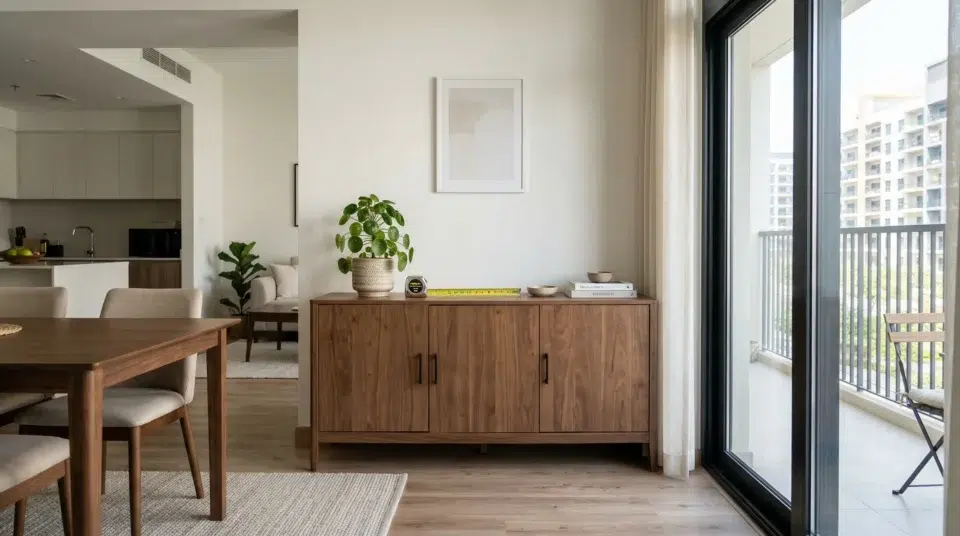
The call comes in every summer without fail. A family in Al Barsha bought a buffet 18 months ago, a beautiful high-gloss white piece, loved it on delivery day, and photographed it for Instagram. Now it has a bubble the size of a dirham coin on the front of the door, a whitish haze along the bottom edge where the plinth meets the tile, and a drawer that no longer closes flush. Or it is a wooden buffet in a marina apartment where the building faces the sea: the surface has developed a subtle grey bloom in the corner that gets the most morning light, and the bottom shelf has developed a soft bow that was not there before. These are not random product failures. They are predictable, preventable outcomes of the specific climate conditions in UAE homes, and they occur because the buyer, through no fault of their own, was never told what the UAE climate actually does to furniture materials.
In 36 years of delivering and installing furniture across Dubai, Sharjah, Abu Dhabi, Ajman, and the Northern Emirates, the Karnak Home team has seen every material failure the Gulf climate can produce, and every success story too. We know which finishes last ten years in a Jumeirah villa and which ones start showing wear after the first summer in a Downtown Dubai apartment. We know which wood species actually perform in the cycle of humid August and dry January, and which ones promise far more than they deliver. We know how air conditioning changes everything, because in the UAE, AC is not a seasonal luxury; it runs for nine months a year and turns the interior of a well-insulated modern apartment into a climate zone as controlled and specific as a wine cellar, but with very different parameters than the furniture manufacturer in Italy or Malaysia designed for.
This guide is the most complete material-level comparison of wood and high-gloss buffet options for UAE homes that exists in English. We will go through every material category, every finish type, every climate variable, and every practical scenario with honest performance assessments, clear AED cost guidance, and specific product direction for your UAE home type. By the end of this article, you will know exactly which material choice to make, and why, and you will never receive that summer phone call we described above.
Why the UAE Climate Is Unlike Any Other Market in the World
Understanding why buffet materials behave differently in the UAE requires understanding what the UAE climate actually consists of, because it is genuinely unusual, a combination of stresses that does not exist in the markets where most furniture is designed and tested.
The Five Climate Stresses UAE Furniture Must Survive
Stress 1: Summer heat extremes. Dubai’s outdoor temperature from June to September averages 38 to 42 degrees Celsius. The interior surface temperature of a poorly insulated exterior wall in a west-facing apartment on a July afternoon can reach 55 to 60 degrees Celsius. Even in well-insulated modern buildings, interior air temperatures can reach 28 to 30 degrees without continuous AC. Most furniture manufacturing standards test for performance up to 35 degrees. UAE conditions exceed this regularly.
Stress 2: Humidity swings across the calendar year. Dubai’s relative humidity averages 80 to 90 percent in July and August, dropping to 25 to 35 percent in December and January. This 50 to 60 percent swing across a single year is one of the most dramatic humidity cycles experienced by residential furniture anywhere in the world. Every expansion and contraction cycle it forces on wood fibres and panel glue lines is cumulative stress.
Stress 3: Air conditioning drying effect. UAE AC systems run at 20 to 23 degrees Celsius for nine or more months of the year. This sustained cooling does not simply lower temperature — it desiccates interior air significantly, often pushing indoor relative humidity below 40 percent even in summer months when outdoor humidity is extremely high. The result is furniture that lives in conditions alternating between extremely dry (AC on) and briefly very humid (when AC is off, or in rooms with poor airflow).
Stress 4: UV radiation intensity. The UAE receives an average UV index of 10 to 12 (extreme scale) for six months of the year. South and west-facing windows without solar film transmit significant UV energy onto furniture surfaces, accelerating the degradation of pigments, glue lines, and surface coatings. A buffet placed within two metres of an unfilmed south-facing window in Jumeirah or Al Furjan will receive more annual UV exposure than the same piece placed in a north-facing room in London would receive across a decade.
Stress 5: Fine desert dust. UAE air contains fine particulate matter from desert sand, construction activity, and periodic dust storms (shamal). This dust is abrasive at a microscopic level: it settles on horizontal surfaces and, when wiped away with a damp cloth repeatedly, gradually micro-scratches lacquered and gloss surfaces. Over three to five years in a Dubai apartment, a high-gloss surface wiped weekly will develop a fine surface haze that is visible in raking light, even if it cannot be felt by touch.
Why These Five Stresses Combine to Create Unique Failure Modes
No single one of these stresses, in isolation, would be unusual for furniture manufactured to a reasonable standard. What makes the UAE market different is that all five operate simultaneously on the same piece of furniture, in the same room, across the same calendar year. A buffet that would last 15 years in a London dining room may show material degradation in three to four years in a poorly specified UAE environment, not because it is a bad product, but because it was never designed for these combined stresses.
The good news is that furniture specified correctly for UAE conditions lasts just as long, or longer, than its European equivalent. The key is knowing which specifications matter. Our durable buffet furniture Dubai collection is selected and specified with all five UAE climate stresses in mind. Every piece we carry is assessed for UAE suitability before it reaches our Sharjah showroom floor.
Wood Buffets in the UAE: An Honest Performance Assessment
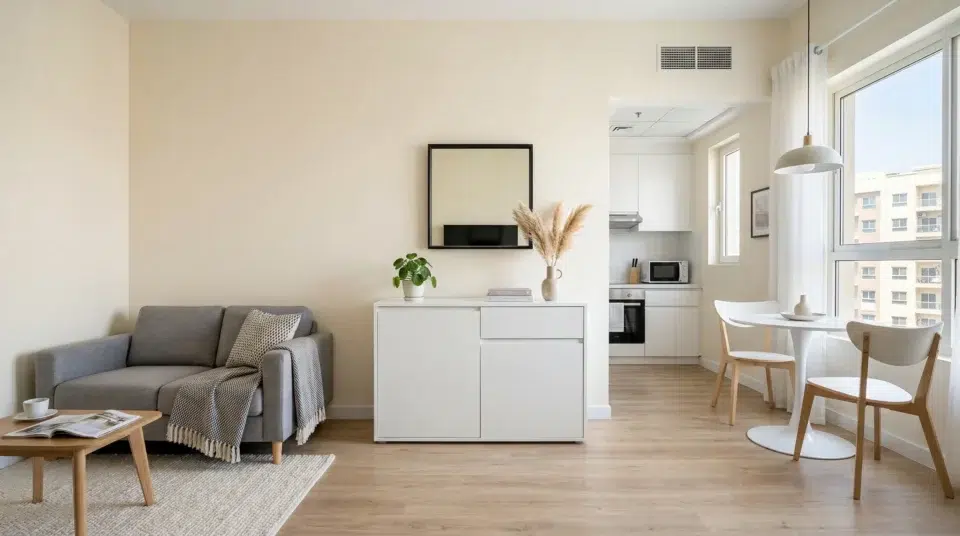
Solid Teak: The UAE’s Best-Performing Natural Wood
Teak (Tectona grandis) is the only wood species that was, by evolutionary design, built for conditions approaching the UAE climate. Native to the monsoon forests of Southeast Asia, teak evolved to handle alternating seasons of extreme humidity and extreme dryness. It contains natural silica oils that resist moisture absorption, repel insects, and provide a degree of UV resistance absent in almost every other commercial timber species.
In UAE conditions, a properly finished solid teak buffet will not warp, will not delaminate, and will not develop surface mould even in a coastal apartment in Dubai Marina or a poorly ventilated room in an older building in Sharjah. Its natural oils mean it requires less frequent maintenance than any other wood: a light application of teak oil twice a year maintains the surface in excellent condition across a decade or more.
The honest disadvantages are cost and weight. A solid teak buffet of quality construction runs between AED 6,000 and AED 16,000 in the UAE market. It is also significantly heavier than engineered alternatives; a 180 cm teak buffet can weigh 85 to 110 kg, which matters enormously for the 78 percent of UAE residents who move every two to three years. Professional movers charge a premium for heavy, solid wood pieces, and they require more careful handling to avoid corner damage during a UAE apartment move.
UAE verdict: The highest-performing natural wood option for UAE conditions. Appropriate for homeowners, long-term residents, and buyers who move infrequently. The material that justifies its premium most completely is in the Gulf climate.
Solid Oak: Strong Performance with One Climate Vulnerability
Solid oak is the second most common choice for premium UAE wooden buffets, and it performs well, with one important caveat. Oak is more hygroscopic than teak: it absorbs and releases atmospheric moisture more readily, which means the humidity swing between UAE summer and UAE winter causes more pronounced expansion and contraction in an oak piece than in teak.
In practice, this manifests as slight seasonal gapping at panel joints in winter (when interior air is at its driest) and occasional drawer tightness in summer (when wood expands in the briefly humid outdoor air). Neither of these effects causes structural damage if the piece is properly constructed with expansion allowances built into the joinery. The problem arises when oak furniture is manufactured to tight tolerances for a European climate with a smaller humidity range: the UAE’s extreme swing can push those joints beyond their designed tolerance.
When purchasing a solid oak buffet for UAE use, always ask whether the joinery allows for thermal movement. Confirm that the piece has been finished with an oil or hard-wax oil product rather than a film-forming varnish: film finishes on oak crack under the UAE’s humidity cycle, while penetrating oil finishes move with the wood. Pricing: AED 4,500 to AED 11,000 for quality solid oak buffets in the UAE market.
UAE verdict: Good long-term choice if specified correctly. Requires more maintenance than teak. Avoid film varnish finishes; insist on oil or hard-wax oil finishing.
Rubberwood and Acacia: The Mid-Range Wood Story
Rubberwood (from the Hevea brasiliensis tree) and acacia are the two most common mid-range solid wood species in UAE furniture retail. Both are significantly more affordable than teak or oak, both are available from sustainable plantation sources, and both perform reasonably well in UAE conditions with proper finishing.
Rubberwood is naturally resistant to fungal growth, useful in coastal UAE environments, and takes paint and stain well, making it a versatile material for coloured buffets. Its weakness is that it is not as hard as oak or teak, meaning it shows dents and scratches more readily in a busy family dining room.
Acacia is harder than rubberwood, has a naturally dramatic grain pattern, and contains moderate natural oils that provide some climate resistance. In UAE conditions, it performs well as long as it is kept in air-conditioned rooms. Acacia left in an un-air-conditioned space (storage room, covered parking during a move) will develop surface checking rapidly.
Pricing: AED 1,800 to AED 4,500 for rubberwood buffets; AED 2,200 to AED 5,500 for acacia buffets in the UAE market.
UAE verdict: Practical mid-range choices that perform well with care. Not the long-term investment that teak or oak represents, but appropriate for UAE renters and medium-term residents who want real wood at an accessible price.
Wood Veneer: The Intelligent Middle Ground
Real wood veneer, thin slices of genuine wood (typically 0.6 mm to 2 mm thick) bonded to an engineered wood core, is the material that delivers the best combination of value, performance, and aesthetic quality in the UAE buffet market. It provides the visual warmth, natural grain, and genuine wood surface of solid wood, while the engineered core beneath it is dimensionally more stable than solid wood across the UAE’s humidity cycle.
Quality veneer work, using genuine veneer rather than paper foil printed to look like wood, is visually indistinguishable from solid wood in normal lighting conditions. Under magnification or at panel edges, you can identify the veneer, but in a styled dining room, it is impossible to tell the difference. More importantly for UAE residents: a quality veneer buffet is significantly lighter than a solid equivalent, making it more practical for the UAE’s frequent-move rental market.
The critical quality indicator for UAE conditions is the adhesive used in the veneer bonding. Moisture-resistant PVA or polyurethane adhesives maintain their bond across the UAE humidity cycle. Standard water-based PVA adhesives can soften during a humid UAE summer, particularly if the piece is near a balcony door that is opened regularly. Always ask your retailer about the adhesive specification before purchasing a veneered buffet for UAE use.
High-Gloss Buffets in the UAE: What the Brochure Does Not Tell You
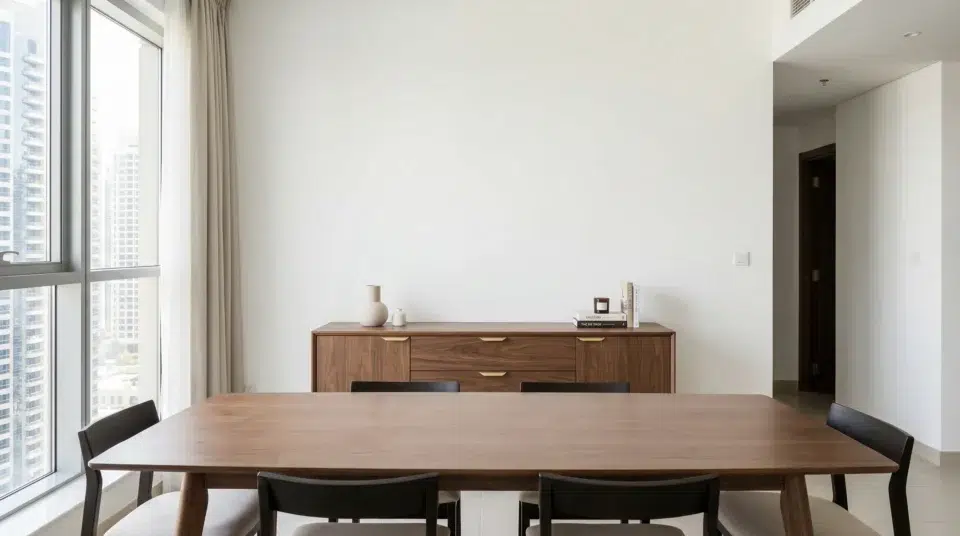
What High-Gloss Actually Means: and Why the Type of Gloss Matters More Than the Gloss Itself
“High-gloss” describes the surface reflectivity of a finish, not the finish chemistry. A high-gloss result can be achieved through several completely different manufacturing processes, and in the UAE context, the process matters enormously:
Polyester high-gloss is the premium standard for UAE-appropriate high-gloss buffets. Applied in multiple coats and cured under UV light, polyester lacquer achieves a hardness of 3H to 4H on the pencil scale, resists the household cleaning chemicals routinely used in UAE homes (bleach-diluted sprays, alcohol-based cleaners), and maintains colour stability without yellowing for eight or more years in UAE conditions. It does not bubble or delaminate in humidity because it forms a complete sealed membrane over the panel surface.
Acrylic paint high-gloss is the middle tier. Better than standard paint, but not as hard or UV-stable as polyester. In UAE conditions, it will typically maintain good appearance for three to five years before fine surface hazing becomes visible in raking light.
Standard air-dry lacquer high-gloss is the lowest tier and the one responsible for the summer call-backs we described in our opening. Air-dry lacquer achieves surface hardness of only 1H to 2H, has limited UV resistance, and forms a semi-permeable surface membrane that allows moisture vapour to pass through during humidity changes. In UAE conditions, this allows moisture to enter the panel from the reverse side (particularly the bottom plinth area, which sits close to cool tiled floors where condensation can collect in summer), causing the bubbling and delamination visible in the photograph above.
The question to ask before purchasing any high-gloss buffet in the UAE is not “Is this high-gloss?” but “What is the lacquer chemistry?” If the retailer cannot answer this question, you should treat the piece as standard air-dry lacquer and assess whether that risk is acceptable for your UAE home context.
The UV Yellowing Problem: Why White High-Gloss Turns Cream in UAE Homes
White high-gloss buffets are the most popular single colour choice in the UAE apartment market. They are also the most vulnerable to the specific failure mode of UV-induced yellowing, which occurs when the pigment in a white paint or lacquer oxidises under sustained UV exposure.
In a room with a south or west-facing window without solar film, the UV intensity reaching interior surfaces over a UAE summer is exceptional. A white high-gloss buffet placed within two metres of such a window will typically begin showing visible yellowing within two to three years if the lacquer does not contain a UV inhibitor.
The visual result is not uniform yellowing across the whole piece; it is patchy. The panels facing the window yellow faster than those facing away. Door fronts yellow faster than the carcass sides. The result is a piece that looks aged and uneven rather than cleanly white, and which cannot be restored to its original colour without complete refinishing.
The prevention: Specify a white high-gloss buffet with a UV-inhibitor in the lacquer formulation. All pieces in our high gloss sideboard Dubai collection carry UV-inhibitor specifications as a category standard. We will not stock a white gloss piece that lacks this protection, because we know exactly what the UAE climate does to unprotected white finishes.
The Micro-Scratch Accumulation Problem: Why High-Gloss Ages Faster Than Matte in UAE Homes
High-gloss surfaces are not inherently more delicate than matte surfaces, but they make the same degree of wear far more visible. A scratch that is imperceptible on a matte linen-finish surface becomes clearly visible on a high-gloss surface because gloss relies on surface continuity for its appearance; any disruption to that continuity catches light differently and registers immediately.
UAE homes are typically cleaned more frequently than European homes: daily or near-daily dusting and wiping is the norm in a climate where fine dust settles on horizontal surfaces within 24 hours of cleaning. Each wipe of a microfibre cloth on a gloss surface is a minor abrasion event. Over 36 months of daily cleaning, even with a quality microfibre cloth and appropriate spray cleaner, a high-gloss surface will develop visible micro-scratch haze in the areas cleaned most frequently.
This is not a product defect. It is a predictable result of sustained surface contact. The mitigation is simple: use only a damp microfibre cloth (never a dry cloth, which increases abrasion significantly) and a pH-neutral furniture cleaner. Never use alcohol, bleach-diluted spray, or abrasive cream cleaner on a high-gloss surface. In UAE homes where domestic helpers are responsible for cleaning, these instructions must be communicated explicitly.
The Material Comparison: Head-to-Head for UAE Conditions
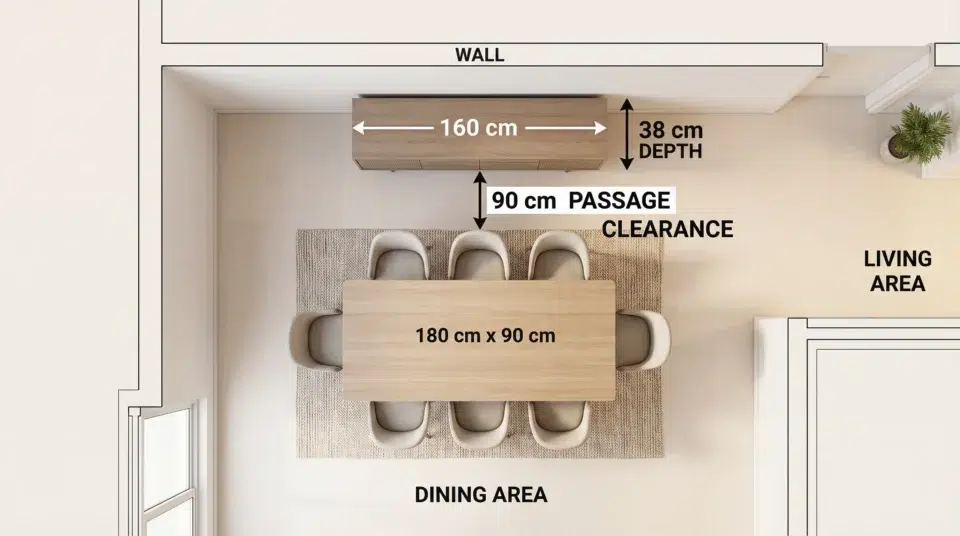
Performance Scorecard for UAE Conditions
| Performance Factor | Solid Teak | Solid Oak | Wood Veneer (Quality) | Polyester High-Gloss | Acrylic Gloss | Air-Dry Lacquer |
|---|---|---|---|---|---|---|
| Humidity resistance | Excellent | Good | Good (depends on adhesive) | Excellent | Moderate | Poor |
| UV resistance | Good | Moderate | Moderate | Excellent (with inhibitor) | Moderate | Poor |
| Heat tolerance | Excellent | Good | Good | Good | Moderate | Poor |
| Scratch resistance | Good | Good | Good | Good | Moderate | Poor |
| Dust wipeability | Good | Good | Good | Good (with correct cloth) | Good | Moderate |
| Ease of UAE move | Moderate (heavy) | Moderate (heavy) | Good (lighter) | Good | Good | Good |
| Cost range (AED) | 6,000 to 16,000 | 4,500 to 11,000 | 1,800 to 6,500 | 2,200 to 7,500 | 1,500 to 4,500 | 750 to 2,200 |
| Recommended UAE tenure | 7 years or above | 5 years or above | 3 years or above | 3 years or above | 2 to 4 years | 1 to 2 years |
This table represents our honest assessment based on 36 years of UAE delivery and follow-up across Dubai, Sharjah, Abu Dhabi, Ajman, and the Northern Emirates. It is the table we wish every UAE buyer had access to before making their first furniture purchase in this country.
The Special Case of Engineered Wood MDF Cores: What the Panel Specification Tells You
The core material beneath a veneer or lacquered surface determines the piece’s structural performance in UAE conditions more than any other single specification. Here is what to look for:
Standard MDF (Medium Density Fibreboard): Density 680 to 720 kg per cubic metre. Adequate for interiors with stable air conditioning. Vulnerable to moisture absorption from the edges and reverse face if not sealed. In UAE conditions, unsealed MDF edges swell when exposed to humidity, pushing veneer and lacquer off the surface from the edge inward.
Moisture-resistant MDF (MR-MDF, sometimes called green core MDF): Density 720 to 760 kg per cubic metre, manufactured with moisture-resistant urea formaldehyde resin rather than standard resin. Resists swelling significantly better than standard MDF in UAE humidity conditions. The standard we require for all Karnak pieces sold for UAE conditions. Always look for this specification — it is not automatic in mid-range furniture imported from markets with milder climates.
HDF (High Density Fibreboard): Density above 800 kg per cubic metre. Superior hardness and moisture resistance. Used in premium panel construction and door skins. The best panel core choice for UAE conditions, though rarely specified at the consumer level in product descriptions. Ask for it by name when purchasing premium pieces.
Particleboard (chipboard): The lowest-grade core material. Highly susceptible to moisture absorption, swelling, and structural weakening in UAE conditions. A buffet with a particleboard core and paper-foil surface wrap will fail in two to three UAE summers regardless of how the surface finish is rated. Avoid entirely for UAE residential use above the very entry level.
Browse our best buffet material UAE humidity selection to see pieces that meet MR-MDF or HDF core standards across all price points.
Room-by-Room Recommendations for UAE Homes
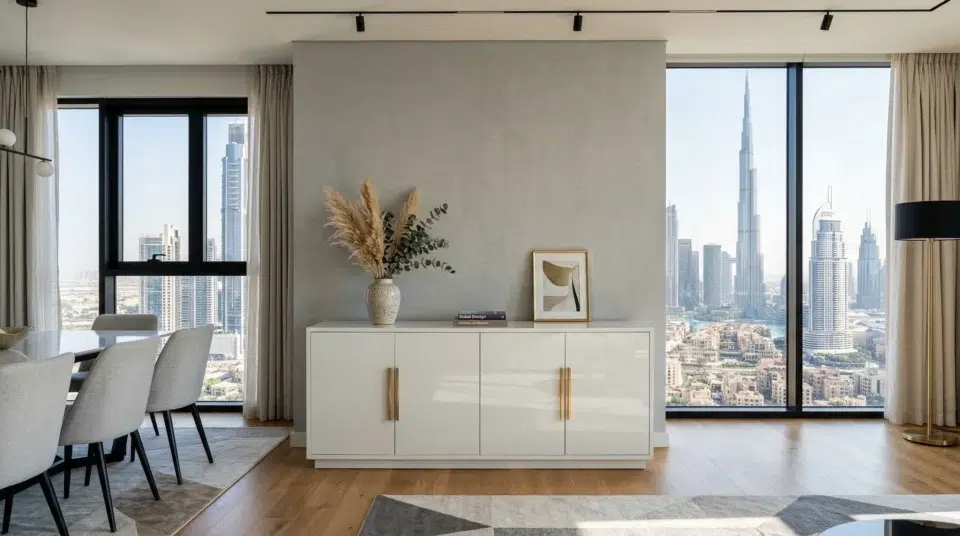
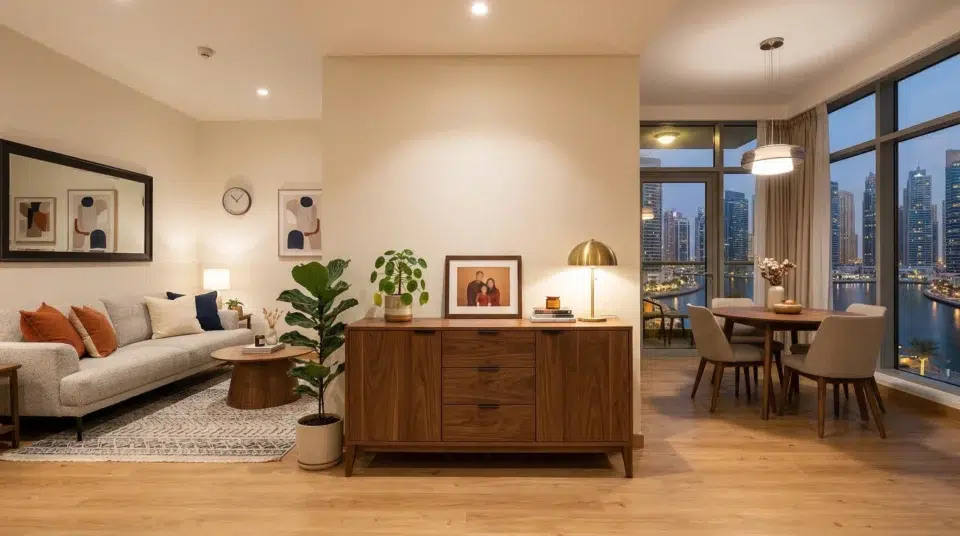
Coastal Apartments: Dubai Marina, JBR, Abu Dhabi Corniche
Coastal residences within 500 metres of the sea face a compounded challenge: salt air accelerates oxidation of metal hardware, and the slightly higher average humidity of coastal air stresses panel materials more consistently than inland locations. For these residences, we have specific recommendations:
Surface finish: Polyester high-gloss or oil-finished solid teak. Both form sealed surfaces that prevent salt-laden moisture vapour from penetrating the panel. Avoid unsealed natural wood finishes in these locations.
Panel core: MR-MDF minimum; HDF preferred. Standard MDF will absorb coastal moisture and swell at the edge seams within two to three years.
Hardware: Powder-coated steel or satin brass. Never bear chrome or standard electroplated brass in coastal UAE locations. Apply a thin coat of paste wax to all hardware every six months.
Positioning: Keep the buffet away from the balcony door opening path. Even a sealed polyester gloss piece will be affected if it regularly receives salt spray from an open balcony door during a summer shamal.
Desert-Adjacent Villas: Arabian Ranches, Al Furjan, Dubailand, Remraam
Villas in inland communities do not face the salt-air challenge but encounter the most extreme UV and dust conditions. South and west-facing rooms in these communities receive direct afternoon sun that can push interior surface temperatures on non-air-conditioned days above 45 degrees Celsius.
Surface finish: Oil-finished solid wood (teak or oak) for the natural wood option, oil finishes tolerate thermal expansion and contraction better than film finishes. For gloss: UV-inhibitor polyester lacquer is essential, not optional, in these locations. A white gloss buffet without a UV inhibitor in a south-facing Arabian Ranches villa dining room will yellow visibly within 18 months.
Positioning: Place the piece on the north or east wall of the room wherever possible. If the piece must go on a south or west wall, ensure solar window film on all windows in that room.
High-Rise Apartments with Significant AC Use, Business Bay, Downtown Dubai, JLT
High-rise apartments with continuous AC use present the drying stress as the primary challenge. Rooms that maintain 20 to 22 degrees Celsius with low relative humidity (35 to 45 percent) year-round put wood through a sustained drying cycle that causes checking and cracking in unfinished or lightly finished solid wood.
Surface finish: For wood pieces, a hard-wax oil or full-fill lacquer is better than an open-oil finish in these environments; the full-fill provides a surface membrane that slows the moisture loss from the wood surface in the dry AC interior. For gloss pieces, the drying stress is less of an issue than UV and abrasion: standard polyester gloss performs well.
Additional care: In continuous-AC apartments, consider a small humidifier during winter months to prevent wood from drying below 30 percent relative humidity, at which point visible checking can appear in solid wood pieces even with good finishing.
Older Apartment Buildings: Deira, Bur Dubai, Al Nahda, Sharjah, Al Qusais
Older UAE apartment buildings present a specific challenge: exterior walls are often less well insulated than newer construction, and humidity migration from poorly sealed exterior wall surfaces can affect pieces placed directly against them. In some older buildings, particularly in Deira and parts of Bur Dubai built before the early 2000s, visible salt efflorescence on exterior wall surfaces in summer indicates active moisture migration through the wall itself.
For pieces in these buildings, the most important precaution is simple: never place any furniture directly against an exterior wall. Maintain a 3 to 5 cm air gap between the back of the piece and the wall. Use solid rubber or cork furniture feet rather than flat felt pads, which allow the piece to sit directly on the tile and block air circulation at the base.
Surface finish: Polyester high-gloss or sealed veneer with moisture-resistant adhesive. Avoid porous natural wood finishes in rooms with suspected wall moisture migration.
Material Care Guide for UAE Buffets, 12-Month Calendar
Solid and Veneered Wood Care: The UAE Annual Schedule
Monthly (year-round): Dust with a soft, slightly damp microfibre cloth. Never use a dry cloth on any wood surface in the UAE, dry cloth wiping with fine desert dust present is an abrasive event. Use a pH-neutral wood furniture spray cleaner.
March (pre-summer): Apply a maintenance coat of furniture wax or hard-wax oil to all accessible solid wood surfaces, including the interior of shelves. This prepares the wood for the humidity stress of summer and provides a protective layer before the most demanding season.
August (mid-summer check): Inspect all joints, drawer fronts, and door edges for any early signs of swelling or misalignment. Minor drawer tightness in August is normal for solid wood pieces in UAE conditions and typically resolves as humidity drops in October. If swelling is severe, allow the piece to acclimatise at 22 degrees Celsius for two to three weeks before forcing any drawers.
October (post-summer): Apply a second maintenance coat of oil or wax. Check and re-tighten any loose hardware screws (the thermal cycle of UAE summer loosens screw fixings slightly in most pieces).
December to January: If your home has very dry winter air (below 30 percent relative humidity is common in UAE interiors in January), consider placing a small humidifier in the room with the wooden buffet. This prevents the deep winter drying that causes visible checking in solid wood.
High-Gloss Buffet Care: What Works and What Destroys the Surface
Always: Use a damp microfibre cloth only. A dedicated high-gloss furniture spray (silicone-free, pH-neutral) applied sparingly is the appropriate cleaning product.
Never: Dry cloth, paper towel, or kitchen roll on a gloss surface. Alcohol-based sprays or bleach dilutions. Abrasive cream cleaners or bathroom tile cleaners. Placing hot items directly on a glossy surface without a protective mat.
Fingerprints and smudges: The most common maintenance complaint for gloss surfaces in UAE family homes. A microfibre cloth barely dampened with water, followed by a dry buff, removes fingerprints completely without requiring any cleaning product.
Scratch prevention: Place a self-adhesive felt pad on the underside of any decorative object placed on a gloss surface. The UAE practice of placing heavy brass trays and decorative objects directly on gloss surfaces creates circular abrasion marks that are visible over time.
Annual polish: Once a year, apply a non-abrasive high-gloss furniture polish with a machine polisher or a clean microfibre in a circular motion. This fills micro-scratches with the polish medium and temporarily restores the mirror depth of the surface. It is not a permanent fix for deep scratches, but it extends the high visual performance of the gloss surface significantly.
The Budget-to-Material Guide for UAE Buyers
| Budget | Material Choice | Best Application | AED Range | UAE Tenure Match |
|---|---|---|---|---|
| Entry | Melamine-wrapped particleboard or standard MDF | Light storage, short-term rental, studio apartments | AED 700 to AED 1,800 | 1 to 2 years |
| Entry-Plus | MR-MDF with acrylic gloss or melamine surface | One and two-bedroom apartments, 2 to 3 year lease | AED 1,800 to AED 3,200 | 2 to 3 years |
| Mid-Range | MR-MDF or HDF core with real wood veneer | Two and three-bedroom apartments, family homes | AED 2,200 to AED 5,500 | 3 to 7 years |
| Mid-Premium | Solid rubberwood or acacia with oil finish | Villa dining rooms, longer-term residents | AED 3,500 to AED 7,000 | 5 to 8 years |
| Premium | Solid oak or teak with oil or hard-wax finish | Owned villas, long-term UAE residents, investment pieces | AED 6,000 to AED 16,000 | 8 to 20 years |
All materials and finishes in our collection are labelled with their core specification in our buffet material guide, UAE online store. If a product listing does not specify core material and finish chemistry, contact our team before purchasing. We believe UAE buyers deserve this information as a right, not an afterthought.
Frequently Asked Questions About Buffet Materials for UAE Homes
FAQ 1: Will a wooden buffet warp in Dubai’s heat and humidity?
It depends entirely on the wood species, the quality of construction, and how the piece is maintained. Solid teak and properly veneered engineered wood buffets with moisture-resistant cores do not warp in UAE conditions when kept in air-conditioned rooms with normal maintenance. Problems occur when solid wood pieces are stored unprotected during moves, when pieces are placed in rooms without consistent air conditioning, or when the construction uses standard (not moisture-resistant) MDF cores. At Karnak, our wooden buffet Dubai heat collection specifies only moisture-resistant boards and appropriate finishing for every piece we stock. If you are uncertain about a specific piece, WhatsApp us at +971 58 908 8107, and our team will give you an honest assessment before you purchase.
FAQ 2: Why is my high-gloss buffet bubbling after two years in Dubai?
Bubbling on a high-gloss buffet surface in the UAE is almost always caused by one of two things: moisture migration from the back or base of the panel (particularly if the piece sits against an exterior wall or directly on a cool tile floor without air circulation) or a sub-standard air-dry lacquer finish that has allowed moisture vapour penetration. Standard air-dry lacquer forms a semi-permeable surface membrane; polyester lacquer forms a sealed one. If your piece has begun bubbling, the damage cannot be reversed without full refinishing. Prevent it in a future purchase by specifying polyester lacquer and keeping at least 3 cm of clearance between the piece and any exterior wall. Our team at +971 58 908 8107 can advise on next steps for affected pieces.
FAQ 3: What is the most durable buffet material for a Dubai apartment with kids and pets?
For UAE families with children under 12 and pets, the most practical material combination is a moisture-resistant MDF core with a hard polyester lacquer surface in a mid-tone matte or satin finish. The MR-MDF core handles the humidity stress of UAE conditions. The polyester lacquer surface (hardness 3H or above) resists crayon marks, paw scratches, and the daily impact of a busy family home. Mid-tone colours (warm grey, linen, warm oak tones) show fingerprints and light scuffs far less than pure white. Hardware should be T-bar or recessed pull style rather than pointed or angular cup handles at child height. See our full guidance in our durable buffet furniture Dubai family range.
FAQ 4: Does a high-gloss buffet require more maintenance than a wooden one in UAE conditions?
The maintenance routines are different, with one being more demanding than the other. A high-gloss buffet requires more attention to daily cleaning technique, always using a damp microfibre, never a dry cloth, to prevent micro-scratch accumulation from UAE dust. A wooden buffet requires twice-yearly oiling or waxing to maintain its surface protection across the humidity cycle. Most UAE buyers find the wood maintenance routine easier to execute correctly: applying oil twice a year is a deliberate, visible task, whereas switching to the correct cleaning cloth for a gloss surface requires a consistent daily habit that is easily broken by different household members.
FAQ 5: Is an MDF buffet safe for long-term use in the UAE’s humidity?
Standard MDF is not recommended for long-term use in rooms without consistent air conditioning. However, moisture-resistant MDF (MR-MDF, sometimes labelled as green-core MDF) performs well in UAE conditions even in rooms with variable humidity, provided all edges are properly sealed, a specification that all quality manufacturers meet as standard. The key question is not “MDF or not MDF” but “standard MDF or MR-MDF.” Our moisture-resistant furniture Dubai collection specifies MR-MDF as the minimum core standard for all enclosed storage pieces.
FAQ 6: Can I refinish a damaged buffet surface in the UAE?
Yes, with conditions. Solid wood buffets with oil or wax finishes can be sanded, cleaned, and re-oiled at home with basic tools and widely available products. A two-hour afternoon of work will restore a surface showing light scratches or minor UV graying to a near-new appearance. High-gloss lacquered surfaces cannot be refinished at home: they require a professional spray application to achieve the level of surface necessary for gloss appearance. However, deep scratches in a high-gloss surface can be filled and buffed by a furniture restoration specialist. Dubai and Sharjah have several mobile furniture repair services that make home visits. WhatsApp our team at +971 58 908 8107 for a referral if needed.
FAQ 7: Is solid wood or engineered wood a better value for money in the UAE?
For the majority of UAE buyers, particularly those on two to five-year contracts or in rental accommodation, quality engineered wood with MR-MDF core and real wood veneer offers better value per dirham spent than solid wood. It costs significantly less, performs nearly as well in UAE conditions, is lighter and more practical for UAE moves, and looks visually identical in normal use. Solid wood becomes a better value for UAE homeowners or very long-term residents who plan to keep the piece for 10 or more years: at that tenure, the superior longevity of solid teak or oak means the cost per year of use drops below the equivalent for a veneer piece. The crossover point in our calculation is approximately 8 years of intended use.
FAQ 8: What questions should I ask before buying a buffet in Dubai to ensure it lasts?
The five questions that will protect any UAE buffet buyer are: What is the panel core material, and is it moisture-resistant? What is the finish chemistry (polyester, acrylic, air-dry lacquer, oil)? Does the white or coloured finish include a UV inhibitor? What is the adhesive used in veneer bonding (if applicable)? And what is the edge sealing specification? Are all panel edges sealed, or only the visible faces? A retailer who can answer all five questions clearly is a retailer whose quality standards you can trust. A retailer who cannot answer them is one whose products may not meet UAE standards, even if they look beautiful in the showroom. Our team at Karnak can answer all five for every piece we sell. Visit our showroom in Industrial Area, Sharjah, or contact us at +971 58 908 8107.
Conclusion
The wood versus gloss buffet question in Dubai does not have a single universal answer. It has a correct answer for each specific UAE home context: solid teak for a permanent villa owner in Mirdif who wants a 15-year investment; polyester high-gloss for a Business Bay apartment renter who wants maximum light reflection and easy cleaning; moisture-resistant MDF veneer for the majority of UAE buyers who want the look of real wood at a practical price and weight; and careful avoidance of standard air-dry lacquer and standard MDF at any price point for any UAE home in any location.
The UAE climate is not hostile to furniture. It is specific. It rewards buyers who understand its particular combination of UV intensity, humidity cycling, AC drying, fine dust abrasion, and coastal salt air with furniture that performs beautifully for a decade or more. It taxes buyers who purchase without this understanding, and the cost of that tax is always the same: a phone call in August, a bubble on a door front, and the uncomfortable realisation that a preventable failure is now an expensive one.
Visit our Sharjah showroom, open Saturday to Thursday, 9 AM to 9 PM, to see, touch, and compare materials in person. Our team will answer every specification question honestly, including the ones that might lead you to a less expensive piece. WhatsApp us at +971 58 908 8107 with a photo of your room, and we will give you a genuine recommendation.
Ready to Choose the Right Buffet Material for Your UAE Home?
Shop Climate-Tested Buffets for UAE Homes: Browse our complete buffet material guide UAE collection
Visit Our Showroom: Industrial Area, Sharjah, UAE (Sat to Thu, 9 AM to 9 PM)
WhatsApp Us: +971 58 908 8107 (Material questions, samples, booking)
Call: +971 58 908 8107
Related Articles
- The Ultimate Guide to Buying Buffets in Dubai and the UAE (2026)
- 2026 Buffet and Sideboard Trends Transforming UAE Dining Rooms
- Buffet or TV Unit? How UAE Open-Plan Homes Are Using Both in 2026
- Best Buffet Sizes for Dubai and Abu Dhabi Apartments
- Seven Mistakes to Avoid When Buying a Sideboard in the UAE
Ready to Choose a Buffet That Survives UAE Heat, Humidity & Dust?
After comparing wood vs high-gloss finishes head-to-head for Dubai’s unique climate stresses, from solid teak’s natural resilience to polyester gloss’s sealed protection, and why white gloss often fails, you’re set to pick a durable buffet or sideboard that lasts 7–15+ years in your villa, apartment, or majlis setup. Complete your space with matching pieces that arrive with free delivery, free installation, free consultation, and expert material advice across Dubai, Sharjah, Abu Dhabi, and the UAE.
- → Buffets & Sideboards – Climate-tested wood (teak/veneer) & high-gloss (polyester/UV-protected) options built to handle UAE humidity, UV, heat & dust
- → Dining Tables – Matching wood or gloss tables perfect for family Eid gatherings & majlis entertaining
- → Display Units – Complementary displays in durable materials for showcasing in coastal or desert UAE homes
- → Consoles – Slim consoles in wood/gloss finishes are ideal for narrow apartment entries or villa hallways
- → TV Media Units – Media storage in matching resilient finishes for open-plan living-dining zones
- → Coffee Tables – Centre tables echoing your buffet’s material for cohesive, long-lasting setups
- → Bookcases – Adjustable storage in wood/veneer/gloss to organise multigenerational family spaces
- → Sofas & Loveseats – Modular & corner sofas creating welcoming zones around your durable buffet
- → Accent Chairs – Stylish chairs adding comfort to dining areas with climate-resistant frames/finishes
- → Center Tables – Low, wide tables in matching durable materials for seamless entertaining flow
- → Living Room Furniture – Full collections that integrate your chosen buffet material into open-plan UAE homes
✅ Free Delivery • ✅ Free Installation • ✅ Free Consultation across the UAE
💬 WhatsApp Us Now – Mention “Wood vs Gloss Guide” for priority help