
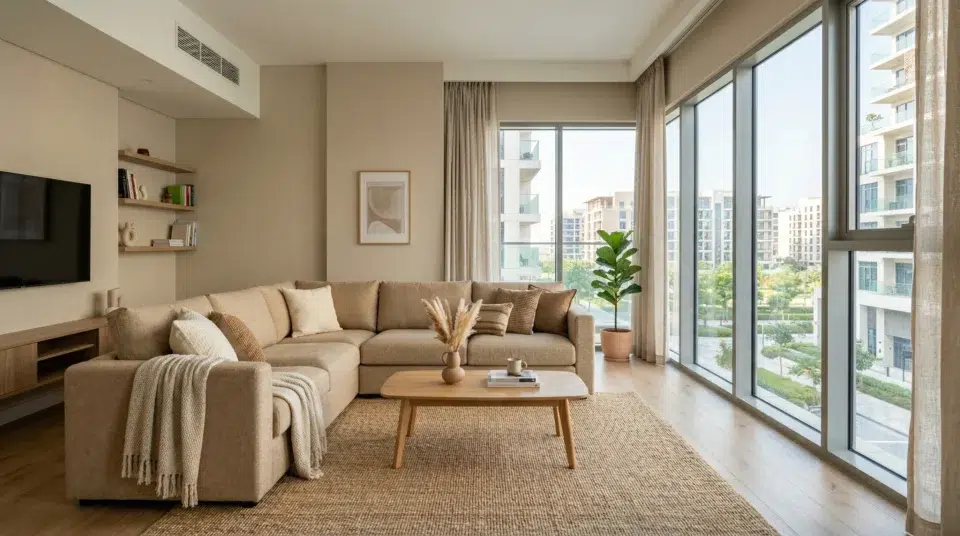
Best Sofa Fabric Dubai Climate Guide will help you walk through the process of finding and choosing the right fabric acording to UAE Climate. You finally found the perfect sofa. The colour matches your walls. The size fits your living room in Dubai Marina. You place the order, wait for delivery, unwrap it with excitement, and within fourteen months, the fabric is pilling, the cushions smell faintly of dampness, and the colour has shifted from deep charcoal to a washed-out grey along the armrests. This is not a rare story in the UAE. It is, in fact, one of the most common furniture complaints Karnak Home receives from families in JVC, Al Reem Island, Downtown Dubai, and Mirdif, and in almost every case, the problem was not the sofa itself. It was the fabric.
At Karnak Home, we have been delivering sofas to UAE families since 1988, for more than 36 years, and over 70,000 households served across Dubai, Abu Dhabi, Sharjah, Ajman, and the Northern Emirates. Our delivery teams enter hundreds of homes every month. They see what happens to sofas in Jumeirah villas when the AC runs at 20 degrees all summer. Experience has shown them exactly how microfibre holds up after two years beside a balcony door in Business Bay. More than anyone, they understand that choosing the best sofa fabric for Dubai’s climate is a decision that will either protect your investment for a decade or cost you a replacement in eighteen months.
This guide covers everything a UAE resident needs to know in 2026: how the Gulf climate physically attacks sofa fabrics, which materials survive and which fail, the honest truth about leather versus fabric in Dubai’s heat, a full budget breakdown in AED, eight mistakes buyers make every year, ten expert tips drawn from three decades of local deliveries, and eight real questions answered in full. By the end, you will know exactly which fabric to choose for your home, your family, and your budget, whether you are a new expat setting up your first apartment in Al Barsha or a long-term resident upgrading the family majlis in a Muwaileh villa.
Why the Best Sofa Fabric for Dubai’s Climate Is Not What Works Elsewhere
The Gulf Microclimate Inside Your Home
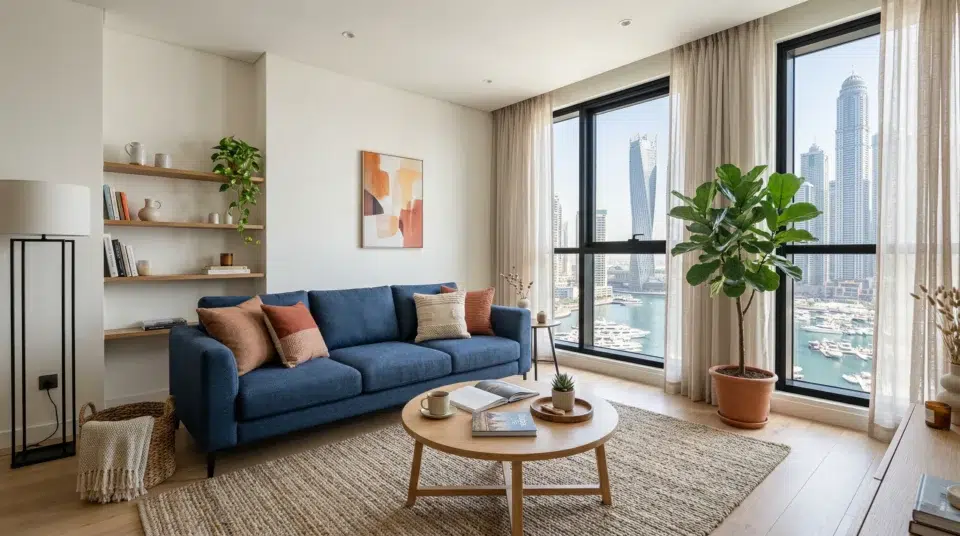
Most fabric guides are written for temperate climates, where the biggest enemy of upholstery is general wear. In the UAE the threats are fundamentally different, and they operate simultaneously. Outdoor temperatures in Dubai reach 46 to 48 degrees Celsius between June and September. Indoors, air conditioning units run continuously, often cycling between 19 and 24 degrees throughout the day. This constant thermal cycling, hot exterior, cold interior, and the movement of bodies in and out, creates a microclimate inside your living room that most imported fabrics were never designed to handle.
Humidity: The Hidden Destroyer
Abu Dhabi and coastal Dubai experience relative humidity levels of 80 to 95 percent during the summer months, particularly overnight and in the early morning. Even in air-conditioned apartments in Al Raha Beach or Dubai Marina, the humidity that enters through balcony doors, delivery windows, and human activity condenses against cold surfaces. A sofa placed against an exterior wall or near a sliding door in a Jumeirah Beach Residence apartment faces repeated moisture exposure that slowly degrades foam, weakens fabric fibres, and encourages mould growth inside cushion cores. Fabric sofa UAE humidity management is not optional; it is the primary selection criterion for any serious UAE buyer.
UV Exposure and Colour Fastness
Natural light in the UAE is intense year-round. South and west-facing apartments in areas like Sports City, Remraam, and Mudon receive direct sun from mid-morning to sunset. Even UV-filtered glazing allows a significant proportion of solar radiation through, and sofas positioned near windows fade considerably faster in the Gulf than in northern European homes. Fabrics rated below Grade 5 on the standard Blue Wool Scale (BWS) will show visible fading within two to three years in a sun-exposed Dubai apartment. Always ask for the lightfastness rating before purchasing.
The Renter Reality: 78 Percent of UAE Households
Approximately 78 percent of UAE residents rent their homes rather than own them. This has a direct impact on sofa fabric choices. Renters in areas like International City, Deira, and Al Nahda tend to move every one to three years, which means sofas must withstand repeated removal, transport, and reinstallation without structural damage. Fabrics that snag easily, crease permanently, or lose shape during a move are a poor investment for renters. Durability under handling, combined with climate resistance, defines the ideal sofa fabric for the UAE rental market.
The Majlis Consideration
The majlis the formal guest reception room found in Emirati and many Arab households across Sharjah, Ajman, and Ras Al Khaimah, demands a very specific upholstery standard. Fabrics must withstand concentrated use during Ramadan, Eid gatherings, and family celebrations, when a sofa may seat eight to twelve guests over a single evening. Stain resistance, resilience under pressure, and the ability to be wiped clean between guests are non-negotiable requirements. The best sofa fabric for Dubai and UAE majlis settings combines formal visual appeal with the practical performance of a commercial-grade textile.
Multigenerational Homes and Pets
UAE households are frequently multigenerational, with grandparents, parents, children, and sometimes domestic staff all sharing the same living space. Sofas in Al Ain villas, Sharjah townhouses, and Abu Dhabi apartments must survive the full spectrum of users: toddlers with juice cups, teenagers with food, elderly residents who need firm, easy-grip upholstery, and pets in households where animals are permitted. No single fabric excels at everything, but performance-grade textiles come closest, and understanding the hierarchy of needs in your specific household is the starting point for any wise choice.
The 7 Main Sofa Fabric Types Ranked for UAE Conditions
1. Performance Fabric: The UAE Winner
Performance fabrics sold under brand names like Crypton, Sunbrella, and Revolution are engineered textiles designed specifically to handle moisture, staining, UV exposure, and abrasion. In a Dubai apartment or Abu Dhabi villa, they outperform every other category over a five-year ownership period. Performance fabrics resist spills at the fibre level rather than through a surface coating, meaning they do not crack, peel, or lose their protective properties after cleaning. They are rated for 50,000 to 100,000 double rubs (the industry standard for wear resistance), they hold colour in direct UAE sunlight, and they are fully washable without specialist treatment.
For families in Jumeirah with children and dogs, for new expats in Marina apartments who entertain frequently, and for villa owners in Meadows or Arabian Ranches who value longevity over price, performance fabric is the single best upholstery fabric UAE buyers can choose in 2026. The AED range for a quality performance-fabric sofa starts at around AED 2,800 for a two-seater and rises to AED 9,500 for a large L-shape configuration. It is not the cheapest category, but the cost per year of use makes it the best value in the UAE market.
2. Microfibre: The Practical Everyday Choice
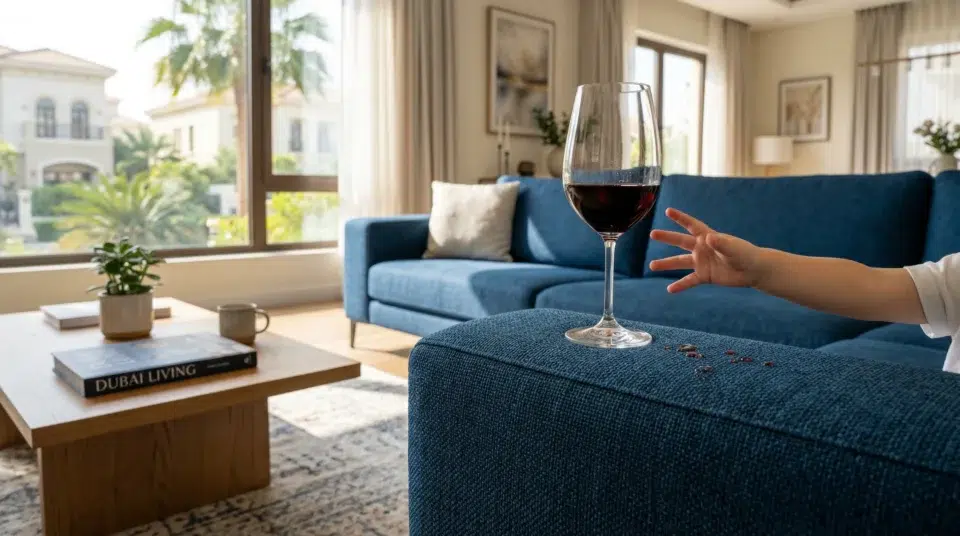
Microfibre is a tightly woven synthetic fabric with a suede-like finish that has become one of the most popular sofa upholstery choices in UAE apartments over the past decade. It is soft to the touch, relatively affordable at AED 1,800 to AED 5,500 for standard configurations, and it resists light staining and dust accumulation better than loose-weave naturals. In a Deira flat or a Barsha Heights apartment where budget is a key consideration, microfibre offers solid performance for the price. However, it is not immune to UAE humidity: microfibre sofas placed against exterior walls in coastal areas like Al Mamzar or Corniche Abu Dhabi can develop a musty odour within eighteen months if moisture is not actively managed. Ensure the foam core is high-density (minimum 32 kg per cubic metre) and that the sofa has some clearance from exterior walls.
3. Velvet: High Risk, High Reward
Velvet is having a sustained moment in UAE interior design, particularly in Downtown Dubai penthouses, Palm Jumeirah apartments, and premium Sharjah villas, where a dramatic, luxurious aesthetic is the goal. Emerald, cobalt, and dusty rose velvet sofas photograph beautifully and create powerful visual anchors in formal living rooms. The challenge in the UAE is significant: velvet attracts and retains dust at a higher rate than any other upholstery fabric, a real concern in desert areas like Al Quoz, Nad Al Sheba, and areas near construction in new communities such as Dubai South or Yas Island. Velvet also crushes under concentrated weight and can take days to recover in humid conditions. If you choose velvet in the UAE, select a crushed or cut velvet with a dense pile rather than a flat velvet, use a sofa cover during peak dust season, and keep the sofa away from direct sunlight.
4. Linen and Natural Weaves: Beautiful but Demanding
Linen and natural fabric blends are popular among design-conscious buyers in areas like Al Wasl, Umm Suqeim, and Mirdif, where a relaxed, organic aesthetic suits family homes. The issue in the UAE is direct: linen absorbs moisture. In a coastal Dubai apartment or a ground-floor Sharjah townhouse, a linen sofa can become a humidity trap, particularly in the area between the seat cushion and the base. Linen wrinkles, fades unevenly in direct sun, and is difficult to clean without professional equipment. It is a viable choice only in homes with excellent climate control, no children, no pets, and a willingness to invest in professional cleaning once or twice per year. Prices range from AED 2,200 to AED 7,000 depending on configuration.
5. Leather: The Most Misunderstood Option in Dubai
Leather versus fabric sofa Dubai is one of the most searched questions in the UAE furniture market, and the honest answer is more nuanced than most retailers admit. Full-grain leather the highest quality tier, ages beautifully in a controlled indoor environment, and is genuinely easy to wipe clean. For a family in a well-insulated Jumeirah villa with consistent AC at 22 degrees, full-grain leather is an excellent long-term investment. The problem arises in two very common UAE scenarios: first, bonded leather (also sold as PU leather or faux leather), which begins cracking and peeling within two to four years in UAE conditions due to the combination of AC dryness and body heat. Second, any leather sofa placed near a frequently used balcony door or in a room where the AC is turned off at night, because the temperature and humidity swings cause the hide to dry out and crack along the fold lines. If you want leather, buy full-grain, budget at least AED 6,000 for a two-seater, and commit to quarterly conditioning with a product formulated for UAE climate conditions.
6. Outdoor and Semi-Outdoor Fabrics Indoors
An emerging and genuinely smart trend among long-term UAE residents is using outdoor-grade fabrics, such as woven olefin, solution-dyed acrylic, and high-performance polyester, on indoor sofas. These fabrics were engineered for the Arabian Gulf outdoor furniture market: they are UV-stable, moisture-resistant, anti-microbial, fast-drying, and rated for 75,000 to 150,000 double rubs. A sofa upholstered in solution-dyed acrylic in a Dubai apartment near Safa Park or a semi-covered outdoor lounge in a Umm Al Quwain beach villa will outperform almost any indoor fabric in raw durability terms. The aesthetic range has improved enormously you can find these fabrics in sophisticated neutrals, rich jewel tones, and textured weaves that do not look or feel commercial. Expect to pay AED 3,500 to AED 11,000 for custom configurations through Karnak Home’s fabric selection consultation service.
7. Polyester and Blended Synthetics: Read the Label
The majority of mid-market sofas sold in the UAE in the AED 1,200 to AED 3,500 range are upholstered in polyester or a polyester-cotton blend. Quality varies enormously within this category. A tightly woven, high-thread-count polyester sofa fabric can deliver reasonable performance in a dry, well-maintained indoor environment. A loosely woven, low-thread-count blend will pill within six to twelve months and fade noticeably within two years in UAE conditions. The key specification to check is double-rub rating (minimum 25,000 for acceptable durability) and lightfastness grade (minimum Grade 4 on BWS for UAE conditions). Ask the retailer for the fabric specification sheet before committing to any purchase in this price range.
2026 Trends That Actually Work in UAE Homes
Boucle in Air-Conditioned Spaces Only
Boucle, the looped, textured fabric that dominated global interior design between 2023 and 2025, remains popular in the UAE in 2026, but with an important local caveat. The looped texture of boucle traps fine sand and dust particles at a significantly higher rate than smooth-weave fabrics, making it unsuitable for homes near construction sites (Dubai South, Expo City corridor, Al Furjan) or for homes where balcony doors are regularly opened. Boucle works beautifully in fully climate-controlled apartments in Business Bay, DIFC, and City Walk, where dust infiltration is minimal and professional cleaning is practical. Choose boucle in a tight, dense weave rather than a loose, large-loop construction for better dust resistance.
Earthy Terracotta and Warm Neutrals
The dominant colour direction for UAE sofa fabrics in 2026 is a move away from cool greys and arctic whites toward warm terracotta, sand, camel, and rust tones. This shift is aesthetically intelligent in the UAE context: warm neutrals are far more forgiving of the slight yellowing and patina that UAE light conditions introduce over time. A sofa in sand or camel that develops a warm undertone after two years of Gulf light looks intentional. The same process on a cool grey makes it look dirty. For families in Al Barari, Damac Hills, and Emirates Hills, warm neutral performance fabrics offer both trend alignment and practical longevity.
Performance Tweed and Textured Weaves
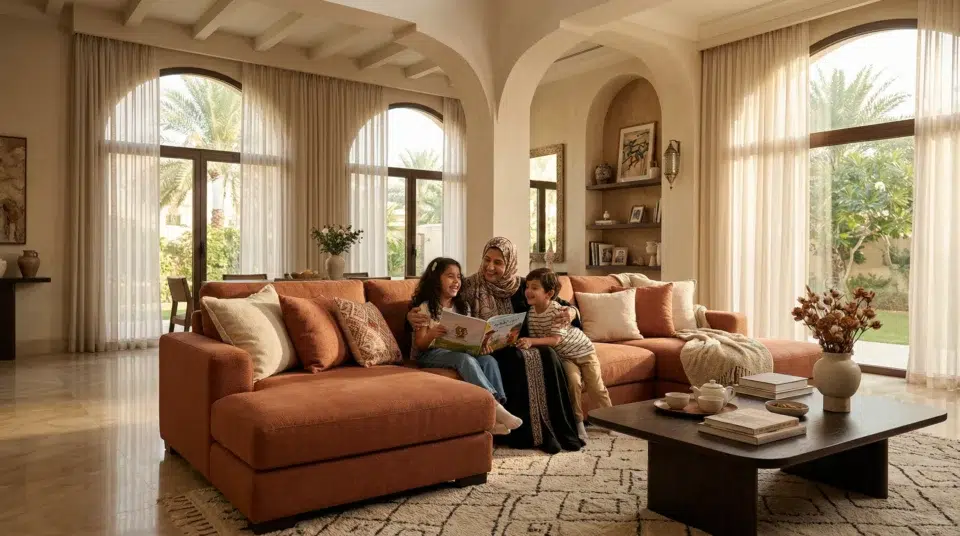
For homeowners in Sharjah’s Al Majaz district, Ajman’s Corniche, and Ras Al Khaimah’s Al Hamra community who want visual texture without the maintenance demands of boucle or velvet, performance tweed and thick-weave synthetic textiles offer an excellent 2026 solution. These fabrics mimic the visual complexity of natural wool tweed but are moisture-wicking, stain-resistant, and rated for heavy use. They are particularly well-suited to majlis seating arrangements where the combination of formal visual weight and practical durability is the primary requirement.
Modular and Reconfigurable Sofa Systems
The growing mobility of the UAE expat population moving between apartments in Jumeirah Lakes Towers, Media City, and Tecom as leases change, has driven significant interest in modular sofa systems that can be reconfigured and transported without specialist disassembly. In 2026, the best modular systems use clip-and-lock frame connections that survive multiple moves without loosening, and the most popular fabrics for these systems are performance microfibre and solution-dyed polyester because both handle the repeated stress of assembly and disassembly without snagging or tearing at the upholstery seams. Browse Karnak Home’s corner and L-shape sofa collection for current modular options with fabric configurability.
Anti-Microbial Fabrics Post-2020
Demand for anti-microbial upholstery fabric in UAE homes has remained elevated since 2020 and shows no sign of declining. Families in Dubai Silicon Oasis, Muwaileh in Sharjah, and Khalifa City in Abu Dhabi now routinely ask for sofas with anti-microbial fabric treatment as standard, rather than as a premium add-on. The best anti-microbial fabrics use silver ion technology embedded at the fibre level rather than a surface spray coating. Surface-treated anti-microbial fabrics lose their effectiveness after six to twelve washes; fibre-level treatments last the life of the upholstery. Ask specifically for fibre-level treatment when purchasing any sofa fabric. UAE humidity protection is a priority.
Materials and Fabrics Built for the UAE Climate
The Moisture Test: What Happens Inside Your Cushions
The most significant long-term damage to UAE sofas occurs not on the fabric surface but inside the cushion core. When warm, humid air enters a sofa structure through the gaps between cushions, around the frame base, or through the fabric itself and contacts the cooler foam beneath, moisture condenses. Over time, this trapped moisture degrades polyurethane foam, causing it to crumble, compress unevenly, and develop odour. The fabric covering this damaged foam will begin to sag, wrinkle, and lose its appearance regardless of its own quality. The solution has two parts: choose a foam density of at least 32 to 35 kg per cubic metre (ak for this specification in writing), and choose a fabric with a tight enough weave that moisture vapour transmission is restricted, a key advantage of performance fabrics over linen and open-weave naturals.
Fabric Performance Against UAE-Specific Threats
| Threat | Best Fabric | Acceptable | Avoid |
|---|---|---|---|
| High humidity (coastal Dubai, Abu Dhabi) | Performance fabric, outdoor-grade synthetic | Microfibre (tight weave) | Linen, loose cotton blends |
| UV fading (south-facing, full sun) | Solution-dyed acrylic, performance polyester | Tightly woven microfibre | Velvet, light-coloured linen |
| Dust and sand (construction zones) | Smooth-weave performance, leather | Microfibre | Boucle, velvet, open weave |
| Children and food staining | Crypton-grade performance fabric | PU-coated microfibre | Linen, velvet, untreated cotton |
| Pets (hair, claws, odour) | Performance fabric, tightly woven synthetic | Microfibre | Velvet, open-weave linen |
| AC dryness (leather cracking) | Full-grain leather with conditioning | Performance fabric | Bonded or PU leather |
| Formal majlis use | Performance tweed, performance velvet | Microfibre | Loose linen, flat velvet |
Frame Materials in the UAE Context
The fabric is only part of the equation. The sofa frame must also withstand UAE conditions. Kiln-dried solid hardwood frames, such as teak, rubberwood, and beech, are the standard for quality sofas because they do not warp or split under the UAE humidity-temperature cycling that degrades softwood and particleboard frames within two to four years. Metal frames (powder-coated steel or aluminium) are excellent for structural longevity but transmit cold in heavily air-conditioned rooms, which can feel uncomfortable. At Karnak Home, all sofas in the mid and premium sofa range use kiln-dried hardwood frames with an eight-point suspension system. Request the frame specification from any retailer before purchase if they cannot provide it, that is a signal about the product’s quality tier.
Child and Pet Safe Fabric Standards in the UAE
For families with young children or pets, a large proportion of Karnak Home’s customers in Al Furjan, Reem Island, and Mirdif require a fabric selection must include toxicological safety alongside physical durability. The best upholstery fabric UAE child-safety standards require is OEKO-TEX Standard 100 certified, meaning they have been tested and confirmed free from harmful levels of over 100 substances, including formaldehyde, heavy metals, and allergenic dyes. OEKO-TEX certification is not yet universal among UAE furniture retailers, but Karnak Home’s fabric selection includes certified options across the performance and synthetic categories. Ask to see the OEKO-TEX certificate number at the point of purchase.
8 Mistakes UAE Buyers Make When Choosing Sofa Fabric in 2026
Mistake 1: Choosing Fabric Based on Instagram Photos Alone
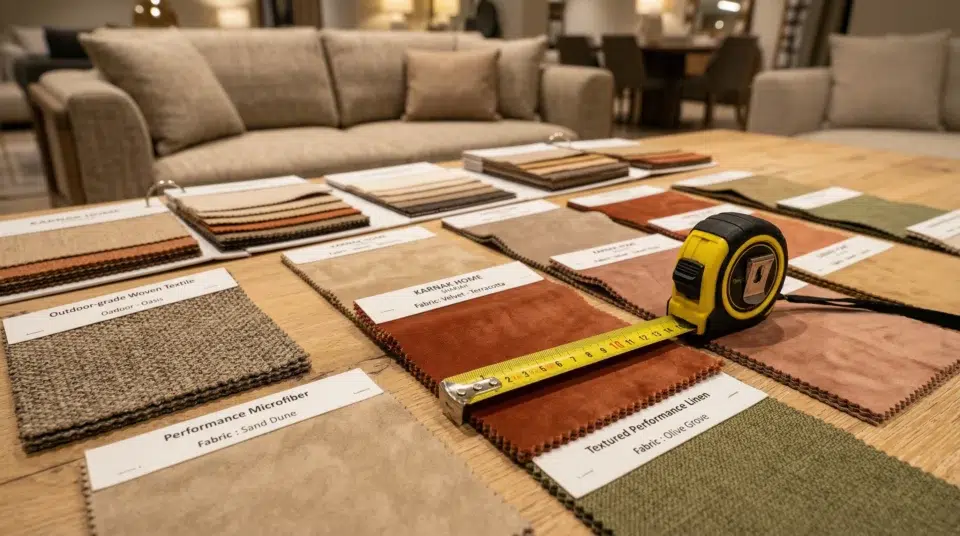
Instagram and Pinterest images of living rooms are taken in controlled lighting, post-processed, and often styled in studios rather than actual UAE apartments. A pale grey linen sofa photographed in a Scandinavian studio will look dramatically different in the flat natural light of a 75-square-metre Barsha Heights apartment. Always view fabric samples in your own home’s actual light conditions, ideally at different times of day, before committing to a colour or material.
Fix: Request fabric swatches from your retailer and hold them against your wall in morning, midday, and evening light. Karnak Home provides free swatch samples for all two-seater and three-seater sofa ranges upon request via WhatsApp.
Mistake 2: Buying Bonded Leather in the UAE
Bonded leather made from shredded leather scraps bonded with polyurethane onto a fabric backing is widely sold in the UAE market at price points between AED 900 and AED 3,500. It looks identical to full-grain leather in the showroom and on product photography. Within eighteen to thirty months in UAE AC conditions, it begins to crack, peel, and flake in a process that cannot be reversed or repaired. The sofa becomes unwatchable and must be replaced entirely.
Fix: If your budget is below AED 4,500 and you want the leather look, choose a high-quality PU-coated microfibre (suedette) instead of bonded leather. It will not peel. If your budget allows AED 6,000 or more, invest in full-grain leather from a supplier who can confirm the hide grade in writing.
Mistake 3: Ignoring the Foam Specification
Foam density in the UAE market sofas ranges from as low as 18 kg per cubic metre (extremely poor; collapses within one year) to 40 kg per cubic metre (commercial-grade; lasts fifteen years or more). Most budget sofas in International City and Deira furniture markets use 20 to 24 kg foam. This foam compresses permanently after heavy use, making the fabric covering it sag and wrinkle. No fabric, however good, can maintain its appearance over failing foam.
Fix: Specify a minimum foam density of 32 kg per cubic metre for seat cushions and 28 kg per cubic metre for back cushions. Ask for this in writing. For a family sofa in a Sharjah townhouse or Abu Dhabi apartment that will be in daily use, consider 36 to 40 kg seat foam for maximum longevity.
Mistake 4: Placing a Fabric Sofa Against an Exterior Wall
UAE exterior walls, particularly in older buildings in Deira, Bur Dubai, and Ajman city centre, reach significant thermal mass during summer. A sofa placed directly against such a wall absorbs and radiates heat differently from the rest of the room, and the temperature differential accelerates moisture condensation inside the cushion structure. The area of fabric in contact with the wall also receives negligible air circulation, encouraging odour and mould.
Fix: Leave a minimum gap of 10 to 15 centimetres between any sofa back and an exterior or load-bearing wall. In apartments on lower floors in older buildings, consider a dehumidifier in the living room during the summer months (June to September).
Mistake 5: Choosing Light-Coloured Velvet Near Windows
Velvet in white, cream, pale pink, or light grey looks magnificent in online catalogue photography but is a high-maintenance choice in any UAE home with significant natural light. Velvet crushes in the direction of the pile under daily use and in sunlit areas; even where UV glazing is used, the warmth of the Gulf sun shifts pale velvet tones toward yellow within two to three years.
Fix: If you want velvet in a sun-adjacent room, choose mid-to-dark saturated tones — navy, forest green, deep burgundy, or charcoal. These tones develop a natural patina rather than appearing to yellow. Position the sofa at least 1.5 metres from the nearest window. Browse Karnak Home’s sofa bed collection for velvet options in darker, UAE-appropriate tones.
Mistake 6: Not Asking About Fabric Stain Treatment
The majority of sofa fabrics arrive from the manufacturer without any factory stain protection applied. Stain-resistant sofa fabric Dubai buyers need is often a matter of aftermarket treatment, a Scotchgard-type spray or professional stain-guard application applied before or immediately after delivery. Many buyers assume their fabric is protected because the retailer used the word “easy clean.” Easy to clean and stain-resistant are not the same thing. Easy clean means the fabric can be cleaned with water; stain-resistant means the stain cannot penetrate the fibre structure in the first place.
Fix: Ask specifically whether the fabric has factory-applied stain treatment or whether aftermarket treatment is required. For sofas in homes with children or frequent entertaining, budget an additional AED 150 to AED 350 for professional stain-guard application at the point of delivery.
Mistake 7: Selecting Sofa Size Before Measuring the Room
A sofa that is even 20 centimetres too long for a living room in a 65-square-metre apartment in Jumeirah Village Circle or Discovery Gardens looks overwhelming, blocks traffic flow, and creates a cramped, stressful environment. In the UAE, where apartment sizes are frequently smaller than marketing brochures suggest, oversizing is one of the most common and most regrettable sofa purchases.
Fix: Measure your room length, width, and the distance from the sofa’s intended position to the television or focal wall before browsing. A sofa should leave at least 90 centimetres of clear walking space on each open side. For rooms under 15 square metres, a two-seater or compact three-seater (maximum 200 centimetres in length) is almost always the right choice.
Mistake 8: Buying Without Checking Delivery and Warranty Terms
The UAE furniture market includes a wide spectrum of quality and service commitment. Some imported sofas available online or at discount furniture markets in Industrial Area, Sharjah, or Al Quoz come without any manufacturer warranty, without professional installation, and with delivery terms that leave assembly entirely to the buyer. If something goes wrong a fabric defect, a frame creak, a zipper failure, there is no recourse.
Fix: Always confirm in writing: the length of the fabric warranty (minimum two years for acceptable quality), whether delivery includes professional installation and packaging removal, and whether the retailer offers a home visit for post-delivery issues. Karnak Home provides free delivery and free professional installation on all sofa purchases, with a minimum two-year fabric and frame warranty across the full sofa range.
2026 Budget Guide in AED: Which Sofa Fabric for Which Home
| Tier | AED Range (2-seater / 3-seater / L-shape) | Best Fabric | Best For |
|---|---|---|---|
| Budget | AED 1,200 to 2,800 / AED 1,800 to 3,800 / AED 2,800 to 5,500 | Tight-weave polyester, microfibre | Studio/1BR apartment (JVC, Discovery Gardens, International City); renters on short leases; first UAE home setup |
| Mid-Range | AED 2,800 to 5,500 / AED 3,800 to 7,500 / AED 5,500 to 11,000 | Performance fabric, solution-dyed synthetic, quality microfibre | 2 to 3BR apartment (Marina, JLT, Business Bay, Reem Island); families with children; 2 to 5-year lease commitment |
| Premium | AED 5,500 to 9,500 / AED 7,500 to 14,000 / AED 11,000 to 22,000 | Crypton performance, full-grain leather, outdoor-grade woven acrylic | Villa owners (Jumeirah, Arabian Ranches, Saadiyat, Khalifa City); long-term residents; formal majlis; luxury apartments (Palm, Downtown, DIFC) |
10 Expert Tips from 36 Years of UAE Sofa Deliveries
In our 36 years of delivering furniture to UAE families from the Northern Emirates to Abu Dhabi, we have seen every possible combination of fabric, climate, and household. These ten tips represent the most consistent lessons we have learned from thousands of real deliveries.
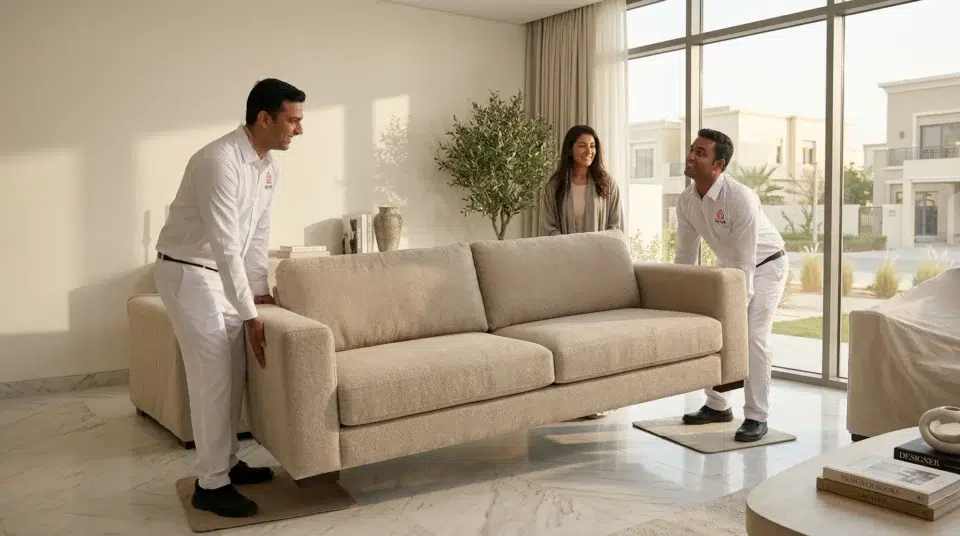
1. Measure twice, order once. Always include diagonal clearance. In our experience, the single most common delivery problem in Dubai Marina towers, JLT high-rises, and older Deira buildings is a sofa that fits the room perfectly but cannot be manoeuvred through the front door or around the stairwell. Always measure the narrowest point of the entry door frame, lift interior, corridor bend, and confirm the sofa’s diagonal dimension with your retailer before placing the order. A sofa 220 centimetres long requires a clear diagonal entry path of at least 230 centimetres.
2. Request the fabric certification documents at the point of sale. We have seen buyers pay premium prices for what a salesperson described as “performance fabric” only to receive an unbranded synthetic of unclear specification. Request the fabric brand name, double-rub rating, lightfastness grade, and OEKO-TEX certificate number in writing. A reputable retailer will have these available immediately.
3. Do not place your sofa in the first strong position you think of. In our 36 years, we have seen that the instinctive sofa placement — against the longest wall, facing the television is often not the optimal position for UAE conditions. Test at least two alternative arrangements before committing. In particular, consider whether any position keeps the sofa away from both direct sun exposure and exterior walls.
4. Use sofa feet or risers in ground-floor units. Ground-floor apartments in Abu Dhabi’s Al Khalidiyah, Sharjah’s Al Nahda, and older Deira buildings retain ground moisture that rises through concrete slabs and affects furniture at floor level. A sofa with raised feet, a minimum of 12 to 15 centimetres, has significantly better air circulation beneath it and is far less vulnerable to bottom-up moisture damage.
5. Invest in a quality sofa cover for peak dust season. The UAE construction boom continues to generate significant airborne particulates in areas like Dubai South, Town Square, and Ras Al Khor. During periods of high construction dust or the March-to-May shamal wind season, a well-fitted sofa cover reduces deep-pile contamination dramatically and extends the time between professional cleans.
6. Clean spills immediately and from the outside in. Every fabric type, including performance fabric, suffers when a spill is allowed to dry and is then rubbed from the centre outward, which spreads the stain and drives it deeper into the weave. Blot immediately with a clean white cloth, working from the outer edge of the spill toward the centre. For most performance fabrics, mild dish soap diluted in water is sufficient.
7. Rotate your seat cushions every three months. In households where certain seats are preferred the television-side cushion, the corner section, uneven compression develops over time. Rotating and flipping cushions every three months distributes wear evenly and can add two to three years to the perceptible life of even a budget-tier sofa. This simple maintenance step is consistently overlooked by UAE buyers.
8. Consider the sofa bed option if you host family visits. UAE households frequently receive extended family visits from South Asia, Egypt, and the Levant for one to four weeks at a time. A quality sofa bed in a performance or microfibre fabric gives a comfortable sleeping surface without requiring a dedicated guest room. Ensure the sofa bed mechanism is tested at the showroom — a stiff or difficult mechanism becomes a source of frustration quickly.
9. Match your accent chair fabric to your sofa’s performance level, not just its colour. We regularly see living rooms in Dubai and Abu Dhabi where the homeowner has invested in a quality performance-fabric sofa and then purchased a complementary accent chair in velvet or linen because it matched the colour palette. The result is a room where the sofa outlasts the chair by five to seven years, and a costly mismatch develops. Coordinate both the colour and the performance specification of all seating pieces in the room.
10. For villa owners: consider professional re-upholstery before replacement. In our experience, a structurally sound sofa with a kiln-dried hardwood frame, common in premium sofas from the 2010s and 2015s that UAE villa families often own can be re-upholstered in a modern performance fabric for AED 800 to AED 1,800, extending its life by eight to twelve years. This is often a better financial decision than replacing the entire sofa. Ask Karnak Home about our upholstery consultation service when you visit our Sharjah showroom.
Frequently Asked Questions
It depends on your budget and lifestyle. Full-grain leather works well in controlled environments (AC at 20–23°C, away from sunlight). It is durable, wipe-clean, and ages beautifully. However, it is more expensive and needs regular maintenance. For most homes, especially apartments, fabric sofas are often the more practical choice.
Performance fabrics like Crypton, Sunbrella, and Revolution are best for UAE humidity as they resist moisture at fibre level. Microfibre works in drier inland areas like Al Ain. Avoid linen, cotton, and velvet in coastal zones such as Dubai Marina or JBR. Always choose foam density of at least 32 kg/m³ to prevent internal moisture damage.
Vacuum weekly during dusty months (October–April) and every 10–14 days in summer. Schedule professional cleaning once yearly, or every 6 months for homes with kids or pets. Leather needs conditioning every 3–4 months, while velvet and linen require professional care only.
The best sofa fabric for kids is performance fabric (Crypton-grade) due to high stain resistance, durability, and safety standards (OEKO-TEX). Microfibre is a good budget option. Avoid velvet, linen, and loose weaves. Choose mid-tone colours like warm grey or sand to hide stains and wear.
Yes, all fabrics fade in direct sunlight. Solution-dyed fabrics perform best, maintaining colour for 5–8 years. Lower-quality fabrics may fade within 12–18 months. Choose materials with lightfastness Grade 4+, ideally Grade 5–6 for sun-exposed rooms.
Yes. Outdoor fabrics like solution-dyed acrylic and olefin are ideal for UAE conditions. They offer UV resistance, moisture protection, and durability. They last longer than standard upholstery but may feel slightly firmer—always request samples before purchase.
Performance fabrics and PU-coated materials are the easiest to clean, often requiring just mild soap and water. Crypton fabrics even tolerate diluted bleach. Leather is wipeable but needs conditioning. Avoid velvet and linen, which are difficult to maintain.
Sofa lifespan depends on quality and usage. Budget options (AED 1,200–2,500) last 2–4 years. Mid-range sofas (AED 2,500–6,000) last 4–8 years. Premium sofas (AED 6,000+) can last 8–15 years or more with proper care.
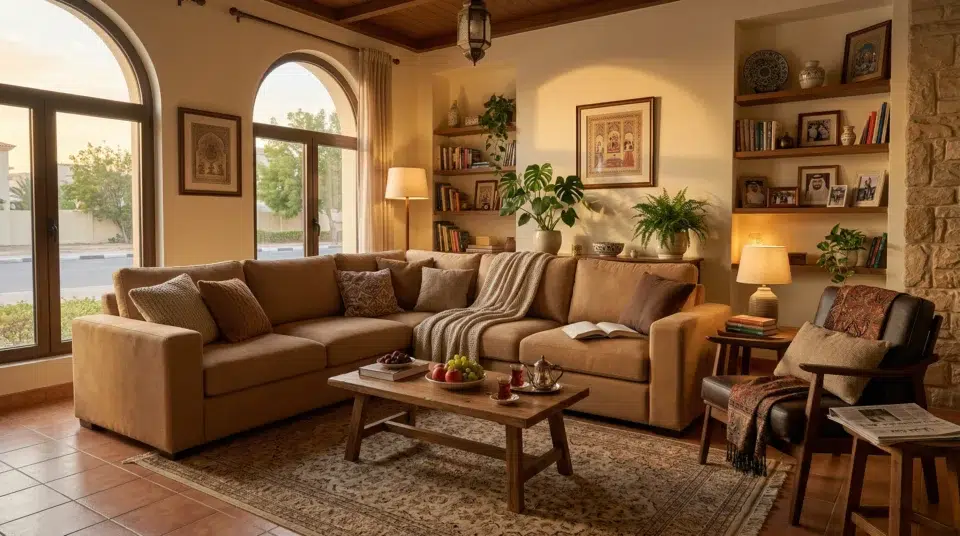
The three most important decisions in choosing a sofa for a UAE home in 2026 are: fabric performance specification first (double-rub rating, lightfastness grade, moisture resistance), foam density second (minimum 32 kg per cubic metre for daily family use), and size third (measure every entry point between the delivery vehicle and your room before ordering). The UAE’s climate is not hostile to comfort; it simply demands a higher standard of specification than most imported furniture catalogues are designed for. Choosing the right fabric from the start is not a luxury decision; it is a practical one that determines whether your investment lasts two years or twelve.
For the 78 percent of UAE residents who rent their homes, for the families navigating moves between apartments in JVC and Business Bay, for the multigenerational households in Sharjah and Abu Dhabi who need a sofa that can handle everything from a toddler’s juice to a grandmother’s afternoon nap, the right fabric choice is the difference between a piece of furniture that becomes part of your home’s story and one that becomes an expensive regret. Dubai’s heat, its humidity, its dust, and its sunlight are facts of life here, and the best sofa fabric for Dubai’s climate is one that was chosen with those facts in mind.
Karnak Home has been making exactly this calculation with UAE families since 1988. Whether you visit our showroom in Sharjah Industrial Area, browse our full range online, or send us your room measurements and a photo on WhatsApp, our team will help you choose the fabric, the configuration, and the foam specification that is right for your home, your family, and your life in the UAE. WEnjoy free delivery and installation on every sofa. Plus, we stand behind everything we sell with a full guarantee.
Ready to Choose the Right Sofa Fabric for Your UAE Home?
Browse our full sofa range online: Shop sofas with UAE climate-tested fabrics
Visit our showroom: Industrial Area, Sharjah, UAE (Saturday to Thursday, 9 AM to 9 PM)
WhatsApp us: +971 58 908 8107 (Measurements, fabric swatches, room planning, booking)
Call: +971 58 908 8107
Related Articles
- How to Choose the Right Sofa Size for Your UAE Apartment
- Corner Sofa vs L-Shape Sofa: Which Works Better in UAE Homes?
- Sofa Beds for UAE Homes: Guest-Ready Without a Guest Room
- How to Style Your Living Room Around a Statement Sofa
- The 2026 UAE Living Room Trends That Actually Work in Real Homes
Expert Resources from Karnak Home
- Explore our full living room furniture collection
- Find the perfect accent chair to complement your sofa
- Shop UAE-ready sofa beds for guest rooms and studios
- Browse all two-seater sofas for compact UAE apartments
- View our complete three-seater sofa range with fabric options
- Discover corner and L-shape sofas for UAE family living rooms
كيف تختار أفضل قماش كنبة لمناخ دبي في 2026
يُعدّ اختيار قماش الكنبة المناسب في الإمارات قراراً يتجاوز مسألة الجماليات وحدها، إذ إن المناخ الخليجي بحرارته الشديدة ورطوبته العالية وأشعته الشمسية القوية يُشكّل تحدياً حقيقياً أمام كل عائلة تسعى إلى أثاث يدوم طويلاً. في كرنك هوم، نساعد عائلات الإمارات منذ عام 1988 على اتخاذ هذا القرار بثقة ووعي.
إن السؤال الذي يتكرر يومياً في صالة عرضنا بالمنطقة الصناعية في الشارقة هو: ما أفضل أقمشة كنب الإمارات التي تتحمّل الرطوبة وتبقى جميلة لسنوات؟ الإجابة باختصار هي الأقمشة التقنية عالية الأداء. هذه الأقمشة مُصمَّمة خصيصاً لمقاومة الرطوبة والبقع والأشعة فوق البنفسجية، وتُصنَّف بما لا يقل عن 50,000 غزلة مزدوجة، مما يجعلها الخيار الأول لعائلات دبي وأبوظبي والشارقة.
عند الحديث عن كرسي إكسنت دبي 2026 وما يُناسبه من أقمشة، تبرز ضرورة التنسيق بين الكنبة والكراسي المكمّلة من حيث مستوى الأداء، لا من حيث اللون فحسب. فالغرفة التي تجمع كنبة بقماش تقني ومع كرسي مبطّن بالمخمل ستعاني من تفاوت واضح في العمر الافتراضي بعد ثلاث إلى خمس سنوات.
أما أفضل كراسي مميزة الإمارات لمجالس البيوت الخليجية، فهي تلك المُنجَّدة بأقمشة التويد التقنية أو الأقمشة المُعالجة لمقاومة البقع، التي توفر المظهر الرسمي المطلوب في غرف الضيوف دون التضحية بالمتانة. في موسم رمضان والأعياد حين تستقبل الأسرة العشرات من الزوار، تكشف هذه الأقمشة عن قيمتها الحقيقية.
للعائلات الباحثة عن كنب مقاوم للرطوبة دبي بميزانية معقولة، يتراوح سعر الكنبة ثلاثية المقاعد بقماش تقني عالي الجودة بين 3,800 و7,500 درهم إماراتي، وهو استثمار يمتد عمره من ثماني إلى اثنتي عشرة سنة مقارنة بأربع إلى خمس سنوات للكنبة الاعتيادية في مناخ الخليج.
كما نُلفت الانتباه إلى ضرورة الانتباه لكثافة الإسفنج الداخلي عند شراء كنب الإمارات 2026: لا تقل عن 32 كيلوغراماً للمتر المكعب للمقاعد، و28 كيلوغراماً للظهر. هذا المعيار غالباً ما يُهمَل ويُسبّب انهيار الكنبة قبل أوانها في البيئة الرطبة.
تفضّل بزيارة صالة عرض كرنك هوم في المنطقة الصناعية، الشارقة، للاطلاع على مجموعتنا الكاملة من الكنبات والأقمشة المختارة خصيصاً للمناخ الإماراتي. يسعدنا استقبالك من السبت إلى الخميس بين الساعة التاسعة صباحاً والتاسعة مساءً، أو تواصل معنا عبر واتساب على الرقم 971 58 908 8107+ للحصول على استشارة مجانية وعينات قماش مُرسَلة إلى منزلك.
Ready to Choose the Right Sofa Fabric and Complete Your UAE Living Room?
Now that you know exactly which performance fabrics, microfibre, and performance weaves survive Dubai’s heat, humidity, and family life best in 2026, explore Karnak Home’s curated collections featuring these climate-optimised options. Perfect for villas, apartments, and majlis spaces across Dubai, Abu Dhabi, and Sharjah — all with free delivery, free installation, and free consultation.
- → Living Room Furniture – Complete climate-ready living room sets with the best sofa fabrics for UAE heat, humidity, and daily family use
- → Sofas Collection – Sofas upholstered in performance fabrics, microfibre, and 2026 trends designed specifically for Dubai and UAE conditions
- → Majlis Sofas – Durable majlis seating with high-performance, stain-resistant fabrics built for heavy gatherings in UAE homes
- → Corner L-Shape Sofas – Modular L-shape sofas in moisture-resistant and UV-stable fabrics ideal for flexible villa and apartment layouts
- → 3-Seater Sofas – Family 3-seater sofas featuring top-rated performance fabrics that handle UAE climate and pets/kids
- → 2-Seater Sofas – Compact 2-seater sofas in easy-care microfibre and performance weaves for modern Dubai apartments
- → Sofa Beds – Multi-functional sofa beds with durable, humidity-resistant fabrics for guest space in UAE homes
- → Accent Chairs – Complementary accent chairs in matching 2026 performance fabrics and warm neutrals
- → Coffee Tables – Stylish coffee tables to complete your fabric-updated living room in any UAE community
- → Console Tables – Space-saving consoles perfect for apartments and villas with your new climate-smart sofa
- → TV Media Units – Modern TV units that pair seamlessly with performance-fabric sofas in family areas
- → Center Tables – Durable centre tables for busy majlis and living rooms across the UAE
💬 WhatsApp Us Now for Free Fabric Consultation Shop All Living Room Furniture Now →