
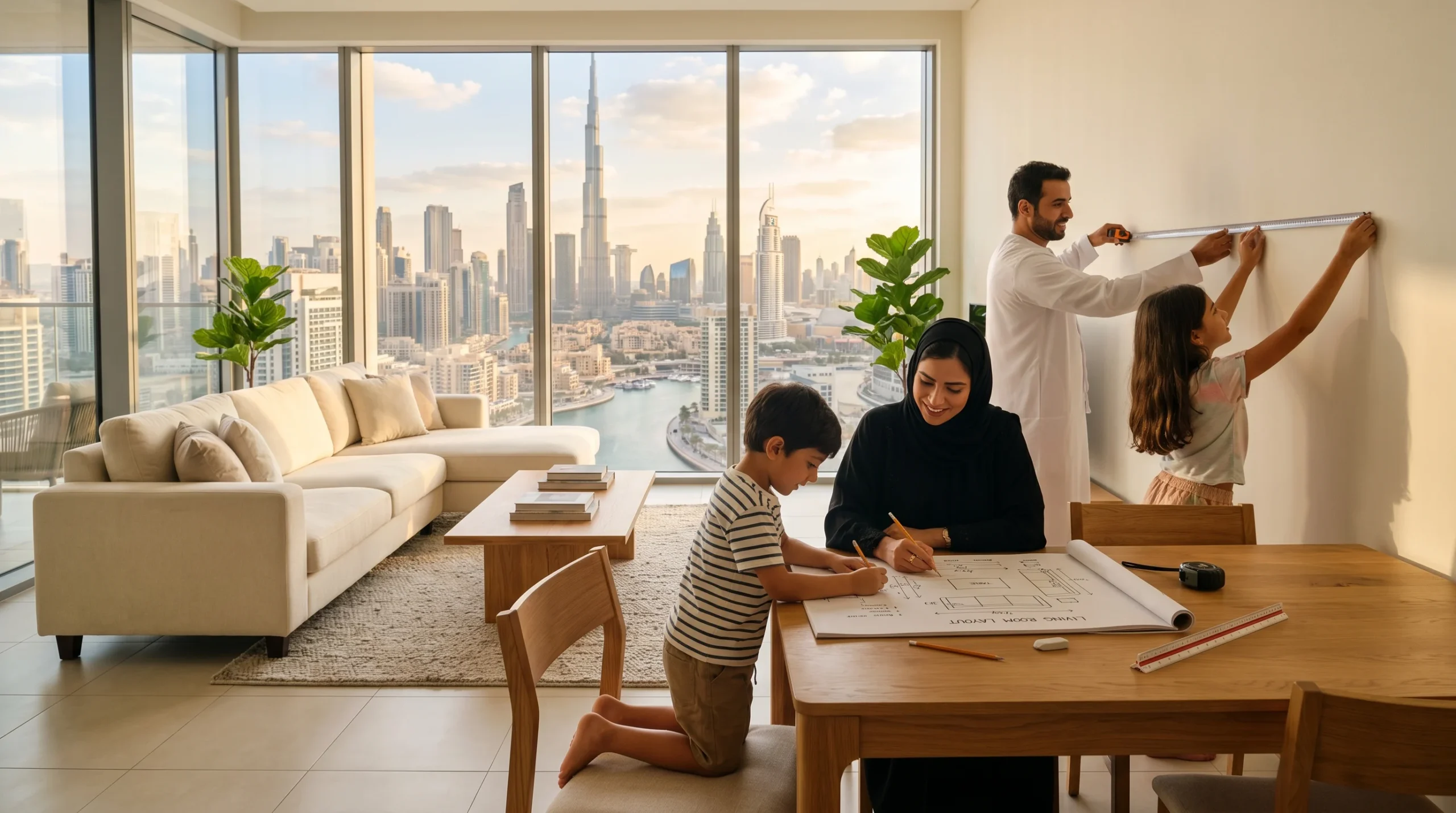
Have you ever moved into a new home, excitedly brought in all your furniture — and then realised the sofa is blocking the air conditioning vent, the dining table barely fits, and the bedroom wardrobe door can’t fully open? You’re not alone. This is one of the most common and most avoidable frustrations families across Dubai, Abu Dhabi, and Sharjah face every year.
At Karnak Home, we’ve been helping UAE families furnish their homes since 1988. Over 35 years and more than 70,000 families served, we’ve seen every layout mistake imaginable — and helped thousands of families avoid them. The good news is that a little planning before you buy a single piece of furniture can save you thousands of dirhams, weeks of stress, and a lot of unnecessary returns.
This guide walks you through exactly how to approach your furniture layout plan for a UAE property, whether you’re moving into a compact studio apartment in Dubai Marina, a two-bedroom flat in Sharjah, or a spacious villa in Abu Dhabi or Jumeirah. To stay updated on the latest government initiatives and city developments that may impact your new community, you can visit the Dubai Media Office website.
Why Furniture Layout Planning Matters More in the UAE
The UAE has a distinct residential landscape that affects furniture planning in ways that many guides — written for European or American homes — simply don’t address.
For starters, most UAE apartments are delivered either unfurnished or semi-furnished, which means you’re starting completely from scratch. Unlike older housing markets, you’re often furnishing four or five rooms simultaneously, which makes a coherent plan even more critical. Without one, you end up with mismatched sizes, competing styles, and furniture that simply doesn’t work together as a home.
Then there’s the climate factor. UAE homes are designed around air conditioning. Furniture placed directly in front of AC vents restricts airflow and can cause your system to work harder, increasing electricity bills and reducing the lifespan of both your unit and your upholstery. Maintaining your home’s cooling efficiency is vital, and you can find official energy-saving tips through the Dubai Electricity and Water Authority. This alone is a reason to plan around your HVAC before you shop.
Finally, the UAE has a wonderfully diverse residential architecture. High-rise apartments in Dubai tend to have open-plan layouts with long, narrow living areas and large glass frontages. Abu Dhabi flats often have more traditional room separation. Villas across all emirates typically feature a formal majlis or guest reception space alongside family living areas — a dual-room dynamic that requires completely different furniture approaches.
Understanding which type of home you have before you shop is step one.
Step 1 — Get Your Measurements Right (Before Anything Else)
This sounds obvious. It almost never gets done properly.
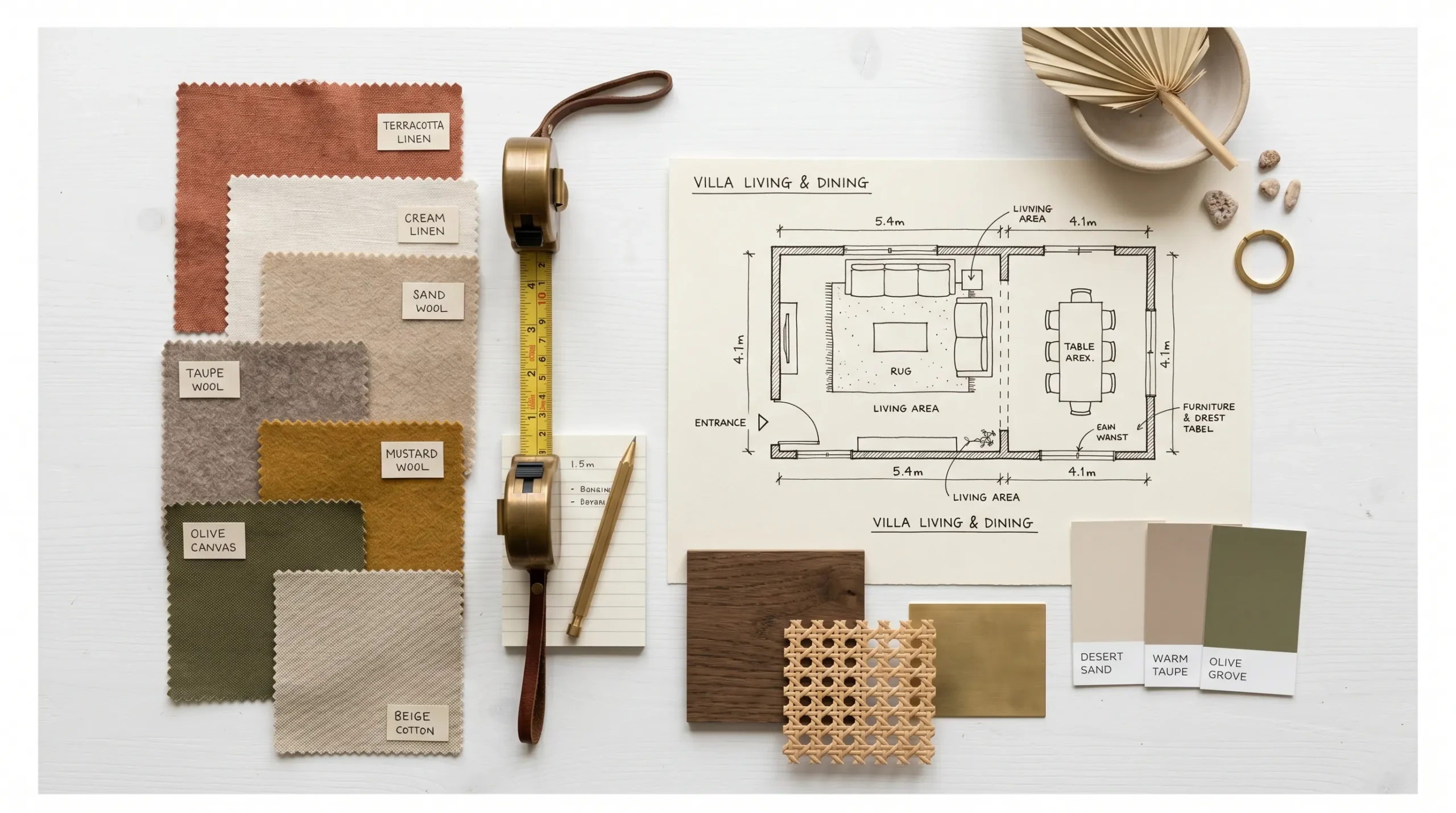
The single most important thing you can do before furnishing a UAE property is measure every room — not just the length and width, but the full picture. Walk through your empty property with a steel tape measure and a notepad, or use a free app like MagicPlan or RoomScan Pro to create a digital floor plan on your phone.
What to Measure in Every Room
For each room, you want to record: the full length and width, the ceiling height (relevant for tall wardrobes and display units), the exact position of every door and its swing direction, the position of every window, the location of AC units, electrical sockets, light switches, and TV points, and the position of any fixed elements like pillars, built-in niches, or kitchen peninsulas.
A standard UAE apartment bedroom typically ranges from 3.5m × 3.5m for a secondary room to 4.5m × 5m for a master. Living rooms in a two-bedroom apartment are commonly around 4m × 5.5m, though open-plan layouts can run much larger. Villas, of course, vary enormously — but it’s not uncommon for a villa majlis to reach 6m × 7m or more.
Write everything down. Then, when you’re browsing furniture online or walking through a showroom, you have real numbers to work with — not guesses.
The Traffic Flow Rule
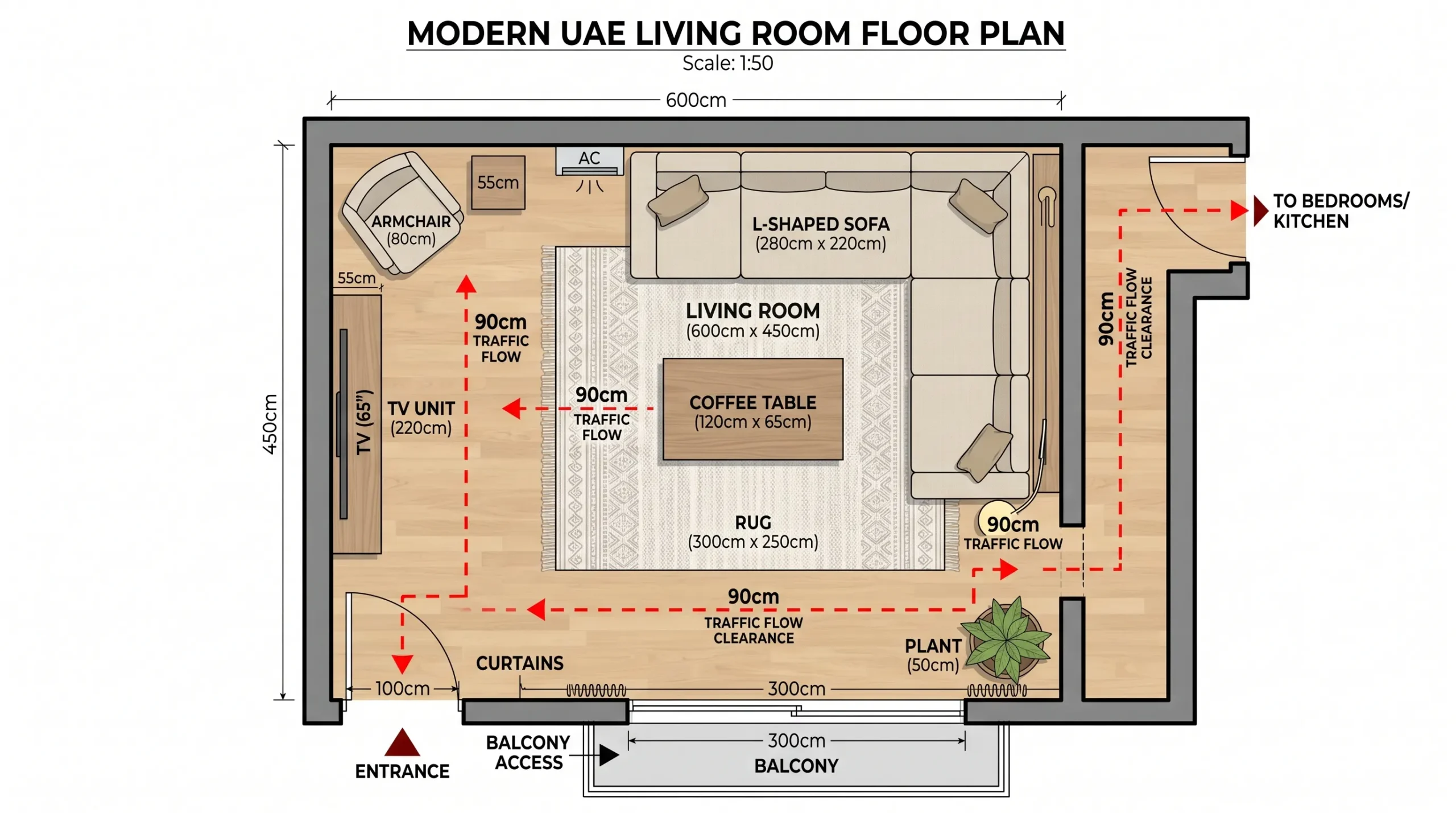
One principle that experienced interior designers consistently apply is the 90cm rule: every main circulation path in a room — the walkway from door to sofa, from dining chair to kitchen, from bed to bathroom — should have a minimum of 90cm of clear space. In tighter rooms, 75cm is the absolute floor. This is what keeps a room feeling liveable rather than cramped.
In Dubai and Sharjah apartments especially, living rooms can feel generous on paper but become tight once a sofa, coffee table, TV unit, and dining set all compete for the same space. Traffic flow planning prevents this.
Sketch It Out — Even Roughly
You don’t need to be an architect. A rough sketch on graph paper, with 1 square = 0.5m, is enough to test whether your furniture ideas actually fit. Mark out your doors, windows, and AC units first. Then draw furniture shapes to scale — a standard three-seater sofa, for instance, typically runs 200–230cm wide and 85–95cm deep. A dining table for four sits around 90cm × 150cm. A queen bed is 160cm × 200cm.
If you find that your sketch is getting crowded, that’s valuable information before you’ve spent a dirham.
Step 2 — Understand Your Room’s Focal Point
Every well-designed room has a focal point — the visual anchor that the furniture arrangement flows around. Getting this right is what separates rooms that feel pulled together from rooms that feel chaotic.
Living Room Focal Points in UAE Homes
In most UAE living rooms, the focal point is either the television wall or a large window with a view. Inside beachfront or high-rise apartments, the floor-to-ceiling window almost always wins — and your sofa should face it, not the blank wall opposite. Morover, In more enclosed apartments or villas, the TV wall becomes the natural anchor.
A common mistake is placing the sofa against a wall to “save space.” In rooms under 20 square metres, this can work. In larger rooms, it actually makes the space feel emptier and harder to furnish. Floating the sofa — pulling it 30–50cm away from the wall — creates a defined seating zone and makes the room feel more intentional.
Dining Areas and Open-Plan Layouts
Many modern UAE apartments use open-plan layouts where the living room and dining area share a single large space. The challenge here is defining each zone visually without walls. The most effective technique is a large area rug under the sofa and coffee table (minimum 2m × 2.8m to anchor a standard three-seater arrangement), which creates a visual floor boundary that separates the living zone from the dining zone.
The dining table should always be centred under any overhead pendant lighting — if your apartment has a ceiling rose or downlight cluster in the dining area, that’s your anchor point. Size the table to the space: you need at least 90cm clearance on all sides of the dining table to pull chairs out and walk around comfortably.
Step 3 — Room-by-Room UAE Layout Planning
Living Room Layout
The living room in a UAE home carries a lot of social weight. Whether it’s a family sitting room, a majlis-style formal reception, or a compact studio lounge area, this is the room where layout decisions have the highest impact.
For a typical 4m × 5.5m apartment living room, a 220cm three-seater sofa paired with a 90cm × 55cm coffee table and a floating TV unit around 160cm wide creates a balanced, proportionate arrangement. If you have the space, a single accent chair or two-seater creates a conversation grouping that works well for UAE families who regularly host guests.
Explore Karnak Home’s Sofa Collection to find options sized precisely for UAE apartments and villas.
Bedroom Layout
The bedroom layout in UAE homes almost always starts with the bed — and it should. The bed is the largest single piece and its placement determines everything else.
In a standard master bedroom, the bed should ideally be positioned so that you can walk around both sides. This means the headboard against the longest solid wall, centred where possible. A queen bed (160cm × 200cm) with two 50cm bedside tables on either side requires a minimum wall width of 260cm — and you still need 90cm clearance on the walk-around sides, meaning the room needs to be at least 380cm wide if the bed is against one wall.
Built-in wardrobes are standard in most UAE properties, which is a genuine advantage for layout planning — they’re already fixed and don’t need to be placed. What does need careful planning is the swing space for wardrobe doors (typically 60–65cm for standard doors) and whether a dresser or chest of drawers is needed at all.
For kids’ bedrooms, bunk beds or mid-sleeper loft beds are excellent space-savers that work well in the 3.5m × 3.5m secondary bedrooms typical of UAE apartments. Browse Karnak Home’s Kids Furniture Range for beds and storage designed specifically for smaller rooms.
Dining Room Layout
If your property has a separate dining room — more common in villas and larger apartments — the layout rules are more generous but the principles are the same. Centre the table in the room, ensure 90cm+ clearance on all sides, and match the table size to the room’s proportions.
A 6-seater rectangular table typically measures around 180cm × 90cm. For a room that’s 4m × 4m, this works comfortably. Go larger — an 8-seater at 220cm × 100cm — and you’d want the room to be at least 4.8m in its shorter dimension.
Round tables are underused in UAE homes and deserve more consideration. They encourage conversation, work brilliantly in square rooms, and — crucially — take up less visual space than a rectangular table of equivalent seating capacity.
Explore Karnak Home’s Dining Furniture Collection for a full range of sizes suited to UAE dining rooms.
Home Office Layout
Remote and hybrid working has changed how UAE families use their homes. Dedicated home office spaces — or at least a functional desk setup in a bedroom or study — are now a real requirement, not a luxury.
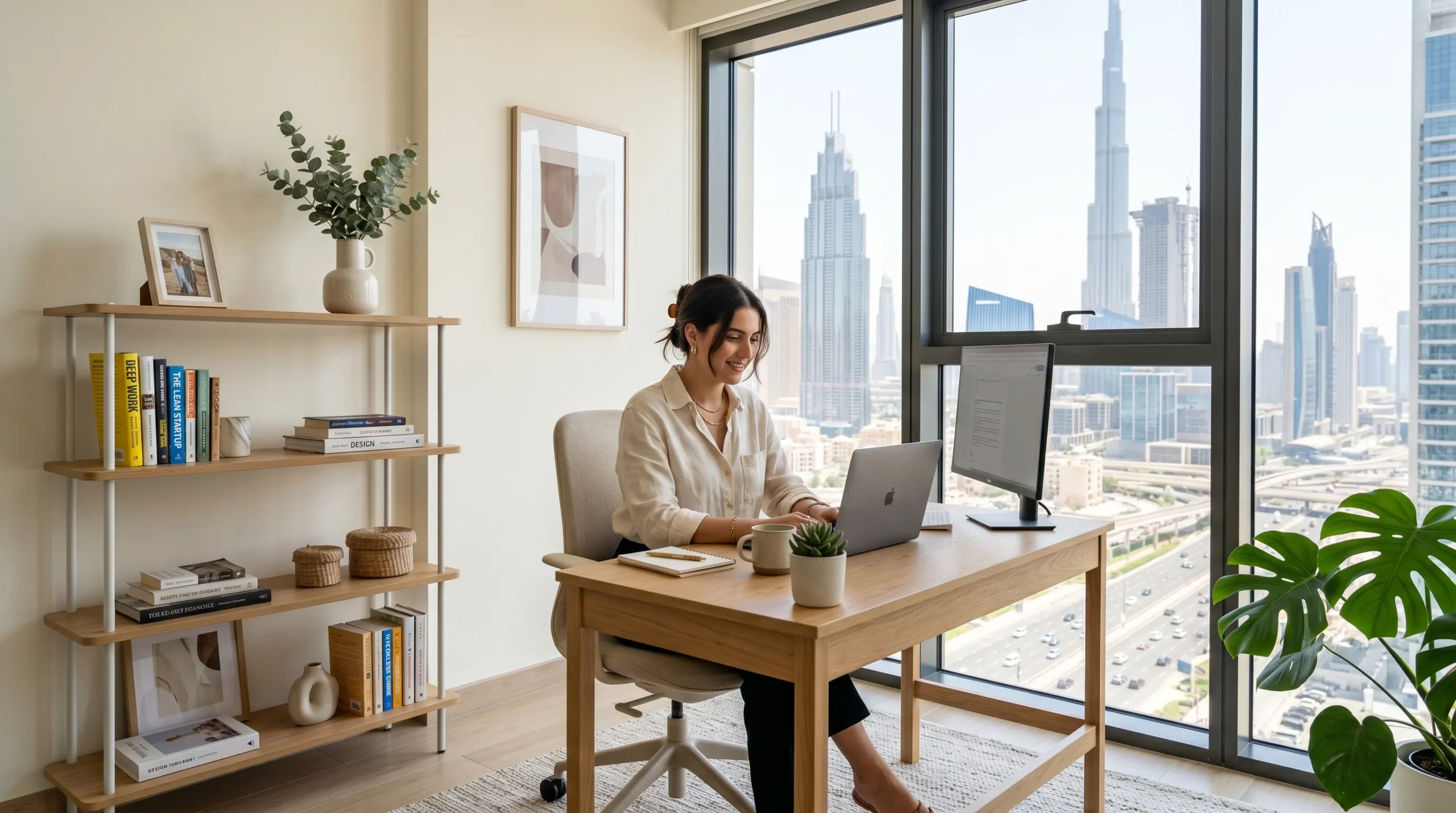
The most important layout principle for a home office is positioning the desk to face a wall or window rather than a doorway. Facing a wall reduces visual distraction; facing a window (especially in daylight hours, when the UAE sun is generous) boosts alertness and reduces eye strain. A 120cm × 60cm desk is sufficient for most single-monitor setups; a 140cm × 70cm desk is more comfortable for those who work with multiple screens or physical paperwork.
Step 4 — UAE-Specific Considerations Most People Miss
Air Conditioning Placement
This is the single most UAE-specific factor in furniture planning and the one that almost no generic guide covers. In UAE homes, split AC units are typically positioned high on the walls, and their airflow direction is adjustable — but furniture placed directly underneath or in front of them will still obstruct circulation.
As a rule, keep upholstered furniture — sofas, armchairs, beds — at least 50cm from a direct AC outlet. Leather and faux leather sofas are particularly susceptible to cracking when repeatedly hit by cold, dry conditioned air. Fabric sofas are more forgiving but can hold cold air in ways that make extended sitting uncomfortable during peak summer.
Sun Exposure and UV Damage
The UAE receives intense sunlight year-round. A south or west-facing room will flood with direct afternoon sun, and over time this will fade upholstery, bleach wood finishes, and degrade lower-quality materials noticeably faster than the UAE climate is often given credit for.
When planning your layout, check which direction your main windows face. If it’s west-facing, consider UV-filtering curtains or blinds as part of your room plan — not an afterthought. For furniture itself, darker or patterned fabrics hold their colour better than pale solids in high-UV rooms. Quality hardwood frames hold up significantly better than composite or MDF in conditions where temperature and humidity fluctuate between fully air-conditioned interiors and the outdoor heat.
Villa Majlis Considerations
If you’re moving into a UAE villa with a traditional majlis or formal guest reception room, the layout conventions are different from a Western living room. Seating runs along three walls in an L- or U-shape, typically low and deep, creating a communal space designed for group conversation rather than TV-focused relaxation. The layout is inherently about face-to-face arrangement — the focal point is the gathering itself, not a screen.
Getting the majlis right is about proportion: the seating should feel generous without being so large that the room feels crowded. A 6m × 5m majlis comfortably accommodates three full majlis seating sections; anything smaller should use two sections maximum to preserve breathing room.
Common Furniture Layout Mistakes UAE Families Make
Mistake 1: Buying Furniture Before Taking Measurements
We see this constantly. A family visits a showroom, falls in love with a dining set, orders it, and then discovers the table is 20cm too wide for their dining room. Or a bed frame arrives and the wardrobe door can’t fully open. Take your measurements first, always. Bring them to the showroom. Our team at Karnak Home is trained to help you find pieces that fit your exact dimensions — but only if we know what those dimensions are.
Mistake 2: Choosing a Sofa That’s Too Large or Too Small
In Dubai apartments especially, people tend to either go too large — choosing a four-seater sofa or an oversized sectional that overwhelms a 15–20sqm living room — or too small, underestimating the room and ending up with furniture that looks lost. As a rough guide: a room under 18sqm suits a compact two-to-three seater (180–210cm). A room between 18–28sqm suits a standard three-seater or small L-shape. A room over 28sqm can comfortably accommodate a larger L-shaped or modular configuration.
Mistake 3: Ignoring Traffic Flow Between Rooms
In UAE apartments, the living room often doubles as the main corridor between the front door, kitchen, and bedrooms. If your sofa placement cuts across this natural flow, the room will always feel awkward, no matter how nice the furniture is. Always map your traffic flow lines first, then arrange furniture around them.
Mistake 4: Forgetting the AC Unit
As discussed above — don’t place upholstered furniture directly in front of or below AC units. This is specific to Gulf living and makes a real difference to both comfort and furniture longevity.
Mistake 5: Not Accounting for Storage
UAE families accumulate a lot. Between Ramadan decorations, children’s toys, sporting equipment, and the general needs of family life, storage is always at a premium. When planning your layout, factor in where your storage furniture — sideboards, storage ottomans, bookshelves, TV units with drawers — will sit. Storage is part of the layout plan, not a separate problem.
What to Budget: Honest AED Guidance
Furnishing a new UAE property from scratch is a significant investment. Here’s a realistic range for quality furniture that will last in the UAE climate:
A studio apartment furnished with sofa, bed, wardrobe, small dining table, and essential storage typically runs between AED 8,000–15,000 for mid-range quality that you’d be happy with for 7–10 years.
A two-bedroom apartment fully furnished — living room sofa set, dining set, master bed and wardrobe, second bedroom set, and office furniture — ranges from AED 20,000–40,000 at a quality level that balances durability with design.
A three-to-four bedroom villa with a majlis, family sitting room, formal dining, four bedrooms, and storage throughout is realistically a AED 60,000–120,000+ investment for furniture that’s appropriate to the space and built to last.
These ranges assume mid-to-upper quality — the kind of furniture that survives children, UAE summers, and a decade of daily family life. Spending significantly below these ranges generally means replacing furniture within three to five years, which rarely saves money in the long run.
Expert Tips from 35 Years of Furnishing UAE Homes
Over three and a half decades furnishing homes across Dubai, Abu Dhabi, Sharjah, Ajman, and beyond, the Karnak Home team has learned some things that don’t make it into design textbooks.
1. Always measure your building’s elevator or stairwell first. A large sofa or king bed frame that doesn’t fit in the lift is a genuine logistical problem in UAE high-rises. Maximum sofa length for most Dubai Marina and JBR buildings with standard lifts is around 220–230cm. Know your building’s constraints before you order.
2. Rugs make or break a UAE living room. The right-sized rug anchors your seating group and adds warmth to what are often tiled or marble floors in UAE properties. Too small, and it looks like an afterthought. As a rule: all front legs of all seating should sit on the rug. A 200cm × 300cm rug is the minimum for most three-seater sofa arrangements.
3. In open-plan apartments, use furniture to define zones, not walls. A sofa facing away from the dining area, a bookshelf used as a room divider, a pendant light over the dining table — these are the tools that create rooms within rooms in open-plan UAE apartments.
4. Think about where the sun is at 3pm. That’s typically when west-facing UAE rooms get the most direct, intense light. If your main seating area faces west, glare on screens and heat build-up near windows is a real daily issue. Position seating perpendicular to west-facing windows where possible.
5. Don’t rush the kids’ room. It’s tempting to furnish children’s bedrooms last and quickly. But children spend a huge amount of time in their rooms — studying, playing, sleeping. A well-planned kids’ room with proper bed height, desk positioning relative to natural light, and smart storage actually matters for their daily wellbeing.
6. Consider furniture leg height in relation to your flooring. UAE properties often have polished marble or large-format tile floors that scratch easily. Low sofa legs with large surface area distribute weight better and are gentler on flooring. Felt pads on all legs — every leg, every piece — are non-negotiable.
7. If in doubt, go lighter in colour. UAE interiors tend toward lighter tones because they make air-conditioned spaces feel cooler and more spacious. A light grey, warm white, or natural linen sofa reads as larger and more airy than a dark charcoal equivalent — particularly in apartments where natural light is limited.
Conclusion: Making Your Decision
Planning your furniture layout before you move is one of the most valuable hours you’ll spend before moving into a UAE property. It costs nothing, requires only a tape measure and a piece of paper, and can save you thousands of dirhams in wrong purchases, replacement costs, and the genuine stress of furniture that doesn’t work in your home.
The process is straightforward: measure every room carefully, identify your focal points and traffic flows, plan room by room with real dimensions, and account for UAE-specific factors like AC placement and sun exposure. Then — and only then — shop.
Key Takeaways:
- Measure every room before you buy anything, including ceiling heights, door swings, and AC positions.
- Follow the 90cm traffic flow rule in every room — it’s the single biggest factor in whether a room feels liveable.
- Account for UAE-specific factors: AC unit placement, UV exposure from west-facing windows, and elevator dimensions for delivery.
- Match furniture size to room size — oversized and undersized furniture are equally common and equally avoidable mistakes.
- Budget realistically: quality furniture suited to the UAE climate and family life is a long-term investment, not an expense.
Frequently Asked Questions (FAQs)
Furniture layout planning is especially important in UAE homes because most properties are unfurnished and require complete setup from scratch. Proper planning helps avoid common issues like blocked AC vents, poor airflow, and overcrowded spaces. It also ensures your furniture fits well within apartment or villa layouts, saving money on returns and replacements.
Before purchasing furniture, measure the full room dimensions, including length, width, and ceiling height. Also note door swings, window positions, AC units, and electrical points. Using tools like floor plan apps or a simple sketch helps you visualise how furniture will fit and ensures a smooth layout process.
The ideal sofa size depends on your room size. For most Dubai apartments, a 2–3 seater sofa (180–220 cm) works best in living rooms under 20 sqm. Larger spaces can accommodate L-shaped or modular sofas. Always maintain at least 90 cm of walking space for comfortable movement.
To maintain proper airflow and energy efficiency, avoid placing sofas, beds, or other large furniture directly in front of AC vents. Keep at least 50 cm distance from AC units to prevent airflow blockage, reduce electricity costs, and protect furniture from long-term damage.
Common mistakes include buying furniture without measuring, choosing oversized or undersized sofas, ignoring traffic flow, blocking AC vents, and not planning storage. These issues can make homes feel cramped, inefficient, and uncomfortable despite having good-quality furniture.
Conclusion: Making Your Decision
Planning your furniture layout before you move is one of the most valuable hours you’ll spend before moving into a UAE property. It costs nothing, requires only a tape measure and a piece of paper, and can save you thousands of dirhams in wrong purchases, replacement costs, and the genuine stress of furniture that doesn’t work in your home.
The process is straightforward: measure every room carefully, identify your focal points and traffic flows, plan room by room with real dimensions, and account for UAE-specific factors like AC placement and sun exposure. Then — and only then — shop.
Key Takeaways:
- Measure every room before you buy anything, including ceiling heights, door swings, and AC positions.
- Follow the 90cm traffic flow rule in every room — it’s the single biggest factor in whether a room feels liveable.
- Account for UAE-specific factors: AC unit placement, UV exposure from west-facing windows, and elevator dimensions for delivery.
- Match furniture size to room size — oversized and undersized furniture are equally common and equally avoidable mistakes.
- Budget realistically: quality furniture suited to the UAE climate and family life is a long-term investment, not an expense.
كيفية تخطيط توزيع الأثاث في منازل الإمارات بطريقة ذكية وعملية
هل سبق أن انتقلت إلى منزل جديد بحماس، ثم اكتشفت أن الأريكة تعيق مخرج المكيف أو أن طاولة الطعام بالكاد تتسع؟ هذه مشكلة شائعة يمكن تجنبها بسهولة مع تخطيط توزيع الأثاث في الإمارات بشكل صحيح قبل الشراء. في بيئة سكنية مثل دبي وأبوظبي والشارقة، حيث تختلف المساحات وأنماط الشقق والفلل، يصبح التخطيط المسبق ضرورة وليس رفاهية.
أول خطوة أساسية هي أخذ قياسات الغرف بدقة، بما يشمل الطول والعرض وارتفاع السقف، إضافة إلى مواقع الأبواب والنوافذ ووحدات التكييف. هذه التفاصيل تساعدك على إنشاء مخطط الأرضية واضح، سواء باستخدام ورقة بسيطة أو تطبيقات رقمية. بدون هذه الخطوة، ستعتمد على التخمين — وهو السبب الرئيسي لمعظم أخطاء التأثيث.
في تصميم داخلي في دبي خصوصاً، تلعب المساحات المفتوحة دوراً كبيراً. لذلك، من المهم تحديد نقطة محورية لكل غرفة، مثل التلفاز أو النافذة، ثم ترتيب الأثاث حولها. كما يجب مراعاة حركة المرور داخل الغرفة، وترك مسافة لا تقل عن 90 سم بين القطع الأساسية لضمان الراحة وسهولة الحركة.
عامل آخر مهم في توزيع الأثاث داخل منازل الإمارات هو التكييف. وضع الأثاث أمام فتحات الهواء يقلل من كفاءة التبريد ويؤثر على عمر الأثاث نفسه. كذلك، يجب الانتباه لاتجاه الشمس، لأن الإضاءة القوية قد تؤثر على الأقمشة والأخشاب مع الوقت.
التخطيط الجيد لا يضمن فقط جمال المنزل، بل يوفر المال والوقت ويمنع التعديلات المزعجة لاحقاً. كل قطعة يجب أن يكون لها مكان محدد يخدم الوظيفة والجمالية معاً.
إذا كنت ترغب في تنفيذ هذا التخطيط باحترافية، زوروا صالة عرضنا أو تواصلوا معنا عبر واتساب للحصول على استشارة مخصصة تناسب منزلكم في الإمارات.
Ready to Find the Perfect Furniture for Your UAE Home?
Karnak Home has been helping UAE families furnish their homes since 1988. Our showroom carries one of the widest selections of sofas, beds, dining sets, wardrobes, office furniture, and kids furniture in the UAE — and our team is trained to help you find pieces that actually fit your space, your family, and your budget. Whether you prefer to browse online or walk through the showroom with your floor plan in hand, we’re here to help you get it right.
Shop Online: karnakhome.com