
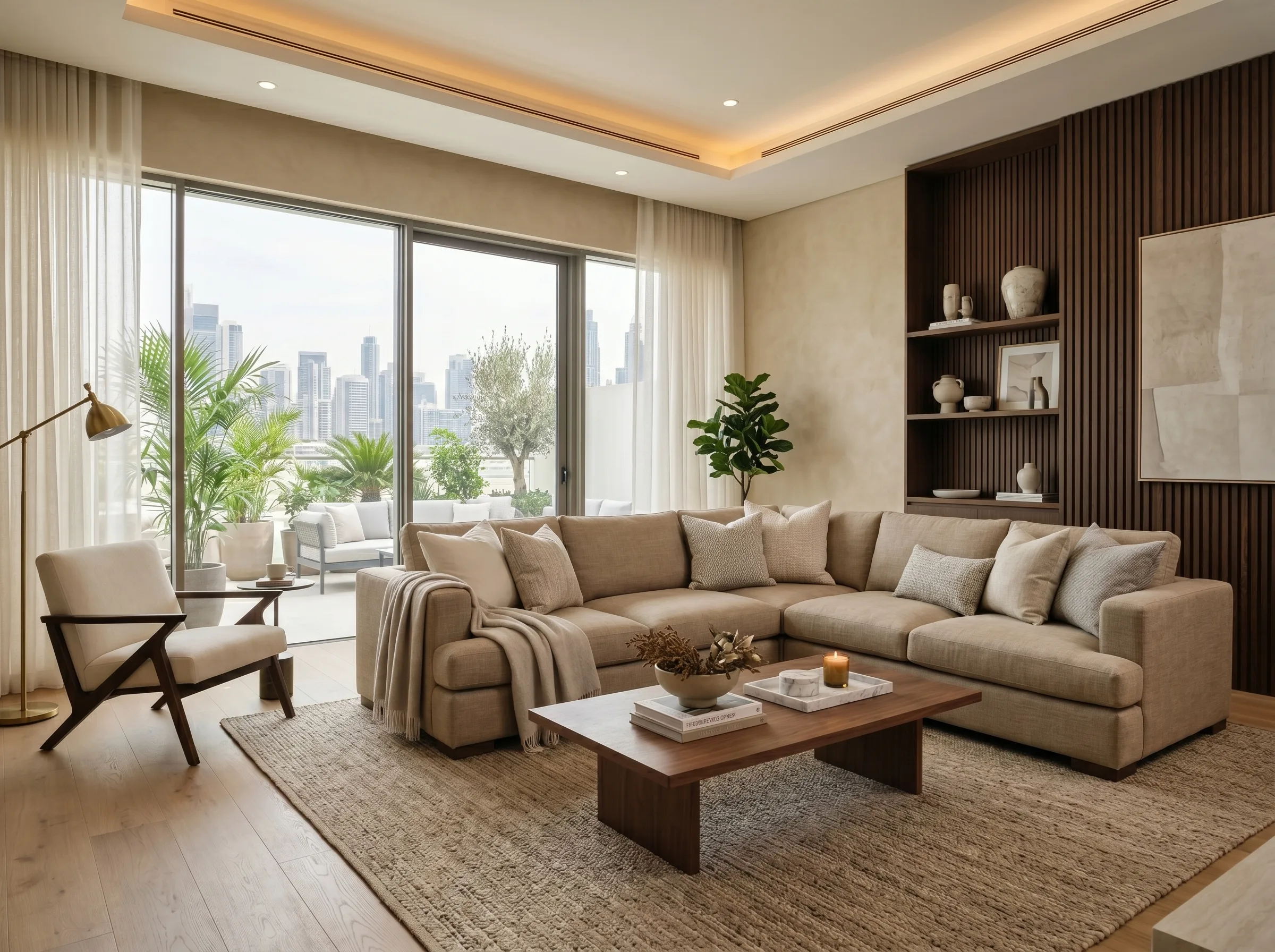
You finally decided on an L shape sofa. You have the layout figured out, you know roughly where it goes, and you have a budget in mind. Then you get to the showroom or browse online and the questions start piling up. Linen or microfiber? Leather or velvet? Performance fabric or natural weave? What actually survives Dubai summers, a house full of kids, and AC running twelve hours a day?
These questions matter more in the UAE than almost anywhere else on earth. Dubai’s outdoor temperatures hit 45 degrees Celsius in summer while your indoor AC keeps the room at 20 to 22 degrees. That 25-degree daily swing, combined with humidity levels that can spike above 90 percent on coastal days, creates conditions most furniture fabrics were never engineered for. Add sandstorms that push fine dust through window seals and a lifestyle where families genuinely live on their sofas, and a poor fabric choice shows its problems within 18 months.
At Karnak Home, we have been helping UAE families navigate exactly this decision since 1988. More than 70,000 families across Dubai, Abu Dhabi, Sharjah and beyond have trusted us to guide them, and the fabric question is one of the most consistent ones we hear. This guide covers what we have learned over 35 years of watching fabrics perform, fade, pill, stretch and survive in UAE homes.
Moreover, if you are looking to better understand the UAE lifestyle, weather, and daily living? Check out this excellent UAE Living Guide by First Abudhabi Bank (FAB) for insider tips and practical advice on navigating life in the Emirates.
Why Dubai’s Climate Is Uniquely Demanding on Sofa Fabric
Before comparing materials, it helps to understand what your sofa fabric is actually dealing with every single day in a UAE home.
The most damaging factor is not heat alone. It is the combination of extreme UV exposure, rapid humidity shifts and constant air conditioning. UAE sunlight is intense year-round and UV radiation at this latitude degrades fibers faster than in temperate climates. A sofa positioned near a window facing south or west in a Dubai apartment can receive direct sun for three to six hours daily, and over a year, this fades and weakens fabric at a pace that surprises families who relocated from Europe or South Asia.
Humidity is the second issue. Along the coast in Dubai, Sharjah and Ajman, outdoor humidity routinely exceeds 70 percent and spikes much higher in summer. Indoors your AC removes moisture aggressively, but the swings stress fibers. Natural fabrics like cotton and untreated linen absorb and release moisture as conditions change, which over time causes them to relax, lose structure and develop a worn appearance faster than their quality warrants.
The third factor is how UAE families actually use their living rooms. In many households, the living room is the center of daily life. Children do homework on the sofa. Guests visit regularly. Fabric that might last eight years in a lightly used European sitting room may need replacing in four if it was the wrong choice for an active UAE household.
Understanding this context helps you move past surface-level decisions like color or texture and focus on what the fabric is actually built to do.
The Main Fabric Categories for L Shape Sofas in UAE
Microfiber and Performance Synthetics
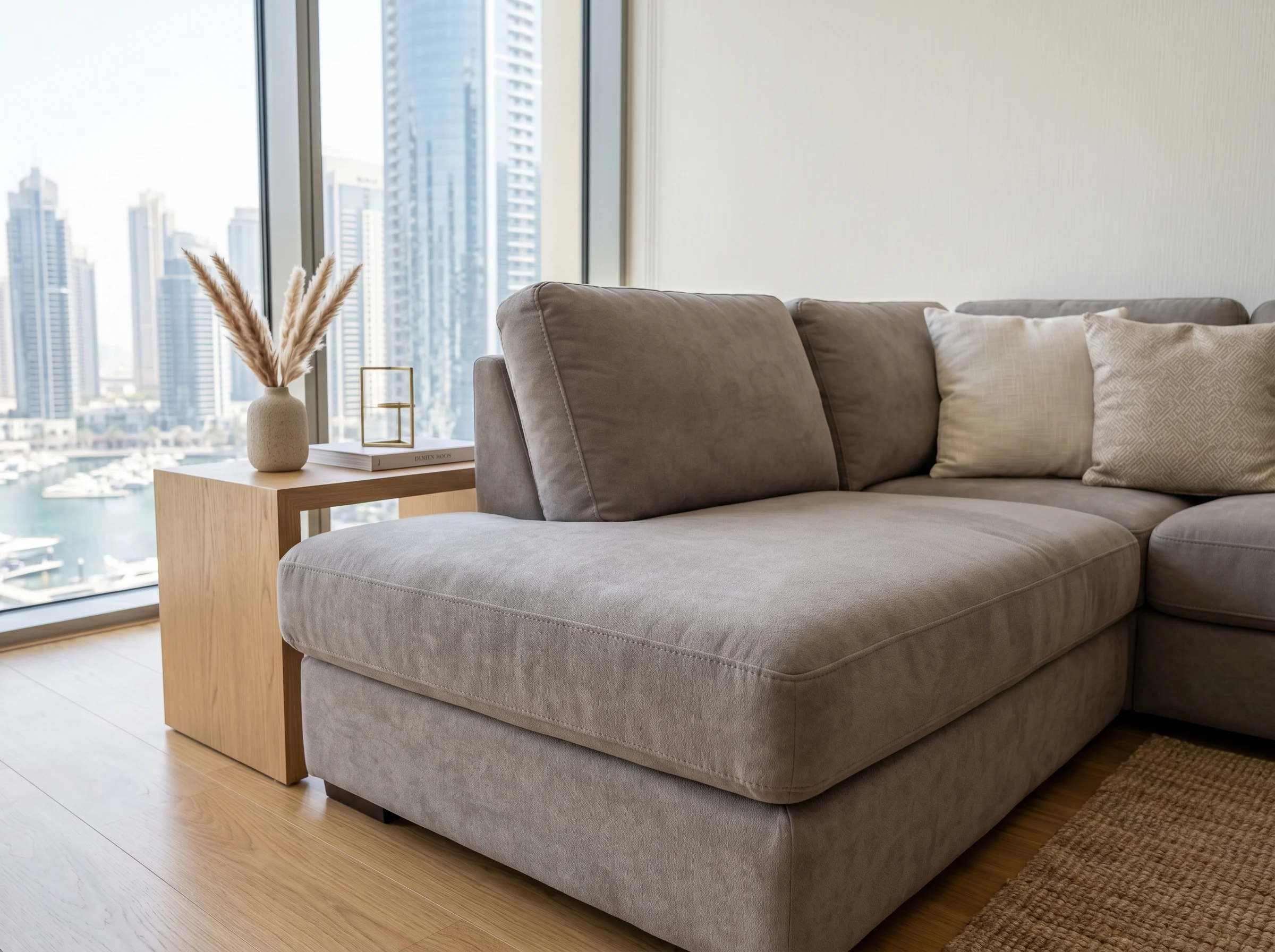
Microfiber is consistently the most practical choice for UAE families and it is the fabric we recommend most often for high-traffic L shape sofas in Dubai homes. The fibers are extremely fine, typically less than one denier, which means the weave is very tight. Liquid sits on the surface rather than soaking in, dust does not embed deeply, and the material resists the kind of abrasion that comes from children and daily use.
In Dubai’s climate specifically, quality microfiber has three advantages that matter. It does not absorb moisture from humidity fluctuations the way natural fabrics do, so it holds its shape and density over time. It resists UV degradation better than cotton or linen when a UV-resistant finish is applied. And it cleans easily with a damp cloth, which matters when you are dealing with sandstorm dust that coats everything indoors within a day of peak conditions.
The practical downside of microfiber is breathability. In a well-air-conditioned Dubai home this is rarely a problem because you are not sitting on a hot surface, but in rooms where the AC is used sparingly or where the sofa is near a glass wall, you can feel the material trap heat against skin. Not every microfiber product is the same quality either. Budget options from generic suppliers pill within a year and look tired fast. A quality microfiber L shape sofa from a reputable supplier costs between AED 3,500 and AED 9,000 depending on size, and the difference in fiber density between the lower and upper ends of that range is visible and tangible.
Performance fabric blends, often sold under brand names like Crypton or marketed as stain-guard treated weaves, take microfiber properties further. These fabrics have barrier treatments built into the fiber itself rather than applied as a surface coating that washes off. They resist stains, odors and moisture more thoroughly and are genuinely worth the premium for families with young children or pets.
Linen and Linen Blends
Linen has become the interior design fabric of the moment in UAE homes, and it is not hard to understand why. It photographs beautifully, it reads as sophisticated and natural in a way synthetics do not, and it suits the neutral palettes that dominate Dubai villa interiors in 2026.
The honest truth about linen on an L shape sofa in the UAE is that it requires commitment. Pure linen is breathable and cool to the touch, which is a genuine comfort advantage in climates where skin contact with fabric matters. It also develops a pleasant lived-in character over time rather than simply looking worn. These are real benefits.
But linen absorbs moisture, which means it is sensitive to UAE humidity. It stains more readily than microfiber. It wrinkles and creases when sat on repeatedly in the same spots, particularly on the seat cushions and the arm rests of an L shape sofa where weight and friction concentrate. It also fades in direct sunlight faster than most synthetic options.
The practical answer for families who love the linen aesthetic is a linen blend, typically 55 percent linen and 45 percent polyester or a similar ratio. The blend retains the natural texture and visual appeal of pure linen while the synthetic content adds dimensional stability, stain resistance and durability. A quality linen blend L shape sofa in a Dubai context performs well over five to seven years with reasonable care. A pure linen sofa in an active household with children may start showing its age in two to three.
Pricing for linen blend L shape sofas in the UAE generally runs from AED 4,500 to AED 12,000 depending on the sofa’s size and construction quality. Lighter neutral tones are most popular but require more attention to cleaning, particularly in homes with children.
Velvet
Velvet on an L shape sofa is a bold choice in Dubai and one that comes with specific conditions attached. When it works, it works extremely well. Deep teal, dusty rose, sage and charcoal velvet sectionals photograph beautifully and create a focal point in a living room that no flat fabric achieves.
The concern in UAE homes is the pile. Velvet’s raised loop structure traps dust, pet hair and fine particles efficiently. In a city where sandstorm season pushes fine particulates indoors regularly, velvet requires more consistent vacuuming and upkeep than flat-weave fabrics. It also shows seating impressions, the areas where the pile compresses from regular use, more readily than other materials. Brushing the pile back into place is a manageable task but it is an ongoing one.
Modern velvet sofas sold in UAE showrooms are typically made from polyester velvet rather than traditional cotton or silk velvet. Polyester velvet holds up significantly better in a climate context. It is more moisture resistant, more fade resistant, and cleans more easily than natural pile fabrics. If you are drawn to velvet, polyester velvet on a well-constructed frame is the version to choose.
Velvet is better suited to UAE apartments with good dust management, adult households or families where the children are older and the sofa is not the primary play surface. It is a less practical choice for villas with open doors, spaces where shoes come off at the entry and dust tracking is managed, or households with young children and pets.
Bonded Leather and Genuine Leather
Leather on an L shape sofa in Dubai is a topic that deserves honesty. Genuine full-grain or top-grain leather is not inherently a bad choice in the UAE if you understand what it needs. Bonded leather, which is made from leather scraps and polyurethane and used in most budget leather sofas, is a poor choice by any standard in a hot, humid climate.
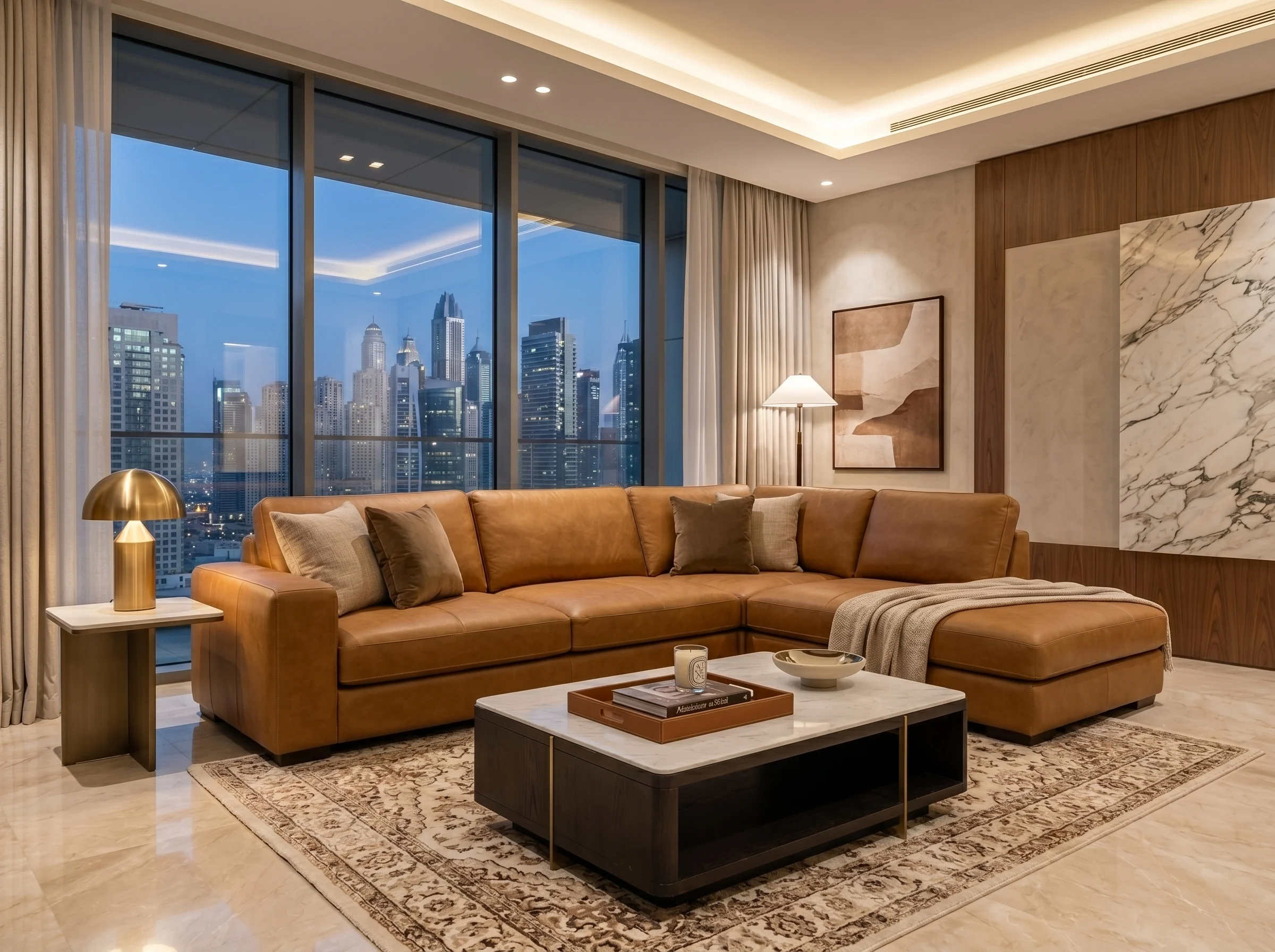
Genuine leather in a well-air-conditioned Dubai home stays cool because leather is a poor thermal insulator, making it more comfortable in a hot climate than many people expect. Good quality leather does not absorb moisture quickly, cleans with minimal effort and develops a patina that many families find more attractive than synthetic alternatives over time. A genuine leather L shape sofa from a quality supplier in the UAE runs from AED 8,000 to AED 25,000 or more depending on the leather grade and sofa size.
The maintenance requirements are real. Genuine leather needs conditioning two to three times per year to stay supple in an air-conditioned environment that dries it out over time. It needs to be kept from prolonged direct sunlight, which causes it to dry, crack and fade. And it shows scratches from pets and sharp objects clearly.
Bonded leather is the version to avoid. It peels. In a UAE home where the AC runs consistently and temperatures outside are extreme, bonded leather typically begins to flake and peel within two to three years. Once it starts, no repair product stops the progression. Families frequently discover that what appeared to be a leather sofa at an attractive AED 2,500 price point is a bonded leather product that needs full replacement within three years.
Cotton and Cotton Blends
Plain cotton upholstery is affordable and feels comfortable against skin, but it is one of the harder fabrics to maintain in a UAE context. It absorbs moisture readily, which in a humid coastal environment means it can stay damp and develop odors if not dried properly. It stains easily, fades in UV exposure faster than synthetics, and pills with regular use.
Cotton blends with polyester content of 30 percent or more improve all of these characteristics substantially. A 70/30 cotton-polyester fabric has meaningfully better durability, stain resistance and shape retention than pure cotton while retaining some of the soft, breathable feel that makes cotton appealing in the first place.
For families on a tighter budget who want a fabric L shape sofa, a quality cotton-poly blend is a reasonable middle ground, typically priced between AED 2,800 and AED 6,500. Go in with realistic expectations about maintenance, keep it away from direct sun and address stains quickly.
How UAE-Specific Conditions Should Guide Your Choice
Villa vs. Apartment Living
L shape sofas in Dubai villas face different conditions than those in apartments. Villas typically have more natural light, often through larger windows or glass doors that open to gardens or pools. This means more UV exposure for the sofa, making UV resistance a higher priority. Villas also tend to have higher foot traffic, more outdoor-indoor movement and in many cases children and pets. Performance fabric, quality microfiber or genuine leather with UV protection are stronger choices for villas.
Apartments, particularly in towers with floor-to-ceiling glass, can have significant solar gain on specific walls depending on orientation. A sofa placed against or near a south or west-facing glass wall in an apartment receives intense sun and requires the same UV-resistant fabric consideration as a villa. Smaller apartment layouts also mean the L shape sofa is often the dominant piece in the room, so its long-term appearance matters more.
Families with Young Children
If your household includes children under eight years old, fabric choice becomes a durability and cleaning decision first and an aesthetic one second. The priority list is stain resistance, cleanability, abrasion resistance and durability. Performance microfiber or a performance fabric blend wins this category clearly. Choose a mid-tone color rather than very light or very dark, as both show marks more readily. Light beige and ivory are genuinely hard to maintain with young children. Warm grey, taupe, slate blue and similar mid-tones are more forgiving.
Consider removable and washable seat cushion covers if the sofa you are choosing offers them. This feature is available on some models and adds years to the sofa’s practical life in an active family household.
Pets
Pet owners in the UAE face the same trade-offs as pet owners anywhere with the added intensity of a climate that keeps everyone indoors together for much of the summer. Velvet traps pet hair effectively and requires daily attention. Genuine leather shows scratches from claws. Microfiber and performance fabrics clean more easily and are the practical default for households with dogs or cats.
Common Mistakes UAE Families Make When Choosing Sofa Fabric
Mistake 1: Choosing Fabric Based on Showroom Appearance Alone
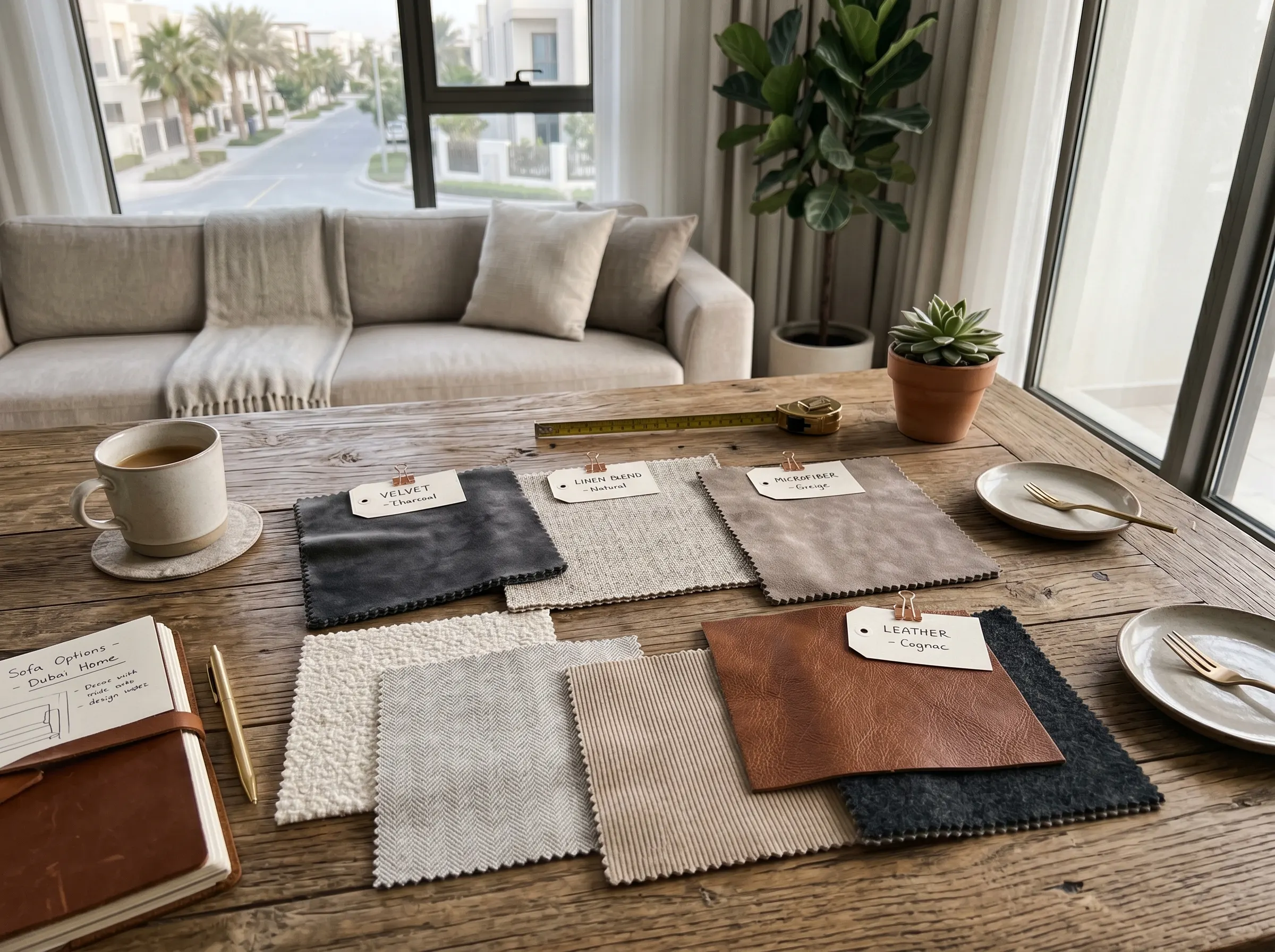
Fabric looks different under showroom lighting than in your home. It behaves differently on a sofa that is sat on daily versus one that is occasionally touched in a display. Ask for fabric samples, take them home, look at them in your natural light at different times of day, and sit with them for a few days before deciding.
Mistake 2: Underestimating Sun Exposure
Many families do not track where direct sunlight falls in their living room across different times of day and different seasons. The angle of the winter sun in Dubai is lower than in summer, which means winter sun can penetrate further into a room. If your sofa sits where sunlight will hit it for two or more hours daily at any point during the year, UV degradation is a meaningful factor in your fabric decision. This rules out untreated linen and lower-grade cotton as sensible long-term choices for that position.
Mistake 3: Prioritising Trend Over Climate Reality
Bouclé upholstery, textured boucle-style weaves and highly open natural weaves are fashionable in 2026 and they look genuinely beautiful in interior photography. They are also among the hardest fabrics to maintain in a UAE family home. Open weaves trap dust and particles deeply. They are difficult to vacuum thoroughly and spot-cleaning risks snagging the weave structure. Reserve trend fabrics for accent chairs and low-traffic pieces rather than the primary family sofa.
Mistake 4: Buying a Large L Shape Sofa Without Confirming Fabric Cleanability
L shape sofas are large pieces with seams, corners, tight angles and often fixed cushion areas that are harder to clean than a standard two or three-seater. Before purchasing, confirm whether the fabric can be spot cleaned with water and mild detergent, whether the cushion covers are removable and washable, and what the manufacturer’s cleaning guidance actually is. Buying a large sofa with a high-maintenance fabric and discovering this after the first child-related incident is a preventable frustration.
Mistake 5: Choosing Bonded Leather for Its Price
This deserves its own point because the consequences are significant. Bonded leather sofas are often priced in the AED 1,800 to AED 3,500 range and marketed as leather sofas. In UAE conditions they typically begin peeling within two to three years. Replacing a large L shape sofa every two to three years costs more over a decade than buying a quality fabric or genuine leather option once. If the budget is limited, a quality microfiber sofa in the AED 3,500 to AED 5,000 range is a considerably better long-term decision than bonded leather at AED 2,500.
Fabric Care in UAE Conditions: What Your Sofa Needs
The right care routine extends sofa fabric life significantly in the UAE’s demanding climate. These are practical instructions that apply across most upholstery types.
For all fabric sofas, vacuuming with a soft brush attachment weekly removes the fine dust that accumulates indoors, particularly after weather events. Dust that is left to sit works into fibers and creates the dull, tired appearance that accelerates aging. This is a ten-minute task that makes a genuine difference.
Rotate cushions every two to three weeks if your sofa has reversible or removable seat cushions. L shape sofas see uneven use because one or two seat positions tend to be heavily preferred. Rotating distributes wear and compression evenly.
Address liquid spills immediately. Blot, do not rub. Rubbing spreads the stain and works liquid deeper into the fiber. For microfiber and performance fabrics, a damp cloth and mild detergent removes most spills cleanly if caught within a few minutes. For linen blends, blot and allow to air dry without heat. For genuine leather, blot and apply a very light conditioner application after the area dries.
Keep your sofa at least 30 centimetres from direct AC vents where possible. Constant forced air accelerates drying and cracking in leather and can stress seams in fabric sofas over time.
Reupholstering or using removable slipcovers is a practical option if you bought a sofa with structural quality but the original fabric has reached the end of its life. Quality sofas from reputable suppliers have frames and construction worth preserving, and reupholstering extends their life substantially.
Expert Tips from Karnak Home’s 35 Years in UAE Furniture
These are the practical observations that come from supplying and servicing furniture in UAE homes for over three decades.
The sofa that photographs best in a showroom is rarely the most practical for daily family life. The sofa that performs best over five to eight years in a UAE home is built on a solid hardwood or engineered wood frame, uses high-density foam rated at 32 kg per cubic metre or above, and is upholstered in a fabric that was chosen for UAE conditions rather than for aesthetic trends.
Light-colored sofas in large UAE families with children under ten are consistently the ones we are asked to help with the most, usually because families chose them for how they looked in a display and discovered within a year that cleaning was a daily battle. If you love light colors, consider performance fabric with a built-in stain barrier and accept the maintenance commitment consciously rather than discovering it under pressure.
An L shape sofa in a Dubai villa living room with 500 square feet or more of floor space can handle a larger profile and deeper seat. An L shape sofa in a Dubai apartment typically benefits from a modular design that can be reconfigured if the family moves. Ask specifically about modular versus fixed configurations before purchase.
Warranty coverage on the fabric itself is worth examining carefully. Many warranties cover the frame and spring system but exclude fabric deterioration. A supplier who stands behind fabric quality as well as construction quality is signaling confidence in what they sell.
The UAE’s supplier landscape has changed significantly since the mid-2000s. There are now genuinely high-quality locally made furniture options alongside established international brands. Price is not always a reliable indicator of quality at the higher end of the market, but it remains a reliable warning sign at the lower end. A large, well-constructed L shape sofa cannot be produced honestly for AED 1,500.
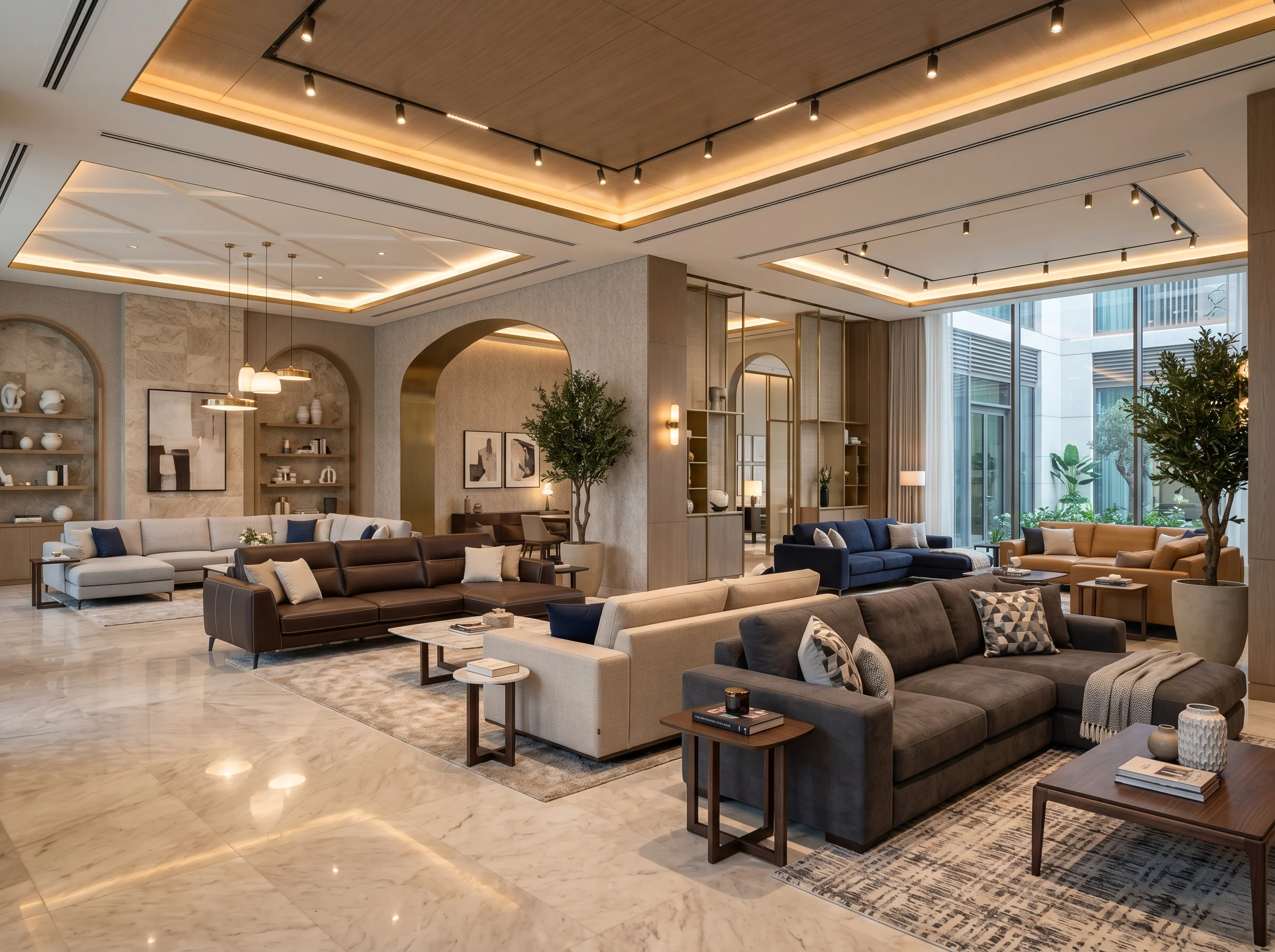
Pricing Guide: What to Expect in the UAE Market in 2026
Fabric prices themselves are only one part of the total cost of an L shape sofa. The frame construction, foam density, cushion filling, seam quality and supplier support are all part of the value equation. These are realistic price ranges for the UAE market in 2026.
Entry level microfiber L shape sofas from established UAE retailers run from AED 3,200 to AED 5,500. At this level you should expect a solid functional sofa with reasonable durability. Frame quality varies and is worth examining. Ask whether the frame is solid wood, engineered wood or metal.
Mid-range L shape sofas in performance fabric, quality microfiber or linen blend fall between AED 5,500 and AED 11,000. This is the segment where most UAE families find the best balance of quality and value. Construction quality is generally better, foam density is higher and fabric options are broader.
Premium L shape sofas in genuine leather, high-performance fabric or specialist upholstery materials start from AED 11,000 and extend to AED 25,000 or above for large Italian or European-manufactured pieces. At this level you are paying for materials, craftsmanship and often brand heritage.
Karnak Home carries L shape sofas across all three segments and can guide you to the best value option within your specific budget.
Conclusion: Making Your Fabric Decision with Confidence
Choosing L shape sofa fabric in Dubai is not complicated once you understand the key variables. Your climate exposure, household traffic, maintenance preferences and budget together point clearly to the right answer for your family.
For most UAE families with children and active households, quality microfiber or a performance fabric blend delivers the best combination of durability, cleanability and value. Linen blends are a strong choice for families who love natural textures and are willing to manage the maintenance commitment. Genuine leather rewards families who invest in it properly and appreciate its longevity. Velvet suits adult-focused living rooms with good dust management. Bonded leather should be avoided.
The fabric decision is also not permanent. A sofa with excellent frame and foam construction can be reupholstered when the fabric eventually reaches the end of its life, which means buying quality construction first and choosing a practical fabric that suits your current life stage is a sound strategy.
Key Takeaways:
- UAE climate demands UV resistance, humidity tolerance and cleanability above all other fabric considerations
- Microfiber and performance fabrics offer the best combination of durability and low maintenance for active UAE households
- Avoid bonded leather in any climate but especially in the UAE where heat and AC cycling accelerate peeling
- Position and sun exposure in your specific home should directly influence your fabric shortlist
- Construction quality underneath the fabric determines how long the sofa is worth maintaining
Ready to Find Your L Shape Sofa?
Karnak Home has been helping UAE families furnish their homes since 1988, and our team at the Dubai showroom knows the local market, the local climate, and the real-world performance of every fabric we carry. Browse our full L shape sofa collection online and filter by fabric type, size and color, or come into the showroom where our team can walk you through options in person, show you fabric samples, and help you make a decision you will be comfortable with for years.
Shop Online: Karnak Home
Visit Our Showroom: Dubai – Showroom Address & Directions
Expert Advice: Call Us or WhatsApp our team for personalised guidance
Related Articles:
- The Ultimate Guide to L Shape Sofas in Dubai: Best Picks for UAE Apartments and Villas (2026)
- L Shape Sofa Set: Your Complete Entertaining Hub – Choosing the Perfect L-Shape Sofa Set in Dubai & UAE
- Living Large in a Small Space? Our Top Picks for Sofa L Shape Small Designs
- Easy-Clean Luxury: The Best L-Shape Leather Sofas for UAE Families