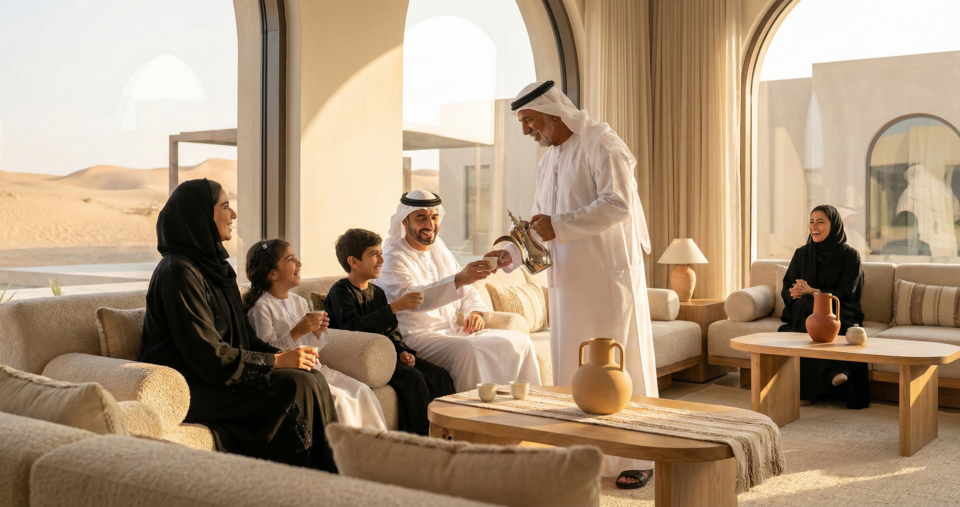
Walk into any Emirates Hills villa, and you’ll immediately recognize whether the Arabic majlis was designed by craftsmen or assembled from a catalog. The difference isn’t aesthetic, it’s generational. Your majlis is where family milestones unfold, where business partnerships are sealed over Arabic coffee, and where your grandchildren will one day gather. This isn’t furniture you replace in five years.
Since 1988, discerning UAE homeowners have understood what mass-market retailers won’t tell you: an authentic Arabic majlis represents cultural heritage, investment value, and architectural mastery. In this comprehensive guide, you’ll discover how the 2026 “Desert Minimalism” movement is reshaping majlis design, what quality indicators distinguish heirloom pieces from temporary furniture, and why climate-adapted materials matter more in Dubai than anywhere else in the world.
Understanding the Arabic Majlis: More Than Just Seating
The Arabic majlis traces its roots to Bedouin hospitality traditions, where tribal leaders created dedicated spaces for community gatherings and conflict resolution. Today’s majlis serves identical social functions while adapting to contemporary villa architecture.
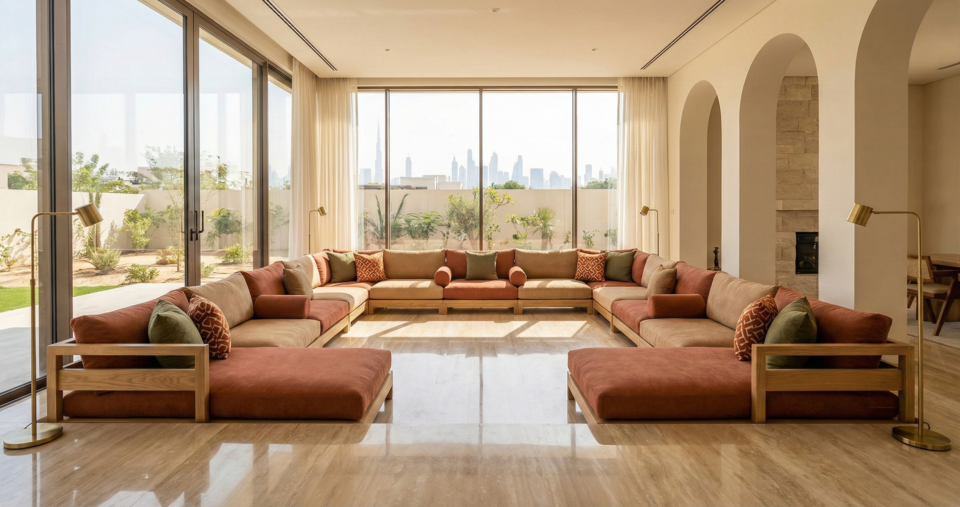
Traditional floor seating emphasized equality, everyone at eye level, no hierarchical positioning. Modern interpretations preserve this low-profile principle through raised platforms or architectural sofas that maintain the same visual language. The U-shaped or L-shaped configuration isn’t decorative; it creates natural conversation flow where every guest can engage with the entire gathering without turning.
When you invest in custom majlis furniture designed for your specific villa dimensions, you’re preserving cultural authenticity while solving practical spatial challenges.
In UAE homes, the majlis frequently appears in gender-specific configurations. Men’s majlis occupies the villa’s public-facing areas, designed for business discussions and formal entertaining. Women’s majlis, equally significant, provides private space for family gatherings and intimate social connections. Understanding this cultural context shapes every design decision from spatial planning through color selection.
2026 Design Evolution: Desert Minimalism vs. Traditional Maximalism
The UAE’s luxury interior design landscape experienced a seismic shift between 2020-2026. What we’re witnessing isn’t trend-chasing—it’s cultural refinement.
The Old Guard (2010s Majlis Aesthetic):
Heavy burgundies and golds dominated color palettes. Ornate carved wood covered every surface. Maximum embellishment signaled luxury. High-gloss finishes reflected artificial lighting. Dense patterns competed for attention across textiles and wallcoverings.
The 2026 Standard (Desert Minimalism):
Earth-toned textiles echo the Emirates’ natural landscape: terracotta inspired by dunes at sunset, warm limestone beiges, olive greens referencing the ghaf tree. Matte finishes replace reflective surfaces. Architectural clarity dominates over ornamental excess. Quality reveals itself through material substance, not decorative volume.
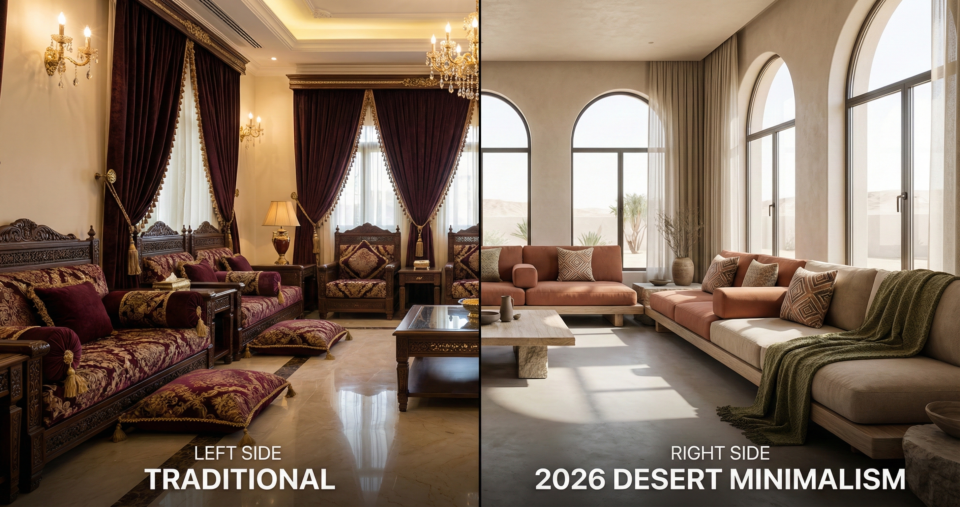
This isn’t rejecting Emirati heritage, it’s distilling it to essential elements. The majlis retains its cultural significance as the heart of hospitality. But the visual language now speaks through material integrity rather than surface decoration.
Contemporary UAE architects designing villas in Arabian Ranches, Jumeirah Golf Estates, and Dubai Hills Estate increasingly integrate majlis spaces that demand this refined aesthetic. Trying to force 2010s maximalism into these architectural contexts creates visual discord that undermines both design approaches.
The True Cost of Quality: Why Material Specifications Matter in Dubai
Here’s what furniture retailers won’t explain: Dubai’s climate destroys inadequate materials with brutal efficiency. Humidity fluctuations between 30-85% throughout the year, combined with constant AC cycling, create expansion-contraction stress that mass-market furniture simply cannot survive.
Frame Construction That Lasts 20+ Years:
Standard particle board with veneer wrapping fails within 18-36 months under UAE conditions. The veneer delaminates. The particle board swells. Joints separate.
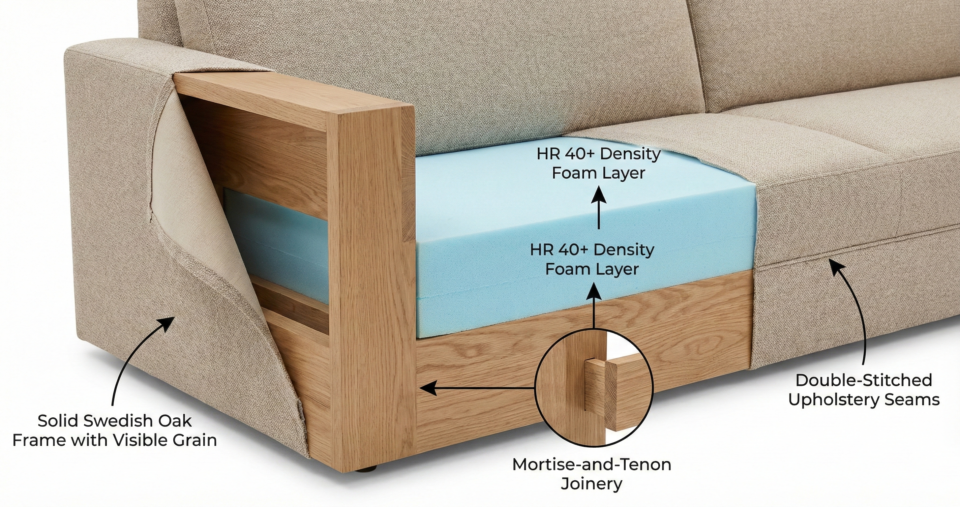
Solid Swedish oak or premium beech, kiln-dried to 8% moisture content, maintains structural integrity indefinitely. Proper kiln-drying removes moisture that would later cause warping. Marine-grade mortise-and-tenon, the same construction method used in boat building, provides joint strength that survives humidity cycling.
Foam Engineering That Doesn’t Collapse:
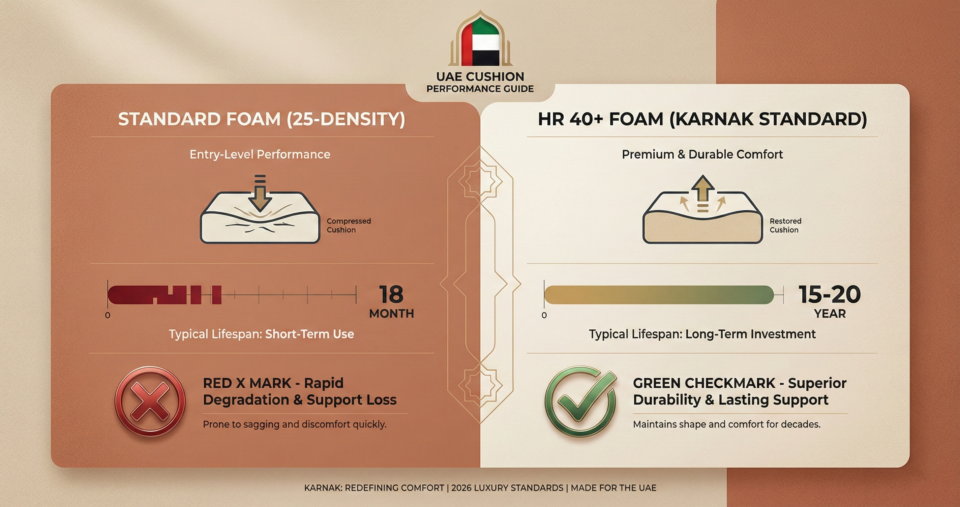
This specification matters more than most buyers realize. Standard foam used in budget furniture measures 25-density (1.8 lb/ft³). It feels soft initially but compresses within 6-12 months, leaving permanent body indentations.
HR 40+ foam (High Resilience, 2.5 lb/ft³ minimum) costs significantly more but maintains supportive structure through 15-20 years of daily use. The difference isn’t firmness, it’s compression recovery. HR foam returns to its original shape after each use. Standard foam gradually loses this resilience, leaving you with seating that looks intact but feels exhausted.
Climate-Adapted Upholstery:
Not all fabric performs identically across climates. What succeeds in European humidity levels fails in Dubai’s extremes. Quality majlis furniture uses textiles pre-tested under UAE-specific conditions: accelerated aging protocols that simulate years of exposure to local temperature swings, humidity variations, and dust penetration.
Custom vs. Catalog: Why One-Size-Fits-All Fails in UAE Villas
Every villa presents unique spatial challenges. A U-shaped majlis configuration that dominates an Arabian Ranches grand reception room overwhelms a Dubai Marina apartment’s available space. Ceiling heights, natural lighting angles, traffic flow patterns, and existing architectural details—these variables demand customized solutions.
Mass-market retailers measure your space, then try forcing their standard SKUs into your dimensions. The result: awkward gaps, proportion mismatches, sightline disruptions. You’re adapting your home to accommodate their furniture limitations.
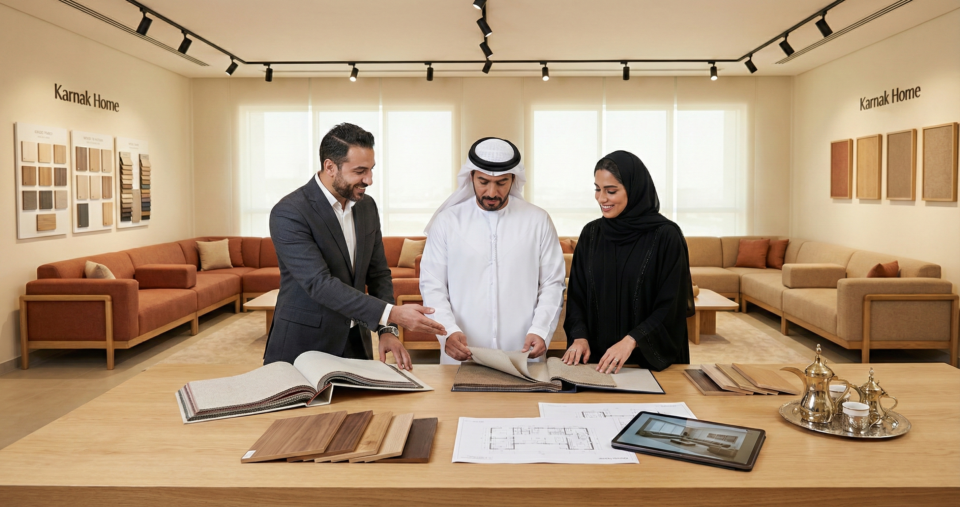
Professional custom majlis design begins with an on-site consultation process that measures not just dimensions but also understands how your family actually inhabits the space.
Professional custom majlis design begins with an on-site consultation that measures not just dimensions but also understands how your family actually inhabits the space. Where does natural light enter? How many people typically gather? What existing architectural features should the majlis complement or contrast? These questions shape design decisions that catalog furniture can never address.
The cost premium for true customization, typically 25-35% above mass-market alternatives, delivers proportional value. You’re paying for architectural integration that makes the majlis appear designed into the villa’s structure rather than placed as an afterthought.
Buying Framework: What to Inspect Before Any Purchase
Furniture retailers rely on buyers not understanding quality indicators. Here’s your practical inspection checklist:
Frame Verification:
Ask for wood species and moisture content specifications. “Solid wood” means nothing without species identification. Request to see unfinished frame sections during production. Examine joint construction, mortise-and-tenon with wood glue indicates quality; staples or screws suggest cost-cutting.
Foam Specifications:
Demand foam density numbers in lb/ft³. Anything below 2.0 won’t provide acceptable longevity. Ask if it’s standard polyurethane or high-resilience grade. Request compression recovery data if available.
Upholstery Standards:
Inspect seam construction, double-stitched with bonded nylon thread rated for 10,000+ tension cycles, separates premium from budget. Ask about the fabric origin and whether it’s been tested under UAE climate conditions. Generic “luxury fabric” claims without specifics indicate low-quality sourcing.
Warranty Analysis:
Premium manufacturers offer 10-15 year structural warranties because they engineer for longevity. Budget retailers provide 1-2 years because that’s their expected functional lifespan. Warranty terms reveal manufacturer confidence more accurately than marketing claims.
Cost-Per-Year Reality:
A AED 25,000 majlis set lasting 20 years costs AED 1,250 annually. A AED 15,000 set requiring replacement every 3 years costs AED 5,000 annually. The “expensive” furniture becomes dramatically more affordable when analyzed through actual usage lifespan.
Cultural Considerations for Modern UAE Families
The majlis serves functions that Western furniture concepts don’t accommodate. Understanding these cultural requirements shapes every design decision:
Hospitality Performance:
Your majlis represents your family’s honor through its capacity to welcome guests comfortably. Skimping on seating capacity or comfort quality sends unintended social messages. The majlis isn’t private furniture, it’s public-facing cultural infrastructure.
Generational Durability:
Emirati families view quality furniture as an heirloom, not a temporary purchase. The majlis your children remember from their childhood should be the same majlis your grandchildren experience.
Architectural Integration:
Modern UAE villa design incorporates majlis spaces as architectural features, not afterthought additions. The majlis should feel designed into the home’s structure—ceiling treatments, lighting design, and flooring transitions all coordinate with the seating configuration.
Seasonal Functionality:
Ramadan and Eid gatherings demand maximum capacity. The majlis layout must accommodate extended family events without requiring furniture addition or rearrangement. This capacity planning influences initial design specifications.
Installation and Delivery: The Final Quality Test
Premium furniture manufacturers handle installation personally rather than outsourcing to third-party contractors who lack product knowledge. This final touchpoint reveals manufacturer confidence and expertise.
Karnak Home’s local UAE manufacturing enables 7-10 day custom delivery timelines, substantially faster than imported furniture’s 8-12 week shipping windows. Local production also eliminates shipping damage risks and allows for on-site adjustment if architectural details require modification.
These local manufacturing advantages extend beyond convenience to encompass sustainability, quality control, and long-term service accessibility.
These local manufacturing advantages extend beyond convenience to encompass sustainability, quality control, and long-term service accessibility. When your majlis requires reupholstery in 15 years, working with a local manufacturer means straightforward service rather than replacement necessity.
Frequently Asked Questions
Q: What’s the average cost of a quality Arabic majlis in Dubai?
Custom-built majlis furniture from reputable manufacturers typically ranges from AED 20,000-50,000, depending on size, material specifications, and configuration complexity. This investment delivers 20+ years of daily use when properly specified. Budget alternatives under AED 15,000 generally require replacement within 3-5 years, making them more expensive over time.
Q: How long should a well-made majlis last?
With proper specifications—solid hardwood frame, HR 40+ foam, climate-adapted materials—a quality majlis provides 20-25 years of structural integrity and comfort. Reupholstery around year 12-15 extends this further. Mass-market alternatives typically fail within 18-36 months under UAE climate conditions.
Q: What’s the difference between traditional and modern majlis design?
Traditional majlis emphasizes ornate carved details, rich burgundy/gold color palettes, and maximum embellishment. Modern “Desert Minimalism” refines this to earth-toned textiles (terracotta, warm beige, olive), clean architectural lines, and material quality over surface decoration. Both honor cultural heritage; the modern approach distills tradition to essential elements.
Q: Can I customize a majlis for a small Dubai apartment?
Absolutely. Professional custom design adapts majlis principles to any spatial constraints. L-shaped configurations work better than U-shaped ones in compact spaces. Modular components allow flexible arrangement. The key is working with manufacturers who customize dimensions rather than forcing standard products into incompatible spaces.
Q: How do I maintain an Arabic majlis in Dubai’s climate?
Quality majlis furniture with proper climate adaptation requires minimal maintenance. Vacuum upholstery weekly to prevent dust accumulation. Avoid direct sunlight exposure, which fades textiles. Maintain consistent indoor humidity (45-55%) through proper AC management. Professional deep cleaning every 18-24 months preserves fabric appearance. The frame and foam require no maintenance when properly specified.
Conclusion: Building Legacy, Not Just Furnishing Space
Your Arabic majlis represents far more than seating; it’s where your family’s story unfolds across generations. Every business partnership sealed over Arabic coffee, every Ramadan gathering, every milestone celebration happens in this space. Cutting corners on quality means compromising these irreplaceable moments.
The 2026 design evolution toward Desert Minimalism doesn’t reject Emirati heritage; it refines cultural expression through material integrity and architectural clarity. When you invest in properly specified majlis furniture, you’re not purchasing temporary furniture. You’re building a tangible legacy.
Explore Karnak Home’s custom majlis collection to discover how 35+ years of UAE craftsmanship translates into furniture that honors your family’s hospitality tradition.