
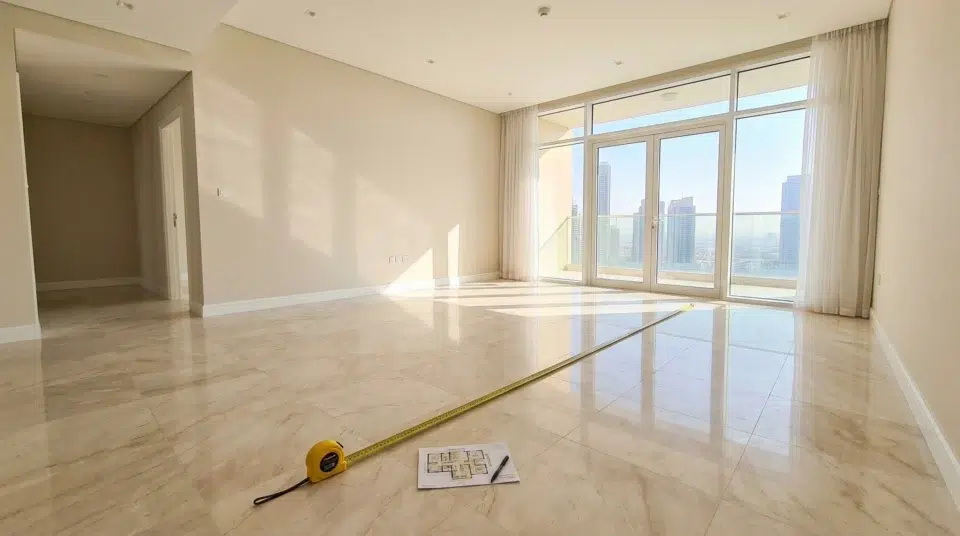
You’ve found the perfect sofa. You can picture it in your living room — the colour is right, the style suits you, the price works. Then it arrives, and it doesn’t fit through the door. Or it fits, but the room feels suffocating. Or worse, there’s a yawning gap on one side because the sofa is a full metre shorter than the wall it was meant to anchor.
This is one of the most common furniture mistakes we see at Karnak Home, and after 35 years helping families across the UAE furnish their homes — over 70,000 families and counting — we can tell you it’s entirely preventable. The fix is simple: measure first, shop second. This guide walks you through exactly how to do that, with UAE-specific advice for apartments in Dubai and Abu Dhabi, spacious villas in Sharjah and Al Ain, and everything in between.
UAE homes have their own character — the wide, open-plan reception areas popular in newer Dubai builds, the formal majlis that doubles as a family gathering space, the compact second bedrooms in apartments that still need to fit a wardrobe, a study desk, and sometimes a kids’ bed. Good furniture planning respects those realities. This guide gives you the tools to do it properly.
What You Need Before You Start Measuring
Good measurements start with the right tools and the right mindset. Rushing through this stage is where most people go wrong. Give yourself 20–30 minutes, treat it seriously, and the time you invest now will save you hours of headache — and potentially thousands of dirhams in return logistics fees — later.
The Tools You’ll Need
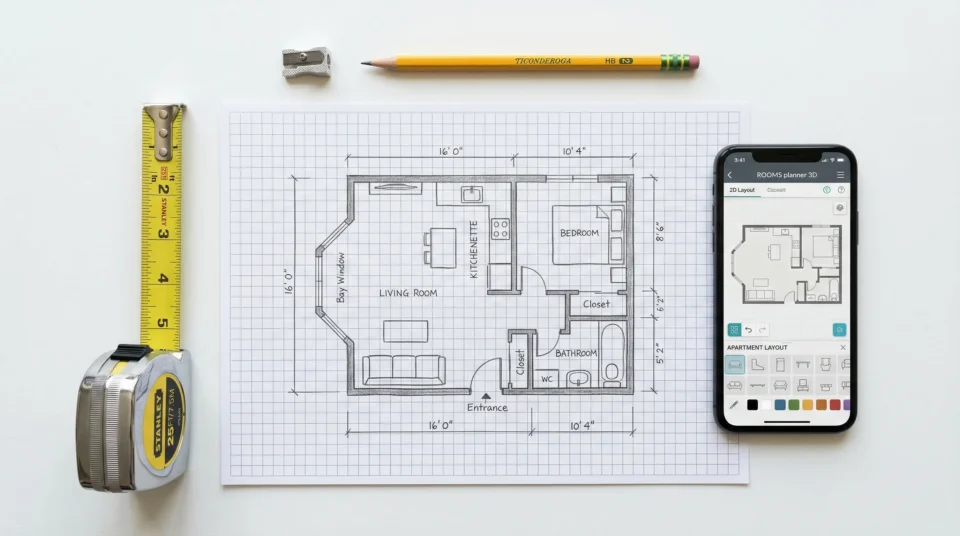
A steel measuring tape of at least 5 metres is essential. The flexible cloth tapes used in tailoring are not accurate enough for furniture. A pencil, a notepad, and ideally graph paper (or a room planning app on your phone) will let you sketch a floor plan as you go. A second person to hold the other end of the tape makes the whole job faster and more accurate, especially in larger villa reception rooms.
Useful apps include the free Magicplan (iOS and Android), which uses your phone camera to auto-generate a floor plan, and IKEA’s Place app, which uses augmented reality to visualise pieces in your space. Neither replaces careful manual measurement, but both are helpful for experimenting with layouts once you have your figures.
What to Measure in Every Room
For every room, you need five key measurements: overall length, overall width, ceiling height, door width and height including the frame, and the position of windows, air conditioning units, and electrical sockets. In UAE homes, the split AC unit mounted high on the wall is a critical consideration. Tall wardrobes and shelving units must clear it, and you need to leave enough room for a technician to service it — typically 30–40 cm of clearance above the unit and 15 cm to the side.
Note the position of light switches and thermostat controls too. A sofa or bed headboard placed directly over a light switch is an annoyance you’ll live with every day. A sideboard blocking a thermostat means you’ll be climbing over furniture to adjust the AC every summer — and in the UAE, that means every single day from May through October.
How to Measure Your Living Room for Furniture
The living room is where most UAE families spend the most time together, and it’s also where the most expensive furniture decisions are made. Getting these measurements right sets the tone for the whole home.
Measuring for a Sofa
Start with the total length of the wall where the sofa will sit. Then subtract at minimum 30 cm from each end to leave breathing room between the sofa and the adjacent wall or corner unit. What’s left is your maximum sofa length. In a typical Dubai 2-bedroom apartment living room of around 4.5 metres wide, this gives you roughly 3.8 metres of workable sofa wall — enough for a generous 3-seater or a modest corner sofa.
Now measure the depth of the room from that wall to the opposite wall or to the TV unit. For comfortable seating, you need at least 45–50 cm of clearance between the front of the sofa and the coffee table, plus another 40–50 cm between the coffee table and the TV unit or opposite seating. Add those numbers to your sofa’s depth (typically 85–100 cm for a standard sofa) and you’ll quickly know whether an L-shaped corner sofa is realistic or whether a more compact 2-seater-plus-armchair arrangement makes better sense.
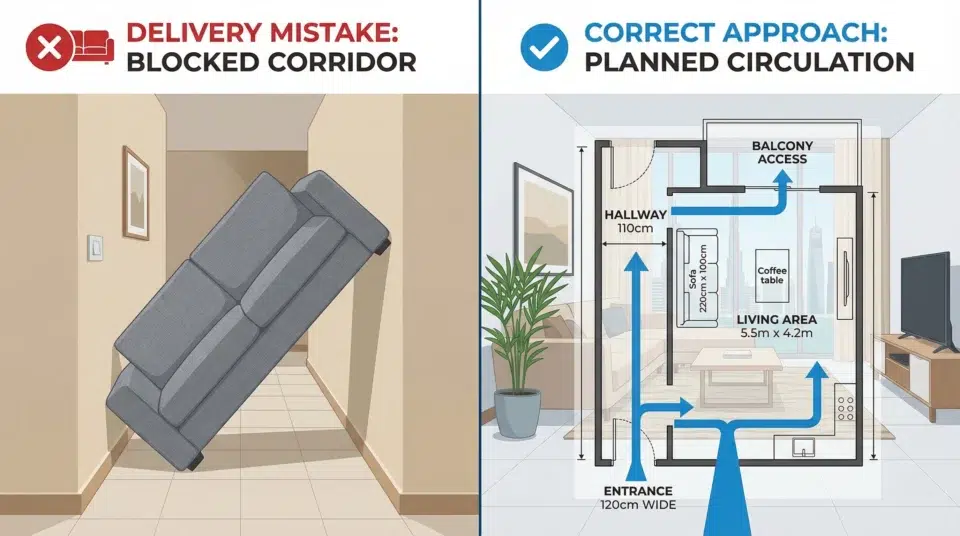
Don’t forget to measure the path from your front door to the living room. In many UAE apartment buildings, you’re navigating a corridor, a turn, and potentially a lift. The standard minimum corridor width in UAE residential buildings is 90 cm, but the lift dimensions are the real constraint — most residential lifts are 110–130 cm deep and 90–110 cm wide. A sofa longer than 200 cm almost certainly needs to be delivered via the stairwell or disassembled, so always confirm delivery logistics with your retailer before purchasing.
Measuring for a Coffee Table
The coffee table is often an afterthought, but the wrong size can make even a well-chosen sofa feel awkward. The ideal coffee table length is roughly two-thirds of your sofa’s length. For a 220 cm sofa, you’re looking at a table around 140–150 cm long. Height-wise, a coffee table should sit within 5 cm of your sofa’s seat height — so if your sofa seat is 45 cm from the floor, aim for a table between 40 and 50 cm high.
For families with young children, round or oval coffee tables with no sharp corners are worth the premium. We’ve seen this request more times than we can count from parents in the UAE, and it’s a genuinely practical consideration, not just a design preference.
Measuring for a TV Unit
Measure the width of the wall where your TV unit will sit, then note the position of the nearest socket or media port. Your TV unit should not extend beyond the TV itself — the generally accepted rule is that your unit should be at least as wide as your TV and ideally about 5–10 cm wider on each side. For a 65-inch TV (approximately 144 cm wide), you want a unit of at least 160 cm.
Height matters more than most people realise. For comfortable viewing from a sofa, the centre of your TV screen should be roughly at eye level when you’re seated — approximately 100–110 cm from the floor for most adults. Factor this into how high your TV unit sits and whether you’re wall-mounting or using a freestanding unit.
How to Measure Your Bedroom for Furniture
The bedroom is the most personal room in the home, and in UAE culture, it’s also often a space that’s shared with extended family in mind. Getting the dimensions right here means sleeping well and living comfortably.
Bed Sizes Used in the UAE
This is an area where UAE homes diverge significantly from European or American standards, and it causes real confusion when people shop online or order from international brands. The most common bed sizes in UAE homes are:
Standard Single: 90 cm × 190 cm. Used in children’s rooms, maids’ rooms, and compact second bedrooms. Double (Full): 135 cm × 190 cm. Less common in UAE master bedrooms but often used in guest rooms. Queen Size: 150 cm × 200 cm. Popular in apartment master bedrooms. King Size: 180 cm × 200 cm. The UAE standard king — note this is different from US King (193 × 203 cm). Super King: 200 cm × 200 cm. Common in larger villa master bedrooms.
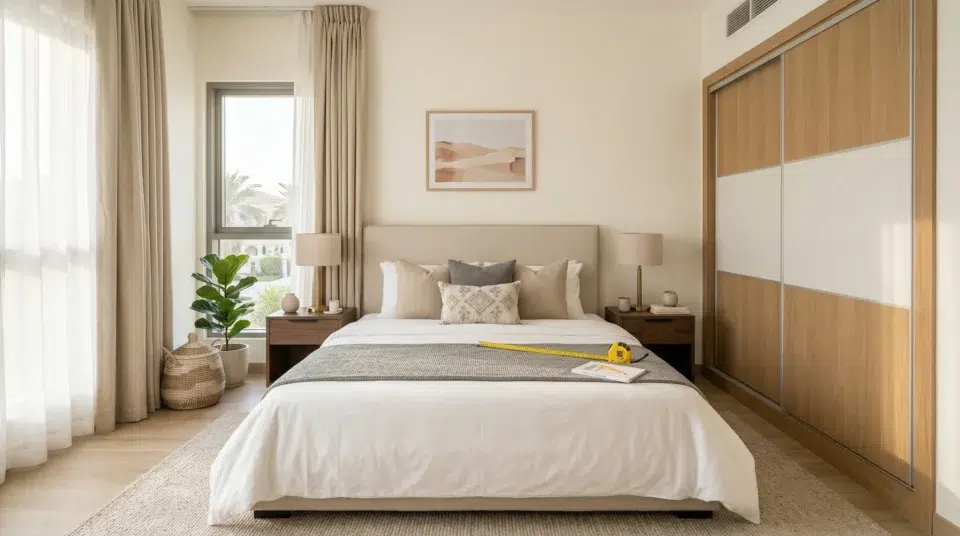
When measuring your room for a bed, you need more than just floor space. Allow a minimum of 60 cm on each side of the bed for comfortable circulation — enough to make the bed properly, to open bedside table drawers, and for children or elderly family members to navigate safely. At the foot of the bed, you need at least 90 cm of clearance to a wardrobe or wall, and ideally 100–120 cm if you’re placing a blanket box or ottoman there.
Measuring for Wardrobes
Wardrobes are the most complex furniture item to measure for, because they involve not just floor space but ceiling height, wall width, door swing clearance, and proximity to the AC unit. Standard wardrobe depths range from 55 to 65 cm. In compact UAE apartments, 55 cm depth wardrobes make a meaningful difference to how the room feels — you gain 10 cm of floor space, which translates to more comfortable circulation.
For sliding-door wardrobes — extremely popular in UAE bedrooms because they require no door-swing clearance — measure your wall width carefully and ensure the structure is level. UAE buildings settle, and floors that appear flat can have a slight gradient. A wardrobe installer worth their fee will check this before fitting.
Ceiling heights in UAE apartments vary considerably. Older buildings from the 1990s and early 2000s often have ceiling heights of 2.6–2.7 metres, while newer developments commonly reach 2.8–3.0 metres or higher. Floor-to-ceiling fitted wardrobes look best and use every centimetre of space, but they require precise measurement and professional installation.
How to Measure Your Dining Room for Furniture
In many UAE homes, the dining area is part of an open-plan living and dining space rather than a separate room. That makes the measurement conversation both simpler and more complex: simpler because you have more visual flexibility, more complex because the furniture has to work with everything else in the open plan.
Dining Table Dimensions
The rule of thumb for dining tables is 60 cm of table width per person. For a family of four dining side by side, you need at least 120 cm of table width. For six people, aim for a table at least 160 cm long and 85–90 cm wide. For eight, 200 cm or longer.
More important than the table itself is the clearance around it. You need a minimum of 90 cm between the edge of the table and the nearest wall or piece of furniture — enough for a chair to be pulled out fully and for someone to walk behind a seated person. For comfortable movement in a family home where children are running to and from the kitchen, 110–120 cm of clearance is better.
Measure from the floor to the underside of any windowsill or AC unit that sits near the table. If you’re planning a sideboard or buffet unit against a dining room wall, the top surface should typically sit between 85 and 95 cm from the floor — this allows you to serve from it comfortably without bending.
Round vs. Rectangular Tables in UAE Homes
Round tables are excellent for smaller dining areas in UAE apartments. They allow more people to sit comfortably in less floor space because there are no corners taking up room, and they’re easier to navigate around. A round table seating four comfortably needs a diameter of at least 110 cm; seating six requires at least 150 cm. The required clearance around the table remains the same — 90 cm minimum.
Rectangular tables suit longer, narrower dining spaces and are more common in villa dining rooms where the space is generous. Extension tables — which are increasingly popular at Karnak Home — are an excellent compromise for UAE families who host regularly but don’t want to waste floor space on a large table every day.
Common Mistakes UAE Families Make When Measuring
After three and a half decades in the furniture business, we’ve seen every measuring mistake possible. Here are the ones that come up most often — and how to avoid them.
Mistake 1: Measuring the Room but Forgetting the Delivery Path
This is the single most common and most costly mistake. You spend time measuring your living room carefully, you buy the perfect sofa, and then it can’t make the turn from the lift lobby into your front door. Always measure the full delivery route: the lift dimensions, every doorway it passes through, every corridor turn. For large furniture pieces — sofas over 200 cm, king-size bed frames, large wardrobes — call your building management before purchase to confirm access. Many UAE buildings have service lifts with larger dimensions than the passenger lift, which can solve this problem entirely.
Mistake 2: Ignoring Clearance Space
Floor space and clearance space are different things. A bedroom can physically fit a super king bed, but if there’s only 40 cm on each side, you’ll feel cramped every day. The furniture fits; the life doesn’t. Always plan for at minimum 60 cm circulation space around beds, 90 cm around dining tables, and 100 cm as the main traffic flow through any living area. In family homes, add another 20 cm to every clearance measurement to account for real life — the school bags left on the floor, the toddler running through, the grandmother walking carefully.
Mistake 3: Not Accounting for UAE Climate Specifics
This one is less obvious but genuinely important. UAE summers mean your AC runs almost continuously from May to October, and that means air movement around your furniture matters. Avoid placing tall furniture units directly in front of AC vents or returns — it reduces efficiency and can cause moisture issues in the long term. Equally, south-facing rooms in UAE buildings receive intense afternoon sun. Solid wood furniture placed in direct sunlight for hours each day will fade, warp, and dry out faster than it would elsewhere. Note which walls get direct sun and plan furniture placement accordingly.
Mistake 4: Measuring Only the Floor
Ceiling height matters. In UAE apartments with 2.6–2.7 metre ceilings, a tall wardrobe or bookcase that works beautifully in a 3-metre-ceiling villa will make a room feel oppressive. Conversely, rooms with high ceilings can absorb larger, grander furniture that would overwhelm a typical apartment. Always note your ceiling height and factor it into proportional decisions, not just practical clearance.
Mistake 5: Buying Before Measuring the Existing Furniture
If you’re adding to an existing room rather than starting from scratch, measure everything you’re keeping. New furniture needs to work in scale and proportion with what’s already there. A new dining table that’s 10 cm taller than your existing chairs will make every meal uncomfortable. A new sofa that’s 15 cm deeper than the old one might push your coffee table into the TV unit. Measure everything in the room, not just the space.
Standard Furniture Dimensions: Your UAE Reference Guide
Having a reference for standard furniture sizes helps you plan before you even set foot in a showroom. These are the ranges you’ll encounter most often.
Sofas: 2-seater: 140–170 cm wide. 3-seater: 180–220 cm wide. Corner/L-shape: 230–280 cm on the long side, 140–180 cm on the short side. Depth: 80–100 cm. Seat height: 40–48 cm.
Beds: Single: 90 × 190 cm. Double: 135 × 190 cm. Queen: 150 × 200 cm. King: 180 × 200 cm. Super King: 200 × 200 cm. Bed frame adds approximately 5–10 cm to each dimension.
Dining Tables: 2-person: 70–90 cm round or 80 × 60 cm. 4-person: 110–130 cm round or 120 × 80 cm. 6-person: 150–170 cm long, 85–90 cm wide. 8-person: 200–220 cm long, 90–100 cm wide.
Wardrobes: Standard depth: 55–65 cm. Standard height: 200–240 cm. Width per door panel (sliding): 60–90 cm.
Dining Chairs: Seat height: 44–48 cm (to match standard 75–76 cm table height). Width: 40–50 cm. Depth: 40–50 cm. With armrests, add 4–8 cm each side.
Coffee Tables: Height: 40–50 cm. Standard rectangular: 120 × 60 cm. Round: 80–100 cm diameter.
Expert Tips from 35 Years of Furnishing UAE Homes
These are the pieces of advice we give to every family who comes to us for help — the things that don’t appear in product descriptions but make a real difference to how a home feels to live in.
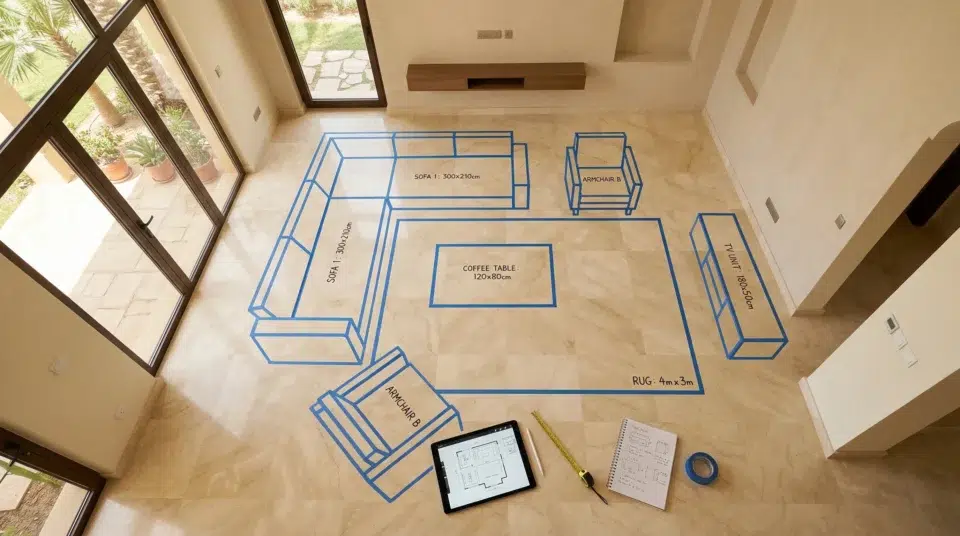
Tip 1: Use masking tape on your floor. Before you buy anything, use masking tape to mark out the exact footprint of the furniture you’re considering on your floor. Live with it for a day or two. Walk around it. Sit where the sofa would be. This single step prevents more regret than anything else we can suggest.
Tip 2: Plan for the furniture you’ll add later. Many UAE families furnish in stages — a sofa now, a dining set in a few months, a home office setup next year. Plan the whole room before you buy the first piece. Leaving space for a bookcase you haven’t bought yet is much easier than trying to squeeze one in after the fact.
Tip 3: Think about the morning and evening light. The quality of natural light in a UAE apartment changes dramatically throughout the day. If you can, visit your room at different times before finalising furniture placement. A dining table placed to catch morning light through an east-facing window turns an ordinary breakfast into something pleasant. Equally, a TV placed where it catches afternoon sun from a west-facing window will be unwatchable from 3pm onwards.
Tip 4: Allow extra clearance in high-traffic family areas. The 90 cm minimum clearance figure assumes a calm adult walking through. In reality, UAE family homes are busy places — children running, visitors arriving in groups, domestic helpers carrying laundry. In main corridors and living areas, 110–120 cm is the more realistic functional minimum.
Tip 5: For villas, think about how rooms connect. Many UAE villas have large, open-plan ground floors where the reception, dining area, and kitchen flow into one another. Furniture planning in these spaces isn’t about individual rooms — it’s about zones. Define each zone with an area rug of appropriate size (the rug should be large enough that all key furniture legs sit on it), and use furniture scale to signal the transition between zones without physical barriers.
Tip 6: When in doubt, go slightly smaller. In our experience, families consistently underestimate how much clear floor space improves daily life. A sofa that’s 20 cm shorter than the maximum that would fit creates a room that feels more spacious, more comfortable, and easier to clean. You can always fill a room, but you can’t expand its walls.
Tip 7: Revisit measurements after any major building work. If you’ve had a bathroom extension, a kitchen renovation, or any structural work done, re-measure everything. Walls in UAE buildings are sometimes thickened by tile and plaster work during renovations, and a doorway that was 95 cm wide before work can emerge at 88 cm — wide enough for people, not necessarily for your new three-seater sofa.
A Note on Buying Furniture Online vs. In-Showroom for UAE Homes
Online furniture shopping has grown significantly in the UAE over the past several years, and we understand why — it’s convenient, it’s fast, and you can browse at midnight after the children are in bed. But there’s a genuine limitation to buying furniture online without seeing it first, and it’s worth being honest about.
Photography flattens dimensions. A sofa that looks large and generous in a product image can arrive and feel compact in your actual space, or vice versa. Fabric colours shift significantly depending on screen calibration and photography lighting. A “dark grey” on screen can be almost charcoal, or it can have noticeable blue undertones that clash with your existing palette.
For this reason, our recommendation for significant purchases — sofas, bed frames, wardrobes — is to see the piece in person at least once, even if you ultimately order online for convenience. Bring your measurements with you. Bring paint samples or fabric swatches from your existing pieces. Sit on the sofa. Open the wardrobe doors. Feel the drawer action. These are things a product page simply cannot tell you.
For smaller pieces — side tables, desk chairs, dining chairs when you’ve already seen the matching table — online shopping works well, provided you have your measurements and you’re confident in the dimensions shown.
Conclusion: Measure Once, Furnish Right
Getting your room measurements right before you shop isn’t about being overly cautious — it’s about respecting both your money and your home. A room that’s been thoughtfully planned, where furniture fits the space and suits the life lived in it, feels qualitatively different from one that was assembled piece by piece without a plan. You feel it the moment you walk in.
The families we’ve helped furnish their homes over the past 35 years — in Dubai, Abu Dhabi, Sharjah, Ajman, Ras Al Khaimah, and across the UAE — all have different homes, different tastes, and different budgets. What they have in common is that the ones who measured carefully and planned properly ended up happier with their choices. Every time.
Take the 30 minutes to measure properly. Sketch your floor plan. Tape it out. Then come and see us.
Key Takeaways:
- Measure your room’s full dimensions including ceiling height, door width, delivery path, and the position of AC units and sockets — not just floor area.
- Always plan for clearance space, not just furniture footprint: 60 cm beside beds, 90 cm around dining tables, 100 cm for main traffic flow, and more in busy family homes.
- Use masking tape to mark out furniture footprints on your floor before purchasing — this single step prevents more regret than anything else.
Ready to Find the Right Furniture for Your Home?
At Karnak Home, our showroom team is trained to help UAE families plan spaces properly — not just sell furniture. Bring your measurements, your floor plan sketch, and your questions. We’ll help you figure out what works for your specific home, your family’s lifestyle, and your budget. Whether you’re furnishing a new apartment in Business Bay, a villa in Mirdif, or a family home in Sharjah, we’ve seen it before and we know what works.
Shop Online: karnakhome.com Visit Our Showroom: [Karnak Home Showroom Address, Dubai, UAE] Speak to Our Team: [Phone Number]
Related Articles:
- How to Choose the Right Sofa Size for Your UAE Living Room
- The Best Wardrobe Solutions for UAE Apartments: Sliding vs. Hinged Doors
- How to Plan an Open-Plan Living and Dining Space in Dubai
- Kids’ Bedroom Furniture Guide: Safe, Durable Choices for UAE Families
Ready to Measure and Shop the Right Furniture for Your UAE Home?
You’ve now learned exactly how to measure your living room, bedroom, and dining areas, including clearances for sofas, beds, coffee tables, TV units, and wardrobes, to ensure a perfect fit in Dubai apartments, villas, and majlis spaces while navigating lifts, corridors, and AC constraints. Explore our quality collections designed for UAE homes, with expert guidance available for measurements and installation.
- → Living Room – Complete living room furniture, including sofas, coffee tables, and TV units sized perfectly for measured UAE open-plan and apartment spaces
- → Sofas – 2-seater, 3-seater, L-shape, and corner sofas with accurate dimensions for your measured wall lengths and traffic flow
- → Corner L-Shape Sofas – Spacious L-shaped sofas ideal for measured family villas and majlis areas in Dubai and UAE homes
- → Coffee Tables – Stylish coffee tables in proportions that match your sofa measurements and family clearance needs
- → TV Media Units – TV units and consoles sized correctly for your measured wall and eye-level viewing height
- → Bedroom – Quality bedroom furniture, including beds and storage solutions with proper clearances for UAE apartments and villas
- → Bedroom Sets – Complete bedroom packages featuring beds and wardrobes that fit your measured room dimensions
- → Wardrobes – Sliding and hinged wardrobes in depths (55–65 cm) suited to compact apartments and family bedrooms
- → Dining Tables – Dining tables and chairs with seating widths and clearances tailored to your measured dining area
- → Home Furniture – Full home collection built to UAE standard sizes and family living requirements
- → Furniture Packages – Complete room packages with coordinated pieces that respect your precise room measurements
💬 Get Free Consultation on WhatsApp Shop All Living Room Now →