
Picture this: you have just collected the keys to your new villa in Arabian Ranches, or perhaps your lease in Business Bay has finally allowed you to stop renting furnished. The dining room is bare, the living area needs a storage anchor, and you are staring at hundreds of options online, wooden buffets, high-gloss sideboards, open-shelf units, slim cabinets, each one marketed as perfect for UAE homes. Yet none of the product descriptions tell you whether that piece will warp in Dubai’s humidity, fit through a JLT apartment door, or survive the way a UAE family actually lives: children doing homework at the dining table, guests arriving on short notice for a Friday majlis, and a domestic helper moving furniture during weekly deep cleans.
Karnak Home has been delivering furniture across the UAE since 1988. In those 36 years, we have completed more than 70,000 home furnishing journeys, from compact studio apartments in International City to sprawling family villas in Mirdif, from newly married couples in Al Furjan to multigenerational households in Sharjah and Ajman. Our delivery teams have navigated lifts in Downtown Dubai towers that are exactly 90 cm wide, stairwells in Abu Dhabi villas that bend at impossible angles, and master bedrooms in Palm Jumeirah residences where the owner changed their mind three times before the unit touched the floor. We have seen what works and, more importantly, what breaks, physically, aesthetically, and financially.
This guide is your single, authoritative resource on buying buffets and sideboards for UAE homes in 2026. We cover every dimension that matters: which sizes suit which apartment or villa type, which materials survive the Gulf climate without fading or swelling, which finishes complement both Arab-traditional majlis corners and contemporary open-plan dining rooms, and which mistakes cost UAE buyers hundreds of dirhams every year. By the time you finish reading, you will know exactly which buffet belongs in your home, what to pay for it, and how to make it last for the next decade in this beautiful, demanding climate.
Why Buying a Buffet in Dubai Is Completely Different from Anywhere Else
If you have ever browsed UK furniture websites or scrolled through American interior design feeds searching for sideboard ideas, you already know the disconnect. The rooms look nothing like yours. The proportions feel wrong. The advice ignores the facts of life in the UAE: extreme summer heat, an almost entirely renting population, furniture that must move every two or three years, families that span multiple cultures under one roof, and dining rooms that double as entertainment spaces for 20 guests on Eid weekend.
The Renter Reality and What It Means for Buffet Buying
Approximately 78 percent of UAE residents rent their homes. That single statistic changes everything about how you should approach a buffet purchase. Renters in JVC, Jumeirah Village Triangle, and Discovery Gardens need furniture that is modular enough to fit a new layout, neutral enough to work across two or three different apartment colour schemes, and robust enough to survive a professional moving company loading it into a truck without wrapping it in a dozen blankets. A buffet you buy in 2026 must still look good and stay structurally sound in your next home in 2028 or 2029.
This means you should prioritise solid or engineered wood frames over MDF-only construction, choose finishes in warm neutrals (walnut, white, light oak, stone grey) rather than bold statement colours, and always verify the disassembly options before purchasing. At Karnak, our buffets and sideboard collection includes pieces specifically designed with removable legs and bolt-through panel systems that survive multiple UAE relocations without loosening.
Apartment Dimensions Across Dubai and the UAE Measurements You Actually Need
The average one-bedroom apartment in Business Bay measures roughly 65 to 75 square metres. A two-bedroom in JLT typically runs 90 to 110 square metres. Villas in Arabian Ranches and Al Furjan vary enormously from 200 to 600 square metres, but the dining room rarely exceeds 20 to 25 square metres even in a four-bedroom unit.
For apartments, a buffet between 120 cm and 150 cm wide with a depth of 35 cm to 40 cm is almost always the safe choice. It provides real storage without blocking walkways. For villa dining rooms, pieces from 160 cm to 200 cm wide feel proportionate and can store everything from extra crockery to children’s craft supplies in the drawers below. In smaller studio and one-bedroom units in International City or Al Nahda, Sharjah, a slim sideboard of 100 cm to 120 cm wide and just 30 cm deep is enough to function as both a storage unit and a visual divider between the living and dining zones.
The UAE Climate and Your Buffet’s Lifespan
Dubai averages 350 days of sunshine a year. Summer temperatures inside a west-facing apartment can push interior surfaces to 38 to 42 degrees Celsius without air conditioning running continuously. UAE humidity oscillates between 80 percent in summer and under 30 percent in winter, and that swing causes wood to expand and contract repeatedly across a 12-month cycle.
Poorly constructed buffets — those built from raw MDF without a proper moisture barrier or lacquer seal — absorb this humidity and begin to bow, bubble, or delaminate within 18 to 24 months. This is why we always recommend lacquered or UV-cured finishes for UAE homes, and why solid wood pieces should carry a minimum of two coats of oil or wax sealant on their interior shelves, not just the exterior faces.
The Majlis Crossover: When a Buffet Becomes the Centre of Hospitality
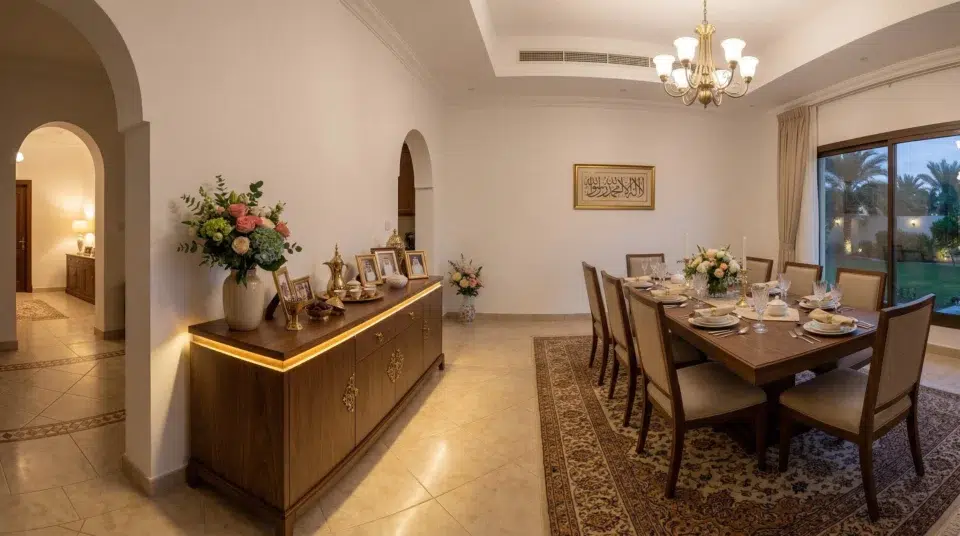
Emirati and Arab Gulf households treat the sideboard as a piece of active hospitality furniture, not passive storage. It holds the Arabic coffee service, the dates tray, the guest towels, and the premium incense accessories. For families in Abu Dhabi, Sharjah, and across the Northern Emirates, a buffet placed at the entrance to the majlis or along the primary seating wall must balance traditional warmth with functional depth — drawers wide enough for prayer accessories, surfaces solid enough to hold large silver trays, and aesthetics calm enough not to clash with geometric carpets and ornate cushion fabrics.
Our dining room storage solutions bridge this gap with designs that read as modern yet carry enough warmth in their wood tones and brass hardware to feel entirely at home in a traditional Gulf setting.
Expat Moves, Multigenerational Homes, and the 3-Year Furniture Cycle
The average expat family in Dubai moves once every two to three years. A Karnak delivery manager once told us that one Mirdif villa had received furniture deliveries from us four times across different tenant families in the same calendar year. This cycling of residents means UAE furniture must be universally appealing: a walnut sideboard that suits a Lebanese family in Jumeirah must also appeal to a British family in Emirates Hills and an Indian family in Dubai Silicon Oasis when it is resold or left behind.
Multigenerational households are common in Sharjah, Ajman, and across Abu Dhabi’s residential suburbs need buffets with deeper storage: at least two rows of shelving behind doors, ideally with adjustable shelf heights to accommodate everything from a grandmother’s china collection to a teenager’s board game stack.
H2 2: The Seven Main Types of Buffets and Sideboards for UAE Homes
Understanding what each type does and which UAE home it suits is the most important step in this buffet’s Dubai buying guide. Buying the wrong category of piece is the single most common and most expensive mistake UAE buyers make.
Classic Wooden Buffet Cabinet: The UAE Workhorse
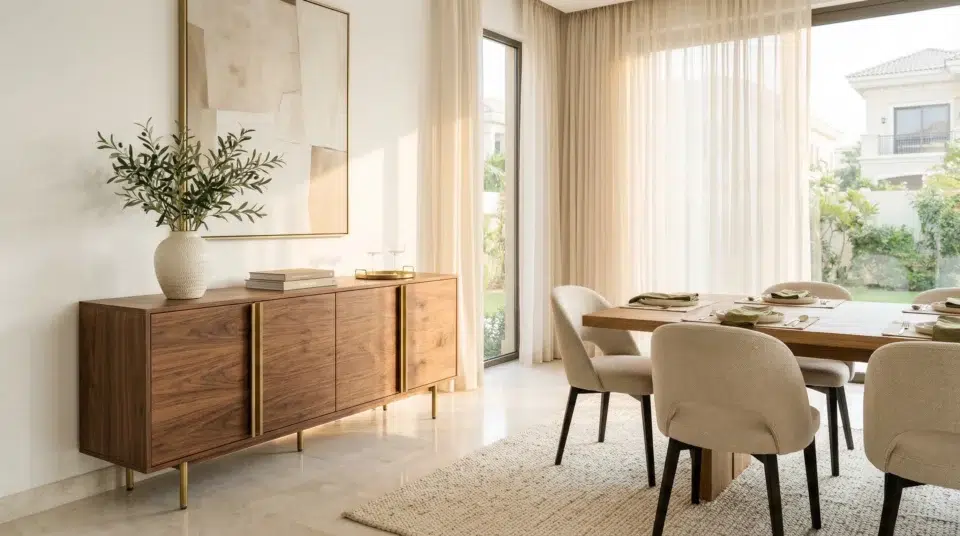
This is the most popular piece in the UAE market for good reason. A classic wooden buffet typically measures 150 to 180 cm wide, 80 to 90 cm tall, and 40 to 45 cm deep. It combines two or three doors with a central drawer bank, giving you enclosed storage below and a generous surface above for display or practical use.
In villa dining rooms in Arabian Ranches or Al Furjan, the classic wooden buffet anchors the room visually. Look for pieces with solid wood frames and engineered wood (high-density MDF) panels. This combination gives you the warmth and stability of real wood at a price that makes sense in a renter’s market. Pricing for quality pieces in this category ranges from AED 1,800 to AED 4,500, depending on the wood species, finish, and hardware detail.
High-Gloss Sideboard, Contemporary Apartments in JLT and Downtown Dubai
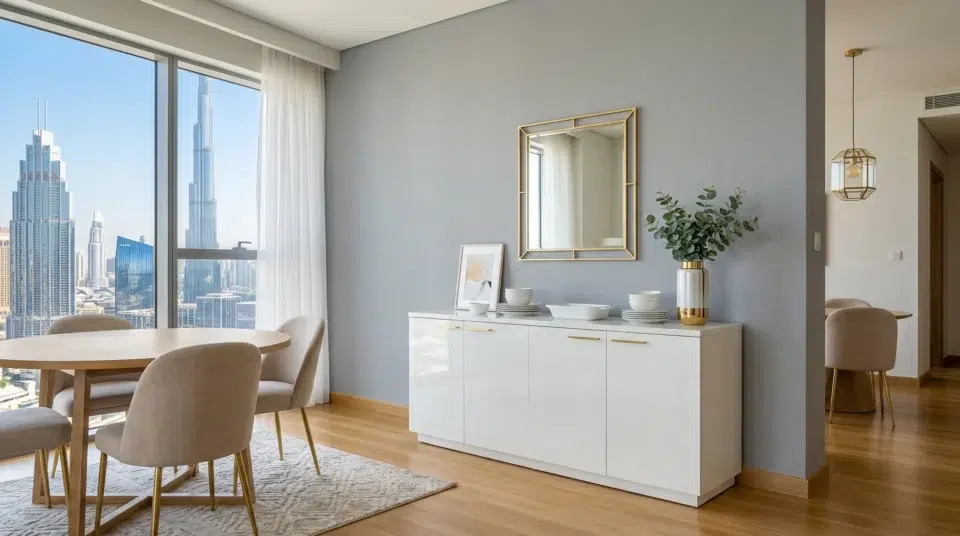
High-gloss finishes in white, anthracite, and champagne became the dominant aesthetic in UAE apartment developments between 2018 and 2024, and they remain extremely strong in 2026 for a simple reason: they reflect artificial light beautifully in rooms where natural light is limited. A JLT apartment facing north or east may receive direct sun for only a few hours each morning. A high-gloss sideboard bounces that light across the room, making the space feel larger and brighter.
Choose pieces with UV-protected lacquer rather than standard paint gloss. Standard gloss scratches under the repeated contact of cleaning products; UV lacquer holds its mirror finish for years, even with weekly wiping. Pricing for quality high-gloss sideboards sits between AED 2,200 and AED 5,500.
Explore our full range of modern sideboard furniture for Dubai homes to see the complete high-gloss collection.
Slim Sideboard, The Studio, and One-Bedroom Essential in International City and Al Nahda
A slim sideboard typically 100 to 130 cm wide and 28 to 35 cm deep, is purpose-built for compact UAE apartments. It performs two functions simultaneously: it stores everything from cutlery to router cables, and it acts as a room divider or visual break between zones in an open-plan layout.
In International City, Al Barsha, and the older apartment stock in Deira and Bur Dubai, hallways and dining alcoves are often no more than 180 cm across. A slim sideboard at 30 cm depth leaves a full 150 cm of clear passage, meeting Dubai’s fire safety guidance for residential corridors. At between AED 900 and AED 2,400, this is also the most budget-accessible format.
Open-Shelf Buffet: Display-Focused Living in Palm Jumeirah and Emirates Hills
An open-shelf buffet sacrifices the privacy of doors for the visual drama of full display. It suits homeowners who have a curated collection of ceramics, art objects, or barware they genuinely want to show. In Palm Jumeirah apartments and Emirates Hills villas — where interior design is often professionally managed and maintained — the open-shelf buffet creates a gallery wall effect at furniture scale.
The practical risk is dust, and in the UAE, dust is a constant reality. Open shelves in Dubai homes require weekly wiping rather than monthly. Choose lacquered or sealed shelves that repel fine desert dust rather than porous raw wood that traps it. Price range: AED 1,500 to AED 4,000.
Buffet with Mirror The UAE Space Multiplier
Attaching a vertical mirror to a buffet cabinet is a design move that originated in French provincial furniture but has found its truest home in UAE apartments, where maximising the perception of space is a constant objective. A 160 cm buffet with a 120 cm by 60 cm mirror panel above it effectively doubles the visual footprint of the piece, reflects natural light from a balcony door, and eliminates the need for a separate mirror purchase.
In Dubai Marina and Business Bay apartments, where floor plans are long and narrow, the buffet-plus-mirror combination creates a focal wall that anchors the dining area without requiring any additional furniture. Expect to pay between AED 2,800 and AED 6,500 for quality pieces in this format.
Hallway Sideboard First Impressions in Dubai Villas
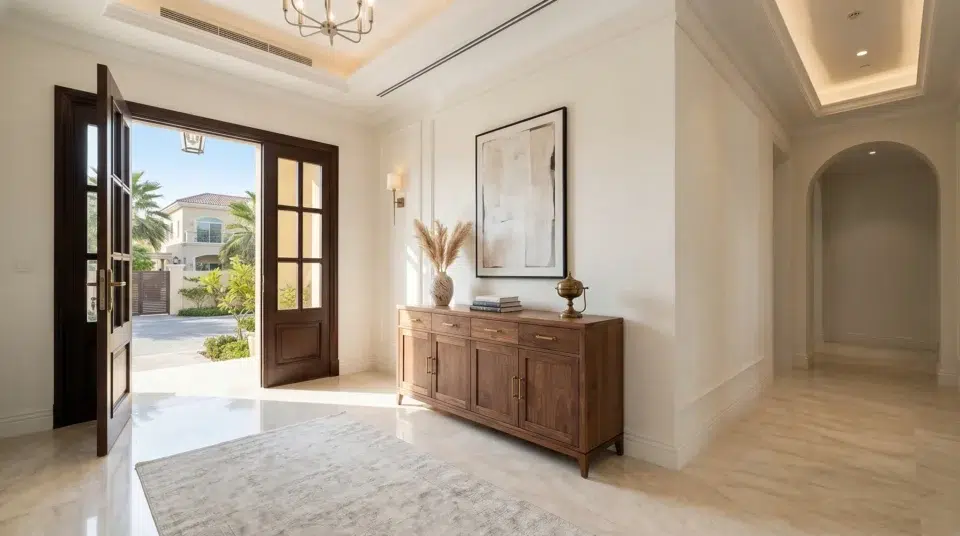
The entryway of a UAE villa is a social declaration. Guests in Arabian Ranches, Jumeirah Golf Estates, and DAMAC Hills see your hallway before they see anything else, and a well-chosen sideboard with a tray for keys, a vase for flowers, and closed storage for shoes and bags sets the tone for the entire home.
Hallway sideboards should be narrow (no more than 38 cm deep) to preserve the walking passage, and their height matters: 85 cm to 95 cm is ideal for placing items at adult standing height without bending. A drawer with a felt lining protects small valuables like keys, watches, and remote controls from the interior dust that accumulates even in UAE homes with excellent air filtration.
High-Capacity Dining Buffet Eid and Entertaining in Sharjah and Abu Dhabi Villas
For families who regularly host 15 to 30 guests, a common reality in Sharjah, Abu Dhabi suburbs, and across the Northern Emirates, the buffet doubles as a serving station on Eid, National Day, and during Ramadan Iftar gatherings. A high-capacity dining buffet typically measures 180 to 220 cm wide with a depth of 45 to 50 cm, providing enough surface area to lay out warming trays, a coffee station, and a dessert display simultaneously.
Look for pieces with heat-resistant surface finishes. Many standard lacquered MDF buffets cannot handle the continuous heat of warming trays placed directly on their surfaces. Our dining room buffet cabinets at Karnak include models with tempered glass inserts and ceramic-surface options specifically rated for hosting use.
2026 Trends That Actually Work in UAE Homes
Trend reports written for European or American markets are largely irrelevant to UAE buyers. A design direction that works in a Scandinavian home raw wood, low light, neutral grey throughout falls flat in a south-facing Dubai villa where every surface needs UV resistance, and the room is flooded with warm orange light for six hours each day. Here are the 2026 directions that genuinely function in the Gulf environment.
Fluted Panel Doors, Texture Without Pattern
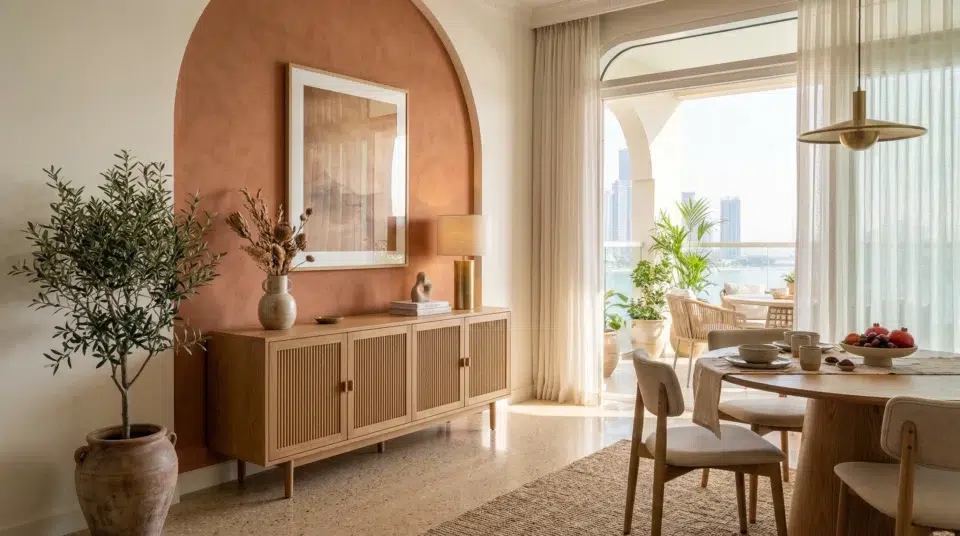
Fluted or ribbed door panels, vertical grooves pressed into MDF or routed into solid wood, add tactile and visual texture without introducing a pattern that clashes with UAE décor. They work equally well in front of a geometric Arabic tile feature and alongside a minimalist marble dining table. In 2026, fluted panels in warm oak, sand, and sage green are appearing in showrooms across Sharjah, Dubai, and Abu Dhabi, and they are selling faster than any other buffet style we have stocked in recent memory.
Warm Neutrals Replacing All-White: The End of the Sterile Kitchen Look
White high-gloss dominated UAE apartments for nearly a decade. It remains practically easy to clean, reflective, and universally appealing to landlords and future tenants. But the 2026 buyer is reaching for warmth: stone beige, warm linen, pale putty, and greige are now outselling pure white in our Sharjah showroom by a ratio of roughly three to two. These tones photograph beautifully in UAE light, age gracefully without showing yellowing, and coordinate naturally with both light marble flooring and the dark wood feature walls common in newer Dubai villa developments.
Mixed Metal Hardware, Brass, Black, and Satin Gold
Single-tone metal hardware, all chrome or all matt black, is giving way to considered mixing in 2026. A walnut buffet with satin brass cup handles and a black steel frame sits comfortably in a home that has both warm-toned pendant lights and a dark-framed balcony door. For UAE homes specifically, brass and gold tones carry cultural resonance: they echo the gold accents in traditional Gulf design and the warm light that defines the UAE living experience. Our sideboard Dubai living room collection reflects this shift with new hardware options across our 2026 range.
Integrated Lighting, LED Strips Inside Buffets
LED strip lighting inside glass-fronted buffet cabinets is no longer a luxury add-on it is becoming a standard feature in mid-range and above pieces. In UAE apartments where overhead lighting is often a single central fixture, in-buffet lighting provides ambient depth, makes the dining area feel designed rather than improvised, and allows you to display glassware or crockery with genuine drama. Look for pieces with dimmable, warm-white (2700K to 3000K) LED strips rather than cool white, which drains warmth from the room at night.
The Return of the Low, Wide Sideboard: Japanese Influence in UAE Interiors
The low sideboard typically 55 to 70 cm in height rather than the standard 80 to 90 cm, creates a horizontal visual line that makes ceilings feel higher, and rooms feel calmer. In UAE apartments where ceilings are often set at exactly 2.7 metres (a near-universal standard in Dubai and Abu Dhabi residential construction), a low sideboard positions your display and storage 20 to 30 cm below the eye line of a standing adult, allowing wall art and mirrors above it to read clearly. This proportion is borrowed from Japanese tansu furniture traditions and is landing extremely well in the modern UAE market.
Sustainability Signals Reclaimed Accents and FSC-Certified Wood
UAE consumers in 2026 are increasingly asking about the provenance of their furniture’s timber. FSC certification (Forest Stewardship Council) is becoming a meaningful purchase driver, particularly among expat buyers from Europe and Australia. Reclaimed wood accents a live-edge detail on a buffet top, or reclaimed teak drawer fronts on an engineered wood carcass, satisfy this desire for authenticity without requiring the buyer to pay the premium of an entirely solid-reclaimed piece. If sustainability matters to your household, ask your retailer specifically about certification; it is a question we at Karnak take very seriously.
Materials and Fabrics Built for the UAE Climate
The UAE climate is a buffet’s toughest test. Direct sun, fluctuating humidity, fine dust, air conditioning running for nine months of the year, and the repeated thermal shock of stepping from a 45-degree exterior into a 20-degree interior; all of these stresses are unique to the Gulf region and demand specific material choices.
Solid Wood: The Premium Long-Term Choice
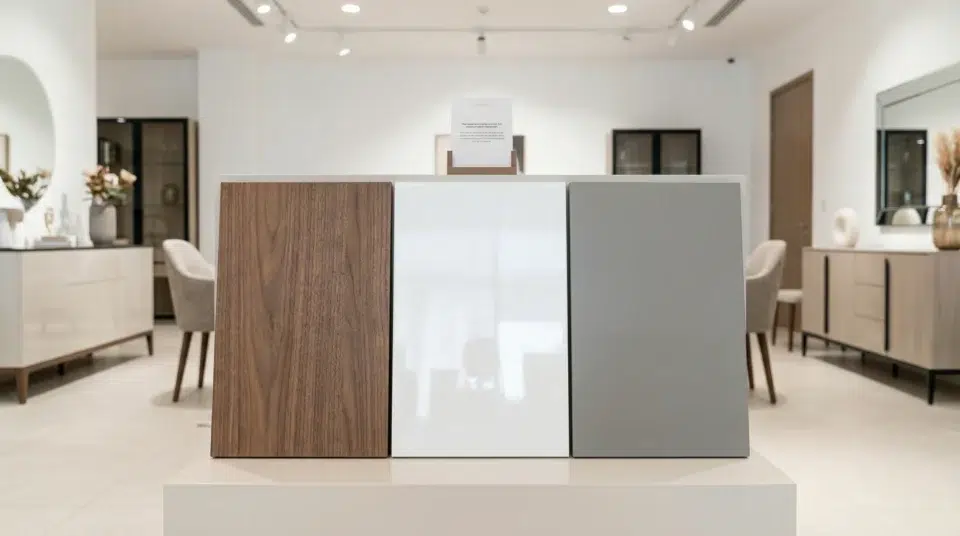
Solid wood buffets, teak, oak, acacia, and rubberwood are the most durable options for UAE homes, but they require the most care. In a climate with extreme humidity swings, all-solid-wood pieces need to be kept in air-conditioned rooms continuously. A solid teak buffet stored in a garage or covered parking area during a move will absorb moisture and expand visibly. Inside a temperature-controlled home, solid wood is essentially indestructible: it can be sanded, re-oiled, and refinished every few years, effectively giving you a new piece at the cost of an afternoon of light maintenance.
Teak is the superior choice for UAE conditions because it contains natural oils that resist the drying effect of UAE winters (when indoor humidity can drop below 25 percent) and repel moisture during humid summers. Expect to pay AED 4,500 to AED 12,000 for a quality solid teak or oak buffet.
Engineered Wood and Quality MDF, The Smart Middle Ground
Engineered wood (HDF and quality MDF panels bonded to real wood veneers) is the backbone of the UAE furniture market. When made to a high standard, with moisture-resistant glue lines, a minimum 18 mm panel thickness, and UV-lacquered or melamine-wrapped surfaces, it outperforms cheap solid wood in stability, resisting warping even when the AC cycles off overnight. The veneer surface gives you the visual warmth of real wood without the price premium.
The keyword here is quality. Thin MDF (below 12 mm) with paper foil wrapping instead of real veneer will delaminate within two summers in UAE conditions. Always ask for the panel thickness and finishing specification before purchasing. Our best buffet tables UAE 2026 range uses only 18 mm and above MDF with real wood veneer or multi-layer lacquer finishes across all pieces.
Metal Frames and Legs, Heat, Rust, and the Right Choice
Metal legs and frames add structural integrity and visual lightness to buffet cabinets. In the UAE, the choice of metal finish matters more than in cooler climates. Powder-coated steel resists the surface oxidation that can occur in coastal areas like Dubai Marina, JBR, and along Abu Dhabi’s Corniche, where salt air is a factor. Electroplated brass and chrome finishes are beautiful but require monthly polishing in coastal environments to prevent micro-pitting.
Satin brass a slightly matte version of the traditional bright brass finish, has emerged as the most maintenance-friendly luxury option for UAE homes. It ages gracefully, does not show fingerprints as readily as mirror-polished brass, and coordinates with both warm and cool interior palettes.
Glass Inserts and UV Exposure in UAE Homes
Glass-fronted buffets, whether with clear, fluted, or smoked glass panels, are popular in UAE homes because they allow display while providing dust protection. In rooms with significant UV exposure (south or west-facing windows without solar film), ordinary clear glass will not protect the items inside from fading. If you have a south-facing dining room in a Dubai villa or a sun-drenched apartment in Jumeirah, specify tempered glass with a UV inhibitor coating. This is a detail rarely mentioned in standard product descriptions but critically important for protecting your crockery, glassware, and decorative objects over a five to ten year period.
Pet and Child Safety in UAE Households
UAE families with pets or young children need to think carefully about surface finishes and hardware. Sharp-edged cup handles at child height are a genuine injury risk. Soft-close drawer mechanisms are not a luxury in a home with toddlers, they are a safety requirement. For households with dogs or cats, choose finishes with a hardness rating above 2H on the pencil hardness scale: this rules out most flat-paint finishes and favours lacquered or polyurethane-coated surfaces that resist both scratch marks from paws and crayon scribbles from curious children.
Eight Mistakes UAE Buyers Make When Buying a Buffet in 2026
This is one of the most searched topics in our customer service inbox: people writing to us weeks after delivery, asking whether something can be fixed. In almost every case, the problem traces back to one of these eight preventable errors.
Mistake 1: Buying Without Measuring the Room AND the Lift
We deliver furniture across Dubai, Abu Dhabi, Sharjah, and Ajman every day, and the single most heartbreaking scenario our drivers encounter is a beautiful buffet that physically cannot enter the lift. Standard residential lifts in older Dubai apartment buildings (particularly in Deira, Bur Dubai, and parts of Al Barsha) have interior dimensions as small as 90 cm by 110 cm. A 180 cm wide buffet that is shipped as a single unit will not fit. Always measure your lift’s interior width and height before purchasing any piece wider than 120 cm. If your piece must be shipped disassembled, confirm this with your retailer before ordering.
Fix: Measure the lift interior (width, depth, height), the stairwell width on every floor, and your doorway width, including the door frame. Give these measurements to your retailer before finalising your purchase.
Mistake 2: Choosing Finish Based on Showroom Lighting
Showrooms are lit to make every piece look its absolute best. Cool white spotlights make high-gloss finishes gleam. Warm amber downlights make walnut veneers glow with richness. Your home has completely different lighting, and a finish that looks stunning in a Sharjah showroom may appear flat or yellowed under the overhead fluorescent strip light common in older UAE apartments.
Fix: Request a finish sample and take it home. Place it in your actual room, in daylight and under your evening lighting, for at least one full day before committing.
Mistake 3: Ignoring the Weight of What Will Go Inside
A 160 cm buffet with three shelves behind two doors will hold a very large amount of weight when fully loaded. Crockery, serving dishes, bottles of water, spare linens, children’s games: these items are heavier than they seem. Cheap shelf brackets and thin shelf material will bow noticeably within six months under this load. The standard test is simple: check the stated shelf load rating. Any shelf in a dining buffet should carry at least 15 kg per shelf without deflection.
Fix: Ask specifically for the shelf load rating. For heavy crockery or appliance storage, choose shelves of a minimum of 18 mm solid MDF or particleboard with central support brackets.
Mistake 4: Buying a Size That Suits the Room but Not the Wall
A 200 cm buffet looks perfectly proportionate in a large villa dining room — until you place it against the only available wall, which also contains a door frame, a light switch, a power socket, and an air conditioning return vent. UAE villa dining rooms are rarely as open as they appear in floor plans: there is always an obstruction you did not anticipate. Always identify the exact wall where the buffet will stand, photograph it, and mark every obstruction before choosing your width.
Fix: Photograph your target wall and mark every obstacle with a piece of painter’s tape at actual height and width. Then measure your desired buffet size against those marks before purchasing.
Mistake 5: Overlooking Assembly Instructions Until Delivery Day
UAE furniture buyers frequently order online and then discover on delivery day that their chosen piece requires two hours of assembly, tools they do not own, and a second person to hold panels while bolts are tightened. In our experience, this is especially common with flat-pack pieces ordered from international platforms without local UAE assembly support.
Fix: Confirm at the point of purchase whether assembly is included. At Karnak, our free installation service covers all pieces — our team installs, levels, and places every item before leaving your home.
Mistake 6: Choosing a Buffet Without Considering the Flooring
Rubber or felt feet that perform well on ceramic tile — the most common UAE apartment floor — may scratch polished marble, which is common in Abu Dhabi and higher-end Dubai villa developments. Conversely, a buffet with small metal glide feet will indent soft vinyl flooring, which is increasingly common in newer Dubai apartment builds.
Fix: Check your flooring type and ask your retailer which foot type suits it. Self-adhesive felt pads are an inexpensive and effective solution for tile and marble, but they need replacing every 12 to 18 months in UAE conditions as the adhesive dries out in the heat.
Mistake 7: Buying Before Deciding on a Dining Table
This sounds obvious, but we see it frequently. A buyer purchases a buffet in a warm walnut tone, then buys a dining table three weeks later and discovers the table is a cooler, greyer wood. The tones clash. In a small apartment dining area, two competing wood tones in the same room create visual discomfort that no amount of styling will fully resolve.
Fix: If possible, shop for your dining table and buffet on the same visit, or at a minimum, bring a photo of one when purchasing the other. Our showroom in Industrial Area, Sharjah, holds both categories side by side precisely so you can coordinate.
Mistake 8: Neglecting the Service Cable and Socket Reality
UAE apartment walls are generously supplied with power sockets, but their positions rarely align perfectly with where furniture buyers want to place pieces. A buffet with an LED-lit interior or a drawer with USB charging built in requires a nearby socket. In older buildings across Deira, Al Qusais, and Sharjah, sockets may be low on the wall and directly behind where the buffet would sit, making them inaccessible after the piece is placed.
Fix: Before delivery, check all socket positions on your target wall. If access will be blocked, have an electrician relocate the socket plate to a convenient height, typically 40 to 50 cm above floor level, or choose a buffet with rear cable management channels that allow socket access even when the piece is against the wall.
2026 Budget Guide in AED
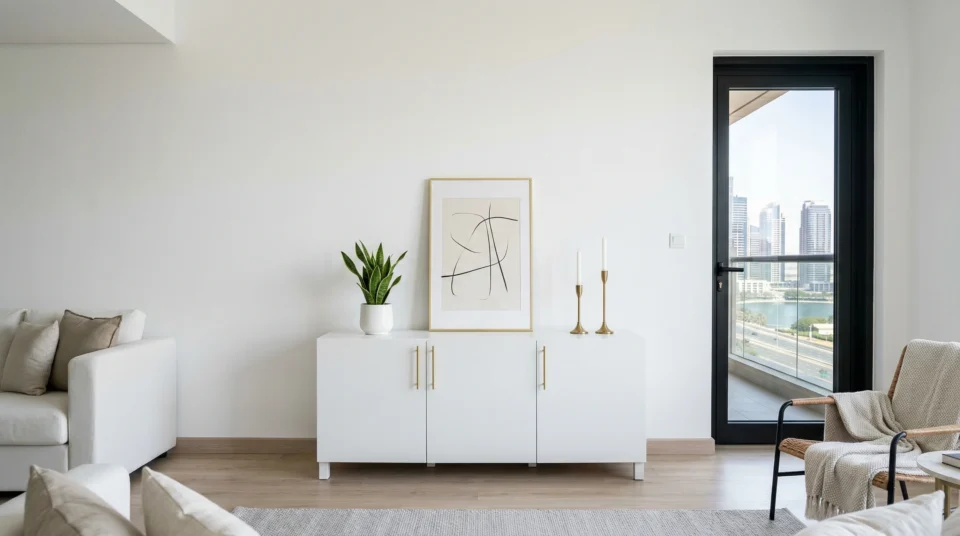
| Budget Tier | Piece Type | AED Range | Best For |
|---|---|---|---|
| Entry | Slim MDF sideboard, melamine wrap, basic handles | AED 750 to AED 1,800 | Studios, one-bedroom apartments in International City, Deira, Al Nahda |
| Mid-Range | Engineered wood buffet with veneer, soft-close drawers, quality hardware | AED 1,900 to AED 4,500 | Two and three-bedroom apartments in JLT, JVC, Business Bay, Al Barsha |
| Premium | Solid wood or high-grade veneer, UV lacquer, brass hardware, LED lighting | AED 4,600 to AED 12,000 | Villas in Arabian Ranches, Mirdif, Al Furjan, Palm Jumeirah apartments |
What the Entry tier gives you: Functional storage, clean aesthetics, and the flexibility to upgrade when your budget grows. Not designed for heavy crockery loads or frequent moves — use this tier for items like linens, stationery, and lightweight accessories.
What the Mid-Range tier gives you: This is the UAE buyer’s sweet spot. Properly constructed mid-range pieces from quality retailers last seven to ten years with normal care, survive multiple UAE moves, and provide genuine storage capacity for a family’s full dining and living room needs.
What the Premium tier gives you: Investment-grade furniture that increases in warmth and character as it ages. Appropriate for homeowners (not renters), long-term UAE residents, or buyers who want to furnish once and not revisit the decision for a decade or more.
For every tier, Karnak offers free delivery across Dubai, Sharjah, Abu Dhabi, Ajman, and Ras Al Khaimah, plus free installation by our trained assembly team. Browse the full range across all price points at our buffet furniture online UAE store.
Ten Expert Tips from 36 Years of UAE Deliveries
In our 36 years of delivering and installing furniture across the UAE, we have accumulated a set of truths about this specific market that no international buying guide will ever tell you. Here are the ten we return to most often.
Tip 1: Always order in March or September. These are the quietest delivery periods in the UAE furniture calendar, meaning you get faster scheduling and our installation teams have more time to spend on levelling and finishing.
Tip 2: In our 36 years we have seen that the most regretted purchases are always the ones bought on impulse during sale events. A buffet is a long-term investment. Take the time to measure, sample, and coordinate before buying.
Tip 3: If your apartment building has narrow lifts, always call ahead. Our team will tell you within two minutes whether your chosen piece can be delivered intact or needs to come in panels.
Tip 4: Never place a buffet directly against an exterior wall that is not insulated or does not have a vapour barrier. In older buildings in Bur Dubai and parts of Sharjah, exterior walls can transmit moisture during summer. Leave a 2 to 3 cm gap between the back of the buffet and the wall for air circulation.
Tip 5: In our 36 years, we have seen that white high-gloss finishes show yellowing most noticeably in UAE homes where the piece receives three or more hours of direct southern sunlight each day. Orient your buffet so it does not face a south-facing window directly.
Tip 6: A sideboard placed in a hallway should clear the skirting board by at least 1 cm on each side to allow the piece to sit flush without rocking. Many UAE villas have skirting tiles rather than wood skirtings, and these extend 8 to 10 mm from the wall; always account for this when measuring depth.
Tip 7: Our delivery records show that Dubai Marina and JBR addresses have the highest incidence of salt-related surface wear on metal hardware. If you live within 500 metres of the sea, apply a thin coat of clear paste wax to all metal hardware every six months.
Tip 8: For Ramadan and Eid entertaining, plan your buffet surface space at 60 cm per serving station. A 180 cm buffet top comfortably holds three stations: drinks, savouries, and sweets, perfect for a standard UAE family gathering of 20 to 30 guests.
Tip 9: In our 36 years, we have seen that the best way to protect a buffet’s surface during a UAE move is a purpose-made felt moving blanket combined with a hard foam corner guard. Never use newspaper or thin bubble wrap against lacquered surfaces — the ink and thin plastic can bond to the surface in the UAE heat and leave permanent marks.
Tip 10: If you are choosing a buffet for a room that will also serve as a home office (common in Dubai apartments post-2020), choose a piece with at least two deep drawers (minimum 10 cm internal depth) to accommodate A4 files and laptop accessories. The best dining room storage pieces double comfortably as hybrid work storage without looking like office furniture.
H2 8: Frequently Asked Questions About Buffets in the UAE
FAQ 1: What is the difference between a buffet and a sideboard?
In practice, the terms are used interchangeably across the UAE furniture market. Technically, a sideboard is a lower, longer piece designed for formal dining rooms, often with a serving surface at standing height. A buffet is typically taller (above 85 cm) and was historically used as a food serving station in dining rooms. In the contemporary UAE market, both terms refer to the same category of storage furniture: a horizontal cabinet with doors, drawers, or a combination, placed against a dining or living room wall. At Karnak, we use the terms interchangeably in our buffets and sideboards for UAE homes collection. What matters is the dimensions, finish, and function not the label.
FAQ 2: What size buffet suits a standard Dubai two-bedroom apartment?
For a two-bedroom apartment in Dubai, typically 85 to 110 square metres, common in JLT, JVC, Business Bay, and Dubai Hills a buffet between 140 cm and 160 cm wide, 80 to 90 cm tall, and 38 to 42 cm deep is the most versatile choice. This size provides genuine storage without dominating the room, fits comfortably against the primary dining wall, and proportionally balances a standard 160 cm to 180 cm dining table placed in the centre of the room. Always confirm your wall length minus door frames, skirting tiles, and any architectural protrusions before ordering. Our team can advise on specific dimensions for your layout via WhatsApp at +971 58 908 8107.
FAQ 3: How much should I spend on a buffet in the UAE?
The right budget depends on your tenure in the UAE and the role the piece plays in your home. If you are on a two-year contract and renting a furnished apartment in Dubai, an entry-level piece at AED 750 to AED 1,800 makes financial sense. If you are a long-term UAE resident furnishing a villa you own or plan to rent for five or more years, investing AED 3,500 to AED 6,000 in a quality mid-to-premium piece will cost you less per year of use than repeatedly replacing budget items. Our buffet price UAE guide covers every budget with clearly stated quality specifications for each tier.
FAQ 4: Does Karnak deliver buffets across the UAE?
Yes. Karnak delivers and installs across Dubai, Sharjah, Abu Dhabi, Ajman, Ras Al Khaimah, Fujairah, and Umm Al Quwain. Our free delivery and free installation service covers the entire UAE. Delivery times vary by emirate, typically one to three business days for Dubai and Sharjah, two to five days for Abu Dhabi and the Northern Emirates. Our installation team arrives with all necessary tools, assembles your piece, levels it to your floor, and removes all packaging. Contact us at +971 58 908 8107 to confirm delivery timelines for your location.
FAQ 5: Which buffet finish is best for a UAE home with young children?
For families with children under ten, we consistently recommend a matte or satin lacquered finish in a mid-tone colour: warm linen, stone beige, or soft grey. Gloss finishes are beautiful but unforgiving — every fingerprint, crayon mark, and toy scrape shows clearly. Matte lacquer in a mid-tone conceals daily wear far better while still being wipeable with a damp cloth. Avoid flat paint finishes: they are not durable enough for children’s contact. Hardware should have no sharp edges; specify T-bar or recessed handles rather than pointed or angular cup handles at child height. Our child-safe range within our modern buffet furniture Dubai selection flags these specifications clearly.
FAQ 6: Can I use a sideboard as a TV unit in a UAE apartment?
Many UAE apartment owners do exactly this, and in compact one and two-bedroom layouts it is an excellent space-saving strategy. A sideboard at 50 to 55 cm height is low enough to position a 55-inch television above it on the wall at the correct viewing angle for a seated sofa position (screen centre at approximately 110 to 120 cm from the floor). The sideboard below provides storage for media accessories, game consoles, and router equipment. Ensure the piece is at least 40 cm deep to accommodate the wall bracket footprint and any media boxes placed on top. We have a full comparison article on the TV unit versus buffet debate on our blog that addresses this question in detail.
FAQ 7: What is the best buffet material for a Dubai Marina or JBR apartment?
Coastal proximity is a real factor in material selection for Dubai Marina, JBR, Palm Jumeirah, and Abu Dhabi’s Corniche area apartments. Salt air present even in air-conditioned interiors through ventilation systems accelerates the oxidation of bare metal and can cause surface bubbling on poorly sealed lacquered finishes over a five to seven-year period. For coastal UAE locations, choose: UV-cured lacquer or polyurethane topcoats (not standard air-dry paint), powder-coated or satin-treated metal hardware (not bare brass or chrome), and engineered wood panels with moisture-resistant E1 or E0 formaldehyde-free glue lines. Our delivery records from Dubai Marina confirm that pieces meeting these specifications perform without any finish degradation even after eight or more years in coastal apartments.
FAQ 8: How do I style a buffet for UAE entertaining?
UAE hospitality culture calls for a buffet surface that is both functional and visually welcoming. The standard Karnak recommendation for styling a dining buffet for guests is the rule of thirds: divide your surface into three zones. The left third holds a practical element (Arabic coffee service, a candle, a tray of dates). The central third holds a statement decorative piece (a tall vase, a sculptural object, a framed print). The right third holds another practical or seasonal element. Keep the surface no more than 60 percent filled: negative space communicates calm confidence, which is the aesthetic signature of the best UAE homes. For Ramadan and Eid, replace one practical zone with a themed hospitality tray. For more inspiration, explore our buffet storage ideas UAE apartments styling section.
Conclusion
The right buffet for your UAE home in 2026 comes down to three non-negotiable decisions: get the size right for your specific room and building access, choose a finish and material that suits your climate exposure and lifestyle, and set a budget that reflects how long you plan to stay in the UAE and how hard the piece will work for your family. A correctly chosen sideboard is one of the highest-value furniture investments a UAE household can make. It anchors the dining or living room visually, solves the storage chaos that every busy UAE family knows well, and adds genuine warmth to the spaces where your family spends its most important moments together.
UAE living is beautiful and demanding in equal measure. Limited square metres, a climate that tests every surface, a rental market that keeps you moving, and a family life rich with gatherings, guests, and the kind of generous hospitality that the Gulf does better than anywhere else in the world: all of these realities deserve furniture designed to match them. The pieces in this guide are not abstract design objects from a European catalogue. They are answers to the specific problems of UAE homes in 2026.
Visit our showroom at Industrial Area, Sharjah, open Saturday to Thursday, 9 AM to 9 PM, and bring your measurements. WhatsApp our team at +971 58 908 8107 with a photo of your room, and we will recommend the right piece, confirm delivery, and have it installed in your home within days.
Ready to Transform Your UAE Home?
Shop Buffets and Sideboards Online: Explore our full collection of buffets and sideboards for UAE homes
Visit Our Showroom: Industrial Area, Sharjah, UAE (Sat to Thu, 9 AM to 9 PM)
WhatsApp Us: +971 58 908 8107 (Measurements, swatches, booking)
Call: +971 58 908 8107
Related Articles
- TV Unit vs Buffet: Which One Does Your UAE Home Actually Need?
- Wood vs High-Gloss Buffets: A UAE Climate Comparison 2026
- Best Buffet Sizes for Dubai and Abu Dhabi Apartments
- Buffets Under AED 5000: The UAE Buyer’s Shortlist
- Seven Mistakes to Avoid When Buying a Sideboard in the UAE
Ready to Complete Your Perfect Dining Setup in Dubai?
Now that you know exactly how to choose a buffet or sideboard that survives UAE heat, fits your lift, and handles majlis crowds, pair it with matching pieces that deliver free delivery, free installation, and free consultation across Dubai, Sharjah & Abu Dhabi.
- → Buffets & Sideboards – Storage anchors built for UAE villas & apartments with exact lift-friendly sizes
- → Living Room Furniture – Full collections that match your new buffet for seamless open-plan Dubai homes
- → Dining Tables – Perfectly sized tables that complete your buffet for large family Eid gatherings
- → Coffee Tables – Matching centre & coffee tables that tie together your majlis-ready living area
- → Consoles – Slim hallway & entry consoles ideal for narrow Dubai villa entrances
- → TV Media Units – Wall-to-wall units that balance your buffet storage in modern apartments
- → Display Units – Open & glass display cabinets for Palm Jumeirah & Emirates Hills trophy homes
- → Center Tables – Low, wide centre tables that echo 2026 trends and pair beautifully with sideboards
- → Bookcases – Tall & low bookcases offering extra adjustable storage for multigenerational UAE families
- → Sofas & Loveseats – Corner & 3-seater sofas that create the full hospitality zone around your buffet
- → Accent Chairs – Stylish accent chairs that add the finishing touch to your new buffet corner
✅ Free Delivery • ✅ Free Installation • ✅ Free Consultation across the UAE
💬 WhatsApp Us Now – Mention “Buffet Guide” for priority help