
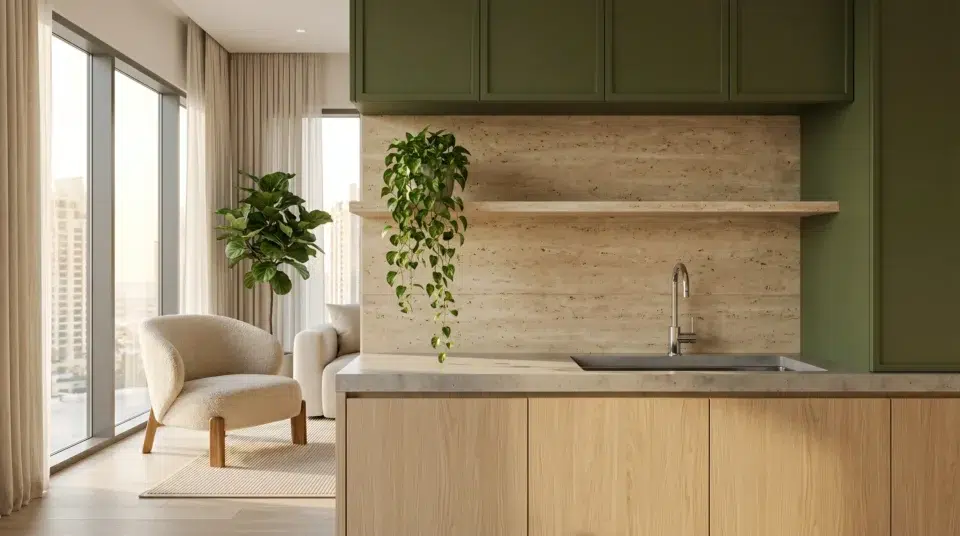
Every five years or so, something shifts in Dubai’s interior design conversation. The shift that is happening right now in 2026 is more significant than most. After more than a decade of cool whites, chrome finishes, and the relentless pursuit of that pristine show-apartment look, Dubai homeowners are moving decisively in a different direction. They want warmth. They want nature. They want technology that actually makes daily life easier in a city that is hot, dusty, and demanding. And they want all of this to survive a Gulf summer without fading, cracking, or requiring a specialist to maintain.
Karnak Home has been part of this conversation since 1988. We have furnished more than 70,000 UAE homes across Dubai, Abu Dhabi, Sharjah, Ajman, Ras Al Khaimah, Fujairah, and every community in between. From the Emirati family in Jumeirah upgrading their villa majlis to the British couple who just purchased their first apartment in JVC, from the Indian family renewing their long-term lease in Silicon Oasis to the design-forward young professionals in DIFC who want their 600-square-foot studio to feel like a boutique hotel: we see UAE home design evolving in real time, and what we are seeing in 2026 is genuinely exciting.
This guide will walk you through every significant renovation trend dominating Dubai interiors in 2026. More importantly, it will tell you which trends are worth investing in for the UAE climate specifically, which ones look beautiful on Instagram but fail in the Gulf heat and humidity, what each trend costs in AED, how to implement each one in both apartments and villas, and exactly how Karnak Home can help you achieve the result you want faster, with less stress and with products that perform for years in UAE conditions.
Why 2026 Is a Turning Point for Renovation Trends in Dubai
1.1: The Post-Minimalism Moment
The austere all-white-and-grey interiors that defined Dubai apartments from approximately 2014 to 2022 served a specific market moment: rapid turnover, landlord-neutral presentation, easy photography for short-term rental platforms. In 2026, the landscape has changed. Long-term residents who have chosen Dubai as a permanent home rather than a two-year posting want interiors that reflect personality, culture, and comfort. The renovation trends in Dubai 2026 are fundamentally about personalisation.
H3 1.2: Climate Awareness Is Now a Design Driver
UAE residents have always lived with extreme heat, relentless sun, and coastal humidity. What is new in 2026 is that these realities are explicitly shaping material and product choices at the design stage rather than being discovered as problems after installation. Renovation clients in Dubai Marina, Abu Dhabi’s Al Raha Beach, and Sharjah Corniche apartments are now asking about UV ratings, humidity resistance, and anti-dust surfaces before asking about colour. This is a meaningful maturation of the market.
1.3: Investment Mindset Among Dubai Property Owners
Dubai’s property market has delivered strong capital appreciation in most communities since 2021. In areas like Jumeirah Village Circle, Business Bay, Dubai Hills Estate, and Arabian Ranches, homeowners are now thinking about renovation as an investment strategy, not just a lifestyle choice. Renovation trends that increase rental yield, attract quality tenants and photograph well for listing platforms are gaining prominence over purely aesthetic choices.
1.4: The Emaar Community Aesthetic
The Emaar master-planned communities, including Dubai Hills Estate, Arabian Ranches, The Springs, The Meadows, The Lakes, and Emaar South, have their own distinct renovation culture. Villa owners in these communities tend to undertake more comprehensive renovation projects because they own rather than rent, have access to garden and outdoor spaces, and are part of communities where property presentation is a shared social norm. The 2026 renovation trends in these communities lean heavily toward indoor-outdoor continuity, natural material palettes, and the majlis-modern fusion aesthetic.
Trend 1 Biophilic Design Built for the UAE Climate
Biophilic design, the deliberate integration of natural elements into interior spaces, is the single biggest renovation trend in Dubai in 2026. But its application in the UAE is significantly different from how it manifests in cooler, more naturally green environments.
2.1: Why Biophilic Design Works Particularly Well in Dubai
There is a psychological logic to biophilic interiors that is especially powerful in a desert city. When the outdoor environment for five months of the year is functionally hostile to extended human exposure, the indoor environment takes on greater importance as a source of natural calm and sensory relief. Bringing nature inside a Dubai apartment or villa is not decoration. It is a genuine quality-of-life investment.
2.2: Plants That Survive UAE Indoor Conditions
The challenge with indoor plants in Dubai is the combination of air-conditioned-dried air, low natural humidity (except in coastal areas during summer), and the absence of natural sunlight in many north-facing UAE apartments. The indoor plants that perform reliably in UAE air-conditioned interiors are: snake plants (Sansevieria), ZZ plants, pothos, peace lilies, rubber plants, and the ever-popular fiddle-leaf fig in well-lit positions. Avoid plants requiring high humidity in rooms with aggressive air conditioning, and never place tropical plants near cooling vents.
2.3: Natural Materials as the Structure of Biophilic Design
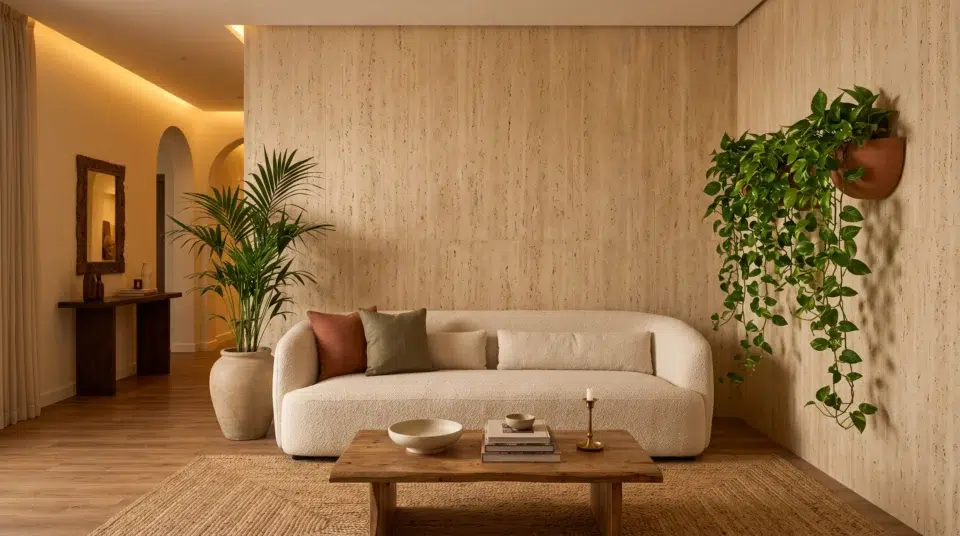
Beyond plants, biophilic design in 2026 UAE interiors relies on natural and natural-effect materials: travertine and limestone-effect surfaces, warm timber tones in furniture and flooring, woven natural fibres in rugs and cushions, and linen and cotton in curtain fabrics. Karnak Home’s curtains and blinds collection includes a range of natural linen and textured cotton options that bring biophilic warmth to UAE windows while providing the UV filtering and privacy that Dubai’s proximity to neighbours and sunlight both require.
2.4: Feature Walls That Bring Nature Indoors
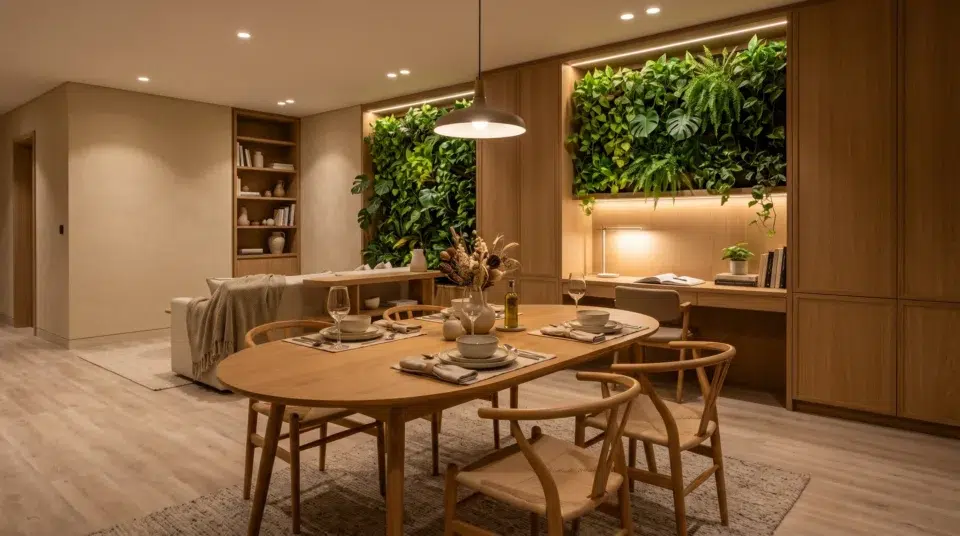
The natural stone feature wall is 2026’s most sought-after renovation element in Dubai. Travertine effect panels, lime-wash painted walls, rattan and cane wall panels, and vertical garden systems with climate-appropriate plants are all appearing in Dubai villa and apartment renovations at an accelerating rate. In a 900-square-foot Business Bay apartment, a single travertine-effect feature wall in the living room costs approximately AED 3,500 to AED 8,000, including materials and installation, and transforms the entire room’s character.
Biophilic design AED cost guide:
| Element | Budget (AED) | Mid (AED) | Premium (AED) |
|---|---|---|---|
| Indoor plants and planters (set of 5) | 300 to 800 | 900 to 2,000 | 2,500 to 6,000 |
| Natural linen curtains (per room) | 600 to 1,200 | 1,500 to 3,000 | 3,500 to 8,000 |
| Travertine feature wall (per wall) | 2,500 to 5,000 | 5,500 to 10,000 | 11,000 to 25,000 |
| Timber-look LVT flooring (per sqft installed) | 22 to 35 | 36 to 55 | 58 to 90 |
| Natural fibre accent rug | 400 to 900 | 1,000 to 3,000 | 3,500 to 12,000 |
Trend 2 Smart Home Renovation in UAE Apartments and Villas
Smart home technology is no longer a premium add-on in Dubai renovation conversations. In 2026, it is expected that infrastructure in mid-range and above renovation projects, particularly in communities like Dubai Hills Estate, Palm Jumeirah, and Business Bay, where tech-forward buyers are driving the market.
3.1: What Smart Home Renovation Actually Means in the UAE Context
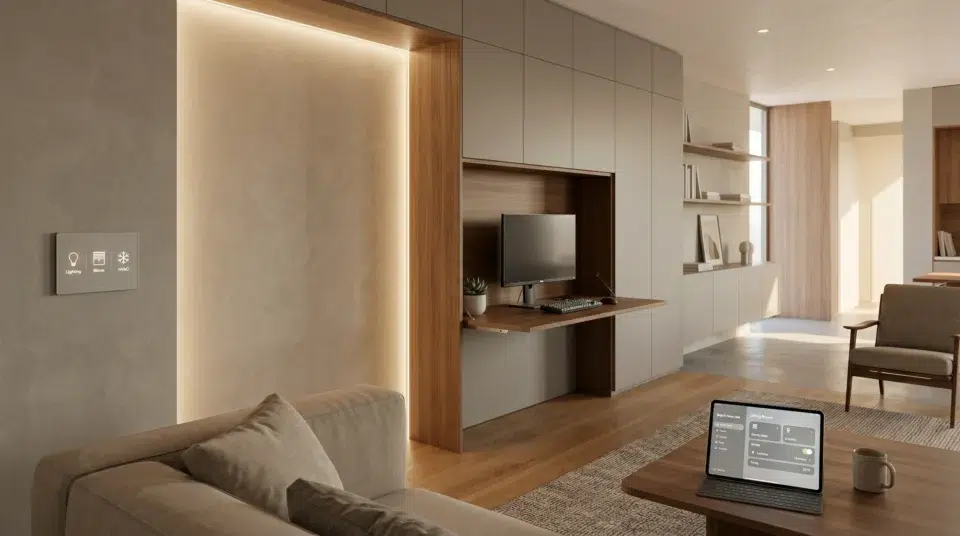
Smart home renovation in the UAE has a specific and practical meaning that differs from the global template. In a city where electricity costs, cooling efficiency, and summer comfort are the dominant household concerns, the smart home systems that deliver the highest return are: smart air-conditioning control (scheduling, zone management, remote access), motorised and smart blinds for solar heat gain management, smart lighting with scene setting and dimmer control, and video intercom and access systems. These are not luxury indulgences. In a Dubai apartment that receives five months of direct sun, smart blinds that automatically close at 2 PM when the western sun peaks can reduce cooling bills by 15 to 25 percent.
3.2: Motorised Blinds and Smart Curtain Systems
Karnak Home’s curtains and blinds range includes motorised roller blinds and curtain track systems compatible with major smart home platforms, including Google Home, Amazon Alexa, and Apple HomeKit. Motorised blinds in a standard Dubai apartment living room (two windows, one balcony door) cost approximately AED 3,500 to AED 7,000, including motor units, control hub, and installation. The energy saving in a west-facing Business Bay or JLT apartment typically justifies this investment within 18 to 24 months.
3.3: Smart Lighting as the Most Accessible Smart Renovation
If budget is a constraint, smart lighting delivers the highest visible impact per dirham in a smart home renovation. Replacing existing downlights with dimmable smart bulbs and adding a scene controller costs as little as AED 800 for a one-bedroom apartment. At the premium end, full recessed lighting replacement with integrated smart dimmer panels and scene programming runs AED 8,000 to AED 25,000 for a three-bedroom villa in The Springs or Emirates Hills, but the lifestyle impact is transformational.
3.4: Integrated Smart Storage in UAE Apartment Renovations
Smart storage in 2026 goes beyond pull-out drawers and soft-close hinges. In compact Dubai apartments, the trend is for custom-fitted storage walls with integrated charging stations, cable management systems, hidden desk drop-downs, and modular configurability that allows the storage to evolve as family needs change. Karnak Home’s wardrobes and closets service designs and installs exactly this type of integrated smart storage system, with a full consultation to map your specific needs before any manufacturing begins.
4: Trend 3 Japandi and Warm Minimalism in Dubai Interiors
Japandi, the fusion of Japanese minimalism and Scandinavian hygge sensibility, has been building in Dubai’s design consciousness since 2023. In 2026, it had moved from niche design circles to mainstream renovation projects in apartments and smaller villas across the city.
4.1: Why Japandi Works in UAE Apartments
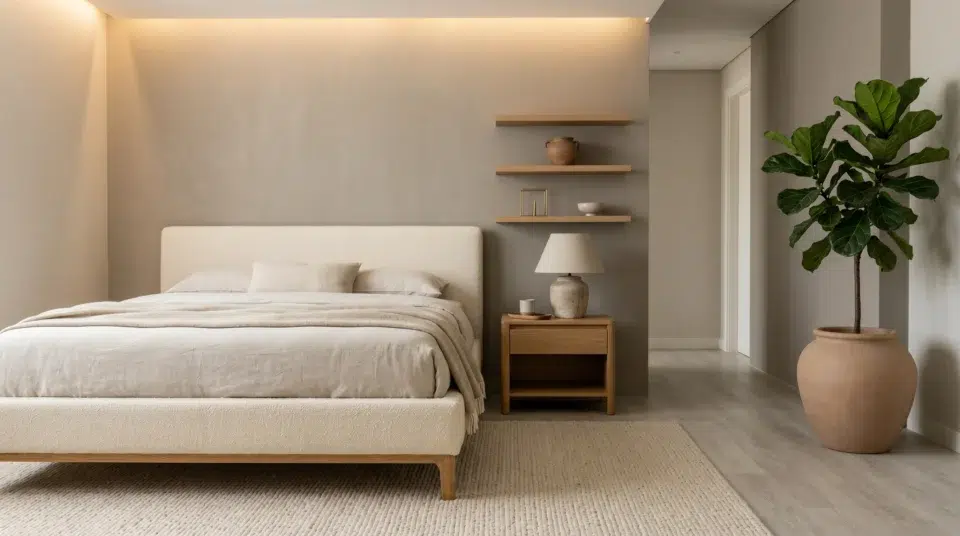
Dubai’s apartment architecture, with its emphasis on clean geometry, open-plan layouts, and large windows, is naturally sympathetic to the Japandi aesthetic. The style’s hallmarks, warm natural materials, muted earthy palettes, artisanal craft objects, low-profile furniture with clean lines, and an absence of visual clutter, address several specific pain points of UAE apartment living. Visual calm in a small space. Tactile warmth in an air-conditioned environment. And a timeless quality that makes the space feel equally suitable for a quiet Tuesday evening and a gathering of twelve for Eid.
4.2: The Japandi Colour Palette for UAE Walls
The Japandi palette in 2026 UAE interiors gravitates toward warm off-whites and bone tones (replacing the cold whites of 2018), dusty sage and muted olive greens, warm taupes and mushroom greys, deep charcoal as an accent, and rust and terracotta as punctuation colours. Crucially, these colours perform well under the particular quality of natural light in UAE interiors, which is typically intense and directional, either blazing direct sun or sharp reflected light from neighbouring glass facades.
4.3: Japandi Furniture Choices for UAE Homes
The furniture that defines Japandi in a UAE context is: low-profile sofas with solid timber legs and textured performance fabric upholstery, accent chairs in boucle, chunky weave, or soft velvet, coffee tables in solid oak or walnut with clean rectangular forms, floating shelving in warm timber tones, and nightstands with a single drawer and artisanal ceramic lamp. The emphasis throughout is on quality of material over quantity of pieces. A Japandi room has fewer objects, but each one is genuinely well-made.
4.4: Japandi Flooring for Dubai Homes
The flooring that most completely realises the Japandi vision in a UAE apartment is warm-toned engineered timber or high-quality LVT in a pale oak or ash effect. Karnak Home carries a range of parquet flooring and LVT options that deliver the Japandi timber aesthetic with the humidity resistance and dimensional stability that UAE conditions require. In a 1,000-square-foot JVC apartment, Japandi LVT flooring in a pale ash effect transforms the entire mood of the space for approximately AED 22,000 to AED 38,000, including installation.
Trend 4 Climate-Proof Materials as a Design Philosophy
In 2026, climate resilience will no longer be a technical specification discussed only between contractors and suppliers. It has become a genuine design philosophy, with UAE homeowners actively seeking materials that are beautiful and built for the Gulf. This is one of the most important renovation trends Dubai has produced because it improves both the aesthetic and the durability of every space it touches.
5.1: UV-Resistant Materials Across Every Surface
Direct and reflected sunlight in UAE homes is more intense than in almost any residential market in the world. Fabrics, flooring, painted surfaces, and furniture finishes that lack UV stabilisation fade, bleach, and crack within one to three UAE summers. In 2026, UV resistance is a baseline specification, not an upgrade, for any quality renovation in Dubai, Sharjah, Abu Dhabi or any other UAE emirate. Karnak Home’s accent chairs and sofa fabrics are selected with specific attention to UV resistance ratings, ensuring that the deep dusty rose or rich sage green you choose on purchase day is still vibrant three UAE summers later.
5.2: Humidity-Proof Renovation Materials for UAE Coastal Homes
For residents of Dubai Marina, Palm Jumeirah, JBR, Al Raha Beach in Abu Dhabi, the Sharjah Corniche, Ajman Corniche, and Fujairah coastal apartments, humidity management is not a seasonal concern. It is a year-round reality. The renovation materials that perform best in these environments are: fully vitrified porcelain tiles (zero water absorption), premium LVT with a waterproof core, aluminium and powder-coated steel for any metal furniture or fixture elements, and closed-cell foam upholstery filling that does not absorb ambient moisture. Avoid solid timber flooring, MDF-based cabinetry without edge sealing, and natural stone without sealant maintenance in these environments.
5.3: Anti-Dust Surfaces A UAE-Specific Design Requirement
Dubai’s fine silica dust, which penetrates sealed windows and settles on every surface during shamal wind events, is one of the most under-discussed renovation challenges in the city. Matt and heavily textured surfaces, particularly on furniture and wall finishes, trap dust far more effectively than smooth, semi-gloss, and lacquered surfaces. In 2026, UAE renovation clients are increasingly specifying smooth lacquer finishes on cabinetry, semi-gloss wall paint in high-traffic areas, and easy-wipe performance fabrics on sofas and dining chairs, specifically to manage the relentless dust cycle. Karnak Home’s display units and TV media units are finished in smooth lacquer specifically suited to UAE dust management.
5.4: Thermal Performance in Villa Renovation
UAE villas, particularly single-storey villas in communities like The Springs, The Meadows and Mirdif, can accumulate significant heat gain through roof and west-facing walls by mid-afternoon in summer. Renovation trends that address thermal performance include reflective roof coating systems, external wall insulation cladding, double-glazing upgrades for original single-pane windows, and the strategic placement of heavy thermal-lined curtains on west and south-facing windows. These are not purely environmental choices. A villa with improved thermal performance is a villa with lower electricity bills, a more comfortable environment for children and elderly family members, and a stronger appeal to future tenants or buyers.
5.5: Sustainable and Eco-Friendly Renovation Choices in the UAE
Sustainable renovation in the UAE has moved from idealism to practical mainstream in 2026. LED lighting throughout (replacing any remaining halogen or fluorescent fittings), low-VOC paints that improve indoor air quality in sealed air-conditioned environments, FSC-certified timber used in furniture and fit-out, and energy-efficient cooling management through smart home systems: these are the sustainable renovation choices that UAE homeowners are making in 2026. They are also the choices that align with Dubai’s 2030 sustainability strategy and increasingly with the preferences of quality tenants and buyers who are looking for homes with lower running costs.
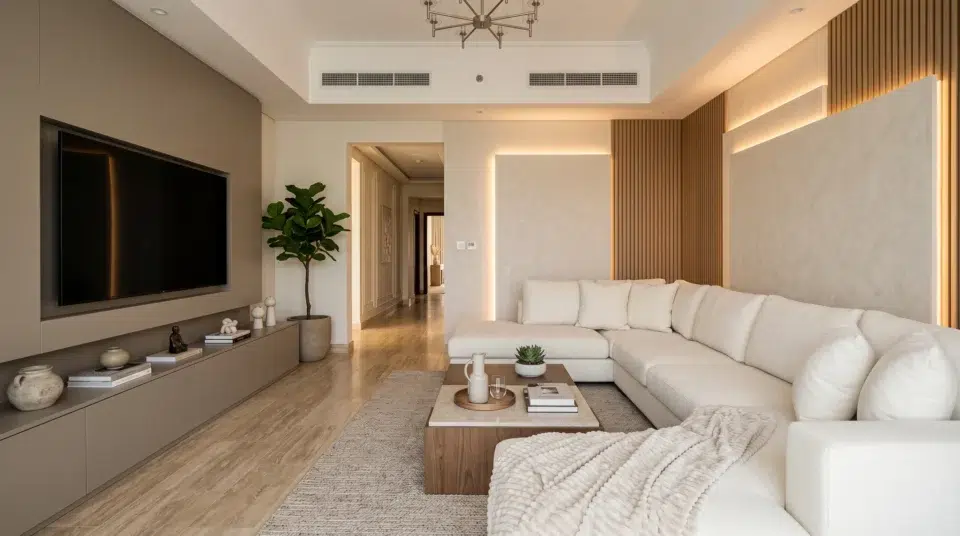
Trend 5 Open Plan Living and Space Maximisation in UAE Apartments
Open-plan living as a concept is not new to Dubai. What is new in 2026 is the sophistication with which UAE apartment owners are approaching the challenge of making an open-plan space work for the full range of activities UAE family life demands: cooking, eating, working, entertaining, relaxing, and accommodating visiting extended family, all within a footprint that is frequently under 1,000 square feet.
6.1: Zone Definition Without Walls
The 2026 approach to open-plan apartments in Dubai avoids the binary choice between a fully open space and room divisions. Instead, zones are defined through flooring transitions, furniture placement, lighting design, ceiling treatment changes, and area rugs. A living zone, a dining zone, and a study zone can coexist in a 750-square-foot Business Bay apartment without a single wall, by using an LVT-to-tile transition at the kitchen boundary, a low-backed sofa to define the living zone boundary, and a pendant light to anchor the dining area.
6.2: The Open-Plan Dining Consideration
The dining table in an open-plan UAE apartment is simultaneously the social heart of the home and its most spatially demanding piece of furniture. In 2026, the trend is for extendable oval dining tables in warm timber tones, which provide a compact everyday footprint (160x90cm) that extends to 210x90cm for family gatherings. Paired with upholstered dining chairs in a performance fabric that can handle daily use as informal seating, the dining zone becomes one of the most versatile areas in an open-plan UAE apartment.
6.3: Loveseats and Two-Seater Configurations for Small Apartments
In JVC, Dubai Silicon Oasis, Jumeirah Village Triangle, and similar communities where one-bedroom and studio apartments dominate, the oversized three-seater sofa is often the wrong choice. The 2026 trend for smaller UAE apartments is compact two-seater sofas or loveseats paired with a single statement accent chair. This combination seats three to four people for casual gatherings while maintaining the sense of space that makes a compact apartment liveable day-to-day.
6.4: Built-In and Semi-Built-In Storage for Open-Plan Spaces
Open-plan living only works when storage is abundant and well-organised, because in an open plan, there is nowhere to hide clutter. The 2026 renovation trend for UAE apartments is floor-to-ceiling fitted storage along one full wall of the living-dining space, combining closed cabinet storage with open display shelving. This eliminates freestanding furniture pieces that fragment the floor area while providing far more storage capacity than conventional sideboards and bookshelves. Karnak Home’s bookcases, buffets, and sideboards offer modular options that can be configured to achieve this effect in UAE apartments without a full custom fit-out.
Trend 6 The Majlis Modern Fusion in UAE Villa Renovations
The most culturally significant renovation trend in the UAE in 2026 is not imported from Scandinavia or Japan. It is homegrown, and it is genuinely beautiful: the deliberate fusion of Gulf design heritage with contemporary materials and technology.
7.1: What Majlis-Modern Means in Practice
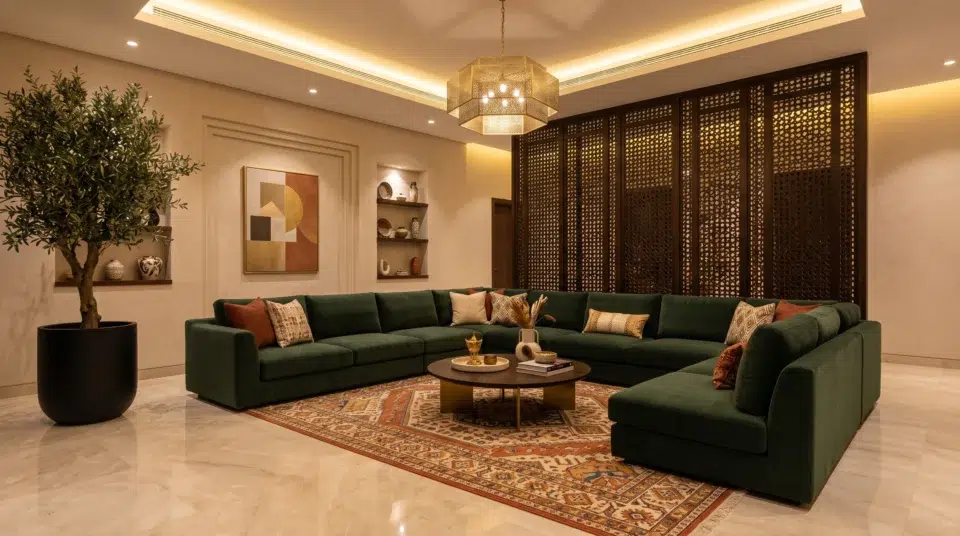
Majlis-modern design retains the functional and social essence of the traditional Gulf reception room, the low seating that encourages prolonged conversation, the generous proportions that accommodate large gatherings, the richness of textile and surface, and the sense of ritual hospitality. But it delivers these qualities through contemporary materials and a visual language that is unambiguously of its time. Low-profile modular sofas in deep jewel tones (sapphire, forest green, burnt umber) against a neutral wall. Hand-knotted Persian or Moroccan rugs over polished concrete. Mashrabiya-inspired laser-cut metal or timber panels as room dividers. Karnak Home’s majlis furniture range is designed from the ground up for this cultural contex7.2: The Role of the Chaise in Contemporary Majlis Design
The chaise lounge and the daybed are enjoying a renaissance in UAE villa interiors in 2026, specifically as a bridge between the traditional reclining posture of Gulf seating culture and the contemporary furniture vocabulary. A sculptural chaise in a deep jewel-tone velvet, positioned at an angle to the main seating arrangement, adds both visual interest and a culturally resonant invitation to relaxation that works in majlis-adjacent spaces.
7.3: Lighting the Modern Majlis
The 2026 lighting specification for a majlis-modern villa room combines: indirect cove lighting at ceiling perimeter (warm white, 2700K), a statement pendant or chandelier as a central focal point (the 2026 trend favours geometric forms in brushed brass or blackened steel over ornate crystal), and low-level accent lamps on side tables and niches. The combination creates a rich layering of light sources that shifts the room from bright and welcoming for daytime visits to warm and intimate for evening gatherings.
Seven Renovation Trend Mistakes UAE Homeowners Make in 2026
Mistake 1: Choosing trend-led colours without testing them in the UAE light
The coral and sage that look perfect in a Stockholm flat can read very differently in the intense directional light of a Dubai apartment facing east. Fix: Always test paint colours in your actual room at three different times of day before committing. Ask your paint supplier for test pots, and observe them in morning, midday, and evening light conditions.
Mistake 2: Buying Japandi furniture without measuring the UAE apartment corridors
The beautiful low-profile Japanese-style bed frame you found online has a headboard that is 220cm wide. Your apartment bedroom door is 90cm wide. This is the most common furniture delivery crisis in Dubai. Fix: Measure door width, corridor width, and lift interior dimensions before ordering any piece of furniture wider than 100cm or taller than 200cm.
Mistake 3: Installing natural timber flooring in a coastal Dubai property
The engineered timber floor in a Palm Jumeirah apartment looks magnificent for eight months, then starts to bow and separate at the joints as summer humidity peaks. Fix: Use premium LVT with a waterproof SPC or WPC core in any coastal UAE property. Reserve engineered timber for inland, fully air-conditioned properties with good humidity control.
Mistake 4: Over-committing to a single trend rather than building a flexible base
A room decorated entirely in 2026 Japandi, all boucle and pale ash and mushroom grey, will feel dated by 2029. Fix: Invest in neutral, high-quality base pieces (sofa, flooring, wall colour) in timeless tones, and express the trend through changeable elements: cushions, rugs, curtains, accent chairs, and lighting.
Mistake 5: Ignoring acoustic renovation in open-plan apartments
Hard flooring, glass windows, minimal soft furnishings, and open-plan layout combine to create apartments with extremely poor acoustics. Every sound echoes. Fix: Incorporate at least one large area rug, heavy curtains rather than roller blinds alone, and upholstered seating. These three additions reduce echo dramatically without any structural work.
Mistake 6: Installing biophilic elements without a maintenance plan
A vertical living wall of tropical plants installed in a Dubai apartment in November looks extraordinary. By July, with inconsistent care in the air-conditioned environment, it can be a maintenance liability. Fix: Either choose low-maintenance species and install an automated irrigation system, or use high-quality botanical replicas that are indistinguishable from the real thing at normal viewing distance.
Mistake 7: Selecting smart home systems that are not UAE infrastructure compatible
Not all smart home platforms marketed internationally are fully functional with the UAE telecom infrastructure and the specific power supply standard (240V, 50Hz). Fix: Before purchasing any smart home system for a UAE property, verify UAE compatibility explicitly with the supplier and check the availability of local technical support.
2026 Renovation Trend Budget Guide in AED
| Renovation Trend | Budget Tier (AED) | Mid-Tier (AED) | Premium Tier (AED) | Best For |
|---|---|---|---|---|
| Biophilic living room (plants, natural curtains, feature wall) | 5,000 to 12,000 | 15,000 to 30,000 | 35,000 to 70,000 | All apartment sizes; premium for villas |
| Smart blinds and lighting (1BR apartment) | 2,500 to 5,000 | 6,000 to 12,000 | 14,000 to 28,000 | JVC, Business Bay, Marina apartments |
| Japandi bedroom complete (bed, flooring, lighting, curtains) | 12,000 to 22,000 | 25,000 to 50,000 | 55,000 to 110,000 | Mid and premium apartments, villas |
| Climate-proof flooring (LVT full apartment) | 18,000 to 32,000 | 35,000 to 60,000 | 65,000 to 120,000 | All UAE property types |
| Open-plan space optimisation (furniture, storage, lighting) | 15,000 to 30,000 | 35,000 to 65,000 | 70,000 to 140,000 | Compact Dubai apartments |
| Majlis-modern living room (sofa, rug, lighting, divider) | 25,000 to 50,000 | 55,000 to 110,000 | 120,000 to 280,000 | Emirati and Gulf villas, large Dubai apartments |
| Full sustainable renovation add-ons (LED, low-VOC, smart AC) | 4,000 to 9,000 | 10,000 to 22,000 | 25,000 to 55,000 | All property types |
Frequently Asked Questions
For resale and rental yield, smart home integration (motorised blinds, smart lighting, intelligent cooling control) adds the most demonstrable value to Dubai apartments in 2026 because it directly addresses the two strongest tenant priorities: comfort and energy cost. For personal quality of life, biophilic design consistently produces the highest satisfaction ratings among UAE homeowners who have undertaken it. For photography and listing appeal, a Japandi-style renovation with warm flooring and a cohesive colour palette produces results that stand out strongly on Bayut, Property Finder, and Airbnb. Browse Karnak Home’s living room furniture to start building your 2026 trend renovation.
In a 600 to 800-square-foot Dubai apartment, biophilic design works best through restraint: three to five carefully chosen plants rather than a maximalist jungle, a single natural material feature wall rather than multiple competing natural surfaces, and natural linen curtains that bring softness and texture without requiring any structural work. The goal is to introduce enough organic warmth to change the mood of the space without overwhelming it. Start with Karnak Home’s accent chairs in boucle or textured natural fabric and build the biophilic palette outward from there.
Premium SPC-core LVT (Stone Plastic Composite) is the definitive answer for UAE apartment flooring in 2026. It is 100 percent waterproof, dimensionally stable across the full range of UAE temperature and humidity conditions, comfortable underfoot, visually sophisticated in quality products, and available at accessible price points. For coastal properties in Dubai Marina, Palm Jumeirah, JBR, and Abu Dhabi waterfront locations, SPC LVT is not just the best choice. It is the only choice that will perform reliably through five or more UAE summer humidity cycles. Karnak Home carries an extensive LVT flooring range tested for UAE conditions.
Absolutely. The Japandi philosophy of calm, quality, and purposeful minimalism aligns closely with the Gulf aesthetic of refined hospitality and material excellence. The adaptation for an Emirati or Gulf family home involves warming the palette with terracotta and deep jewel tones, ensuring the seating arrangement respects Gulf hospitality postures (generous seating depth, welcoming layout), and incorporating cultural objects and textiles within the Japandi framework rather than excluding them. The result is a deeply personal aesthetic that is both contemporary and culturally resonant. Karnak Home’s majlis collection includes pieces that bridge this aesthetic beautifully.
A practical and effective smart home renovation in a one-bedroom Dubai apartment, covering motorised blinds in the living room and bedroom, smart LED lighting in all rooms with scene control, and a smart entry system, can be achieved for AED 6,000 to AED 14,000, including all equipment and installation. This is a meaningful investment but one that pays returns in daily comfort, energy saving, and property appeal. For a three-bedroom villa in Arabian Ranches or Dubai Hills Estate, a comprehensive smart home renovation including smart AC control, full lighting scenes, automated blinds and integrated security runs from AED 25,000 to AED 80,000 depending on specification. WhatsApp Karnak Home at +971 58 908 8107 to discuss smart renovation options with our team.
The sustainable renovation choices that make genuine practical sense for UAE homes are: LED lighting throughout (reducing electricity consumption from lighting by 60 to 80 percent versus halogen), low-VOC paint (critical in sealed air-conditioned environments where volatile compounds concentrate), smart cooling management (the single largest energy cost in any UAE home), UV-filtering window film or motorised solar-control blinds (reducing cooling load by limiting solar heat gain), and water-efficient bathroom fixtures (an important sustainability metric in an arid country). Each of these choices reduces running costs while improving comfort and sustainability. Explore Karnak Home’s furniture packages for sustainable, long-lasting UAE home solutions.
The majlis-modern trend has a broad appeal that extends well beyond Emirati and Gulf Arab families. For non-Arab UAE residents, the key elements to incorporate are: generous, low-profile seating arranged for conversation (the functional core of the majlis tradition), rich textile layering with rugs, cushions, and throws, warm and indirect lighting that creates intimacy, and a designated hospitality zone within the home, even if the whole room is not dedicated to it. These elements create a warmth and a welcome that resonates with the UAE’s culture of hospitality, regardless of the cultural background of the homeowner. Karnak Home’s living room range includes pieces that serve this aesthetic beautifully.
The most direct way to see, feel, and plan your 2026 renovation in Dubai is to visit Karnak Home’s showroom in the Industrial Area, Sharjah, which is open Saturday to Thursday from 9 AM to 9 PM. Our showroom displays furniture, flooring, curtains, wardrobes, and accessories across all the 2026 trend categories discussed in this guide. Our consultants can help you plan a complete renovation from materials selection to furniture layout, with free delivery and free installation across all UAE emirates. You can also browse our complete range at karnakhome.com or contact our team on WhatsApp at +971 58 908 8107 to start a conversation about your renovation project today.
Three trends above all others will define the UAE home renovation landscape through the rest of this decade: biophilic design that brings nature and calm into spaces insulated from a harsh outdoor climate, smart home systems that make Gulf living more comfortable and more efficient, and the climate-proof material philosophy that finally treats UAE-specific conditions as a design opportunity rather than a constraint.
Whether your project is a studio apartment in JVC that needs a complete visual refresh or a five-bedroom villa in Arabian Ranches that deserves a comprehensive renovation investment, the principles are the same: choose materials that will perform in the UAE climate for at least a decade, select furniture that balances visual ambition with the practical demands of UAE family life, and lean into the specific design culture of this remarkable country rather than importing solutions designed for a different climate and a different way of living.
Karnak Home’s showroom in the Industrial Area, Sharjah, is open Saturday to Thursday from 9 AM to 9 PM, and our team is ready to help you plan and deliver your 2026 renovation. Browse our complete furniture, flooring, curtains, and wardrobe ranges at karnakhome.com, WhatsApp us at +971 58 908 8107 for a free consultation, measurements, and swatches, or call us directly on +971 58 908 8107. Free delivery and free installation across all UAE emirates. Your best home is waiting.
Ready to Start Your 2026 Dubai Renovation?
Explore Our Complete Range: Home Furniture UAE Karnak Home
Browse Smart Storage and Wardrobes: Custom Wardrobes and Closets UAE
Shop Flooring for UAE Homes: LVT, Parquet, and Carpet Tiles
Visit Our Showroom: Industrial Area, Sharjah, UAE (Saturday to Thursday, 9 AM to 9 PM)
WhatsApp Us: +971 58 908 8107 (Consultations, measurements, swatches)
Call: +971 58 908 8107
Related Articles
- The Complete Guide to Renovation Services in Dubai 2026
- 7 Renovation Mistakes Dubai Homeowners Make and How to Avoid Them
- How to Choose the Right Flooring for a UAE Apartment
- Biophilic Design for Dubai Apartments: A Practical 2026 Guide
- Smart Home Renovation in the UAE: What Actually Works
Expert Resources from Karnak Home
- Browse our accent chair collection for UAE trend renovations
- Explore complete furniture packages for Dubai apartments and villas
- Shop Karnak deals for UAE renovation budgets
- Discover our full sofa range for UAE living rooms
- Find the perfect dining table for your open-plan UAE home
- Explore bedroom sets for a complete 2026 renovation
دليل الكارنك الشامل لخدمات التجديد في الإمارات 2026
في عام 2026، تشهد دبي والإمارات تحولاً جوهرياً في عالم تصميم المنازل وتجديدها. لم يعد الأثاث الأبيض البارد والجدران الرمادية الخالية من المشاعر هو المعيار السائد. اليوم، تبحث الأسر الإماراتية والخليجية وعائلات المقيمين على حدٍّ سواء عن منازل تعكس الدفء والشخصية والوظيفية، مع مراعاة متطلبات مناخ الخليج الصارم.
يُعدّ التصميم البيوفيلي من أبرز اتجاهات الديكور الداخلي في دبي 2026، وهو ذلك النهج الذي يُدخل الطبيعة إلى داخل المنزل من خلال النباتات الخضراء والمواد الطبيعية والإضاءة الدافئة. وتُقدم كارنك هوم مجموعة متكاملة من أثاث غرف المعيشة والستائر والأرضيات التي تُجسّد هذا الاتجاه بأسلوب يناسب البيئة الإماراتية.
كذلك يكتسب مفهوم المنزل الذكي في الإمارات 2026 أهمية متصاعدة، لا سيما في ظل ارتفاع درجات الحرارة وتصاعد تكاليف التبريد. تُتيح الستائر الآلية وأنظمة الإضاءة الذكية وأجهزة التحكم في تكييف الهواء للأسر تحقيق راحة أعلى بتكاليف تشغيل أقل. ويُتيح كارنك هوم خدمات الستائر والبلايند المتكاملة التي تشمل الأنظمة الآلية المتوافقة مع متطلبات المنازل الإماراتية.
أما اتجاه التجديد الصديق للمناخ في الإمارات، فيعني اختيار مواد تصمد أمام الشمس الحارقة والرطوبة الساحلية وعواصف الغبار. إن أسطح الأثاث المقاومة للأشعة فوق البنفسجية، والأرضيات من نوع LVT المقاومة للماء، والأقمشة عالية الأداء القابلة للتنظيف، هي المعايير التي تُميز التجديد الحقيقي في 2026 عن مجرد التغيير الشكلي.
ولأصحاب الفلل في مجتمعات دبي هيلز وأرابيان رانشز والجميرا، فإن اتجاه الجلسة المعاصرة يُجسّد التوازن المثالي بين التراث الخليجي الأصيل والتصميم العصري. توفر كارنك هوم مجموعة مجالس متكاملة صُممت خصيصاً لهذا الغرض، تجمع بين عمق الأريكة المريحة ورقي المواد وجمال الألوان.
زوروا معرضنا في المنطقة الصناعية بالشارقة من السبت إلى الخميس من الساعة التاسعة صباحاً حتى التاسعة مساءً، أو تواصلوا معنا عبر واتساب على الرقم +971 58 908 8107. توصيل مجاني وتركيب مجاني في جميع أنحاء الإمارات.