
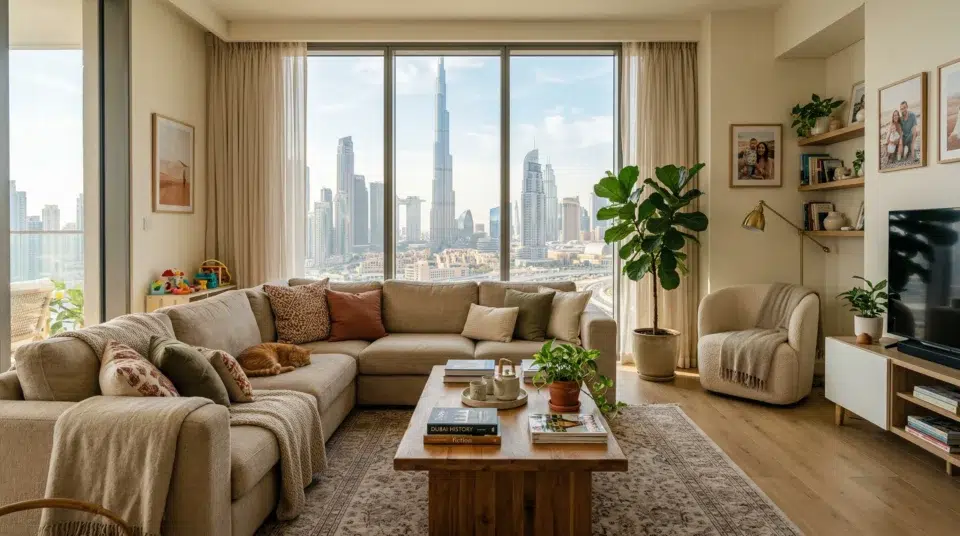
You’ve got the keys. The floor plan is burned into your memory. And now you’re standing in an empty apartment in Dubai Marina or a freshly handed-over villa in Arabian Ranches, asking yourself: where do I even start?
It’s a question we’ve helped over 70,000 UAE families answer since 1988. At Karnak Home, we’ve seen every kind of move — expats arriving from Europe with nothing but suitcases, growing Emirati families upsizing to a bigger villa, young couples furnishing their first Dubai apartment on a careful budget. What we’ve learned in 35 years is this: the families who approach a new home with a clear checklist make smarter decisions, spend less money overall, and end up far happier with the result than those who buy room by room in a panic.
This guide gives you that checklist. Room by room, priority by priority, with honest AED budget ranges and UAE-specific advice you won’t find in a generic furniture blog.
Dubai homes have their own personality. The climate means your furniture choices matter more than they do in cooler countries — certain fabrics trap heat and are miserable by June, while others stay comfortable year-round. Dubai apartments tend to have open-plan living and dining areas that demand careful space planning. Villas in communities like Mirdif, The Springs, or Mudon often have generous room sizes but awkward alcoves and storage challenges. And if you have children — or are planning to — the UAE’s indoor lifestyle for most of the year means your furniture will take more daily use than you might expect. Let’s build your checklist properly.
Start Here: Before You Buy a Single Piece of Furniture
The single biggest mistake people make when moving to a new home is buying furniture before they’ve done these four things. This section can save you thousands of dirhams.
Measure Everything — Twice
This sounds obvious, but it gets skipped constantly. In Dubai, ceiling heights vary dramatically between older Bur Dubai apartments (sometimes as low as 2.4m) and newer JVC or Business Bay towers (often 2.8–3.0m). That affects whether tall wardrobes work, how high beds should be, and whether statement pendant lights over a dining table are practical.
Before you buy anything, measure: room length and width, doorway widths (critical for sofas and beds), ceiling height, window sill heights, and the distance between fixed features like columns, kitchen islands, and alcoves. A standard sofa that’s 240cm wide will feel perfectly sized in a 6m living room and claustrophobic in a 4m one. Write these numbers down. Keep them on your phone. Every good furniture decision starts here.
For Dubai villas specifically, measure your staircase width before ordering large bedroom furniture. A beautiful king bed frame that can’t make the turn on a narrow villa staircase is a painful and expensive lesson — one we’ve watched happen more than once.
Understand Your Layout Before You Commit to a Style
Open-plan living and dining is the dominant layout in Dubai apartments from Business Bay to Dubai Hills. This is actually a blessing for furniture planning — it forces you to think about the whole space as one cohesive environment rather than separate rooms. Your sofa, dining table, and the connection between them should feel intentional.
In most UAE apartments, the living and dining area shares one continuous space of roughly 25–45 square metres. A good rule: your dining table should not be so large that it blocks natural flow from the kitchen to the living area. A 6-seater rectangular table (typically around 160cm x 90cm) works well in most Dubai apartments. Villas can usually accommodate 8-seater or larger.
Prioritise Rooms by How Fast You Need Them
You don’t need to furnish everything on day one. Prioritise in this order: bedroom first (you need to sleep comfortably from night one), living area second (it’s where daily life happens), dining area third, and then the remaining bedrooms, home office, and kids’ rooms as time and budget allow. This approach lets you spread costs sensibly rather than buying everything in a rush and regretting half of it.
Factor in Dubai’s Climate
This is UAE-specific advice that makes a real difference. Year-round air conditioning means your home stays cool, but it also means air circulation is limited and humidity — particularly in summer — can be significant in some areas near the coast. Solid wood furniture can expand and contract or even crack in fluctuating temperature and humidity if it’s low-quality or not properly treated. Fabric sofas in light colours show dust more obviously in Dubai’s environment. Leather and faux leather can feel sticky in humid months if your AC isn’t keeping up.
The practical takeaway: choose furniture materials suited to the UAE climate. Engineered wood with proper veneer is often more stable than cheap solid wood. Fabric sofas in performance weaves (tightly woven, easy to clean) are genuinely better suited to Dubai family life than loose-weave linen. We’ll cover material choices in detail for each room.
The Living Room Furniture Checklist
The living room in a Dubai home works harder than almost any other space. It’s where the family gathers after school, where you entertain guests during Eid, where children do their homework, and where you decompress after a long day. Getting this room right matters.
The Sofa: Your Most Important Purchase
Your sofa is probably the highest-value piece of furniture you’ll own, and it’s the one that most affects how your living room feels every single day. In Dubai, families typically live with their sofas for 7–12 years, so this is not a place to rush or under-budget.
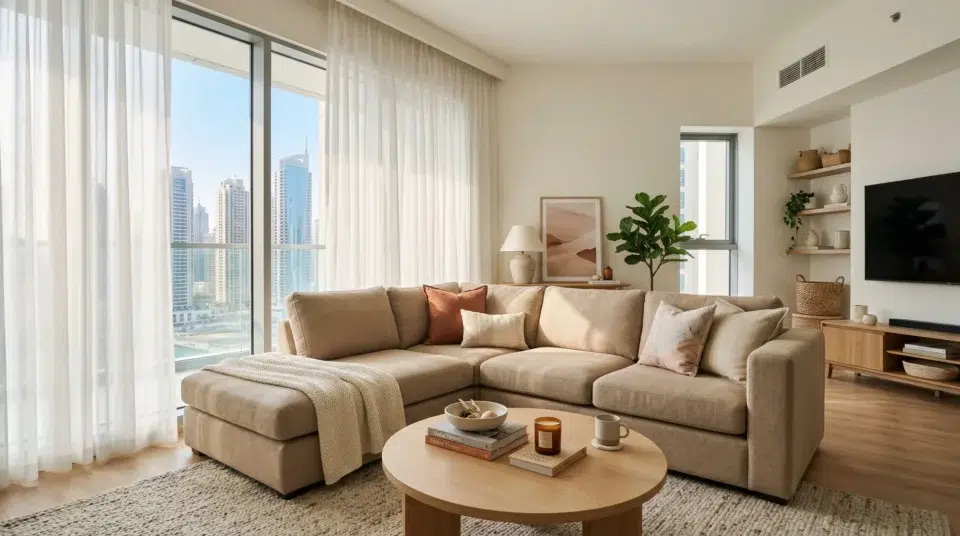
For a typical Dubai apartment, an L-shaped sectional or a 3-seater plus 2-seater combination are the two most practical configurations. An L-shaped sectional works beautifully in corner layouts — very common in Dubai apartment living rooms where the TV wall and the window wall meet at 90 degrees. The 3+2 combination offers more flexibility if you rearrange rooms or move home.
For UAE family life, performance fabric is the smart choice — particularly if you have children or pets. It resists staining, cleans easily, and doesn’t fade in Dubai’s bright light. A good quality fabric sofa from Karnak Home starts from around AED 2,800 for a solid 3-seater and AED 4,500–8,000 for a full sectional, depending on configuration and fabric grade. Browse our sofa collection →
Leather and faux-leather sofas are popular in Dubai for their easy cleaning, but genuine leather in a poorly air-conditioned room can be uncomfortable in summer. If you love the leather look, high-quality bonded leather or PU leather handles the UAE climate more forgivingly and costs significantly less.
Coffee Table, Side Tables, and TV Unit
These three pieces frame your sofa and anchor the room. For Dubai apartments, a coffee table with storage (a lift-top design or one with a lower shelf) is practical — UAE living rooms often serve double duty as homework or casual dining spaces. Dimensions to aim for: coffee table height should be within 5cm of your sofa seat height, and the table should be at least 45cm from the sofa for comfortable legroom.
TV units in Dubai homes need to accommodate increasingly large screens — 65″ and 75″ televisions are now common, and many families go bigger. Make sure your TV unit is wide enough that the TV doesn’t overhang (add at least 20cm either side of the screen), and check that cable management is practical if you have a soundbar or gaming consoles.
A floating TV wall panel — a wall-mounted unit that spans the width of the living room — is one of the most popular choices in Dubai villas and larger apartments. They look elegant, maximise floor space, and solve storage. Prices start from around AED 1,800 for a basic floating unit and go up to AED 6,000+ for full custom-look configurations.
Rugs, Lighting, and Finishing
A rug defines the seating zone in an open-plan living area — it’s one of the most impactful and affordable ways to make a living room feel complete. In Dubai apartments without much natural variation in flooring, a well-chosen rug creates the visual anchor the room needs. As a size guide: in most Dubai living rooms, a 200cm x 300cm rug is the minimum that looks proportionate under a sectional sofa. Go larger if you can — undersized rugs are one of the most common decorating mistakes we see.
Living Room Checklist:
- Sofa (sectional or 3+2 combination)
- Coffee table
- Side tables (x2)
- TV unit or floating wall panel
- Floor lamp or table lamps
- Rug (200×300 minimum for most Dubai living rooms)
- Curtains or blinds
The Bedroom Furniture Checklist
Bedrooms in Dubai homes range from compact studio-style spaces (sometimes as small as 10 square metres in older Deira apartments) to generous master suites in Jumeirah villas with dedicated dressing rooms. Your checklist adapts to what you have.
The Bed: Size, Frame, and Mattress
In the UAE, king size beds are standard in master bedrooms — it’s genuinely worth fitting one if the room allows it. A standard UAE/international king is 180cm x 200cm. Measure your room against this footprint, leaving at least 60cm clearance on each side of the bed for comfortable movement, and at least 90cm at the foot of the bed if you plan to have a TV opposite.
For smaller second bedrooms, a queen (160cm x 200cm) is the practical choice. Single and double beds work well in guest rooms or children’s rooms.
Bed frame selection in Dubai should account for storage — under-bed drawers or a hydraulic lift storage base are extremely popular in UAE apartments where built-in storage is often limited. A hydraulic storage bed gives you a surprisingly large amount of hidden storage, ideal for extra bedding, seasonal items, and things you don’t need daily. These start from around AED 1,800 for a fabric-upholstered storage bed and range up to AED 4,500 for premium designs.
The mattress is as important as the frame — arguably more so. UAE families tend to prefer medium-to-firm memory foam or pocket spring mattresses. The climate consideration: memory foam retains some heat, so if you sleep warm, look for memory foam with a cooling gel layer, or opt for a quality pocket spring mattress which sleeps cooler. Budget honestly for mattresses: a mattress you’ll spend a third of your life on deserves at least AED 1,200–2,500 for a king size. Explore beds and mattresses →
Wardrobes: The Make-or-Break Storage Decision
This is where Dubai apartment buyers consistently get frustrated. Many newer buildings provide built-in wardrobes, but they’re often poorly designed — inadequate hanging space, shallow shelving, no dedicated drawer storage. If you’re in an older building or a villa without built-ins, you’ll need freestanding wardrobes.
For a master bedroom, a two-door or three-door wardrobe with a combination of hanging rails and shelving is the baseline. A standard two-door wardrobe is approximately 90–100cm wide; a three-door is 135–150cm. If your bedroom wall allows, a sliding-door wardrobe of 200–250cm width gives you serious storage with a clean, contemporary look.
Consider your clothing. UAE weather means you likely have a large collection of light clothes plus a separate section for the rare cold-weather months. A well-designed wardrobe has both long hanging space (for abayas, dresses, suits) and shorter double-hanging sections for shirts and folded items. Drawer inserts inside wardrobes are worth the extra cost — they make daily life genuinely easier. Browse wardrobes →
Bedroom Dressing Area and Side Tables
Bedside tables are small but important. They need to be at the right height (typically 55–65cm, or within 5cm of your mattress top), have at least one drawer for bedside essentials, and ideally have a surface large enough for a lamp, phone, and water glass. In Dubai, USB-integrated bedside tables are increasingly popular — practical given how many devices UAE families charge overnight.
A dressing table or mirror is worth prioritising if you don’t have a dedicated dressing room. Wall-mounted mirrors save floor space in smaller bedrooms and are popular in Dubai apartments. If you have the space, a dressing table with drawers keeps makeup and accessories organised and off the bathroom counter.
Bedroom Checklist:
- Bed frame (with or without storage)
- Mattress
- Bedside tables (x2 for master)
- Wardrobe (freestanding or built-in)
- Dressing table or full-length mirror
- Chest of drawers (if wardrobe space is limited)
The Dining Room Furniture Checklist
Dubai families eat together — really together. Whether you’re hosting extended family for Friday lunch, entertaining colleagues, or just doing a regular weeknight dinner, the dining area in a UAE home earns its place.
Choosing the Right Dining Table
Size first. For a family of four, a 120–140cm rectangular table is comfortable daily use. For a family of five or six, go to 160–180cm. If you regularly host large gatherings (common in UAE family culture), a 200cm+ table or one with an extendable leaf is worth serious consideration.
Round tables work wonderfully in smaller Dubai apartments — they fit more people for their footprint than rectangular tables and feel more sociable. A 120cm round table seats four comfortably and six with a squeeze. A 140cm round seats six properly.
Material choice for UAE dining tables: glass tops look sleek but show every fingerprint in Dubai’s dusty environment and are not ideal with young children. Solid wood with a lacquer finish is durable and classic. Ceramic tabletops have become popular — they’re scratch-resistant, heat-resistant, and wipe clean easily, making them genuinely well-suited to UAE family dining. Prices for a good quality 6-seater dining set (table plus chairs) typically range from AED 2,200 to AED 6,500 depending on materials and design.
Dining Chairs and Benches
Upholstered dining chairs in performance fabric or faux leather are the practical choice for families. They’re comfortable for longer meals and clean up well after children. A bench on one side of a rectangular table is a popular choice in Dubai homes — it’s informal, flexible (more people can squeeze on), and it reduces the number of chairs cluttering the space when not in use.
Chair height should be checked against table height. Standard dining tables are 75–76cm high; standard chairs are 44–46cm seat height, giving roughly 30cm of comfortable clearance. If you’re buying separately, verify these measurements.
Dining Room Checklist:
- Dining table (size matched to family and room)
- Dining chairs (allow one per regular diner plus two extra for guests)
- Sideboard or buffet cabinet (for serving and storage)
- Pendant light above table (important for ambience)
Kids’ Room Furniture Checklist
UAE families — both Emirati and expat — tend to invest thoughtfully in children’s spaces. Kids in Dubai spend significant time indoors during summer months, so their rooms need to be genuinely comfortable, functional spaces for sleep, play, and study.
Safety First in Every Decision
When choosing kids’ furniture in the UAE, safety standards matter. Look for furniture that meets international safety certifications. Sharp corners on beds and desks are a real concern — rounded-edge designs or corner protectors are worth it. Bunk beds should have guardrails on the upper bunk at least 16cm high to prevent rolling falls. Wardrobes and drawers should have anti-tip anchoring — wall-fix them regardless of how stable they seem freestanding.
Beds, Storage, and Study
For younger children (3–8 years), a single bed (90cm x 200cm) is standard. Many Dubai families choose beds with built-in storage drawers because children’s rooms accumulate an extraordinary amount of stuff. Mid-sleeper beds with a desk or play area underneath are enormously popular in Dubai apartments where space is at a premium — they give children a dedicated desk without needing a separate desk in the room.
For older children and teens, consider investing in a proper study desk and chair setup. UAE children spend significant time studying, and an ergonomically appropriate desk setup genuinely matters for posture and focus. A height-adjustable desk chair, a desk with good surface area (at least 120cm wide), and proper lighting should all be on your checklist.
For two children sharing a room — common in Dubai apartments — a bunk bed saves enormous floor space. Solid bunk beds that convert to two separate singles as children grow are a smart long-term investment. Browse kids’ furniture →
Kids’ Room Checklist:
- Bed (single, mid-sleeper, or bunk depending on age and space)
- Wardrobe (kids need their own storage)
- Desk and study chair
- Bookshelf or wall storage
- Toy storage (ottoman, bins, or low shelving)
Home Office Furniture Checklist
Post-pandemic Dubai life has made the home office a genuine priority rather than an afterthought. Whether you work from home full-time, occasionally, or just need a space to manage household admin, a functional home office setup improves life measurably.
In UAE apartments, the home office is often carved from a spare bedroom, a study nook, or even a well-designed corner of the living room. The key pieces: a desk with adequate surface area (120–150cm minimum for real work), an ergonomic chair (this is where people consistently under-invest and pay for it with back pain), and storage.
A monitor arm frees up desk surface area and is one of the best small investments for a home office. Filing cabinets or a pedestal under the desk handles paperwork. For video calls — common in Dubai’s international business culture — consider the visual backdrop; a neat bookshelf or a clean wall reads better than a bedroom door.
Ergonomic chairs worth buying properly: for serious home office use, budget AED 800–2,000 for a chair with proper lumbar support, adjustable height, and armrests. Cheaper chairs under AED 400 are rarely ergonomically adequate for more than two hours of sitting.
Common Furniture Mistakes to Avoid When Moving to Dubai
In 35 years of helping UAE families furnish their homes, we see the same errors repeatedly. These are the ones worth knowing before you spend a dirham.
Mistake 1: Buying Before Measuring
Covered above, but worth repeating: it is the single most common costly mistake. A sofa that’s 10cm too wide to fit through a door. A wardrobe that makes the bedroom feel like a corridor. A dining table that blocks the kitchen entrance. Measure first, always.
Mistake 2: Furnishing Everything at Once Under Pressure
Moving deadlines create panic-buying. Families who try to furnish an entire home in one frantic weekend often spend more than planned and end up with pieces they don’t love. It’s genuinely fine to live with a minimal setup for the first month — buy your priority pieces well, then add thoughtfully. The bedroom and living room matter first. The guest room can wait.
Mistake 3: Ignoring Furniture Scale
Dubai apartments often have generous ceiling heights and open-plan layouts that make photos on Instagram look spacious. Then people buy tiny furniture and the room looks hollow. Or they buy furniture scaled for a large villa and it overwhelms a compact apartment. Scale matters. A sectional sofa that’s too small for the room, or a dining table that’s too large for the dining alcove — both feel wrong every single day.
Mistake 4: Choosing Materials Unsuited to UAE Life
We mentioned this earlier, but: dark wood that shows white AC condensation marks. Light linen sofas that show dust within days in Dubai’s environment. Glass coffee tables with young children. Cheap laminate furniture that swells and separates in humid coastal areas. Choose materials thoughtfully for UAE conditions and UAE family life.
Mistake 5: Under-Budgeting for Key Pieces, Over-Spending on Decorative Ones
We frequently see families spend heavily on decorative items — artwork, cushions, vases — before they’ve invested properly in their bed or sofa. The functional anchor pieces of each room deserve your best budget. Decorative items can be added gradually, upgraded as finances allow, and changed with trends without a major cost. A good mattress and a quality sofa cannot.
Honest Budget Guide: Furnishing a Dubai Home in AED
These are realistic, mid-market ranges for furnishing each room in a Dubai home with good quality furniture. Not budget, not luxury — the kind of quality that lasts a UAE family 8–15 years.
Studio Apartment (complete, essential furniture only): AED 8,000 – 14,000
1-Bedroom Apartment (complete): AED 15,000 – 25,000
2-Bedroom Apartment (complete): AED 22,000 – 38,000
3-Bedroom Villa (complete, all rooms): AED 35,000 – 65,000
By Room:
| Room | Essential Budget | Comfortable Budget |
|---|---|---|
| Master Bedroom | AED 4,500–7,000 | AED 7,000–14,000 |
| Living Room | AED 5,000–9,000 | AED 9,000–18,000 |
| Dining Area | AED 2,000–4,500 | AED 4,500–9,000 |
| Kids’ Bedroom | AED 2,500–4,500 | AED 4,500–8,000 |
| Home Office | AED 1,500–3,000 | AED 3,000–6,000 |
These ranges assume mid-market quality — the kind Karnak Home specialises in — not flat-pack budget furniture or bespoke custom pieces. Quality mid-market furniture bought thoughtfully will outlast cheap furniture bought twice.
Expert Tips From 35 Years of Helping UAE Families Move In
1. Don’t buy everything from one style era. Mixing a few contemporary pieces with some warmer, classic elements gives a home a lived-in, personal feel. Showrooms that sell only one rigid style can push you toward a look that feels dated in five years.
2. Ask about delivery lead times before you commit. In Dubai, furniture from local stock can be delivered in 2–5 days. Custom or imported pieces can take 4–12 weeks. If you’re moving in on a fixed date, know your lead times.
3. Consider your flooring before choosing furniture colour. Dubai apartments often have light marble or tile floors. Dark furniture creates strong contrast — dramatic if intentional, harsh if not. Light furniture on light floors needs texture and layering to avoid looking flat.
4. Buy modular where possible for kids’ and teen rooms. Children outgrow furniture fast. A modular bookshelf that reconfigures, a convertible bed, a desk that adjusts — these earn their keep in Dubai family homes.
5. Check warranty terms on every significant purchase. UAE consumer protection law covers furniture defects, but manufacturer warranties vary significantly. At Karnak Home, all furniture comes with clear warranty terms. Know what you’re covered for before you buy.
6. Don’t underestimate delivery access. Many Dubai apartment buildings have strict delivery windows (often 9am–5pm, weekdays only), elevator size restrictions, and stairwell limitations. Confirm these with your building management before scheduling delivery. Share them with your furniture supplier.
7. Invest in proper furniture care from day one. Fabric protection spray on your sofa from day one. Felt pads under all furniture legs on tile and marble floors. Regular dusting of wooden furniture surfaces to prevent dust buildup in Dubai’s environment. Small habits that extend furniture life significantly.
8. Visit a showroom for major pieces. Online shopping is genuinely convenient, and Karnak Home’s online store is designed to make it easy. But for a sofa, a mattress, or a dining set you’ll live with for a decade, sitting on it matters. Our showroom in Dubai lets you experience furniture before committing. Visit our showroom →
Your Room-by-Room Moving Checklist: Quick Reference
Living Room
- Sofa (sectional or 3+2)
- Coffee table
- Side tables (x2)
- TV unit / floating wall panel
- Floor lamp or table lamps
- Rug (200x300cm minimum)
- Curtains or blinds
Master Bedroom
- Bed frame (with storage recommended)
- Mattress
- Bedside tables (x2)
- Wardrobe
- Mirror / dressing table
- Chest of drawers (if needed)
Additional Bedrooms
- Bed frame
- Mattress
- Wardrobe
- Bedside table
Dining Area
- Dining table (right size for family)
- Dining chairs (+ 2 extra for guests)
- Sideboard or buffet cabinet
- Pendant light
Kids’ Room
- Bed (age and space appropriate)
- Wardrobe
- Study desk and chair
- Bookshelf / storage
Home Office
- Desk (120cm+ wide)
- Ergonomic chair
- Storage (shelving or filing)
Conclusion: Making Your Move-In Count
Moving to a new home in Dubai is exciting — and with the right checklist and the right priorities, furnishing it should feel like an enjoyable project rather than an overwhelming one. Start with your bedroom and living room. Measure before you buy anything. Choose materials suited to UAE family life. Budget for quality where quality matters: your bed, your sofa, your kids’ study setup.
Key Takeaways:
- Measure your rooms, doors, and access routes before ordering any furniture
- Prioritise bedroom and living room; furnish the rest thoughtfully over time
- Choose performance fabrics and climate-appropriate materials for UAE conditions
- Invest more in functional anchor pieces; decorate gradually
Ready to Find Your Furniture?
Karnak Home has been helping UAE families turn empty houses into proper homes since 1988 — over 70,000 families across Dubai, Abu Dhabi, Sharjah, and beyond. Our showroom carries everything on this checklist, and our team genuinely knows the difference between a sofa that’ll last a UAE family 10 years and one that won’t make it through five. Whether you’d rather shop thoughtfully in the showroom or order from the convenience of your phone, we’re here to help make your move easier.
Shop Online: karnakhome.com Visit Showroom: Karnak Home, Dubai — see directions Expert Advice: Call or WhatsApp our furniture advisors
Related Articles:
- How to Choose the Right Sofa for a Dubai Apartment
- Wardrobe Buying Guide: Built-in vs Freestanding for UAE Homes
- Furnishing a Dubai Villa: Room-by-Room Expert Guide
- Best Furniture Materials for the UAE Climate
Ready to Get Furniture That Fits Your New Dubai Home? Explore Our Collections
Now that you have the complete checklist room priorities, sizes, climate tips, and budget guidance browse our full range below. UAE-made, built for real family moves, apartments, villas, and our climate. Free delivery & installation across all seven emirates.
- → All Living Room – Sofas, coffee tables, TV units, majlis furniture
- → All Sofas – From 2-seater to L-shaped, starting AED 1,500
- → Corner & L-Shaped Sofas – Space-saving for large villa living rooms
- → 3-Seater Sofas – Classic family size
- → Coffee Tables & Center Tables – Matching pieces to anchor your layout
- → TV Media Units – Storage & display for your setup
- → All Bedroom – Beds, wardrobes, nightstands
- → Wardrobes – Fitted & freestanding storage
- → Kids Furniture – Beds, bunk beds, study desks
- → Mattresses – Pocket spring, memory foam, latex for comfort
Special March Offer: Up to 50% off selected furniture + free delivery & installation limited time.
WhatsApp for Free Move-In Advice & Quote
Shop All Furniture Now →