
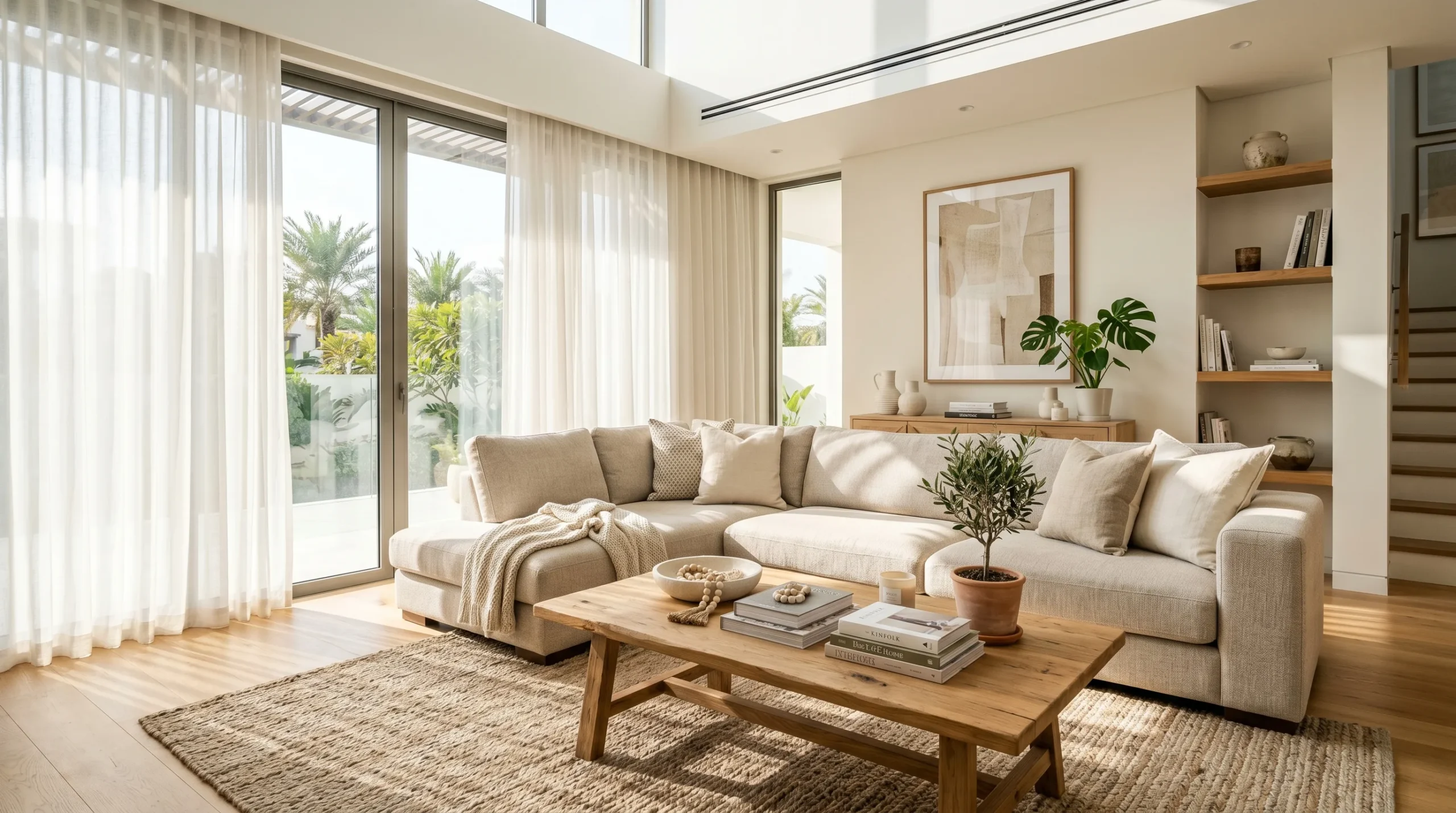
Here is a question we hear constantly at our showroom: “Why does my furniture look ten years older after just one UAE summer?” It is a fair question — and after 35 years serving over 70,000 families across the UAE, we have seen exactly what happens when good furniture meets a Gulf summer without proper preparation. The answer is almost never poor furniture. It is almost always a combination of factors that are completely preventable.
The UAE summer is unlike anything furniture was designed to handle in its country of origin. Whether your sofa came from Italy, your dining table from Malaysia, or your wardrobe from Germany — none of those factories tested their products at 45°C with 80% humidity followed by eight hours of dry, ice-cold air conditioning. According to official data from the National Center of Meteorology, these extreme fluctuations are standard for the region, creating genuinely one of the harshest environments furniture faces anywhere in the world.
Maintaining your home’s interior is a key part of preserving your property value, a sentiment often echoed by experts at Bayut, who emphasize that climate-controlled maintenance is essential for long-term residency in the Emirates. This guide walks you through exactly what to do — and what to stop doing — before summer arrives, during the season itself, and in the cooler months after.
We will cover every major furniture category, give you honest material-by-material guidance, and share the specific lessons we have learned helping UAE families from Jumeirah to Khalidiyah, from Al Ain villas to Downtown Dubai apartments. For those looking to integrate these tips into a broader sustainable UAE lifestyle, understanding the science of your home’s micro-climate is the first step.
Why UAE Summers Damage Furniture Differently
Before getting into the care routines, it is worth understanding the actual mechanisms of damage. This is not just about heat. The UAE summer creates a three-way stress on every piece of furniture in your home, and each component attacks different materials in different ways.
Heat: Outdoor temperatures regularly exceed 45°C from June through August. This alone causes wood to expand, glues to soften, leather to dry and crack, and synthetic fabrics to degrade faster than their rated lifespan.
Humidity: Coastal areas like Dubai, Abu Dhabi, and Sharjah see humidity spike to 85–90% during summer nights and early mornings. Wood absorbs moisture and swells. Metal frames begin to oxidize internally. Fabric upholstery holds moisture against foam cores, encouraging mildew that you often cannot see until the smell appears.
The AC Cycle: This is the factor most families underestimate. Every time you leave home and turn the AC up to 28°C, then return and drop it to 20°C, the air inside your home swings from humid to dry multiple times a day. Wood is particularly vulnerable to this cycling — it contracts and expands repeatedly, eventually causing splitting, warping, and joints loosening. The effect is cumulative and often invisible until one summer it becomes structural.
If you live in an apartment with north-facing rooms, you will typically see less sun damage but more humidity damage. Villa residents with large windows and direct sun exposure face a different battle — UV fading, leather drying, and wood bleaching are the primary concerns. Knowing which applies to your home shapes which care steps matter most for you.
Before Summer: The Pre-Season Checklist (March–April)
The best time to protect your furniture is before the heat arrives. A few hours of preparation in March or April will genuinely prevent hundreds — sometimes thousands — of dirhams in premature replacement costs. Here is what our team recommends systematically.
Deep Clean Everything Before Sealing It
The single most common mistake families make is applying conditioning products or covers to furniture that has not been properly cleaned first. Any dust, skin oils, food residue, or moisture trapped under a conditioner or cover becomes a breeding ground for bacteria and mould during the humid months.
For fabric sofas and upholstered pieces, vacuum every surface thoroughly — including under cushions, along seams, and behind the backrest. If you have young children, check under seat cushions for crumbs and debris that you may not notice until summer odours make them impossible to ignore. Professional upholstery cleaning before summer, typically costing AED 150–350 depending on sofa size, is worth considering every two to three years.
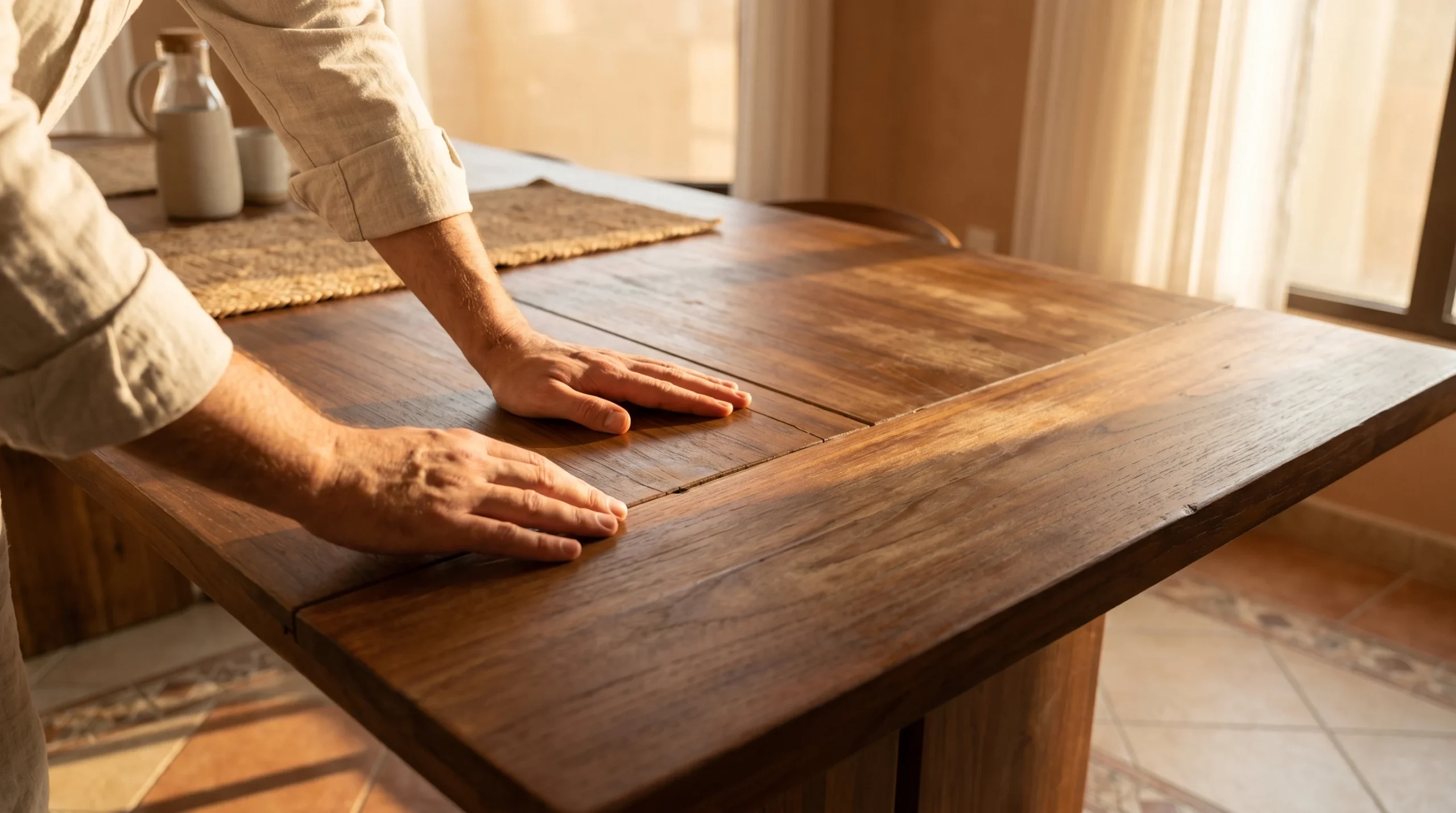
Wooden surfaces — dining tables, bed frames, wardrobes, coffee tables — should be wiped down with a lightly dampened cloth to remove dust and grease, then allowed to dry completely before any polish or wax is applied. Never apply wood conditioner to a surface that feels even slightly cool or damp to the touch.
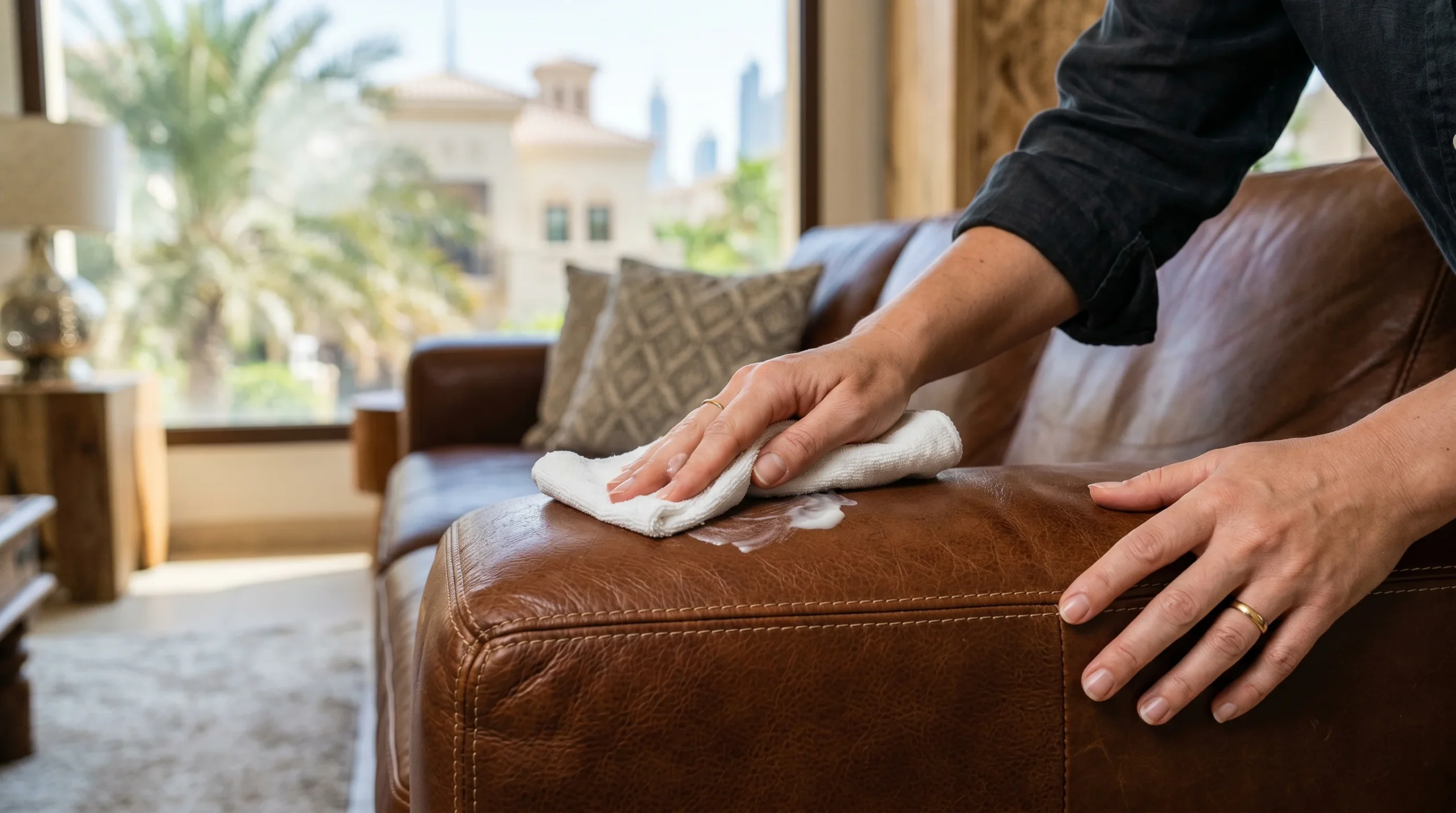
Leather furniture requires specific attention before summer. Wipe with a clean, dry cloth first, then a leather-specific cleaner, and only then apply conditioner. Think of it like sunscreen — it only works on clean skin.
Condition Leather Before the Heat Hits
Leather is one of the most heat-sensitive materials in UAE homes, and it suffers most when it enters summer already dry. In the cooler months, leather loses moisture gradually. By the time you notice cracking or stiffness, the damage has been building for months.
Apply a quality leather conditioner — available at most hardware and home stores in the UAE for AED 40–90 per bottle — to all leather sofas, chairs, and headboards in March. Work it in with a soft cloth using circular motions. Allow it to absorb for at least 30 minutes, then buff off any excess. For full leather sofas (as opposed to PU or bonded leather), this should be done twice — once in March and once in May.
How do you know if your sofa is genuine leather versus PU? Genuine leather has irregular natural grain patterns, feels slightly warm to the touch, and will develop a patina over time. PU leather has a perfectly uniform pattern, often feels cooler, and tends to peel at stress points after a few years rather than crack. PU requires conditioner too, but the products differ — use a PU-specific or synthetic leather conditioner.
Treat and Seal Wooden Furniture
Wood in UAE homes faces a specific challenge: it was likely kiln-dried and sealed for a temperate climate, and the humidity swings here exceed what that original treatment was designed for. Before summer, inspect all wooden furniture joints. Run your hand along tabletop edges and along the base of wardrobes. Any slight movement or creaking in joints that were previously solid is an early warning sign.
Apply a quality furniture wax or oil-based polish to all untreated or lightly treated wooden surfaces. For dining tables with heavy daily use, a harder paste wax provides better protection than spray polishes. Rub in the direction of the grain, allow to dry to a haze, and then buff. This creates a thin barrier against moisture absorption.
For outdoor or semi-outdoor wooden furniture — common in UAE villas with covered terraces — a teak oil or exterior wood sealant is appropriate, even for non-teak woods. Reapply every season. The cost is typically AED 50–120 per litre, and a litre covers most standard garden furniture sets.
Check Your Mattress Before the Hot Months
Mattresses are the piece of furniture most families completely forget about in their seasonal care routine, and they are among the most vulnerable to UAE summer conditions. Foam and spring mattresses absorb ambient humidity slowly, and by peak summer — July and August — a mattress in a room with imperfect air circulation can hold meaningful moisture in its core.
Before summer, rotate your mattress 180 degrees (head to foot) if it is non-pillow-top, or flip it completely if the manufacturer allows. This even out wear and gives the previously compressed side a chance to breathe and recover. Air the mattress for at least four hours by standing it upright against a wall in a dry, air-conditioned room before putting it back.
Invest in a quality mattress protector if you have not already. A waterproof-yet-breathable protector — typically AED 80–250 depending on size — creates a washable barrier between your body and the mattress. In UAE summers, when everyone sweats more even in air-conditioned rooms, this protection is genuinely important for mattress longevity.
Wardrobes and Storage Furniture: The Hidden Risk
Wardrobes and storage units are often overlooked because they do not sit in direct sunlight or feel the AC directly. But internal wardrobe spaces are poorly ventilated by design, and in UAE summers they can become warm, humid microclimates that damage both the furniture and the clothing inside.
Before summer, place small silica gel sachets inside each wardrobe section. These absorb excess moisture and are inexpensive — packs of ten sachets are widely available in UAE supermarkets for AED 15–25. Replace them every three to four months. Check the back panels of wardrobes for any signs of condensation marks or slight swelling, which indicate moisture is already accumulating.
Do not pack wardrobes so tightly that air cannot circulate between clothing items. Overcrowded wardrobes hold more heat and moisture, which affects both the internal surfaces and the garments. This is especially relevant in UAE apartments where storage space is at a premium and families often pack more into wardrobes than they were designed for.
During Summer: June Through September
Pre-season preparation handles the majority of the work, but there are active habits that matter throughout the summer months themselves.
AC Management for Furniture Longevity
The ideal indoor temperature for furniture preservation is 20–24°C, and the ideal humidity level is 40–60%. Most UAE homes running full air conditioning in summer land in this range comfortably. The problem is not the AC being on — it is the AC being off for extended periods while families travel during summer holidays.
If you are leaving your UAE home for more than two weeks during summer, do not turn off the AC entirely. Set it to 26–28°C on a timer or leave it running continuously. A completely closed, unventilated apartment in July can reach internal temperatures of 38–42°C with humidity spikes as the building’s concrete absorbs and releases heat. This environment will cause wood to warp, leather to crack, foam to compress permanently, and fabric to take on odours that are extremely difficult to remove.
The electricity cost of running your AC at 26°C for a month is significantly less than the cost of replacing furniture damaged by one season of heat exposure. This is one of the clearest return-on-investment decisions in home care.
Sun Protection: Rotate and Shield
Direct sunlight is highly damaging to virtually every furniture material. UV rays fade fabric, dry and crack leather, bleach wood finishes, and degrade foam over time. In UAE summers, the sun angle and intensity make this particularly acute.
If any furniture is in a position that receives direct sun for more than one or two hours per day, reposition it or install UV-filtering window film. Window film is available across the UAE from AED 25–60 per square metre installed, and it blocks up to 99% of UV radiation while barely affecting the light quality in a room. This is one of the best investments for furniture longevity in UAE homes.
Rotating sofas and chairs quarterly so that different sections receive the sun exposure evens out fading. If one armrest is consistently bleaching while the other looks new, that unevenness is much harder to address than even, gradual toning across the whole piece.
Upholstered Furniture During the Humid Months
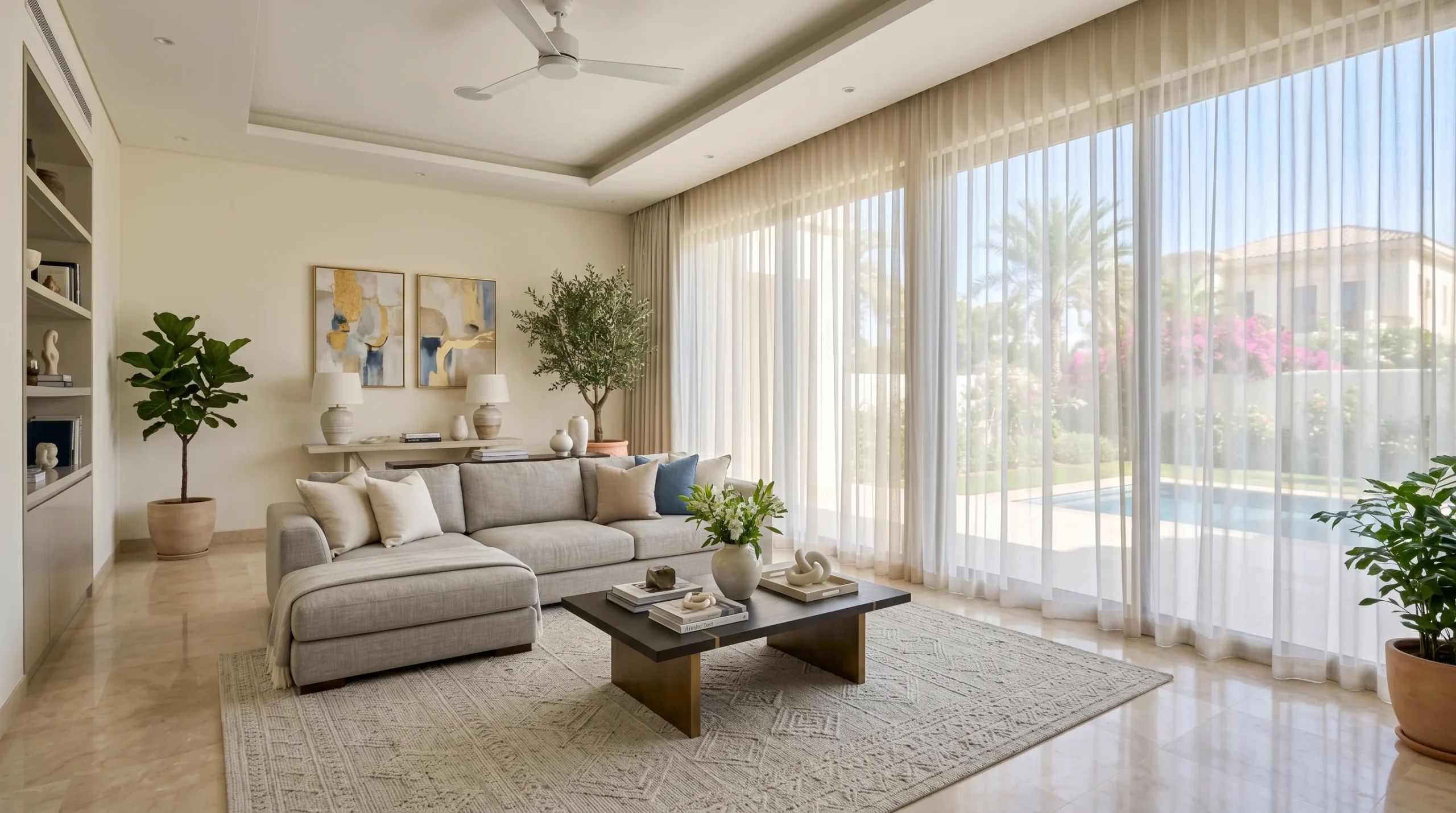
Fabric sofas in coastal UAE locations — Dubai Marina, Corniche Abu Dhabi, Sharjah waterfront areas — face genuine mould risk during peak humidity weeks in July and August. The risk is higher in ground-floor apartments, older buildings with less effective vapour barriers, and rooms adjacent to kitchens or bathrooms.
Keep sofa cushions upright when the sofa is not in use for extended periods — overnight or when you are away — to allow air circulation through the cushion cores. If your sofa cushions are removable, stand them upright leaning against the sofa back once a week during summer. This takes thirty seconds and makes a meaningful difference to cushion foam longevity.
If you detect any musty smell from upholstered pieces during summer, act immediately rather than waiting. Lightly mist the surface with a 50/50 solution of white vinegar and water from a spray bottle, allow to dry completely in an air-conditioned room, then vacuum. Serious mould penetration requires professional cleaning. The longer you wait, the more the mould embeds into the foam core rather than just sitting on the fabric surface.
After Summer: The October Reset
The weeks after summer heat breaks — typically mid-October through November — are the ideal time for your annual furniture assessment and any deeper maintenance. Furniture that has been through a UAE summer may show signs of stress that are easier to address now than after another season.
Post-Summer Inspection: What to Look For
Walk through your home with fresh eyes and check each piece of furniture systematically. On wooden pieces, check joints for movement and look along flat surfaces for any slight cupping or warping — a tabletop that previously lay perfectly flat may have developed a slight bow that is barely visible but will worsen over time. Tighten any screws that have loosened in wardrobe hinges, bed slats, or chair joints. This takes perhaps thirty minutes and extends furniture life significantly.
On leather, check for any fine surface cracking, particularly at folded areas like armrests and seat creases. Fine surface cracks caught now can be treated with leather filler and conditioner. Left another season, they become splits that are either invisible — requiring reupholstery — or impossible to fully repair.
On fabric sofas, check for any pilling, snags, or colour inconsistency that might indicate UV damage in specific areas. Check the underside of sofa cushions for any moisture staining or mould spots that developed during summer. These are almost always treatable if caught in October rather than left until the following year.
Deep Conditioning After Summer Stress
October is the second key conditioning moment of the year for leather furniture. After a UAE summer, even well-maintained leather will be drier than before. Repeat the cleaning and conditioning process from your pre-summer routine. Two thorough conditionings per year — March and October — is the minimum for leather pieces to last their potential lifespan in UAE conditions.
For wooden furniture, a post-summer polish application restores the protective layer that has been partly abrared by cleaning and daily use over summer. This is also the right time to address any minor scratches using colour-matched wood markers or touch-up kits, typically AED 30–80, available in most UAE hardware stores.
Refreshing Mattresses and Bedding After Summer
October is the ideal time for an annual mattress deep-clean. Strip all bedding and mattress protectors, launder everything according to care labels, and then vacuum the mattress surface thoroughly with an upholstery attachment. If you have access to an outdoor shaded area on a dry October or November morning, airing the mattress for two to three hours in low-humidity conditions makes a noticeable difference to freshness.
For families considering replacing a mattress, late October and November — just before UAE year-end sales — is a good moment to assess whether your current mattress has degraded enough to warrant replacement. A mattress that has lost significant support or developed persistent odours after cleaning has likely exceeded its useful life, regardless of its age in years.
Common Mistakes UAE Families Make With Furniture Care
Over 35 years and tens of thousands of home visits and conversations, the same errors come up repeatedly. These are the most costly ones.
Mistake 1: Using General Cleaning Products on Specialist Materials
Multi-purpose sprays and kitchen cleaners are genuinely damaging to leather, treated wood, and many upholstery fabrics. They contain solvents, bleaching agents, or acids that strip protective coatings, dry out natural materials, and cause irreversible discolouration. Always use material-specific products. When in doubt, plain water and a soft cloth causes less damage than the wrong cleaner.
Mistake 2: Placing Furniture Directly Against External Walls
External walls in UAE buildings — particularly in older construction — can sweat condensation during summer as cool interior air meets warm wall surfaces. A wardrobe or sofa pushed flush against an external wall traps this moisture against the furniture’s back panel, accelerating deterioration. Leave at least five centimetres of clearance between furniture backs and external walls. This applies especially to wardrobes in bedrooms with windows, and to sofas on ground-floor apartments.
Mistake 3: Ignoring the Legs and Base
The floor-level area of furniture is where humidity concentrates and where dust, pet dander, and food particles accumulate. Wardrobe bases, sofa legs, and bed frames at floor level are the first places mould and rust appear. Clean under and around furniture legs regularly, check wooden legs for swelling or softening (early mould signs), and use furniture leg pads to prevent moisture wicking from floor surfaces — particularly relevant on marble and stone floors, which can be cold and slightly damp in summer.
Mistake 4: Assuming PU Leather Lasts as Long as Genuine Leather
This misunderstanding causes real disappointment. PU (polyurethane) leather has a lifespan of three to six years under UAE conditions, compared to ten to twenty-plus years for well-maintained genuine leather. It is not a poor product — it has real advantages including lower cost, easier cleaning, and vegan credentials. But families who buy PU expecting the same lifespan as genuine leather and neglect care because they assume it is maintenance-free end up replacing sofas much sooner than necessary. PU benefits from conditioning too, and from keeping it out of direct sunlight.
Mistake 5: Over-Watering Indoor Plants Near Furniture
This is more common than it sounds. Indoor plants are popular in UAE homes, and over-watered plants — particularly in non-draining pots — create localised humidity pockets that damage adjacent furniture. If you have plants near wooden furniture or fabric sofas, check that pots have drainage and that you are not watering so frequently that the soil stays constantly wet. The effect on nearby furniture over a UAE summer can be significant.
Material-by-Material Quick Reference
Different furniture materials have distinct seasonal care needs. Here is a condensed guide covering the most common materials in UAE homes.
Genuine Leather: Condition twice yearly (March and October). Keep from direct sun. Never use water to clean spills — blot immediately with a dry cloth, then treat with leather cleaner. Target indoor temperature: 20–24°C.
PU / Bonded Leather: Condition with synthetic leather conditioner twice yearly. Keep from direct sun. Avoid sharp objects — once PU peels, it cannot be repaired, only replaced. Average lifespan in UAE: 3–6 years.
Fabric Upholstery: Vacuum weekly during summer. Deep clean annually before summer. Stand cushions occasionally to air through. Check for mould in August. Scotchgard or equivalent fabric protector reapplication every two to three years helps significantly.
Solid Wood: Polish quarterly. Condition with wood oil twice yearly. Maintain 40–60% indoor humidity. Keep from direct sun. Check joints annually. Lifespan when cared for: decades.
MDF and Engineered Wood: More vulnerable to moisture than solid wood. Keep bases from direct floor contact in humid areas. Do not clean with wet cloths — use lightly dampened microfibre only. Swelling in MDF panels is usually permanent.
Metal Frames: Wipe with a dry cloth regularly to prevent dust accumulation, which holds moisture. For any surface chips on painted metal frames, touch up immediately with matching paint to prevent rust. Chrome frames respond well to a light application of car chrome polish twice yearly.
Rattan and Cane: Genuinely challenging in UAE humidity. Wipe with a lightly dampened cloth monthly during summer to prevent the material from drying and cracking in AC. Avoid direct AC airflow on rattan pieces — the drying effect is rapid and causes splitting.
Honest Guidance on When to Repair vs. Replace
One of the questions we hear most often is whether to invest in repairing furniture or put that money toward something new. There is no universal answer, but there are clear signals.
Repair makes sense when: The structure and frame are sound, the damage is purely cosmetic or surface-level, the piece has sentimental value, or the item is genuinely high quality that will outlast a replacement if restored. Reupholstery of a quality sofa frame typically costs AED 800–2,500 depending on size and fabric, and for a solid hardwood frame it can be excellent value.
Replace makes sense when: The frame has structural damage, the foam has permanently collapsed, MDF panels have swollen and delaminated, or the total repair cost exceeds 50–60% of a quality replacement. Also consider whether the piece is meeting your family’s current needs — a sofa bought before children that is now showing wear from daily family use may simply need replacing with something more appropriate for your life stage.
Expert Tips From 35 Years of UAE Furniture Experience
These are the specific, practical points we share with families who come to us with furniture problems or questions.
Run a dehumidifier in storage rooms. If you store seasonal furniture, bedding, or extra pieces in a storage room, a small dehumidifier — available for AED 250–600 — prevents the moisture accumulation that damages stored furniture over UAE summers far more than most people realise.
Invest in proper furniture pads under all pieces. Felt pads under sofa feet, bed frames, and wardrobe bases do two things: they prevent floor scratching, and they provide a micro-gap that significantly reduces moisture transfer from cold marble floors to furniture legs. Replace them annually — they compress and lose effectiveness.
Use throws strategically, not just decoratively. A quality cotton throw over the back and arms of a fabric sofa in summer is not just aesthetic. It protects the highest-contact areas from sweat oils, sunscreen residue, and wear. Washing a throw weekly is easier and cheaper than deep-cleaning a sofa.
The sniff test before buying secondhand. If you are purchasing pre-owned furniture in UAE — increasingly common and often excellent value — smell it carefully before buying. A musty or mildewy odour means moisture damage that usually cannot be fully reversed. Pass on anything that smells even slightly damp.
Be cautious with furniture near kitchen extractor areas. Grease-laden air from cooking distributes further than most people assume. Dining chairs, the nearest section of a sofa, and any wooden shelving near an open-plan kitchen accumulate a thin layer of cooking grease that holds dust, hardens, and is significantly harder to clean than regular dust. Wipe these pieces down fortnightly in addition to regular cleaning.
Know your building’s orientation. In UAE apartments, south and west-facing rooms receive the harshest afternoon sun exposure. If your main living space faces west, your furniture investment is working against more UV exposure than a north-facing equivalent. Factor this into your material choices when buying — solution-dyed fabrics, darker leathers, and UV-resistant finishes cost marginally more but are significantly more appropriate for high-sun rooms.
Re-evaluate furniture arrangements after summer. Furniture that made sense positioned a certain way when you moved in may, over time, have ended up in sub-optimal positions — too close to AC vents (drying), in a sun stripe that has shifted seasonally, or against an exterior wall. October is the right moment to assess whether repositioning would extend the life of your key pieces.
Frequently Asked Questions (FAQ)
The “Gulf Summer” creates a unique stress cycle that most furniture isn’t tested for. While external temperatures hit 45°C, the real damage comes from the AC Cycle. Moving from 85% humidity outdoors to dry, 20°C indoor air causes wood to expand and contract rapidly, leading to warping and loose joints. Additionally, high humidity in coastal areas like Dubai Marina or Abu Dhabi Corniche can trap moisture in upholstery, leading to invisible mildew growth inside foam cores.
In the UAE’s harsh climate, leather should be conditioned at least twice a year: once in March (Pre-Summer) and once in October (Post-Summer). Leather enters the summer heat already dry from the winter AC; conditioning it in March acts like “sunscreen,” preventing the heat from cracking the hide. If you have a south-facing villa with high sun exposure, a third application in July is recommended to maintain flexibility and color.
No. Leaving your AC off for extended periods during the summer holidays is one of the most expensive mistakes you can make. An unventilated apartment in July can reach internal temperatures of 40°C+. This environment causes glues to soften, wood to split, and synthetic materials to degrade. We recommend setting your AC to a constant 26–28°C. The electricity cost is significantly lower than the cost of replacing heat-damaged furniture.
High humidity in cities like Sharjah and Dubai can lead to musty odors in upholstered pieces. To prevent this, ensure air circulation by standing sofa cushions upright once a week to let the foam “breathe.” If you detect a smell, lightly mist the fabric with a 50/50 water and white vinegar solution. For long-term protection, apply a fabric protector (like Scotchgard) every two years to create a moisture-resistant barrier.
Direct UV rays through large villa windows can bleach wood and dry out finishes in just one season. To protect your investment:
Apply a hard paste wax in March to create a physical barrier against moisture and heat.
Install UV-filtering window film, which can block up to 99% of harmful rays without losing natural light.
Maintain a 5-centimeter gap between wooden wardrobes and external walls to prevent condensation and “sweating” that leads to wood rot.
Conclusion: Protecting What You Have, Knowing When to Invest
UAE summers are genuinely hard on furniture — but the vast majority of damage we see after 35 years in this industry is preventable. A small investment of time and a modest spend on the right products twice a year will extend the life of quality furniture by years, sometimes decades. The families who get the most from their furniture investments are not necessarily those who spend the most. They are the ones who understand the materials they own and give them the right attention at the right times of year.
If your furniture is reaching the point where maintenance is no longer enough — or if you are setting up a new home and want to make choices you will not regret through five or ten UAE summers — we would genuinely enjoy helping. Our team at Karnak Home brings over 35 years of experience watching how furniture performs across UAE conditions. We can help you choose materials and constructions that suit your specific home, your family’s lifestyle, and the UAE climate honestly and practically.
Key Takeaways:
- Pre-summer preparation in March–April (conditioning, cleaning, checking joints) prevents the majority of UAE summer furniture damage.
- The AC cycle — not just heat or humidity alone — is the primary mechanism of wood damage in UAE homes; maintain 20–24°C consistently, especially while travelling.
- Post-summer assessment in October is the most important and most overlooked moment in UAE furniture care; minor issues caught then prevent major damage the following year.
- Material choice matters enormously in UAE conditions — genuine leather, solution-dyed fabrics, solid wood, and quality MDF all perform very differently, and knowing which you own determines which care steps apply.
العناية بالأثاث في مناخ الإمارات: دليلكم الشامل
في “كرنك هوم”، واجهنا آلاف التساؤلات حول سبب تدهور الأثاث بسرعة خلال أشهر الصيف. الحقيقة هي أن دورة التكييف المتقلبة والرطوبة العالية تشكل تحدياً كبيراً لأي قطعة أثاث، سواء كانت مصنعة في أوروبا أو آسيا. لضمان استدامة استثماركم، قمنا بإعداد هذا القسم المخصص لعملائنا المتحدثين باللغة العربية.
حماية الأثاث من حرارة الصيف والرطوبة
تتطلب العناية بالأثاث في الإمارات استراتيجية استباقية تبدأ قبل ذروة الحرارة. نوصي دائماً بالقيام بـ تنظيف عميق لجميع الأقمشة والجلود في شهري مارس وأبريل. إن تراكم الغبار والزيوت قبل الصيف يؤدي إلى حبس الرطوبة، مما يخلق بيئة مثالية لنمو العفن داخل الحشوات. بالنسبة للأخشاب الصلبة، فإن استخدام واكس الأثاث أو الزيوت الطبيعية يوفر طبقة حماية تمنع الخشب من امتصاص الرطوبة الزائدة ومن ثم التشقق عند تشغيل التكييف بقوة.
من أكثر الأخطاء شيوعاً هي ترك المنزل لفترات طويلة خلال الإجازة الصيفية مع إطفاء أجهزة التكييف تماماً. نوصي بترك التكييف على درجة حرارة 26-28 مئوية للحفاظ على دوران الهواء، حيث أن الحرارة المحتبسة قد تؤدي إلى ذوبان الغراء في المفاصل الخشبية وتلف الألياف الصناعية. كما يجب الانتباه إلى أشعة الشمس المباشرة التي تتسبب في بهتان الألوان وتلف الجلد؛ لذا ننصح باستخدام ستائر واقية من الأشعة فوق البنفسجية أو تغيير ترتيب الأثاث بعيداً عن النوافذ الكبيرة خلال أشهر يونيو ويوليو وأغسطس.
بعد انتهاء الصيف، في شهر أكتوبر، قم بفحص مفاصل الطاولات والكراسي، حيث يميل الخشب للتقلص والتمدد، مما يؤدي لارتخاء البراغي. إن العناية البسيطة والمنتظمة مرتين في السنة ستوفر عليك آلاف الدراهم في عمليات الاستبدال المبكرة.
هل يحتاج أثاثكم إلى تجديد أو صيانة احترافية؟
نحن في “كرنك هوم” نضع خبرتنا التي تمتد لـ 35 عاماً بين أيديكم. تفضلوا بزيارة صالتنا أو تواصلوا معنا عبر واتساب للحصول على استشارة مجانية.
تفضل بزيارة معرضنا: دبي، الإمارات العربية المتحدة.
تواصل معنا عبر واتساب: رقم الواتساب
Ready to Find Furniture Built for the UAE?
Whether you are replacing a piece that has finally reached the end of its life or furnishing a new home with UAE conditions in mind from the start, Karnak Home’s showroom and online store offer the range and expertise to help you choose well. Our team can advise specifically on which materials and constructions perform best across Dubai, Abu Dhabi, Sharjah, and beyond. Browse at your own pace online, or visit us for a conversation with someone who has seen how every material in our range actually performs in UAE homes over years and decades — not just on a showroom floor.
Shop Online: karnakhome.com
Visit Our Showroom: Karnak Home, Dubai
Speak to an Expert: +971 50 465 6780 or WhatsApp