
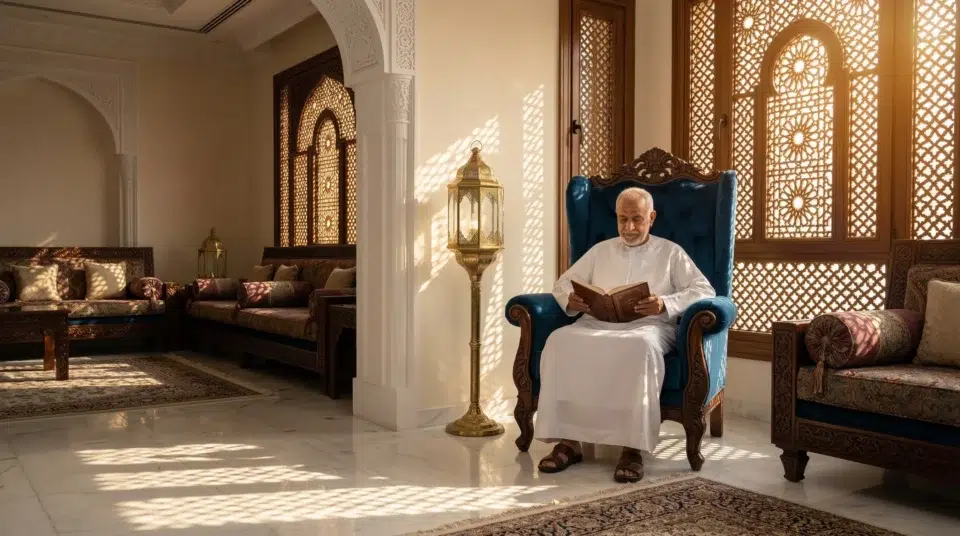
There is a room in the great Emirati home that operates by different rules from every other space in the house. The majlis, whether it occupies a dedicated wing in a villa in Mohamed Bin Zayed City or a carefully preserved formal room in an older family property in Mirdif, is not simply a sitting room. It is the physical expression of a household’s relationship with its guests, its culture, and its sense of what hospitality means. Every piece of furniture in the majlis carries meaning. The accent chair, positioned as the single seat of particular status, or paired with low upholstered benches along the walls, or placed at the corner of a contemporary open-plan reception room that wants to speak Arabic without requiring a dedicated majlis, is the piece that most clearly communicates this cultural literacy.
At Karnak Home, we have been furnishing UAE homes since 1988. Across 36 years and more than 70,000 families served, we have delivered furniture to majlis rooms in Emirati and Gulf national villas from Al Ain to Abu Dhabi to Ras Al Khaimah, and to the formal reception rooms of expat families who have lived long enough in the UAE to understand and love the majlis tradition. We have seen what works in a culturally authentic majlis, what works in a contemporary Arabic-crossover interior design scheme, and what fails in both contexts. That experience, combined with genuine respect for the design heritage this article is about, is the foundation of this guide.
This is the most complete guide available in 2026 to selecting, styling, and placing an Arabic accent chair in a UAE home. It covers the design principles of the majlis tradition and how they translate into furniture choice, the specific chair types and silhouettes that honour rather than imitate Arabic heritage, the material and upholstery traditions of the Gulf home, the 2026 trends where contemporary UAE design and Arabic heritage intersect most powerfully, the common mistakes made even by well-intentioned buyers, and a clear AED budget guide for every level of investment from a well-made heritage-inspired piece to a bespoke commissioned luxury chair. Whether you are Emirati, a Gulf national, or a respectful admirer of Arabic design culture, this guide will help you make the right choice for your home.
Why Arabic Accent Chair Selection in UAE Homes Requires a Cultural Framework
Selecting an Arabic accent chair is not only an aesthetic decision. It is a cultural one. Understanding the principles that govern Arabic interior design, particularly the majlis tradition, ensures that the chair you choose genuinely honours the heritage it draws from rather than reducing it to surface decoration.
The Majlis Tradition and Its Furniture Philosophy
The word majlis derives from the Arabic root meaning to sit. In its fullest cultural sense, a majlis is both a physical space and a social institution: the dedicated room where a household receives guests, conducts conversations of consequence, and demonstrates its commitment to the Arabic value of generational hospitality. The furniture philosophy of the traditional majlis follows principles that differ fundamentally from Western interior design. Where Western design emphasises the individual comfort piece, the majlis prioritises communal seating along the room’s perimeter, creating a configuration that includes every person in the gathering rather than arranging seats to face a focal point such as a television.
In the traditional majlis, seating is low, generous, and continuous. Upholstered benches, floor cushions, and low-arm settees run along three walls, creating an uninterrupted horizontal line of hospitality. The single accent chair, when it appears, is placed at the room’s focal end, typically opposite the entrance, and is understood as the seat of the host or the most honoured guest. Its elevated back height, its more elaborate upholstery, and its slightly more imposing presence mark it as distinct within the otherwise egalitarian perimeter seating arrangement.
The Contemporary Majlis and the Rise of Crossover Arabic Design
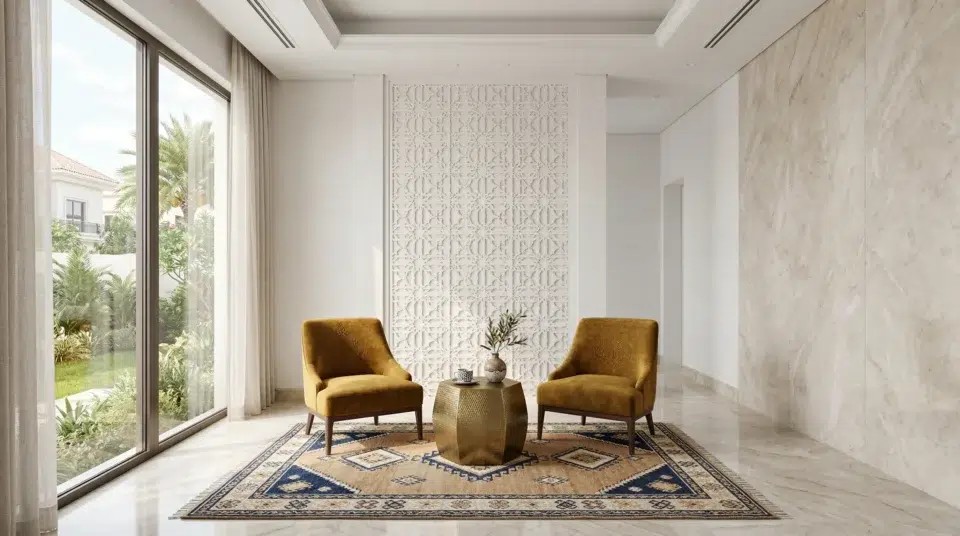
Modern UAE villa design, particularly in developments such as Emirates Hills, Saadiyat Island, and the prestigious compounds of Mohamed Bin Zayed City and Khalifa City in Abu Dhabi, has evolved significantly from the traditional dedicated majlis room. Contemporary Emirati and Gulf national families increasingly want formal reception spaces that communicate cultural identity through design language rather than through architectural separation. A contemporary open-plan villa reception room that incorporates Arabic-inspired accent chairs, geometric textile rugs, brass lantern lighting, and mashrabiya-screened window dressing achieves the cultural signal of a majlis without requiring a physically separate room.
This crossover aesthetic is one of the most important developments in UAE interior design in the 2020s, and it creates a new context for the Arabic accent chair: a piece that carries the visual vocabulary of Gulf heritage while functioning within a modern open-plan interior. For interior designers working in Dubai and Abu Dhabi, and for homeowners who want their spaces to reflect their cultural identity with contemporary sophistication, understanding how to select an Arabic accent chair for this crossover context is essential.
The Expat Who Loves Arabic Design: Respect and Authenticity
A significant and growing segment of Arabic accent chair buyers in the UAE is long-term expats who have absorbed and genuinely love Arabic interior design culture through years of living in the Gulf. Many have visited traditional Emirati homes, experienced the warmth of majlis hospitality, and want to incorporate elements of that aesthetic into their own interiors. This is a respectful and welcome impulse, and when executed with genuine cultural understanding rather than superficial decoration, it produces interiors that honour rather than appropriate the tradition. The key principle for expats navigating this space is this: let the design elements do authentic work. An Arabic-inspired accent chair positioned with a geometric rug, a quality brass lantern lamp, and an ornate side table creates a genuine cultural conversation. The same chair with mismatched decorative elements from several different cultural traditions creates visual confusion.
UAE Villas and the Architectural Contexts of Arabic Accent Chairs
Arabic accent chairs in UAE homes typically appear in four distinct architectural contexts. The first is the dedicated traditional majlis room, which has its own strict internal logic. The second is the formal reception room in a contemporary villa that integrates Arabic design elements within a modern interior framework. The third is the living room corner in a villa or large apartment where a single Arabic-inspired accent chair functions as the room’s cultural focal point. The fourth is the private family room or master bedroom sitting area, where an Arabic-inspired accent chair adds warmth and personal heritage reference in a more intimate context.
Each context has different requirements for chair scale, formality level, and design intensity. A throne-style high-back chair in heavily carved dark walnut with jewel-toned velvet upholstery is appropriate for the formal, dedicated majlis in a villa in Emirates Hills. A more restrained curved-back armchair with Arabic geometric upholstery in a mid-tone performance fabric is appropriate for a contemporary villa living room crossover corner in Al Barsha or Arabian Ranches. The cultural vocabulary is the same; the volume at which it is spoken must be calibrated to the context.
Climate and the Majlis Room: Practical UAE Considerations
Majlis rooms in UAE villas present specific climate management challenges. Large formal rooms with high ceilings in properties across Abu Dhabi and Dubai often have less effective air circulation than the main living areas, since they are used intermittently rather than daily. During peak summer months when temperatures reach 45 to 50 degrees Celsius and humidity along the coast reaches 70 to 90 per cent, a seldom-used majlis can accumulate heat and moisture more rapidly than a continuously occupied room. Arabic accent chair upholstery choices for majlis rooms must account for this: velvet and natural fabric chairs in a majlis that is closed during summer months for several weeks should be covered with breathable fabric dust covers to prevent moisture absorption and dust accumulation. Performance fabric and coated synthetic options require less maintenance in these conditions, though the cultural aesthetic of the majlis traditionally favours richer natural materials.
Multigenerational Emirati Households and Seating Accessibility
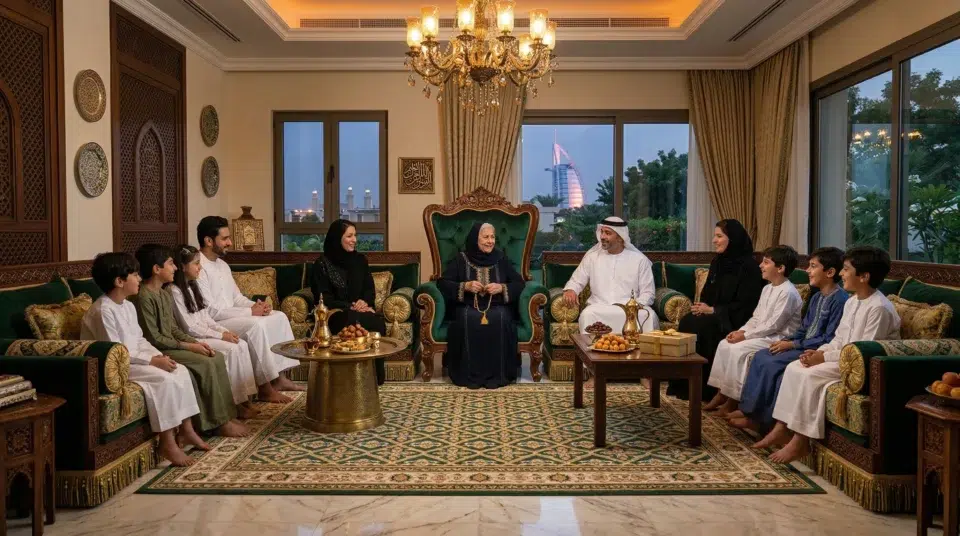
Emirati and Gulf national family structures frequently include three generations under one roof or in closely connected compound properties. Grandparents and elderly family members are central participants in majlis gatherings, and their physical comfort must be designed as deliberately as the aesthetic of the space. For elderly household members, Arabic accent chairs with seat heights of 44 to 50 centimetres from the floor and firm lateral armrests that support the body during the process of sitting and rising are the correct specification. The purely decorative, very low-seat accent chairs that look beautiful in photographs but require physical effort to rise from are a poor choice for any UAE home where elderly family members are regular guests or residents.
The Definitive Style Guide to Arabic Accent Chair Types for UAE Homes
Arabic accent chairs available in the UAE market range from historically faithful interpretations of traditional Gulf seating to contemporary designs that use Arabic visual vocabulary in thoroughly modern silhouettes. This section defines each type and specifies its correct context.
The High-Back Throne Style Chair: The Traditional Majlis Statement Piece
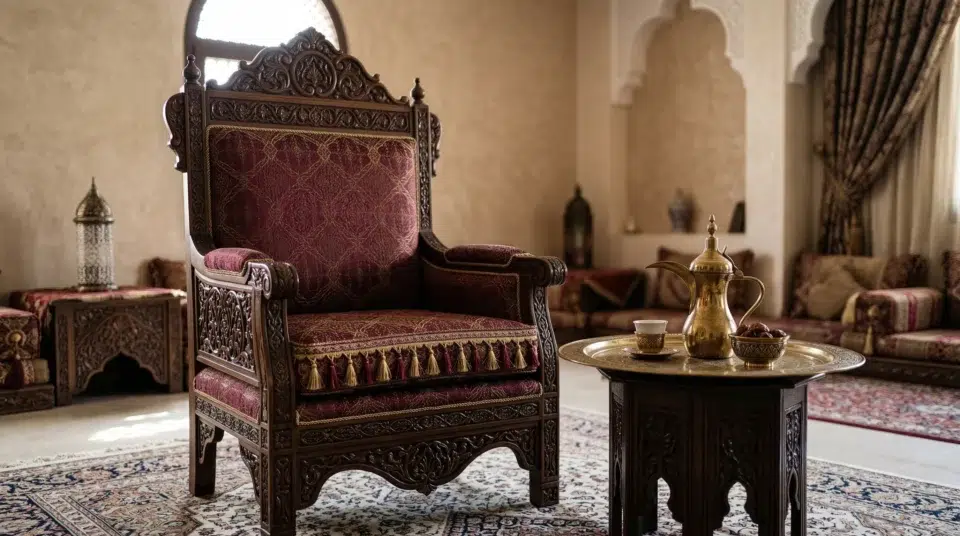
The high-back throne-style Arabic accent chair is the most culturally direct interpretation of traditional Gulf formal seating. Characterised by a back height of 110 to 130 centimetres, carved dark or medium wood frame detailing often incorporating arabesque or geometric motifs, heavily upholstered seat and back in rich fabrics such as deep velvet or brocade weave, and wide flat armrests at a generous height of 68 to 75 centimetres, this chair communicates formal authority within the majlis context with complete clarity.
In a dedicated traditional majlis, the high-back throne-style chair is placed at the focal end of the room, opposite the entrance, slightly elevated on a low platform if the room architecture supports it. It should be flanked by smaller-scale majlis seating on both sides rather than isolated in open space, which would read as theatrical rather than culturally grounded. For a contemporary villa reception room in Mohamed Bin Zayed City or an Emirates Hills villa, a single throne-style chair used as a sculptural statement piece in a corner beside a tall brass floor lamp creates a powerful design focal point. Price range in the UAE market: AED 2,500 to 12,000, depending on wood quality, carving complexity, and fabric specification. Browse our formal majlis accent chairs UAE for available options.
The Low-Seat Generous-Armed Chair: The Classic Majlis Perimeter Piece
The classic Arabic majlis seating silhouette is lower, wider, and more horizontally generous than its European counterpart. A seat height of 36 to 44 centimetres, a seat depth of 60 to 70 centimetres, and wide flat armrests of 12 to 18 centimetres create a seating experience rooted in ease and extended comfort: the posture of someone who expects to sit for a long time in conversation, not someone perching briefly. When adapted into a single accent chair rather than a continuous bench, this silhouette becomes a compact statement piece that carries the majlis tradition into a contemporary open-plan context.
For UAE villa owners in Jumeirah, Al Barsha, and Arabian Ranches who want an Arabic design reference in their living room without a dedicated majlis room, a low-seat, generous-armed Arabic accent chair in a rich performance fabric or quality velvet placed beside a low hexagonal brass side table creates a culturally coherent corner that speaks the majlis aesthetic quietly and confidently. Seat height 38 to 44 cm. Overall width 80 to 95 cm. Recommended fabric: deep jewel tones in tight-weave velvet or quality brocade for formal contexts, or Arabic geometric performance fabric weave for contemporary crossover rooms.
The Carved Wood Frame Armchair: Craft as Cultural Expression
In Arabic interior design, the quality of the woodworking in furniture communicates status and cultural investment as clearly as the fabric does. Carved wood frame armchairs, where the visible wooden elements of the back crest, the arm panels, and the leg columns carry arabesque, geometric, or calligraphic carving, are among the most culturally expressive furniture pieces available in the UAE market. Walnut, ebony-stained hardwood, and light honey-toned cedar are the most common wood tones in Gulf furniture tradition, each carrying slightly different regional and aesthetic associations.
In a contemporary UAE interior, a carved wood frame armchair does not require a full traditional context to work effectively. A single carved-frame chair in a modern neutral-toned living room in a villa in Dubai Hills or Al Reem Island, positioned with a simple geometric rug and a clean-lined brass floor lamp, creates a cultural conversation between contemporary and heritage design that reads as sophisticated rather than incongruous. The craft of the carving is the visual event. Keep the surrounding space restrained to allow it to be seen clearly. Price range: AED 1,800 to 7,000. View our carved wood armchairs UAE collection.
The Contemporary Arabic Chair: Geometry and Pattern in Modern Silhouettes
The most commercially accessible category for the majority of UAE buyers is the contemporary Arabic accent chair: a modern silhouette, typically a clean-lined barrel or open-back armchair with slim legs and a proportionate seat width of 70 to 82 centimetres, upholstered in a fabric featuring Arabic geometric pattern, arabesque motif, or traditional Gulf textile colour palette. This chair type requires no architectural context to succeed. It works in a modern Dubai apartment, a villa family room, a bedroom corner, and a contemporary reception room with equal effectiveness because the cultural reference is carried by the fabric rather than the structure.
For expats and younger Emirati families in developments like Town Square, Emaar South, and Al Reem Island who want to incorporate Arabic design culture into contemporary interiors, the contemporary Arabic chair is the most practical entry point. The geometric fabric can be sourced in performance weave for family-room durability, in velvet for bedroom luxury, or in a natural weave equivalent for a formal guest room. The chair’s modern silhouette ensures it integrates with contemporary furniture without requiring a complete room redesign. Browse our Arabic-style armchairs in the UAE for the current geometric pattern range.
The Brass-Detailed Accent Chair: Gulf Metalwork Tradition in Furniture
Brass is one of the most consistently present materials in Gulf decorative arts, from engraved dallah coffee pots to ornate door knockers to the metalwork of traditional wooden chests. In contemporary UAE furniture, brass detailing on accent chairs takes the form of brass nail-head trim along seat and back edges, brass-capped leg ends, brass-inlay decorative panels on arm surfaces, and brass ring-pull details. A chair with quality brass trim detailing in an otherwise clean-lined contemporary silhouette carries the metalwork tradition of Gulf craft into a modern furniture context with restraint and elegance.
For buyers in Abu Dhabi and Dubai who want a cultural reference that is subtle rather than overtly decorative, a clean-lined armchair with quality brass nail-head detailing in a deep jewel-tone velvet achieves the Gulf design aesthetic without any single element that reads as costume or theme. The brass is a detail, not a declaration. Price range: AED 1,400 to 4,500. Our Gulf-inspired accent chairs with brass detailing include several pieces with this specific specification.
2026 Trends Where Arabic Heritage and Contemporary UAE Design Meet
Arabic interior design in the UAE is not static. The most interesting design territory in 2026 is the space where Gulf heritage principles intersect with contemporary international aesthetics, creating interiors that are distinctly Emirati and distinctly modern simultaneously.
Trend 1: Jewel Tones as the New Cultural Palette
The traditional Arabic colour vocabulary of lapis, emerald, deep gold, burgundy, and sapphire is reasserting itself in UAE interiors after years of dominance by Nordic neutrals. In 2026, jewel-tone velvet accent chairs are the most visible expression of this reassertion. A deep sapphire chair in a white-walled Abu Dhabi villa formal room, a forest green accent chair in a Sharjah family home with Arabic geometric cushions, and a rich burgundy carved-frame armchair in an Emirates Hills majlis are all expressions of the same trend: the confident return of the Gulf’s own colour culture to its own homes. These colours also perform acceptably in UAE conditions when specified in quality tight-pile polyester velvet, since darker tones resist the dust visibility that makes light velvet impractical in sandy Gulf environments.
Trend 2: Mashrabiya Pattern as Upholstery Motif
The mashrabiya lattice pattern, historically used in carved wooden window screens to provide privacy and filter light in Arabic architecture, is one of the most recognisable and beloved motifs in Gulf visual culture. In 2026, this pattern is appearing on accent chair upholstery as a woven or printed geometric fabric, transforming a contemporary chair silhouette into a culturally resonant piece through the power of pattern alone. A slim-profile modern armchair in a mashrabiya-pattern performance fabric, placed in a contemporary Dubai villa living room, achieves the Arabic design reference with subtlety and sophistication. The chair’s silhouette can be entirely contemporary. The pattern does the cultural work.
Trend 3: Low-Seat Majlis Proportions in Contemporary Frames
Contemporary UAE furniture designers are increasingly revisiting the proportional logic of traditional majlis seating, specifically its lower seat height and generous seat depth, and reinterpreting it within contemporary furniture aesthetics. A chair with a 40-centimetre seat height, a 65-centimetre seat depth, and slim powder-coated black metal legs is structurally a modern piece but somatically a majlis piece: the body adopts the low, relaxed, extended posture associated with extended Gulf hospitality. For Emirati and Gulf national buyers who want furniture that feels culturally familiar in its physical experience even when it looks contemporary in its visual design, this trend is one of the most satisfying available in 2026.
Trend 4: Arabesque Carved Backs on Otherwise Minimal Chairs
One of the most refined expressions of Arabic design culture in contemporary furniture is the chair that is entirely restrained except for a single element of extraordinary craft. A chair with a clean-lined seat and simple legs in natural wood, where the back panel features an arabesque or geometric carved detail in the wooden frame, achieves maximum cultural impact with minimum design noise. The carved back is the entire statement. In a contemporary white-walled reception room in Al Reem Island, Abu Dhabi, or a villa in Mohammed Bin Rashid City, this chair reads as the work of someone who knows exactly what they are doing with Arabic design: using it with precision, not with volume.
Trend 5: Arabic Calligraphy Motifs on Statement Chairs
Arabic calligraphy, recognised as one of the highest art forms in Islamic culture, is appearing in 2026 on limited-edition accent chairs as embroidered, woven, or printed upholstery motifs. Verses of significance, blessings, and poetic phrases rendered in classical Arabic script create chairs that are simultaneously furniture and cultural artefacts. For a majlis room where conversation is the highest purpose and every element of the room contributes to that purpose, a calligraphy-motif accent chair in a quality fabric introduces a meaningful dimension that a purely decorative pattern cannot achieve. This trend is particularly strong among Emirati families furnishing new properties in Abu Dhabi’s premium developments on Yas Island and Saadiyat Island.
Trend 6: The Heritage-Modern Pair Matching One Traditional and One Contemporary Chair
One of the most design-intelligent trends in UAE formal rooms in 2026 is the deliberate pairing of one authentically traditional Arabic accent chair, typically a carved-frame piece in a rich fabric, with one contemporary Arabic-crossover accent chair in a modern silhouette with heritage pattern upholstery. The two chairs, placed symmetrically or in a conversational angle to each other, create a design dialogue between tradition and modernity that is architecturally interesting and culturally honest. It signals that the homeowner understands and values both expressions of their heritage. For interior designers working on UAE villa formal rooms in developments like Tilal Al Ghaf and Damac Hills, this pairing approach is becoming a signature move.
Trend 7: Natural Materials as Cultural Authenticity Signals
In 2026, the most culturally informed Arabic accent chairs in UAE homes are specified with genuinely natural materials: solid walnut or cedar frames with no veneer, natural wool or cotton fabric blends in traditional weave patterns, and hand-applied finishes rather than factory lacquers. These material choices signal cultural seriousness and investment in craft rather than decoration. For luxury villa buyers on Palm Jumeirah, Emirates Hills, and Saadiyat Island, specifying a truly natural-material Arabic accent chair is both a design statement and a values statement. The price premium, typically AED 4,000 to 12,000 for genuine craft-quality pieces, is understood by this audience as the correct investment in furniture that carries meaning.
Materials and Upholstery for Arabic Accent Chairs in UAE Homes
The material traditions of Arabic furniture design intersect with the practical climate realities of UAE living in ways that require informed compromise in some cases and principled specification in others.
Brocade and Woven Jacquard: The Fabric of the Traditional Majlis
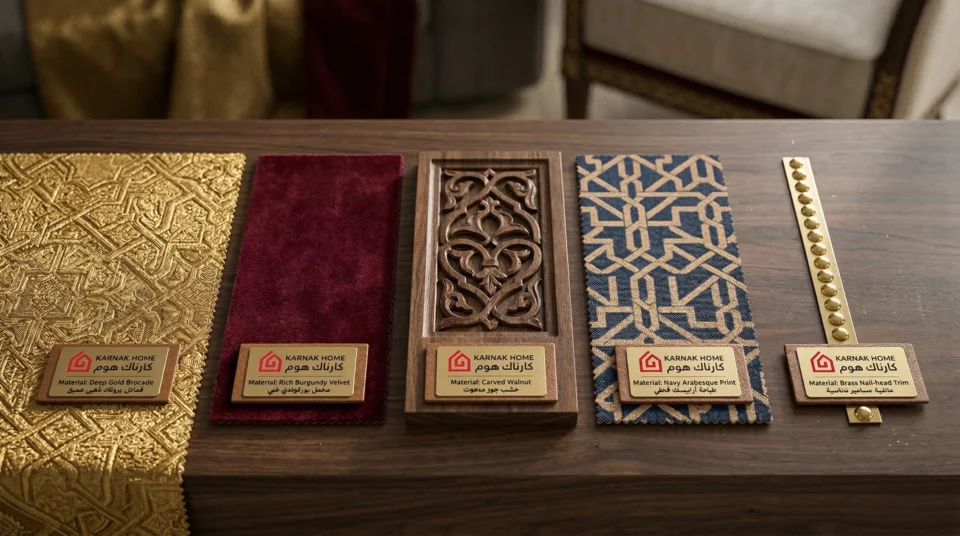
Brocade and jacquard weave fabrics, characterised by raised geometric or floral patterns woven into the textile structure rather than printed on its surface, are the historic upholstery fabrics of formal Arabic furniture. Their raised pattern surface creates tactile richness and visual depth that printed fabrics cannot match, and their association with formal Gulf interiors is culturally specific and widely understood. In a dedicated traditional majlis in an Abu Dhabi or Dubai villa, brocade or jacquard upholstery on the accent chair is the culturally correct choice.
The practical limitation of brocade in UAE conditions is its maintenance requirement. Brocade weaves are not stain-resistant, require professional cleaning rather than spot treatment, and should not be used in rooms that experience high humidity without air conditioning. For a formally maintained majlis room that is cleaned regularly and climate-controlled consistently, brocade is manageable and beautiful. For a family room or a room that doubles as a children’s play area, it is the wrong fabric regardless of its cultural appropriateness. In those contexts, choose a geometric performance fabric that achieves the visual reference of brocade with genuinely practical maintenance.
Velvet in the Arabic Context: Depth, Luxury, and Cultural Association
Deep-pile velvet has a long association with luxury in both European and Arabic interior design traditions. In the Gulf context, velvet’s light-absorbing depth and rich colour saturation align naturally with the jewel tones of the Arabic colour palette. A deep sapphire velvet accent chair in a UAE majlis room does not look incongruous. It looks exactly right. The practical rules for velvet in UAE conditions are the same as those described in our fabric vs leather accent chair UAE guide: choose tight-pile polyester velvet in deep tones, ensure consistent air conditioning, and plan for annual professional cleaning in high-use rooms. In a formal majlis used primarily for guest reception, where daily contact is lower than in a family living room, velvet is a genuinely practical and culturally resonant choice.
Carved Walnut and Dark Hardwood: The Frame as Cultural Statement
The visible wooden frame of an Arabic accent chair is not a structural background. It is a primary design element. Carved walnut, ebony-stained hardwood, and dark rosewood-toned finishes are the most culturally resonant frame choices for Arabic accent chairs in UAE formal rooms. The quality of the carving indicates investment in craft: shallow machine-routed patterns read as decoration applied after the fact; deep hand-guided or precision-tool carving reads as furniture made by someone who understood the cultural significance of what they were making. When purchasing a carved wood frame Arabic accent chair, always inspect the carving depth and consistency. Sharp, deep, consistent carving edges indicate quality. Rounded, shallow, inconsistent lines indicate a manufactured shortcut that will become more visually apparent as the piece ages.
Performance Fabric in Arabic Pattern: The Practical Crossover Choice
For UAE families who want Arabic design culture in a chair that also survives daily family use, Arabic geometric print or woven performance fabric is the correct compromise. Solution-dyed performance fabrics are now available in traditional Arabic geometric patterns, arabesque motifs, and Gulf colour palettes that are visually indistinguishable from traditional natural fabric weaves at a conversational distance. The practical difference is transformative: the performance fabric resists staining, UV fading, and humidity, cleans with a damp cloth, and costs significantly less to maintain than natural brocade or velvet over a five-year ownership period. For the family room Arabic crossover chair in Arabian Ranches, Al Barsha, or Sharjah, performance fabric in an Arabic pattern is not a cultural compromise. It is a culturally intelligent and practically sound decision. Explore our Arabic pattern performance fabric chairs for current options.
8 Mistakes UAE Buyers Make When Choosing an Arabic Accent Chair
These are the errors that most frequently undermine the cultural and aesthetic success of Arabic accent chair purchases in UAE homes.
Mistake 1: Treating Arabic design as costume rather than culture. The most common and most damaging mistake is selecting Arabic-looking decorative elements from multiple disconnected traditions and assembling them in a room without cultural coherence. A carved Arabic chair beside a Moroccan lamp beside an Indian embroidered cushion beside a Turkish carpet creates cultural confusion rather than cultural richness. Fix: choose one primary design tradition, the Gulf Arabic tradition for UAE homes, and let all selected elements speak the same visual language. Consistency of cultural reference creates authenticity.
Mistake 2: Choosing a throne-style chair for a room that cannot carry its scale. A high-back throne-style Arabic accent chair at 125 centimetres back height is a genuinely imposing piece. In a modest villa family room with a 2.8-metre ceiling and existing furniture at standard contemporary proportions, it looks theatrical rather than formal. Fix: reserve throne-style Arabic chairs for dedicated majlis rooms with ceiling heights above 3.2 metres, or for formal reception rooms in large villas. For smaller rooms, choose a low-seat, generous-armed Arabic chair at 90 to 100 centimetres back height.
Mistake 3: Using machine-quality carved detail as a substitute for genuine craft. Shallow machine-routed arabesque patterns on chair frames look convincing in photographs but read as manufactured decoration in person. The distinction becomes visible within the first sixty seconds of examination. Fix: when purchasing a carved frame Arabic accent chair, handle and examine the carving in person at a showroom. Deep, clean-edged, consistent carving that feels like a relief sculpture is the correct standard. Our team at the Karnak Home showroom in Sharjah can demonstrate the difference between quality and economy carving on our in-stock pieces.
Mistake 4: Ignoring elderly family member comfort in formal rooms. Many UAE formal majlis and guest rooms are designed primarily for visual impact, with very low-seat accent chairs that are difficult for elderly family members to rise from without assistance. In Emirati and Gulf national households where elderly grandparents are honoured guests in every gathering, this is a serious functional failure. Fix: ensure that at minimum one accent chair in every formal UAE room has a seat height of 44 to 50 centimetres and firm lateral armrests that support the body during rising.
Mistake 5: Placing the formal accent chair in a position that breaks the room’s social geometry. The traditional majlis places the seat of honour at the focal end of the room, clearly visible from the entrance and accessible to everyone in the gathering. Placing the primary Arabic accent chair against a side wall or in a corner that is not visible from the room’s entrance undermines the social logic of the arrangement entirely. Fix: identify the room’s focal axis from the entrance door before placing any furniture, and position the primary accent chair at the end of that axis, where it commands the room’s attention naturally.
Mistake 6: Choosing light or warm-neutral upholstery for a formal Arabic accent chair. Cream, ivory, and warm beige upholstery on an Arabic accent chair look elegant in a showroom. In a formal UAE majlis used for regular guest reception during the extended hosting seasons of Ramadan and Eid, light upholstery requires professional cleaning every six to eight weeks to maintain the visual standard expected in a formal room. Fix: choose deep jewel tones or rich mid-tones, sapphire, emerald, burgundy, deep gold, or forest green, for formal Arabic accent chairs that will see regular use during UAE hospitality seasons.
Mistake 7: Not accounting for the acoustic and light quality of the majlis room. Formal majlis rooms in UAE villas are often the largest, most architecturally imposing rooms in the property, with high ceilings, marble floors, and large windows. These features create acoustic brightness (sound bouncing between hard surfaces) and intense directional light at certain times of day. An accent chair placed directly in the path of afternoon west-facing light in a villa in Abu Dhabi will have its upholstery UV-faded within one to two years if not specified in a UV-stabilised fabric. Fix: identify the room’s light paths at different times of day before placing any formally upholstered chair, and specify UV-stabilised fabrics for any chair that will receive more than four hours of direct or near-direct sunlight daily.
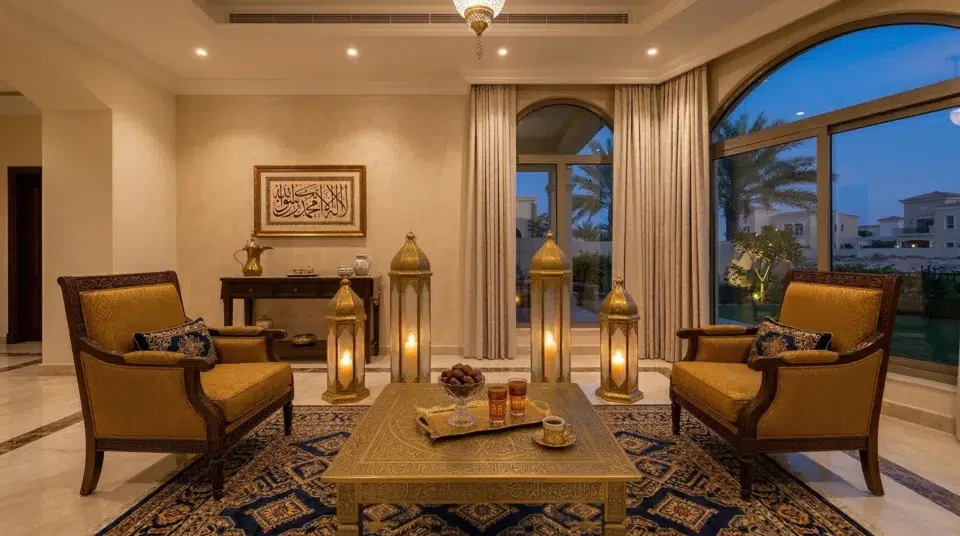
Mistake 8: Purchasing an Arabic accent chair without considering the complete vignette. A beautiful Arabic accent chair standing alone on a marble floor without a complementary side table, lamp, or rug reads as an isolated object rather than a considered cultural statement. Fix: plan the complete corner or focal arrangement before purchasing. The chair should be accompanied by at minimum one complementary piece: a hexagonal brass side table, an engraved metal lantern floor lamp, or a geometric-pattern area rug. The ensemble creates the cultural context. The chair alone cannot.
2026 Budget Guide in AED for Arabic Accent Chairs in UAE Homes
The Arabic accent chair market in the UAE spans from accessible contemporary interpretations to bespoke luxury commissions. This table reflects current market pricing as of March 2026.
| Tier | AED Range | What You Get | Best For |
|---|---|---|---|
| Mid-Range | AED 900 to 2,500 | Emirati villa owners in Dubai and Abu Dhabi, formal reception rooms, and dedicated majlis spaces | Expats and young Emirati families in apartments and mid-range villas across JVC, Al Barsha, Sharjah, Arabian Ranches |
| Premium Heritage | AED 2,500 to 6,000 | Kiln-dried hardwood frame with quality carved detail, velvet or brocade upholstery, HR foam, 7-year-plus durability | Palace-level villas on Palm Jumeirah, Emirates Hills, Saadiyat Island, and formal majlis commissions |
| Luxury Craft | AED 6,000 to 14,000 | Solid walnut or dark hardwood hand-carved frame, natural brocade or custom fabric, traditional joinery, investment-grade piece | Palace-level villas on Palm Jumeirah, Emirates Hills, Saadiyat Island, formal majlis commissions |
| Bespoke Commission | AED 14,000 and above | Fully custom specification, handmade construction, calligraphy or family crest motifs on request | UHNW Emirati households, new villa majlis fit-outs, heritage property restorations |
For most UAE buyers, the premium heritage tier at AED 2,500 to 5,000 delivers the most culturally satisfying combination of authentic design vocabulary, quality material, and practical UAE climate performance. Browse our Arabic accent chairs with AED pricing for current availability at each tier.
10 Expert Tips from 36 Years of Furnishing UAE Majlis and Formal Rooms
In our 36 years, we have furnished hundreds of dedicated majlis rooms and formal reception spaces across UAE villas from Abu Dhabi to Ras Al Khaimah. These are the principles that most consistently produce successful outcomes.
Tip 1: In our 36 years, we have seen that the most successful Arabic accent chair selections begin with the room’s cultural purpose, not its dimensions. Ask first: what does this room need to communicate about the household that owns it? The answer to that question will determine the correct level of design formality before any measurement is taken.
Tip 2: We always advise customers to furnish a dedicated UAE majlis room to select the accent chair first, before any other piece, because it establishes the room’s design register. Every subsequent selection, the perimeter seating, the side tables, the rugs, and the lighting, should be calibrated to the accent chair’s level of formal intensity. A high-carved throne-style chair requires high-intensity companions. A contemporary Arabic crossover chair calls for more restrained accompaniment.
Tip 3: In our experience, the most common material mistake in UAE formal rooms is choosing brocade or natural fabric upholstery for a majlis that is closed and unventilated for extended periods during summer. We strongly recommend that customers who leave UAE villas unoccupied for four to six weeks during summer, which is very common among both Emirati families and expat residents, use breathable fabric dust covers on all upholstered formal seating in the majlis to prevent moisture absorption during the unventilated period.
Tip 4: We have observed consistently that the Arabic accent chair performs best when it is the most elaborate piece in the room rather than one elaborate piece among many. A room where every surface is carved, gilded, patterned, and textured produces visual noise. A room where most surfaces are restrained and one piece, the Arabic accent chair, carries the full weight of cultural expression, produces cultural intelligence.
Tip 5: Over the years of deliveries to UAE villa formal rooms, we have found that the floor covering beneath and around the Arabic accent chair is as important as the chair itself in establishing the space’s cultural character. A high-quality hand-knotted or machine-made geometric-pattern rug in a traditional Gulf colour palette, positioned so that the chair’s front legs rest on the rug’s inner third, anchors the vignette and connects the chair to its cultural context more powerfully than any other single accessory.
Tip 6: In our 36 years, we have seen that customers who choose Arabic accent chairs based purely on visual impact in a showroom and then live with them daily frequently find the very low seat heights of traditional pieces uncomfortable for extended sitting. If you are purchasing a low-seat Arabic accent chair for a room that will also be used for extended family gatherings of two or more hours, confirm the seat height and test the sitting and rising movement personally. Cultural authenticity and physical comfort are not mutually exclusive, and many quality pieces offer both.
Tip 7: We always recommend to customers in formal UAE villa contexts that they consider using our Arabic accent chair styling consultation service before finalising a major purchase. Our consultants have specific experience with majlis and formal Arabic room design and can visit the property, assess the architectural context, and recommend the correct piece, placement, and accompanying elements as an integrated design decision rather than a series of individual purchases.
Tip 8: In our experience delivering across Abu Dhabi, Ras Al Khaimah, and Al Ain, we have found that the most culturally resonant formal rooms are those where the homeowner has incorporated at least one genuinely handmade element alongside quality manufactured furniture. A single hand-embroidered cushion on an Arabic accent chair, a hand-beaten brass tray beside it, or a hand-calligraphed artwork on the wall above it introduces an authentic craft quality that elevates the entire room and signals genuine cultural investment rather than decorated consumption.
Tip 9: We have observed that UAE buyers who photograph traditional Arabic interior spaces they genuinely love, whether in a family elder’s home, in a heritage property, or in a museum exhibit, and bring those photographs to our showroom, make significantly better and more culturally coherent decisions than those who search online for “Arabic furniture UAE.” Existing real spaces communicate proportion, material combination, light quality, and cultural register in ways that product photographs never can. Let the lived Arabic spaces guide you.
Tip 10: In three and a half decades of UAE furniture experience, the most consistent lesson we have drawn from formal Arabic room design is this: the quality of every material in the room is immediately legible to every person who enters it. UAE formal rooms are observed closely by guests who understand quality. A single genuinely fine piece, a well-carved chair in a beautiful fabric, in a room that is otherwise restrained and well-proportioned, communicates cultural seriousness. Many mediocre pieces assembled without principle communicate the opposite. Invest in one piece of genuine quality rather than filling the room.
Frequently Asked Questions About Arabic Accent Chairs in UAE Homes
FAQ 1: What is the correct placement for an Arabic accent chair in a dedicated UAE majlis room?
The traditional placement for the primary Arabic accent chair in a dedicated UAE majlis room is at the room’s focal end, opposite the entrance, positioned so that it is immediately visible and accessible to every person who enters. It should be placed on, or at the edge of, a high-quality area rug that defines the chair’s zone within the room. Side tables and a floor lamp should flank it. In a room with continuous perimeter seating along three walls, the accent chair at the focal end communicates both formal authority and welcoming hospitality, the two core values of Arabic majlis culture. For placement guidance specific to your room’s dimensions, WhatsApp a floor plan photograph to our team at +971 58 908 8107.
FAQ 2: Can an Arabic accent chair work in a contemporary UAE apartment without a dedicated majlis room?
Yes, and this is one of the most successful applications of Arabic design culture in modern UAE living. A single Arabic-crossover accent chair, either a contemporary silhouette in an Arabic geometric performance fabric or a carved-frame armchair in a quality velvet, placed in a well-considered corner of a contemporary Dubai or Abu Dhabi apartment, creates a culturally resonant focal point without requiring any architectural support. The key is restraint in the surrounding elements: the rest of the room should be calm and neutral, allowing the Arabic chair’s design vocabulary to be read clearly. Browse our Arabic design accent chairs for UAE apartments for contemporary crossover options specifically sized for apartment living.
FAQ 3: Which Arabic accent chair fabrics are most appropriate for UAE Ramadan and Eid gatherings?
Ramadan and Eid are the periods of most intensive formal entertaining in UAE households. For formal rooms that will receive guests daily over 30 days of Ramadan, plus the three days of Eid Al Fitr, the correct fabric specification is a tight-weave performance fabric in an Arabic geometric pattern, or a quality tight-pile polyester velvet in a deep jewel tone. Both resist the daily contact of extended guest seating and clean effectively between sessions. Natural brocade, while culturally most appropriate, requires professional cleaning after intensive use and may not maintain its visual standard across a full month of Ramadan gatherings without intermediate cleaning. For long-term investment pieces in formal majlis rooms used only for major occasions, natural brocade remains the culturally and aesthetically superior choice.
FAQ 4: What is the difference between a majlis accent chair and a standard accent chair?
A majlis accent chair is distinguished from a standard accent chair by three design characteristics specific to the Gulf seating tradition. First, its seat height is typically lower, at 36 to 44 centimetres versus 44 to 50 centimetres for a standard Western accent chair, creating the relaxed, grounded posture associated with extended Arabic hospitality. Second, its seat depth is more generous, at 60 to 70 centimetres, designed for extended sitting rather than brief perching. Third, its upholstery and frame carry culturally specific design elements: geometric pattern, arabesque carving, jewel-tone colour, or brass detailing that reference the visual vocabulary of Gulf decorative arts. A standard accent chair may be comfortable and beautiful. A majlis accent chair is also culturally articulate.
FAQ 5: How do I maintain an Arabic brocade accent chair in a UAE villa?
Arabic brocade accent chairs in UAE formal rooms require a specific maintenance routine. Weekly: brush the surface gently with a soft upholstery brush to remove fine dust before it settles into the weave. Monthly: use a low-suction handheld vacuum on the lowest setting with a fabric attachment to remove deeper dust particles without disturbing the brocade pile. Seasonally: if the room is closed and unventilated for extended periods, cover the chair with a breathable cotton dust cover. Annually, engage a professional upholstery cleaning service experienced with delicate woven fabrics. Do not spot-clean brocade with water or household cleaning products, as water marks are permanent on most brocade weaves. For professional cleaning referrals in Dubai and Abu Dhabi, our team at +971 58 908 8107 can recommend trusted specialists.
FAQ 6: Is a carved wood frame Arabic accent chair durable enough for the UAE climate?
Yes, provided the frame is made from kiln-dried hardwood rather than solid green timber or wood composite. Kiln-dried walnut, beech, and hardwood equivalents have had their moisture content stabilised to a level that resists the warping and joint-loosening that UAE temperature and humidity cycling would otherwise cause. The carved decoration on a quality hardwood frame has no negative impact on structural integrity when the carving is applied to non-structural visual panels rather than to load-bearing frame members. Inspect the joints at the arm-to-back connection and the leg-to-seat connection; these should be tight, flush, and either mortise-and-tenon or quality dowel construction. Loose or gapped joints at delivery indicate a frame that will loosen further under UAE conditions.
FAQ 7: Can expat families incorporate Arabic accent chairs into their home without it appearing inauthentic?
Absolutely, when done with genuine cultural understanding and design coherence. The Arabic interior design tradition is one of the world’s great decorative arts systems, and it has been admired and adopted by non-Arabic cultures for centuries. What distinguishes respectful incorporation from superficial imitation is the quality of understanding that guides the selection and placement decisions. An expat family that has genuinely lived in the UAE, understands the hospitality culture of the majlis, and selects an Arabic accent chair as part of a considered interior scheme that respects the design system’s internal logic, is creating an interior that honours the tradition. Consulting our team at Karnak Home, who have 36 years of experience navigating exactly this question in UAE homes, is the most reliable way to get this right.
FAQ 8: Does Karnak Home offer delivery and installation of Arabic accent chairs across all the UAE Emirates?
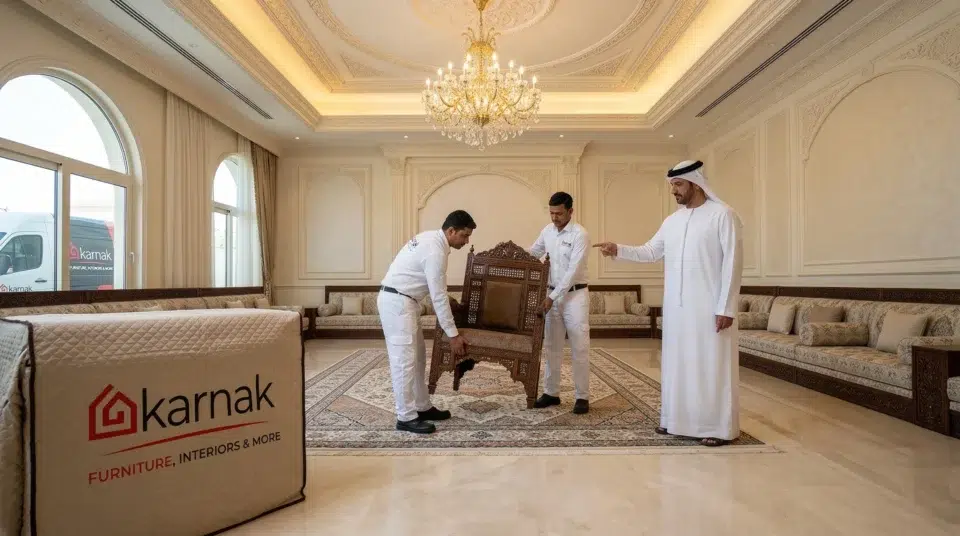
Yes. Karnak Home offers free delivery and free installation on eligible Arabic accent chair orders across Dubai, Abu Dhabi, Sharjah, Ras Al Khaimah, Al Ain, Ajman, and all UAE Emirates. For large or delicate formal pieces being delivered to villa majlis rooms in gated communities across Emirates Hills, Khalifa City, Saadiyat Island, and Mohamed Bin Zayed City, our delivery team coordinates community access permissions and property-specific logistics in advance. Our team has extensive experience handling carved wood frames and formally upholstered pieces, and treats every delivery of a significant piece with the care its cultural and material value deserves. Contact us at +971 58 908 8107 or browse our complete Arabic accent chair collection.
Conclusion
Three principles from this guide will guide every Arabic accent chair decision you make in a UAE home. First, the chair’s cultural vocabulary must be internally consistent: one design tradition, expressed with quality materials and genuine craft, communicates cultural intelligence; many decorative references assembled without principle communicate cultural confusion. Second, the scale and formality of the chair must be calibrated to the room that will receive it, from the high-back throne piece in a dedicated majlis with 3.5-metre ceilings to the contemporary Arabic crossover armchair in a modern Dubai apartment living room. Third, the complete vignette, chair, rug, side table, lamp, matters as much as the chair itself; an Arabic accent chair in isolation is a beautiful object, but within a considered arrangement, it becomes a cultural statement.
For Emirati families who have been guardians of majlis culture for generations, for Gulf national households who carry the hospitality tradition from Riyadh to Muscat and call the UAE home, and for expat families who have lived long enough in this country to love what they have seen in the homes of their neighbours and friends, the Arabic accent chair is one of the most meaningful furniture investments available. It carries the history of a seating tradition rooted in generosity, conversation, and the deliberate creation of a space where every guest is honoured. That meaning does not diminish with the years. In a world of generic interiors, it becomes rarer and more valuable.
Karnak Home has been part of UAE homes since 1988. We understand this culture because we have lived inside it for 36 years, delivering furniture to every kind of UAE household from a Sharjah apartment to an Emirates Hills palace. Visit our showroom, send us a photograph of your room, or call our team at +971 58 908 8107 for a personal consultation on any Arabic accent chair in our collection. Free delivery and free installation are standard on eligible orders across every UAE Emirate.
Ready to Bring Arabic Heritage Into Your UAE Home?
Shop Arabic Accent Chairs Online: Browse the complete Arabic and majlis-inspired accent chair collection at Karnak Home
Visit Our Showroom: Industrial Area, Sharjah, UAE (Saturday to Thursday, 9 AM to 9 PM)
WhatsApp Us: +971 58 908 8107 (Fabric samples, room consultation, delivery booking)
Call: +971 58 908 8107
Ready to Add Authentic Arabic Elegance with a Modern Majlis Accent Chair?
You’ve just explored the best Arabic and majlis-style accent chairs for UAE homes in 2026—covering traditional features (low-profile seating, ornate carvings, brass/wood inlays, tufted velvet), modern blends (minimalist lines, neutral palettes, performance fabrics for humidity/UV/dust), sizing for majlis corners in villas vs compact apartments, placement tips (U-shape, L-shape, focal wall), cultural importance for hospitality/family gatherings, common mistakes (height mismatches, heavy dark woods in small spaces), budget tiers (AED 1,200–4,000 range), and 2026 trends (subtle geometric patterns, synthetic rattan hybrids, eco-leather). These pieces preserve Emirati generosity while fitting contemporary Dubai/Abu Dhabi/Sharjah lifestyles. Now discover our majlis-inspired and Arabic accent chair collections—with free delivery, free professional installation, and free in-home consultation across all Emirates.
- → Majlis Furniture – Authentic low seating and corner sets perfect for traditional majlis zones and Arabic accent chair integration
- → Accent Chairs – Majlis-style and Arabic-inspired accent chairs with modern fabrics, carvings, and low profiles for UAE hospitality
- → Living Room Furniture – Coordinating pieces to blend majlis accent chairs into modern family living rooms
- → Sofas – Low-profile and modular sofas that complement Arabic/majlis accent chairs in villa or apartment settings
- → Corner L-Shape Sofas – Corner seating ideal for creating U-shape or L-shape majlis layouts with accent chairs
- → Coffee Tables – Low ornate or travertine tables suited for majlis coffee service beside Arabic accent chairs
- → Display Units UAE – Shelving to showcase cultural accents (brass trays, dates) around majlis-style seating
- → Furniture Packages – Majlis and living room bundles including Arabic accent chairs with savings
- → Karnak Deals – Offers on velvet, leather, and hybrid majlis accent chairs with free services
💬 Get Free Consultation on WhatsApp Shop All Majlis Furniture Now →