
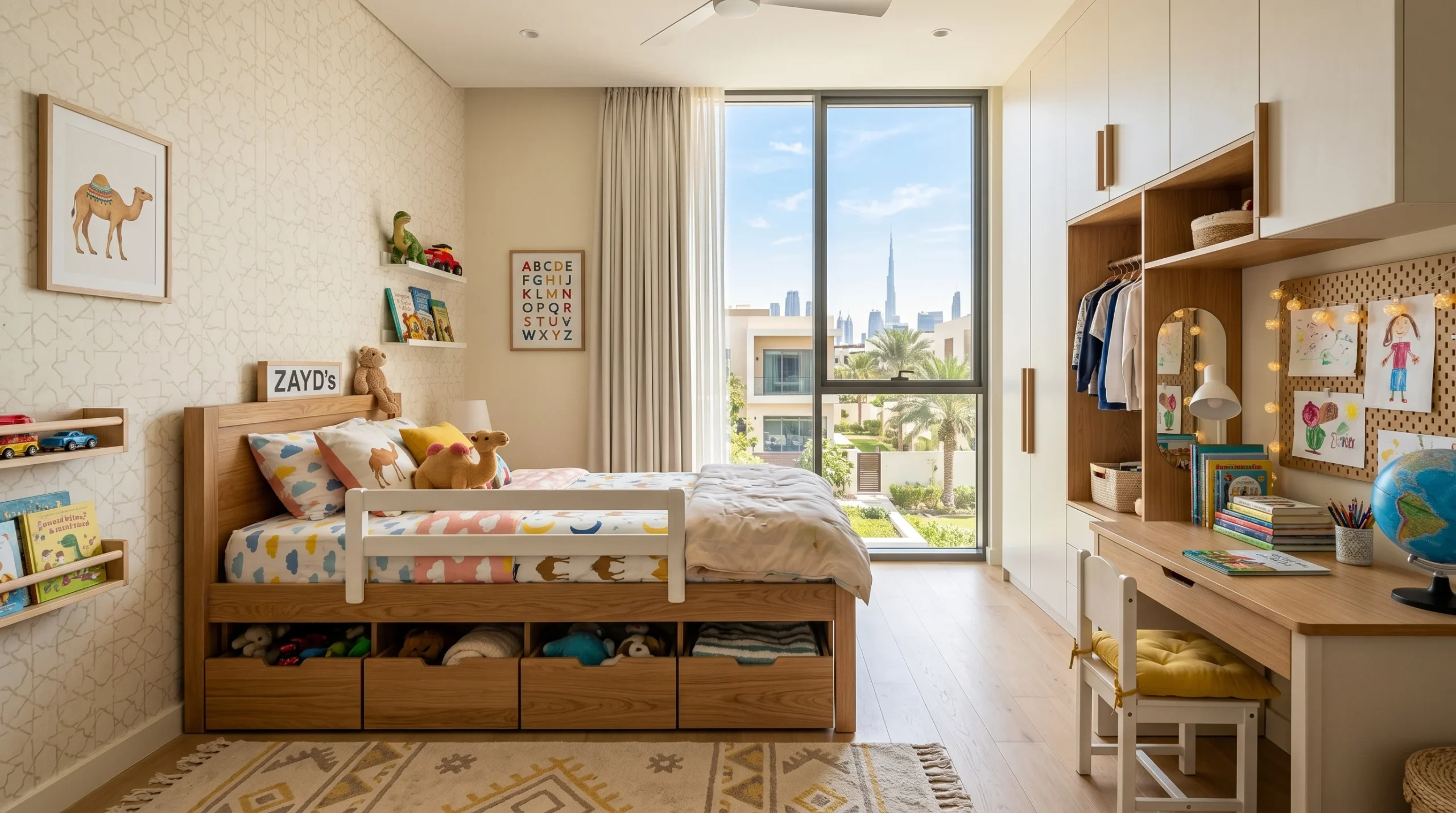
What does a good kids room actually need? It sounds simple until you are standing in a furniture showroom comparing bunk bed safety rails, worrying about whether that wardrobe finish is safe to breathe around, and trying to figure out if this bed will still make sense in five years when your child is three sizes bigger.
These are real questions UAE families ask every single day. At Karnak Home, we have been helping families across Dubai, Abu Dhabi, Sharjah, and beyond furnish their homes since 1988. Over 70,000 families served means we have seen what works in a compact Jumeirah Lakes Towers apartment, what survives in a busy Mirdif villa with four kids, and what parents wish they had done differently. This guide pulls all of that experience into one honest, practical resource so you can make a confident decision for your family.
Dubai families face some unique furniture considerations that parents in other parts of the world simply do not. The climate here runs hot and dry for most of the year, with air conditioning running almost continuously, which affects how wood behaves, how materials hold up, and what finishes are genuinely safe in an enclosed space. Space planning matters differently too, whether you are furnishing a high-rise apartment in Downtown Dubai or a sprawling villa in Arabian Ranches. And with international families constantly growing, many parents are choosing furniture that can adapt across different life stages rather than replacing everything every few years. All of that thinking is built into the guidance below.
What Makes Kids Room Furniture Truly Safe : What to Look For in Dubai
Safety is the word every furniture brand uses, but very few explain what it actually means in practice. After three and a half decades in this industry, we can tell you that safe kids furniture comes down to five specific things: structural stability, material quality, finish safety, edge and corner treatment, and hardware reliability. Let us walk through each one honestly.
Structural stability means the piece will not tip, collapse, or wobble under the kind of daily abuse children naturally deliver. In practice this means checking that beds have proper center support slats rather than relying on the mattress itself to bear load, that wardrobes have anti-tip wall fixings included and used, and that bunk beds meet the safety standards specified by EN 747 or equivalent, which cover rail heights, ladder angles, and load capacity. Any reputable Dubai furniture retailer should be able to tell you exactly which standard a product meets. If they cannot, treat that as a red flag.
Material quality is where many families get caught out by attractive-looking but poorly constructed furniture. Solid wood, whether oak, pine, beech, or rubberwood, is consistently the most durable option for kids furniture and holds up better to Dubai’s air-conditioned environment than many alternatives. MDF and particleboard are not automatically bad choices — Karnak Home carries quality MDF products — but the density and binding agents matter enormously. Low-density particleboard will begin to sag, chip, and swell at joints within a few years, especially in high-humidity periods like Dubai summers. When you are comparing options, ask specifically about board density and whether the core material is moisture-resistant grade.
Understanding Furniture Finishes and Indoor Air Quality
This is the safety conversation most families do not know to have. In Dubai’s climate, windows stay closed and air conditioning runs for months. Whatever chemicals off-gas from furniture finishes stay concentrated inside your home. This is particularly relevant in a child’s bedroom where your child sleeps eight to ten hours every night.
The key terms to ask about are VOC content and formaldehyde emissions. VOC stands for volatile organic compounds, which are gases released from paints, lacquers, and adhesives used in furniture manufacture. Formaldehyde is specifically used in the resins that bind MDF and particleboard together. Both are regulated under standards like CARB Phase 2 (California Air Resources Board) and the European E1 classification. E1 or CARB-compliant furniture has meaningfully lower formaldehyde emissions and is what you should be looking for in any kids room piece.
At Karnak Home, our kids furniture range is sourced from manufacturers who comply with these standards. When you visit our showroom or browse online, look for these certifications listed in the product specifications, and do not hesitate to ask our team directly if you are unsure.
Edge Treatment and Hardware : The Details That Prevent Injuries
Rounded edges and corner protection are standard on good quality kids furniture for a reason. A child running into a sharp corner at speed can cause a significant injury. Look specifically at the edges of bed frames, desk corners, and wardrobe doors. Quality kids furniture will have radius-rounded edges on all exposed surfaces, not just the most obvious ones.
Hardware is equally important. Drawer runners should operate smoothly and include soft-close or child-proof stops so small fingers do not get trapped. Wardrobe hinges should have soft-close mechanisms and be recessed rather than protruding. Bed frame bolts should use a design that cannot be loosened by a child’s hands over time. These are the details that separate furniture made with families in mind from furniture that merely looks good in a showroom.
How to Choose Kids Furniture That Grows With Your Child
One of the most common and expensive mistakes Dubai families make is buying age-specific furniture that needs complete replacement within three or four years. Children grow quickly and their needs change — but a well-chosen bed or wardrobe can genuinely serve a child from age three through to their teenage years with minimal adaptation. Here is how to think about longevity.
Beds: From Toddler Years to Teenage
The most versatile kids bed investment for Dubai families is a mid-sleeper or standard single with built-in storage drawers underneath. In a typical Dubai apartment, a 10×12 foot kids bedroom benefits enormously from the under-bed storage, which removes the need for a separate toy chest or chest of drawers. Bed frame dimensions to look for: a standard single at 90x200cm works from around age 3 through adulthood, so there is no need to buy a toddler-specific frame unless you are transitioning from a cot and want the side rails for safety.
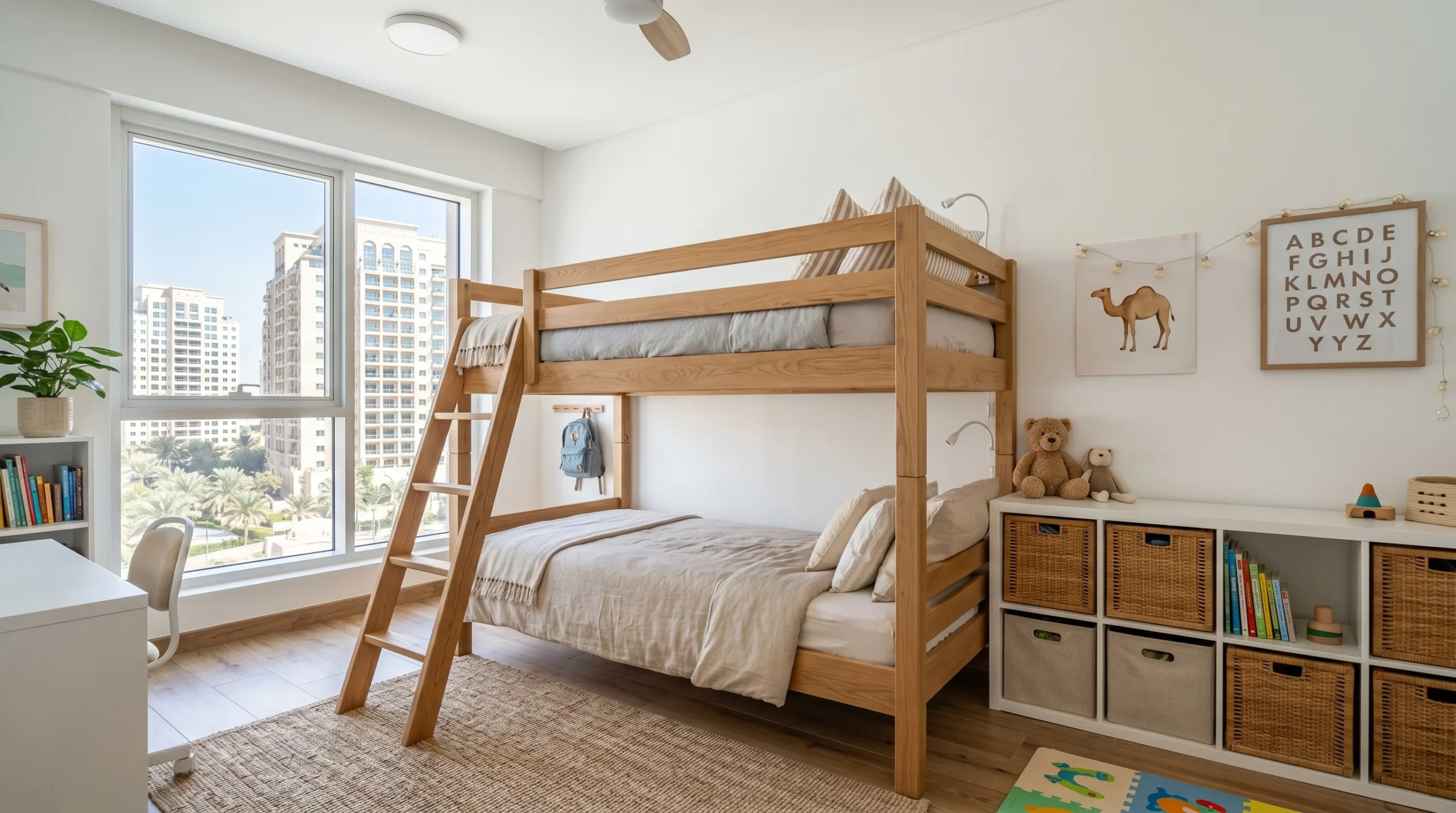
Bunk beds are a practical choice for families with two children sharing a room, which is common in Dubai’s three and four-bedroom villa layouts. When selecting a bunk bed, verify that the top bunk guardrail extends at least 16cm above the mattress surface on all sides, that the ladder is fixed rather than removable, and that the overall height allows comfortable standing clearance underneath. In rooms with standard 2.6 to 2.7 metre ceilings, typical in most Dubai apartments and villas — a bunk bed with a 150cm lower sleeping height leaves adequate clearance.
Convertible beds that expand from single to double, or that feature a pull-out trundle for guests, add flexibility without requiring new purchases as your child grows and starts having friends sleep over. These are particularly practical for families in Dubai’s vibrant social culture where weeknight and weekend sleepovers are common.
Study Desks and Storage: Supporting School Years in Dubai
Dubai’s competitive school environment means children often have significant homework from early primary school onwards. A dedicated study area in the bedroom, or a designated homework corner, is not a luxury — it is a practical investment in your child’s academic routine. The right desk setup depends primarily on your child’s age and the amount of time they spend studying.
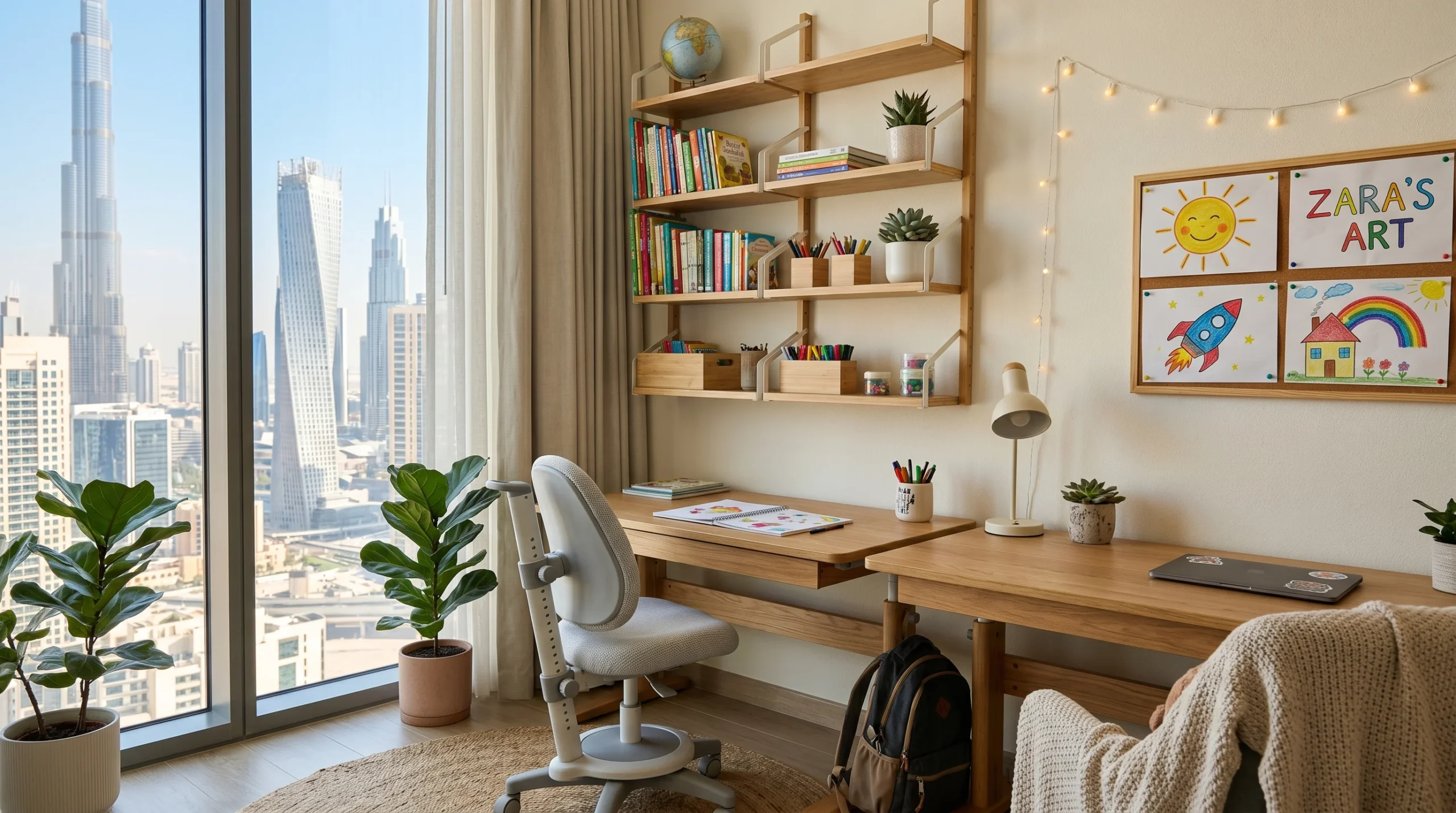
For children aged 5 to 10, a desk height of 55 to 60cm paired with a height-adjustable chair is ideal, allowing the chair to grow with the child rather than being replaced annually. For older children and teenagers, a standard 75cm desk height works well. Look for desks with a raised back panel or hutch for stationery and book storage, which keeps the work surface clear — a detail that makes a genuine difference to how well a child can concentrate.
Storage in kids rooms is always underestimated. UAE families, particularly those in Dubai’s busy school circuits, accumulate books, craft supplies, sports equipment, and seasonal items at speed. Open shelving combined with closed storage like drawers and cupboards works better than either alone. A rough planning guideline: for a primary school-aged child, aim for a minimum of 0.5 cubic metres of accessible toy and book storage separate from wardrobe hanging space. It sounds technical but in practice it translates to a two-shelf bookcase plus two under-bed drawers, which is a realistic and achievable combination even in smaller rooms.
Wardrobes: Planning for Growth
A wardrobe that fits a 7-year-old’s capsule clothing collection will not fit a 14-year-old’s wardrobe without significant reorganisation. The practical solution is a wardrobe with a mix of hanging space and adjustable shelves, combined with drawer storage for folded items. Internal configurations with adjustable shelf pins are worth specifying rather than fixed shelves, as they allow you to reconfigure the interior as your child’s needs change.
Standard wardrobe depth for a kids room is 58 to 60cm, which handles adult-sized hanging clothes and leaves room for folded storage without being unnecessarily bulky. Width depends on your room layout, but a two-door wardrobe at 120cm wide is the minimum that provides genuinely useful storage. Three-door options at 180cm provide significantly more capacity and are worth considering if the room allows, as they typically serve a child well into their teenage years without feeling overfilled.
Sliding door wardrobes are a practical choice for smaller Dubai apartments where swing clearance from hinged doors eats into limited floor space. Hinged doors give easier full access to the interior and are generally better suited to villa settings with more floor space.
Dubai-Specific Furniture Considerations Every Parent Should Know
Living in Dubai creates some specific furniture challenges and opportunities that most global buying guides simply do not address. Here is what our 35 years of experience in the UAE has taught us.
Climate and Air Conditioning Effects on Furniture
Dubai’s summer temperatures push past 45°C outdoors, but indoors air conditioning creates a consistently cool, dry environment for much of the year. This dry interior air causes solid wood to contract and can create small gaps at joints over time — this is normal behaviour in solid wood furniture and is not a defect. What it means practically is that solid wood kids furniture should be positioned away from direct aircon vents where possible, and that furniture made from engineered wood products like quality MDF may actually be more dimensionally stable in Dubai’s indoor environment than some solid wood options.
Conversely, during the humidity spikes of August and September, the same furniture will expand slightly. This is why quality joinery using proper mortise and tenon or dowel joints, combined with appropriate finishing, matters so much. Cheap furniture with poorly fitted joints will show visible gaps or sticking during these seasonal transitions. Good furniture, properly made, moves with the seasons without incident.
Apartment vs Villa Kids Rooms in Dubai
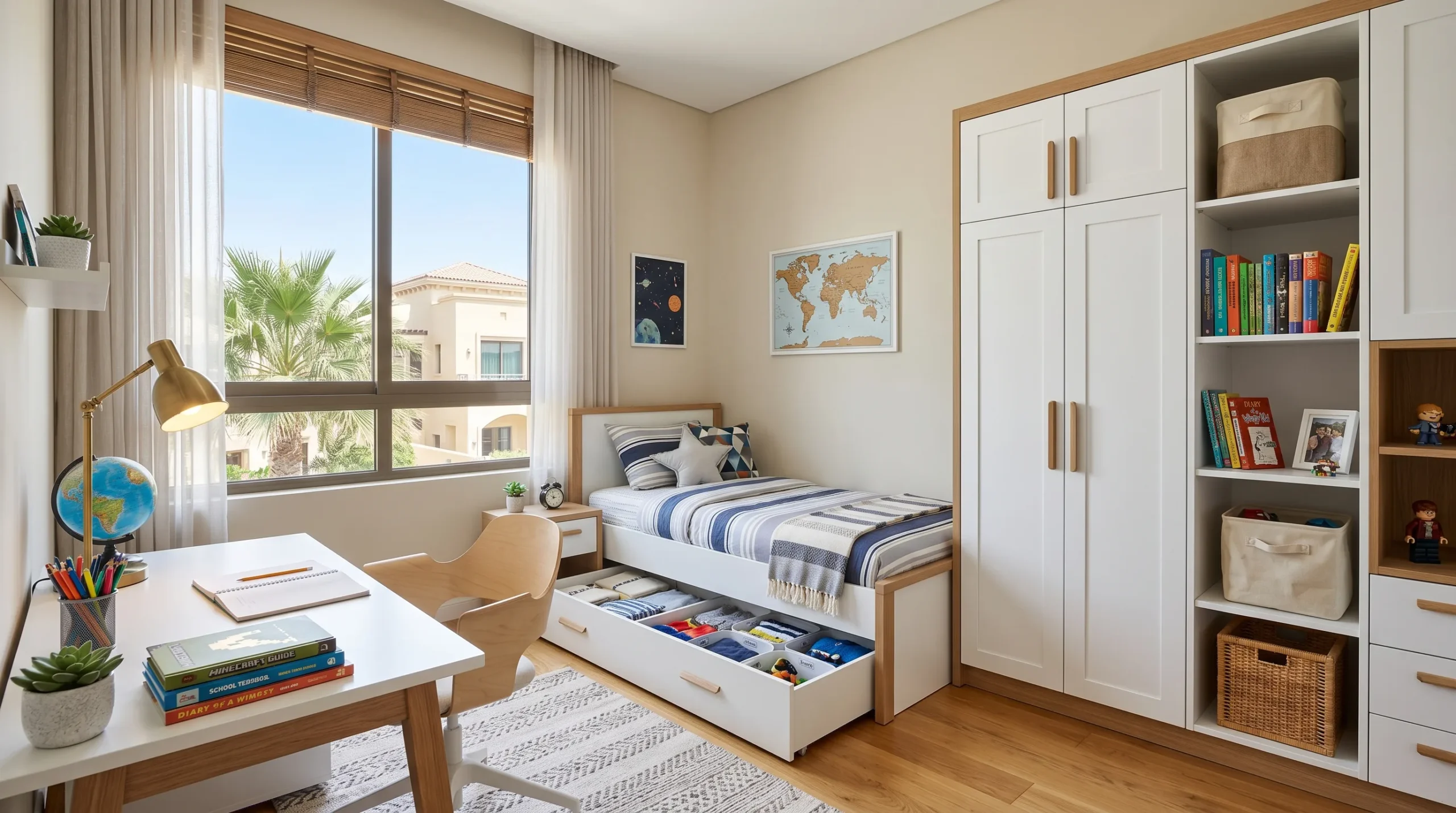
The majority of Dubai families live in apartments, where kids bedrooms typically range from 9 to 14 square metres. In these spaces, furniture selection and placement needs to maximise every corner. The most effective configurations we have seen in Dubai apartments consistently use the following approach: one wall for the bed with under-bed storage, one wall for a combined wardrobe and study desk unit, and open floor space kept clear for play.
In Dubai villas, kids bedrooms are typically larger — 15 to 25 square metres is common in areas like The Springs, Mirdif, Jumeirah, and Arabian Ranches — and this allows for freestanding furniture combinations with dedicated play areas. In these settings, a separate bed, wardrobe, bookcase, and desk can coexist comfortably, and bunk beds become an option for siblings sharing even in generously sized rooms.
Shared Kids Rooms : A Common Dubai Reality
Whether by choice or practical necessity, many Dubai families have children sharing bedrooms. The city’s housing costs and the preference for maintaining a dedicated guest room means two children sharing a room is extremely common across all income levels. For shared rooms, the key planning principles are clear territory definition for each child, equal storage allocation, and a furniture layout that allows reasonable privacy even in a shared space.
Bunk beds or twin beds positioned to create a natural divide in the room, combined with individual study desks and wardrobe sections or separate wardrobes, give each child ownership of their space. This reduces conflict and makes the shared arrangement more sustainable as children grow. We have helped hundreds of Dubai families solve shared room challenges — it is one of the most common conversations our showroom team has.
Common Mistakes Dubai Parents Make When Buying Kids Furniture
These are the situations we see most frequently, and the ones that result in frustrated follow-up visits or repeat purchases that could have been avoided.
Mistake 1: Buying Furniture That is Too Age-Specific
Character-themed beds and toddler-scale furniture look wonderful at age four and look completely out of place at age eight. More importantly, they require full replacement rather than adaptation. Unless there is a compelling reason, choose furniture in neutral, timeless styles that a child will not grow out of aesthetically. The design energy should go into bedding, wall art, and accessories — items that are inexpensive to change as your child develops their own tastes.
Mistake 2: Underestimating Storage Requirements
Almost every family we work with, when we review their existing kids rooms, has insufficient storage. The result is clutter on floors and surfaces, which affects both the child’s ability to concentrate and the parents’ sanity. When you are planning a kids room, add 25% to whatever storage estimate you think you need. You will use it. Dubai school children in particular accumulate a significant volume of books, art supplies, and activity equipment that needs a home.
Mistake 3: Choosing on Price Alone
The cheapest kids furniture available in Dubai is genuinely cheap — particleboard construction at low density, decorative film rather than real wood veneer, weak drawer runners, and finishes that chip within months of daily use. The cost saving upfront typically results in replacement within two to three years, which is not a saving at all. The middle tier of the market — quality engineered wood or solid rubberwood at the AED 800 to AED 2,500 range per piece — represents the genuine value point for most families. This price range gets you durability, finish safety, and functionality that will last the full childhood.
Mistake 4: Not Measuring Before You Buy
This sounds too obvious to include but remains the single most common practical error. Confirm not just that a piece fits in the room, but that it can navigate the building entrance, elevator, stairwell, and bedroom doorway. Standard Dubai apartment elevator interior dimensions are approximately 110cm wide by 140cm deep. Many villa stairwells have 90cm clearance. A wardrobe that is 58cm deep and 180cm wide will not navigate a 90cm doorway without being partially disassembled. If you are ordering from Karnak Home, our delivery and assembly team can advise on access requirements before your order is finalised.
Mistake 5: Ignoring Wall Fixing Requirements
Anti-tip wall fixing is not optional for wardrobes in a children’s bedroom. An unrestrained wardrobe, regardless of its quality or price, can tip forward if a child attempts to climb it — which children inevitably do. Confirm that any wardrobe you purchase comes with anti-tip hardware and that your walls can accommodate it. In Dubai apartments with drywalled interior walls, standard wall anchors may need to be supplemented with toggle bolts or professional wall finding. Our installation team handles this as standard on all wardrobe deliveries.
Kids Room Furniture Pricing Guide for Dubai Families
Honest pricing guidance is something many retailers avoid giving. We believe informed families make better decisions and become better long-term customers, so here is a realistic breakdown for the Dubai market.
A complete kids bedroom setup — bed frame with storage, wardrobe, study desk and chair, and bookshelf — will typically fall into one of three ranges based on quality tier.
The entry level, covering adequate but basic functional furniture from compressed particleboard construction, typically runs AED 2,500 to AED 4,000 for a complete room. At this price point you are getting functional furniture that will serve its purpose for three to five years with careful treatment. It is a reasonable starting point for younger children in rooms that will be redesigned as they grow.
The mid-range, covering quality MDF or engineered wood with solid wood components, appropriate certifications, and well-designed functionality, runs AED 5,000 to AED 10,000 for a complete room. This is the tier that genuinely delivers the best value over a child’s full bedroom years. Pieces in this range typically last a full ten to twelve years without looking dated or wearing out.
The premium tier, covering solid wood furniture, premium European or locally manufactured pieces, and custom configurations, starts around AED 12,000 for a complete room and can scale significantly from there. For families furnishing a Dubai villa master kids room or wanting heritage-quality furniture, this range delivers genuinely exceptional longevity and aesthetic quality.
These prices assume standard retail and do not account for seasonal promotions. Karnak Home runs promotions throughout the year, and our team can advise on current offers when you visit our showroom or browse online.
Expert Tips From 35 Years of Furnishing UAE Kids Rooms
1. Prioritize Bed Placement
Start with the bed placement first, not last. The bed is the largest piece and its positioning determines every other furniture decision. In most Dubai kids’ rooms, placing the bed along the longest uninterrupted wall gives the most flexibility for the remaining furniture.
2. Match Mattress Depth to Safety Specs
Specify a mattress at the same time as the bed frame, from the same retailer where possible. Mattress depth affects the practicality of safety rails on bunk beds and mid-sleepers; a mattress that is too thick can reduce the effectiveness of protective rails. A 15cm to 20cm mattress is the appropriate range for most kids’ bed frames.
3. Plan for Hardware Evolution
Buy handles and knobs in a style that can be replaced. Drawer and door hardware is one of the easiest and most affordable ways to update the feel of a room as your child grows. A wardrobe with standard-screw hardware can be updated from playful knobs at age six to more mature brushed metal handles at age twelve without any other changes.
4. Optimize Lighting and Desk Orientation
Consider the lighting plan before finalizing desk placement. A study desk without adequate task lighting creates eye strain. In Dubai’s glare-intensive environment, natural light is often better managed with blackout blinds for sleep and diffused film or indirect lighting for study. Position the desk perpendicular to any window to minimize screen glare.
5. Account for Hard Flooring
Think carefully about flooring and furniture leg types. Dubai apartments often have marble or tile flooring, which means furniture slides easily and legs can scratch the surface. Specify felt pads or rubberized feet on any freestanding furniture; it is a minor detail that prevents significant frustration and floor damage.
6. Protect Physical Play Space
Do not fill a kids’ room completely. The temptation with Dubai’s storage requirements is to pack every available square meter. Children need physical play space inside, particularly during the hot months when outdoor play is limited. A rough guideline: at least 30% of the floor area should remain clear.
7. Select Finishes Based on Maintenance
Choose washable or easy-clean surfaces wherever possible. A wardrobe door in a high-gloss finish shows every handprint but can be wiped clean in seconds. A matte textured surface looks calmer but requires more effort to clean. Choose based on your tolerance for both aesthetics and maintenance effort.
Conclusion: Making the Right Choice for Your Family
Choosing kids room furniture is one of those decisions that shapes daily life for years. The right bed means your child sleeps well. Additionally, the right desk means homework gets done. Moreover, the right wardrobe means mornings run on time rather than in chaos. And the right overall setup — safe, durable, scaled to your space and budget — is one you will not need to revisit for a long time.
The guidance above reflects what we genuinely tell families who walk into our showrooms and call our team for advice. No single rule applies to every situation, and the best choice for a family in a Downtown Dubai studio-style apartment will be different from the best choice for a Mirdif villa with three kids and ample space. What remains consistent is the framework: prioritise safety certifications, choose appropriate materials for Dubai’s environment, think about longevity over the child’s full bedroom years, and plan storage more generously than you think you need.
Key Takeaways:
At the heart of a good kids room is furniture built to handle real family life — the climbing, the homework, the growth spurts, and the changing tastes. Safety means specific certifications and structural details, not just a marketing claim. Materials and finishes matter more in Dubai’s enclosed, air-conditioned environment than in many other climates. And the best value is almost always in the mid-range tier: furniture that lasts the full childhood without requiring replacement.
Ready to Find the Perfect Kids Furniture?
Karnak Home’s kids furniture collection brings together everything in this guide — safe materials, smart storage, durable construction, and designs that genuinely stand the test of time in UAE homes. Our showroom team in Dubai has helped thousands of families plan kids rooms across every size, budget, and brief. Whether you prefer to browse and buy online at your own pace or come in for a hands-on look at quality and size, we are here to help you make a confident decision.
Shop Online: karnakhome.com
Visit Our Showroom: Karnak Home, Al Barsha South, Dubai, UAE
Speak to Our Expert Team: Call or WhatsApp us for personalised advice