
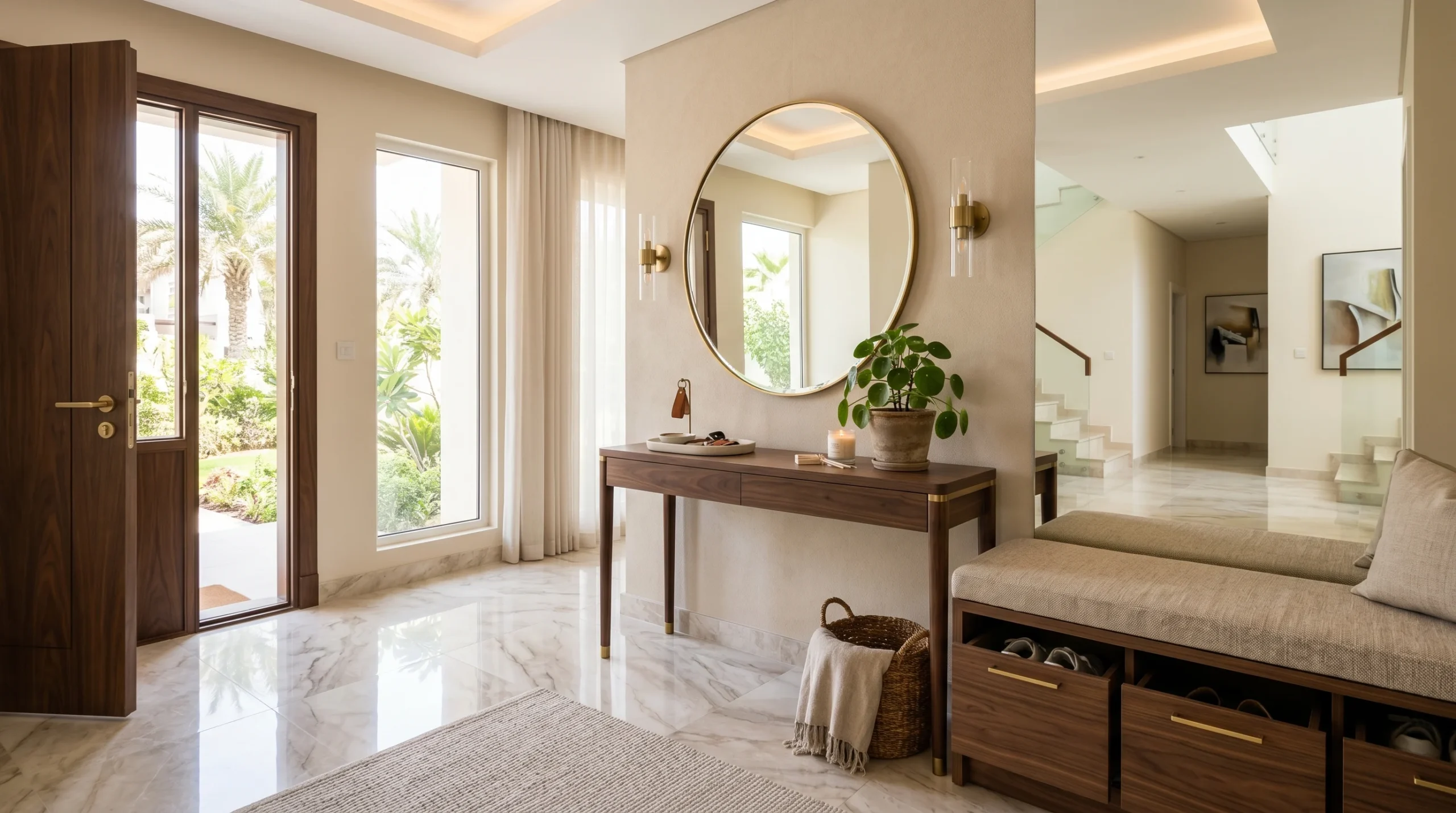
What does your home say before anyone sits down, before anyone sees your living room, before a single word is exchanged? It says it in the entryway. The moment a guest steps through your front door, that first three seconds, sets the emotional tone for everything that follows. Yet in our 35 years of helping families across the UAE furnish their homes, the entryway is the one space that gets planned last, budgeted least, and thought about the least carefully.
At Karnak Home, we’ve helped over 70,000 families make smart furniture decisions since 1988. We’ve worked with everything from compact apartments in Al Quoz to sprawling villas in Arabian Ranches, and we’ve noticed one consistent pattern: families who invest a little thought and a modest budget into their entryway end up with homes that feel more cohesive, more welcoming, and frankly, more organized. This guide gives you everything you need, practical measurements, honest AED pricing, material advice suited to the UAE climate, and furniture ideas that actually work in the real homes UAE families live in.
Understanding Your Entryway: The Foundation of Smart Planning
Before you buy a single piece of furniture, you need to understand what kind of entryway you’re actually working with. In the UAE, there are really three common entry scenarios, and the furniture approach for each one is quite different.
The first is the compact apartment hallway — common in buildings across JVC, Dubai Marina, International City, and similar developments across the country. These are typically 90cm to 120cm wide and between 2–3 metres long. Every centimetre counts here, and the wrong piece of furniture will make the space feel cramped and cluttered rather than welcoming.
The second is the mid-size villa or townhouse entryway — common in communities like The Springs, Mirdif, Mudon, and newer Sharjah and Abu Dhabi developments. These give you a bit more room to work with, usually 1.5–2 metres wide, and often open into a living area. You have more design options, but you still need to respect traffic flow, especially in a family home where children, bags, shoes, and guests all pass through.
The third is the grand foyer — found in larger villas in Emirates Hills, Palm Jumeirah, Al Barsha villas, and similar addresses. Here the challenge is different: you have space, but filling it badly with oversized or mismatched furniture is just as problematic as overcrowding a small hallway. This space demands thoughtful curation rather than volume.
Measuring Your Space Before You Shop
This sounds obvious, but it’s one of the most common mistakes we see. Families fall in love with a console table online, order it, and discover it blocks the door swing or makes the hallway feel like an obstacle course. Before you buy anything, take these measurements:
Width of your hallway: This determines whether you can use a standard console table (typically 30–40cm deep) or need an ultra-slim option (20–25cm deep). For anything under 100cm wide, go slim.
Door swing clearance: Measure how far your front door swings open. Your furniture must clear this completely — not almost, completely. A 90cm door typically needs at least 95–100cm of clearance from the hinge side.
Height of ceiling and wall space above: This tells you whether a tall mirror, artwork, or wall-mounted shelving works proportionally.
Length of the hallway: This determines how much you can layer — a bench here, a console there — without creating a corridor that feels like an airport security lane.
Write these numbers down. Bring them when you visit our showroom. They make every conversation significantly more productive.
The Four Furniture Essentials for a Functional UAE Entryway
After 35 years and thousands of home consultations, we’ve identified four furniture categories that make the biggest functional and visual difference in any UAE entryway. You don’t need all four — but understanding each one helps you prioritise according to your space and your family’s lifestyle.
1. The Console Table: Your Entryway’s Anchor Piece
The console table is the workhorse of the entryway. It provides a surface for keys, bags, mail, and the small rituals of coming and going. Done well, it anchors the entire space visually. Done badly, it’s a magnet for clutter and a waste of money.
For UAE homes, the key consideration beyond size is material durability in a high-humidity, high-AC environment. The UAE’s combination of outdoor heat and humidity, followed by cool air-conditioned interiors, creates constant thermal cycling that can stress certain wood materials over time. Engineered wood (MDF with veneer or melamine finish) handles this significantly better than solid wood in most cases, because it doesn’t expand and contract as dramatically with humidity changes. Solid wood pieces can still be used, but should ideally be placed away from direct air conditioning vents.
Good console table dimensions for UAE homes:
- Compact apartment: 80–100cm wide, 20–25cm deep, 75–80cm tall
- Mid-size villa entry: 100–120cm wide, 30–35cm deep, 75–80cm tall
- Large foyer: 120–160cm wide, 35–40cm deep, 75–85cm tall
Height matters for ergonomics too. A surface at hip height (roughly 75–80cm) is comfortable for placing and retrieving items without bending. Go significantly higher and it starts to feel awkward.
Typical AED price range: AED 350–900 for entry-level options with clean finishes. AED 900–2,500 for mid-range with better build quality and more refined aesthetics. AED 2,500+ for premium materials and designer styling.
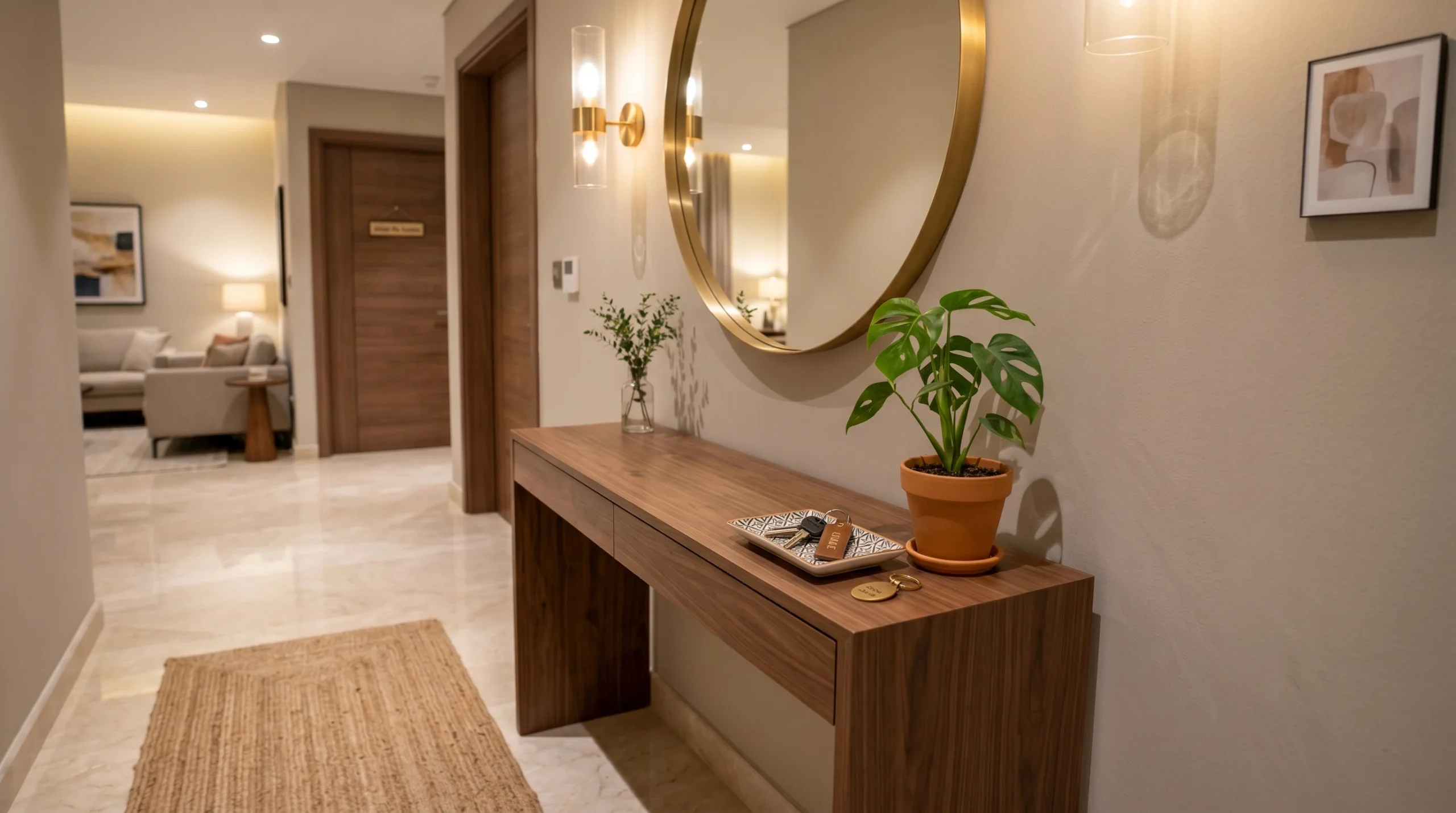
2. Shoe Storage: The Underrated MVP of UAE Family Homes
Here’s something we’ve noticed without exception: in UAE family homes, shoe storage is a bigger daily need than most families account for when they’re furnishing. Multiple pairs of school shoes, sandals, formal shoes, sports shoes, outdoor slippers — a family of four can easily accumulate 20–30 pairs that need accessible, organised storage near the door.
This is especially true if your home has a no-shoes-indoors rule, which is very common in UAE households. Without proper shoe storage at the entry point, shoes end up scattered across the floor — which creates a hazard, makes the entryway look chaotic, and causes the very first impression problem we’re trying to solve.
Shoe storage options that work well in UAE entryways:
A shoe cabinet with closed doors keeps everything concealed and dust-free — which matters in the UAE, where fine dust is a real issue. Look for options with ventilation gaps in the back or sides so shoes can breathe and don’t develop odours. Capacity for 12–20 pairs is realistic for a family cabinet; expect to spend AED 450–1,200 for a good quality option.
A bench with under-seat storage serves double purpose — somewhere to sit and take off shoes plus storage underneath. Extremely practical for families with young children who need to sit to change footwear. Dimensions to look for: 90–120cm wide, 40–45cm seat height (comfortable for adults and older children), 30–35cm depth. Budget AED 600–1,800 for decent quality.
A shoe rack — either open or semi-open — is the most space-efficient option for tight hallways, but only works if you’re committed to keeping it tidy. In homes with young children, we’d generally steer you toward closed storage first.
3. Mirrors: The Secret to Making Any Entryway Feel Larger
A well-placed mirror does three things in an entryway: it makes the space feel larger and brighter, it serves the practical function of a final appearance check before leaving the house, and it adds a strong visual element that elevates the entire area.
For UAE homes, mirrors are particularly valuable in apartment entryways where natural light is often limited. A large mirror opposite the entry door or on a side wall will reflect both artificial and natural light, making a narrow hallway feel noticeably more open.
Sizing guidance: A mirror that runs from approximately waist height to slightly above eye level (roughly 90cm–170cm tall) works well above or alongside a console table. Full-length mirrors (160–180cm) leaning against a wall or mounted vertically are excellent in larger entryways and villa foyers.
Frame material note for UAE climate: Metal frames (brushed gold, matte black, chrome) are the most durable choice in the UAE’s humidity fluctuations. They won’t warp, swell, or develop the small cracks that sometimes appear in painted wood frames over time with air conditioning cycling. Solid wood frames are fine but benefit from occasional conditioning.
4. Entryway Seating: Small but High-Impact
Not every entryway needs seating, but if you have the space and a family with children, a bench or small stool near the door earns its place every single day. It’s where you sit to put on shoes, where children perch while parents get ready, where guests wait a moment before being invited in.
A narrow bench — 90–120cm wide, 35–45cm deep — fits comfortably in most mid-size villa entryways without blocking traffic. For very tight hallways, a single upholstered cube or stool (45x45cm) tucks neatly into a corner and serves the same function at a fraction of the footprint.
Upholstery choice matters here. In UAE homes, the entryway seat takes wear from outdoor clothing, occasional dust from outside, and the kind of casual, heavy use that a formal living room sofa doesn’t. Choose performance fabrics (easy-clean microfibre or leatherette) over delicate weaves. They wipe clean, resist staining, and hold up to the daily abuse a family entry inevitably delivers.
Planning for the UAE Lifestyle: Practical Considerations
Furniture decisions don’t happen in a vacuum. In the UAE, there are some lifestyle and climate factors that genuinely affect what works and what doesn’t.
Dust: The Hidden Enemy of Open Shelving
The UAE’s climate brings fine airborne dust, particularly during the spring months and during shamal winds. Open shelving in the entryway — the kind popular in Scandinavian home décor — looks beautiful in magazine photos but requires significantly more maintenance here than in a European climate. Decorative objects on open shelves need dusting multiple times per week, not weekly.
This doesn’t mean you should avoid open shelving entirely, but go in with realistic expectations. If you want low-maintenance entryway furniture, closed cabinet doors and covered storage will serve you better. If you love the open aesthetic, commit to the upkeep — a quick wipe-down twice a week keeps it looking intentional rather than neglected.
Heat and Direct Sunlight
Many UAE villa entryways — particularly older-style villas in Jumeirah, Mirdif, and similar areas — have a window or small skylight near the front door. This is lovely for light but can be harsh on furniture finishes over time. UV exposure bleaches and degrades many furniture finishes, particularly laminates and upholstered pieces in lighter colours.
If your entryway gets direct sunlight for part of the day, consider UV-protective window film (inexpensive and highly effective) and choose furniture in darker tones or with UV-resistant finishes. Our team can advise on specific pieces with finishes that handle sun exposure particularly well.
Family Traffic Flow: Think in Rush-Hour Terms
In a family home, the morning rush — school runs, work departures, everyone needing shoes and bags and keys simultaneously — is the real test of your entryway layout. Mentally simulate that scenario when you’re planning your furniture placement. Is there enough space for two adults and two children to be in the entryway at the same time without creating a bottleneck? And is the shoe storage accessible without everyone crowding one spot? Moreover, is the console at a height children can use independently for depositing school bags?
These are the questions that separate entryway furniture that works from entryway furniture that looks good in photos but creates daily frustration.
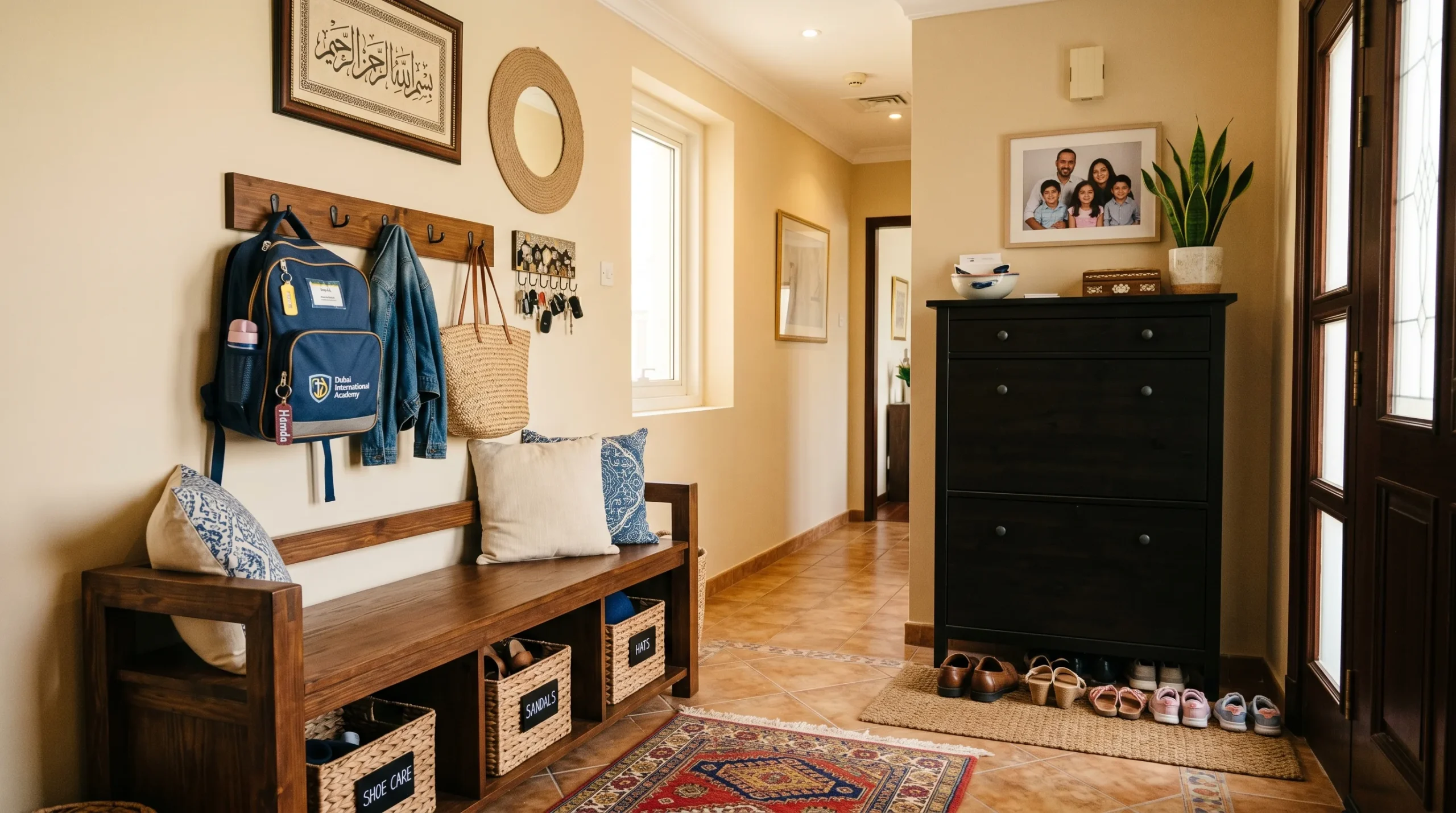
Style Directions That Work Well in UAE Homes
While function always comes first, the aesthetic of your entryway matters. Here are four style directions we see working consistently well in UAE homes — each achievable at a range of price points.
Modern Arabic / Contemporary Gulf
This aesthetic draws on regional design heritage updated with contemporary proportions. Geometric patterns in metalwork, rich dark woods (walnut finish, dark oak), deep jewel tones in upholstery accents, and brass or gold hardware. It sits naturally in traditional Arabic-style villas as well as more contemporary homes where the owners want to acknowledge their regional identity. A dark wood console with brass legs, a cushioned bench in a deep teal or burgundy, a statement mirror with a geometric metal frame — this combination is both culturally resonant and deeply stylish.
Modern Minimalist
Clean lines, neutral palette, concealed storage, no visual clutter. This works particularly well in apartment entryways and newer Dubai developments where the architecture itself is minimal. White, off-white, greige, and natural wood tones. A slim console in white or light oak finish, a frameless or thin-frame mirror, integrated shoe storage with push-to-open doors (no visible handles disrupting the clean lines). Maintenance is the trade-off — fingerprints and dust show more on light, flat surfaces.
Warm Contemporary
The most versatile approach and probably the most popular with UAE families. Warm neutrals — taupe, sand, terracotta, camel — combined with natural textures (rattan accents, wood grain, woven baskets for storage). This style accommodates a wide range of budgets, is very forgiving if you want to add or change pieces over time, and photographs beautifully if you’re someone who cares about home aesthetics on social media. It also tends to hide everyday wear and fingerprints better than pure white minimalism.
Transitional / Classic
For larger villa entryways and foyers where a degree of formality is appropriate. More traditional furniture forms — cabriolet legs, shaped mirrors, upholstered benches with button tufting — in neutral or richer colour palettes. This approach works well when the rest of the home has a more classic or European-influenced interior design. Invest in quality here, as transitional-classic pieces in inferior materials can look dated quickly, while well-made pieces age gracefully.
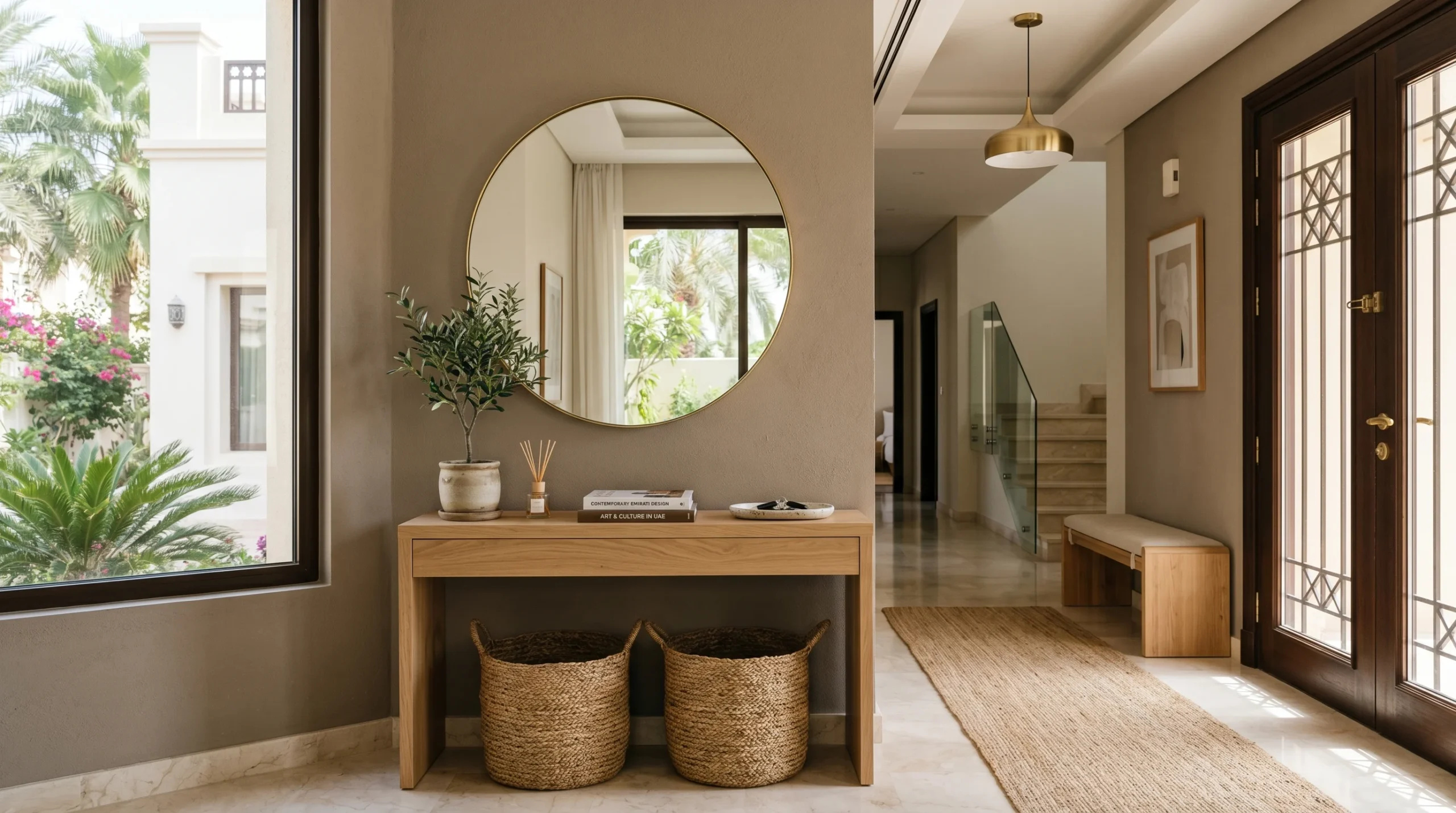
Common Mistakes to Avoid in UAE Entryways
In over three decades of helping families furnish their homes, these are the mistakes we see most often — and they’re all completely avoidable.
Mistake 1: Choosing Furniture That’s Too Large for the Space
The most common error, and the one with the most immediate consequences. A console table that’s 10cm too deep, or a shoe cabinet that’s 20cm too tall, can make an entryway feel oppressive and difficult to navigate. Always measure first, choose slightly conservative sizing, and when in doubt, go smaller. A small piece of furniture in an entryway looks intentional and elegant. An oversized one looks like a mistake.
Mistake 2: Ignoring Vertical Space
UAE apartment hallways in particular are often narrow, and the natural response is to try to make them wider by keeping furniture very low. But this misses the opportunity to use vertical space effectively. Tall, slim mirrors visually extend the ceiling. Wall-mounted hooks and shelves above eye level free up floor space while adding storage. A tall, narrow shoe cabinet (30cm deep, 180cm tall) stores far more than a wide, low one and takes less floor footprint. Think vertically, not just horizontally.
Mistake 3: Neglecting Lighting
The entryway is often the darkest area of the home, especially in apartments. Dark space feels unwelcoming and cramped regardless of how well-furnished it is. If you have a ceiling fitting, use a warm-toned bulb (2700K–3000K) rather than cool white. Add a small table lamp on your console if you have a power socket nearby. A mirror that reflects light sources effectively multiplies the perceived brightness of the space without any electrical work.
Mistake 4: All Storage, No Style
Some families, understandably focused on practicality, fill the entryway with storage to the exclusion of any decorative element. A shoe cabinet, a rack, a hook board, a basket — functional, yes, but visually it communicates “utility room” rather than “welcome to our home.” One or two deliberate decorative touches — a small plant, a framed piece of art or calligraphy, a quality mirror — cost relatively little and transform the entire feeling of the space.
Mistake 5: Buying Everything at Once Without a Plan
The temptation when furnishing an entryway is to buy a matching “set” — console, mirror, bench, shoe cabinet all from the same collection. This can work, but matched sets sometimes look formulaic and don’t always suit the specific proportions of your space. A better approach is to start with the one or two pieces that solve your biggest functional problem (usually shoe storage and a landing surface), live with them for a few weeks, and then add further pieces thoughtfully. Your entryway will feel more curated and personal than if you filled it in one shopping trip.
Honest Budget Guidance: What to Expect in AED
There’s a wide range of price points for entryway furniture, and the right investment depends on factors like how long you plan to stay in your home, how much daily traffic the space gets, and whether the entryway is a significant visual feature of your home.
Basic functional setup (AED 800–2,000 total): A slim shoe cabinet or open rack + a simple mirror. Covers the core needs without aesthetic ambition. Suitable for short-term rentals or transitional living situations.
Mid-range complete entryway (AED 2,000–5,000 total): Quality console table + shoe storage bench or cabinet + mirror. Good materials, decent construction, considered aesthetics. Suitable for families who plan to stay in their home for several years. This is the sweet spot for most UAE families, and it’s where Karnak Home has the strongest selection.
Premium / statement entryway (AED 5,000–12,000+): High-quality materials throughout — solid wood or premium engineered wood, quality upholstery, statement lighting. Appropriate for larger villa foyers where the entryway is a significant design feature, or for families who invest meaningfully in their interiors across the board.
Where to invest vs. where to save: Invest more in pieces you interact with physically every day — the bench (seat height and cushion quality matters), the shoe cabinet (quality hinges and smooth operation over years of daily use). You can save on purely decorative elements like small trays, plant pots, or wall art. A quality AED 200 decorative tray from a homeware store looks as good as an AED 800 designer version. A cheap bench with a flimsy hinge system will frustrate you within six months.
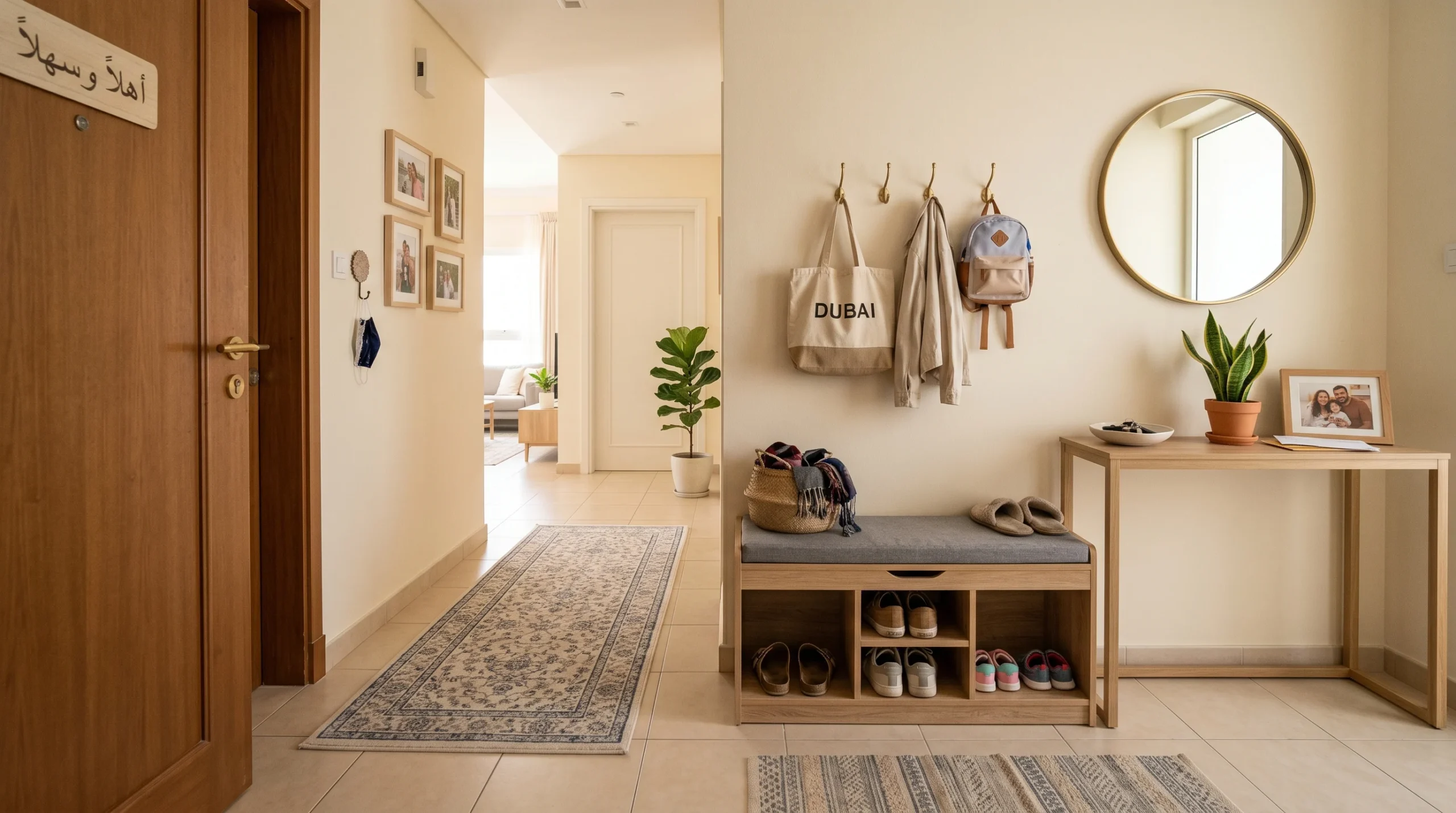
Expert Tips From 35 Years of Furnishing UAE Homes
These are the practical recommendations our team gives families after thousands of entryway consultations. They’re the kind of advice you get after helping enough families make enough mistakes and enough good decisions to know what actually matters.
1. The “30-second test.” Stand at your front door and time how long it takes you to: hang your keys, put your bag down, remove your shoes, and check your appearance before leaving. If any step in that sequence doesn’t have an obvious, easy home, that’s where your next furniture purchase should focus. Entryway furniture should reduce friction, not add to it.
2. Anchor with one statement piece, then layer. In most entryways, one piece does most of the visual heavy lifting — usually the console table or a large mirror. Get that piece right first in terms of scale, material, and finish, then add supporting pieces that complement it. This approach avoids the visual noise of five similarly-sized pieces competing for attention.
3. Dark floors and light walls — or vice versa — create definition. Many UAE apartments have light tile or marble flooring, which is beautiful but can blend with light furniture in a way that makes the entryway feel flat. A console in a medium or dark wood tone creates instant visual contrast and definition. Conversely, if your flooring is darker, lighter furniture and a large mirror keep the space from feeling heavy.
4. Don’t underestimate hooks. Simple wall hooks — installed at adult height (140–150cm) and child height (100–110cm) — are one of the highest-value-per-dirham entryway additions you can make. Bags, jackets, the children’s school bags, visitors’ abayas — everything has a home without consuming floor or surface space. A quality multi-hook rail costs AED 80–300 and earns back its cost in daily convenience within the first week.
5. Think about evening lighting specifically. Most UAE families arrive home after dark for at least part of the year. The entryway experience at night is often quite different from during the day. Check your lighting at 9pm, not just at noon. Warm, inviting light makes a disproportionate difference to how welcoming your home feels on a tired weekday evening.
6. Consider the nose as well as the eye. A quality reed diffuser or subtle room fragrance near the entryway creates a welcoming sensory experience that guests notice without necessarily identifying. It’s a small detail, but it consistently makes homes feel more considered and more inviting.
7. Rugs protect and define. A durable entryway rug (natural fibres like jute, or flat-weave synthetic that can be shaken out or wiped) protects your flooring from the grit and dust tracked in from outside, and visually defines the entryway zone. Choose a size that fits fully within the hallway — a rug that’s too small makes the space feel awkward. Expect to spend AED 150–500 for a quality entryway rug; replace it every 2–3 years as it takes significant wear.
8. Hardware and finishing details matter more in the entryway than anywhere else. Because the entryway is a small space that’s seen up close and often, small details read clearly. A quality handle on a shoe cabinet, a well-finished mirror frame edge, solid shelf brackets — these details communicate quality and care in a way that’s less visible in a large living room. Don’t save on hardware and finishing.
Conclusion: Making Your Decision
The entryway is genuinely one of the highest-impact spaces in your home for the investment it requires. Unlike a full living room or bedroom, a well-furnished entryway doesn’t need to cost a great deal — but it does need to be thought through carefully. The families who get it right are the ones who measure first, think about their actual daily habits and needs, choose materials suited to the UAE climate and lifestyle, and resist the urge to fill the space before they understand it.
Whether you’re working with a narrow apartment corridor in Deira or a generous villa foyer in Khalifa City Abu Dhabi, the principles are the same: start with function, anchor with one good piece, keep traffic flow clear, and add personality without clutter.
Key Takeaways:
- Measure your space before browsing — hallway width, door swing clearance, and ceiling height all determine what works
- Prioritise shoe storage in UAE family homes; it has the highest daily functional impact of any entryway piece
- Choose materials suited to the UAE’s humidity cycling and dust environment — closed storage, durable finishes, and metal hardware outlast open shelving and painted wood over time
- Invest in build quality on pieces you interact with physically (benches, cabinet hinges, hooks) and save on purely decorative elements
- Start with one statement piece, solve your biggest functional problem, and layer additional pieces thoughtfully rather than furnishing everything at once
Ready to Find the Perfect Entryway Furniture?
Karnak Home has been helping UAE families make smart furniture decisions since 1988. Our showroom carries a carefully selected range of console tables, shoe cabinets, entryway benches, and storage solutions suited specifically to the apartments, townhouses, and villas that UAE families actually live in. Our team doesn’t work on commission — they work on giving you honest advice that serves your home and your budget, whether that results in a single AED 400 purchase or a complete room furnishing.
Browse our range online at karnakhome.com, or visit us in person, our team genuinely enjoys helping families think through furniture decisions with real tape measures and honest conversation.
Shop Online: karnakhome.com
Visit Showroom: Al Barsha South, Dubai, UAE
Expert Advice: Call +971 50 465 6780 | WhatsApp Us : +971 50 465 6780