
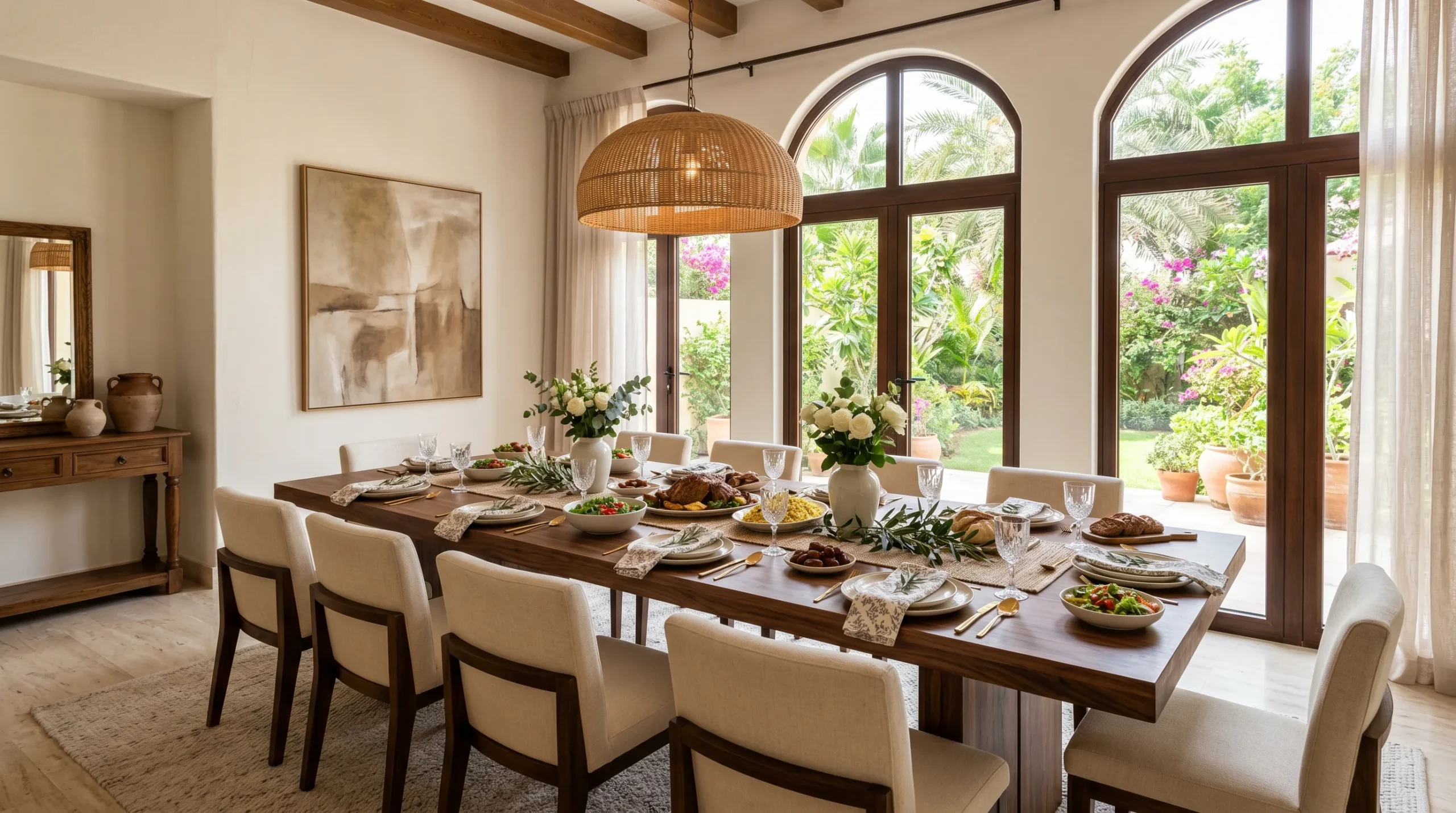
How many times have you sat down to plan a family gathering — Eid dinner, a Friday lunch, a cousin’s birthday — and suddenly realized your dining table simply isn’t big enough? You pull in chairs from the kitchen, drag a folding table from the storeroom, and by the time everyone sits down, someone’s elbow is in the corridor.
If that sounds familiar, you’re not alone. In more than 35 years serving over 70,000 UAE families, this is one of the most common challenges we hear at Karnak Home: the dining room looks fine on a regular Tuesday, but the moment guests arrive, it falls apart.
Looking to better understand the UAE lifestyle, weather, and daily living? Check out this excellent UAE Living Portal by Gulf News for insider tips and practical advice on navigating life in the Emirates.
This guide is here to change that. We’re going to walk you through exactly how to plan and arrange your dining room furniture for the way UAE families actually live — large gatherings, multi-generational meals, and a deep culture of hospitality. No generic advice. Real guidance based on decades of experience in Dubai homes, Abu Dhabi villas, and Sharjah apartments.
Whether you’re furnishing a brand-new space or rethinking what you already have, by the end of this article you’ll know precisely what to buy, how to arrange it, and what to avoid.
Understanding How UAE Families Actually Use Their Dining Rooms
Before you measure a single centimeter, it’s worth stepping back and thinking honestly about how your dining room gets used — because UAE family dining patterns are genuinely different from what most furniture advice online assumes.
In many Western contexts, the dining table is used primarily by the nuclear family: two parents, two children, quick meals. The guidance written for that lifestyle — a 4-seater table, a compact arrangement — is completely wrong for most UAE homes. Here, the dining room is a social hub. Friday lunches can involve 15 to 25 people. Ramadan gatherings regularly bring multiple families together. Eid dinners span three generations. Guests are welcomed without notice. The table needs to be ready for all of it.
There is also the practical matter of space. A villa in Arabian Ranches, a townhouse in Mirdif, and an apartment in Dubai Marina have entirely different footprints and entirely different needs. What works in one context fails completely in another. This guide addresses both, with clear advice for larger villa spaces and practical solutions for apartment living.
Finally, consider the climate. UAE summers are long and intense, which means entertaining shifts indoors for a significant portion of the year. Your dining room carries the full weight of that social life. It needs to be genuinely capable — not just aesthetically pleasing.
How to Choose the Right Dining Table Size for UAE Gatherings
This is where most families go wrong, and it is almost always in the same direction: they choose a table that fits their everyday family and forget about the gathering scenario.
The rule we give every customer at Karnak Home is simple: design for your gathering size, not your everyday size. If your household is 4 people but your average gathering is 12, buy the 12-seat table. You will never regret having more space. You will always regret having less.
Standard Dining Table Sizes and How Many They Seat
Here is a practical reference that accounts for the comfortable elbow room UAE families expect:
- 140cm length: seats 4 comfortably, maximum 6 tightly
- 160–180cm length: seats 6 comfortably, up to 8
- 200–220cm length: seats 8 comfortably, up to 10
- 240–260cm length: seats 10–12
- 280cm and above: 12–14, suitable for large villas
For gatherings regularly exceeding 10 people, a fixed large table is almost always the better investment over an extendable one — the extensions on most mid-range extendable tables add seating but compromise on structural rigidity and surface height consistency over time. If you do choose an extendable table, ensure the extension mechanism is tested in-store before purchase and that the extended size still fits your room with adequate circulation space around it.
Width matters as much as length. A dining table narrower than 90cm makes passing dishes genuinely awkward in a UAE context where shared plates are the norm. 100–110cm width is the sweet spot for most families. Very large serving dishes and traditional platters are easier to place on a 100cm+ surface.
Round vs Rectangular: Which Works Better for UAE Gatherings
This question comes up every week in our showrooms, and the answer depends more on your room shape than personal preference.
Rectangular tables are the default for most UAE dining rooms, and for good reason. They maximize seating in a long, rectangular space — which describes the majority of villa and apartment dining rooms. They align naturally with walls, leave clear sightlines, and work well with a central runner and serving dishes down the middle.
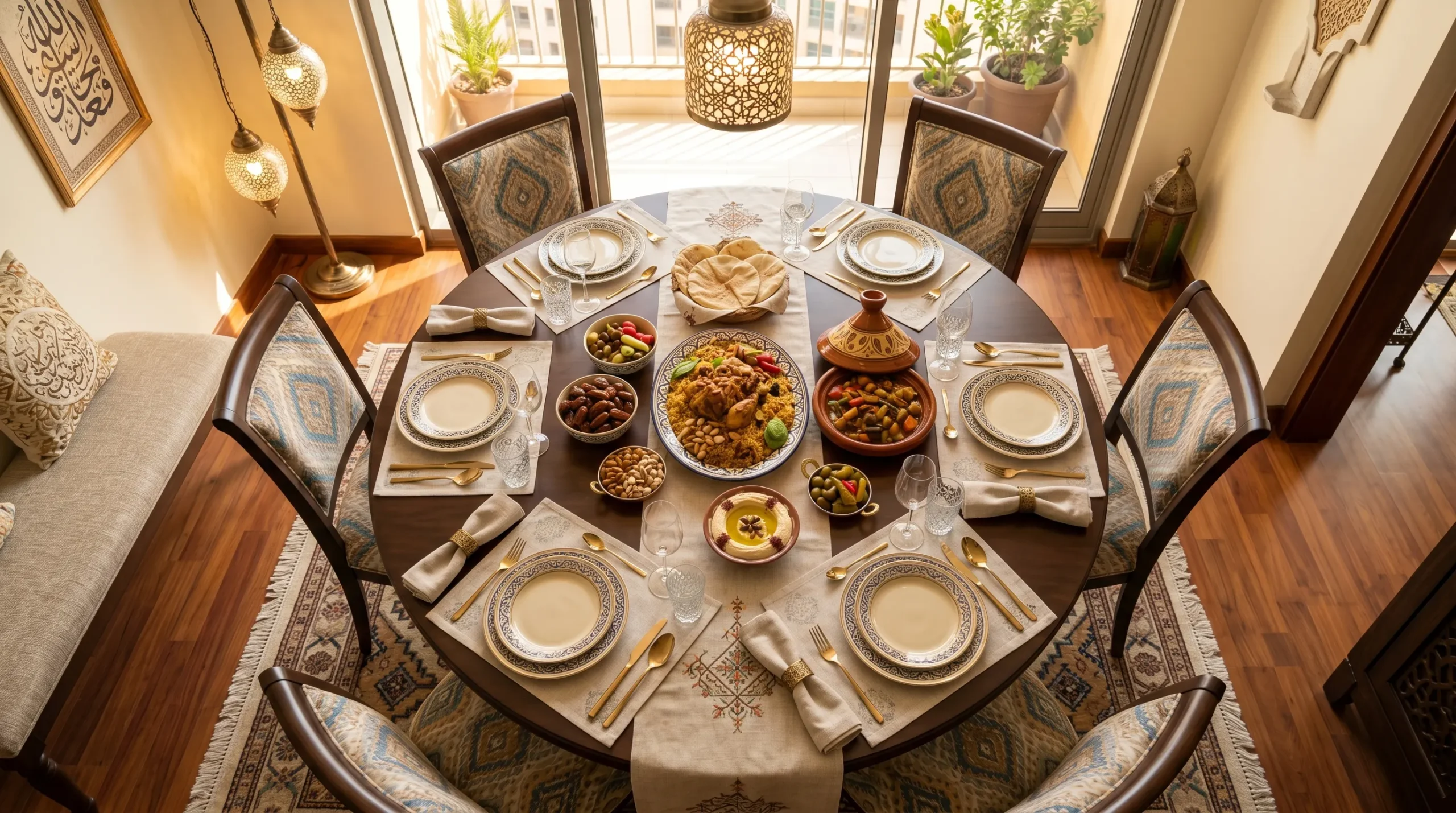
Round tables, however, create something special: equality and conversation. Nobody is at the head of the table. Everyone can see everyone. For families that value that dynamic — and many UAE families do, particularly for more intimate gatherings — a round table of 150–180cm diameter can seat 6–8 people beautifully and makes the dining room feel warm and inclusive. The limitation is purely mathematical: beyond a 180cm diameter, a round table becomes difficult to reach across, and the room needs to be more or less square to not feel awkward.
Oval tables offer a genuine middle ground that is underused in UAE homes. They seat as many as a rectangular table of similar length, soften the visual weight of the room, and eliminate the hard corner issue that is particularly relevant in tighter spaces.
The Extendable Table: When It Makes Sense
An extendable dining table is a sensible choice specifically when you have an apartment or townhouse where space is genuinely limited and you cannot justify the footprint of a large table on regular days. If your everyday household is 4–5 people but gatherings bring 8–10, a quality extendable table from 160cm to 220cm is a smart investment.
Key things to verify before purchase:
- The extension leaves should be stored somewhere accessible — ideally within the table base itself, not in a separate cupboard where they are forgotten
- The joining mechanism should be flush with no ridge — important for tablecloths and cleaned surfaces
- The chair set should still fit the extended configuration without looking mismatched
If you are in a villa and space is not a constraint, skip the extendable option. A well-built fixed table at the size you need will outlast and outperform an extendable one over a 10-year horizon.
Dining Room Layouts That Work for UAE Homes
The furniture you choose matters — but so does how you arrange it. A well-chosen table in a poorly planned layout will still frustrate you during gatherings.
The Standard Centred Layout
The most common arrangement in UAE villas: dining table centred in the room with chairs on all sides and a pendant light overhead. This works when the room dimensions are at least 400cm x 350cm for a 10-seater setup.
Minimum clearance measurements to maintain:
- 90cm between table edge and any wall — this allows a seated person to pull their chair back without obstruction
- 120cm between table edge and a wall if people need to pass behind seated guests regularly (essential for gatherings)
- 60cm between table edge and a sideboard — functional but not circulation-friendly; 90cm is better
If your room falls short of these clearances, you either need a smaller table or you need to address the layout differently — perhaps removing unnecessary furniture or shifting the table off-centre toward the less-used wall.
Layouts for Open Plan Living Rooms and Dining Rooms
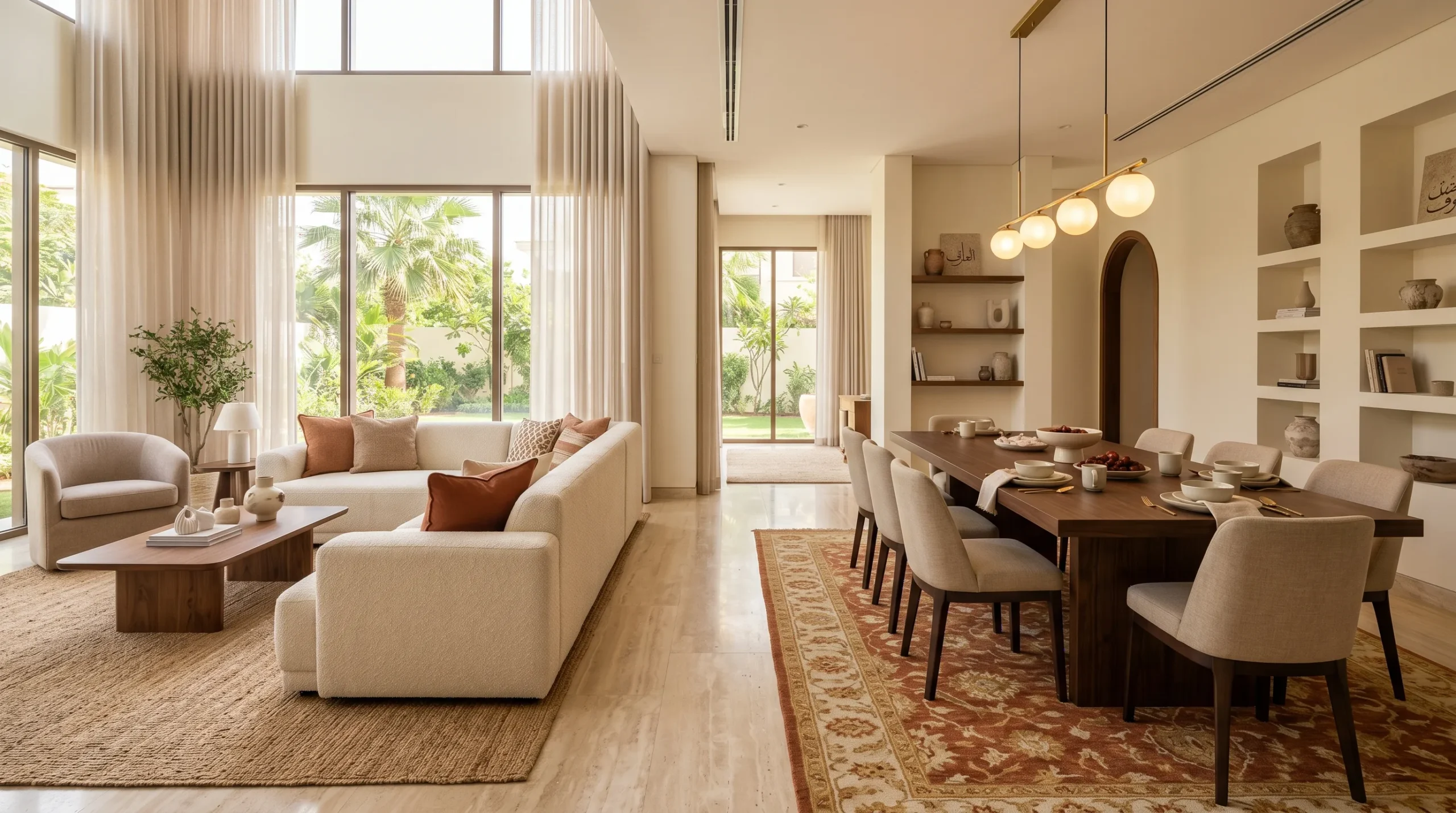
A large proportion of UAE apartments and newer villas are built open-plan, with the dining area and living area sharing one large space. This is wonderful for entertaining but presents a specific challenge: where does the dining room begin and end?
The most effective approach is to use a large area rug under the dining table and chairs to visually anchor the dining zone. Choose a rug that extends at least 60–70cm beyond the chair legs on all sides — when chairs are pulled out, they should still sit on the rug. This creates definition without a physical barrier.
Lighting does the same work vertically: a pendant light or chandelier hung directly over the dining table signals the zone instantly. In open-plan spaces, this overhead definition is important.
For furniture selection in open-plan spaces, consider the visual dialogue between your dining chairs and your sofa. They do not need to match, but they should belong to the same visual family — similar wood tones, complementary upholstery colours, consistent material language.
Layouts for Smaller Apartments
In a one or two-bedroom apartment — common for younger families and couples across Dubai and Sharjah — the dining room is often a defined but compact space. Here, the priorities shift:
- Choose a table that fits the room with correct clearances even before considering aesthetics
- Bench seating on one or two sides of the table saves space and can accommodate more people when needed — a bench can seat 3 where 2 chairs would go
- Wall-mounted shelving replaces a sideboard if floor space is limited
- Chairs that stack or tuck completely under the table are valuable in tight spaces
Do not sacrifice the clearance minimums for a larger table. A smaller table with comfortable circulation is always a better dining experience than a larger table where nobody can move freely.
Seating: Dining Chairs, Benches, and What UAE Families Should Know
Seating selection is where most dining room projects underperform. The table gets careful attention; the chairs are almost an afterthought. This is a mistake.
Dining Chair Height and Comfort
Standard dining table height is 75–76cm. Standard dining chair seat height is 44–47cm, giving approximately 28–30cm of clearance between the seat and the table underside — the space your legs occupy. If you are buying a table and chairs as a set from Karnak Home, this is already coordinated. If you are mixing pieces, measure both.
For UAE gatherings, where people sit at the table for extended periods — long Eid lunches, Ramadan iftars — seat comfort matters more than it does for a quick meal. Look for:
- A seat depth of at least 44cm for comfortable sitting
- Back support that reaches at least mid-back height — fully upholstered high-back chairs are ideal for extended dining
- Upholstered seats in a stain-resistant fabric if there are children at the table. A dining chair with a removable, cleanable seat cover is worth every extra dirham.
How Many Chairs Do You Actually Need?
Buy more chairs than your table nominally seats. A 10-seat table should have at least 12 chairs. Gatherings expand. Chairs get occupied. Having two chairs in reserve — matching the set — means you are never pulling in the mismatched kitchen stool.
Store the extra chairs in a bedroom wardrobe or a storeroom. The matching set ensures your dining room looks intentional even when fully expanded.
Mixing Chair Styles
A popular trend in UAE homes over the past few years: anchor chairs (the chairs at the two short ends of a rectangular table) in a different style or colour than the side chairs. This is a deliberate design choice — not a mistake — and when done well, it adds visual interest and hierarchy to the dining room. The key is to keep one element consistent: the same leg finish, the same fabric colour family, or the same silhouette type.
Storage and Serving: The Case for a Sideboard or Buffet
A dining table and chairs solve only part of the dining room equation. Where do you put the serving dishes? The extra cutlery? The linen, the candles, the spare glassware for gatherings? In UAE family homes, these are not small considerations.
A sideboard — a low storage unit, typically 150–200cm wide and 80–90cm tall — is one of the most underrated pieces of dining room furniture. It serves during gatherings as a buffet surface where platters are placed before people serve themselves. It serves daily as concealed storage for everything the dining room needs to function. And it anchors the dining room visually, providing a horizontal element that balances the table.
In a villa dining room, a 180cm sideboard on the wall opposite or adjacent to the table works well. In smaller apartments, a 90–120cm narrow sideboard or a credenza with a smaller footprint serves the same function without dominating the space.
If your dining room lacks the wall space for a sideboard, consider a wall-mounted floating shelf at serving height (90–95cm from the floor) — this provides surface area during gatherings with no floor footprint at all.
Common Mistakes UAE Families Make With Dining Room Furniture
Mistake 1: Buying a Table That Fits the Empty Room, Not the Furnished One
The room looks larger when empty. When you add chairs — pulled out, occupied — the effective room shrinks significantly. Always mock up the table footprint with tape on the floor and add 90cm clearance on all sides before you commit.
Mistake 2: Choosing Chairs Based on Appearance Only
A chair that looks elegant in the showroom but has a shallow seat depth and minimal back support will feel punishing after 45 minutes at an Iftar table. Always sit in dining chairs for at least a few minutes when purchasing. Test the seat depth, the back height, the armrest position if there are armrests.
Mistake 3: Ignoring Gathering Mode When Planning the Layout
You plan the layout for your everyday family of 5. You forget that Eid brings 18 people. The extra chairs have nowhere to go. The sideboard is against the wall that should be serving access. Plan for the peak-use scenario, not the everyday one.
Mistake 4: Selecting a Material That Doesn’t Suit UAE Conditions
Solid wood dining tables are excellent in UAE homes — stable, durable, and they develop character over time. Veneer tables are more vulnerable to humidity, particularly in coastal areas like Dubai Marina or Abu Dhabi Corniche. High-gloss lacquered surfaces show fingerprints and minor scratches more visibly than matte or satin finishes. Marble and stone tops are beautiful but heavy, cold to the touch, and require sealing to prevent staining from food and liquids. Understand what you are buying.
Mistake 5: Underestimating the Impact of Lighting
The right table in a badly lit room feels wrong. A pendant light hung too high (above 75cm from table surface) loses intimacy and focus. Hung at 60–70cm above the table surface, a pendant creates a warmly lit pool of light that makes food look better and people feel at ease. Dimmable lighting is a genuine upgrade for dining rooms used for both everyday meals and entertaining.
Budget Guidance: What to Expect in AED
Dining room furniture is a long-term investment. Here is an honest range for what you will encounter at different quality levels:
Entry level (functional, basic materials):
- 4–6 seat dining set: AED 1,500–3,000
- 8–10 seat dining set: AED 3,000–5,500
- Sideboard: AED 800–1,500
Mid range (solid materials, better construction, longer lifespan):
- 6–8 seat dining set: AED 5,000–10,000
- 10–12 seat dining set: AED 9,000–18,000
- Sideboard: AED 2,000–5,000
Premium (solid wood, quality upholstery, heirloom-grade construction):
- 8–10 seat dining set: AED 18,000–35,000+
- Sideboard: AED 5,000–12,000+
The mid-range bracket is where most UAE families find the best balance of quality and value. At Karnak Home, the majority of dining room sets we recommend for family use fall within AED 7,000–16,000 for a complete 8–10 seat setup including table and chairs. These are pieces built to withstand 10–15 years of active family use — including the gatherings.
Expert Tips: 35 Years of Dining Room Advice for UAE Families
1. Always buy your chair set with at least 2 extra chairs. Store them matching. You will need them.
2. Measure the door before you commit. Many UAE villas have internal doorways of 80–90cm. A dining table wider than that must be brought in disassembled or through an alternative entry point. Confirm with your retailer before purchase.
3. Choose upholstered chairs in performance fabric if you have children under 10. The extra cost of stain-resistant fabric pays for itself in peace of mind within a single Eid season.
4. A sideboard at 90cm height serves as a buffet during gatherings. This is not just a storage piece — it is functional hospitality furniture.
5. Solid wood over veneer if your budget allows. In UAE humidity and temperature variations, solid wood handles seasonal movement far better than veneer over MDF.
6. For open-plan spaces, the dining rug must be large enough. The rug should extend 60–70cm beyond the chairs on all sides when chairs are pulled out. Most families undersize their dining rug significantly.
7. Test chair comfort at the showroom. Sit for at least 3–5 minutes. Stand up. Pull the chair in and out. Assess how the chair slides on your flooring type — some chairs scratch marble floors without felt pads, which Karnak Home includes as standard.
8. Consider the view from the kitchen. In open-plan UAE homes, the dining table is visible from the kitchen. A visually clean, well-proportioned table makes the entire social space feel more composed.
Conclusion: Making Your Dining Room Work for Your Family
A dining room that genuinely works for UAE family life is not accidental. It is the result of making deliberate choices about table size, layout clearances, seating comfort, and the gathering scenarios your family lives. The furniture itself is the last step — but the thinking beforehand determines whether you enjoy it or manage around it for the next decade.
The single most common shift we see at Karnak Home is families who have been managing a dining room that is too small for their actual gatherings, finally investing in the right configuration — and discovering that hosting becomes a pleasure instead of a logistical exercise.
Start with your gathering number. Plan the layout with tape on the floor. Account for clearances. Then choose your table, your chairs, and your sideboard for that reality.
Key Takeaways:
- Design your dining room for your gathering size, not your everyday household size
- Maintain 90cm minimum clearance on all sides of the table — 120cm wherever guests pass
- Buy 2 extra matching chairs beyond your table’s nominal seating capacity
- A sideboard is functional hospitality furniture, not just storage
- Upholstered chairs in performance fabric are worth the upgrade for families with children
Ready to Find the Perfect Dining Room Furniture?
Karnak Home’s dining room collection spans every style, size, and budget relevant to UAE family life, from solid wood tables for large villas to compact extendable sets for apartment living. Our team has been helping families across Dubai, Abu Dhabi, Sharjah, and the wider UAE get their dining rooms right since 1988. Visit our showroom to see the full range in person, speak with a furniture expert, and get honest guidance on what will work for your specific space.
We offer delivery across all seven emirates, and our team can advise on anything from sofa dimensions to full room layouts. There’s no pressure and no commission-driven sales – just genuine guidance from people who know UAE homes.
Shop Online: Karnak Home
Visit Our Showroom: Dubai – Showroom Address & Directions
Expert Advice: Call Us or WhatsApp our team for personalised guidance
Related Articles:
10 Common Furniture Buying Mistakes UAE Families Make (And How to Avoid Them)
Entryway and Hallway Furniture Ideas for UAE Homes: First Impressions Matter
How to Furnish a Guest Room in a UAE Villa for Eid: Comfort Meets Impressions
How to Choose the Right Dining Table Size for Your UAE Family