
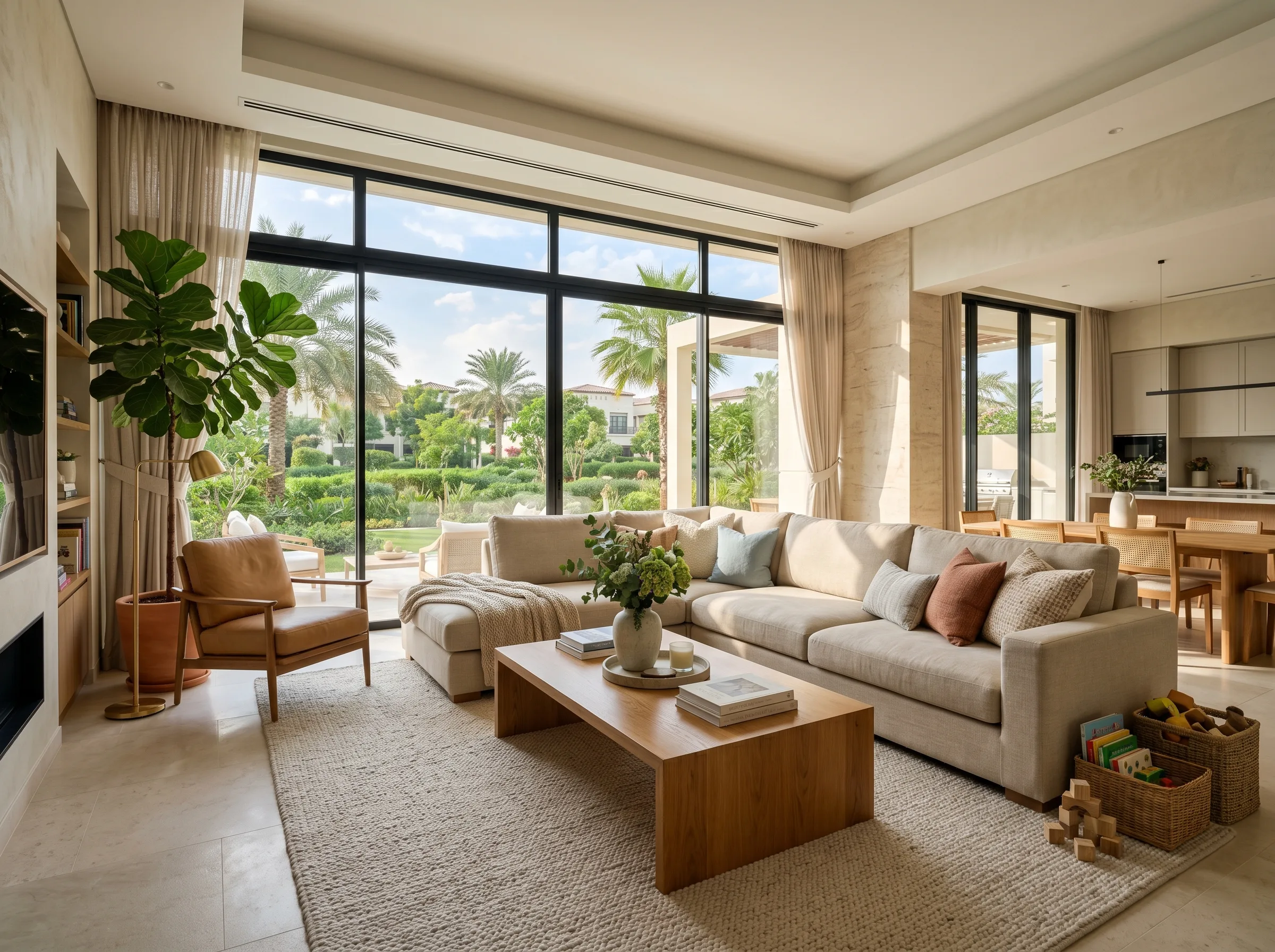
Have you recently moved into a new Dubai community — or are you planning to? If so, you’ve probably noticed something: the furniture that looked perfect in your old apartment doesn’t quite feel right in your new home. The ceilings are higher. The rooms flow differently. The lifestyle has shifted. Dubai new Community Furniture Trends is what you need to keep up to with.
You’re not imagining it. Dubai’s newest residential communities — from Dubai Hills Estate and Emaar South to Damac Lagoons, Sobha Hartland 2, and Town Square — are being designed with a fundamentally different philosophy than older developments. And that philosophy is changing what families actually need from their furniture.
At Karnak Home, we’ve been helping UAE families furnish their homes since 1988. In that time, we’ve seen Dubai transform from a handful of neighbourhoods into one of the world’s most dynamic cities. We’ve furnished homes in Jumeirah, Arabian Ranches, Downtown, and now in the new wave of master-planned communities reshaping the outskirts of the city. After 35 years and more than 70,000 families served, we can tell you this with confidence: 2026 is a genuinely different moment in Dubai home design. The trends aren’t just aesthetic — they reflect real changes in how people are living.
This guide will walk you through exactly what those changes are, what they mean for your furniture choices, and how to make smart decisions whether you’re in a sprawling five-bedroom villa or a sleek two-bedroom apartment in a new community tower.
Moreover, if you are looking to better understand the UAE lifestyle, weather, and daily living? Check out this excellent UAE Living Guide by First Abudhabi Bank (FAB) for insider tips and practical advice on navigating life in the Emirates.
Why Dubai’s New Communities Are Different : And Why It Matters for Furniture
Understanding the furniture trends starts with understanding the communities themselves. The master-planned developments launching and maturing in 2025–2026 share several design characteristics that set them apart from Dubai’s older stock.
First, these communities are green. Dubai Hills, Damac Hills 2, The Valley, and similar projects are built around parks, walking trails, lakes, and open spaces. That outdoor access changes how families use their homes — there’s more indoor-outdoor movement, more emphasis on relaxed living, and less pressure to make the home itself the entertainment hub. Furniture that works in this context is comfortable, low-maintenance, and unpretentious.
Second, these communities offer more varied unit types than older areas. You’ll find villas alongside townhouses, mid-rise apartments, and high-rise towers all within the same master plan. A family in a 4-bedroom corner villa in Emaar South has completely different furniture needs from a young professional in a studio apartment in the same community’s tower. Generic advice doesn’t work here — your home type matters enormously.
Third, the residents of these communities are more internationally diverse than ever. European, Asian, Arab, and African families are all moving in, bringing different preferences for layout, storage, seating style, and aesthetics. Furniture retailers who understand this diversity — rather than pushing a single “Dubai look” — serve these communities far better.
The 5 Furniture Trends Defining New Dubai Communities in 2026
1. Modular and Flexible Furniture Is Now Non-Negotiable
The single biggest shift we’re seeing across new Dubai communities in 2026 is the move toward modular furniture — pieces that can be reconfigured, added to, or repurposed as your family’s needs change.
This trend is driven by practical reality. Many families moving into new communities are still figuring out how they’ll use their space. A formal dining room might become a study. A guest room might become a nursery. An open-plan living area might need to be divided when remote work becomes a permanent fixture of family life. Furniture that locks you into one configuration becomes a liability.
The most popular expression of this trend is the modular sectional sofa. Rather than a fixed three-seater plus two-seater combination, families are choosing systems where individual modules — corner units, ottomans, chaise longues, armless seats — can be arranged and rearranged freely. A good modular sofa system in a Dubai villa living room typically starts around AED 4,500 and can scale to AED 15,000+ as you add modules over time. That incremental approach suits families who want quality without committing the full budget upfront.
The same logic applies to bedroom storage. Fitted wardrobe systems with interchangeable internal fittings — adjustable shelving, removable drawer units, fold-out hanging rails — are replacing fixed wardrobes that become obsolete when your clothing storage needs change. Families with young children particularly appreciate this: a wardrobe configured for toddler clothes at low height can be reconfigured for school uniforms and then adult clothing as children grow.
2. Biophilic Design Is Moving from Trend to Standard
Biophilic design — the use of natural materials, organic forms, earthy tones, and indoor plants to create a connection with the natural world — has been talked about for years. In Dubai’s newest communities, it’s crossing from aspirational trend into everyday standard.
The reason is partly the communities themselves. When you live in Dubai Hills Estate and your windows overlook a golf course, or in Damac Lagoons where the landscaping feels almost Mediterranean, you instinctively want your interiors to echo that natural environment rather than contrast with it sharply. The hard, glossy, maximalist interiors that characterised Dubai’s peak-luxury era of the 2000s feel oddly out of place in these greener, more relaxed communities.
In furniture terms, biophilic design means a preference for natural timber over high-gloss lacquer, linen and cotton upholstery over synthetic microfiber, and organic shapes over geometric rigidity. Stone-effect dining tables — whether genuine marble or high-quality sintered stone — are particularly popular because they bring an outdoor, geological quality into the dining room.
One honest note here: real timber furniture in the UAE requires some care. The extreme temperature differentials between Dubai’s air-conditioned interiors and the summer outdoor heat can cause natural wood to move slightly. Good quality engineered wood products — where solid wood veneers are applied over dimensionally stable cores — often perform better in UAE conditions than solid wood throughout. When you’re investing AED 3,000–8,000 in a timber dining table, this distinction matters. Ask about the construction, not just the surface appearance.
3. Open-Plan Living Demands Furniture That Defines Space Without Walls
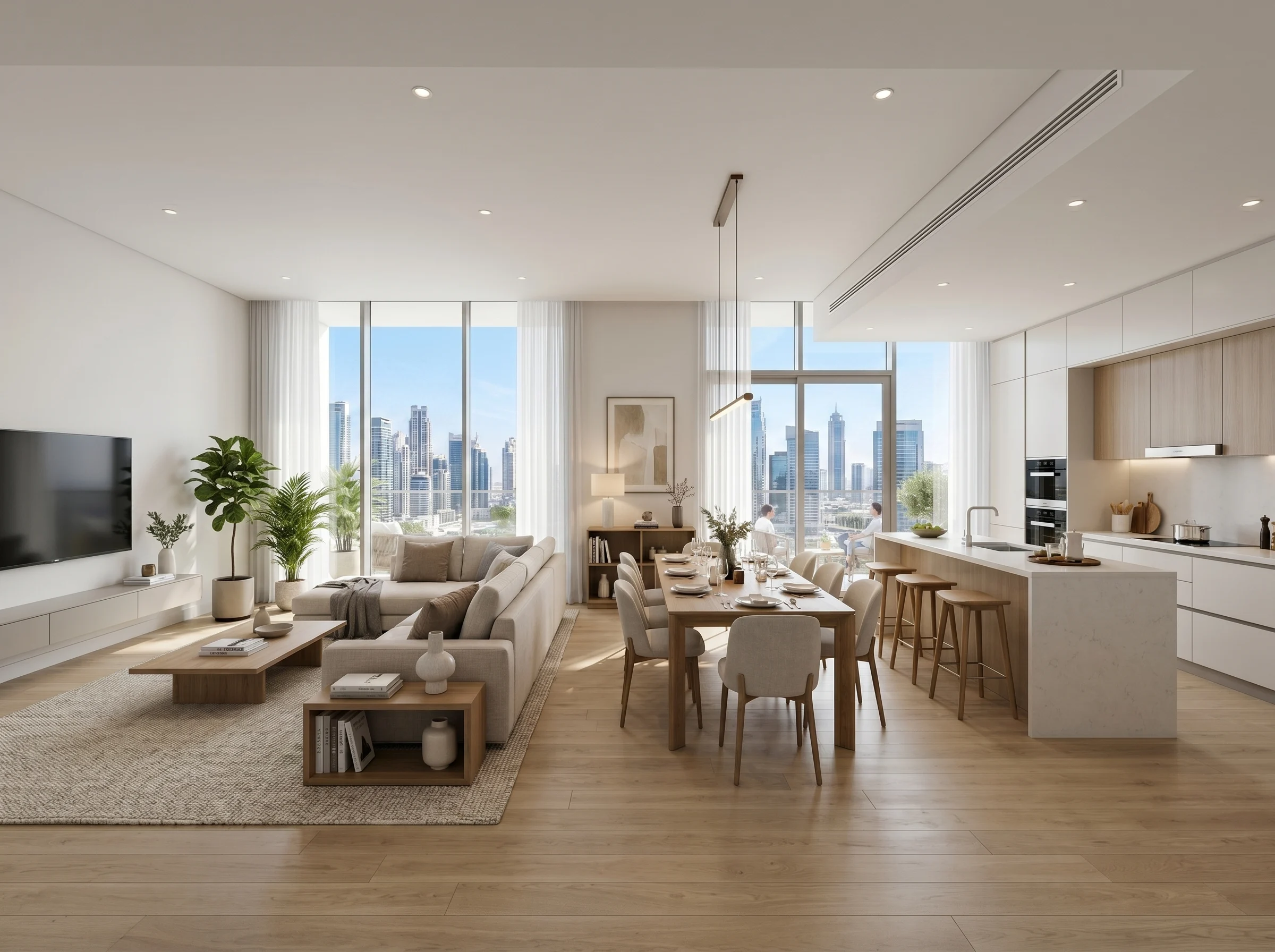
Open-plan layouts — where the kitchen, dining area, and living room flow into one continuous space — have become the default in new Dubai community apartments and many townhouses. These layouts feel wonderfully spacious when empty. They can feel chaotic and undefined once furniture arrives.
The furniture trend responding to this challenge is what designers call “zone-defining” or “anchor” furniture. Rather than pushing everything against the walls and leaving the centre empty (the most common mistake we see), families are using key furniture pieces to create clear visual zones within the open space.
A large area rug under the sofa grouping defines the living zone. A substantial dining table with a pendant light above it anchors the dining zone. A kitchen island or breakfast bar bridges the gap between cooking and casual dining. These pieces work together as a spatial system, not as individual items.
For this to work in a Dubai apartment with a typical open-plan area of 35–50 square metres, scale is critical. Many families choose sofas that are too small because they fear overwhelming the space. The opposite is usually true: a properly scaled three-seat sofa of 220–240cm in length, combined with a coffee table of at least 120cm, creates a sense of intentional living space. A sofa of 180cm in a large open-plan area looks like it’s floating apologetically.
4. Climate-Conscious Material Choices Are Growing
After 35 years in the UAE furniture business, one thing that never changes is the impact of the local climate on furniture choices. What is changing in 2026 is that more families are asking the right questions before they buy, rather than learning through expensive mistakes.
Dubai’s combination of extreme summer heat, high humidity near the coast, and heavily air-conditioned interiors creates a specific set of challenges:
Upholstery fabrics: Performance fabrics — those treated for stain resistance and moisture management — are genuinely worth the additional cost of AED 500–1,500 on a sofa. Families with children will know exactly why. Velvet and silk-effect fabrics look beautiful but require careful maintenance in a household with active kids and pets. Linen-look performance weaves have come a very long way in the past five years and now offer both the natural aesthetic and the practical resilience that UAE family life demands.
Outdoor-adjacent furniture: In communities with private gardens, majlis areas, or large covered balconies, the furniture that occupies these spaces needs to handle temperature extremes. All-weather rattan, powder-coated aluminium, and teak are the materials that genuinely hold up. Avoid anything with solid MDF components in any partially-outdoor position — even covered, the humidity fluctuation will eventually cause swelling and delamination.
Bedroom furniture near air conditioning: Beds and wardrobes positioned directly under or opposite air conditioning units can experience accelerated joint stress from the constant temperature cycling. This is a minor but real consideration when planning bedroom layouts in new community villas where ceiling cassette AC units are common.
5. The “Collect Slowly, Buy Right” Mindset Is Replacing Fast Furnishing
Perhaps the most encouraging trend we’re seeing in new Dubai communities is a genuine shift in how families approach furnishing a new home. The impulse to furnish everything immediately — often with lower-quality pieces under time pressure — is giving way to a more considered approach.
Families are increasingly choosing to live with empty or minimally furnished rooms for a few months rather than fill them quickly with furniture they’ll regret. They’re investing in fewer, better pieces: a genuinely good sofa and dining table rather than a full living set of mediocre quality. They’re treating furniture as a medium-term investment rather than a disposable commodity.
This mindset suits the economics of new community living well. Moving costs in Dubai are significant. Visa and community fees are a real outlay. Many families arrive in a new community with a tighter immediate budget than they’d like. Prioritising one outstanding room at a time — typically the living-dining area, then the master bedroom, then children’s rooms — makes sound financial sense and usually produces better results than attempting to furnish everything at once.
Furniture Choices by Community and Home Type
Dubai Hills Estate and Emirates Hills: The Established Premium Standard
These are the benchmark premium residential communities in new Dubai, and the furniture aesthetic reflects that. Families here tend toward a refined, understated modern aesthetic — quality materials, restrained colour palettes, furniture that impresses without shouting. Bespoke fitted wardrobes are nearly universal in this market, typically running AED 8,000–20,000+ for a master bedroom. Dining tables are often centrepieces of genuine investment — marble or stone-topped tables at AED 6,000–15,000 are common.
If you’re furnishing in this area, the guidance is: invest in the pieces you touch every day first. Sofa, bed, dining table. These are the items that define how your home feels to live in. A beautiful statement artwork or an impressive sideboard can wait — but a sofa that you find uncomfortable or a bed that doesn’t give you good sleep is a daily quality-of-life issue.
Damac Lagoons, The Valley, Town Square: The Family-Practical Market
These communities attract a large proportion of families with young children, often making their first significant Dubai property purchase. The furniture needs here are distinctly different: durability, safety, practicality, and value for money take precedence over pure aesthetics.
For living rooms, stain-resistant performance fabric sofas are the sensible choice. Expect to invest AED 3,500–7,000 for a quality family sofa that will handle real use. Avoid glass coffee tables (a genuine safety risk with young children) and choose solid timber or upholstered alternatives. For dining, extension tables — those that seat 6 but extend to 8 or 10 — are one of the best investments a growing family can make, typically AED 2,500–6,000.
Children’s bedroom furniture in these communities deserves particular thought. Beds with integrated storage — drawers under the mattress, shelving in the headboard — are space-efficient and genuinely useful. For kids sharing rooms, L-shaped bunk beds with study desk configurations use vertical space intelligently and are typically available from AED 2,800.
New Apartment Communities: Sobha Hartland 2, Creek Views, Emaar Beachfront
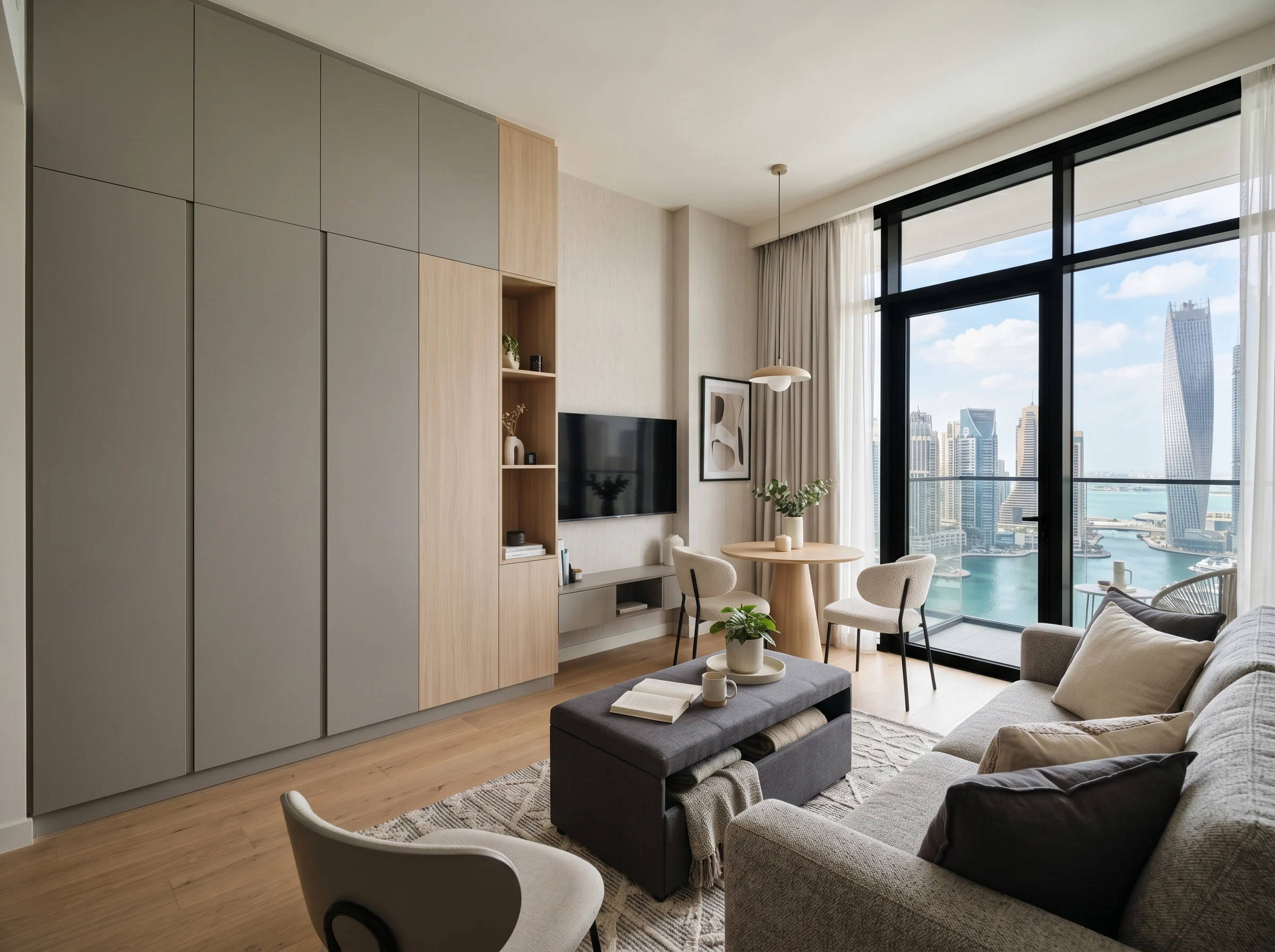
High-rise apartment living in new Dubai communities presents a different set of furniture challenges: smaller footprints, higher ceilings, stunning views, and limited storage. The guiding principle here is multifunctionality.
A sofa bed in a spare room serves guests without requiring a dedicated guest room. An extendable dining table does double duty as a work-from-home surface. Ottoman storage units replace traditional coffee tables while hiding away blankets, toys, or remotes. Fitted wardrobes that reach ceiling height (rather than stopping at 2.1m) make use of space that would otherwise be dead and can add meaningful storage in a 2-bedroom apartment.
Common Furniture Mistakes We See in New Dubai Community Homes
Mistake 1: Buying Furniture Before Confirming Room Dimensions
This is far and away the most common and most painful mistake. A sofa ordered online that turns out to be 10cm too wide to fit through the entrance door. A dining table that seats six but leaves no room to pull chairs back. A wardrobe that blocks a bedroom doorway when open.
Additionally, in new community villas, ceiling heights vary dramatically even within the same development — some ground floor rooms have 3m ceilings, upper floors often drop to 2.6m. Before ordering any significant piece, measure the room, measure the doorways, and measure the staircase or lift if delivery involves upper floors. Our in-home design consultation service exists precisely to prevent this — it’s free and it saves real money.
Mistake 2: Choosing a Sofa Based on Showroom Appearance Alone
A sofa that looks stunning in a showroom may feel very different after three months of daily family use. The showroom lighting is flattering. The cushions are perfectly plumped. There’s no child’s juice spill on the armrest to test the fabric’s resilience.
When choosing a sofa — particularly at the AED 5,000+ level — ask about the internal frame construction (hardwood or kiln-dried timber is better than metal frame for long-term comfort), the cushion core material (high-resilience foam holds its shape far longer than standard foam), and the fabric’s performance rating. A knowledgeable sales consultant should be able to answer all of these without hesitation.
Mistake 3: Ignoring the Dining Table’s Working Width
The dining table is a piece that families often undersize. A table that seats 6 people at 160cm length sounds adequate — but the comfortable working width for a dining table is 90cm minimum, and 100cm is better for family use. At 80cm width, two adults facing each other have barely enough room for their plates, glasses, and a central serving dish.
In new Dubai community dining rooms, which are often part of open-plan layouts and therefore need to work visually in a larger space as well, the guidance is: go to at least 180cm length if you have a growing family, and don’t compromise below 90cm width. A good timber or sintered-stone dining table at this size runs AED 2,800–6,000.
Mistake 4: Under-Investing in the Bed and Mattress
After the sofa, the bed is the furniture item that most directly affects daily quality of life — and yet it’s the one that families most consistently under-invest in. A beautiful bedroom with a mediocre mattress is a daily disappointment in a way that a plain bedroom with an exceptional mattress is not.
The mattress and bed base together should be treated as a unit. A high-quality memory foam or hybrid mattress on a cheap slatted base that allows the mattress to sag will not perform as expected. In Dubai’s climate, a bed base that allows airflow beneath the mattress is also practical — solid divan bases can trap humidity. Budget AED 3,500–8,000 for a combined bed frame and quality mattress for the master bedroom, and you’ll notice the difference every single morning.
Mistake 5: Treating Every Room at the Same Priority Level
Not all rooms are equal in the impact they have on daily quality of life. The living-dining area is where families spend the most time together. The master bedroom is where adults rest and recover. These two areas deserve your best furniture budget. The guest room, the study, the kids’ playroom — these matter, but they can be furnished more economically without it affecting your daily experience meaningfully.
Moreover, we often see families who have an extraordinary kids’ bedroom set and a mediocre family sofa they quietly dislike sitting on every evening. Redirect that thinking: adults need quality too.
Budget Planning Guide for New Community Homes in Dubai
Here are honest AED ranges based on what we see families actually spend at Karnak Home, not aspirational figures:
Studio Apartment — Essential Furnishing:
AED 12,000–22,000 total Core pieces: sofa bed or small sofa, bed and mattress, compact dining table and chairs, wardrobe.
2-Bedroom Apartment — Complete Furnishing:
AED 28,000–55,000 total Core pieces: family sofa, bed and mattress, guest bed, dining table, wardrobes for both bedrooms, basic storage.
3-Bedroom Townhouse — Complete Furnishing:
AED 55,000–95,000 total Core pieces: sectional sofa, dining set, master bed and mattress, two children’s beds, wardrobes, study/home office setup.
4–5 Bedroom Villa — Complete Furnishing:
AED 90,000–200,000+ total Core pieces: living room suite, dining room, master bedroom suite with fitted wardrobes, children’s rooms, guest room, home office, majlis.
Additionally, these ranges allow for quality mid-range furniture throughout. If you prioritise hero pieces — a standout sofa, a genuine stone dining table, a premium bed — and are more economical elsewhere, the results are often better than spending evenly across all categories.
A word on payment: Karnak Home offers financing options that allow families to spread furniture costs interest-free over several months. For a new community move where cash is being used across multiple expenses simultaneously, this can make a meaningful practical difference.
Expert Tips from 35 Years of Furnishing UAE Homes
Tip 1: In any room, establish the focal point before buying anything else.
In a living room, the focal point is usually a TV wall or a view window — and the sofa should face it. In a bedroom, the bed headboard wall is the focal point. Every other piece organises around this anchor. Getting this wrong means everything else in the room feels slightly off, regardless of individual piece quality.
Tip 2: The UAE’s summer is the best time to test upholstery durability.
If you can visit a showroom in July or August and feel how fabrics perform when you’ve been outdoors and come in warm, you get a real sense of how they’ll feel in daily family life. Performance fabrics that feel slightly cooler to the touch at room temperature are a real comfort consideration, not just a marketing claim.
Tip 3: Always test the actual seat height of sofas and dining chairs.
Standard sofa seat heights are 42–48cm. For families with elderly members or shorter individuals, a seat height at the lower end of that range makes getting up and down easier. For dining, the gap between the chair seat and the table underside should be 25–30cm for comfortable seating. These numbers matter more than they sound.
Tip 4: For new community villas with majlis rooms, treat them as a distinct furniture challenge.
A majlis is not a Western living room. The low-seating, perimeter arrangement of traditional majlis furniture serves specific social functions — it allows conversation across a room full of guests. Mixing traditional majlis seating with modern furniture in the same room rarely works well. Decide clearly whether the room is a majlis or a modern lounge, and furnish it accordingly.
Tip 5: In kids’ rooms, buy one size up.
Children outgrow furniture faster than parents expect. A bed frame for a five-year-old that accommodates a full single (90×200cm) mattress will serve them through to their teens without replacement. A toddler bed that fits only a small 70×140cm mattress will need replacing by age six. The cost difference is small; the saving is significant.
Tip 6: Light-coloured furniture and Dubai’s dust are in a constant negotiation.
Cream, ivory, and white upholstery looks elegant in showrooms and in design magazines. In Dubai’s dusty environment, it requires more maintenance than darker colours or mid-tones. This isn’t a reason to avoid light upholstery — it’s a reason to choose it in a performance fabric that can be wiped or spot-cleaned, rather than a delicate natural weave that requires professional cleaning.
Tip 7: Visit the showroom more than once.
The furniture that appeals on a first visit sometimes feels less compelling on a return visit — and the piece you dismissed initially often becomes the clear choice. For significant investments (sofas, beds, dining tables), give yourself at least two visits before committing.
Tip 8: Ask about delivery and assembly lead times before finalising.
In new Dubai communities, particularly during handover periods when many families are moving in simultaneously, delivery slots can book out several weeks ahead. If you have a move-in date, factor in furniture delivery and assembly time. Sleeping on a mattress on the floor for a week is tolerable. Having no sofa for three weeks is genuinely inconvenient.
Conclusion: Making Smart Furniture Decisions in Your New Dubai Community Home
Dubai’s newest communities are some of the most thoughtfully designed residential environments in the world. The homes are better than they’ve ever been. The natural surroundings are greener. The lifestyle on offer is genuinely excellent. Your furniture choices should rise to meet that standard — not as a luxury indulgence, but as a practical investment in how well your family lives day-to-day.
Additionally, the trends we’ve discussed — modular flexibility, natural materials, intelligent zoning, climate-conscious choices, and the collect-slowly mindset — aren’t passing fashion statements. They’re sensible responses to how life in new Dubai communities actually works in 2026.
Moreover, the best furniture decisions come from understanding your specific home, your family’s actual daily habits, and the honest performance characteristics of the pieces you’re considering. That’s the guidance we’ve been offering families across the UAE — from Dubai and Abu Dhabi to Sharjah, Ras Al Khaimah, and beyond — for 35 years.
Key Takeaways:
- New Dubai communities in 2026 demand flexible, modular furniture that adapts as your family’s needs evolve — not fixed pieces that lock you into one configuration
- Natural materials and biophilic design are now standard expectations in new community homes, but require informed material choices for UAE climate performance
- Budget smartly: invest most heavily in the sofa, bed, and dining table — the pieces that directly affect daily quality of life — and be more economical elsewhere
Ready to Furnish Your New Community Home?
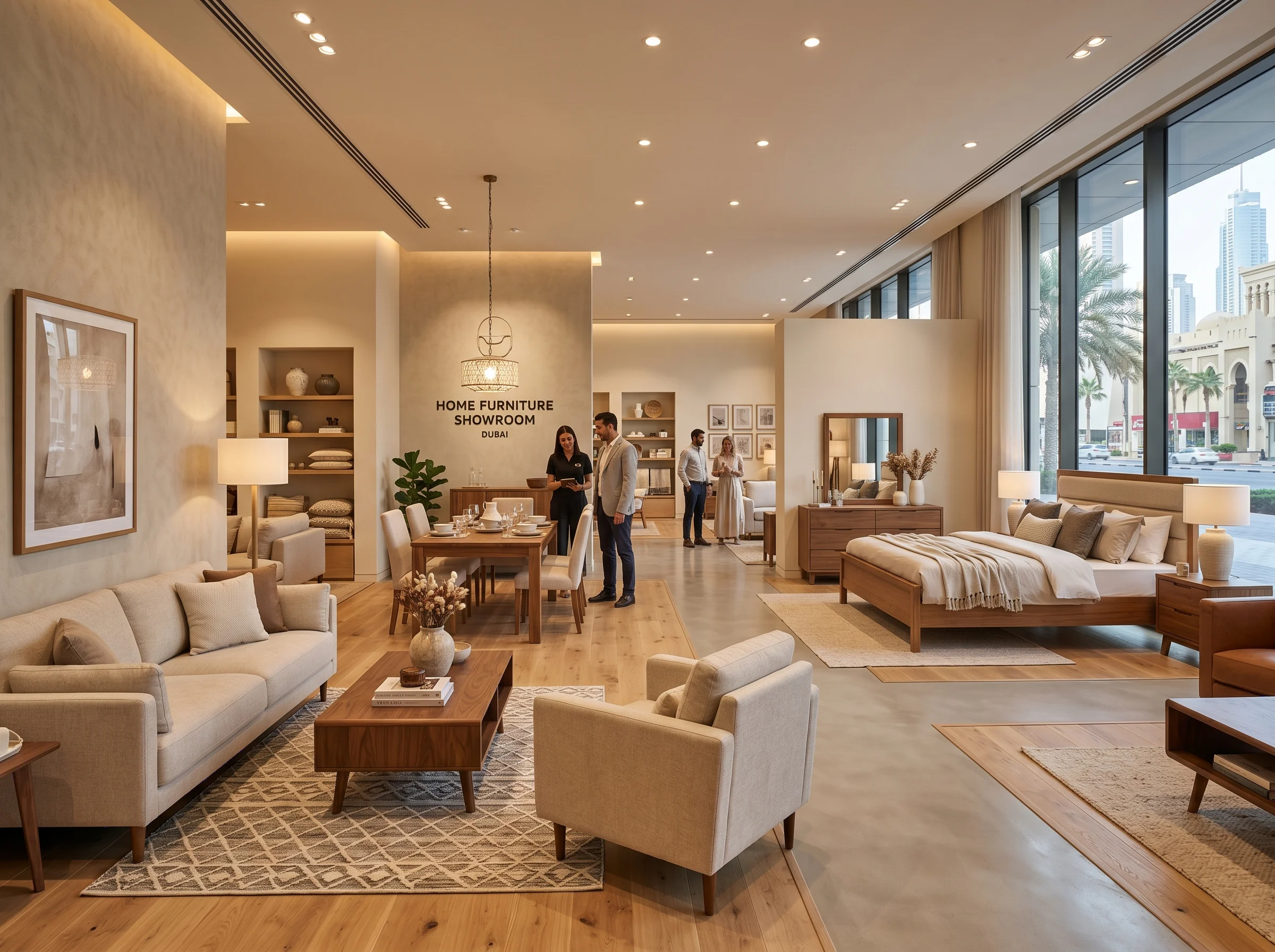
At Karnak Home, we understand that moving into a new Dubai community is one of the most significant investments your family will make. We’ve been helping families navigate exactly these decisions since 1988, not by pushing whatever is in stock, but by taking the time to understand your home, your household, and your budget. Visit our Dubai showroom to see our full range of sofas, beds, dining sets, wardrobes, and kids’ furniture in person or explore our full collection online.
We offer delivery across all seven emirates, and our team can advise on anything from sofa dimensions to full room layouts. There’s no pressure and no commission-driven sales – just genuine guidance from people who know UAE homes.
Shop Online: Karnak Home
Visit Our Showroom: Dubai – Showroom Address & Directions
Expert Advice: Call Us or WhatsApp our team for personalised guidance
Related Articles:
10 Common Furniture Buying Mistakes UAE Families Make (And How to Avoid Them)
Entryway and Hallway Furniture Ideas for UAE Homes: First Impressions Matter
How to Furnish a Guest Room in a UAE Villa for Eid: Comfort Meets Impressions
How to Choose the Right Dining Table Size for Your UAE Family