
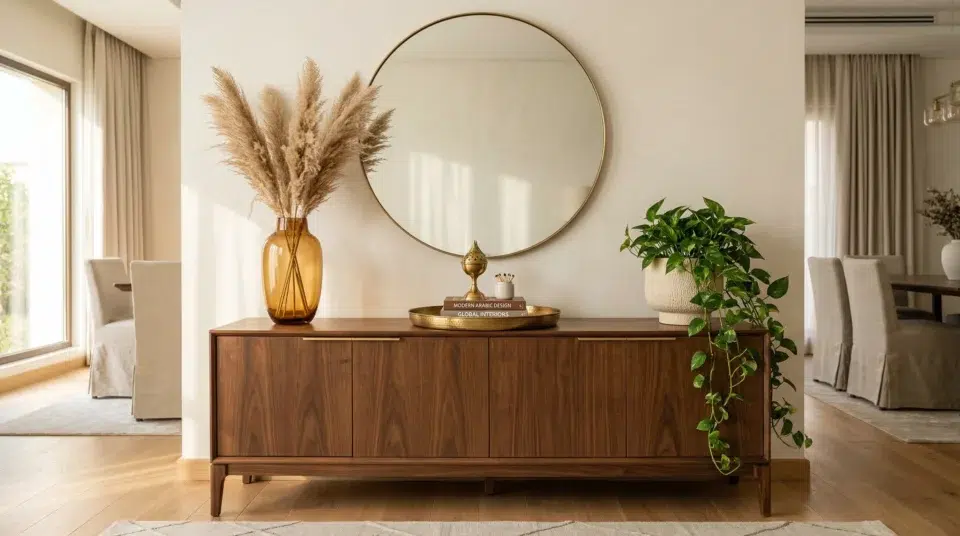
The buffet arrives. The delivery team assembles it, levels the feet, confirms every drawer closes correctly, and leaves. You stand in front of your new piece, beautiful, empty, and realise you have no idea what to put on it. You try a few things: a plant on the left, a candle on the right, a bowl of keys and remotes in the middle. It looks fine. But it does not look like the photograph that made you want this piece. It does not look like the UAE home interior feeds you saved on your phone. It looks like an afterthought rather than the room’s anchor.
This is the most common post-purchase experience with a sideboard or buffet in any UAE home, and it is entirely fixable with a small amount of the right knowledge. Styling is not talent. It is not an ability some people have, and others do not. It is a set of principles, the same principles used by the interior designers who style the homes you admire on Instagram, and those principles are completely learnable. Better yet, they translate directly and specifically to the UAE home context: the role of the buffet in Gulf hospitality culture, the specific light conditions in Dubai and Sharjah apartments and villas, the seasonal rhythms of Ramadan and Eid that transform the expectations of every surface in the house, and the practical reality of a UAE family that actually lives in this room rather than photographing it.
In this guide, we share twelve real buffet and sideboard styling ideas for UAE homes in 2026, from the foundational principles that apply to every context to the specific seasonal, cultural, and room-type variations that make UAE styling distinct from anything a European or American guide will tell you. We also cover what not to put on a buffet, the choices that cost nothing but styling credibility, and the specific accessories available in the UAE market that deliver the most visual impact per dirham spent.
The Foundation: Three Principles That Make Every UAE Buffet Look Designed
Before the twelve ideas, three principles underpin every one of them. These are the principles that separate a styled buffet from a storage surface. Learn them once, and they become automatic.
Principle 1:The Rule of Thirds
Divide your buffet surface mentally into three equal zones: left, centre, right. Place one intentional element in each zone. Then leave deliberate space between them. This is the rule of thirds, borrowed from photography and painting, and it works on a buffet surface for the same reason it works in a frame: the human eye finds asymmetric balance more satisfying than either symmetry or randomness.
In a UAE home context, the rule of thirds typically organises as follows: the left third holds a tall vertical element (a vase, a plant, a stack of books with a small object on top); the central third holds the primary statement piece or, better still, deliberate negative space with a single beautiful object; and the right third holds a composed collection of lower, horizontal elements (a tray, a candle, a small sculptural object).
The key instruction that most guides omit: the zones do not need to be equal in visual weight. A tall dramatic vase in the left third can be balanced by a collection of three small objects in the right third, because height is balanced by quantity. This principle applies regardless of the buffet width, the finish, or the room style.
Principle 2: The Height Gradient
Every styled buffet surface should have at least three distinct heights among its accessories: tall, medium, and low. This creates a visual landscape rather than a flat surface with objects of similar scale. In practice: a 65 cm tall dried botanicals arrangement (tall), a 35 cm round mirror or framed print leaning against the wall (medium), and a 12 cm tray with candles (low). The eye moves between these heights naturally, and the movement is what creates the sensation of a “styled” rather than a “placed” surface.
In UAE homes specifically, the tall element is particularly important because UAE dining rooms often have high ceilings (2.7 metres is standard, newer villas reach 3.0 to 3.2 metres). Without a tall element on the buffet surface, the wall above the piece reads as empty, and the proportion between the buffet’s width and its vertical impact feels unresolved. A tall element whether botanical, architectural, or sculptural, bridges the buffet top and the wall above it.
Principle 3, The Negative Space Commitment
Negative space on a buffet surface is not emptiness. It is a deliberate compositional decision that communicates confidence and calm. The most common styling mistake, and the one that consistently separates amateur styling from professional results, is filling the entire surface. A buffet with every centimetre occupied reads as busy, chaotic, and small, regardless of its actual dimensions.
The practical rule for UAE buffets: never fill more than 60 percent of the surface area with objects. The remaining 40 percent of the clear surface is as important to the composition as the objects themselves. In a UAE majlis or dining room, where the buffet is the most visible piece of furniture from the primary seating position, this 40 percent of breathing space is what makes the room feel generous rather than crowded.
Our buffet styling ideas UAE collection showcases pieces styled with these three principles as the consistent foundation across all finish and width options.
2: The Twelve Styling Ideas for UAE Homes in 2026
Idea 1: The Classic UAE Tray Vignette
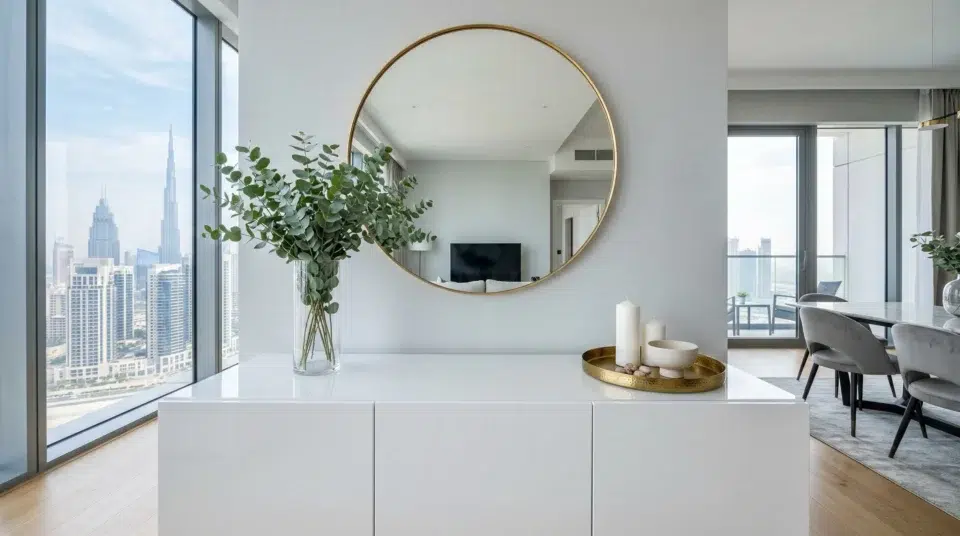
The tray vignette is the most universally successful buffet styling approach for UAE homes, and the one our team recommends first to any buyer who asks where to begin. A tray, brass, silver, woven rattan, or lacquered wood, placed in the right third of the buffet surface, creates an instant compositional container. Everything placed within the tray becomes part of a single composition, making even a group of unrelated objects read as deliberate.
For a UAE home, the tray contents that work best are: a small scented candle or incense accessory (a practical nod to Gulf hospitality culture, where fragrance is part of the welcome), a small ceramic or glass vessel, and a single natural element such as a stone, a dried seedpod, or a small cutting from a plant. The tray unifies these objects and prevents the right third of the buffet from looking like a collection of random items.
The brass tray is the most culturally resonant choice for UAE homes because brass and gold are embedded in Gulf aesthetic tradition, from the colour of the Arabic coffee dallah to the hardware of traditional wooden doors. A 30 to 40 cm round brass tray costs AED 35 to AED 120 from Centrepoint, Home Centre, or Dragon Mart, and immediately elevates any buffet surface.
Idea 2: The Botanicals Moment: Dried vs Fresh in UAE Conditions
Plants and botanicals are the most impactful single element you can place on a UAE buffet surface, but the choice between fresh, dried, and artificial requires some UAE-specific thinking.
Fresh flowers and greenery are beautiful but impractical for sustained display on a UAE buffet. In summer, fresh flowers in a vase will last 24 to 48 hours at room temperature. Even in air-conditioned rooms, the dry interior air reduces fresh flower longevity significantly. Fresh botanicals are appropriate for specific occasions, when you have guests, during Eid, for a dinner party, but not as a permanent styling solution in the UAE climate.
Dried botanicals are the UAE stylist’s go-to for a permanent buffet display. Pampas grass (in cream, white, or dusky pink), dried palm fronds, preserved eucalyptus, dried protea, and cotton stems all perform beautifully in UAE conditions and do not require water or maintenance. They also photograph exceptionally well; the feathery texture of pampas grass or the structural drama of dried palm adds the kind of organic warmth that manufactured objects cannot replicate. Dried pampas arrangements cost AED 40 to AED 150 from UAE home stores and online platforms.
High-quality artificial botanicals are increasingly acceptable in UAE interior design, particularly for buyers who want the visual impact without any maintenance. The key is quality: mass-produced plastic plants from inexpensive retailers read as artificial immediately. Silk or fabric botanicals from quality suppliers, particularly those with realistic stem and leaf texture, are visually convincing at normal room viewing distances.
Idea 3: The Leaning Art Approach: UAE Apartment Friendly and Renter Safe
In UAE apartments where wall-hanging is restricted by lease agreements or where the effort of drilling into concrete walls is prohibitive, the leaning artwork approach is both practically sensible and aesthetically on-trend. A framed print, a canvas, or a square mirror leaned against the wall above the buffet surface, rather than hung on the wall, creates a layered, lived-in, and deliberately casual composition that photographs beautifully.
The leaning element works best when it occupies the medium height in the buffet’s vertical composition: taller than the accessories on the surface, shorter than the ceiling, and wide enough to provide visual backing for the arrangement below. A 50 cm by 70 cm framed abstract print leaning against the wall above the centre of a 160 cm buffet creates the kind of composition that requires no nail, no drill, and no permission from a UAE landlord.
For UAE-specific aesthetic resonance, consider leaning a piece of Arabic calligraphy art, a single Quranic verse in a simple frame, or a contemporary Arabic typography print, above a warm wood-tone buffet. The contrast between the visual complexity of the calligraphy and the clean surface below creates exactly the kind of cultural layering that makes UAE interiors distinctive from their international equivalents.
Idea 4: The Mirror Double: Maximising Light in UAE Apartments
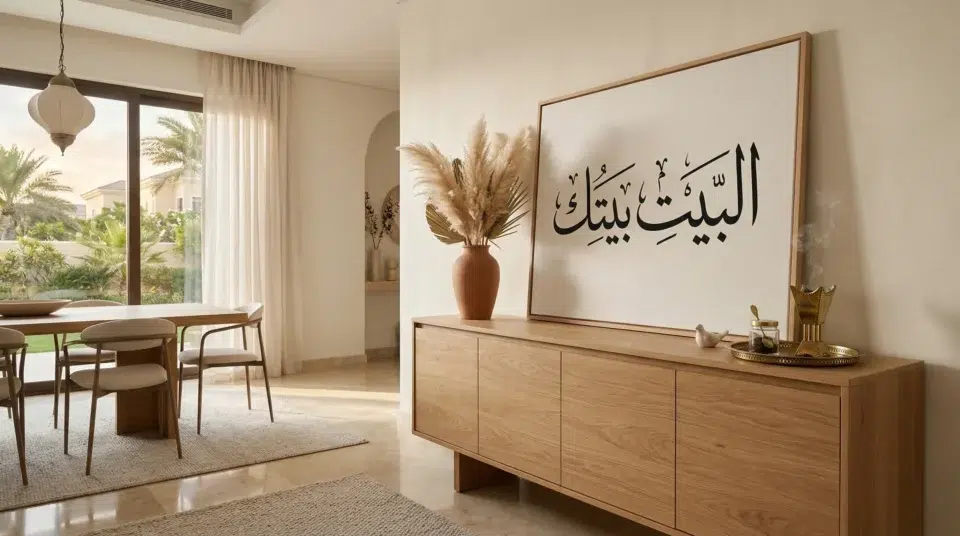
Placing a mirror above a buffet in a UAE apartment is not merely a design choice; it is a practical spatial and lighting strategy. In apartment communities like JLT, JVC, and Al Barsha, where rooms often receive limited natural light from a single window direction, a large round or rectangular mirror above the buffet reflects whatever natural light exists across the room, making the space feel significantly brighter and larger.
The mirror also doubles the visual impact of the buffet’s surface styling: a well-composed arrangement of botanicals, a tray, and a candle seen in reflection appears richer and more layered than the same arrangement seen directly. This is why mirrors above buffets appear so frequently in interior design photography; they make everything better, and they do so without requiring any additional furniture or accessories.
For UAE apartment renters, a leaning mirror (as described in Idea 3) avoids the drilling question entirely. For villa owners and long-term renters in communities like Arabian Ranches, Mirdif, and Al Furjan, a wall-hung mirror creates a more permanent and formal architectural statement.
The round mirror in a thin brass or matte black frame is the dominant mirror form in UAE interior design right now. Sizes between 60 cm and 90 cm in diameter work on most standard buffets. A 70 cm round mirror in a satin brass frame costs AED 150 to AED 450 from UAE retailers and is one of the most cost-effective visual investments for any UAE dining room.
Idea 5: The Seasonal Switch: Ramadan, Eid, and the National Day Transformation
The UAE home surfaces, buffets, side tables, and console tables are reset seasonally in a way that no European or North American styling guide anticipates. In the UAE, the buffet surface is a seasonal stage that reflects the hospitality rhythms of the Gulf calendar.
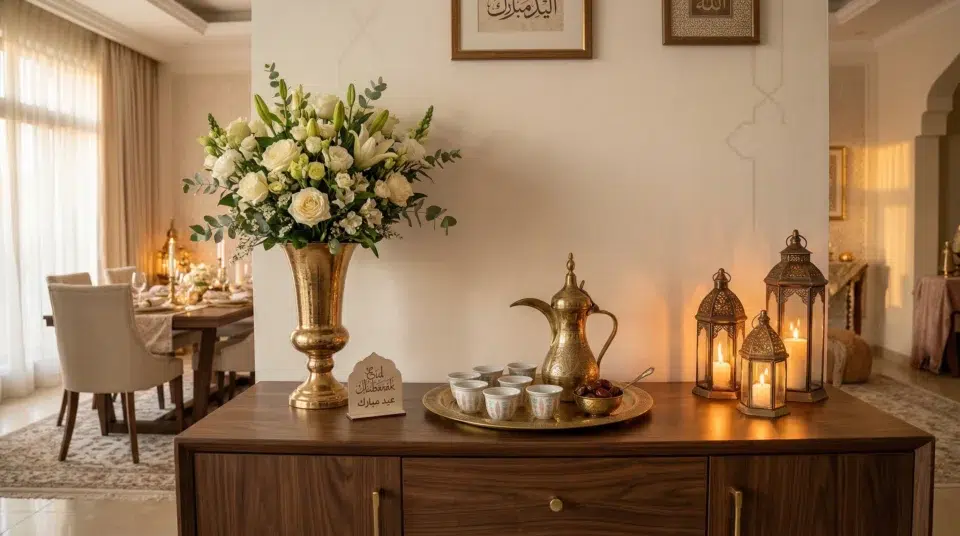
Ramadan styling: The UAE Ramadan aesthetic draws on rich, warm materials, deep burgundy and forest green velvet, gold lanterns, flickering candles, and the specific accessories of Iftar hospitality: the dates dish, the rose water bowl, and the ornate serving tray. A Ramadan-styled buffet replaces the everyday tray vignette with a more elaborate composition: a pair of tall gold lanterns (malaleef) flanking a central arrangement of fresh or dried flowers, a date presentation dish at the front, and a string of warm fairy lights or an LED candle cluster providing ambient light at the back of the surface.
This staging costs relatively little, AED 100 to AED 300 for lanterns, AED 30 to AED 80 for a quality dates dish, AED 40 to AED 80 for fairy lights, and transforms the buffet into the visual centrepiece of a home prepared for the UAE’s most socially significant season. Our Ramadan buffet decoration UAE ideas page shows complete seasonal staging examples across different buffet finishes and widths.
Eid Al Fitr and Eid Al Adha: Eid styling in UAE homes calls for a celebratory register that is warmer and more festive than the contemplative beauty of Ramadan. Fresh flowers replace dried ones. Gold accessories become more prominent. The buffet surface during Eid serves as the visible expression of a household’s generosity: it holds the sweet offerings for guests, the Arabic coffee service, and the ornamental objects that signal celebration.
UAE National Day (December 2): Red, white, black, and green, the colours of the UAE flag, create a specific seasonal palette opportunity for buffet styling in the first week of December. A simple arrangement of flag-coloured flowers (red roses, white orchids, green leaves against a black tray surface) is a respectful, beautiful, and photographically striking National Day styling choice.
Idea 6: The Minimalist UAE: One Perfect Object
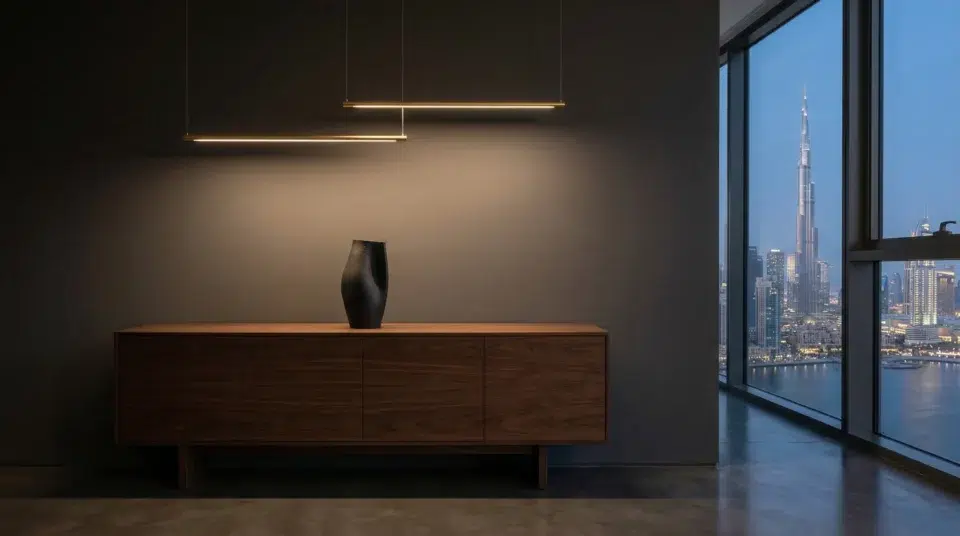
For buyers in contemporary Dubai developments, Downtown Dubai, Dubai Creek Harbour, DIFC-adjacent residences, and Yas Island in Abu Dhabi, the minimalist styling approach has specific appeal. One perfect object, placed slightly off-centre in the left or right third of the buffet surface, with the rest of the surface completely clear.
The object must earn this solo status. It must have genuine visual interest: an unusual form, a beautiful material, a cultural significance, or a striking scale that holds the eye without requiring a supporting cast. A single large sculptural ceramic in a matte earth tone. A single stone object, a smoothed piece of rose quartz, a carved marble sphere. A single piece of Arabic craft: a traditional copper coffee pot on a polished surface, a hand-woven textile folded with architectural precision.
In UAE homes with sophisticated, curated interior design, where the rest of the room’s furniture, art, and accessories are already doing significant visual work, the single-object buffet styling is the most confident possible statement. It says that you trust the room to be complete without crowding every surface.
Idea 7: The Layered Gallery Wall: Buffet as Anchor for Art
When a buffet is placed against a wall that is large enough to accommodate wall-hung art above it, the combination of the piece and its backdrop creates a room within a room, a distinct visual zone that anchors the dining or living space with genuine interior design ambition.
The gallery wall above a UAE buffet works best as a curated collection of three to five pieces of different sizes and formats: a large abstract canvas as the centrepiece, smaller framed photographs or prints at its sides, and one or two smaller objects (a small shelf bracket, a dried botanical in a wall-mounted vase) providing dimensional variation. The arrangement should be asymmetric rather than symmetrically balanced; asymmetry communicates a collected-over-time authenticity that symmetry cannot.
For UAE homes with a mix of cultural influences, common in the homes of long-term residents who have accumulated meaningful objects from travels, from family, and from the UAE itself, the gallery wall above the buffet is the single most personalising design move available. It turns a dining room into a reflection of specific lives and specific stories.
Idea 8: The Practical-Beautiful Balance: Karnak’s Real Family Approach
Not every UAE home is a showroom. Most are lived in by families with children, with domestic helpers, with the ongoing tide of daily life that puts remote controls on tray surfaces and school bags on buffet tops. The practical-beautiful approach to buffet styling accepts this reality and designs for it rather than against it.
The practical-beautiful UAE buffet surface has: a covered tray (with a lid or a cloth) on the right that conceals the practical objects that will inevitably accumulate there (remote controls, loose change, keys, the children’s hair accessories from this morning). A beautiful object or plant arrangement on the left that is genuinely for looking at and is maintained with care. And a central zone that is kept clear as a working surface for setting down items during meal preparation or serving.
This is not a compromise styling approach; it is an honest one that produces results that look intentional and are genuinely usable. In our 36 years of visiting UAE homes after delivery, the buffets that look best at the six-month mark are invariably the ones styled with this practical-beautiful balance rather than the ones attempting showroom perfection against the resistance of daily family life.
3: Styling by UAE Home Type and Room Context
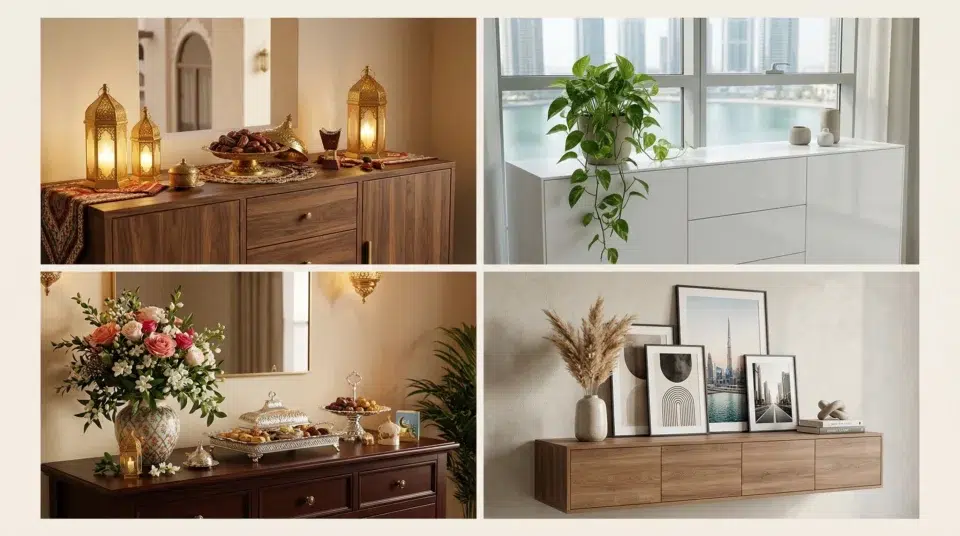
Styling for Compact Apartments: JVC, JLT, Al Barsha
In compact apartment dining areas, the buffet styling must work harder on a smaller surface. The principles scale down rather than simplify: three heights still apply, but the objects are smaller in absolute scale. The tray vignette shrinks to 25 cm in diameter rather than 40 cm. The botanical arrangement moves from pampas grass to a single stem in a bud vase. The leaning art uses a 40 cm by 50 cm print rather than a 60 cm by 80 cm canvas.
The most important compact-apartment styling consideration is vertical rather than horizontal: use taller elements relative to the buffet surface to draw the eye upward and create the impression of more space. A single 60 cm tall dried botanical arrangement on a 120 cm wide slim buffet achieves proportionally the same visual impact as an 80 cm arrangement on a 180 cm villa piece — and it does so in a space where horizontal surface real estate is limited.
Styling for Villa Dining Rooms: Mirdif, Arabian Ranches, Al Furjan, Jumeirah
Villa dining rooms have the space for bolder, more layered buffet styling and benefit from it. A 180 cm buffet in an Arabian Ranches villa dining room can carry a full gallery arrangement: two substantial botanical arrangements flanking a central large-format canvas, with a collection of books and small sculptural objects at surface level, and a cluster of pillar candles in varying heights at the front edge of the surface.
Villa styling in UAE homes also typically incorporates more traditional Gulf accessories than apartment styling: the Arabic coffee service, the incense burner, the pearl-handled letter opener on the writing tray. These objects carry cultural weight and personal meaning that cannot be replaced by generic decorative objects from a home store, and they belong on the buffet surface in any UAE home where they represent the family’s authentic hospitality culture.
Styling for Majlis-Adjacent Spaces: Sharjah, Abu Dhabi, and Traditional UAE Homes
In homes where the buffet is positioned in or adjacent to a majlis, the traditional Gulf receiving room, the styling vocabulary changes meaningfully. The majlis buffet is a functional hospitality surface first and a decorative surface second. It holds the Arabic coffee service (dallah and finjan cups), the dates dish, the incense burner (mabkhara), and the bakhoor (incense pellets) for fragrance welcome.
The aesthetic language of the majlis buffet draws on the traditional Gulf palette: warm woods (teak, acacia, dark walnut), brass and copper accessories, deep green foliage (palm fronds, tropical leaves), and the warm amber of incense smoke and candlelight. Abstract minimalism feels foreign in this context. Abundance, warmth, and the specific objects of Gulf hospitality are the appropriate design language.
If you are styling a buffet for a majlis-adjacent room, the three-principle framework still applies, rule of thirds, height gradient, and negative space, but the objects are drawn from the Gulf hospitality canon rather than from contemporary global design.
Styling for Open-Plan Apartments: The Dual-Purpose Buffet
When the buffet is doing double duty as both a dining storage piece and a living room anchor (with a TV wall-mounted above it, as covered in our companion article), the styling approach must account for the TV’s visual dominance.
A TV-above buffet is not styled to be seen independently; it is styled to support and frame the screen. This means: lower-profile accessories (maximum 30 cm tall with the TV above), a more neutral colour palette that does not compete with the screen’s changing colours, and a priority on practical organisation (remote controls in a tray, media accessories concealed in the closed storage below) over pure decoration.
Browse our dining room buffet decoration UAE guide for styling ideas specifically suited to TV-above placements.
What NOT to Put on a UAE Buffet: The Six Anti-Patterns
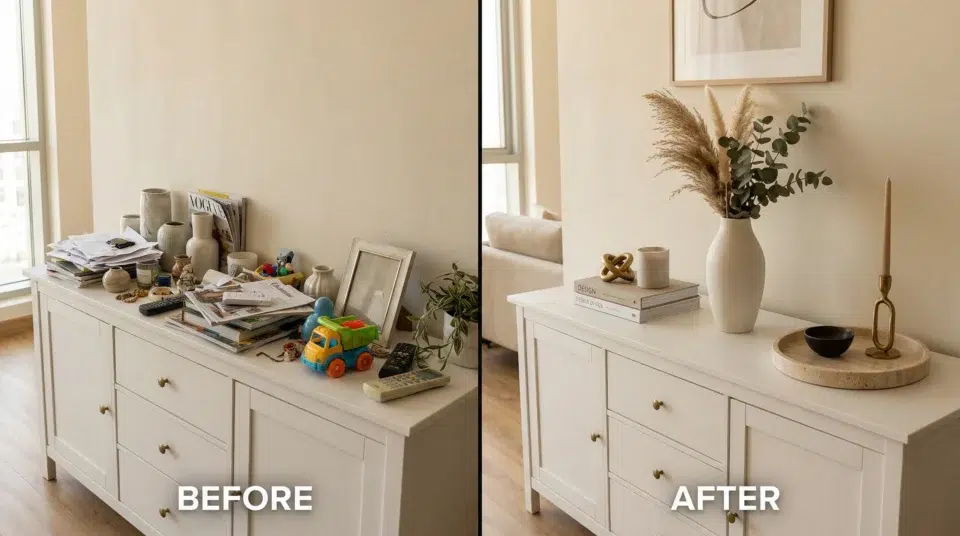
Anti-pattern 1: The full surface. As discussed in Principle 3, filling every centimetre of the buffet surface is the single most common and most visually damaging mistake. The cure is removing objects, not adding more.
Anti-pattern 2: Objects of identical height. Three ceramic vases of the same height arranged across a buffet surface create a flat, monotonous visual rhythm. Replace or rearrange to introduce variation: one tall, one medium, one low, or one tall element flanked by much lower objects.
Anti-pattern 3: The technology dump. Remote controls, phone chargers, laptops, tablets, and similar items should be placed directly on the buffet surface rather than in a tray or inside the piece. Technology items should always be in a tray, in a covered box, or inside the storage below. The presence of a loose cable on a styled buffet surface instantly removes the sense of intention from the entire arrangement.
Anti-pattern 4: The single-material composition. A buffet surface styled entirely with ceramic objects, or entirely with metal objects, or entirely with botanical elements, reads as accidentally themed rather than deliberately composed. The most beautiful buffet surfaces combine at least three different material types: one organic (plant, dried flower, stone, wood), one metallic (tray, candle holder, frame), and one ceramic or glass (vase, bowl, vessel).
Anti-pattern 5: Colour without direction. A collection of decorative objects in multiple, unrelated colours creates visual noise rather than composition. The most effective UAE buffet styling uses a maximum of three colours: a dominant neutral (the colour of the buffet’s finish itself), a secondary natural tone (the warm amber of brass, the green of botanicals, the warm cream of dried pampas), and a single accent colour used sparingly. In UAE homes, warm gold or brass serves as the accent colour that bridges the neutral and natural tones most successfully.
Anti-pattern 6: The seasonal left-behind. Gold lanterns and Eid accessories that are still on the buffet surface in July. Christmas ornaments are still present in February. Seasonal accessories have an expiry date on their appropriateness, and leaving them past that date makes a styled surface look neglected rather than considered. The seasonal switch described in Idea 5 only delivers its full impact if the previous season’s accessories are removed completely before the new ones go up.
5: The UAE Styling Accessories Shopping Guide: Where to Find Them and What to Pay
Brass and Gold Accessories: The UAE Buffet’s Most Versatile Investment
Brass and gold accessories are the UAE buffet stylist’s most consistently reliable purchase because they work across every finish direction: they complement dark walnut, they warm up cool grey, they elevate white gloss, and they carry the culturally resonant warmth of the Gulf aesthetic tradition. A small set of core brass pieces, a round tray, a bud vase, and a single candle holder, costing AED 100 to AED 250 total, will serve the buffet surface through every seasonal change and every future apartment.
Sources in the UAE: Home Centre, Centrepoint, IKEA (brass-finish aluminium rather than solid brass), Pan Emirates, and the home accessories section of Dragon Mart in Ras Al Khor. For quality, solid brass pieces, the Dubai Gold and Jewellery Group’s retail locations and specialist home accessory stores in the Jumeirah area carry genuine brass at premium prices (AED 200 to AED 600 per piece) that will patina beautifully over years of UAE use.
Botanicals Sources and Price Guide for UAE Buyers
Dried pampas grass: AED 40 to AED 150, available from Ikea, Home Centre, Mumzworld, and specialist online florists delivering across the UAE.
Preserved eucalyptus bundles: AED 30 to AED 80 per bundle, available from florists in Jumeirah, Dubai Hills, and most major UAE shopping malls.
Dried palm fronds (for a UAE-specific botanical moment): AED 15 to AED 40 from flower markets in Deira and Al Aweer wholesale flower market.
High-quality artificial stems: AED 25 to AED 120 per stem, available from Pan Emirates, West Elm (Dubai Mall), and specialist artificial plant retailers across the UAE.
Mirrors, Frames, and Art Sources for UAE Buffet Styling
A round brass mirror (60 to 80 cm): AED 150 to AED 500. Available from Home Centre, Zara Home (Dubai Mall and Mall of the Emirates), and Pottery Barn (Dubai Mall).
Arabic calligraphy prints: AED 80 to AED 400 framed. Available from Etsy UAE sellers, Dubai Design District art galleries, and seasonal market events at City Walk and La Mer.
Abstract canvas art: AED 120 to AED 600. Available from Dubai Design District, online through Melltoo and Dubizzle art sellers, and from UAE-based artists on Instagram.
6: Frequently Asked Questions About Styling a Buffet in a UAE Home
FAQ 1: What should I put on a buffet in a Dubai apartment to make it look stylish?
The most reliable starting point for any UAE apartment buffet is the tray vignette plus botanicals combination: a round brass tray on the right third of the surface containing a candle and a small ceramic, a tall dried botanical arrangement in the left third, and deliberate negative space in the centre. This combination costs between AED 80 and AED 250 to assemble from UAE home stores, takes under 15 minutes to set up, and produces a result that photographs well and reads as intentionally styled rather than randomly arranged. For more elaborate ideas, our ” What to put on buffet Dubai guide shows complete styled examples across different buffet sizes and finish categories.
FAQ 2: How do I style a buffet for Ramadan in a UAE home?
Ramadan buffet styling in UAE homes centres on three elements: warm, amber lighting (lanterns, candles, or fairy lights), traditional hospitality accessories (the dates dish, the incense burner, the rose water bowl), and rich material warmth (deep green or burgundy velvet table runner under the accessories, brass and copper objects rather than chrome or silver). Place your lanterns as the tall vertical elements in the left and right thirds, allow the central zone to hold the dates presentation dish as the visual anchor, and add a string of warm white fairy lights at the back of the surface for ambient glow. This staging takes approximately 30 minutes and transforms the buffet from a storage piece to the emotional centre of an Iftar-ready home. Full guidance on our Ramadan buffet decoration in the UAE article.
FAQ 3: What is the best mirror to put above a buffet in a Dubai apartment?
For Dubai apartment rental situations where wall drilling is restricted, the best mirror is a round or rectangular leaning mirror rather than a wall-hung one. A 60 to 75 cm round mirror in a thin satin brass or matte black frame, leaned against the wall above the buffet surface at a slight forward angle, creates the same visual impact as a hung mirror with none of the installation complications. If you do want to mount a mirror, confirm with your building management that minor wall fixings are permitted, most UAE residential buildings allow standard picture hooks. A mirror mounted 15 to 20 cm above the buffet top and approximately equal in width to the central third of the buffet surface is proportionally correct for most apartment buffets.
FAQ 4: How do I style a dark wood buffet in a UAE home without it looking too heavy?
A dark wood buffet becomes heavy-looking when it is paired with equally dark or visually dense accessories. The solution is contrast: pair dark wood with the lightest possible accessories, cream dried pampas grass, white ceramic vessels, pale linen textile accents, and a large bright or light-framed mirror above the surface to reflect light into the zone. The mirror above a dark wood buffet is particularly effective because it introduces a full rectangle of reflected light into the area immediately above the darkest surface in the room, creating brightness that counteracts the weight of the timber. Light-coloured walls behind a dark buffet are also important; if your wall is painted a medium or dark tone, consider the light wood finish direction instead.
FAQ 5: What accessories work best on a white gloss buffet in a UAE apartment?
White gloss buffets are the most versatile UAE buffet finish for accessory coordination because white works with every colour and material. The three styling directions that consistently perform best on white gloss surfaces are: warm brass and gold accessories (the warmth contrasts the cool gloss and prevents the surface from reading as clinical), bold single botanical (one substantial dried pampas or tropical arrangement in a natural clay or matte black vessel, which provides dramatic contrast against the white), and bold texture accent (a woven rattan tray, a boucle-textured cushion or runner across the surface, or a rough linen panel behind the accessories). Avoid placing chrome, silver, or mirror-finished accessories on a white gloss buffet; the similar finish levels compete without creating the contrast that makes styling read.
FAQ 6: How many accessories should I put on a 120cm buffet in a small Dubai apartment?
For a 120 cm buffet in a compact UAE apartment dining area, the maximum is three distinct accessory groups following the rule of thirds: one element on the left, one on the right, and a deliberately empty centre. Do not exceed this number. In a small room, a crowded buffet surface makes the entire space feel smaller and busier. The three elements should provide three heights (one tall, one medium, one low) and three material types (one organic, one metallic, one ceramic or glass). Total accessory spend: AED 60 to AED 180 produces a very good result. Spending more does not improve the outcome; restraint is the principle, and restraint costs less.
FAQ 7: Can I style a buffet in a traditional Arabic home with contemporary accessories?
Yes, and the contrast is one of the most elegant styling directions available in UAE interiors. The combination of a warm teak or acacia wood buffet (carrying the traditional warmth of the Gulf aesthetic) with one or two carefully chosen contemporary accessories, a single architectural ceramic, a clean-lined brass bar tray, and a large-format abstract print, creates a composition that honours the tradition of the space while acknowledging the contemporary reality of UAE life in 2026. The key is proportion: one or two contemporary pieces in the majority of traditional elements, or one traditional piece (the Arabic coffee service on its tray) in a primarily contemporary arrangement. Both directions work. What does not work is an equal split with no clear dominant register.
FAQ 8: How do I style a buffet that also has a TV mounted above it in a Dubai apartment?
The primary rule for TV-above buffet styling is height restraint: no accessory on the surface should exceed 25 to 30 cm in height, as anything taller will sit in the viewing line between the sofa and the screen and create visual distraction. This limits you to: a low tray composition (the practical-beautiful approach from Idea 8 works perfectly here), small-scale botanicals in low vases, and flat, horizontal elements like a small book stack or a wide, low ceramic bowl. The visual interest must come from horizontal layering and material contrast rather than vertical drama. Cable management is as important as accessory placement in this context — a single exposed HDMI cable running from the TV to the sideboard surface destroys the visual integrity of the most beautifully composed arrangement. See our full guide on sideboard decor ideas Dubai open-plan, for complete TV-above styling examples.
Conclusion
Three principles govern every beautifully styled UAE buffet: the rule of thirds, the height gradient, and the deliberate negative space commitment. Apply all three and your piece will look designed rather than arranged, regardless of whether it costs AED 1,200 or AED 12,000, and regardless of whether you spend AED 50 or AED 500 on the accessories around it. The twelve ideas in this guide are applications of these three principles to the specific contexts, seasons, and cultural moments that define UAE home life, from Ramadan lanterns in a Sharjah villa to a single sculptural ceramic on a minimalist Downtown Dubai sideboard.
The UAE home is one of the most interesting and rewarding interiors to style in the world because it sits at the intersection of Gulf tradition and global modernity, of rental practicality and genuine aspirational beauty. The buffet is the piece that most consistently holds this tension: it is the surface that holds the Arabic coffee service and the contemporary ceramic, the Eid lantern and the Japandi botanical, the family photographs and the art print from a gallery in Dubai Design District. When it is styled with intention and the right knowledge, it is the most expressive surface in the room.
Visit our Sharjah showroom, open Saturday to Thursday, 9 AM to 9 PM, to see our full 2026 buffet range styled with seasonal and community-specific accessory arrangements. WhatsApp our team at +971 58 908 8107 with a photograph of your current buffet, and we will send you a specific styling recommendation within the day. Free delivery. Free installation. Every piece, every community, every budget.
Ready to Style Your UAE Buffet?
Shop the Full Buffet Range Online: Explore our complete buffet styling ideas UAE and sideboard collection
Visit Our Showroom: Industrial Area, Sharjah, UAE (Sat to Thu, 9 AM to 9 PM)
WhatsApp for a Styling Recommendation: +971 58 908 8107
Call: +971 58 908 8107
Related Articles
- The Ultimate Guide to Buying Buffets in Dubai and the UAE (2026)
- 2026 Buffet and Sideboard Trends Transforming UAE Dining Rooms
- 7 Buffet Buying Mistakes UAE Homeowners Make in 2026
- Wood vs High-Gloss Buffets: What Actually Survives Dubai’s Climate
- Best Buffets Under AED 5,000 in Dubai: Quality Picks Without Overpaying
Ready to Style Your UAE Buffet with Confidence in 2026?
You’ve mastered the Rule of Thirds, Height Gradient, Negative Space, plus 12 real-home ideas like tray vignettes, dried botanicals, leaning art, seasonal Ramadan/Eid switches, and practical family balances that work beautifully in JVC apartments, Arabian Ranches villas, Sharjah majlis, and open-plan Dubai homes. Now pair your buffet or sideboard with complementary pieces that arrive with free delivery, free installation, free consultation, and expert styling advice across Dubai, Sharjah, Abu Dhabi, and the UAE.
- → Buffets & Sideboards – Warm wood, walnut, teak & gloss finishes perfect as the base for your 2026 styling (trays, botanicals, mirrors & gallery walls)
- → Dining Tables – Matching tables that anchor dining rooms for Eid hosting & family gatherings around your styled buffet
- → Display Units – Open & glass displays complementing your buffet styling with extra showcase space for decor
- → Consoles – Slim consoles for entryways or secondary walls, styled similarly in compact UAE apartments
- → TV Media Units – Low-profile media units for open-plan spaces, allowing dual-purpose buffet styling
- → Coffee Tables – Centre tables in matching woods/metals to extend your buffet aesthetic into living areas
- → Bookcases – Adjustable bookcases adding layered storage & display above/around your buffet gallery
- → Sofas & Loveseats – Modular & corner sofas creating welcoming zones that flow from your styled buffet
- → Accent Chairs – Stylish chairs enhancing dining corners with textures/colors tying to your buffet decor
- → Center Tables – Low wide tables echoing your buffet’s warm neutrals & botanicals for cohesive flow
- → Living Room Furniture – Full collections that integrate your buffet styling into open-plan or majlis-adjacent UAE homes
✅ Free Delivery • ✅ Free Installation • ✅ Free Consultation across the UAE
💬 WhatsApp Us Now – Mention “Buffet Styling Guide” for priority ideas