
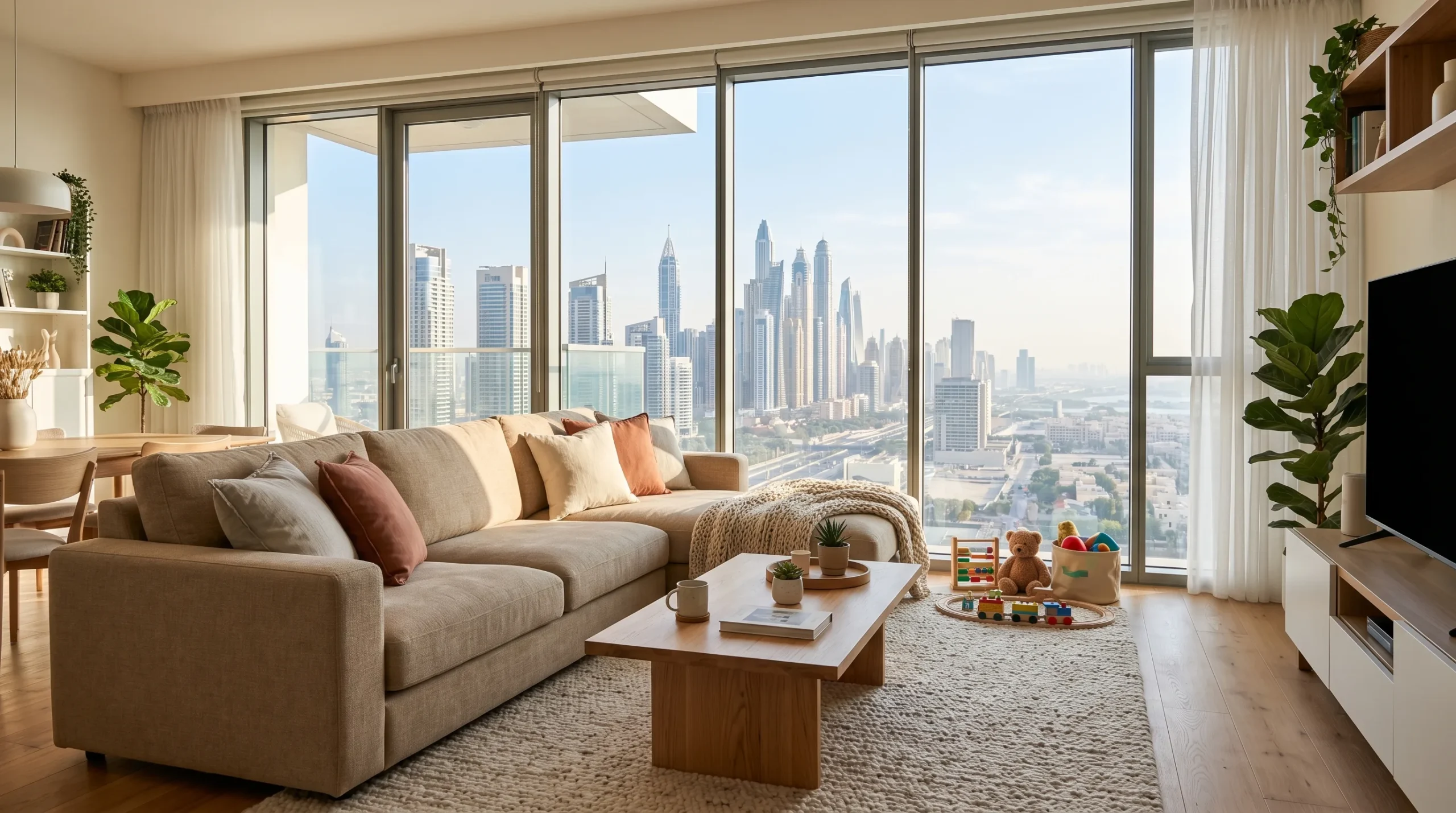
You’ve signed the tenancy agreement, the Ejari is registered, and the keys are in your hand. Now you’re standing in an empty apartment in Dubai, maybe in JVC, Discovery Gardens, Al Furjan, or Business Bay, and the reality sinks in: you need furniture, and you need it fast.
At Karnak Home, we’ve been helping UAE families furnish their homes since 1988. That’s over 35 years and more than 70,000 families across all seven emirates. We’ve seen every situation, the expat landing in Dubai for the first time with a single suitcase, the UAE national upgrading from a villa to a downtown apartment, the growing family realizing their old furniture no longer fits their life. And the single most common question we hear at the showroom is also the one nobody really answers clearly online: Should I choose a furnished or unfurnished apartment, and if I go unfurnished, where do I even start?
This guide answers that question properly. No fluff, no sales pitch, just 35 years of practical furniture knowledge applied to the specific realities of living in the UAE.
Furnished vs. Unfurnished in Dubai: Understanding What You’re Actually Choosing
The Dubai rental market is unlike almost anywhere else in the world. Furnished apartments typically rent for 20-40% more annually than their unfurnished equivalents, and the quality of “furnished” varies enormously. Before you decide which route suits your family, you need to understand what’s actually being offered, and what “furnished” legally means in the UAE.
A legally furnished apartment in Dubai should include basic furniture in every room: a bed and wardrobe in each bedroom, a sofa and coffee table in the living area, a dining table with chairs, and some form of kitchen appliances. In practice, what you’ll find ranges from genuinely tasteful, high-quality furniture in premium buildings to worn, mismatched pieces that look like they’ve furnished six different tenants without being replaced.
Unfurnished apartments in Dubai are typically rented as a shell, four walls, air conditioning units, and light fittings. Sometimes you’ll get built-in wardrobes (more common in newer buildings and villas), and sometimes the kitchen comes with a built-in hob and extractor. Everything else, every sofa, every bed, every dining chair, every bookshelf, you buy yourself.
Who Should Choose a Furnished Apartment?
Furnished apartments make sense for a specific kind of resident: someone on a short-term contract (under two years), someone relocating frequently, or someone who genuinely doesn’t want the responsibility of furniture ownership. If you’re a single professional on a one-year renewable contract and your company might relocate you to Singapore next year, furnished makes financial sense even at the premium price.
For families, the calculus almost always tips the other way. Furnished apartments charge a premium for furniture you didn’t choose, can’t customize, and often don’t love. That same premium, invested in your own quality furniture over a two- or three-year lease, buys you pieces that are yours, suit your lifestyle, and can move with you, to another apartment, another emirate, or even back home.
Who Should Choose Unfurnished?
If you’re in Dubai for two years or more, and statistically, most families who move here stay for considerably longer, unfurnished is almost always the smarter financial decision. The rent saving alone often covers the cost of furnishing an entire two-bedroom apartment. You get to choose exactly what suits your family’s lifestyle, your aesthetic preferences, and the specific layout of your space. And when you leave, or move to a bigger place as your family grows, your furniture comes with you.
The challenge, of course, is that furnishing an apartment from scratch feels overwhelming. That’s exactly what this guide is designed to solve.
The Real Cost of Furnishing an Unfurnished Apartment in Dubai
Let’s be honest about numbers, because this is where most families either overcomplicate things or get caught off-guard. Furnishing an unfurnished apartment in Dubai is a significant investment, but it’s a one-time investment that pays returns every year you’re in the UAE.
Studio Apartments (350–600 sq ft)
A studio in Dubai, common in areas like International City, Sports City, and Al Nahda, needs fewer pieces but needs them to work harder. You’re essentially furnishing a single multipurpose space, so every piece needs to justify its footprint.
Essential furniture for a Dubai studio apartment: A sofa bed or a compact sofa with a separate bed (depending on your sleeping preference), a small dining table with two chairs, a wardrobe (unless built-in), a TV unit, and some form of storage. Budget honestly: a quality sofa bed that will last three to four years starts from around AED 2,500–4,000. A decent queen-size bed frame with mattress runs AED 1,800–3,500. A simple dining set for two costs AED 800–1,800. All-in, you’re looking at AED 7,000–14,000 to furnish a studio properly, less if you’re buying entry-level pieces, more if you’re investing in quality.
One-Bedroom Apartments (700–900 sq ft)
One-beds are the most common apartment type in Dubai, popular with couples, young families, and professionals. The furniture list grows, but so does the space to work with.
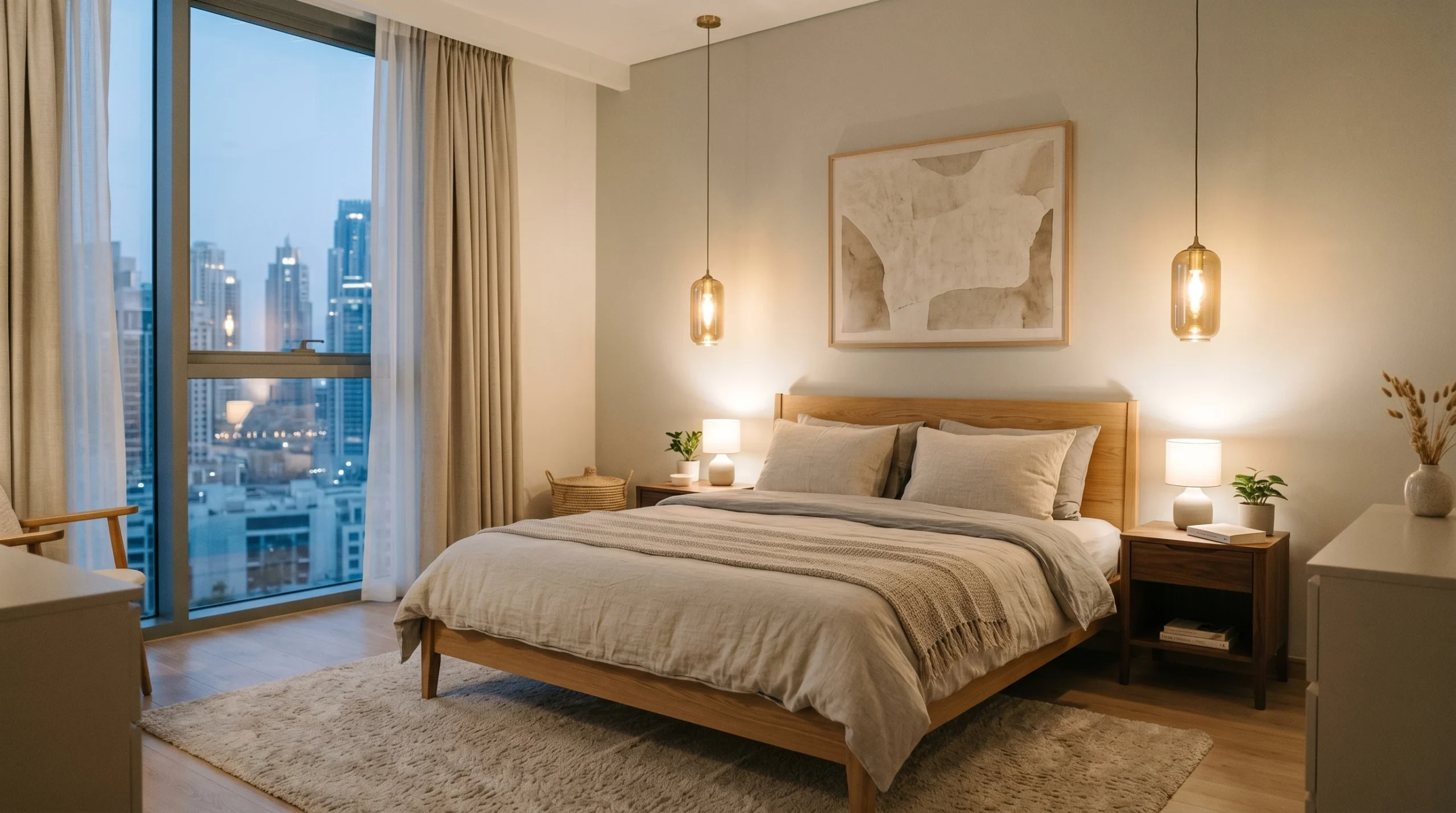
You’ll need a proper sofa (L-shaped or three-seater depending on the living room shape, measure before you buy), a bed and bedside tables for the bedroom, a wardrobe if not built-in, a dining table for four, a TV unit, and likely some storage solutions like a bookcase or console table. Expect to invest AED 15,000–28,000 for a well-furnished, quality one-bedroom. This sounds significant, but spread over a three-year lease, it’s less than AED 800 per month, considerably less than the typical furnished apartment premium.
Two-Bedroom Apartments (1,000–1,400 sq ft)
Two-beds are the sweet spot for young families in Dubai, enough space for a couple with one or two children, or for professionals sharing. The second bedroom might be a kids’ room, a guest room, or a home office depending on your situation, and each requires a different furniture approach.
Living area, master bedroom, second bedroom, and dining area all need proper furnishing. Budget AED 22,000–45,000 for a quality two-bedroom setup. At the higher end of this range, you’re investing in pieces that will last through multiple moves and possibly return to your home country with you.
Three-Bedroom Apartments and Villas
Villas in communities like Arabian Ranches, Mirdif, and The Springs require considerably more furniture, and the scale of spaces changes your purchasing decisions significantly. A villa living room might comfortably seat ten people, requiring either a large sectional or multiple seating pieces. Budget AED 40,000–90,000+ for a quality three-bedroom villa furnishing, depending on the size of your spaces and the quality level you’re targeting.
Room-by-Room: What to Buy First (And What Can Wait)
One of the most practical pieces of advice we give families at the Karnak Home showroom: you don’t have to furnish everything on day one. Prioritize by livability, then add over time.
Living Room: Start Here
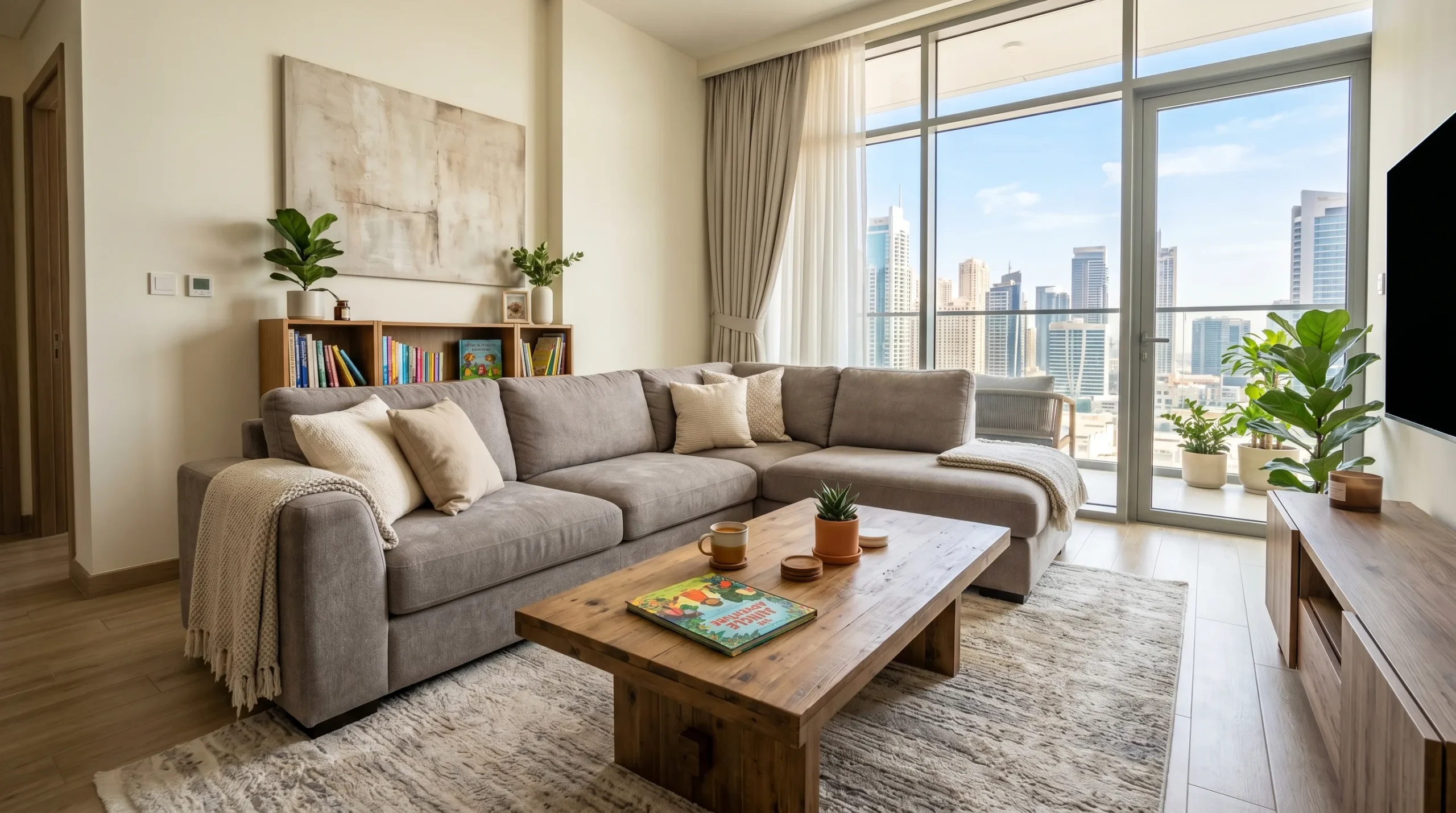
The living room is where your family will spend most of its time, and it’s the room visitors see first. It’s also the room where poor furniture choices are most expensive to fix, a sofa that’s the wrong size for your space, or that degrades in Dubai’s dry, air-conditioned climate within two years, is a costly mistake.
For Dubai apartments, we consistently recommend fabric sofas in performance weaves (look for stain-resistant, easy-clean fabrics, essential with children) or leather sofas in full-grain or semi-aniline leather, which handles Dubai’s temperature swings better than bonded or PU leather. Bonded leather, in particular, tends to crack and peel within two to three years in the UAE’s climate, it might look identical to genuine leather in the showroom but behaves very differently over time. Always ask what type of leather you’re buying.
For size: a standard three-seater sofa is typically 200–220cm wide. An L-shaped sectional for a Dubai apartment living room usually works best at 260–300cm on the long side. Always measure your living room and doorway before purchasing, many Dubai apartments have narrower-than-expected door frames, and not all sofas are designed to be disassembled for delivery.
Browse Sofa Collection | Center Tables / Coffee Tables | TV Units & Media Furniture | Living Room Furniture
Bedroom: Invest Here
After the sofa, the bed is your most important purchase. You’ll spend roughly a third of your life in it, and the quality difference between a well-made and a poor-quality bed is felt every morning. Don’t cut corners here.
For Dubai apartments, a queen-size bed (150x200cm) is the standard for master bedrooms. King-size (180x200cm) works in larger master bedrooms, measure carefully, as you need at least 60cm of clearance on each side for comfortable movement. Many Dubai apartments that seem spacious have bedrooms that are just too narrow for a king without feeling cramped.
The mattress matters as much as the frame. Dubai’s year-round air conditioning creates a very specific sleep environment, most homes are cooled to 21–24°C, which affects mattress feel (a mattress that feels perfect in a warm showroom may feel different in a heavily air-conditioned bedroom). Memory foam mattresses are popular but retain heat more than hybrid or pocket-spring options. If you run cold at night, a pocket-spring or hybrid is usually more comfortable in UAE conditions.
Explore Upholstered Beds | Bedroom Sets | Beds | Nightstands & Bedside Tables | Mattresses
Kids’ Rooms: Plan for Growth
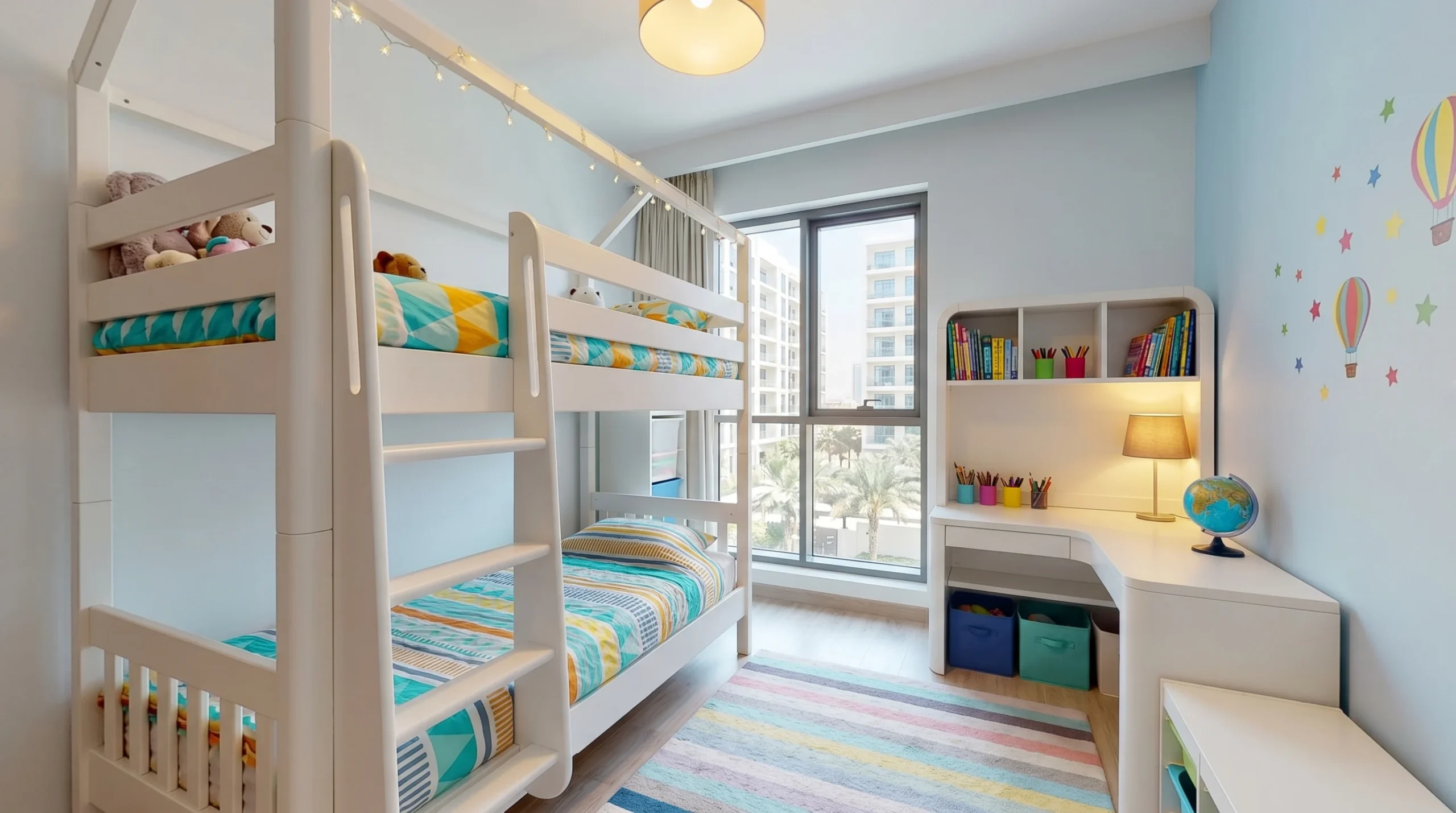
If you have children, or are planning to, the kids’ bedroom requires its own strategic approach. The key word is growth. A bed that fits a four-year-old won’t suit a ten-year-old, and buying twice is more expensive than buying once with longevity in mind.
Bunk beds are extraordinarily popular in Dubai apartments for good reason: they give two children their own sleeping spaces while leaving the floor clear for play and study. Look for bunk beds with solid side rails (a minimum of 16cm above the mattress is the recommended safety standard), wide ladder rungs, and mattress platform dimensions that accept standard UAE-size mattresses (usually 90x200cm for single beds).
A study desk is increasingly essential even for young children, Dubai’s school culture involves significant homework from early primary years. A height-adjustable desk is a smart investment that grows with your child.
View Kids Furniture | Bunk Beds
Dining Area: Don’t Underestimate It
In UAE family culture, the dining table is a gathering place, for meals, for homework, for conversations. It deserves more thought than it usually gets. For a family of four in a two-bedroom apartment, a 160x90cm dining table is the practical minimum; a 180x90cm table gives significantly more comfort and can extend your seating when guests come.
Material matters in Dubai’s climate. Solid wood dining tables are beautiful and durable but require regular care (oiling once or twice a year prevents drying and cracking in air-conditioned environments). Veneer tables offer a similar aesthetic at lower cost but are more vulnerable to moisture damage, less relevant in Dubai’s dry conditions, but worth knowing. Glass-top tables look sleek in apartment settings and are easy to clean, but they require more careful daily management with children.
View Dining Tables & Sets
Wardrobe Solutions
Many Dubai apartments, particularly in older buildings, don’t come with built-in wardrobes. Freestanding wardrobes are the solution, and they vary enormously in quality and functionality.
For a master bedroom, you typically need at least 180cm of hanging width to comfortably accommodate two people’s clothing. A 200–240cm wide wardrobe with a combination of full-length hanging, shelf storage, and drawers is the practical ideal for most Dubai families. In smaller rooms or kids’ bedrooms, two narrower wardrobes placed side by side often give more flexibility than one large unit.
Avoid flat-pack wardrobes with chipboard carcasses if you plan to be in your apartment for more than two years, they tend to swell and warp in environments with humidity fluctuations (even in Dubai’s controlled interiors, humidity changes between summer and winter). Solid board or MDF with proper edge banding holds up considerably better.
Explore Wardrobes | Custom Wardrobes
Common Furniture Shopping Mistakes Dubai Families Make
After 35 years and 70,000+ families, we’ve seen the same mistakes repeated. Here’s how to avoid them.
Mistake 1: Buying Furniture Before Measuring the Apartment
This is the single most common and most expensive mistake. A sofa you love in a showroom may be physically impossible to get into your apartment, or may overwhelm a room that seemed large when empty. Before you buy anything, visit your apartment with a tape measure and note: the dimensions of every room, the width of the front door and any internal doorways the furniture needs to pass through, the height of ceilings (relevant for wardrobes and tall shelving), and the position of air conditioning units, light switches, and power points.
Draw a simple floor plan, it doesn’t need to be architectural quality, just accurate, and use it when visiting showrooms. Reputable furniture retailers will help you work through it. We do this as a matter of course at Karnak Home.
Mistake 2: Prioritizing Price Over Durability
We understand budget pressure, furnishing an apartment is a significant outlay. But the cheapest furniture is almost never the most economical choice over a three-to-five-year Dubai tenancy. A sofa that costs AED 1,200 and needs replacing in eighteen months has cost you more than a AED 2,800 sofa that lasts four years. We see this calculation play out constantly. Entry-level prices can be appropriate for guest bedrooms or secondary spaces, but for primary pieces, the main sofa, the master bed, the dining table, invest in quality.
Ask about frame construction (kiln-dried hardwood frames outlast softwood or MDF frames significantly), suspension systems (eight-way hand-tied springs outperform sinuous springs for longevity), and warranty terms. A retailer confident in their furniture offers a meaningful warranty.
Mistake 3: Buying Everything at Once From One Low-Cost Source
There’s a temptation, especially when time-pressured after a move, to buy an entire apartment’s furniture from a single budget source to get it done quickly. Resist this. Budget furniture suppliers often use materials that look acceptable in showroom lighting but age poorly. Instead, prioritize your spending: invest in the pieces you’ll use most (sofa, bed, dining table) and economize on pieces that matter less (side tables, decorative shelving, laundry furniture).
Mistake 4: Ignoring the Dubai Climate’s Effect on Materials
Dubai’s interior climate, heavily air-conditioned spaces in a hot, occasionally humid environment, is genuinely unusual. Materials that perform well in European homes don’t always translate. Bonded leather cracks and peels (mentioned above). Solid wood furniture benefits from occasional oiling or waxing to prevent drying out. Certain fabric types pill or fade faster in climates where you’re constantly moving between air-conditioned and very hot outdoor environments. Ask your furniture retailer specifically about durability in UAE conditions, it’s a legitimate and important question.
Mistake 5: Forgetting Delivery Lead Times
Dubai’s better furniture retailers typically work to 2–6 week delivery windows for larger pieces. If you’re moving into your apartment on the 1st of the month and expecting to receive all your furniture the same week, you may be disappointed, or pushed toward lower-quality options with faster stock availability. Start your furniture shopping before you move in if at all possible. Visit showrooms during your last month in your previous home, place orders early, and schedule deliveries for your first week in the new apartment.
Expert Tips From 35 Years of Furnishing UAE Homes
These are the pieces of advice we find ourselves giving most often at the Karnak Home showroom, the insights that make a genuine difference.
Tip 1: Start With a Neutral Base, Add Personality With Accessories
Neutral furniture, warm whites, natural timbers, soft greys, warm beiges, gives you flexibility to change the feel of a room without replacing the furniture. Bold, trend-driven furniture can feel dated or limiting quickly. Add personality through cushions, rugs, art, and accessories that can be swapped affordably.
Tip 2: Don’t Forget Delivery Access
Especially relevant in apartment buildings with freight elevators, low-clearance parking, and narrow stairwells. Confirm your building’s delivery logistics before finalizing large orders. Note that many Dubai apartment buildings require booking the freight elevator in advance, this is the tenant’s responsibility, not the retailer’s.
Tip 3: Measure Doorways, Not Just Rooms
Your apartment may be spacious but have a 70cm front door. A sofa that’s 85cm deep at its deepest point won’t go through. Many sofas can be partially disassembled for delivery, ask specifically before purchasing.
Tip 4: Buy Your Mattress In Person
Mattresses are the furniture category where online purchases most often disappoint. Different sleep positions, body weights, and temperature preferences require genuinely different mattress types. Spend time lying on options in the showroom, this is not a category to rush.
Tip 5: Consider Storage From Day One
Dubai apartments, particularly one- and two-bedrooms, often have less storage than UAE family life requires. Build your storage plan into your initial furniture purchases rather than addressing it reactively with mismatched pieces later.
Tip 6: Ask About Warranty and After-Sales Service
The furniture market in Dubai ranges from retailers with strong after-sales support to those who are essentially unreachable after purchase. Ask about warranty terms, what’s covered, and what the claims process looks like. At Karnak Home, we stand behind our products, if something isn’t right, we fix it.
Tip 7: Account for Outdoor and Balcony Furniture
Many Dubai apartments have balconies, and they’re usable for a surprisingly large part of the year, October through April is genuinely pleasant outdoors. Balcony furniture extends your living space meaningfully. UV-resistant materials (powder-coated aluminum, solution-dyed acrylic fabrics, synthetic rattan) handle Dubai’s intense sun far better than standard outdoor furniture.
Explore Outdoor Furniture
Tip 8: Don’t Furnish a Guest Room on Day One
If budget is tight, a guest room can wait. A quality air mattress handles occasional guests adequately while you settle in and save for a proper guest bed. Prioritize the rooms your family lives in daily.
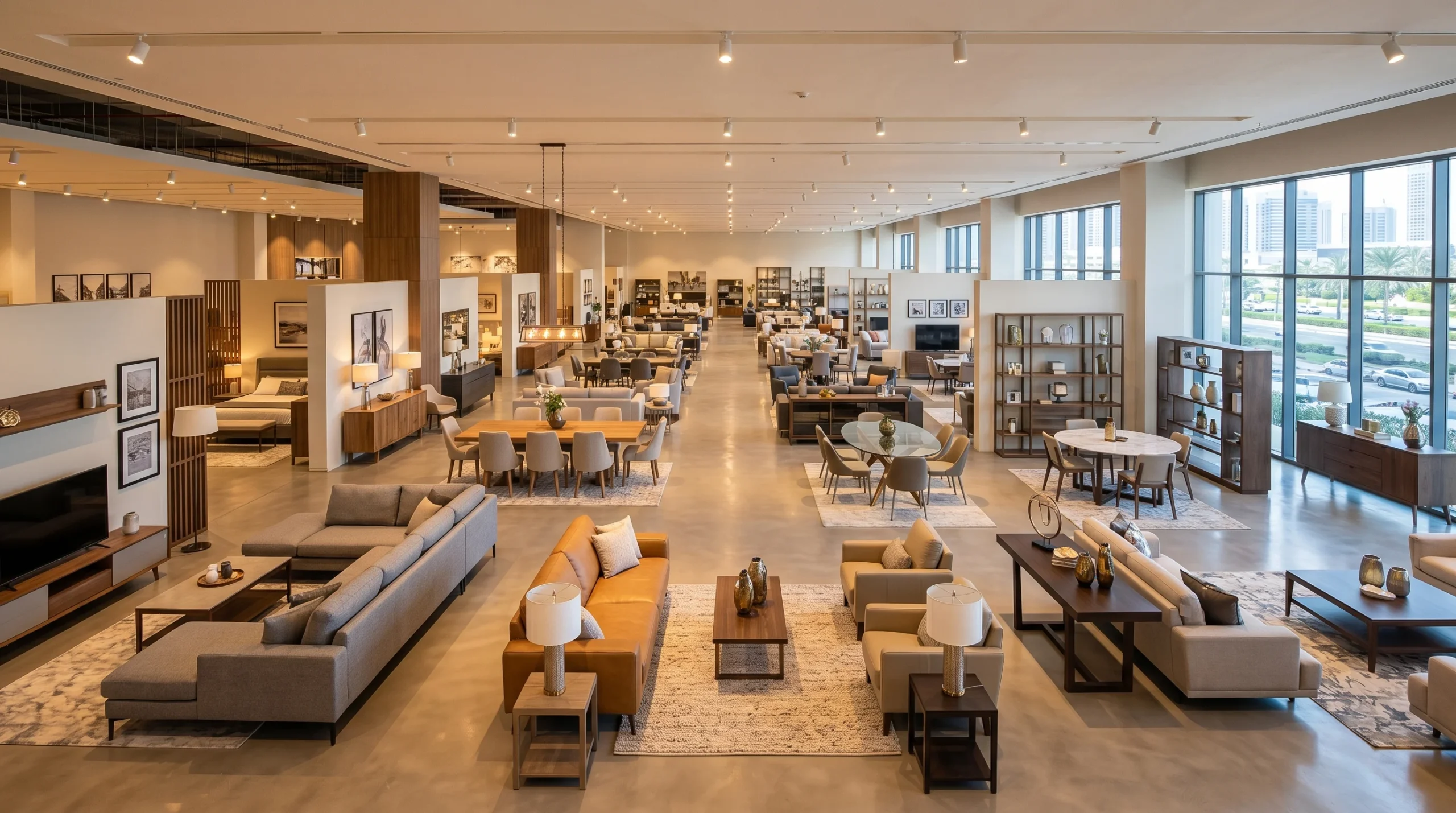
A Practical Checklist: Furnishing Your Dubai Apartment
Use this room-by-room checklist to plan your purchases and prioritize your budget. Mark what’s essential for day one, what can wait for month two, and what can be added gradually.
Conclusion: Making the Right Decision for Your Family
Choosing an unfurnished apartment in Dubai is a commitment, and a smart one for most families planning to stay in the UAE for more than two years. The rental saving is real, the freedom to choose furniture that actually suits your life is valuable, and the furniture you buy becomes an asset that moves with you rather than a service you’re renting.
The key is approaching it with a clear plan: measure first, prioritize by livability, invest where it matters, economize where it doesn’t, and buy from retailers who stand behind their products.
After 35 years and over 70,000 families served across the UAE, that’s the guidance we’d give our own families, and it’s the guidance we offer every customer who walks into a Karnak Home showroom.
Key Takeaways:
- Furnished apartments carry a 20–40% rental premium; for families staying 2+ years, furnishing from scratch is almost always more economical
- Prioritize quality in your most-used pieces: main sofa, master bed, dining table, these are worth the investment
- Measure your apartment and doorways before you shop; the most common and costly mistake is buying furniture that doesn’t fit
- Dubai’s climate affects furniture durability; ask specifically about material performance in UAE conditions
- You don’t need to furnish everything at once, prioritize Day 1 essentials, then add over time
Ready to Find the Right Furniture for Your Space?
Whether you’d like to browse at your own pace or talk through your specific apartment layout with one of our team, Karnak Home makes it straightforward. Our showroom gives you the chance to experience furniture at full scale – something that makes a real difference when you’re choosing pieces for a small space. Our online store lets you filter by dimensions, style, and function so you can shortlist options before committing to a visit.
We offer delivery across all seven emirates, and our team can advise on anything from sofa dimensions to full room layouts. There’s no pressure and no commission-driven sales – just genuine guidance from people who know UAE homes.
Shop Online: Karnak Home
Visit Our Showroom: Dubai – Showroom Address & Directions
Expert Advice: Call Us or WhatsApp our team for personalised guidance
Related Articles: