
The majlis is arguably the most important room in any UAE home. It is where families welcome guests, where deals are made over Arabic coffee, where Eid gatherings happen, and where the culture of Arabic hospitality is put on full display. And yet, when families come to us at Karnak Home after decades of furnishing homes across the UAE, majlis furniture is also one of the rooms they feel most uncertain about. What style? What size? How much should it cost? Traditional or modern, or somehow both?
Over 35 years and 70,000+ UAE families served, we have furnished majlis rooms from compact apartments in Deira to sprawling villas in Mohammed Bin Zayed City. This guide shares everything we have learned, so you can make a confident, well-informed decision, whether you are furnishing a majlis for the first time or giving an existing one a long-overdue refresh.
Understanding the Role of the Majlis in UAE Homes
Before choosing a single piece of furniture, it helps to be clear about how your majlis will actually be used. This sounds obvious, but many families skip this step and end up with a beautifully styled room that does not work for their real life.
In UAE culture, the majlis serves as a formal guest reception space, separated from the more private family areas of the home. It is designed to show respect to visitors, a dedicated, purposeful space that signals hospitality. But within that broad function, the specifics vary enormously from household to household. According to UNESCO, the majlis is recognized as an intangible cultural heritage element, serving as a key social space for community members to gather, exchange news, receive guests, and practice hospitality across the UAE and neighboring countries.
Some families use the majlis almost daily, for informal visits from neighbours and extended family. Others use it primarily for Eid, weddings, and formal occasions, meaning the furniture needs to handle intense, occasional use rather than daily wear. Some households expect men and women to use separate majlis spaces; others have a single, shared reception room. And in apartment living, increasingly common in Dubai and Sharjah, the majlis may double as a TV lounge or even a study area for children during the week.
Getting clear on these patterns before shopping will save you from choosing furniture that looks perfect but lives awkwardly. Ask yourself honestly: How often will this room be used? By how many people at peak times? Will children be in this space? Is formality the priority, or everyday comfort?
Traditional Majlis Furniture: What It Is and Why It Endures
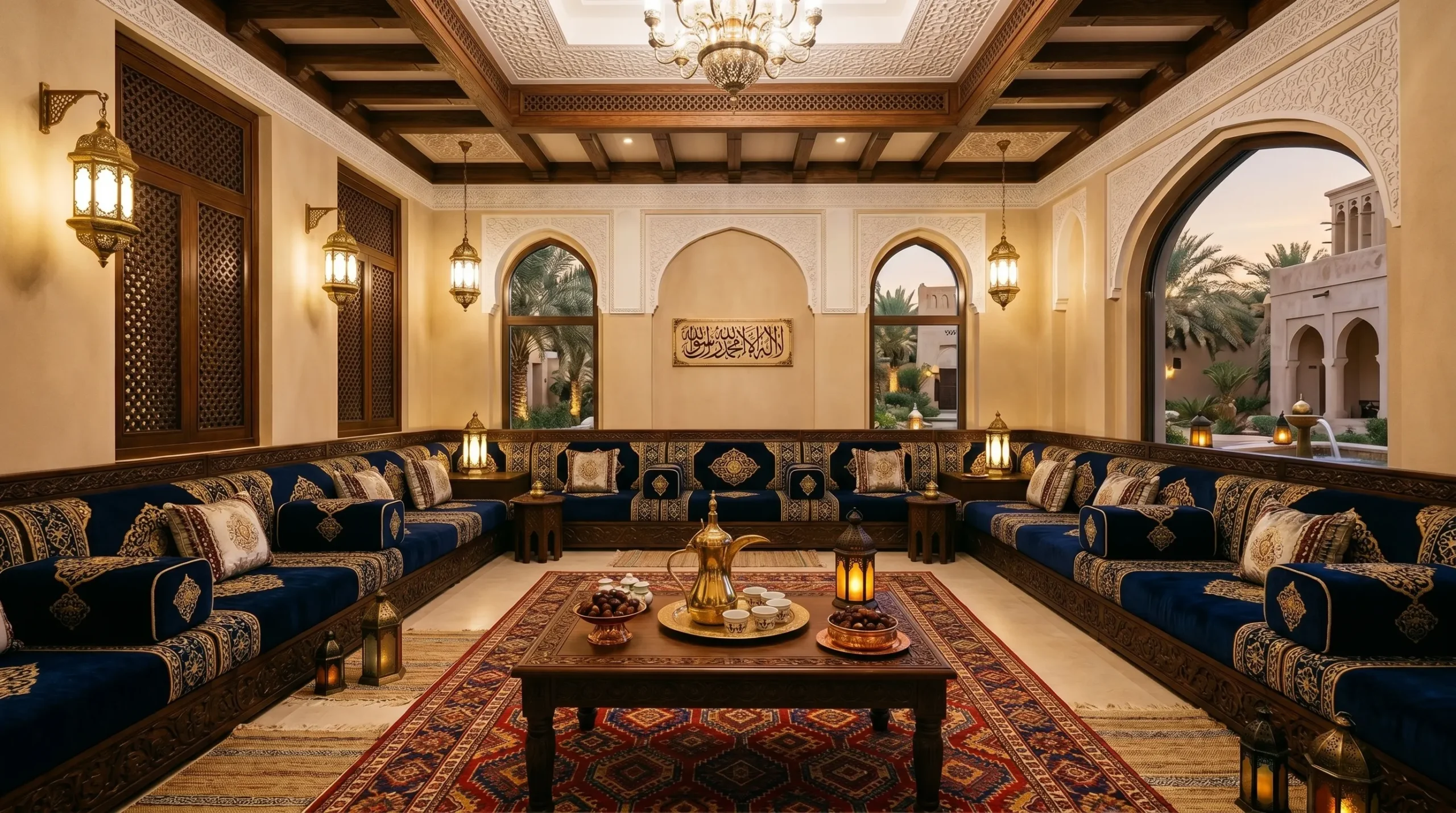
Traditional majlis furniture is defined by its floor-level or very low-profile seating arranged around the perimeter of the room, wall-to-wall continuous seating that wraps around three or even four sides. This layout has practical roots: it maximises the number of guests that can be seated, maintains clear sightlines so no guest is excluded from conversation, and reflects the egalitarian spirit of Arabic gathering culture where no seat is positioned as more important than another.
The Classic Wall-to-Wall Majlis Seating Set
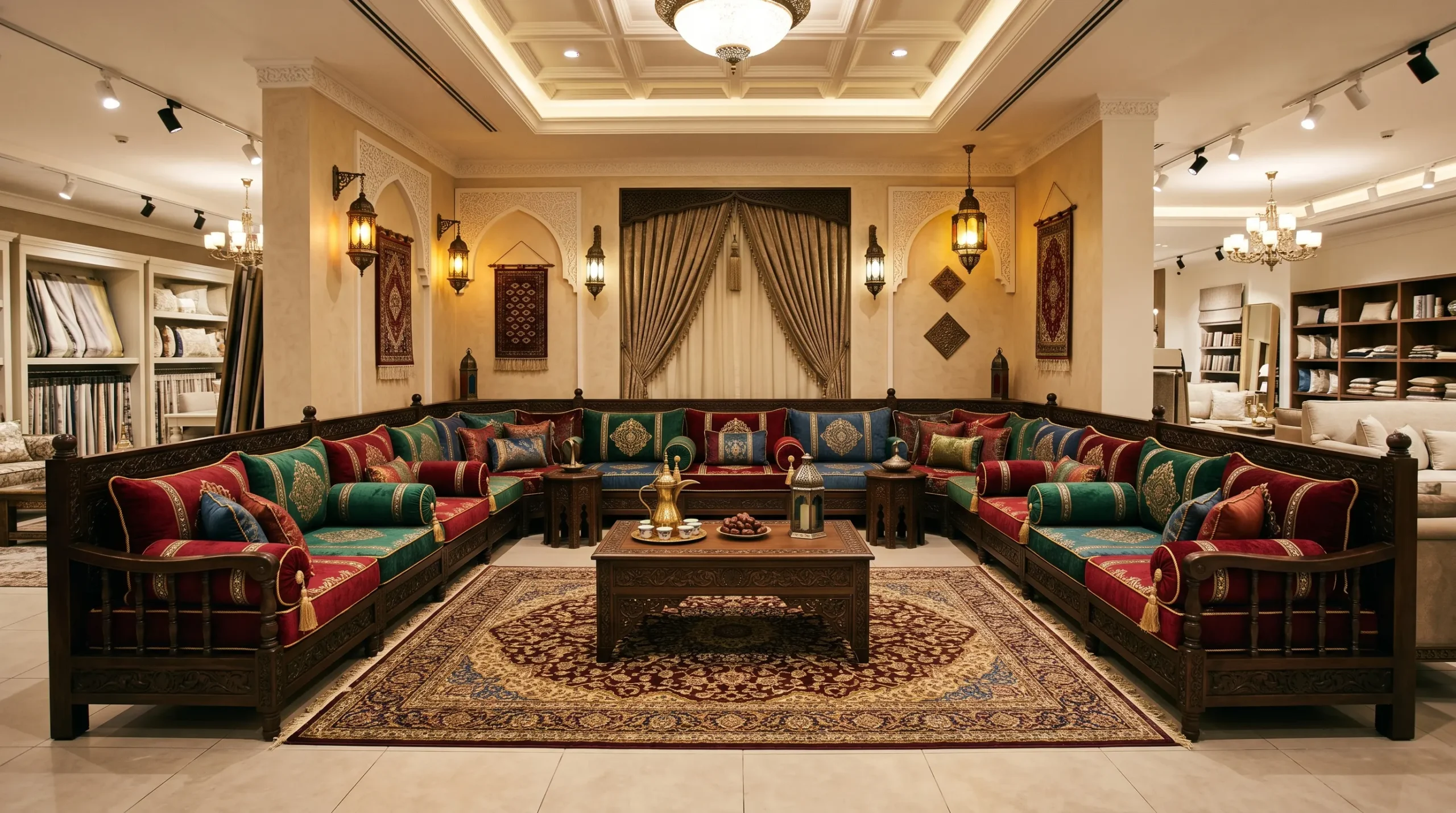
The centrepiece of a traditional majlis is the continuous seating unit, essentially a long, low, upholstered bench with individual back cushions arranged along the wall. In UAE homes, these are typically custom-made or come in modular configurations that can be arranged to fit the exact dimensions of the room.
Seating height in a traditional majlis generally sits between 30 cm and 40 cm from the floor, noticeably lower than a standard European-style sofa (which is typically 45–50 cm). This lower profile creates the signature open, grounded look of a traditional majlis. Seat depth is usually generous, around 65–80 cm; so guests can sit comfortably for extended visits without the seating feeling cramped.
The backrest cushions are usually individual pieces rather than a fixed back, which is an important practical detail: they can be rearranged, removed for cleaning, or swapped out to refresh the room’s colour scheme without replacing the entire set. In higher-quality sets, the base is solid wood with high-density foam cushioning; in lower-cost versions, the base may be engineered wood or metal framing, which is perfectly serviceable for occasional-use rooms but less durable for heavy daily use.
Fabric choice matters enormously in the UAE climate. Air-conditioned rooms create conditions that are actually kinder to fabric than you might expect, the dry, cool air reduces humidity-related wear. However, velvet and heavy brocade fabrics, beloved for their richness, do collect dust and require more maintenance. For families with young children or pets, a tightly woven, slightly textured fabric in medium-to-dark tones is the practical choice. Many of the majlis sets we carry at Karnak Home’s sofa and seating collection are available in performance fabric options that resist staining without sacrificing the luxurious look.
The Arabic Coffee Table (Khwan)
A traditional majlis coffee table, sometimes called a khwan or Arabic low table, sits at the centre of the seating arrangement. The height closely matches the seating: typically 30–40 cm, so guests can reach it comfortably from the low seating without leaning awkwardly.
Traditional coffee tables in this style are often heavily decorated with arabesque carved woodwork, mother-of-pearl inlay, or engraved brass tops. The aesthetic is rich and detailed. However, if the rest of your home leans more contemporary, a simpler geometric marble top on a dark metal or dark wood base can serve the same functional role while bridging traditional and modern aesthetics.
Size should be proportional to the room. In a large villa majlis seating 20+ guests, a long rectangular table (or two matching square tables arranged together) works better than a single round piece that will feel undersized and out of proportion. A rough guide: the table length should be roughly 50–60% of the wall-length of the main seating run.
Decorative and Functional Accessories
A traditional majlis is never just about the main seating. The room comes alive through carefully chosen accessories: incense burners (mabkhar) on their side tables or built-in shelves, the presence of a dallah (Arabic coffee pot) and small handle-free cups (finjan), and often a decorative sword or calligraphy panel on the focal wall.
From a furniture perspective, the supporting pieces that make the most difference are the corner units and occasional tables. Corner seating pieces, which fill the transition point between two walls of seating, need to be designed specifically for 90-degree or angled junctions, and getting these right is one area where cheaper sets often cut corners (literally), leaving awkward gaps or uneven heights at the joins.
Shop our Arabic Majlis Collection
Modern Majlis Furniture: Blending Heritage with Contemporary Style
The “modern majlis” has become increasingly popular across Dubai and Abu Dhabi, particularly among UAE nationals and long-term residents who want to preserve the cultural function of the room while matching the cleaner, more minimal aesthetic of contemporary interior design.
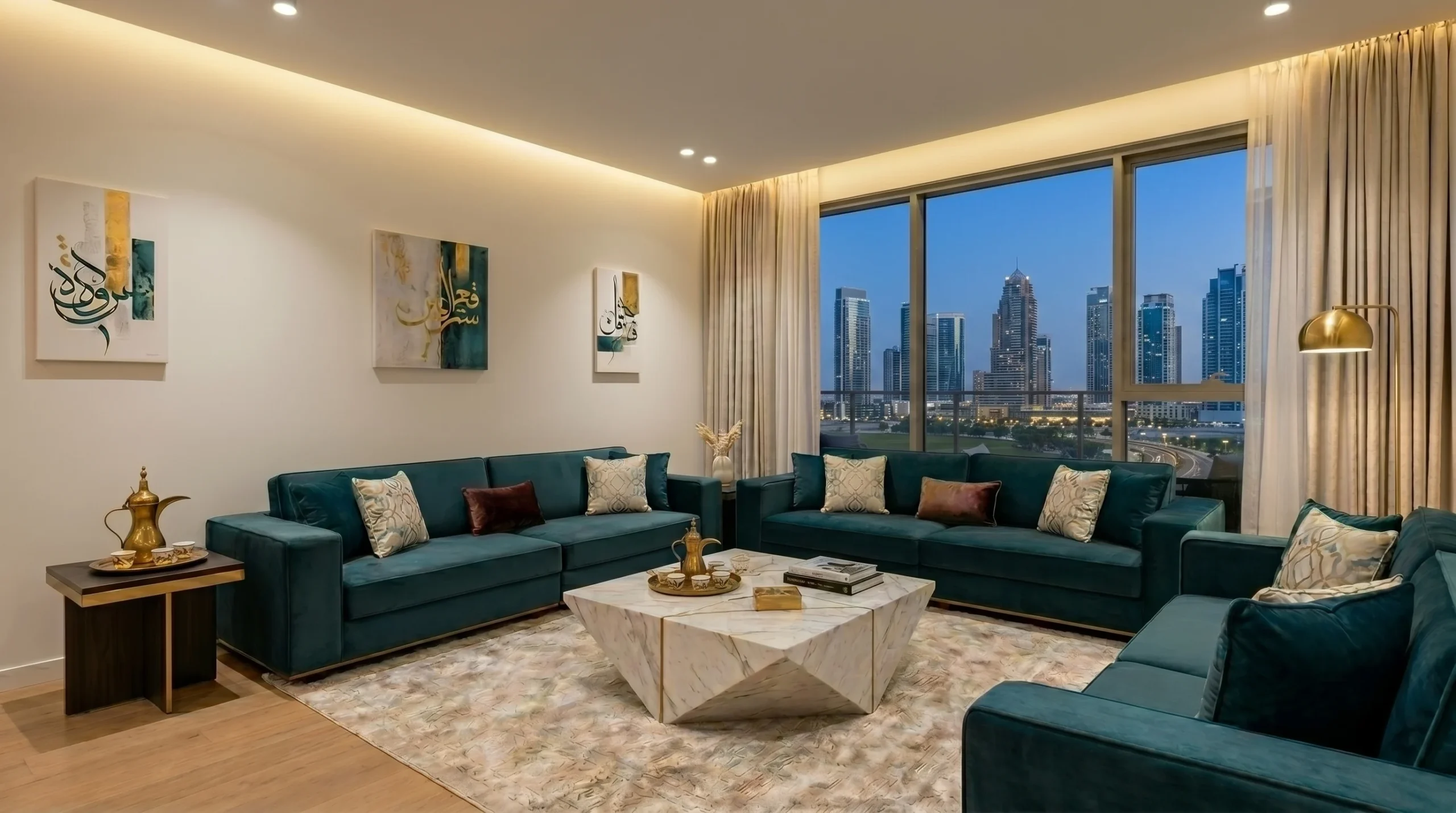
A modern majlis retains the essential spatial logic; perimeter seating, a central table, a sense of formal arrival, but reinterprets the details. Think clean-lined low sofas with solid colour upholstery rather than heavy brocade, geometric or abstract patterns rather than intricate arabesque carving, and a more restrained palette; whites, greiges, charcoals, and deep jewel tones used sparingly.
Modern Majlis Sofa Sets
Rather than a continuous built-in bench, a modern majlis might use modular low sofas arranged in an L or U shape. The advantage here is flexibility: the arrangement can shift for different occasions, individual pieces can be replaced if one wears out, and the room feels less fixed and more contemporary.
When selecting modern sofas for a majlis, keep the seating height close to traditional proportions – 35–42 cm; to maintain the characteristic low, anchored feel of the space. A standard-height European sofa at 48–50 cm will look out of place and break the cultural atmosphere of the room, even if it is technically more comfortable for older guests. If you have elderly family members who struggle with low seating, there are elegant design solutions: slightly raised bases with decorative carved legs that bring the seat to 42–44 cm while still appearing visually low.
Material and Colour Choices for a Modern Majlis
For modern majlis furniture, material selection is one of the most consequential decisions. The most popular choices we see in UAE homes currently:
Velvet upholstery remains a top choice for its richness, now offered in dusty pinks, teal, slate grey, and deep forest green rather than the traditional burgundy and royal blue. Velvet photographs beautifully and feels luxurious, but requires more careful maintenance, particularly in dusty environments near windows or near entrances.
Woven performance fabrics in linen or chenille textures offer excellent durability with a sophisticated look. These are increasingly popular with families who use the majlis regularly rather than only on formal occasions.
Wood and metal combinations on frames and tables give a modern majlis its structure. Dark walnut with brass accents reads as both contemporary and warm, which suits the UAE aesthetic well. Bleached oak or white-lacquered frames are bolder and work beautifully in large, well-lit villas but can appear stark in smaller apartment majlis rooms.
Planning Majlis Furniture for Your Space: Villas vs Apartments
One of the most common challenges we help families solve is adapting majlis furniture to the actual space available, which in UAE homes varies enormously from room to room and building to building.
Villa Majlis: Large Format, High Ceilings
In a traditional UAE villa, the majlis is typically a dedicated room with its own entrance from the main door, completely separate from the family living areas. Ceilings are often 3.5–4 metres high, and the floor plan is generous: commonly 25–45 square metres.
For a room of this size, furniture needs to be bold and proportional. A continuous seating run of 8–12 metres total length is not unusual. The coffee table should be substantial, and the accessories should have presence – delicate pieces will look lost. Wall-to-wall carpet, ideally in a traditional geometric or medallion pattern, is almost always the right choice over bare tile in a formal villa majlis; it absorbs sound and adds warmth that hard flooring cannot replicate in such a formal space.
When measuring for a large villa majlis, the practical rule of thumb is to keep 90–100 cm of clear floor space between the front edge of the seating and the coffee table, and another 50–60 cm between the coffee table and any opposite-facing seating. This ensures guests can stand and move freely without awkwardness.
Apartment Majlis: Making the Most of Limited Space
In apartments across Dubai Marina, JLT, Downtown, and Sharjah’s newer high-rises, families often designate a living room or a section of an open-plan space as a majlis. Here the challenge is creating a culturally meaningful space without overwhelming a 15–20 square metre room.
The key principles for a compact apartment majlis: keep the seating count honest (8–12 guests is realistic; trying to seat 20 in a small apartment will feel crowded and uncomfortable), choose furniture with visible legs or raised bases rather than floor-level pieces (this maintains the visual light and openness of the room), and select a lighter colour palette to avoid the space feeling heavy.
L-shaped modular seating works particularly well in apartment majlis rooms, occupying two walls and leaving the other sides open. A single, well-chosen coffee table rather than multiple pieces keeps the floor uncluttered. Avoid the temptation to fill every surface with decorative accessories – in a smaller room, restraint reads as elegance.
Sizing and Measuring Your Majlis Room: A Practical Guide
Getting the furniture dimensions right before you buy is non-negotiable. Majlis furniture, particularly custom or semi-custom wall seating, is almost impossible to return or exchange once delivered. Here is how to approach measuring correctly:
Step 1 – Room dimensions: Measure all four walls, noting any doors, windows, AC units, and light switches. Map these on a simple floor plan sketch, even a rough one.
Step 2 – Seating run length: Decide which walls will carry seating. Subtract door clearances (minimum 90 cm from door edge) and window sill depths (seating should not obstruct opening windows). The remaining wall length is your maximum seating run per wall.
Step 3 – Depth planning: Traditional seating is 65–80 cm deep. In a room that is 4 metres wide, 80 cm seating on both sides leaves 2.4 metres of central floor space – comfortable. In a room that is 3 metres wide, 80 cm on both sides leaves only 1.4 metres of floor space, which can feel tight. Consider 65 cm depth seating for narrower rooms.
Step 4 – Coffee table height and size: Table height should match seating height or be 2–5 cm lower. Table length: see the 50–60% rule mentioned earlier.
Step 5 – Walkways and doors: Confirm your furniture plan leaves at least 90 cm of clear walkway at all entry points. Many a beautiful majlis has been rendered awkward by a sofa that partially blocks the entrance door.
If measuring and planning feels overwhelming, our team at Karnak Home’s Showroom can arrange an in-home consultation for families across Dubai, Sharjah, Abu Dhabi, and other emirates.
Common Majlis Furniture Mistakes to Avoid
After 35 years of helping UAE families furnish their homes, we have seen the same errors repeat themselves. Here are the most important ones to avoid:
Mistake 1: Choosing Furniture That Is Too Large for the Room
This is the single most common majlis mistake. Families visit a showroom, see an impressive full-size majlis display, and order it for a room that is significantly smaller. The result is seating that crowds the space, a coffee table that fills almost all the remaining floor, and a room that feels claustrophobic rather than welcoming. Always measure first and bring your room dimensions to the showroom.
Mistake 2: Prioritising Style Over Fabric Durability
Beautiful silk brocade or delicate velvet may look magnificent in photographs, but if your majlis is used regularly, and especially if children are present, fabric durability needs to be a core consideration, not an afterthought. A well-chosen performance fabric that cleans easily will look better in three years than a fragile luxury fabric that shows every mark. Ask specifically about the fabric’s rub count (measured in Martindale cycles) when purchasing; for a high-use majlis, look for a minimum of 25,000 cycles.
Mistake 3: Ignoring the Ceiling Height When Choosing Back Cushion Height
Back cushions in a traditional majlis are typically 50–70 cm tall. In a room with 4-metre ceilings, this looks elegant and proportional. In a room with 2.7-metre ceilings (common in apartments), 70 cm back cushions can feel oppressive. Scale the cushion height to your ceiling – 50–55 cm is usually the sweet spot for apartment-scale majlis rooms.
Mistake 4: Buying the Coffee Table as an Afterthought
The coffee table in a majlis is not an optional accessory, it is a structural element of the room’s design. We frequently see families who have beautifully coordinated seating and then place an ill-fitting table that breaks the aesthetic entirely. Treat the coffee table as part of the core set selection, not a secondary purchase.
Mistake 5: Skipping the Carpet
Hard flooring; marble, porcelain tile, engineered wood, is the standard finish in UAE home construction. In most rooms, this is fine. In a majlis, bare hard flooring reads as incomplete and cold, acoustically and visually. A quality Arabic-style carpet grounds the room and brings the seating together into a unified space. It is one of the most impactful and relatively affordable additions you can make.
Majlis Furniture Pricing in the UAE: Honest AED Guidance
Pricing for majlis furniture in the UAE varies enormously based on size, material, customisation level, and brand. Here is an honest breakdown of what to expect at different budget levels:
Entry-level majlis sets (AED 3,000–8,000): Typically machine-made, standard dimensions, limited fabric options. Suitable for a spare or occasional-use majlis where budget is the primary constraint. Durability will be moderate; expect to replace within 7–10 years with regular use.
Mid-range majlis sets (AED 8,000–20,000): Better foam density, wider fabric selection, more configuration options. This is the sweet spot for most UAE families – good quality, considerable choice, and sets that will last 15+ years with reasonable care. The majority of our majlis sets at Karnak Home fall in this range.
Premium and custom majlis sets (AED 20,000–60,000+): Solid wood frames, highest-grade foam and spring systems, fully custom dimensions and fabrics, hand-carved decorative elements. Appropriate for large formal villa majlis rooms where the space demands furniture that makes a statement, and for families who want a set that will last decades.
These prices generally cover the seating and coffee table. Carpets, curtains, and decorative accessories are separate costs to factor into your total budget.
Expert Tips for Your Majlis Room: 35 Years of UAE Experience
Here are the practical insights we return to again and again when advising families on majlis furniture:
1. Buy the seating and coffee table together from the same source where possible. Mixing sets from different manufacturers almost always results in subtle mismatches in height, tone, or finish that are obvious once the room is complete.
2. Order fabric samples before committing. What looks like a rich navy in showroom lighting can appear almost black in certain home lighting conditions. Take samples home and view them at different times of day.
3. Allow 4–8 weeks lead time for semi-custom pieces. If you are furnishing for Eid or a specific occasion, plan well in advance. Last-minute purchases almost always mean accepting compromises on size or fabric.
4. Invest in the base, not just the cushions. Cushions can be recovered or replaced. A poorly constructed base cannot be easily fixed. When assessing quality, check the base frame first.
5. Consider removable, washable cushion covers from the start. Specify zip closures on all seat and back cushions when ordering. This one detail makes maintenance dramatically easier over the life of the furniture.
6. Think about storage for accessories. A dedicated shelf unit or built-in storage for incense burners, coffee equipment, and serving pieces keeps the room functional without surfaces becoming cluttered.
7. Plan your lighting alongside your furniture. Warm, ambient lighting; wall sconces, low pendant lights, or floor lamps, transforms a majlis far more than most families expect. The furniture should be selected with its lighting context in mind.
8. Visit the showroom more than once. For a majlis investment, a single quick showroom visit is rarely enough. Come back with your room measurements, with family members whose input matters, and ideally at a time when the showroom is less busy so you can get proper expert attention.
Caring for Your Majlis Furniture in the UAE Climate
The UAE climate, while managed by air conditioning indoors, still presents specific challenges for furniture longevity.
Dust: Fine desert dust is pervasive, particularly in rooms near entrances. Weekly vacuuming of cushions with a soft brush attachment prevents dust from working into fabric fibres and causing premature wear. Fortnightly for lower-use rooms.
AC Placement: Cold air blowing directly onto upholstered furniture accelerates fabric drying and cracking, particularly for leather pieces. Ensure seating is not positioned directly beneath an AC vent, or adjust the vent direction.
Sun Exposure: Even UV light through glass will fade fabric over time. Majlis rooms with east or west-facing windows are particularly susceptible. UV-filtering window film is a practical investment that protects furniture without compromising room aesthetics.
Incense Smoke: A beautiful part of Arabic hospitality, incense does deposit fine particles on fabrics over time. Good ventilation, even brief post-gathering airing, makes a meaningful difference to long-term fabric condition.
Professional Cleaning: For quality majlis furniture, professional upholstery cleaning every 2–3 years is worthwhile. For sets in the AED 15,000+ range, this maintenance cost is a small fraction of replacement cost.
Conclusion: Making Your Majlis Decision with Confidence
A well-chosen majlis is one of the most personally meaningful furniture investments you will make for your home. It is the room where your hospitality lives, where your family gathers for the occasions that matter most, and where your home makes its first impression on every guest who walks through your door.
The decision does not need to be complicated. Get clear on how the room will be used. Measure carefully before you shop. Prioritise fabric durability alongside beauty. Invest proportionally in the quality of the base and frame. And do not rush, take the time to find pieces that genuinely fit your space, your family, and your aesthetic.
Key Takeaways:
- Traditional majlis seating sits 30–40 cm high with generous seat depth; modern alternatives use modular low sofas that retain the same spatial logic
- Always measure your room carefully before selecting furniture; especially for villa vs apartment spaces
- Fabric durability (Martindale count 25,000+ for regular use) matters as much as aesthetics over a furniture set’s lifetime
Ready to Find Your Perfect Majlis Furniture?
At Karnak Home, we have been helping UAE families create beautiful, functional majlis rooms since 1988. Our showroom carries the full range from traditional Arabic sets to contemporary interpretations, across every price point. Our furniture specialists can walk you through options in person, and our delivery and installation team handle the entire process across Dubai, Sharjah, Abu Dhabi, Ajman, and all other emirates.
Shop Online: Arabic Majlis – Karnak Home
Visit Our Showroom: Dubai – Showroom Address & Directions
Expert Advice: Call Us or WhatsApp our team for personalised guidance
Related Articles: