
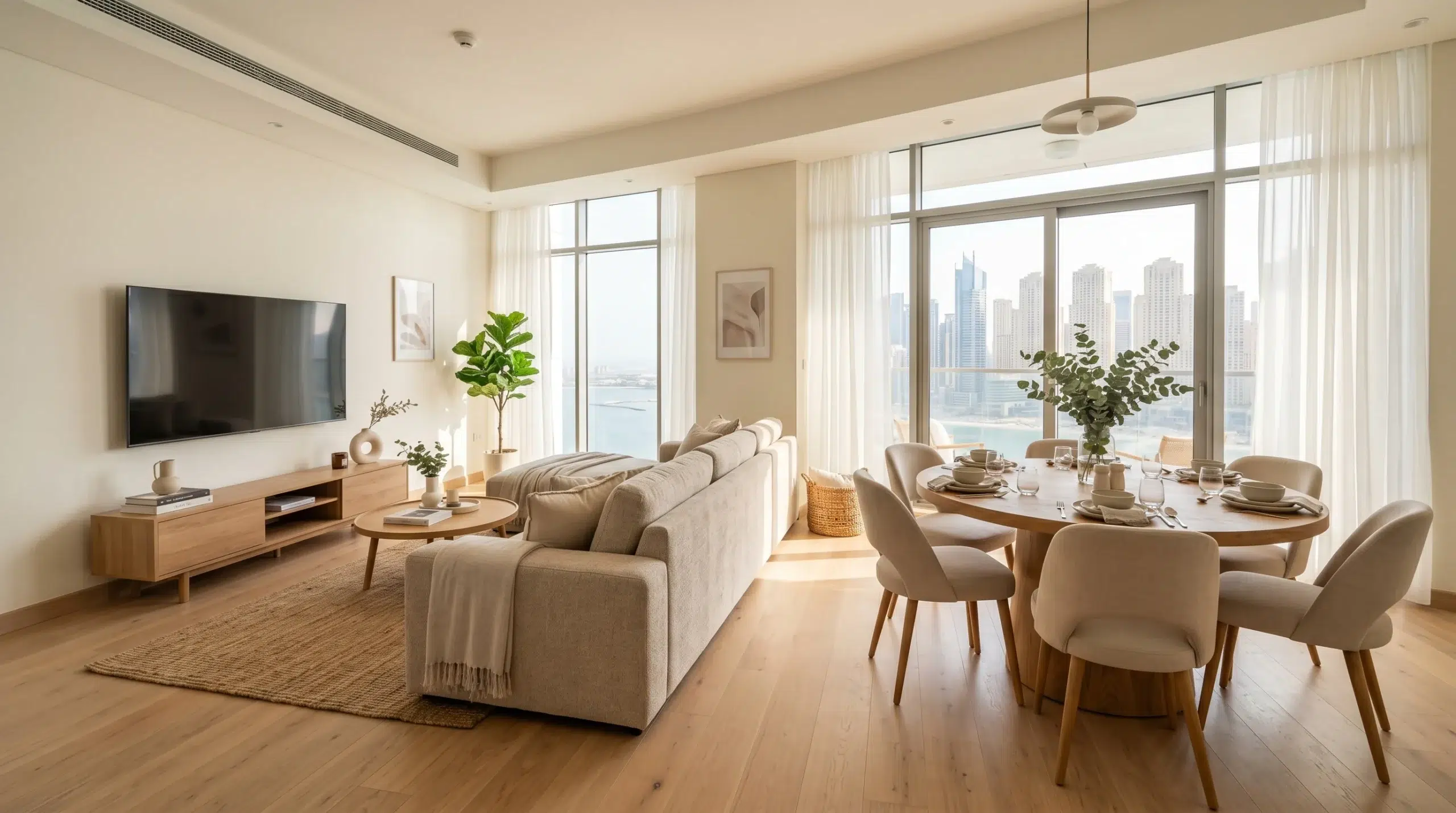
You’ve moved into a beautiful new home in Dubai, Sharjah, or Abu Dhabi, and you’re standing in that big, open living-dining space wondering: where does everything actually go?
It looks amazing in the showroom. But now it’s just you, four walls, and a lot of empty floor space.
This is one of the most common questions our team at Karnak Home hears every single week. After 35 years serving UAE families and helping more than 70,000 homes across all seven emirates, we’ve seen every open-plan layout imaginable, from compact JLT apartments to sprawling Jumeirah villa majlises. The good news? There are clear, proven principles that work. And once you understand them, arranging your furniture becomes logical rather than stressful. This guide walks you through everything, with UAE-specific advice built in throughout.
Looking to better understand the UAE lifestyle, weather, and daily living? Check out this excellent UAE Living Portal by Gulf News for insider tips and practical advice on navigating life in the Emirates.
Why Open-Plan Layouts Are Uniquely Challenging in UAE Homes
Open-plan living is standard in most UAE apartment developments built in the last 15 years, and increasingly popular in newer villas too. Developers love it because it makes spaces feel larger. Families love it for the connectivity. You can be in the kitchen while keeping an eye on children in the living area. But the challenge is real: without walls to anchor furniture against, most people default to pushing everything to the edges of the room, which creates a hollow, disconnected feel.
There are also some considerations specific to UAE living that you won’t find in generic interior guides. Extreme summer heat means your layout needs to account for AC airflow. A sofa sitting directly under a ceiling AC unit will leave guests uncomfortable. Strong afternoon sun through west-facing windows can bleach upholstery fabrics and warp certain wood finishes if furniture placement isn’t considered. And practically speaking, most UAE families host regularly. Eid gatherings, family visits, weekend majlis. So your layout needs to handle everyday life and easily accommodate 15–20 guests when needed.
Section 1: The Foundation — Understanding Zones in an Open-Plan Space
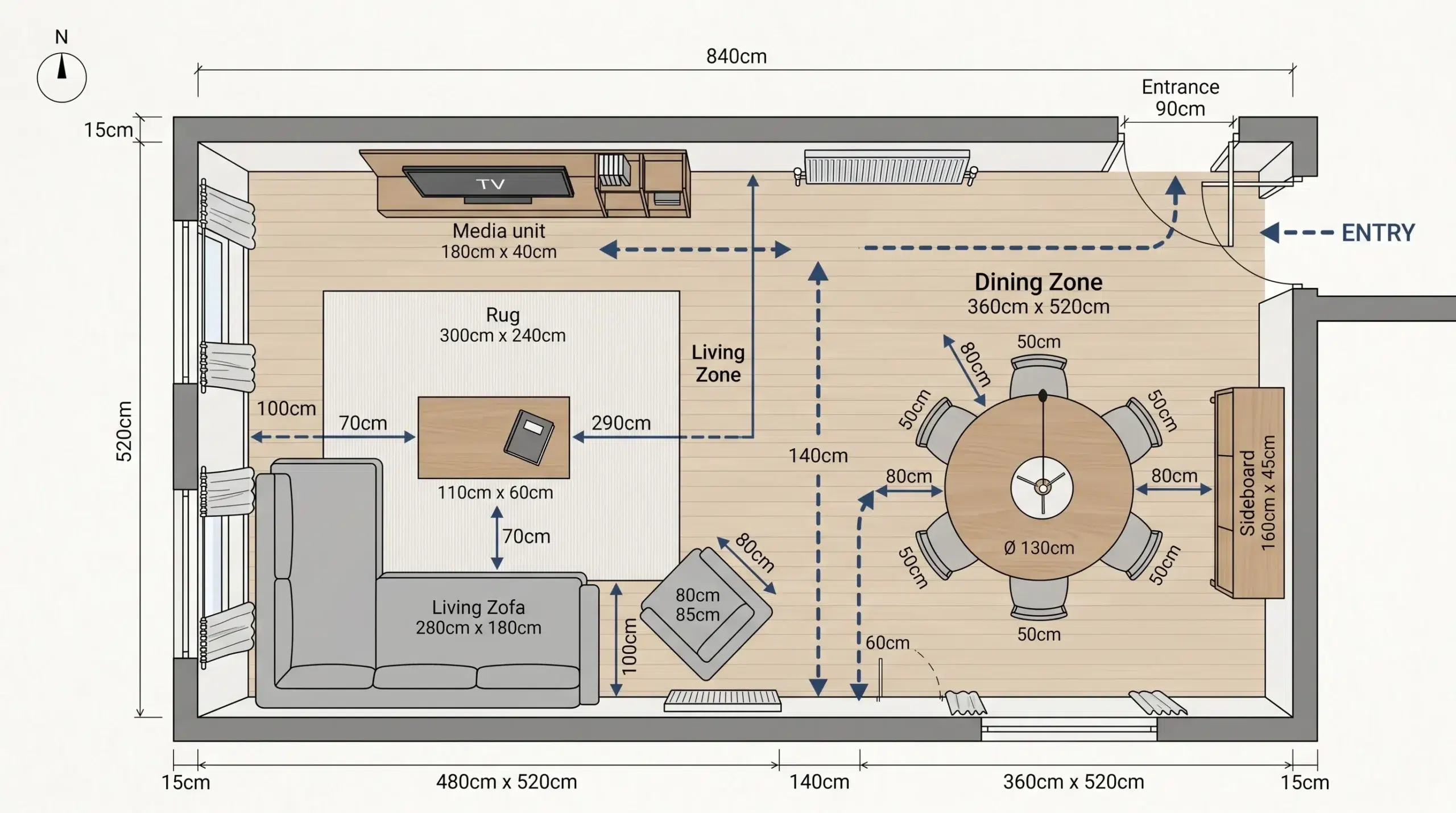
The single most important concept in open-plan furniture arrangement is zone definition. Your open space isn’t one big room. It’s two or three distinct areas that happen to share the same floor. The living zone, the dining zone, and sometimes a study or reading nook. Your job is to define those zones clearly without using walls.
Once you accept this principle, furniture placement becomes much more structured. You’re not deciding where to put a sofa. You’re deciding where the living zone begins and ends, and then placing the sofa as its anchor.
How to Define Your Living Zone
The living zone is almost always anchored by your sofa and oriented toward a focal point, typically a TV wall, a large window, or a feature wall. In most UAE apartments, this zone occupies between 60–70% of the total open-plan footprint.
Start by identifying your focal point. In a typical 2BHK or 3BHK apartment in areas like Downtown Dubai, Marina, or Business Bay, the TV wall is usually already partially defined by a built-in unit or a clear accent wall. Place your sofa facing this focal point, pulled away from the wall by at least 40–50 cm. This is one of the most common mistakes we see. Sofas pushed flat against walls create a waiting-room feel. Pulling the sofa inward actually makes the room feel larger and more intentional.
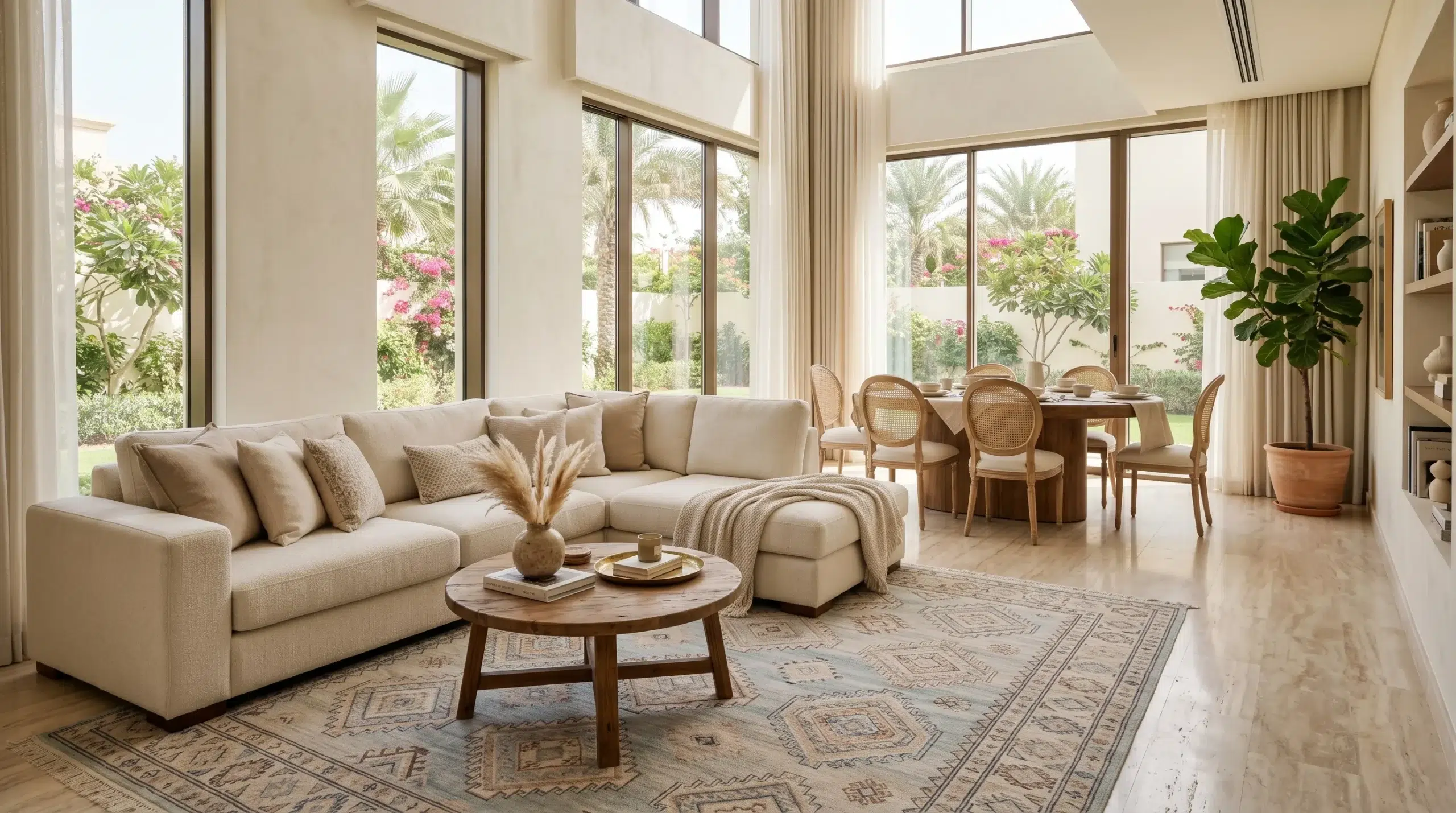
For families with children, a U-shaped or L-shaped arrangement using a sectional sofa works beautifully. It creates a contained, cozy zone that keeps young children within sight and provides generous seating for guests. Explore our living room sofas collection and sectional sofas which includes a wide range of sectionals and modular configurations specifically suited to UAE apartment and villa proportions.
How to Define Your Dining Zone
The dining zone needs one clear anchor: the dining table itself. Position it so there’s a minimum of 90 cm of clearance on all sides where chairs will be pulled out. This allows comfortable movement without chairs bumping into walls or living-room furniture. In practice, 100–110 cm is even better if your space allows it.
In apartments where the dining zone is adjacent to the kitchen, the natural position is between the kitchen and the living area, creating a logical flow from cooking to eating to relaxing. In villas with more generous proportions, the dining area can sit perpendicular to the living zone or even in a separate wing of the open plan.
One thing worth noting specific to UAE family life: dining tables in family homes here tend to get used constantly. Breakfast, homework, crafts, and of course, meals. Consider this when choosing size. A 6-seater dining table (approximately 160–180 cm long) is the practical minimum for a family of four in most UAE homes. If you host regularly, an extendable table is worth every dirham. Browse our dining tables collection.
Using Area Rugs to Anchor Each Zone
If there’s one affordable tool that does more work than anything else in an open-plan layout, it’s the area rug. A well-chosen rug visually defines a zone even in the absence of walls or dividers.
For the living zone, your rug should be large enough that at minimum the front legs of all sofas and chairs sit on it. Ideally, especially in larger spaces, all four legs of every piece should be on the rug. A common sizing mistake is choosing a rug that’s too small. It ends up looking like it’s floating in the middle of the space. In a standard UAE apartment living zone, you’ll typically need a rug of at least 200 x 300 cm, and in villa settings, 250 x 350 cm or larger is appropriate.
The dining zone rug should extend at least 60–70 cm beyond the table on all sides. Enough that chairs remain on the rug even when pulled out. A round table pairs naturally with a round or square rug. A rectangular table works with a rectangular rug. Keep the two rugs distinct in pattern or texture so each zone reads as its own space, but choose colours that relate to each other for visual cohesion.
The Transition Space Between Zones
One thing most guides skip: the transition space between your living and dining zones matters. There should be a natural “path” of approximately 80–90 cm between where the living furniture ends and the dining furniture begins. This isn’t wasted space. It’s the traffic route that lets people move naturally from the entrance through the room without navigating around furniture.
In UAE homes where the helper or family members are regularly moving between kitchen and dining, this path needs to be genuinely clear. We’ve seen families squeeze their layouts so tight that pulling out a dining chair blocks the route to the kitchen entirely, frustrating every single day.
Section 2: Practical Space Planning by Home Type
Apartments (Studio to 3BHK)
The majority of UAE residents live in apartments, and the principles here need to be adapted for tighter proportions. In a 1BHK or studio in areas like JVC, Al Nahda, or Deira, your open-plan space might be as small as 25–30 sqm total. In this case, multi-functional furniture becomes essential.
A sofa that can be extended into a sleeper configuration, a dining table that folds down from 4 to 2 seats, or a storage ottoman that doubles as a coffee table. These aren’t compromises. They’re smart choices that let you live comfortably without feeling cramped. In compact spaces, keep furniture legs visible (avoid solid-base furniture that sits flush to the floor) as this creates a sense of airiness and space.
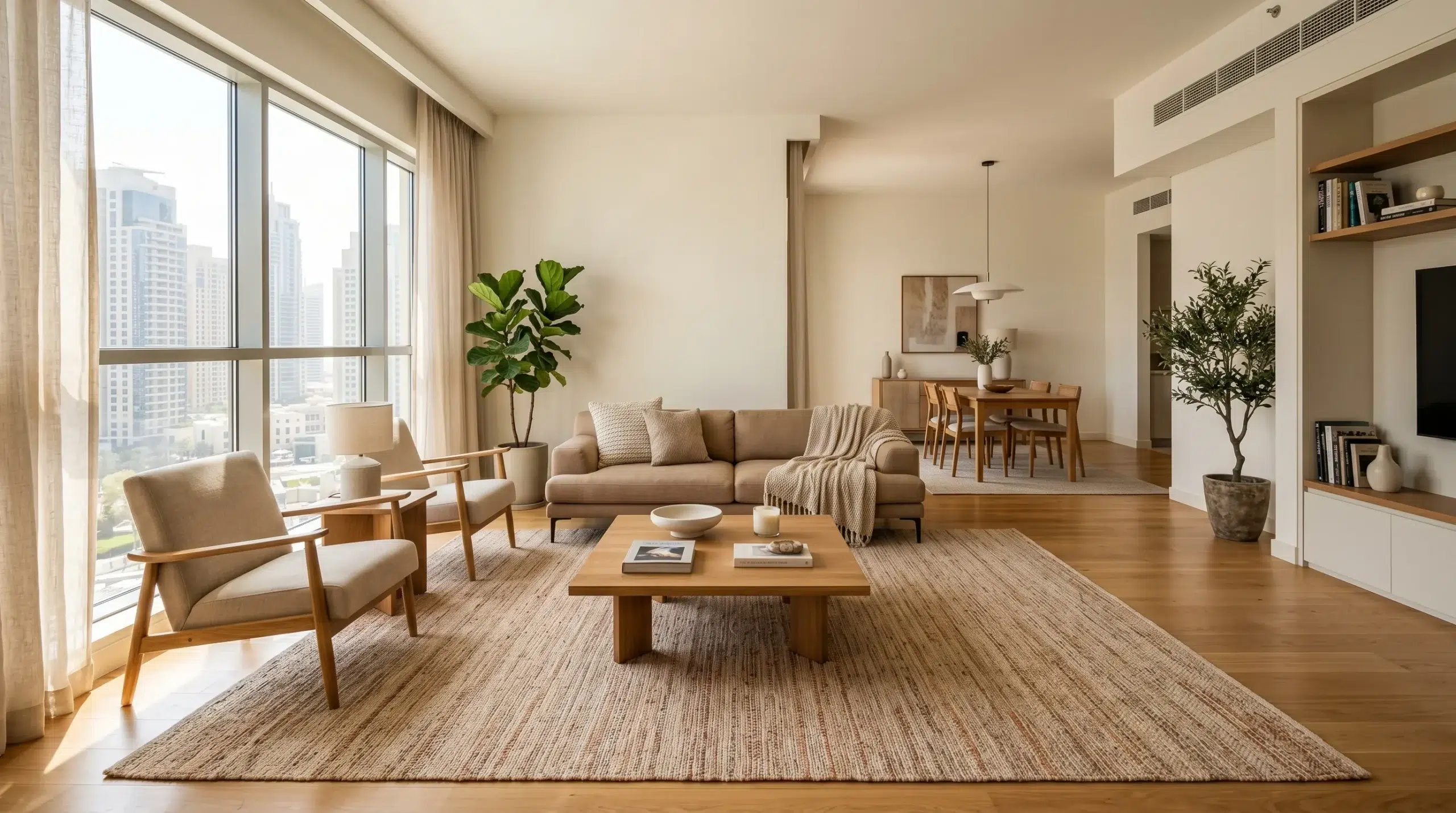
For 2BHK and 3BHK apartments, the most common family configuration across Dubai, Sharjah, and Ajman, a standard sofa-plus-two-armchairs living configuration typically works well alongside a 4–6 seater dining set. The key is keeping the sofa footprint proportionate: a 3-seater sofa of 200–220 cm length, combined with a 160 cm dining table, creates a balanced arrangement without one zone visually dominating the other.
Villas and Townhouses
In UAE villas, particularly common in areas like Arabian Ranches, The Springs, Mirdif, and Al Reef in Abu Dhabi, the open-plan proportions are significantly more generous, which brings its own challenges. Too much furniture and it looks cluttered. Too little and it feels empty and impersonal.
In villa living rooms, a sectional sofa or a 4-5 seater L-shape is usually the right anchor piece for the living zone. This is also where a dedicated majlis area often makes sense. A secondary seating arrangement, potentially with floor cushions or low seating, positioned either in a corner of the open plan or in a separate room off it. This reflects the genuine hospitality culture of UAE family life and gives you flexible seating capacity for larger gatherings.
For villa dining zones, an 8–10 seater dining table is practical and proportionate. Round tables of 120–135 cm diameter work beautifully for 6 and create a more convivial, less formal atmosphere. Browse our dining room furniture.
Climate and Light Considerations Unique to UAE
This point deserves its own section because it’s genuinely important and most international furniture guides ignore it entirely.
AC airflow: Avoid placing sofas, beds, or dining tables directly beneath or in the immediate path of a ceiling-mounted split AC unit. Prolonged direct airflow causes discomfort for occupants and, over time, can dry out and crack leather upholstery. If your layout forces furniture near an AC, consider deflecting the airflow using an adjustable vent cover.
West-facing sun: UAE summers bring intense afternoon sun through west-facing windows between roughly 2–6pm. Fabric sofas in light colours placed in direct sun paths will fade noticeably within 18–24 months. Leather and faux-leather will warm uncomfortably. If your windows face west, position your sofa so it’s out of the direct sun path, or invest in quality blackout or UV-blocking curtains. This is practical advice that saves you money.
Dust: UAE’s dusty environment means furniture with open shelving, fabric-heavy designs, or intricate carved details requires more frequent cleaning. For families with allergies, smooth surfaces, leather, tight-weave fabrics, powder-coated metals, are easier to maintain. Our team is always happy to discuss material practicality for UAE conditions when you visit our showroom.
Section 3: Choosing the Right Furniture for Open-Plan Spaces
Sofas — The Most Critical Decision
In an open-plan layout, your sofa is doing more work than just providing seating. It’s defining the boundary of your living zone, creating the dominant visual anchor of the space, and setting the tone for the entire aesthetic. Getting this right matters.
Size: Scale is everything. A sofa that’s too small gets lost in the space and fails to define the zone. A sofa that’s too large blocks traffic flow and overwhelms the room. As a general rule, your sofa length should span 50–65% of the width of your living zone wall. For a living zone that’s 4 metres wide, that means a sofa between 200–260 cm.
Shape: For open-plan layouts specifically, L-shaped and corner sectional sofas are often superior to traditional 3+2 arrangements. A corner sectional creates a clear zone boundary on two sides, physically delineating the living area without any additional furniture. It also provides more seating in a single footprint, which matters for UAE family hosting culture.
Material: For UAE families with children, performance fabrics (tightly woven, stain-resistant upholstery) are genuinely practical. We’ve seen too many families regret choosing delicate linen sofas after the first year with young children. High-resilience foam seating (not just standard foam) maintains its shape significantly longer in the UAE heat. Explore our full range at Karnak Home Sofas.
Dining Tables — Size, Shape, and Material
The shape of your dining table has a meaningful impact on how the space feels. Round tables encourage conversation and work beautifully in zones where the dining area isn’t huge. They feel less formal and more inclusive. Rectangular tables maximise seating capacity and work well in elongated open-plan spaces where the dining zone runs along one wall.
Material considerations for UAE: Solid wood dining tables are durable and develop character over time, but require care in UAE humidity fluctuations between summer (heavily air-conditioned) and transitional seasons. MDF with veneer is more dimensionally stable in these conditions but won’t last as long. Ceramic and tempered glass tops are easy to clean and highly practical for families. A real consideration when you’re wiping down the table three times a day.
AED pricing guide: Entry-level dining sets (table + 4 chairs) start from around AED 1,500–2,500 for MDF construction. Mid-range solid wood sets run AED 3,500–7,000. Premium solid wood or imported European pieces start from AED 8,000 and up. For most UAE families, the AED 3,500–6,000 range offers the best value. Durable construction, good aesthetics, and materials suited to the climate.
Room Dividers — When You Need More Definition
Sometimes an open-plan space is simply too open. A long, undifferentiated rectangle where no amount of furniture arrangement creates a feeling of distinct zones. In this case, room dividers can help significantly without the expense or permanence of walls.
Options that work well in UAE homes include: tall open bookshelves (which divide visually while maintaining airflow, important for AC efficiency), slatted wooden screens, indoor plants grouped together as a natural partition, and console tables positioned back-to-back between zones. Avoid solid, floor-to-ceiling dividers that block AC airflow entirely. This creates hot and cold spots in the space.
Section 4: Common Mistakes UAE Families Make (And How to Avoid Them)
Mistake 1: Pushing All Furniture Against the Walls
This is far and away the most common mistake we see, and it comes from a natural instinct to “clear the middle” of the room. The result is furniture that looks marooned around the edges of the space, with a vast empty centre that feels awkward and unlived-in.
What to do instead: Pull your sofa at least 40–50 cm away from the wall. Group furniture inward, oriented toward each other and toward the focal point. The living zone should feel like a contained, cohesive conversation space, not a perimeter patrol.
Mistake 2: Buying Furniture Before Measuring
We see this regularly, especially with families who’ve just moved and are excited to furnish quickly. A sofa that looks perfectly sized in the showroom can overwhelm a compact apartment or look undersized in a villa living room. A dining table bought online without checking clearance dimensions blocks the path to the kitchen.
What to do instead: Before you buy anything, sketch your floor plan with accurate dimensions. Mark windows, doors, AC units, and light switches. Then choose furniture based on those measurements. Our showroom team at Karnak Home can help you plan this. Bring your measurements and we’ll guide you through selections that genuinely fit your space.
Mistake 3: Mismatching Scale Between Living and Dining Zones
In an open-plan space, both zones are visible simultaneously. If your living room has an enormous sectional sofa and your dining area has a tiny 4-seater table, the visual imbalance feels wrong even if you can’t immediately identify why. The same problem occurs in reverse. A grand 10-seater dining table alongside a modest 2-seater sofa.
What to do instead: Think of the two zones as one visual composition. The visual “weight” of the living furniture and dining furniture should feel roughly balanced. A larger sofa arrangement pairs naturally with a larger dining table. A more compact living setup suits a 4–6 seater dining configuration.
Mistake 4: Ignoring Traffic Flow
Every person who enters or leaves a room, moves from the kitchen to the dining table, or walks from the sofa to the balcony is a potential furniture collision if you haven’t planned the traffic flow. In UAE family homes, this matters more than it does in smaller households. Between children running, helpers moving between spaces, and regular guests, traffic is constant.
What to do instead: Map out the three or four main traffic routes in your open-plan space before finalising any furniture placement. The path from the entrance to the living area, from the kitchen to the dining table, and from the main living area to the balcony or bedroom corridor should all be clear and at least 80–90 cm wide.
Mistake 5: Choosing a Coffee Table That’s Too Small
The coffee table is a functional workhorse in UAE family living rooms. Drinks, remote controls, children’s snacks, books. Yet families routinely choose coffee tables that are proportionately too small for their sofa. A standard 3-seater sofa should pair with a coffee table of at least 110–120 cm length. An L-shaped sectional needs something larger. Either a single large rectangular table of 130–150 cm, or a cluster of two or three smaller tables.
Section 5: Budget and Pricing Guidance for UAE Families
Being honest about costs is part of how we’ve built trust with 70,000 families over 35 years. Here’s a realistic picture of what different levels of open-plan furniture investment looks like in the UAE market:
Entry Level (AED 5,000–10,000 total): This covers a basic sofa (AED 2,000–3,500), a modest dining set (AED 1,500–2,500), a coffee table (AED 500–800), and an area rug (AED 400–700). At this range, expect MDF construction, standard foam seating, and a more limited choice of finishes. Perfectly functional for a first apartment or furnished rental situation.
Mid Range (AED 12,000–25,000 total): This is where the majority of UAE families shop, and it’s where the sweet spot for value lies. A quality fabric or faux-leather sectional (AED 5,000–9,000), a solid wood or quality MDF dining set (AED 3,500–6,000), and supporting pieces. At this range you get meaningful durability, better fabric grades, and solid construction that will last 8–12 years with reasonable care.
Premium (AED 30,000+): Solid hardwood construction, imported European upholstery fabrics or genuine leather, bespoke sizing options, and pieces that genuinely improve with age. For families in larger villas who want furniture that grows with them over the long term, this is a worthwhile investment.
One honest note: the UAE market has a wide range of quality at every price point, and brand names alone aren’t a reliable guide. At Karnak Home, we’re always willing to explain exactly what you’re getting at each price point. Materials, construction, warranty coverage. Ask us before you buy.
Section 6: Expert Tips From 35 Years of UAE Home Furnishing
After helping more than 70,000 UAE families furnish their homes, here are the practical insights that come up again and again:
Measure the elevator and stairwell before you buy large furniture.
In UAE apartment buildings, getting a large sofa or dining table to the correct floor is the single biggest practical headache families face. A 3-seater sofa that’s 240 cm long might not fit in a standard apartment elevator. Ask your building management for elevator internal dimensions before purchasing large pieces.
Light-coloured furniture shows beauty but demands maintenance.
White and cream sofas photograph beautifully and make spaces feel airy. But in UAE family homes, they require professional cleaning every 6–12 months. If you have children under 10, either choose mid-tones (warm greys, taupes, dusty blues) or accept the cleaning cost as part of ownership.
Don’t fill every corner.
UAE families often feel compelled to fill open-plan spaces completely. Resist this instinct. Empty space is intentional and makes the furniture you do have look more considered. One well-chosen large plant is better than three small ones. One quality side table beats two cheap ones.
Invest most in what you touch most.
The sofa seat cushion, the dining chair seat, the bed mattress. These are the surfaces in direct daily contact with your body. Prioritise quality here over decorative pieces. A beautiful decorative vase doesn’t need to cost AED 2,000. Your sofa cushioning does need to be properly graded foam.
Think about the next five years, not just today.
UAE families grow and change. A couple expecting a first child should think about how the layout accommodates a toddler in 18 months. A family with teenage children should consider how the space functions when those children become young adults. Furniture that’s adaptable, extendable dining tables, modular sofas, pays dividends over time.
The rug anchors everything. Don’t skip it.
Many families finish an entire room, look at it, and feel something is “off.” Usually it’s the absence of a rug. A correctly sized rug unifies the living zone, adds warmth, and reduces echo in hard-floored UAE apartments dramatically. This single piece makes more visual difference per dirham than almost any other element.
Visit the showroom with photos of your space.
Our consultants can offer infinitely better guidance when they can see the actual proportions, light, and existing elements of your home. Bring dimensions, photos, and a rough floor sketch, even a hand-drawn one, and we’ll help you plan something that genuinely works.
Conclusion: Making Your Decision
Arranging furniture in an open-plan living and dining room isn’t complicated once you understand the underlying logic: define your zones, anchor them with your key pieces, plan your traffic flow, and respect the scale of your space. The UAE-specific considerations. AC placement, sun direction, family hosting culture, apartment elevator dimensions. Add a layer of practical detail that makes the difference between a layout that merely fits and one that genuinely works for your daily life.
The most important thing is to plan before you buy. A diagram drawn on graph paper, measurements taken carefully, and 30 minutes of thinking through how your family actually uses the space will save you from expensive mistakes and a layout that never quite feels right.
Key Takeaways:
- Define your living and dining zones independently, then plan each zone’s furniture before thinking about the full room
- Pull furniture away from walls and anchor each zone with a correctly sized area rug
- Account for UAE-specific factors: AC airflow, west-facing sun, family hosting needs, and elevator dimensions before purchasing
Can’t find the perfect piece for your space?
Discover tailored elegance with the Customizable Collection at Kustom Deco.
Ready to Find the Right Furniture for Your Space?
Whether you’d like to browse at your own pace or talk through your specific apartment layout with one of our team, Karnak Home makes it straightforward. Our showroom gives you the chance to experience furniture at full scale – something that makes a real difference when you’re choosing pieces for a small space. Our online store lets you filter by dimensions, style, and function so you can shortlist options before committing to a visit.
We offer delivery across all seven emirates, and our team can advise on anything from sofa dimensions to full room layouts. There’s no pressure and no commission-driven sales – just genuine guidance from people who know UAE homes.
Shop Online: Karnak Home
Visit Our Showroom: Dubai – Showroom Address & Directions
Expert Advice: Call Us or WhatsApp our team for personalised guidance
Related Articles: