
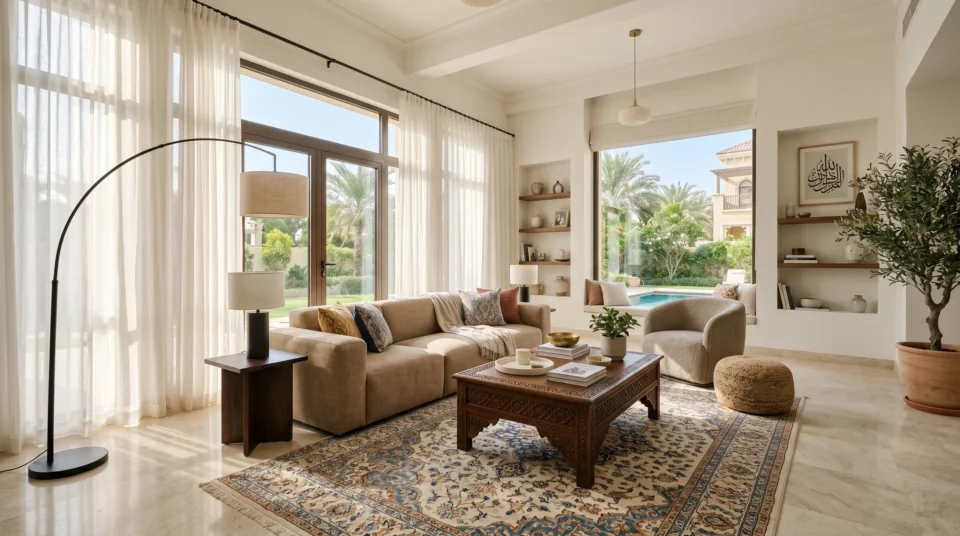
Here is a question Karnak Home‘s consultants hear almost every week on the showroom floor: “I love this modern sofa and that classic wooden cabinet, but will they go together?” It is one of the most common worries UAE homeowners have, and it is completely understandable. With so many beautiful styles available, contemporary, traditional Arabic, Scandinavian, transitional, industrial, the fear of getting it wrong and ending up with a room that looks like a furniture warehouse is real.
The good news? Mixing home furniture styles is not only acceptable, it is actually the hallmark of a home that feels personal, layered, and lived-in rather than sterile and showroom-flat. After 35 years and over 70,000 families served across the UAE, the team at Karnak Home has seen what works, what does not, and why some of the most beautiful homes in Dubai, Abu Dhabi, and Sharjah are the ones where the furniture does not all “match” in the traditional sense.
This guide will walk you through the principles, the pitfalls, and the practical steps to create a home that feels intentionally designed, not accidentally cluttered.
Looking to better understand the UAE lifestyle, weather, and daily living? Check out this excellent UAE Living Guide by First Abudhabi Bank (FAB) for insider tips and practical advice on navigating life in the Emirates.
Why Mixing Furniture Styles Works Especially Well in UAE Homes
The UAE is a uniquely diverse living environment. Many families here have cultural roots in multiple countries, have lived internationally, and bring together influences that no single furniture “style” can fully represent. A family from Egypt living in a modern Dubai apartment might want to honour traditional woodwork while living in a sleek high-rise. An Emirati family in a Sharjah villa may want contemporary comfort alongside heritage Arabic design. An expat couple in JVC may want to blend pieces they brought from Europe with new purchases that suit the Gulf climate.
This cultural plurality is a genuine design asset. It means UAE homes naturally call for a curated mix rather than a catalogue-copy approach. What matters is not that everything comes from the same style family, it is that everything comes together with intention. The principles below are exactly how you achieve that.
The Core Principle: Find Your Common Thread
Before you buy a single piece of furniture, you need to identify what designers call a “common thread”, the unifying element that makes different styles feel like they belong in the same room. Without this, mixing styles does look cluttered. With it, the same room looks considered and sophisticated.
Your common thread can be any of the following elements, but it only needs to be one.
Colour as Your Unifying Language
The most accessible common thread for most UAE families is a consistent colour palette. This does not mean every piece needs to be the same colour. It means the colours across your different pieces should speak to each other. A warm ivory sofa, a honey-toned wooden dining table, and brass-finish light fixtures all share warm undertones, even if one is contemporary, one is traditional, and one is industrial. That shared warmth is your thread.
For UAE homes specifically, warm neutrals work exceptionally well. Whites, creams, warm greys, sand tones, and soft terracottas all suit the natural light levels in Gulf properties and complement the marble flooring common in villas and many apartments. If you are starting from scratch, build your palette around your flooring, it is the one thing you are least likely to change.
A practical tip: pull three colours from your flooring or a fixed wall tile, and let those guide every furniture purchase. At Karnak Home, our consultants often help families do exactly this during showroom visits, bring a photo of your floor or a tile sample and we can help you narrow choices down quickly.
Material Harmony Across Different Styles
The second most effective common thread is material. If multiple pieces in a room share the same material, say, natural wood, they will feel connected even if their silhouettes are completely different. A sleek Scandinavian dining chair and a heavily carved traditional Arabic side table can coexist comfortably if both are solid walnut. The material creates an invisible bridge between the styles.
In UAE homes, the most reliable materials for cross-style mixing are natural wood (particularly dark woods like walnut and mahogany which are culturally resonant in the Gulf), natural linen and cotton upholstery, and warm metals like brass and brushed gold. These materials carry warmth that suits the regional aesthetic and are neutral enough in character to belong to multiple style families.
What to be cautious of: mixing too many competing materials in one room. Chrome, rose gold, matte black, and brushed brass all in the same space creates visual noise. Choose one or two metal finishes and keep them consistent across lamps, handles, and frames.
Scale and Visual Weight
This is the principle most people do not know about, and it is the one that most often explains why a room feels off even when the colours are right. Every piece of furniture has a visual weight, determined by its size, colour depth, and bulk. A room feels balanced when heavy and light pieces are distributed evenly, not when all the heavy pieces are on one side.
A deep-seated, dark fabric sectional sofa is visually heavy. If you pair it with an equally heavy, ornate dining set in dark wood, the room feels oppressive regardless of how beautiful each individual piece is. Balance that sofa with lighter-weight chairs, a glass or marble coffee table, and open shelving rather than a solid cabinet, and the room breathes.
For UAE villas with large open-plan living and dining areas, common in areas like Arabian Ranches, Mirdif, and Al Barsha, this principle of visual weight distribution is especially important. The scale of the space can tempt families to fill it with large pieces throughout, which reads as heavy and cluttered even when everything is technically high quality.
Practical Rules for Mixing Specific Furniture Styles
With the core principle understood, here are the specific combinations that work well in UAE homes and how to execute them.
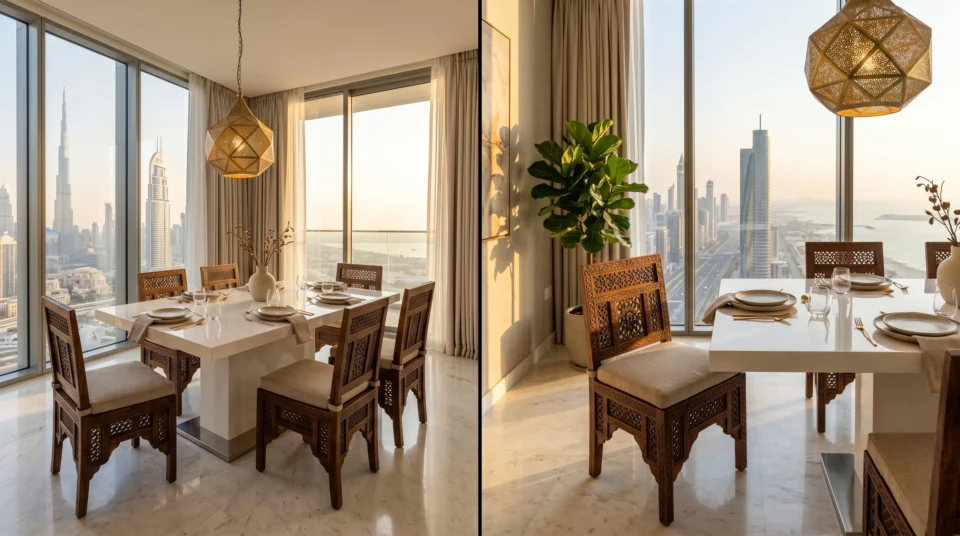
Contemporary + Traditional Arabic
This is the most common mix in UAE homes and also the one with the most potential. Contemporary furniture, clean lines, minimal ornamentation, neutral upholstery, provides the calm, uncluttered backdrop that makes traditional Arabic pieces look like the beautiful, intentional statements they are rather than heavy masses competing for attention.
The formula that works consistently: a contemporary sofa or bed as the primary large piece, with traditional Arabic elements introduced through accent pieces, a mashrabiya-pattern screen, a carved side table, a brass lantern-style floor lamp, cushion covers in traditional patterns. The contemporary foundation gives the traditional elements space to shine.
What does not work: an ornately carved traditional Arabic sofa set placed next to a highly styled contemporary sectional. Both pieces demand attention simultaneously and neither wins. Choose one style for your anchor pieces and let the other play a supporting role.
At Karnak Home, our sofa collection includes both contemporary and transitional styles that are designed to serve exactly this anchor function, neutral enough in design to work as a backdrop, quality enough to be the centrepiece of the room.
Scandinavian + Warm Middle Eastern
Scandinavian furniture, characterised by light wood, clean lines, functional form, and restrained decoration, has become extremely popular in UAE apartments, particularly in newer developments in Dubai Marina, Downtown, and JBR. It suits smaller apartments well because of its visual lightness.
The risk with pure Scandinavian interiors in the UAE is that they can feel cold and somewhat generic, pleasant but without personality or cultural grounding. Mixing in warm Middle Eastern elements resolves this beautifully. A classic Scandinavian dining set gains warmth and depth when paired with a deep-hued Persian or Moroccan rug, brass pendant lighting, and ceramic decorative pieces in terracotta tones.
The key is contrast of texture, not contrast of style. Scandinavian furniture tends toward smooth, light, and minimal. Introduce richness through textured cushions, woven throws, layered rugs, and decorative objects with artisanal character. The furniture styles are different but the room feels unified because each element contributes a complementary quality the other lacks.
Industrial + Warm Natural
Industrial furniture, exposed metal frames, reclaimed wood, raw finishes, has found a strong following in UAE home offices and younger households. It works particularly well in properties with concrete ceilings, large windows, or open mezzanine layouts.
Pure industrial styling in a UAE home, however, can feel harsh and uninviting, especially in a climate where the outdoors is hot and intense for much of the year. Most UAE families want their home to feel like a genuine retreat, which pure industrial design does not always deliver.
The solution is layering in warmth through natural materials. A metal-frame office desk gains character when paired with a leather chair and a solid wood bookshelf. An industrial bed frame becomes inviting with linen bedding, a wool rug, and soft bedside lighting. The industrial structure remains but the room feels liveable.
Our office furniture range includes several pieces designed with this industrial-warm hybrid in mind, metal frames with wood surfaces that suit both home offices and study areas for older children.
Room-by-Room Guide for UAE Homes
Different rooms in UAE homes call for different mixing approaches. Here is how to think about each one.
Living Room: Where Most Mixing Happens
The living room is typically where UAE families do the most ambitious mixing, and where the most mistakes happen. The most common error is treating the sofa, coffee table, TV unit, and accent chairs as separate purchasing decisions rather than as a system.
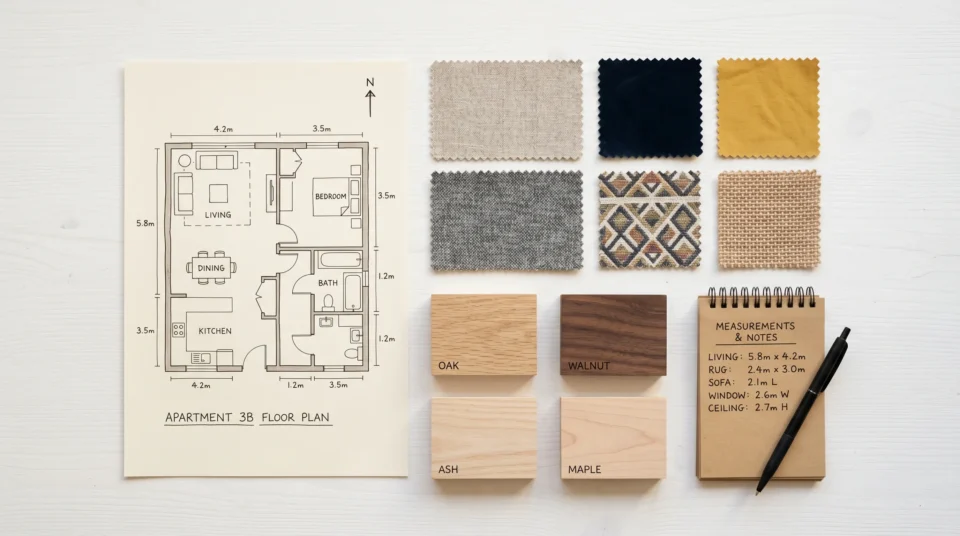
Before buying anything for your living room, lay out the footprint on paper or use a simple app. Decide on your anchor piece first, almost always the sofa. Then build everything else around it in terms of scale, colour, and material. Give yourself a rule of no more than two dominant styles in the room. A third style can appear in accessories and decorative elements only.
For UAE villas with majlis areas, keep the majlis furniture internally consistent, traditional Arabic seating and low tables work best when they match each other, and save your style mixing for the adjacent family sitting room. Blending styles within a formal majlis rarely works well and can dilute the cultural statement the space is meant to make. You can also anchor the layout with cohesive coffee tables and tv media units to balance the transition between areas, while introducing accent chairs for flexible seating.
Bedroom: Restrained Mixing Works Best
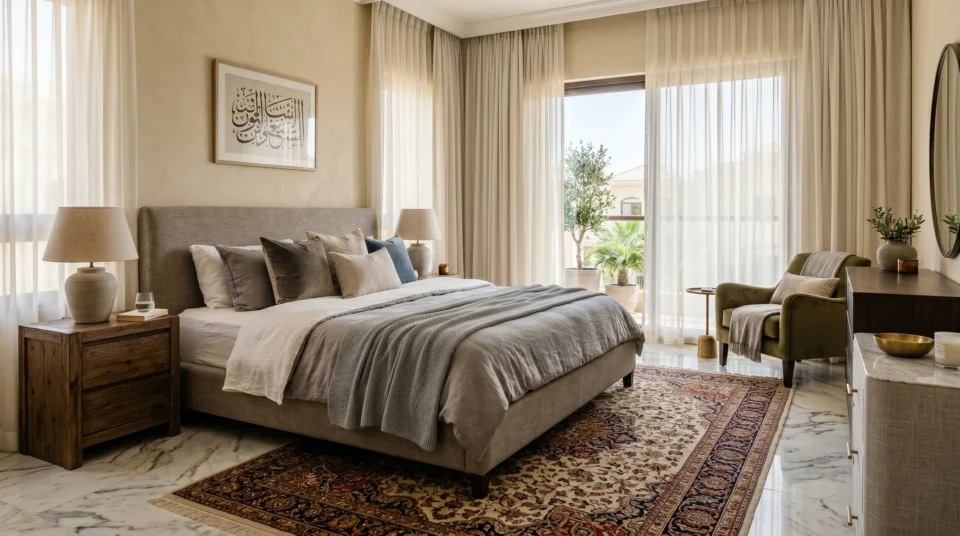
Bedrooms benefit from a more restrained approach to mixing. Because the bedroom’s primary purpose is rest, too much visual variety creates subconscious stimulation that works against relaxation. In practice, this means your bedroom mix should be limited to two elements: your bed and its bedside tables can be from one style family, while your wardrobe and storage can be from another. Accessories, rugs, cushions, artwork, can then draw from a third.
A combination that works particularly well in UAE bedrooms: an upholstered bed frame in a neutral tone paired with solid wood bedside tables and a built-in wardrobe in a contemporary finish. The soft upholstery, warm wood, and clean contemporary storage each bring something distinct but the palette and material warmth unite them. Explore our curated bedroom furniture and premium mattresses to craft a restful yet distinctive aesthetic.
Dining Room: One Style Anchor, One Style Accent
The dining room is where one design principle applies with particular clarity: the dining tables set the style direction, and the chairs can introduce a second style, but nothing else should introduce a third. A marble-topped contemporary dining table looks exceptional with both modern upholstered chairs and traditional carved wooden chairs, either combination works. But pairing a marble contemporary table with carved chairs AND a heavily ornate sideboard AND a traditional chandelier brings too many styles into a confined space.
Keep your dining lighting and storage visually simple if your table-and-chair combination is already doing the style mixing. Let the furniture do the talking.
The Five Most Common Mistakes UAE Families Make
Mistake 1: Buying Everything at Once from One Style Range
When families furnish a new property quickly, common with villa handovers in Dubai, they often buy a complete matched set to save decision fatigue. The result is a technically “coordinated” home that looks flat and impersonal. Matching sets are not wrong, but they leave no room for the personality that makes a home feel like yours.
If you have bought a matched set, you can still add depth and character through rugs, cushions, lighting, and a few deliberate accent pieces in a contrasting style. These are lower-cost investments that make a significant visual difference. Our team can advise on which accent styles work well with your existing furniture, just share a photo when you visit or call us.
Mistake 2: Ignoring Scale
A small coffee table in front of a large sectional sofa looks like an afterthought. An oversized wardrobe in a modest apartment bedroom overwhelms the room. Scale mismatches are one of the most common reasons a mixed-style room feels wrong, and one of the most fixable.
A practical rule: your coffee table should be approximately two-thirds the length of your sofa. Bedside tables should sit at mattress height or within 5 to 7cm of it. Dining chairs should allow at least 25 to 30cm between the seat and the underside of the table. These are not arbitrary numbers, they are the proportions that decades of interior design practice have proven create visual and functional comfort.
Mistake 3: Mixing Too Many Wood Tones
Natural wood is a beautiful material and a wonderful common thread, but only if the wood tones are close enough to read as intentional. Mixing a very light ash dining table with a very dark mahogany TV unit and a medium walnut coffee table in the same open-plan space looks chaotic, not curated. The eye keeps jumping between conflicting tones.
The rule of thumb: stay within two wood tones per space, and make sure they are either very similar (both warm mid-tones, for example) or very deliberately contrasted (very light and very dark, with nothing in between). The “mistake zone” is multiple mid-tones that are close but not the same.
Mistake 4: Neglecting the Floor as a Design Element
In UAE homes, flooring is often marble or large-format tile, beautiful but cool in tone and hard in texture. Rugs are not decorative extras in this context; they are functional design tools that anchor furniture groupings, add warmth, and, crucially, visually “contain” a furniture arrangement so it reads as intentional rather than random. Adding items from our mirrors collection can also help reflect this light and grounding, expanding the visual footprint of your room.
A living room sofa grouping without a rug looks like furniture that has been placed and not finished. The same arrangement with a rug underneath creates a defined zone with visual purpose. For open-plan UAE villas, rugs are often the single most effective tool for making a mixed-style interior feel deliberately designed. Budget AED 800 to 3,000 for a quality rug in a standard villa living room, it is money that transforms the impact of everything else in the room.
Mistake 5: Following Trends Over Personal Needs
UAE homeowners are exposed to a lot of design content, Instagram feeds, developer showrooms, mall displays, and it is easy to be influenced into trending styles that do not actually suit your household. Industrial-minimalist styling may look stunning in a magazine but it does not suit a family with three young children. Oversized modular sectionals are beautiful but impractical in apartments where reconfiguration may be needed.
Buy for your actual life, not your aspirational aesthetic. The most beautiful homes Karnak Home’s team have seen over 35 years are the ones where the furniture clearly reflects how the family actually lives, not how they think they should live. Practicality and beauty are not in opposition; they create each other when the choices are honest.
Budget Guidance: What Mixing Styles Actually Costs in the UAE
Mixing styles does not necessarily mean spending more, but it does mean spending more thoughtfully. Here is a realistic view of what well-executed mixed-style rooms cost in the UAE across different budgets.
For a living room in a standard 2 to 3 bedroom Dubai apartment, a well-executed mix of contemporary sofa, accent chairs, coffee table, and rug typically falls in the AED 8,000 to 18,000 range for quality mid-market pieces. The majority of that budget (roughly 50 to 60%) should go on the sofa, which is your anchor piece and the one item worth investing in for both quality and longevity.
For a master bedroom, a quality upholstered bed, two bedside tables, and a wardrobe that mix styles effectively typically ranges from AED 6,000 to 14,000 depending on wardrobe specification and bed size. King-size beds, the standard choice for UAE master bedrooms, account for a significant portion of this.
For a dining room, a solid dining table paired with mix-and-match chairs (a popular approach that works well aesthetically) ranges from AED 3,500 to 9,000 for a 6-seater setup at good quality.
One budgeting principle worth knowing: it is almost always better to buy fewer pieces of genuine quality than more pieces of lesser quality. A room with three excellent pieces and modest accessories will always look better and last longer than a room filled with budget pieces across the board. UAE climate conditions, heat, humidity in coastal areas, air conditioning effects on materials, mean that furniture quality genuinely matters here more than in more temperate climates.
Expert Tips From 35 Years Serving UAE Families
These are the practical pieces of advice Karnak Home’s team find themselves giving most consistently to families across the UAE.
- Start with one anchor piece you love completely. Do not compromise on the sofa or the bed, these are the pieces the entire room is built around. Everything else should serve them.
- Use odd numbers for accessory groupings. Three cushions, five decorative objects, one statement rug. Odd-numbered groupings look more natural and less contrived than even pairs.
- Photograph your space before you shop. A photo reveals proportions and existing colour relationships that you stop seeing when you live in a space. Many buying mistakes are made because families are working from memory rather than reality.
- Test your colour palette with paint samples first. If you are considering bold upholstery or a distinctive accent colour, test it with a large colour swatch or fabric sample in the actual room at different times of day. UAE light is intense and changes colours dramatically between morning and evening.
- Give each room a clear focal point. In the living room, it is typically the sofa arrangement or the TV wall. In the bedroom, it is the bed. In the dining room, it is the table. Every other piece should support that focal point, not compete with it.
- Do not neglect lighting as a unifying tool. A consistent lighting style across a room, all warm-white LEDs, all at a similar height and intensity, can unify very different furniture styles by bathing them in the same quality of light. Conversely, mismatched lighting undoes even the most carefully considered furniture arrangement.
- Visit the showroom with your floor plan. Our consultants at Karnak Home work with families every day who bring measurements, photos, and floor plans. We can help you identify which combinations will work in your actual space, not just in isolation on a showroom floor.
Conclusion: Making Your Decision
Mixing furniture styles is one of the most rewarding things you can do with your UAE home, but it rewards people who approach it with some intention and a few clear principles. Start with your common thread (colour, material, or visual weight). Keep your anchor pieces to one dominant style. Introduce a second style through accent pieces. Avoid the common traps of scale mismatches, competing wood tones, and trend-chasing over genuine need.
The families whose homes look most beautifully designed are rarely the ones who followed a single style catalogue. They are the ones who made deliberate choices, invested where it mattered, and were willing to build a room over time rather than furnishing it in a single weekend.
Key Takeaways:
- Every successful mixed-style room has a single common thread, colour, material, or visual weight, that creates unity across different styles.
- Anchor pieces (sofa, bed, dining table) should set the dominant style direction; accent pieces introduce contrast and personality.
- Scale, proportion, and lighting are as important to a cohesive mixed-style room as the furniture choices themselves.
Ready to Find the Right Furniture for Your Space?
Whether you’d like to browse at your own pace or talk through your specific apartment layout with one of our team, Karnak Home makes it straightforward. Our showroom gives you the chance to experience furniture at full scale – something that makes a real difference when you’re choosing pieces for a small space. Our online store lets you filter by dimensions, style, and function so you can shortlist options before committing to a visit.
We offer delivery across all seven emirates, and our team can advise on anything from sofa dimensions to full room layouts. There’s no pressure and no commission-driven sales – just genuine guidance from people who know UAE homes.
Shop Online: Karnak Home
Visit Our Showroom: Dubai – Showroom Address & Directions
Expert Advice: Call Us or WhatsApp our team for personalised guidance
Related Articles: