
Is your home starting to feel a little 2022?
You’re not alone. Every year we talk to thousands of UAE families who love their homes but feel something is off. The space doesn’t feel as fresh, as comfortable, or as “them” as it once did. After 35 years helping over 70,000 families furnish their homes across Dubai, Abu Dhabi, Sharjah, and beyond, the team at Karnak Home has seen every trend come and go. Some are worth investing in. Some are expensive mistakes dressed up in nice photography. In this guide, we’ll walk you through exactly what’s shaping UAE interiors in 2026, what you should genuinely consider, and what you can safely ignore.
Design trends in the UAE don’t follow global patterns blindly. Our climate, our lifestyle, our family sizes, and our mix of villa and apartment living all create a very specific set of requirements. A linen sofa that looks beautiful in a London design magazine may show dust within a week in a Dubai apartment. A trend that works in a 600 sqft New York studio makes no sense in a 3,000 sqft Jumeirah villa. Everything we cover here is filtered through that UAE lens. Practical, family-tested, and honestly assessed.
What’s Defining UAE Home Design in 2026
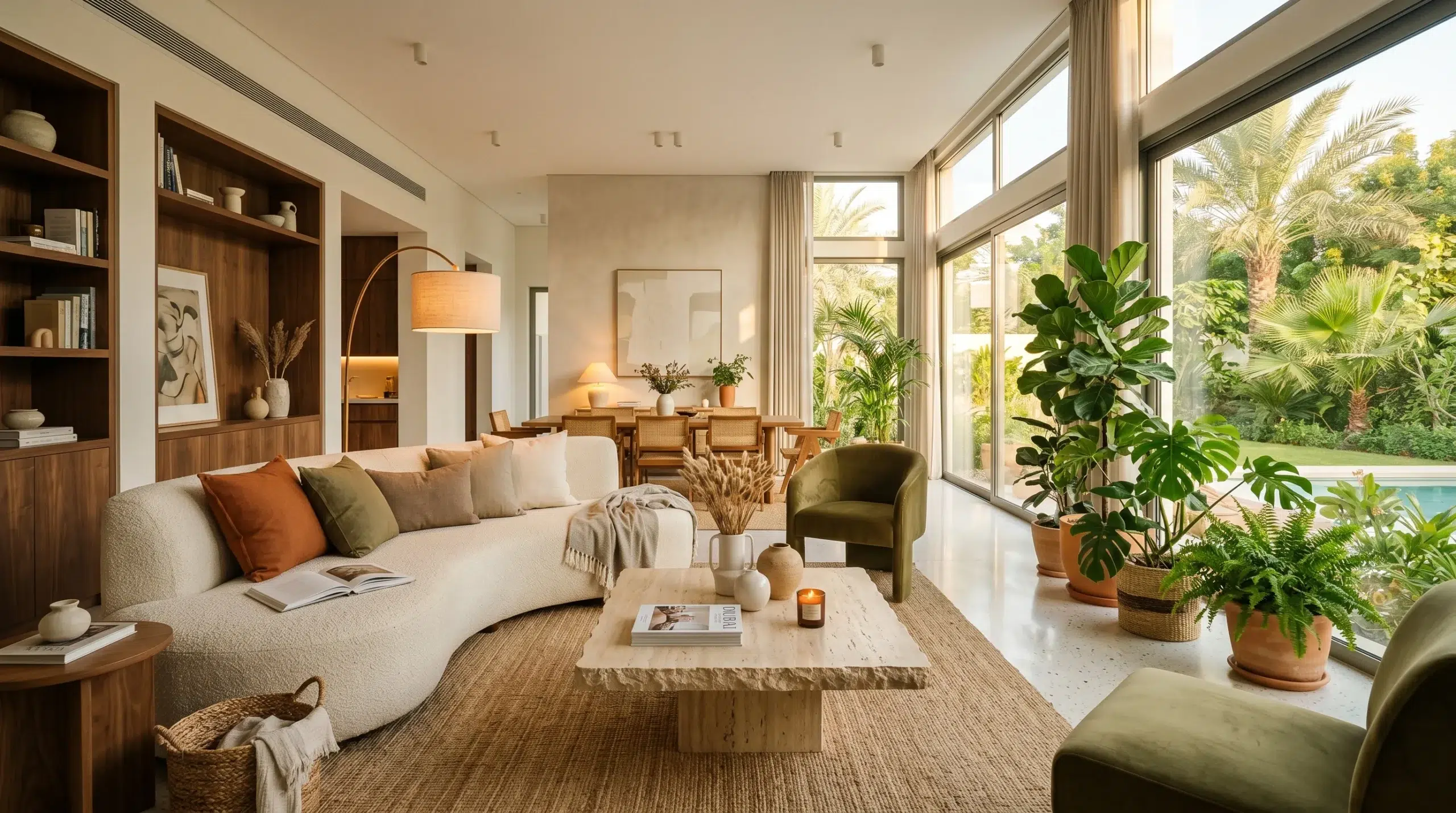
The overarching theme for 2026 is warmth with purpose. After years of stark white minimalism dominating UAE interiors. All white walls, grey tiles, and cold metallic accents. Homeowners are pivoting hard toward warmth, texture, and personality. This doesn’t mean maximalism or clutter. It means choosing pieces that feel considered, natural, and genuinely comfortable for a family that actually lives in the space.
Think warm terracotta, sandstone, deep olive, and camel tones replacing the clinical whites. Think natural materials. Linen, bouclé, travertine, rattan, solid wood. Replacing the shiny surfaces that showed every fingerprint and looked dated within two years. And think about furniture that does more than one job, because whether you’re in a compact Dubai Marina apartment or a sprawling villa in Al Barsha, smart use of space has never been more important.
Three broader forces are driving this shift in the UAE specifically. First, more families are spending more time at home. Remote and hybrid work is still widespread, and people want their homes to feel genuinely restorative. Second, sustainability awareness is growing, and clients increasingly ask us about materials, longevity, and ethical sourcing. Third, and honestly most important: people are tired of replacing furniture every three years because they chased a trend that didn’t last. The 2026 mindset is “buy well, buy once.”
Trend 1: Warm Neutrals and Earthy Tones Are Taking Over
Goodbye Stark White, Hello Warm Sand
The all-white interior has been the default in UAE homes for over a decade. Builders delivered white walls, developers used grey tiles, and homeowners defaulted to white or light grey furniture because it felt “safe.” In 2026, this is changing rapidly. The new neutral palette is warm: think warm white (not cool white), cream, sand, camel, dusty rose, warm terracotta, and deep olive green.
For UAE homes specifically, this shift makes practical sense beyond aesthetics. Cool grey and stark white surfaces show desert dust more visibly than warm sand tones. Warm neutrals are more forgiving, and they work beautifully with the natural light quality in the Gulf. That particular warm, golden-amber quality of afternoon light in Dubai or Abu Dhabi flatters earthy tones in a way it never quite flattered cold greys.
If you’re redecorating rather than starting from scratch, you don’t need to repaint every wall. Start with your largest upholstered pieces. A warm-toned sofa in camel bouclé or sandstone linen immediately shifts the palette of an entire room. Explore our sofa collection → to see current options in warm neutral fabrics.
View Sofa Collection at Karnak Home
The Rise of Terracotta and Deep Earthy Accents
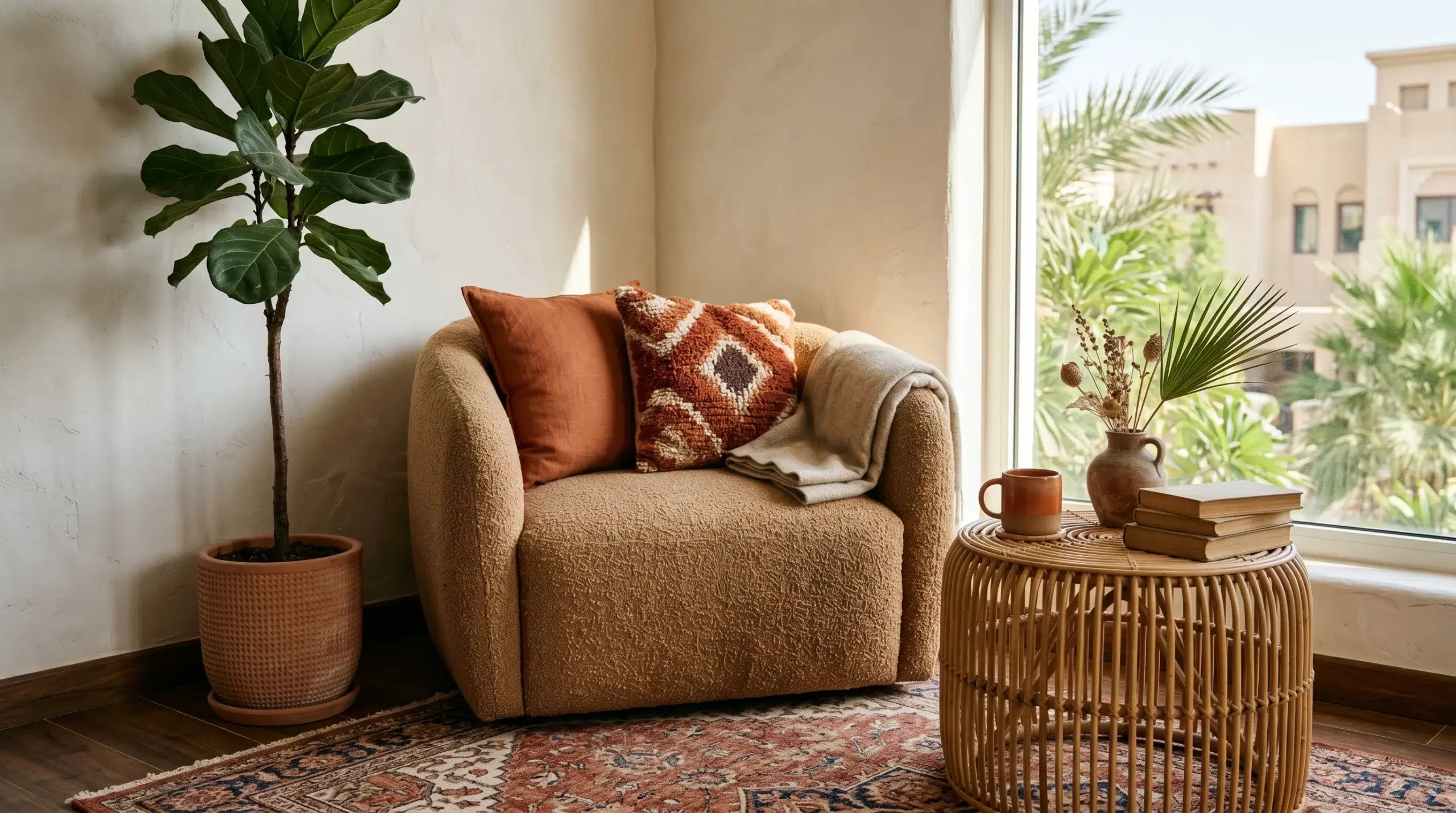
Terracotta is no longer just for plant pots. In 2026, it’s appearing as a genuine accent colour in UAE interiors. In cushion fabrics, in rug tones, in ceramic accessories, and increasingly in upholstered accent chairs. It works exceptionally well against the warm white and sand base tones that are replacing cool greys.
Deep olive and forest green are also growing strongly. These are grounding colours that bring a sense of nature into the home without requiring actual plants (though we’ll come to biophilic design shortly). An olive velvet dining chair or a deep green accent cushion on a sand-toned sofa looks considered and expensive, even when it isn’t.
The key principle for UAE families: don’t go too dark. Homes that receive strong natural light can handle darker tones better, but many UAE apartments. Particularly in denser areas like JLT, Business Bay, or Deira. Have limited natural light. Test your colours in the actual light conditions of your specific space before committing.
Trend 2: Curved and Organic Shapes Replace Sharp Lines
Why Curves Are Everywhere Right Now
If you’ve noticed that every sofa in a design magazine now seems to have rounded arms, you’re not imagining it. The hard, angular furniture that defined the 2010s and early 2020s. Sharp-cornered sofas, rectangular everything, geometric rigidity. Is giving way to softer, more organic shapes. Rounded sofa arms, curved dining chairs, arched shelving units, circular coffee tables, kidney-shaped ottomans.
This trend has psychological reasoning behind it. Curved shapes feel more welcoming and less confrontational. After several years of global stress and disruption, there’s a collective move toward interiors that feel genuinely restorative rather than architecturally impressive. For families with young children. Which is a significant proportion of UAE households. Curved furniture has the added benefit of fewer sharp corners to worry about.
From a practical standpoint, curved sofas and chairs also tend to encourage conversation more naturally than straight, forward-facing arrangements. If you have a wide living room in a villa in Mirdif or Arabian Ranches, a curved or semi-circular sofa arrangement around a circular rug creates a much more inviting social space than two straight sofas facing each other across a long rectangle.
Curves in the Bedroom
The curved trend extends beyond the living room. Curved bedheads are one of the strongest bedroom trends in 2026. Rounded, upholstered headboards in bouclé, velvet, or textured linen are replacing the flat, square panels that dominated for years. These work at every size, from a compact bedroom in an apartment in Dubai Silicon Oasis to a master suite in a Palm Jumeirah villa.
Expect to pay between AED 1,200–3,500 for a good quality curved upholstered bedhead, depending on size, fabric, and construction. The key quality indicator: look for solid timber framing (not MDF or cardboard), dense foam padding of at least 50mm, and fabric that’s been properly pulled and stapled (not glued) at the back. Browse our bed collection → for currently available curved headboard options.
View Bedroom Furniture at Karnak Home
Trend 3: Biophilic Design — Bringing Nature Indoors
What Biophilic Design Actually Means for UAE Homes
“Biophilic design” sounds like expensive jargon, but the concept is straightforward: incorporating natural elements into your interior to create a sense of connection with the natural world. In practice, this means natural materials (wood, stone, linen, rattan), indoor plants, natural light maximisation, organic shapes, and earthy colours. Many of which we’ve already covered.
For UAE homes, biophilic design has particular relevance. We live in an environment where outdoor time is genuinely limited for much of the year. Stepping outside in July and August in Dubai is not the restorative experience it might be in a temperate climate. This makes the home environment even more important as a source of calm and natural connection. Families who spend significant time indoors benefit enormously from spaces that incorporate natural textures and greenery.
The most accessible way to incorporate biophilic principles is through material choices. Replace synthetic or highly processed materials with natural alternatives where your budget allows. A solid wood dining table instead of a high-gloss MDF one. A rattan or jute area rug instead of a synthetic pile. Linen or cotton upholstery instead of polyester microfibre. None of these need to cost dramatically more, but the effect on how a room feels is significant.
Indoor Plants in UAE Homes: What Actually Survives
We’d be remiss not to address the elephant in the room: plants in UAE homes require thought. High temperatures, air conditioning running for months, and variable natural light mean that not all species survive. The good news is that some of the most architecturally striking plants are also the most resilient in UAE conditions.
The ZZ plant (Zamioculcas zamiifolia), the snake plant (Sansevieria), the pothos, and the fiddle-leaf fig (with good light) all perform reliably in UAE apartments and villas. Large format plants. A 1.5m+ fiddle-leaf fig or monstera in a ceramic pot. Create an immediate biophilic statement and function almost like a piece of furniture in terms of their visual weight in a room. Budget AED 200–600 for a quality large-format indoor plant from a reputable UAE nursery.
Trend 4: Multifunctional Furniture for UAE Living
The Smart Space Reality for UAE Families
Whether you’re in a 750 sqft apartment in International City or a 4,500 sqft villa in Emirates Hills, space efficiency matters. Growing families need rooms that adapt. A home office that converts to a guest room, a dining space that expands for Eid gatherings, a children’s bedroom that grows with them over a decade rather than needing complete replacement every few years.
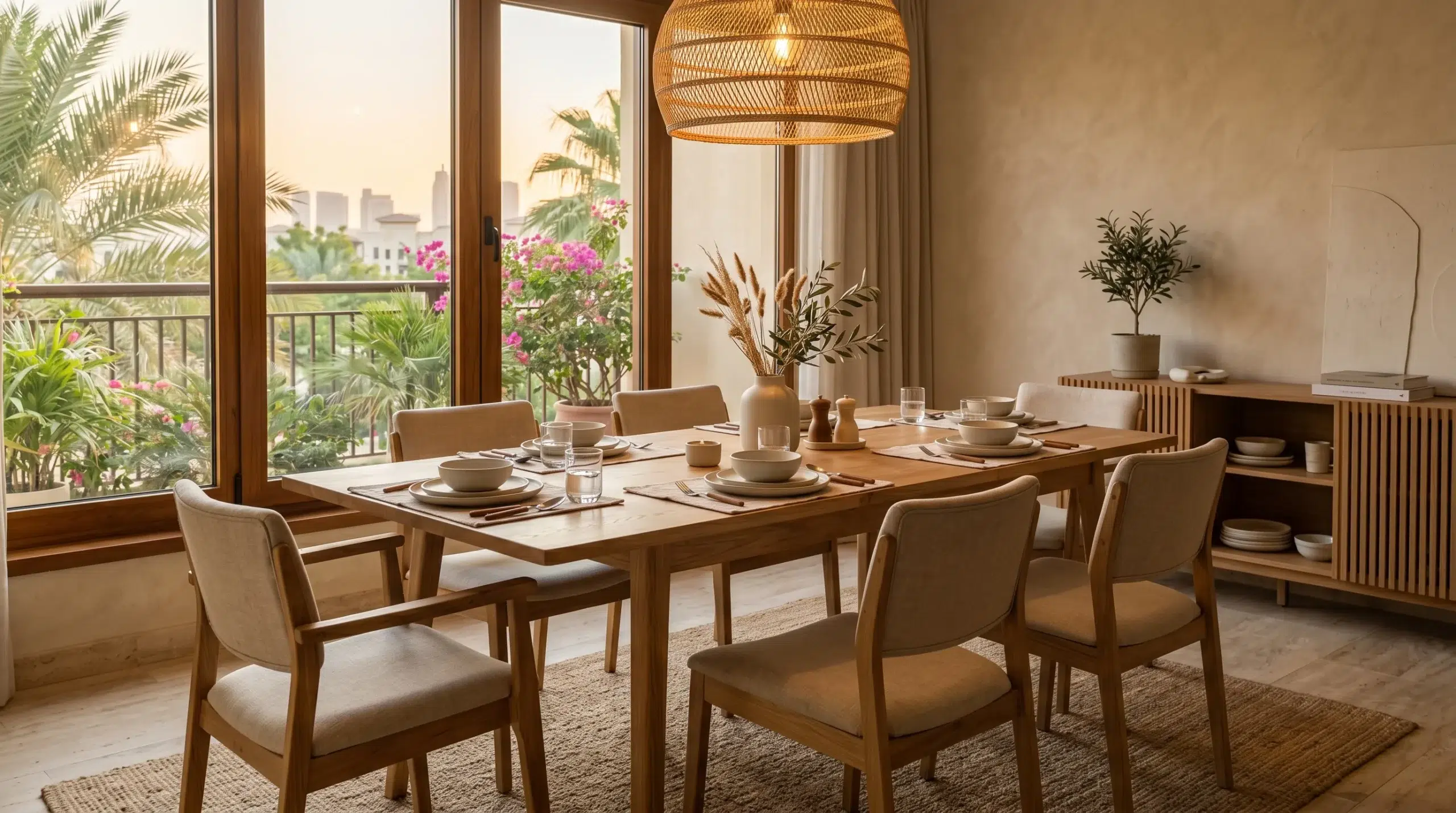
Multifunctional furniture is not a compromise or a budget solution. Done well, it’s genuinely intelligent design. In 2026, the quality and aesthetics of multifunctional pieces have improved dramatically. A sofa bed no longer needs to look like a sofa bed. A storage ottoman can be the most elegant piece in a room. An extendable dining table can sit at 140cm for a Tuesday night family dinner and extend to 220cm for a Friday night gathering of 10.
For families in UAE apartments specifically, the dining-living space planning decision is critical. Many 2-3 bedroom apartments in communities like JVC, Dubai Hills, and Jumeirah Village Triangle have combined living-dining areas of 35–50 sqm. Getting the furniture scale right in these spaces. Not too large, not too small. Is one of the most common challenges we help families navigate. Explore our dining collection → for extendable options suited to UAE apartment living.
View Dining Tables at Karnak Home
Children’s Furniture That Grows
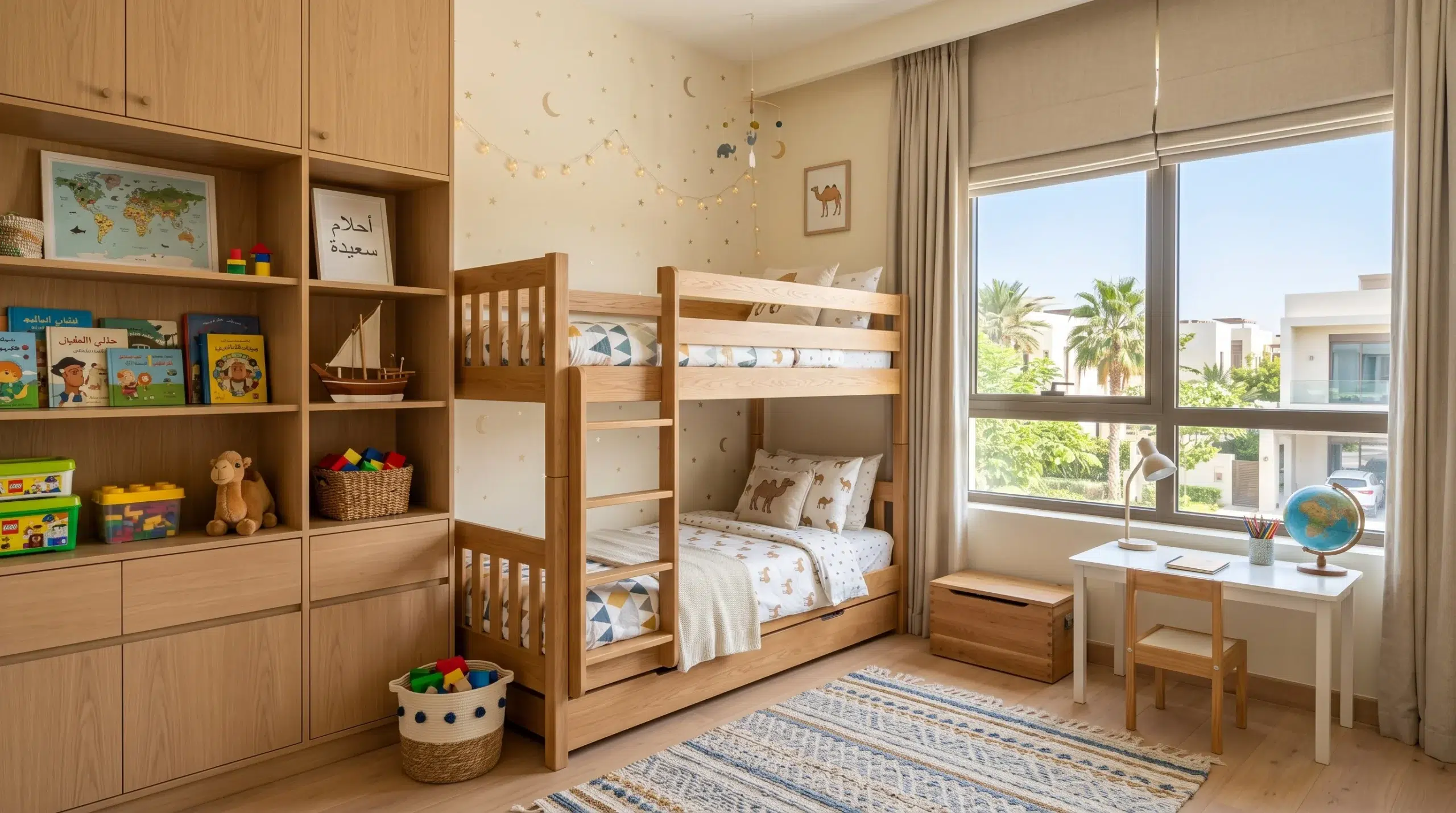
UAE families tend to plan longer-term than many markets, and we’ve observed this pattern clearly over 35 years. Parents want to buy a bed, a wardrobe, and a study setup for a child that will still be appropriate and functional as that child grows from 5 to 15. This drives strong demand for children’s furniture that adapts: extendable beds, modular wardrobe systems that can be reconfigured, and study desks with height-adjustable options.
A quality children’s bed in solid timber construction, sized at 90x200cm to last through teenage years, typically runs AED 1,800–4,500 depending on design and material. Investing properly here is genuinely worthwhile. Replacing a cheap bed that fails at age 8 ends up costing more than buying quality from the start. Safety certification matters too: look for furniture that meets European EN 747 standards or equivalent, particularly for bunk beds. See our kids furniture range →
View Kids Furniture at Karnak Home
Trend 5: Japandi Style — The Dominant Aesthetic for UAE Villas
What Is Japandi and Why Is It Perfect for the UAE?
Japandi. The fusion of Japanese minimalism and Scandinavian warmth. Has been building momentum globally for several years and has now firmly arrived in UAE villa interiors. It combines the Japanese principles of wabi-sabi (finding beauty in imperfection and natural aging) with Scandinavian hygge (warmth, cosiness, and functional beauty). The result is interiors that feel serene, warm, uncluttered, and deeply liveable.
For UAE villas specifically, Japandi is almost a perfect fit. The philosophy of fewer, better pieces aligns with the practical challenge of furnishing large rooms well. It’s very easy to over-fill a 60 sqm villa living room with too many pieces that compete for attention. Japandi’s emphasis on natural materials, warm wood tones, neutral fabrics, and deliberate negative space creates rooms that feel expansive and calm rather than busy.
The key Japandi furniture characteristics: low-profile, clean-lined pieces in warm wood tones (oak, walnut, or teak); upholstery in natural fabrics (linen, cotton, bouclé); limited colour palette (warm whites, cream, warm grey, muted sage); and quality over quantity. If a piece isn’t earning its space, it doesn’t belong.
Applying Japandi Principles Without Starting From Scratch
You don’t need to redecorate completely to incorporate Japandi principles. Start with your sofa. If you currently have a large, overstuffed sofa in a bold colour or pattern, consider whether replacing it with a cleaner-lined piece in a warm neutral fabric would transform the room. Then address your dining area. A solid wood dining table with clean lines and simple upholstered chairs is the quintessential Japandi dining statement.
The Japandi approach to storage is also worth adopting: visible clutter is the enemy. Closed storage. Sideboards, TV units with doors, wardrobes with full-height panels. Keeps the visual calm that Japandi requires. Open shelving should be deliberately curated, not overloaded. This principle works particularly well in UAE villas where storage space is often generous but not always well-used. View our living room furniture →
View Living Room Furniture at Karnak Home
What’s Going Out: Trends to Move On From
Out: All-Grey Everything
The grey-on-grey interior. Grey walls, grey tiles, grey sofa, grey rug. Had a long run but it’s over. Grey reads as cold, flat, and slightly institutional in 2026. If you’re working with grey walls you can’t change (rented property, large repaint project), warm the space with camel, terracotta, or warm white upholstery rather than leaning into more grey.
Out: Highly Polished, High-Gloss Surfaces
High-gloss lacquered wardrobes, shiny chrome fixtures, mirror-finish coffee tables. These were hallmarks of early-2010s UAE interior design and they’ve aged visibly. They show fingerprints, scratches, and dust with unforgiving clarity, which is a particular problem in the UAE’s dusty climate. Matte, brushed, and textured finishes are replacing them across every furniture category.
Out: Fast Furniture and the Annual Refresh Cycle
This is the most important “what’s out” point, and we say it genuinely, not because it serves our sales interests. The cycle of buying inexpensive furniture every 1-2 years. Whether from budget retailers or fast-furniture chains. Is financially wasteful, environmentally problematic, and results in homes that never feel truly settled. We’ve watched this pattern repeat with many families over 35 years. The 2026 mindset is investing properly in pieces that will last 10-20 years. It’s a better financial decision, a better environmental decision, and the result is a home that feels genuinely considered rather than perpetually provisional.
Out: Matching Suite Furniture
The “bedroom suite” or “living room suite” where every piece matches identically. Same wood, same fabric, same hardware. Looks rigid and showroom-like in 2026. Modern UAE interiors mix complementary pieces rather than matchy sets. A solid oak dining table works with upholstered chairs in a different wood tone. A walnut bed frame works with bedside tables in a contrasting light tone. This approach actually makes rooms feel more curated and individual, not less cohesive.
Out: Overly Themed Children’s Rooms
Character-themed children’s rooms. The full princess bedroom, the complete superhero setup. Age quickly and can be expensive to update as children’s tastes change (often rapidly). The more considered approach: invest in quality, neutral-toned furniture that will last a decade, and express your child’s personality through bedding, wall art, and accessories that can be changed affordably as they grow.
Common Furniture Buying Mistakes to Avoid in 2026
Mistake 1: Buying Furniture Before Measuring
This sounds basic, but it remains the single most common and costly mistake we see. A sofa that looked “medium-sized” in a large showroom can overwhelm a 30 sqm living room. Always measure your space, mark it out with tape on the floor, and check not just footprint but also height. Ceiling heights in UAE apartments vary considerably, and tall wardrobes or bookshelf units that work in a villa may feel oppressive in a lower-ceilinged apartment.
Mistake 2: Ignoring UAE Climate When Choosing Materials
Genuine leather in UAE conditions requires consistent care. It dries and cracks in air conditioning if not treated regularly. Solid wood furniture needs a period of acclimatisation when first delivered and should be kept away from direct AC vents. Certain fabrics. Particularly loosely woven natural fabrics. Can attract and show dust more than tighter weaves. None of these are reasons to avoid these materials, but they’re important considerations. Ask about care requirements before purchasing, and choose materials you’re genuinely prepared to maintain.
Mistake 3: Prioritising Price Over Construction Quality
The AED difference between a cheap bed frame and a well-made one can look significant upfront but becomes negligible when spread over 10-15 years of use. Poor construction. Thin MDF frames, weak joints, inadequate fixings. Typically begins to show within 2-3 years in a family home. A bed frame that squeaks, a wardrobe door that droops, a sofa that loses its shape: these aren’t minor inconveniences, they diminish your daily quality of life. Ask specifically about frame material and joint construction before purchasing any major furniture piece.
Mistake 4: Following Trends Too Literally
The purpose of a trend guide like this one is not to tell you to replicate what’s in the photos. It’s to help you understand the direction of good design thinking so you can apply the principles in a way that works for your specific space, family, and budget. Not every UAE home needs a curved bouclé sofa. Not every family needs to adopt Japandi principles. Use trends as inspiration and filter everything through the question: does this work for how my family actually lives?
Mistake 5: Forgetting About Delivery, Assembly, and After-Sale Service
The price of furniture is only part of the total cost. Delivery to upper-floor apartments without service lifts, assembly quality, and what happens if something arrives damaged or develops a fault within the first year. These are important considerations that aren’t visible in the price tag. At Karnak Home, we’ve built our delivery and assembly service and after-sale support around the reality of UAE family homes, not the convenience of the retailer. Read about our warranty and service policy →
Budget Guidance: What to Expect to Spend in 2026
Honest pricing for UAE families, based on quality furniture that will last:
Living Room: A quality sofa in natural fabric suitable for a UAE family. AED 4,500–12,000 depending on size, configuration, and material. A good-quality area rug to anchor the space. AED 800–3,000. A solid wood or stone coffee table. AED 900–2,800. Total starting investment for a well-furnished living room: AED 7,000–18,000.
Bedroom: A solid-frame double or queen bed with quality mattress. AED 3,500–9,000 for the combination. A wardrobe in solid or quality engineered wood. AED 3,000–8,000 depending on size and configuration. Pair of bedside tables. AED 600–2,000.
Dining: Extendable solid wood dining table for a family of 6. AED 3,500–9,000. Set of 6 quality dining chairs. AED 2,400–6,000.
Children’s: A quality children’s bed that will last 10+ years. AED 1,800–4,500. Wardrobe. AED 2,000–5,000. Study desk and chair. AED 800–2,500.
These ranges reflect genuinely good quality that will serve a UAE family well. The lower end of each range represents honest value; the upper end reflects premium materials and more detailed craftsmanship. Our team at Karnak Home can help you navigate these decisions based on your specific budget and needs.
Expert Tips from 35 Years Furnishing UAE Homes
1. Start with Your Floor Plan, Not Furniture
Before purchasing a single piece, map your space accurately. Mark out the dimensions of furniture you’re considering on the floor with tape. Live with the tape for a day before buying.
2. Natural Light Changes Everything
Visit your space at different times of day before finalising colour and material choices. The soft morning light in a north-facing apartment is very different from the intense afternoon light in a south-facing villa room.
3. Invest Most in the Pieces You Use Daily
The sofa your family sits on every evening, the bed you sleep in for a third of your life, and the dining table where you gather for meals — these deserve the majority of your furniture budget. The decorative side table that holds a lamp can be a more modest purchase.
4. Understand the UAE Dust Reality
If you live on a lower floor, near construction, or in a dustier area, choose your upholstery wisely. Tighter weave fabrics and smooth surfaces clean far more easily than loosely woven naturals or heavily textured materials.
5. Air Conditioning Placement Matters
Never position upholstered furniture directly under or in the airflow of an AC unit. Prolonged cold, dry airflow damages both fabric and cushion foam faster than any other factor. In leather, it causes cracking. Always plan your furniture layout around your AC positions.
6. Buy Your Main Pieces Together, Not Piecemeal
It’s tempting to buy one piece now and add others later, but scale relationships between items are critical. A sofa that looks right alone may look completely wrong once you add the correctly proportioned rug and coffee table. Plan the complete picture first, then phase the purchasing if budget is tight.
7. Don’t Underestimate Your Wardrobe & Storage Needs
UAE families consistently tell us they underestimated their storage requirements. Account properly for clothing storage, especially if your family wears traditional and formal attire for occasions. This usually requires significantly more hanging space than standard wardrobes provide.
Ask for help. It’s free. Whether you visit our showroom or use our online consultation service, our team’s 35+ years of experience is genuinely useful and costs you nothing. We’ll tell you honestly if a piece won’t work in your space.
Conclusion: Making Your Decision
Interior design in UAE homes in 2026 is moving toward a clear and genuinely liveable direction: warmer, more natural, more considered, and built to last. The key trends. Warm neutrals and earthy tones, organic curved shapes, biophilic natural materials, smart multifunctional furniture, and the Japandi philosophy of fewer better pieces. All point in the same direction. Less fuss, more warmth, longer-lasting quality.
The “what’s out” side of this guide is equally important. Letting go of cold greys, shiny surfaces, and the disposable furniture mindset will improve both your home and your long-term budget. These aren’t just aesthetic opinions. They’re conclusions drawn from 35 years of watching what works and what doesn’t in real UAE family homes.
Key Takeaways:
- Warm earthy tones are replacing cold greys in UAE homes. Start with upholstery and soft furnishings if you can’t change your walls
- Curved, organic shapes are replacing angular furniture and are genuinely more family-friendly for homes with young children
- Japandi principles. Fewer, better pieces in natural materials with calm colour palettes. Are the dominant aesthetic in UAE villa design for 2026
- Multifunctional furniture is not a compromise; it’s smart planning for UAE families in both apartments and villas
- Buy quality, buy for longevity, and get the measurements right before you buy anything
Also check: Kustom Deco for premium bedroom and living room collections.
Ready to Find the Right Furniture for Your Space?
Whether you’d like to browse at your own pace or talk through your specific apartment layout with one of our team, Karnak Home makes it straightforward. Our showroom gives you the chance to experience furniture at full scale – something that makes a real difference when you’re choosing pieces for a small space. Our online store lets you filter by dimensions, style, and function so you can shortlist options before committing to a visit.
We offer delivery across all seven emirates, and our team can advise on anything from sofa dimensions to full room layouts. There’s no pressure and no commission-driven sales – just genuine guidance from people who know UAE homes.
Shop Online: Karnak Home
Visit Our Showroom: Dubai – Showroom Address & Directions
Expert Advice: Call Us or WhatsApp our team for personalised guidance
Related Articles: