
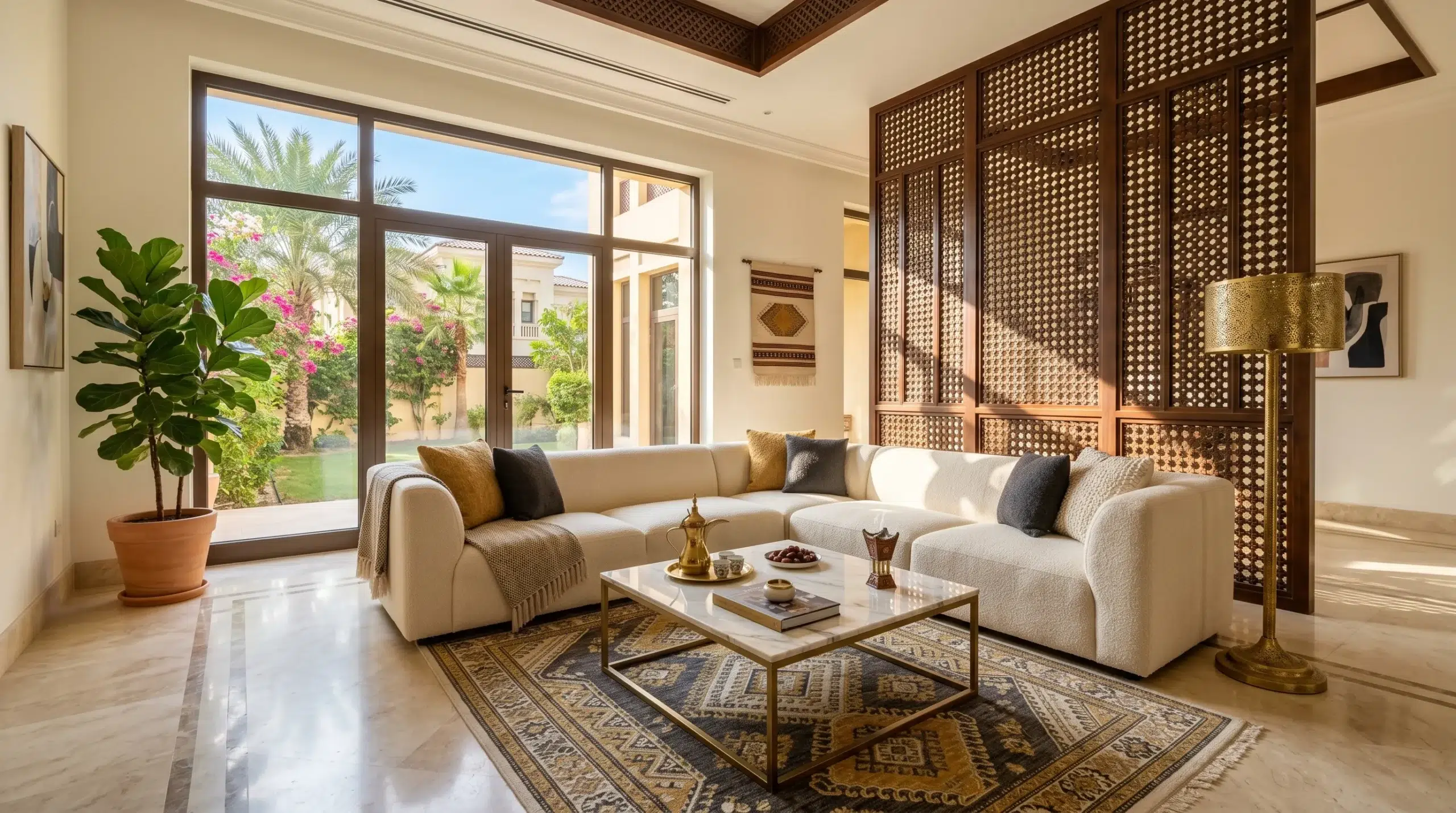
Have you ever walked into a home that felt deeply rooted in UAE culture yet completely fresh and liveable? A space that didn’t feel like a museum, but didn’t abandon its identity either? That balance, traditional soul, contemporary comfort, is exactly what modern Arabic interior design is about, and it’s something thousands of UAE families are actively working to achieve right now.
Here at Karnak Home, we’ve been helping families across Dubai, Abu Dhabi, Sharjah, and beyond furnish their homes since 1988. Over 35 years and 70,000+ families later, we’ve seen every style trend come and go, but the pull of authentic Arabic design never fades. What changes is how families want to live within modern Arabic interior design. Today’s UAE household wants warmth and cultural pride alongside practical, durable furniture that works for real family life.
This guide will show you, room by room and decision by decision, exactly how to achieve modern Arabic interior design.
Understanding the DNA of Modern Arabic Interior Design
Before you can blend anything, you need to understand what you’re working with. Traditional Arabic interiors aren’t just an aesthetic, they’re a philosophy of hospitality, community, and craftsmanship that has evolved across centuries of Gulf culture and forms the foundation of modern Arabic interior design.
The most defining characteristic is generosity of space. Traditional Arabic homes were designed to receive guests with honour, large majlis rooms, low seating that encouraged conversation, layered textiles that communicated wealth and warmth. Nothing was accidental. Every element served the culture of diyafa, Arabic hospitality, which remains central in modern Arabic interior design.
The second defining characteristic is ornamentation with meaning. Islamic geometric patterns, arabesque motifs, Arabic calligraphy, these weren’t decorative afterthoughts. They were expressions of faith, identity, and belonging. When you see a hand-carved mashrabiya screen filtering afternoon light, you’re seeing centuries of craftsmanship and cultural symbolism that enhances modern Arabic interior design.
Third is the material palette. Traditional Arabic interiors favour natural materials, dark walnut and rosewood, polished marble, mother of pearl inlay, hammered brass, silk and wool textiles in jewel tones and earthy neutrals. These materials age beautifully in the Gulf climate, developing character over time rather than deteriorating, making them ideal for modern Arabic interior design.
Understanding these three pillars, generous hospitality, meaningful ornamentation, and natural materials, gives you the framework to make intelligent decisions when selecting modern furniture for modern Arabic interior design. You’re not choosing between old and new. You’re choosing furniture that honours those pillars in a contemporary way.
The Majlis: The Heart of Modern Arabic Interior Design
No discussion of Arabic interiors in the UAE is complete without the majlis. Traditionally a separate reception room for guests, the majlis remains central to UAE family life, it’s where family gathers, where guests are received, and where the culture of hospitality is most visibly expressed in modern Arabic interior design.
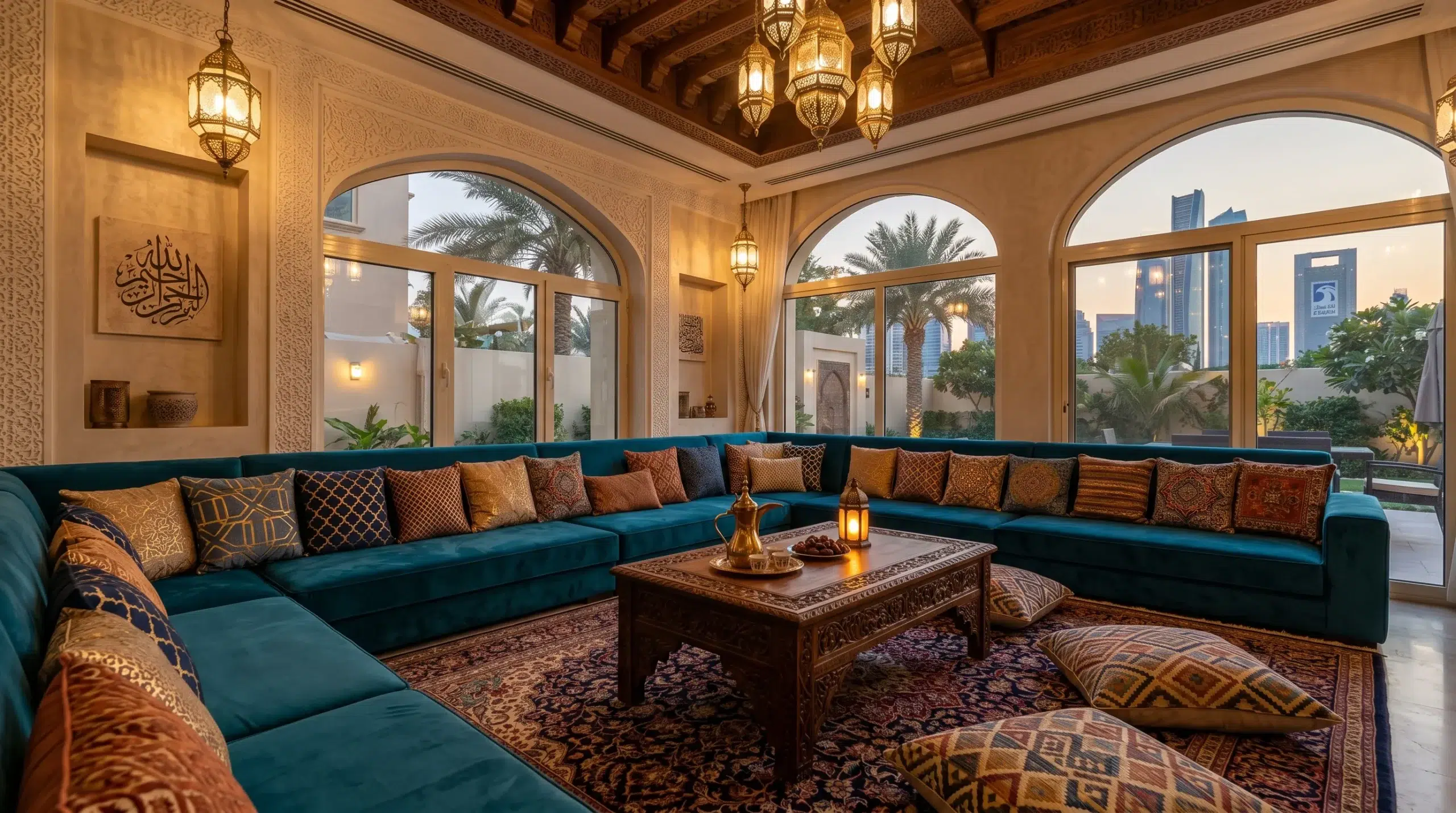
In modern UAE homes, especially apartments in Dubai Marina or Jumeirah, a dedicated majlis room isn’t always possible. But the spirit of the majlis absolutely is. A well-designed corner of your living room with a low-profile sofa, rich cushions, a wooden side table, and considered lighting can serve the same cultural function in a fraction of the footprint.
For villas in areas like Arabian Ranches, Mirdif, or Al Ain, a dedicated majlis room remains common and is well worth investing in properly. Here, traditional diwaniya-style seating, low to the floor, generous in width, arranged along walls in a U or L formation, works beautifully in contemporary fabric options like performance velvet or woven linen that stand up to daily family use.
The key furniture investment for a majlis is a sofa or seating system that’s generous, low, and built for long conversations rather than quick visits. At Karnak Home, our majlis-style sectional sofas start from around AED 4,500 and go up to AED 18,000+ for fully custom configurations in premium fabrics.
How to Blend Traditional and Contemporary in Modern Arabic Interior Design: Room by Room
The Living Room: Anchoring Arabic Identity in Modern Arabic Interior Design
The living room is where most families feel the tension between traditional and contemporary most acutely. Modern Arabic interior design UAE explains how you can mix and combine the traditional Arabic Style with Modern Interior Design.You want it to feel unmistakably Arabic, but you also want it to feel calm, uncluttered, and easy to maintain with children and daily life.
The secret is restraint with intention. You don’t need every Arabic design element in one room. Choose two or three authentic anchors, perhaps a mashrabiya-inspired bookcase, a hand-knotted geometric rug, and a brass pendant light, and let contemporary furniture provide the clean, comfortable backdrop. A neutral sofa in warm white, sand, or soft grey becomes the canvas against which your cultural elements can speak in modern Arabic interior design.
For the sofa specifically, consider proportions carefully. UAE living rooms, particularly in newer Dubai apartments, often have high ceilings but sometimes limited floor space. A low-profile sofa (seat height around 40-42cm) maintains the traditional Arabic aesthetic of being close to the ground, feels generous without dominating the room, and is genuinely more comfortable for the cross-legged sitting that’s natural in Gulf culture. Look for models with removable, washable covers if you have young children, in the UAE climate, dust and the frequency of family gatherings make this a practical necessity rather than a luxury feature.
Coffee tables in Arabic-influenced living rooms deserve more thought than they often receive. A carved dark wood piece or a geometric brass-and-glass table immediately communicates cultural identity without requiring any additional effort. These pieces range from AED 800 to AED 4,000 at Karnak Home depending on material and craftsmanship.
The Bedroom: Restful Luxury With Arabic Character in Modern Arabic Interior Design
Traditional Arabic bedrooms were unapologetically opulent, rich fabrics, carved wooden headboards, layered bedding in jewel tones. Contemporary UAE bedrooms often swing too far in the opposite direction, becoming so minimalist they lose all warmth and character.
The contemporary Arabic bedroom finds a middle path. An upholstered bed frame with geometric pattern detailing or a carved wooden headboard becomes the room’s cultural anchor. Pair it with crisp, neutral bedding and add warmth through cushions and a throw in deep teal, burnt gold, or terracotta, colours that reference traditional Arabic textiles without overwhelming a restful space.
For UAE families specifically, bed storage is non-negotiable. Divan-style beds with hydraulic storage underneath are enormously practical for Dubai apartments where wardrobe space is often limited. A king-size storage bed at Karnak Home typically ranges from AED 2,800 to AED 7,500 depending on upholstery choice and frame material.
Wardrobes in a traditional Arabic context were often large, ornately carved, and freestanding. In modern UAE homes, built-in wardrobe systems make more practical sense, but hinged doors with geometric carved panel detailing, or glass doors with arabesque-pattern iron inserts, bridge the gap between traditional character and contemporary function beautifully in modern Arabic interior design.
The Dining Room: Where Family Gathers in Modern Arabic Interior Design
Arabic hospitality culture is nowhere more visible than at the dining table. Traditional Arabic dining rooms were designed around abundance, large tables, generous seating, and the assumption that extra guests would always arrive.
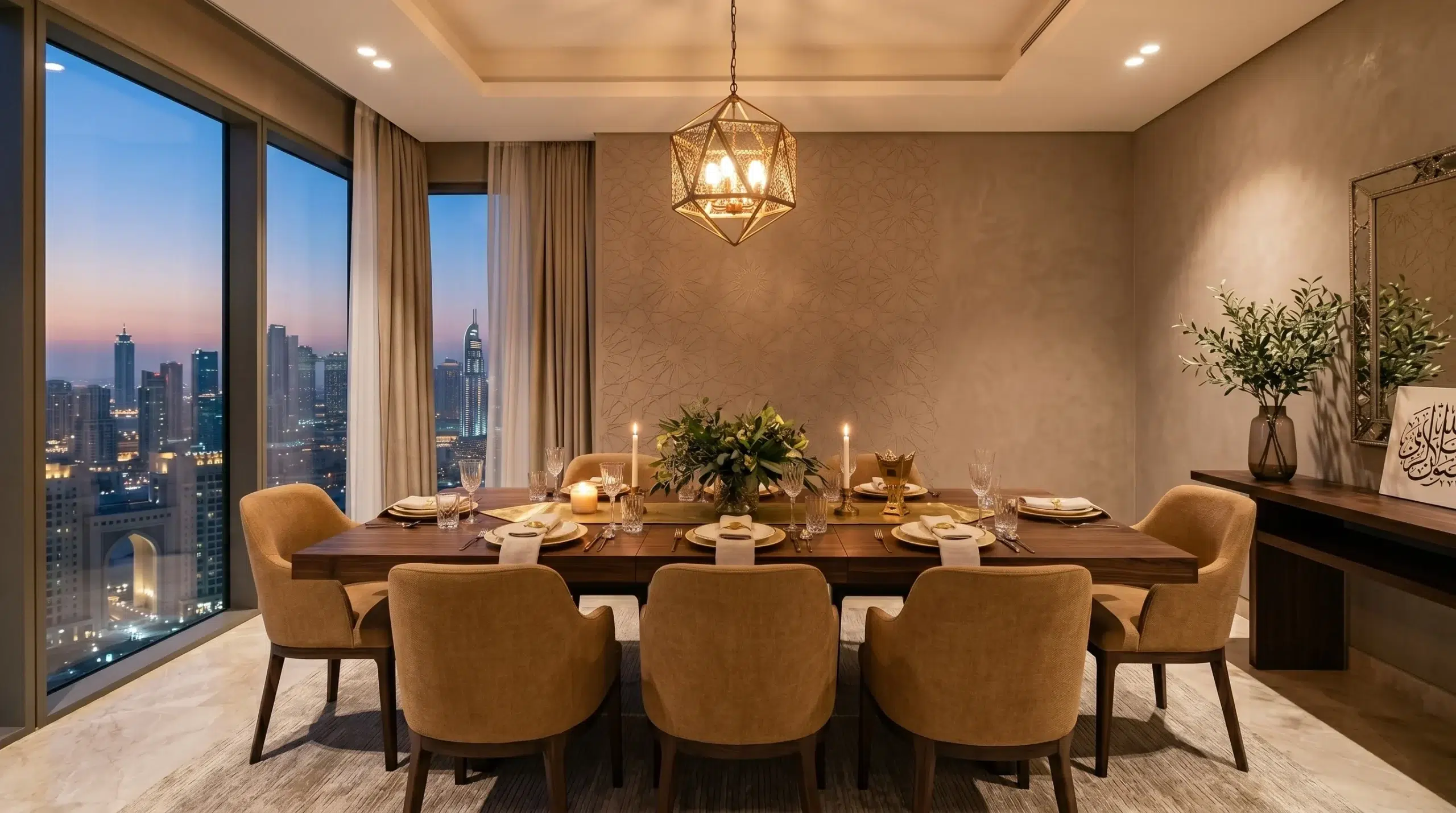
In contemporary Arabic homes, a solid wood extendable dining table is arguably the single best furniture investment you can make. It honours the tradition of generous hospitality (you can seat 10-12 people when extended) while remaining practical for everyday family use (a 4-6 seater in its default configuration). Solid sheesham or acacia wood with brass hardware details immediately reads as Arabic-influenced without being costume-like.
Dining chairs are where many UAE families make a costly mistake: matching everything too perfectly. Traditional Arabic interiors embraced a certain eclecticism, different textures and heights working together. Consider mixing upholstered dining chairs in a rich fabric with rattan or woven accent chairs at the ends of the table. This looks intentional, adds visual warmth, and is more practical for UAE homes where guests of different ages and sizes are common. Dining sets at Karnak Home start from AED 1,800 for 4-seater configurations and range up to AED 12,000+ for large solid wood extendable sets with eight chairs.
Children’s Rooms: Keeping Culture Without Compromising Safety in Modern Arabic Interior Design
UAE families often ask us how to bring Arabic design elements into children’s bedrooms without the obvious safety concerns, sharp carved edges, heavy decorative objects, adult fabrics that don’t survive childhood.
The answer is to bring Arabic identity through pattern and colour rather than through furniture ornamentation. A kids’ bed in simple white or natural wood with a geometric patterned bedspread does more cultural work than a heavily carved piece that won’t survive your child’s first few years. Wallpaper or a mural featuring classic geometric Islamic patterns, in softer, child-appropriate colours, creates strong cultural identity in a space while keeping furniture safe, practical, and easy to update as the child grows.
For children’s beds in the UAE specifically, look for designs at least 15cm off the ground (low enough to be safe for younger children) with rounded edges. Storage is again essential, UAE apartments rarely have enough storage for growing families. A mid-sleeper with built-in desk and storage below is one of the most practical investments for a child’s bedroom in Dubai, maximising limited floor space significantly.
Colours, Materials, and Textures: The Arabic Design Palette for Modern Arabic Interior Design
Colours That Work in UAE Homes for Modern Arabic Interior Design
The traditional Arabic colour palette drew from the landscape of the Gulf, warm sand tones, deep terracotta, lapis blue, burnished gold, and the white of sun-bleached walls. These colours don’t just look good; they’re physiologically appropriate for the UAE climate and light. Warm neutrals don’t show dust as obviously (relevant in the UAE), and they reflect the warm-toned natural light that floods Gulf homes.
For a contemporary Arabic living room, a warm neutral base, think sand, warm white, or greige on walls and large furniture, paired with accent colours in brass, teal, or deep burgundy hits exactly the right balance. Avoid cool greys and stark whites if you want to maintain Arabic warmth; these colour temperatures read as Scandinavian rather than Gulf.
One specific UAE consideration: if your home receives strong direct afternoon sun through west-facing windows (common in Dubai), fabric on sofas and chairs will fade over time. Ask specifically about UV-resistant fabrics when shopping, at Karnak Home, our team can advise on which fabric grades are best suited to sun-exposed rooms.
Materials Worth Investing In for Modern Arabic Interior Design
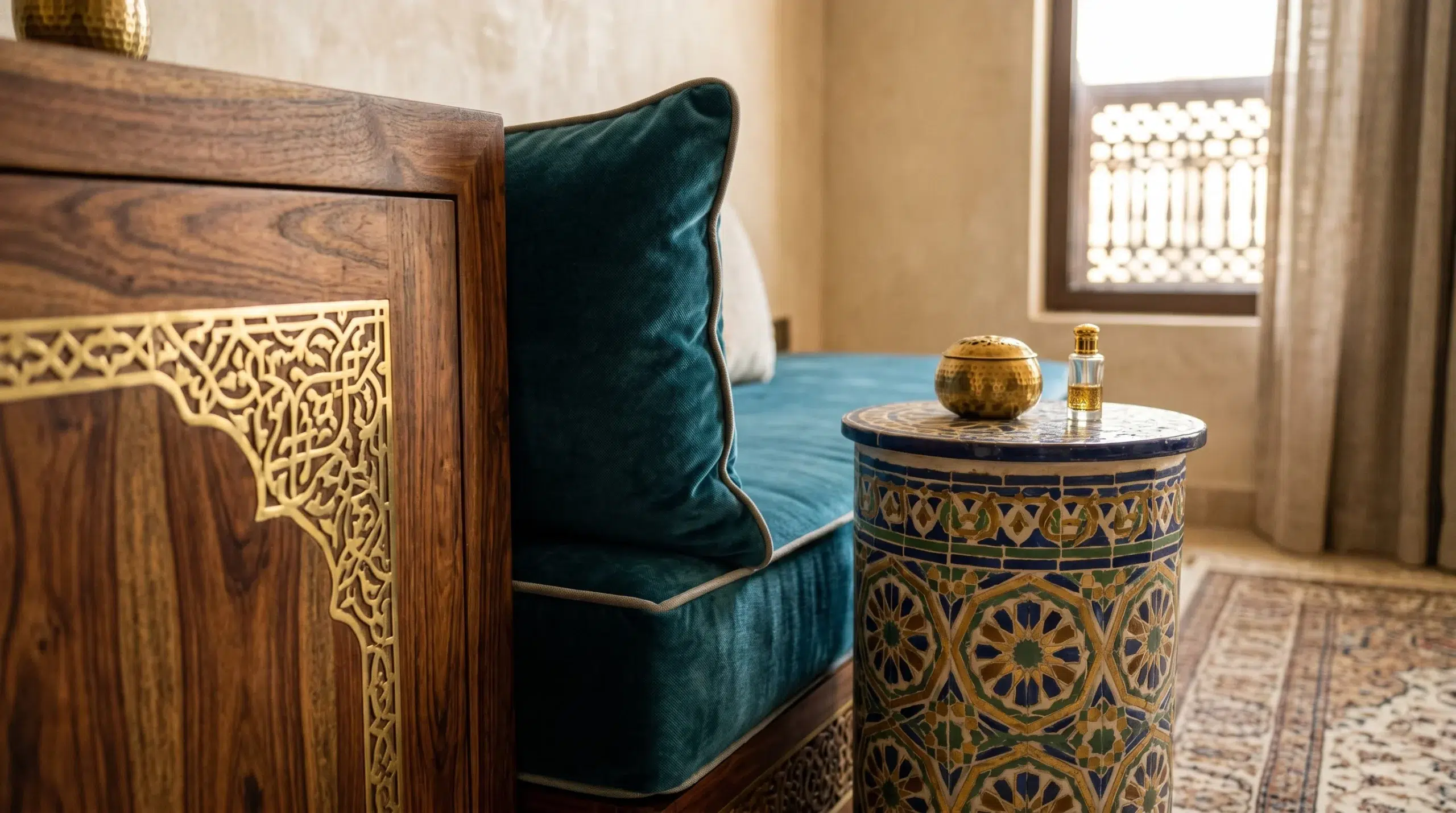
Solid wood, sheesham, acacia, mango, and walnut being the most common in Arabic furniture, is worth the investment in the UAE because it responds well to the climate when properly treated, and develops genuine character over decades. MDF and particle-board furniture, while cheaper upfront, tends to swell and deteriorate faster in environments with high humidity (coastal UAE) or strong air conditioning cycling (interior UAE). If budget is a consideration, invest in solid wood for anchor pieces, bed frames, dining tables, wardrobes, and accept more economical materials in less-stressed items like side tables and shelving.
Brass hardware on furniture is having a sustained moment in Arabic-contemporary design, and for good reason, it references traditional Islamic metalwork directly and ages beautifully. Avoid chrome and brushed steel if you want to maintain a warm, Arabic-influenced aesthetic; these read as too cool and Western.
For upholstery, performance fabrics are genuinely worth the modest price premium in the UAE context. Families here entertain frequently, the dust environment is real, and air conditioning creates fabric stress through temperature cycling. A performance velvet or microfibre-weave upholstery will outlast standard fabric by years and clean more easily, important when you’re serving Arabic coffee and dates in your majlis on a regular basis.
Common Mistakes UAE Families Make With Modern Arabic Interior Design
Mistake 1: Over-Decorating to Prove Cultural Identity
This is the most common mistake we see, particularly in new homes where families feel pressure to make a strong statement. Every surface becomes covered, carved wooden panels, heavy tapestries, ornate lamps, decorative plates, until the room feels more like a souk than a home. Traditional Arabic interiors were actually quite selective in their ornamentation; objects were chosen for quality and meaning, not quantity. Edit ruthlessly. Two or three exceptional pieces will always outperform twenty mediocre ones.
Mistake 2: Buying Scale-Inappropriate Furniture
We regularly see UAE families purchase sofas, dining tables, or wardrobes that are simply too large for their actual rooms, because the piece looked right in a large showroom. Always measure your space first, including ceiling height, doorway widths (you need to get the furniture in), and traffic flow paths. A sofa that seats seven in a room that needs to seat four is not generous, it’s cramped. In Dubai apartments especially, compact but well-proportioned furniture will always look and function better than oversized pieces.
Mistake 3: Ignoring the UAE Climate When Selecting Materials
Purchasing furniture without thinking about the UAE climate is an expensive mistake. Real leather, for example, can crack in heavily air-conditioned rooms with low humidity. Solid wood furniture needs to be properly sealed to handle humidity fluctuations in coastal areas like Dubai Marina or Abu Dhabi Corniche. Light-coloured fabrics in rooms with unfiltered western sun exposure will fade within two to three years. Ask your furniture retailer specifically about material performance in UAE conditions, any experienced team should be able to advise directly.
Mistake 4: Mismatching Style Periods
Placing heavily traditional ornate furniture (carved dark wood, heavy fringe, antique brass) alongside ultra-modern contemporary pieces (glass and chrome, sharp angles, monochrome palette) rarely works. The contrast reads as unresolved rather than intentional. The most successful Arabic-contemporary interiors use transition pieces, furniture with clean contemporary lines but warm materials or subtle pattern references, to bridge the two aesthetics. A contemporary sofa with arabesque-embroidered cushions is a far more successful bridge than a sleek glass coffee table next to a heavily carved traditional cabinet.
Mistake 5: Neglecting Lighting
Lighting is arguably the most transformative and most neglected element of Arabic interior design. Traditional Arabic spaces used light masterfully, filtered through mashrabiya screens, pooled from lanterns, layered between ambient and task sources. In contemporary UAE homes, the common mistake is relying entirely on a single overhead light fitting that bleaches all warmth from the room. Layer your lighting: a statement Arabic-inspired pendant for drama, floor lamps with warm (2700K-3000K) bulbs for ambience, and directional lighting to highlight key decorative pieces. This single change, which doesn’t require buying any new furniture, transforms the feeling of a room completely.
Budget Planning: What to Expect to Spend in AED for Modern Arabic Interior Design
Honest budget guidance matters. Here’s what a realistic Arabic-contemporary home transformation costs in the UAE market:
Living Room (sofa, coffee table, side tables, rug, lighting): AED 8,000 – AED 28,000 A mid-range sofa (AED 4,500-8,000), a quality geometric rug (AED 1,200-3,500), a carved wood or brass-detail coffee table (AED 800-2,500), and a statement lamp (AED 400-1,200) gets you a very well-furnished Arabic-contemporary living room.
Master Bedroom (bed, wardrobe, bedside tables): AED 7,000 – AED 22,000 A solid wood or upholstered bed with storage (AED 2,800-7,500), a built-in wardrobe (AED 2,500-8,000), and matching bedside tables (AED 600-2,000 per pair) covers the essential investment.
Dining Room (table, 6 chairs, sideboard): AED 4,500 – AED 18,000 Solid wood extendable dining table (AED 2,500-7,000), six upholstered chairs (AED 1,200-5,000), sideboard (AED 800-3,500).
Full Home (3-bedroom villa or apartment): AED 35,000 – AED 120,000+ This wide range reflects the difference between mid-market solid wood furniture with good fabric choices versus premium custom configurations with handcrafted pieces.
The most important advice on budget: buy anchor pieces well, and compromise on accessories. A solid wood bed frame that lasts 15 years at AED 5,000 is better value than three cheap frames at AED 1,500 each. Your sofa, dining table, and beds are the pieces worth stretching the budget for. Cushions, rugs, and decorative accessories can be updated affordably as tastes evolve.
Expert Tips from 35 Years of Furnishing UAE Homes for Modern Arabic Interior Design
Having helped over 70,000 UAE families, our team at Karnak Home has developed strong opinions about what actually works in real Gulf homes. Here are the insights we share most consistently:
Start with Your Rug in Modern Arabic Interior Design
The rug anchors the room’s colour palette and sets the style direction. Buy this first, then select furniture to complement it, not the other way around.
Invest in Sofa Base Frame for Modern Arabic Interior Design
In the UAE, sofas are used heavily, large families, frequent guests, children climbing. An 8-way hand-tied spring base will outlast a sinuous spring frame by a decade. Ask about frame construction before purchase.
Choose Larger Dining Table in Modern Arabic Interior Design
Arabic hospitality means guests are always expected. A table that extends to seat 10 costs only marginally more than one that seats 6, and you will use that extra capacity multiple times a year.
Use Warm-White LED Bulbs for Modern Arabic Interior Design
2700K-3000K colour temperature light makes warm woods, brass, and rich fabrics glow. Cool daylight LEDs (5000K+) make even expensive furniture look flat and clinical.
Maintain Proper Spacing in Modern Arabic Interior Design
Leave 90cm minimum between furniture pieces. Traffic flow matters, especially during family gatherings. Overcrowded furniture arrangement is one of the most common livability mistakes in UAE apartments.
Consider Maintenance Needs for Modern Arabic Interior Design
In the UAE, dust settles faster than in most climates. Open-grained rough wood surfaces and heavily textured fabrics trap dust and require significant maintenance effort. Smooth, sealed wood and tightly woven fabrics are more practical for UAE homes.
Furnish Gradually in Modern Arabic Interior Design
Don’t furnish everything at once. The best Arabic-contemporary interiors develop over time, with pieces chosen thoughtfully rather than purchased in a single weekend sweep. Budget for statement pieces first, and allow the room to develop its character gradually.
Conclusion: Making Your Decision in Modern Arabic Interior Design
Modern Arabic interior design in the UAE isn’t about choosing between who you are and how you want to live today. It’s about understanding the principles that made traditional Arabic interiors so enduringly beautiful, generosity, craftsmanship, warmth, meaning, and expressing them through furniture and design choices that serve your actual family life in the contemporary UAE.
The families who get this right aren’t the ones who spend the most, or the ones who follow trends most closely. They’re the ones who make considered choices: quality materials that age well in the Gulf climate, proportions that work for their actual space, a restrained palette that lets the best pieces speak, and a genuine understanding of what they want their home to feel like.
After 35 years and 70,000+ families, we’ve seen that the homes people are proudest of are the ones built intentionally, piece by piece, with real knowledge behind every decision.
Key Takeaways:
- Anchor Arabic identity with two or three exceptional pieces rather than over-decorating; restraint creates more authentic results than abundance.
- Match materials to the UAE climate, performance fabrics, sealed solid wood, and UV-resistant upholstery are practical necessities, not premiums.
- Invest proportionally: buy anchor pieces (sofa, bed, dining table) at the top of your budget; compromise on accessories that can be updated over time.
Ready to Find the Right Furniture for Your Space?
Whether you’d like to browse at your own pace or talk through your specific apartment layout with one of our team, Karnak Home makes it straightforward. Our showroom gives you the chance to experience furniture at full scale – something that makes a real difference when you’re choosing pieces for a small space. Our online store lets you filter by dimensions, style, and function so you can shortlist options before committing to a visit.
We offer delivery across all seven emirates, and our team can advise on anything from sofa dimensions to full room layouts. There’s no pressure and no commission-driven sales – just genuine guidance from people who know UAE homes.
Shop Online: Karnak Home
Visit Our Showroom: Dubai – Showroom Address & Directions
Expert Advice: Call Us or WhatsApp our team for personalised guidance
Related Articles: