
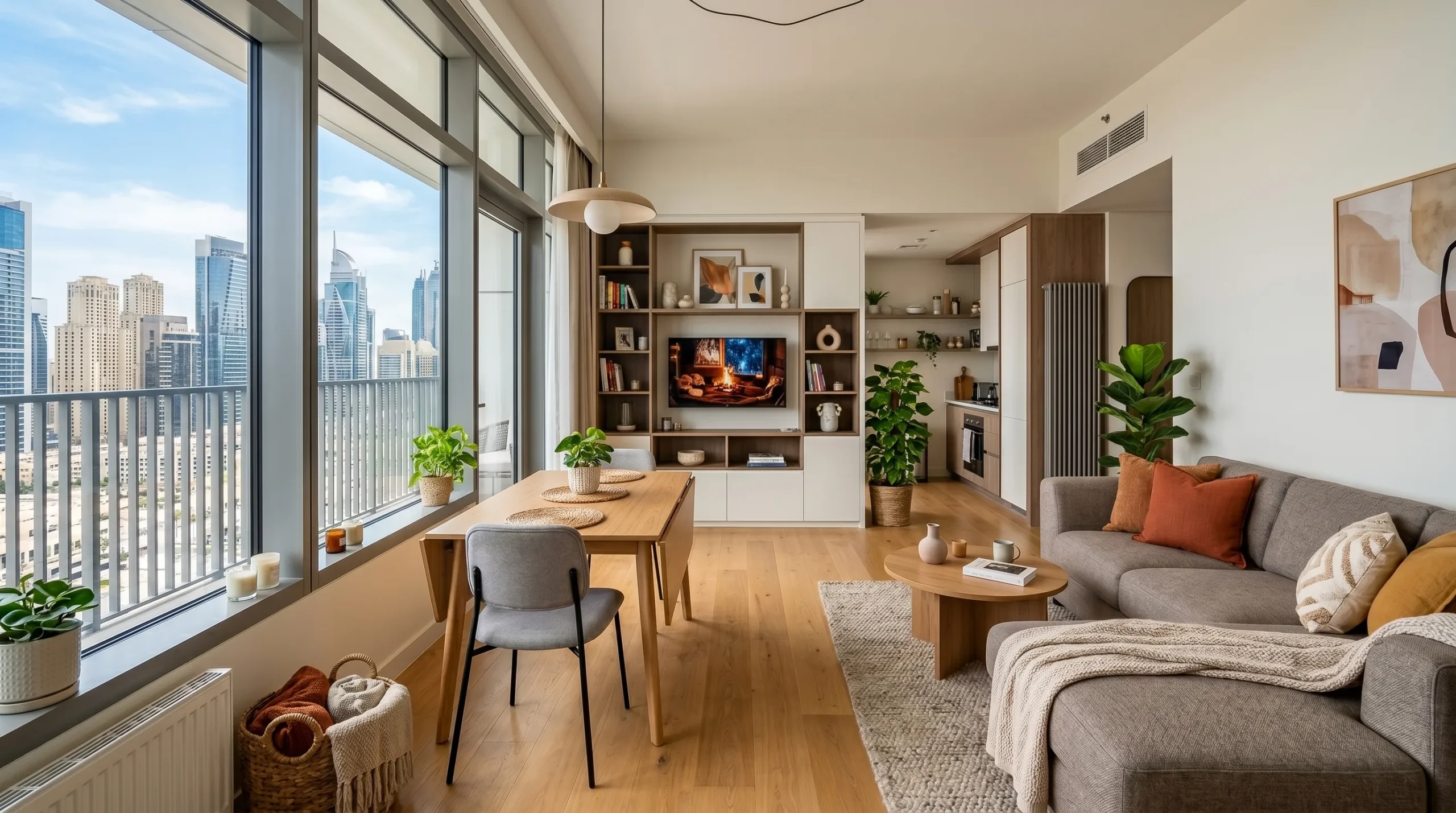
Does your Dubai apartment sometimes feel like a jigsaw puzzle where none of the pieces quite fit? You’re not alone. Whether you’re a young professional in a Downtown studio, a couple settling into a JVC one-bedroom, or a small family making the most of a Dubai Silicon Oasis apartment, the challenge is real: how do you create a home that feels genuinely comfortable, not just functional, within 450 to 800 square feet?
At Karnak Home, we’ve been helping UAE families answer exactly that question since 1988. Over 35 years and more than 70,000 families served across Dubai, Abu Dhabi, and all seven emirates, we’ve seen every space challenge imaginable, and we’ve helped solve most of them. This guide brings together everything we’ve learned about furnishing small apartments in the UAE, written not to sell you something, but to help you make genuinely smart decisions for your home and your family.
Understanding the Small Space Challenge in Dubai
Dubai’s apartment market is unique. A “1-bedroom” in Business Bay might be 650 square feet. The same label in International City might mean 500. Studios range from a cozy 350 square feet in older buildings to surprisingly spacious 600-square-foot layouts in newer developments like Dubai Hills or Emaar Beachfront. The first step in solving any small space problem is understanding exactly what you’re working with – not just the square footage, but the shape of the room, the ceiling height, where the natural light comes from, and how you actually live in the space day to day.
There’s also a UAE-specific layer to consider. Dubai apartments often host guests frequently – family visiting from abroad, colleagues for gatherings, friends during Ramadan. So your furniture needs to work for daily life AND occasional entertaining. The climate matters too: year-round air conditioning means you’re indoors far more than residents in cooler climates, which makes your furniture’s comfort and quality genuinely more important. You’ll log thousands of hours on that sofa.
Choosing the Right Sofa for a Small Dubai Apartment
The sofa is usually the most challenging piece of furniture in a small living space – and also the most important to get right. It sets the visual scale of the entire room, and in a studio apartment, it’s often where you’ll spend the majority of your waking hours at home.
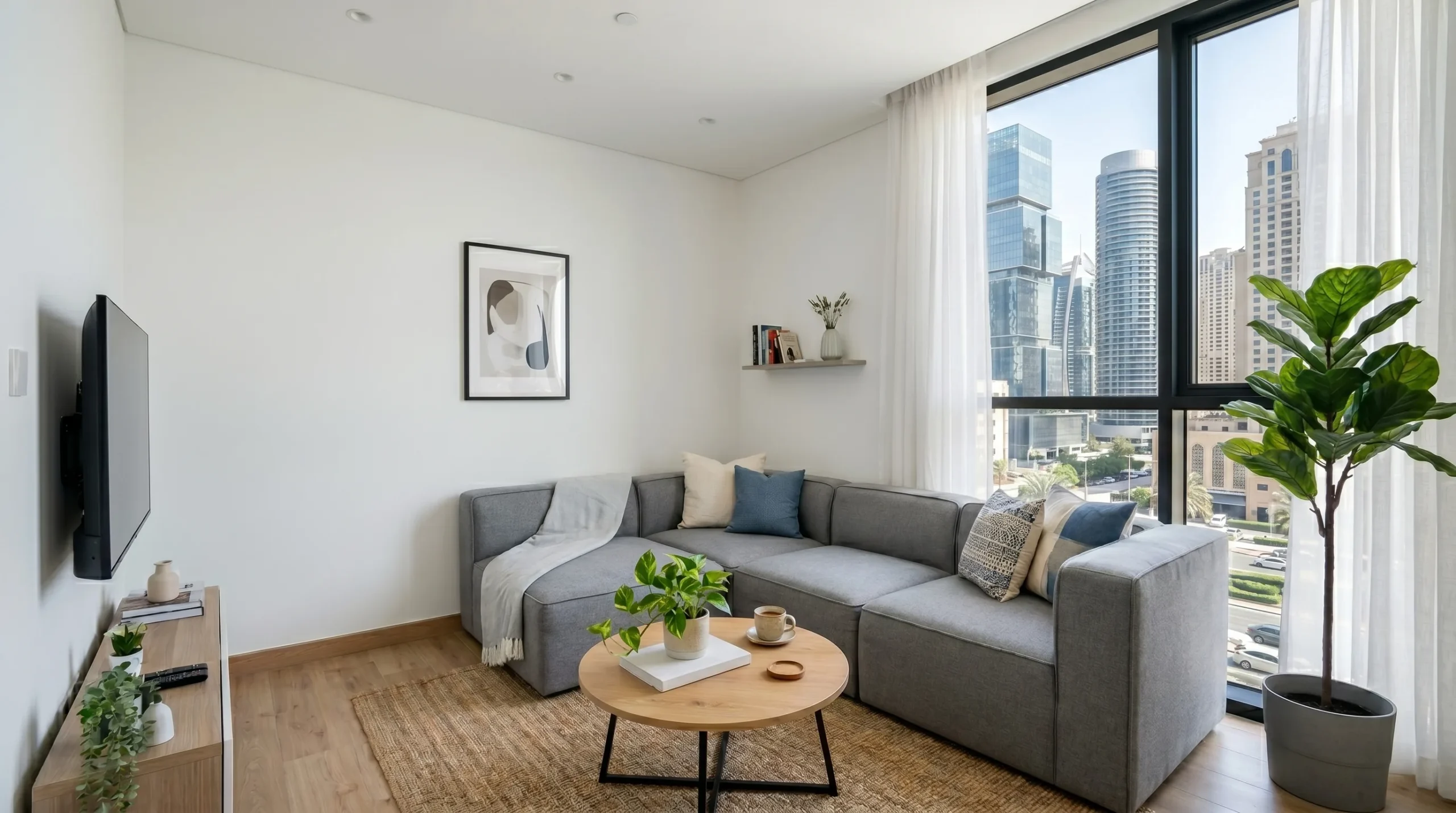
The single biggest mistake people make is buying a sofa that’s too large for the space. In a room under 300 square feet, a standard 3-seater measuring 220-240 cm wide will dominate everything. Instead, look at compact 2-seaters in the 165-185 cm range, or carefully measured modular designs that can hug a corner without blocking natural traffic flow. In a Dubai living room where you’re typically measuring 4m x 3.5m or smaller, a sofa over 200 cm wide will always feel cramped.
Browse our sofa collection to find the right size and fabric for your space.
Sofa Beds: A Genuine Solution, Not a Compromise
Sofa beds have improved dramatically over the past decade. The days of uncomfortable pull-out mattresses that sag in the middle are largely behind us. Modern sofa beds – particularly those using high-density foam or pocket spring mechanisms – offer sleeping comfort that most guests won’t complain about. For a studio apartment in Dubai where you regularly have family or friends visiting from other emirates or abroad, a quality sofa bed is genuinely worth the investment.
When shopping for a sofa bed in the UAE, look for: a mechanism that opens and closes smoothly without tools (you’ll do this many times), a mattress thickness of at least 12 cm for real sleeping comfort, and a fabric that’s easy to clean given Dubai’s dust levels and air-conditioned environments. Microfiber and performance fabrics hold up better in UAE conditions than velvet or loose-weave options.
Budget-wise, expect to pay AED 2,500-4,500 for a quality sofa bed that will last. The AED 1,200 options exist, but in our experience they become uncomfortable to sit on within 18 months and the mechanisms wear out. A good sofa bed is one purchase you don’t want to make twice.
Modular Sofas for Flexible Living
A well-chosen modular sofa might be the single most versatile piece of furniture for a Dubai apartment. The key advantage isn’t just the configuration options – it’s that you can take it with you and reconfigure it when you move. Given how frequently residents in Dubai relocate between apartments, this matters more than it might elsewhere.
Look for modular systems where individual pieces are in the 80-100 cm range. This gives you flexibility to arrange an L-shape in a corner for daily use, then pull pieces apart when you’re hosting. Avoid modular sofas with unusual proprietary connections – standard designs are easier to rearrange and more durable over time.
Beds and Bedroom Furniture: Making the Most of Limited Space
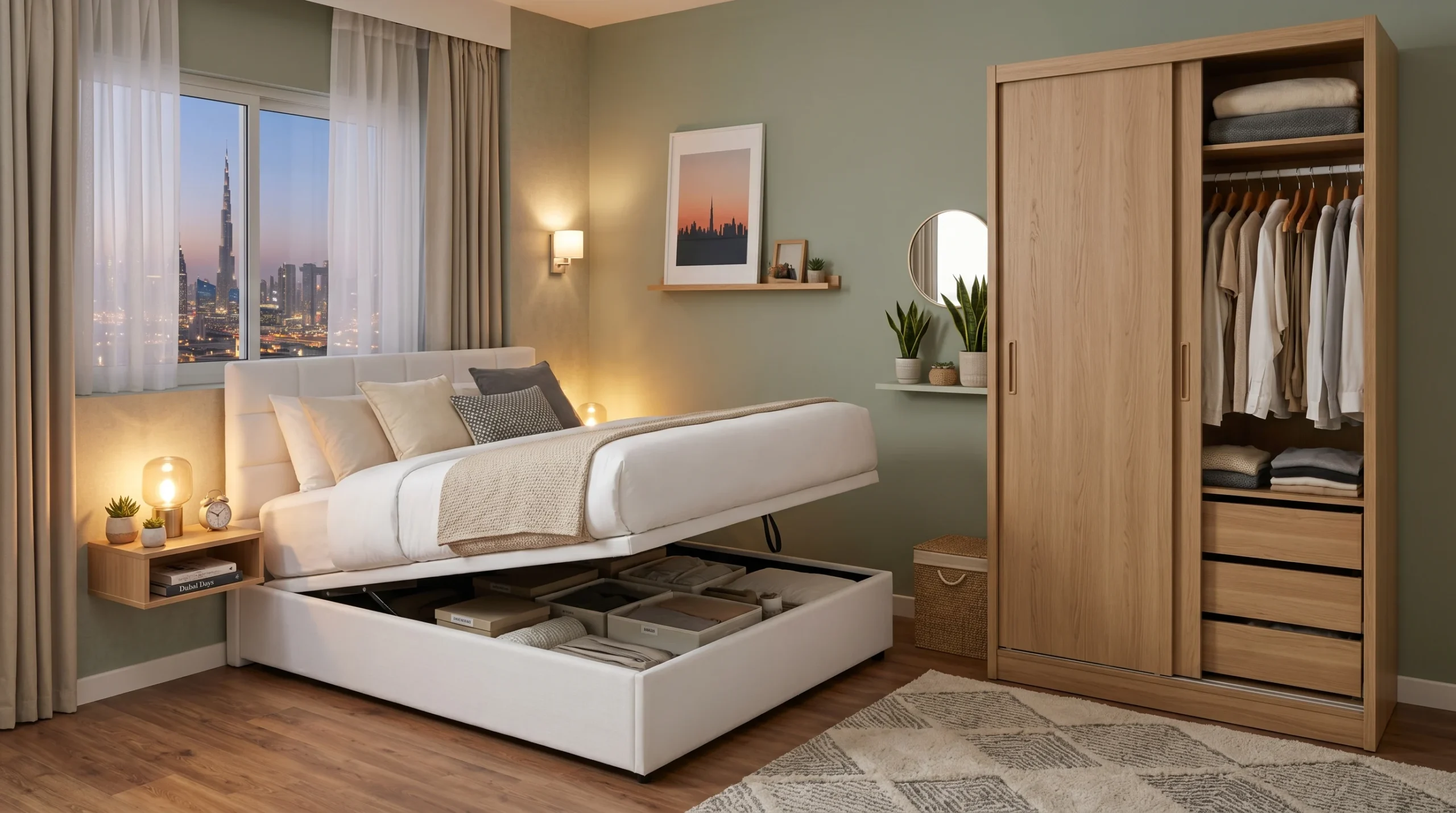
In a one-bedroom Dubai apartment, the bedroom is typically the most constrained room. A standard double bed (140 x 200 cm) plus two bedside tables leaves very little floor space in a 3m x 3.5m bedroom – the approximate size of a typical 1-bedroom in many Dubai developments.
Storage Beds: The Wisest Investment in a Small Bedroom
If there is one piece of furniture we would recommend to almost every small-space Dubai resident without hesitation, it’s a storage bed. A hydraulic storage bed with lift-up base gives you the equivalent of a large wardrobe’s worth of under-bed storage – typically 500 to 700 litres of space. In a small apartment where every cubic metre matters, this is transformative.
In the UAE context, under-bed storage is ideal for: seasonal items (heavier blankets used during the cooler months of November to February), extra bedding for guests, suitcases, and items you don’t need daily. It keeps these things accessible without consuming precious wardrobe or closet space.
When choosing a storage bed, pay attention to the hydraulic mechanism quality. A good mechanism should lift smoothly with light pressure and hold the base securely while you access storage. Lower-quality mechanisms can become stiff or fail within a couple of years. Also check the base slat system – solid or closely-spaced slats are better for mattress support and longevity.
For sizes: in a room under 12 square metres, a Queen size (160 x 200 cm) rather than King (180 x 200 cm) will genuinely change how the room feels. That 20 cm on each side translates to a corridor width that feels either cramped or comfortable.
Wardrobe Strategies for Small Bedrooms
Built-in wardrobes exist in many Dubai apartments, but they’re rarely sufficient – especially for couples. Freestanding wardrobes in small rooms should prioritise vertical space over footprint. A wardrobe that’s 2.0-2.2 metres tall and 120-150 cm wide gives excellent storage capacity while keeping the floor space impact manageable.
Sliding door wardrobes are genuinely better choices for small bedrooms than hinged-door designs. The swing clearance required for hinged doors – typically 50-60 cm – eats into the usable floor space you need for simply moving around the room. Sliding doors eliminate this entirely.
Dining in a Small Space: Smarter Than You Think
Dining furniture in a studio or compact 1-bedroom apartment is where many people give up too easily – either cramming in a table that’s too large, or abandoning a proper dining area altogether and eating on the sofa. Neither is ideal for a home where you’ll be spending considerable time indoors.
Extendable Dining Tables: The Practical Choice for UAE Hosting Culture
An extendable dining table is arguably the most practical piece of dining furniture for a small Dubai apartment, and it suits the UAE’s hosting culture particularly well. Day-to-day, it sits at its compact 80 x 80 cm or 90 x 120 cm size, taking minimal space. When family visits for the weekend or you’re hosting friends for Iftar, it extends to seat 6 or even 8 people.
Look for tables with a smooth, reliable extension mechanism – you’ll appreciate this during Ramadan when you might be extending and packing it daily. Round extendable tables are worth considering for small spaces: the round format is more space-efficient (no sharp corners to navigate around), more inclusive for conversation at the table, and extends symmetrically rather than just lengthening one end.
For a studio apartment, a wall-mounted fold-down table is worth serious consideration. Fixed to the wall and folded flat when not in use, it reclaims floor space entirely. These work beautifully in spaces under 400 square feet where a permanent dining table simply cannot coexist with a sofa and workspace.
Dining Chairs That Double Up
Stackable dining chairs are a practical choice when you only need extra seating occasionally. Store four chairs neatly stacked in a corner or bedroom, and bring them out when needed. For daily use, consider dining chairs with a slimmer profile – chairs with open backs or metal frames make a small dining area feel considerably less heavy than fully upholstered barrel chairs.
Bar stools at a kitchen island or breakfast counter are increasingly popular in Dubai apartment designs, and they work well: the counter height creates a clear visual separation between kitchen and dining without the floor space that a full table-and-chair set requires.
Home Office Furniture in a Studio or 1-Bedroom
Remote work has transformed how Dubai residents use their apartments. A studio that previously only needed to function as a living space and bedroom now also needs to support a working day. This requires a more thoughtful furniture approach.
Desk Solutions That Don’t Take Over the Room
The key principle for home office furniture in a small space is: when the workday ends, the workspace should visually and functionally recede. This doesn’t mean a fold-away desk is always the right answer – fold-away mechanisms require consistent use to stay functional, and the effort of setting up and packing down a workspace every day wears on most people within weeks.
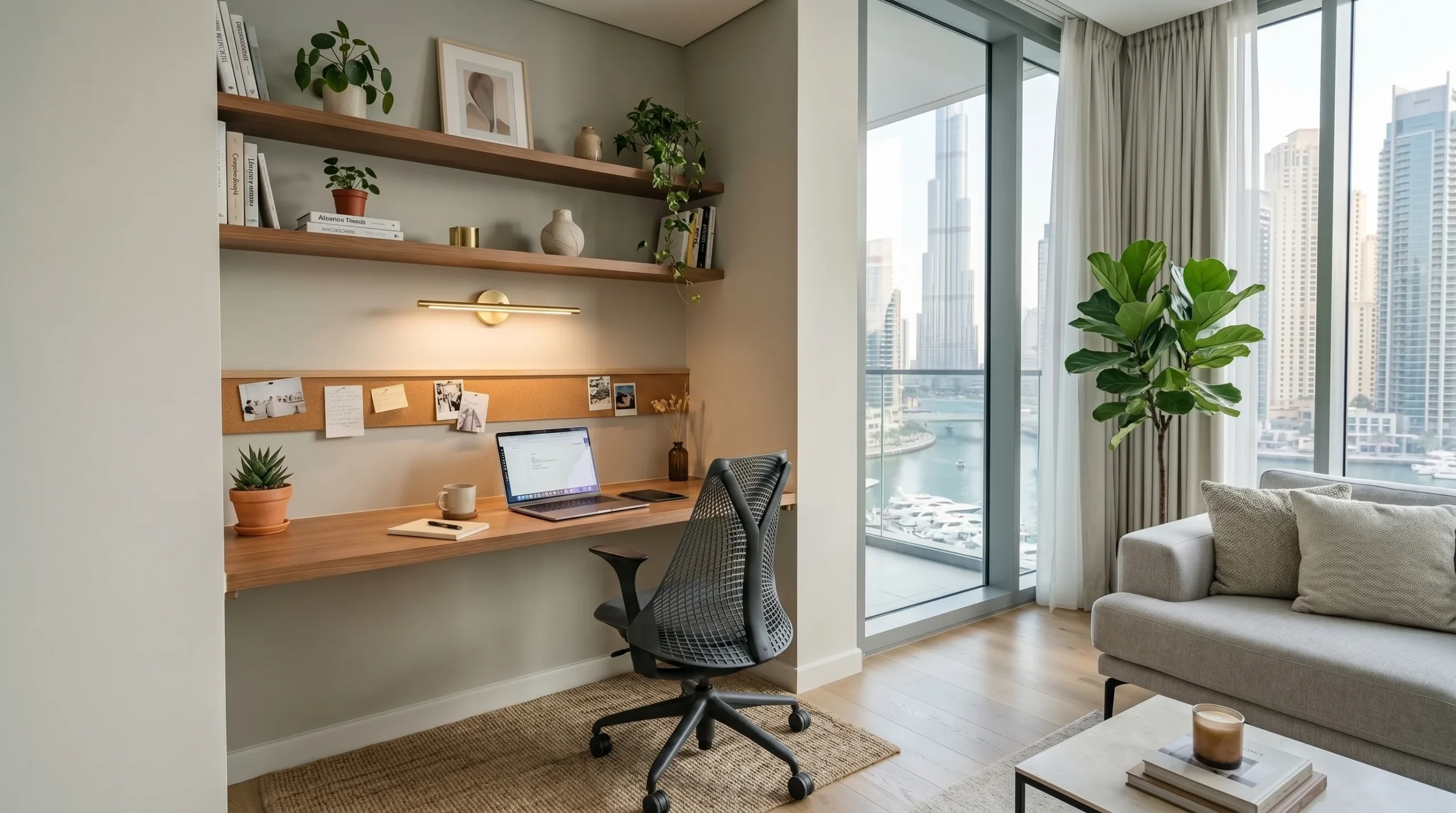
A better approach for many people is a compact desk (80-100 cm wide, 50-55 cm deep) positioned at a 90-degree angle to a wall, combined with a desk organiser system that keeps the surface clear when not in use. When the desk is tidy, it reads as part of the room rather than dominating it. A wall-mounted shelf at desk height achieves the same result with an even smaller footprint.
For the chair, consider a quality task chair that you genuinely enjoy sitting on – back pain from poor seating is a significant health issue for home workers – but choose one with a clean aesthetic that works with your living room when visible. An ergonomic chair in a neutral fabric or mesh doesn’t look out of place in a modern Dubai apartment living area.
Kids’ Furniture in Small UAE Apartments
For families with children living in smaller apartments – more common than often acknowledged in Dubai – the furniture challenge becomes significantly more complex. You need sleeping space, storage for an ever-expanding collection of toys and clothes, and ideally a dedicated area for homework or play, all within a very limited footprint.
Bunk Beds and High Sleepers: Vertical Solutions That Work
A high sleeper or loft bed is the most effective single piece of furniture for a child’s small bedroom. By elevating the sleeping area, you free the floor space beneath for a desk, a wardrobe, or a play area. A child’s study desk under a high sleeper in a 2.5m x 3m room transforms what would otherwise be a cramped, single-purpose bedroom into a genuinely functional space.
For two children sharing a bedroom – common in Dubai apartment living – a quality bunk bed allows two children to sleep comfortably within the same floor footprint as one bed. Look for bunk beds with integrated storage (steps with drawers, rather than a plain ladder) and full-length safety rails on the upper bunk. In UAE buildings, check ceiling heights before purchasing – standard bunk beds require a minimum of 2.4m ceiling height for the upper bunk occupant to sit upright.
Safety note: the upper bunk of a bunk bed is not recommended for children under 6 years old, and this guidance is worth following regardless of manufacturer claims.
Common Mistakes to Avoid When Furnishing a Small Dubai Apartment
After 35 years of helping UAE families furnish their homes, certain mistakes appear so frequently that they’re worth naming directly.
Mistake 1: Buying Furniture Before Measuring the Space
This is the most common and most costly mistake we see. Someone falls in love with a sofa in the showroom, buys it, and discovers it won’t fit through the apartment door – or fits, but leaves the room feeling overwhelmingly cramped. Before you purchase any piece of furniture for a small space, measure not just the room but the doorways, corridors, and elevator dimensions. Many Dubai apartment buildings have lifts that are narrower than you’d expect, and a 3-seater sofa may simply not reach the living room.
Mistake 2: Choosing Glass Coffee Tables in High-Traffic Small Spaces
Glass coffee tables look elegant in showrooms but in small apartments, particularly with children, they present safety concerns and create a visual clutter problem – every fingerprint and mark shows constantly. In a small room, you’ll be bumping into the coffee table far more than in a spacious villa living room. Nesting tables or a compact ottoman with a tray surface are often smarter choices: they can be pushed aside completely when floor space is needed.
Mistake 3: Buying Too Many Pieces at Once
The impulse to furnish an entire apartment in one trip is understandable, but in a small space it often leads to over-furnished rooms that feel chaotic rather than cosy. A better approach: furnish the essentials first (bed, sofa, dining), live in the space for 4-6 weeks, and then identify what you genuinely need. You’ll find that many “essential” pieces were not necessary at all.
Mistake 4: Ignoring Vertical Space
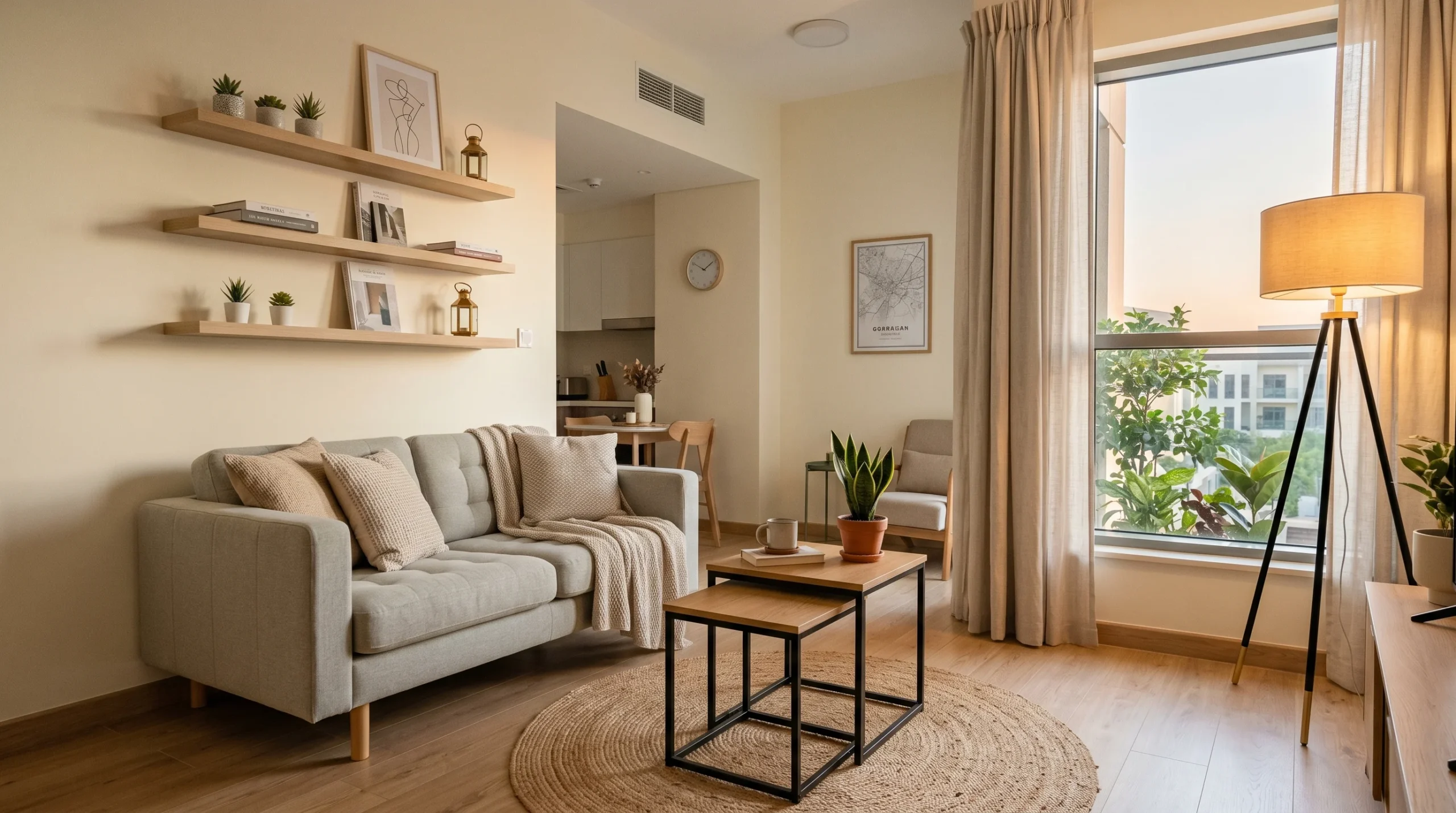
In a small apartment, the walls above eye level are the most underused resource available. Floating shelves, wall-mounted TV units, tall bookcases, and wall-hung cabinets all add significant storage capacity without consuming floor space. Dubai apartments often have 2.7-3.0m ceilings – that extra height above the standard 2.1m furniture line is valuable storage space waiting to be used.
Mistake 5: Prioritising Style Over Function in Very Small Spaces
Furniture that’s beautiful but awkward to live with is always a disappointment, but in a small apartment it becomes genuinely disruptive to daily life. An ornate dining table that can’t be extended, a decorative bed frame that prevents under-bed storage, a sofa that looks striking but has no give – these choices wear on you quickly. In a small space, function has to come first. The good news is that functional, space-conscious furniture design has become genuinely attractive over the past decade.
Budget Guide: What to Expect to Spend in the UAE
Honest pricing guidance, based on current UAE market realities:
A quality sofa bed that will last 5-8 years: AED 2,800-5,500. Budget options exist from AED 1,200, but mechanism durability and sleeping comfort are significantly lower.
A hydraulic storage bed frame (Queen, without mattress): AED 1,800-3,500. Include a quality mattress budget of AED 1,500-3,000 separately.
A modular sofa in performance fabric: AED 3,500-7,000 for a 3-4 piece set. The range reflects material quality and mechanism precision.
An extendable dining table (seats 4-6 when extended): AED 1,200-3,000, with chairs at AED 250-600 each.
A high sleeper or bunk bed for children: AED 2,500-5,000 for a quality piece with integrated storage.
A compact home office desk: AED 600-1,800 for a standalone desk; wall-mounted systems typically AED 400-1,200.
The most important principle: for pieces that bear daily physical stress – sofas, beds, dining chairs – investing in quality pays back over years of use. For purely decorative or supplementary pieces, budget options are a perfectly reasonable choice.
Expert Tips from 35 Years of UAE Furniture Experience
These are the practical insights we share with customers who come to our showroom specifically asking for guidance on small space living.
Match your furniture scale to your room, not to your wish list
Before you fall in love with any piece, check its dimensions against your room measurements. A 10 cm difference in sofa depth changes how a small room feels completely.
Light-coloured furniture makes rooms feel larger – but it’s not the only option
The conventional wisdom is correct, but you can also create the sensation of space with dark furniture if you’re consistent and don’t overcrowd. One oversized piece in a bold colour actually draws the eye and can make the room feel more intentional than five mismatched smaller pieces.
Rugs define zones in open-plan spaces
In a studio apartment, a rug under the sofa-and-coffee-table area visually creates a “living room” separate from the “bedroom area” even without walls. This psychological separation makes the space feel larger and more organised.
Invest in your mattress before you invest in your bed frame
The mattress determines your sleep quality; the bed frame determines your storage and aesthetics. If budget is limited, spend more on the mattress.
Consider furniture legs carefully
Sofas and beds raised on visible legs create visual floor space that tricks the eye into perceiving a larger room. Low-profile furniture that sits directly on the floor tends to make rooms feel smaller and more cave-like.
Don’t over-accessorise
In a small apartment, three well-chosen cushions look curated; twelve cushions in different patterns look cluttered. The same principle applies to all decorative items. Edit ruthlessly.
If you’re renting, think about what moves with you
Dubai’s rental market means most apartment residents move every 1-3 years. Furniture that’s adaptable, easy to transport, and works in multiple configurations is a better investment than bespoke or fixed installations.
Conclusion: Making Your Decision
Furnishing a Small Dubai Apartment
Furnishing a small Dubai apartment well is genuinely achievable – it just requires a more deliberate approach than decorating a larger space. The principles are consistent: measure carefully, prioritise function alongside aesthetics, choose pieces that earn their floor space by serving multiple purposes, and resist the temptation to fill every corner.
Understand Your Lifestyle First
The families who are happiest with their small-space furniture choices are usually those who took time to understand their own habits first. How often do you genuinely host guests? Do you work from home daily or occasionally? Are children in the picture now or in the near future? The answers to these questions should directly shape the furniture you buy.
Why Experience Matters in the UAE
At Karnak Home, we’ve helped over 70,000 UAE families furnish their homes over the past 35 years. This gives us deep knowledge of what furniture withstands Dubai’s climate, fits the most common apartment layouts across Dubai, Abu Dhabi, and Sharjah, and delivers long-term satisfaction. We know what works, and what customers later wish they had chosen differently.
Key Takeaways
- In small Dubai apartments, every piece of furniture should justify its floor space – ideally by serving two or more functions (storage + sleeping, dining + working, etc.)
- Storage beds and extendable dining tables are consistently among the highest-satisfaction purchases for small-space UAE residents
- Measure your room, doorways, and lift dimensions before purchasing anything – this single step prevents the most common and costly furnishing mistakes
- Quality matters more for high-use pieces (sofa, bed, dining chairs) than for purely decorative items; invest accordingly
- Vertical space – walls above eye level – is the most underused resource in most small Dubai apartments
Ready to Find the Right Furniture for Your Space?
Whether you’d like to browse at your own pace or talk through your specific apartment layout with one of our team, Karnak Home makes it straightforward. Our showroom gives you the chance to experience furniture at full scale – something that makes a real difference when you’re choosing pieces for a small space. Our online store lets you filter by dimensions, style, and function so you can shortlist options before committing to a visit.
We offer delivery across all seven emirates, and our team can advise on anything from sofa dimensions to full room layouts. There’s no pressure and no commission-driven sales – just genuine guidance from people who know UAE homes.
Shop Online: Karnak Home
Visit Our Showroom: Dubai – Showroom Address & Directions
Expert Advice: Call Us or WhatsApp our team for personalised guidance
Related Articles: